Bariatric Surgery
Introduction
● Bariatric = Baros meaning heavy/ large
● Bariatric Surgery : A therapeutic intervention to understand and treat
the cause and sequelae of morbid obesity.
Obesity
According to the WHO definition:
“Overweight and obesity are defined as abnormal or excessive fat accumulation
that presents a risk to health”
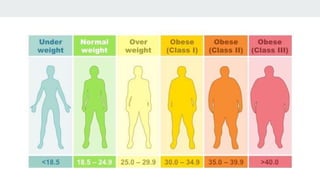
Body Mass Index ( BMI) is a simple index for weight to height that is used to
classify overweight and obese in adults.
Indications for Bariatric Surgery:
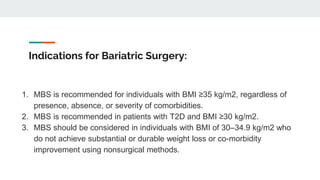
1. MBS is recommended for individuals with BMI ≥35 kg/m2, regardless of
presence, absence, or severity of comorbidities.
2. MBS is recommended in patients with T2D and BMI ≥30 kg/m2.
3. MBS should be considered in individuals with BMI of 30–34.9 kg/m2 who
do not achieve substantial or durable weight loss or co-morbidity
improvement using nonsurgical methods.
Types of Bariatric Surgery:
The common procedures endorsed by the American Society for Metabolic and
Bariatric Surgery are :
● Sleeve Gastrectomy
● Roux-en-Y Gastric Bypass
● Adjustable Gastric Band
● Biliopancreatic Diversion with Duodenal Switch
● Single Anastomosis Duodeno-Ileal Bypass with Sleeve Gastrectomy
Sleeve Gastrectomy
The Laparoscopic Sleeve Gastrectomy, often called the "sleeve", is performed by
removing approximately 80% of the stomach. The remaining stomach is the size and
shape of a banana.
It was first performed in 1990 as the first of a two-stage operation for biliopancreatic
diversion with duodenal switch (BPD-DS)
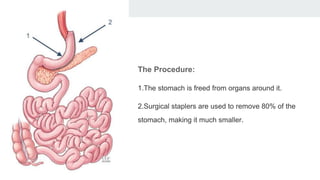
The Procedure:
1.The stomach is freed from organs around it.
2.Surgical staplers are used to remove 80% of the
stomach, making it much smaller.
Advantages
1. Simple and shorter surgery time
2. Can be performed in certain patients with high risk medical conditions
3. May be performed as the first step for patients with severe obesity
4. May be used as a bridge to gastric bypass or SADI-S procedures
5. Effective weight loss and improvement of obesity related conditions
Disadvantages
1. Non-reversible procedure
2. May worsen or cause new onset reflux and heart burn
3. Less impact on metabolism compared to bypass procedures
Roux- en- Y Gastric Bypass (RYGB) :
The Roux-en-Y Gastric Bypass, often called the “gastric bypass”, has now been
performed for more than 50 years and the laparoscopic approach has been refined
since 1993. It is one of the most common operations and is very effective in treating
obesity and obesity related diseases. The name is a French term meaning “in the
form of a Y”.
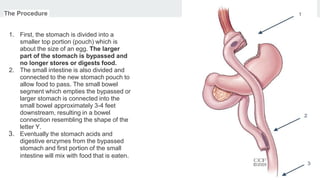
The Procedure
1. First, the stomach is divided into a
smaller top portion (pouch) which is
about the size of an egg. The larger
part of the stomach is bypassed and
no longer stores or digests food.
2. The small intestine is also divided and
connected to the new stomach pouch to
allow food to pass. The small bowel
segment which empties the bypassed or
larger stomach is connected into the
small bowel approximately 3-4 feet
downstream, resulting in a bowel
connection resembling the shape of the
letter Y.
3. Eventually the stomach acids and
digestive enzymes from the bypassed
stomach and first portion of the small
intestine will mix with food that is eaten.
Advantages
1. Reliable and long-lasting weight loss
2. Effective for remission of obesity-associated conditions
3. Refined and standardized technique
Disadvantages
1. Technically more complex when compared to sleeve gastrectomy or gastric band
2. More vitamin and mineral deficiencies than sleeve gastrectomy or gastric banding
3. There is a risk for small bowel complications and obstruction
4. There is a risk of developing ulcers, especially with NSAID or tobacco use
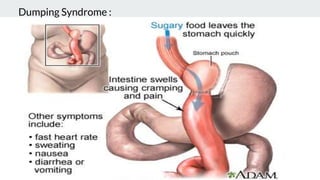
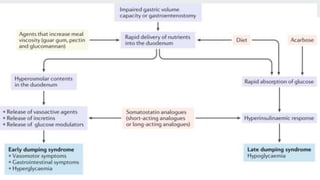
5. May cause “dumping syndrome”, a feeling of sickness after eating or drinking, especially
sweets
Dumping Syndrome :
Adjustable Gastric Band:
The Adjustable Gastric Band is a device made of silicone that is placed
around the top part of the stomach to limit the amount of food a person can
eat. It has been available in the United States since 2001. The impact on
obesity related diseases and long-term weight loss is less than with other
procedures. Its use has therefore declined over the past decade.
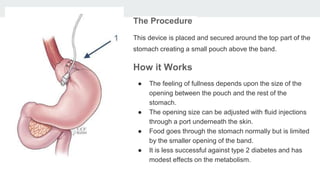
The Procedure
This device is placed and secured around the top part of the
stomach creating a small pouch above the band.
How it Works
● The feeling of fullness depends upon the size of the
opening between the pouch and the rest of the
stomach.
● The opening size can be adjusted with fluid injections
through a port underneath the skin.
● Food goes through the stomach normally but is limited
by the smaller opening of the band.
● It is less successful against type 2 diabetes and has
modest effects on the metabolism.
Advantages
1. Lowest rate of complications early after surgery
2. No division of the stomach or intestines
3. Patients can go home on the day of surgery
4. The band can be removed if needed
5. Has the lowest risk for vitamin and mineral deficiencies
Disadvantages
1. The band may need several adjustments and monthly office visits during the first year
2. Slower and less weight loss than with other surgical procedures
3. There is a risk of band movement (slippage) or damage to the stomach over time (erosion)
4. Requires a foreign implant to remain in the body
5. Has a high rate of re-operation
6. Can result in swallowing problems and enlargement of the esophagus
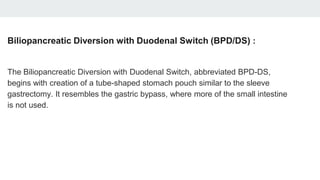
Biliopancreatic Diversion with Duodenal Switch (BPD/DS) :
The Biliopancreatic Diversion with Duodenal Switch, abbreviated BPD-DS,
begins with creation of a tube-shaped stomach pouch similar to the sleeve
gastrectomy. It resembles the gastric bypass, where more of the small intestine
is not used.
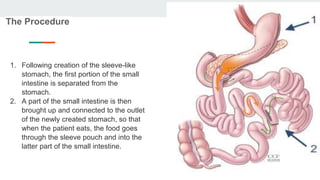
The Procedure
1. Following creation of the sleeve-like
stomach, the first portion of the small
intestine is separated from the
stomach.
2. A part of the small intestine is then
brought up and connected to the outlet
of the newly created stomach, so that
when the patient eats, the food goes
through the sleeve pouch and into the
latter part of the small intestine.
Advantages
1. Among the best results for improving obesity
2. Affects bowel hormones to cause less hunger and more fullness after eating
3. It is the most effective procedure for treatment of type 2 diabetes
Disadvantages
1. Has slightly higher complication rates than other procedures
2. Highest malabsorption and greater possibility of vitamins and micro-nutrient deficiencies
3. Reflux and heart burn can develop or get worse
4. Risk of looser and more frequent bowel movements
5. More complex surgery requiring more operative time
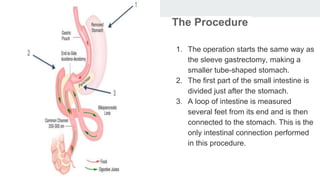
Single Anastomosis Duodeno-Ileal Bypass with Sleeve
Gastrectomy (SADI-S) :
● The Single Anastomosis Duodenal-Ileal Bypass with Sleeve
Gastrectomy, referred to as the SADI-S is the most recent procedure
to be endorsed by the American Society for Metabolic and Bariatric
Surgery.
● There is only one surgical bowel connection in this procedure.
The Procedure
1. The operation starts the same way as
the sleeve gastrectomy, making a
smaller tube-shaped stomach.
2. The first part of the small intestine is
divided just after the stomach.
3. A loop of intestine is measured
several feet from its end and is then
connected to the stomach. This is the
only intestinal connection performed
in this procedure.
Advantages
1. Highly effective for long-term weight loss and remission of type 2 diabetes
2. Simpler and faster to perform (one intestinal connection) than gastric bypass or BPD-DS
3. Excellent option for a patient who already had a sleeve gastrectomy and is seeking further
weight loss
Disadvantages
1. Vitamins and minerals are not absorbed as well as in the sleeve gastrectomy or
gastric band
2. Newer operation with only short-term outcome data
3. Potential to worsen or develop new-onset reflux
4. Risk of looser and more frequent bowel movements
References:
https://asmbs.org/patients/bariatric-surgery-procedures
https://www.who.int/health-topics/obesity#tab=tab_1
THANKYOU!

Bariatric Surgery (1).pptx

  • 1.
  • 2.
    Introduction ● Bariatric =Baros meaning heavy/ large ● Bariatric Surgery : A therapeutic intervention to understand and treat the cause and sequelae of morbid obesity.
  • 3.
    Obesity According to theWHO definition: “Overweight and obesity are defined as abnormal or excessive fat accumulation that presents a risk to health” Body Mass Index ( BMI) is a simple index for weight to height that is used to classify overweight and obese in adults.
  • 5.
    Indications for BariatricSurgery: 1. MBS is recommended for individuals with BMI ≥35 kg/m2, regardless of presence, absence, or severity of comorbidities. 2. MBS is recommended in patients with T2D and BMI ≥30 kg/m2. 3. MBS should be considered in individuals with BMI of 30–34.9 kg/m2 who do not achieve substantial or durable weight loss or co-morbidity improvement using nonsurgical methods.
  • 6.
    Types of BariatricSurgery: The common procedures endorsed by the American Society for Metabolic and Bariatric Surgery are : ● Sleeve Gastrectomy ● Roux-en-Y Gastric Bypass ● Adjustable Gastric Band ● Biliopancreatic Diversion with Duodenal Switch ● Single Anastomosis Duodeno-Ileal Bypass with Sleeve Gastrectomy
  • 7.
    Sleeve Gastrectomy The LaparoscopicSleeve Gastrectomy, often called the "sleeve", is performed by removing approximately 80% of the stomach. The remaining stomach is the size and shape of a banana. It was first performed in 1990 as the first of a two-stage operation for biliopancreatic diversion with duodenal switch (BPD-DS)
  • 8.
    The Procedure: 1.The stomachis freed from organs around it. 2.Surgical staplers are used to remove 80% of the stomach, making it much smaller.
  • 9.
    Advantages 1. Simple andshorter surgery time 2. Can be performed in certain patients with high risk medical conditions 3. May be performed as the first step for patients with severe obesity 4. May be used as a bridge to gastric bypass or SADI-S procedures 5. Effective weight loss and improvement of obesity related conditions Disadvantages 1. Non-reversible procedure 2. May worsen or cause new onset reflux and heart burn 3. Less impact on metabolism compared to bypass procedures
  • 10.
    Roux- en- YGastric Bypass (RYGB) : The Roux-en-Y Gastric Bypass, often called the “gastric bypass”, has now been performed for more than 50 years and the laparoscopic approach has been refined since 1993. It is one of the most common operations and is very effective in treating obesity and obesity related diseases. The name is a French term meaning “in the form of a Y”.
  • 11.
    The Procedure 1. First,the stomach is divided into a smaller top portion (pouch) which is about the size of an egg. The larger part of the stomach is bypassed and no longer stores or digests food. 2. The small intestine is also divided and connected to the new stomach pouch to allow food to pass. The small bowel segment which empties the bypassed or larger stomach is connected into the small bowel approximately 3-4 feet downstream, resulting in a bowel connection resembling the shape of the letter Y. 3. Eventually the stomach acids and digestive enzymes from the bypassed stomach and first portion of the small intestine will mix with food that is eaten.
  • 12.
    Advantages 1. Reliable andlong-lasting weight loss 2. Effective for remission of obesity-associated conditions 3. Refined and standardized technique Disadvantages 1. Technically more complex when compared to sleeve gastrectomy or gastric band 2. More vitamin and mineral deficiencies than sleeve gastrectomy or gastric banding 3. There is a risk for small bowel complications and obstruction 4. There is a risk of developing ulcers, especially with NSAID or tobacco use 5. May cause “dumping syndrome”, a feeling of sickness after eating or drinking, especially sweets
  • 13.
  • 15.
    Adjustable Gastric Band: TheAdjustable Gastric Band is a device made of silicone that is placed around the top part of the stomach to limit the amount of food a person can eat. It has been available in the United States since 2001. The impact on obesity related diseases and long-term weight loss is less than with other procedures. Its use has therefore declined over the past decade.
  • 16.
    The Procedure This deviceis placed and secured around the top part of the stomach creating a small pouch above the band. How it Works ● The feeling of fullness depends upon the size of the opening between the pouch and the rest of the stomach. ● The opening size can be adjusted with fluid injections through a port underneath the skin. ● Food goes through the stomach normally but is limited by the smaller opening of the band. ● It is less successful against type 2 diabetes and has modest effects on the metabolism.
  • 17.
    Advantages 1. Lowest rateof complications early after surgery 2. No division of the stomach or intestines 3. Patients can go home on the day of surgery 4. The band can be removed if needed 5. Has the lowest risk for vitamin and mineral deficiencies Disadvantages 1. The band may need several adjustments and monthly office visits during the first year 2. Slower and less weight loss than with other surgical procedures 3. There is a risk of band movement (slippage) or damage to the stomach over time (erosion) 4. Requires a foreign implant to remain in the body 5. Has a high rate of re-operation 6. Can result in swallowing problems and enlargement of the esophagus
  • 18.
    Biliopancreatic Diversion withDuodenal Switch (BPD/DS) : The Biliopancreatic Diversion with Duodenal Switch, abbreviated BPD-DS, begins with creation of a tube-shaped stomach pouch similar to the sleeve gastrectomy. It resembles the gastric bypass, where more of the small intestine is not used.
  • 19.
    The Procedure 1. Followingcreation of the sleeve-like stomach, the first portion of the small intestine is separated from the stomach. 2. A part of the small intestine is then brought up and connected to the outlet of the newly created stomach, so that when the patient eats, the food goes through the sleeve pouch and into the latter part of the small intestine.
  • 20.
    Advantages 1. Among thebest results for improving obesity 2. Affects bowel hormones to cause less hunger and more fullness after eating 3. It is the most effective procedure for treatment of type 2 diabetes Disadvantages 1. Has slightly higher complication rates than other procedures 2. Highest malabsorption and greater possibility of vitamins and micro-nutrient deficiencies 3. Reflux and heart burn can develop or get worse 4. Risk of looser and more frequent bowel movements 5. More complex surgery requiring more operative time
  • 21.
    Single Anastomosis Duodeno-IlealBypass with Sleeve Gastrectomy (SADI-S) : ● The Single Anastomosis Duodenal-Ileal Bypass with Sleeve Gastrectomy, referred to as the SADI-S is the most recent procedure to be endorsed by the American Society for Metabolic and Bariatric Surgery. ● There is only one surgical bowel connection in this procedure.
  • 22.
    The Procedure 1. Theoperation starts the same way as the sleeve gastrectomy, making a smaller tube-shaped stomach. 2. The first part of the small intestine is divided just after the stomach. 3. A loop of intestine is measured several feet from its end and is then connected to the stomach. This is the only intestinal connection performed in this procedure.
  • 23.
    Advantages 1. Highly effectivefor long-term weight loss and remission of type 2 diabetes 2. Simpler and faster to perform (one intestinal connection) than gastric bypass or BPD-DS 3. Excellent option for a patient who already had a sleeve gastrectomy and is seeking further weight loss Disadvantages 1. Vitamins and minerals are not absorbed as well as in the sleeve gastrectomy or gastric band 2. Newer operation with only short-term outcome data 3. Potential to worsen or develop new-onset reflux 4. Risk of looser and more frequent bowel movements
  • 24.
  • 25.