This work is supported by the National Science Foundation’s
Directorate for Education and Human Resources TUES-1245025, IUSE-
1612248, IUSE-1725347, and IUSE-1914915. Questions, contact education-AT-unavco.org
THERMAL EXPANSION OF WATER
An Important Contributor to Sea-Level Rise
Version: Jan 16, 2019
THERMAL EXPANSION
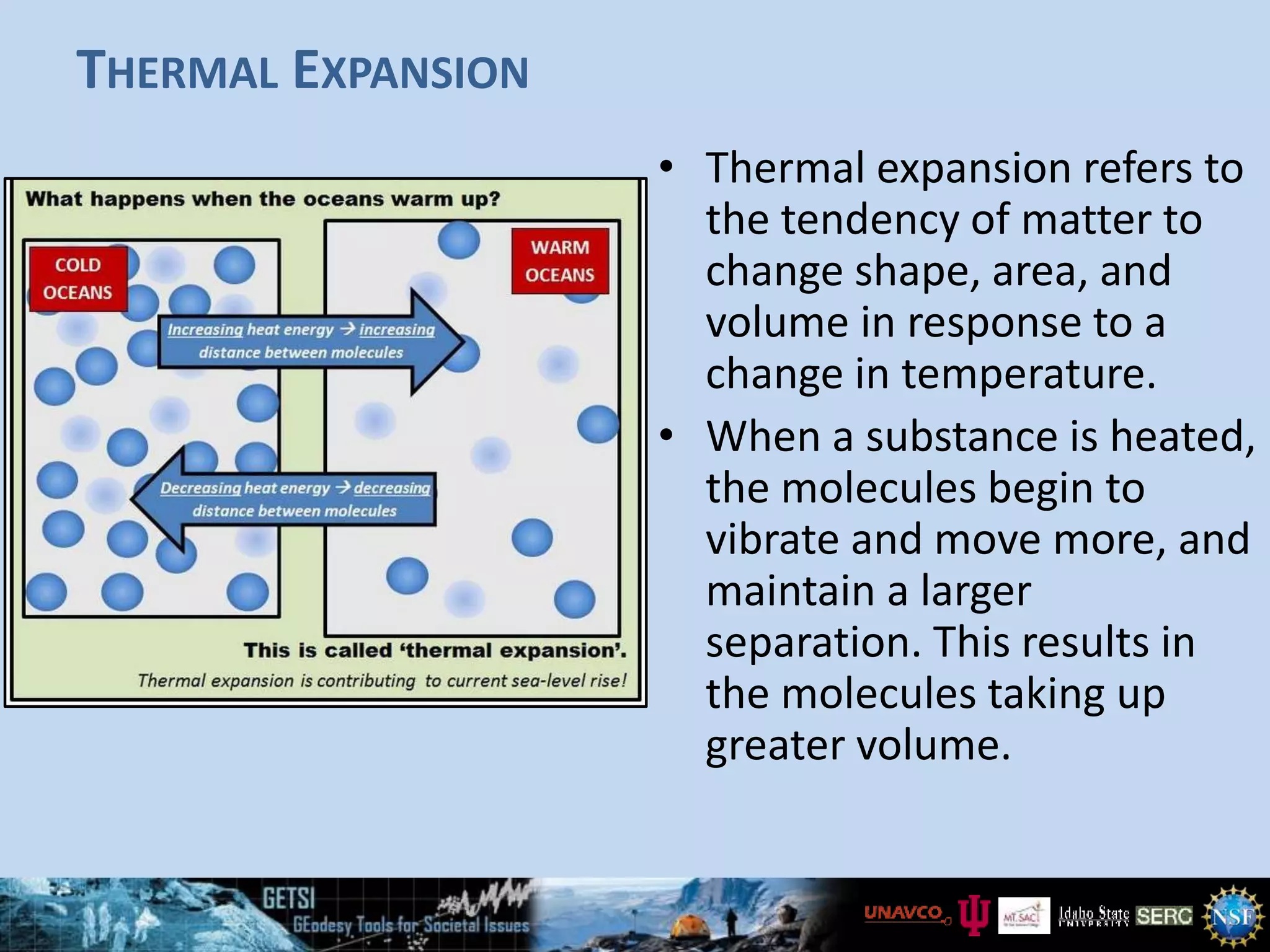
• Thermal expansion refers to
the tendency of matter to
change shape, area, and
volume in response to a
change in temperature.
• When a substance is heated,
the molecules begin to
vibrate and move more, and
maintain a larger
separation. This results in
the molecules taking up
greater volume.
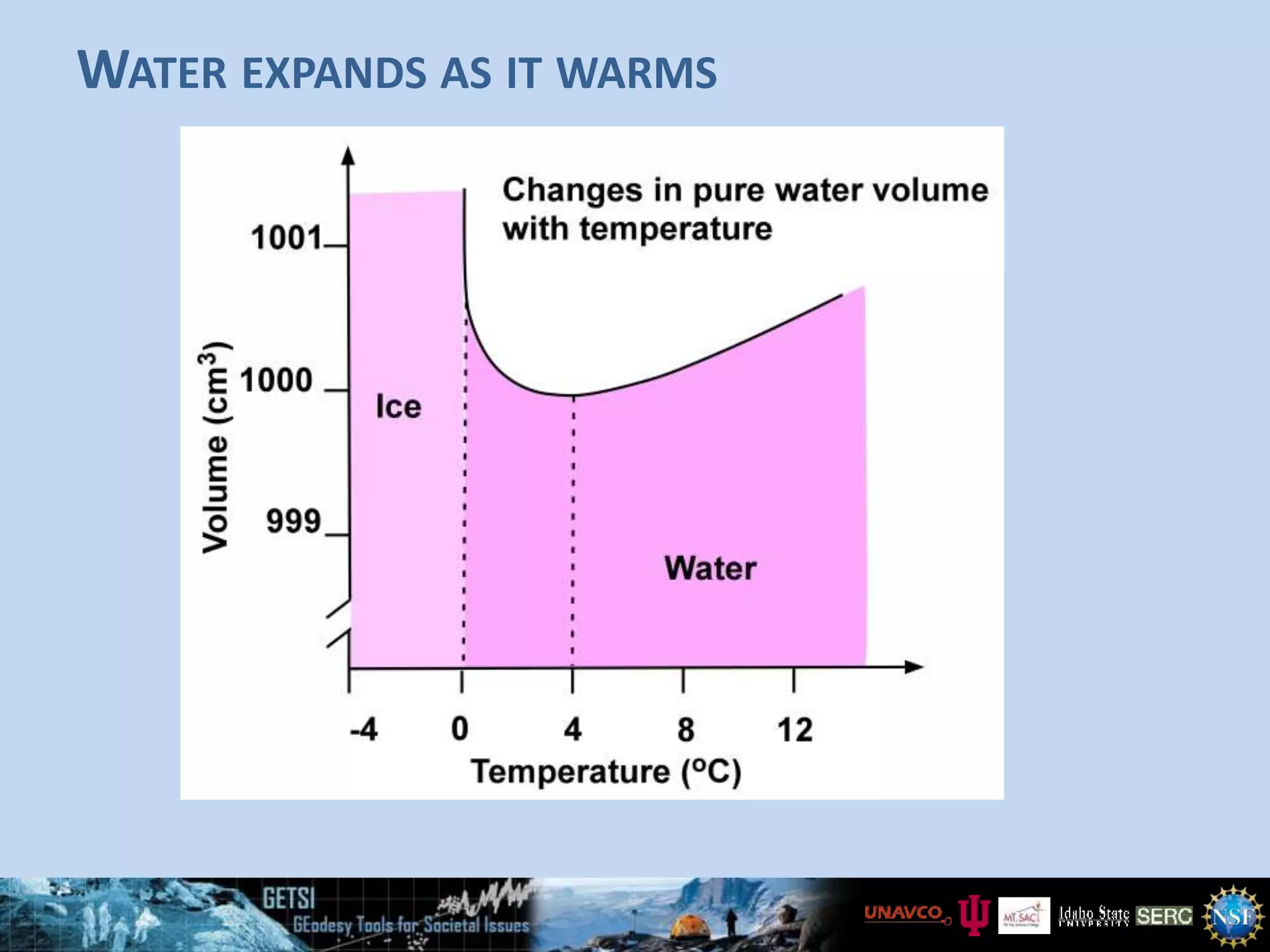
WATER EXPANDS AS IT WARMS
THERMAL EXPANSION OF WATER
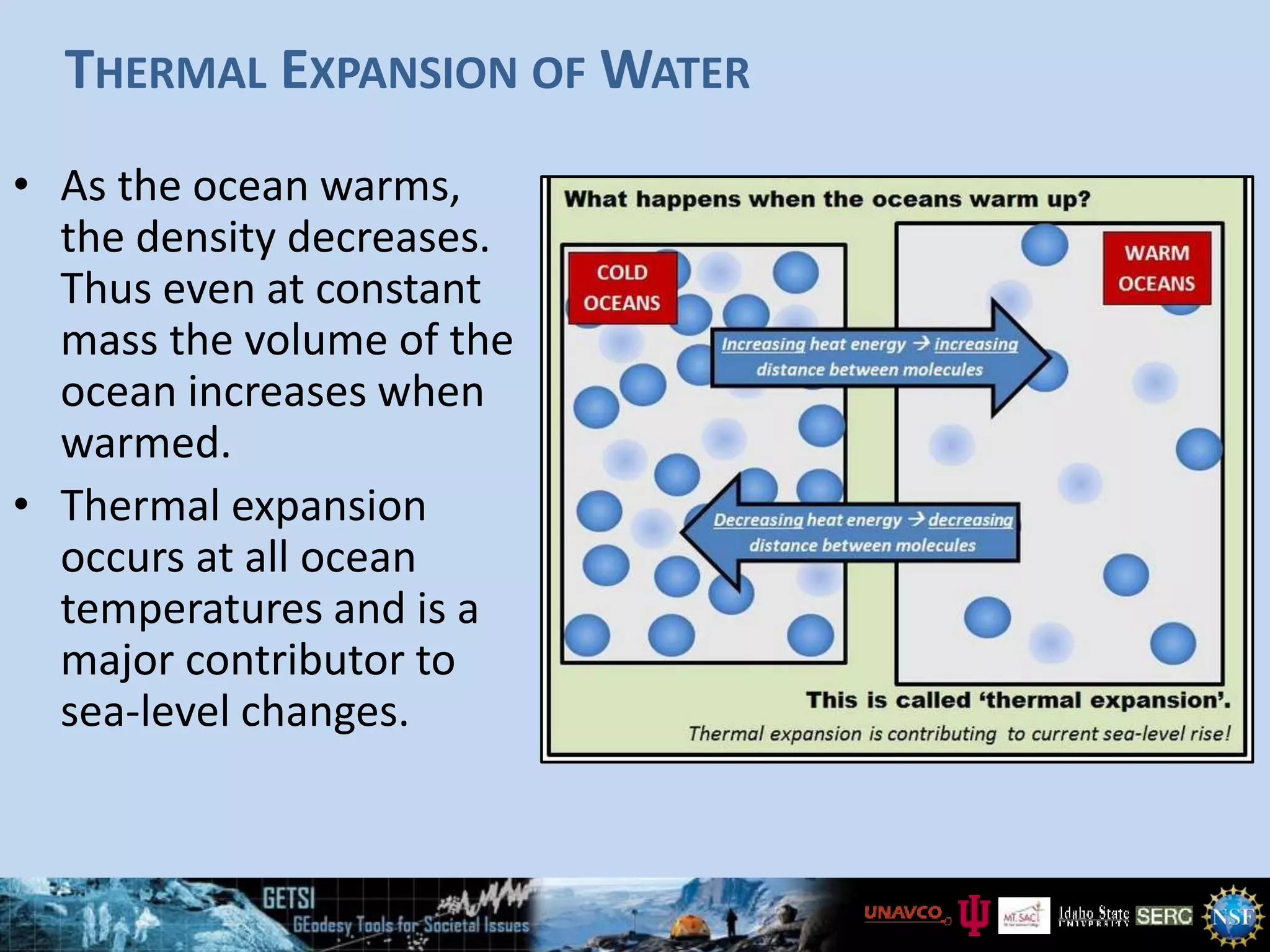
• As the ocean warms,
the density decreases.
Thus even at constant
mass the volume of the
ocean increases when
warmed.
• Thermal expansion
occurs at all ocean
temperatures and is a
major contributor to
sea-level changes.
THE MAJORITY OF ADDITIONAL ENERGY IN THE
EARTH’S CLIMATE SYSTEM IS STORED IN THE OCEANS
• Ocean warming
dominates the total
energy change
inventory.
Plot of energy accumulation in ZJ (1 ZJ =
1021 J) within distinct components of the
Earth’s climate system relative to 1971 and
from 1971 to 2010 unless otherwise
indicated (IPCC 2014).

Overview of Thermal Expansion

  • 1.
    This work issupported by the National Science Foundation’s Directorate for Education and Human Resources TUES-1245025, IUSE- 1612248, IUSE-1725347, and IUSE-1914915. Questions, contact education-AT-unavco.org THERMAL EXPANSION OF WATER An Important Contributor to Sea-Level Rise Version: Jan 16, 2019
  • 2.
    THERMAL EXPANSION • Thermalexpansion refers to the tendency of matter to change shape, area, and volume in response to a change in temperature. • When a substance is heated, the molecules begin to vibrate and move more, and maintain a larger separation. This results in the molecules taking up greater volume.
  • 3.
  • 4.
    THERMAL EXPANSION OFWATER • As the ocean warms, the density decreases. Thus even at constant mass the volume of the ocean increases when warmed. • Thermal expansion occurs at all ocean temperatures and is a major contributor to sea-level changes.
  • 5.
    THE MAJORITY OFADDITIONAL ENERGY IN THE EARTH’S CLIMATE SYSTEM IS STORED IN THE OCEANS • Ocean warming dominates the total energy change inventory. Plot of energy accumulation in ZJ (1 ZJ = 1021 J) within distinct components of the Earth’s climate system relative to 1971 and from 1971 to 2010 unless otherwise indicated (IPCC 2014).

Editor's Notes

  • #3 https://en.wikipedia.org/wiki/Thermal_expansion Image: https://upload.wikimedia.org/wikipedia/commons/a/ac/Thermal_expansion_cartoon.jpg (This file is licensed under the Creative Commons Attribution 4.0 International license.) Figure shows an example of a cold liquid (left) and hot liquid (right).
  • #4 Water expands as it warms and shrinks as it cools. Water is unusual in that it also expands when it turns to ice. Water is densest at ~4 degrees Celsius. Modified from http://janison.cyriljackson.wa.edu.au/Janison/Science/Physics2A2B/Physics2B/0_West1-2B/content/cell2_effects_heat/html/cc2_01.html#
  • #5 http://www.ipcc.ch/ipccreports/tar/wg1/411.htm Image: https://commons.wikimedia.org/wiki/File:Thermal_expansion_cartoon.jpg
  • #6 Energy in > energy out in the Earth system, which is leading to climate warming. This graph shows that ocean warming dominates the surplus energy change inventory. http://www.climatechange2013.org/images/figures/WGI_AR5_FigBox3.1-1.jpg IPCC=Intergovernmental Panel on Climate Change IPCC2014: Ocean warming dominates the total energy change inventory, accounting for roughly 93% on average from 1971 to 2010 (high confidence). The upper ocean (0–700 m) accounts for about 64% of the total energy change inventory. Melting ice (including Arctic sea ice, ice sheets, and glaciers) accounts for 3% of the total, and warming of the continents 3%. Warming of the atmosphere makes up the remaining 1%. “Ocean warming (heat-content change) dominates, with the upper ocean (light blue, above 700 m) contributing more than the mid-depth and deep ocean (dark blue, below 700 m; including below 2000 m estimates starting from 1992). Ice melt (light grey; for glaciers and ice caps, Greenland and Antarctic ice sheet estimates starting from 1992, and Arctic sea ice estimate from 1979 to 2008); continental (land) warming (orange); and atmospheric warming (purple; estimate starting from 1979) make smaller contributions. Uncertainty in the ocean estimate also dominates the total uncertainty (dot-dashed lines about the error from all five components at 90% confidence intervals).“