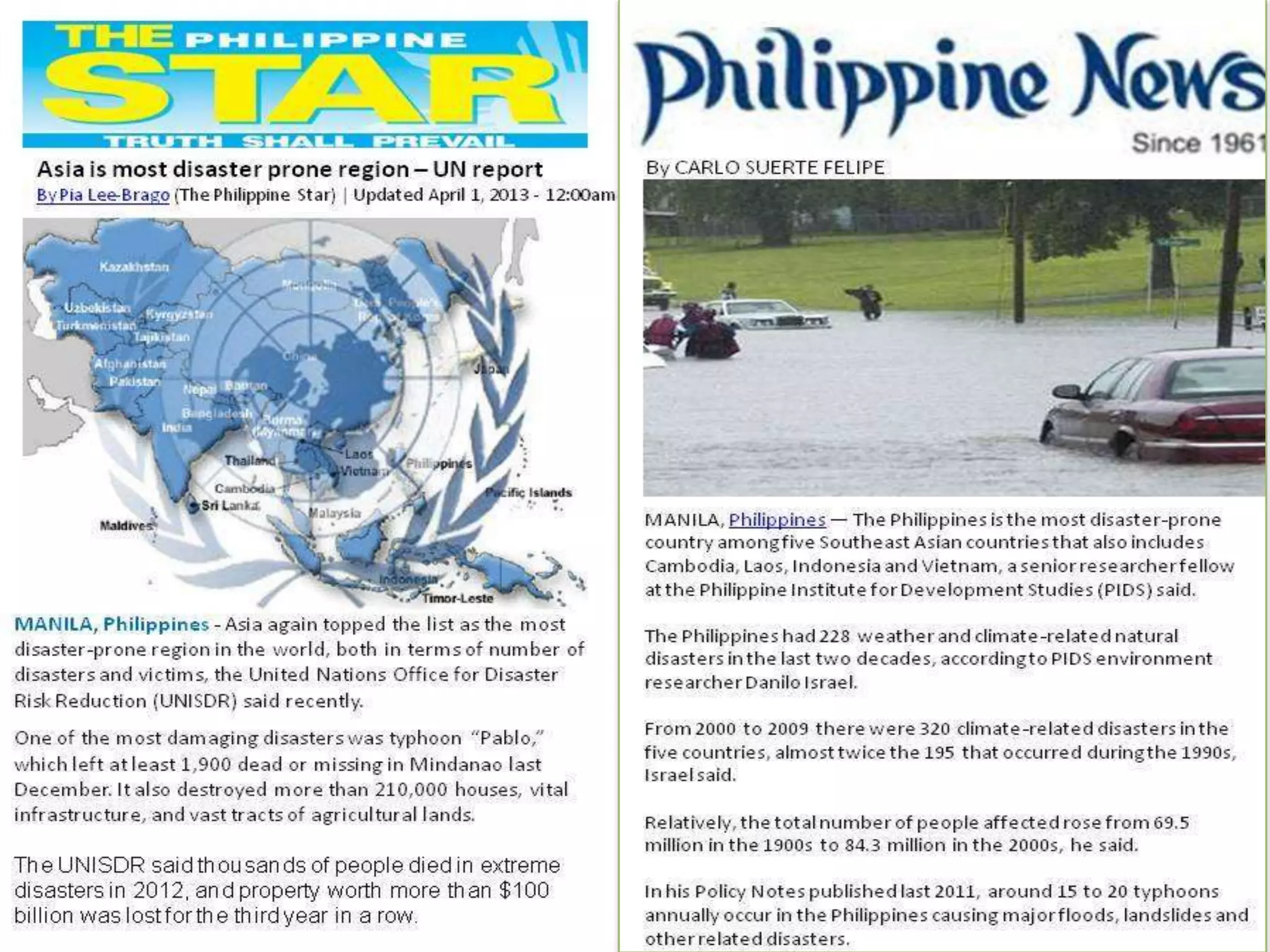
Climate Change Adaptation
in the Philippine Setting
Ms. Ma. Gerarda Asuncion D. Merilo
Climate Change Office
Environmental Management Bureau
Department of Environment and Natural Resources
A recent report by the Working Group 1 to the Fifth Assessment
Report of the Intergovernmental Panel on Climate Change (IPCC-AR5)),
a global group of experts on climate studies had recently been released
in September 2013.
“Warming of the climate system is unequivocal, and
since the 1950s, many of the observed changes are
unprecedented over decades to millenia. The atmosphere
and ocean have warmed, the amounts of snow and ice
have diminished, sea level has risen, and the
concentrations of greenhouse gases have increased.”
(IPCC-AR5 )
What is happening?
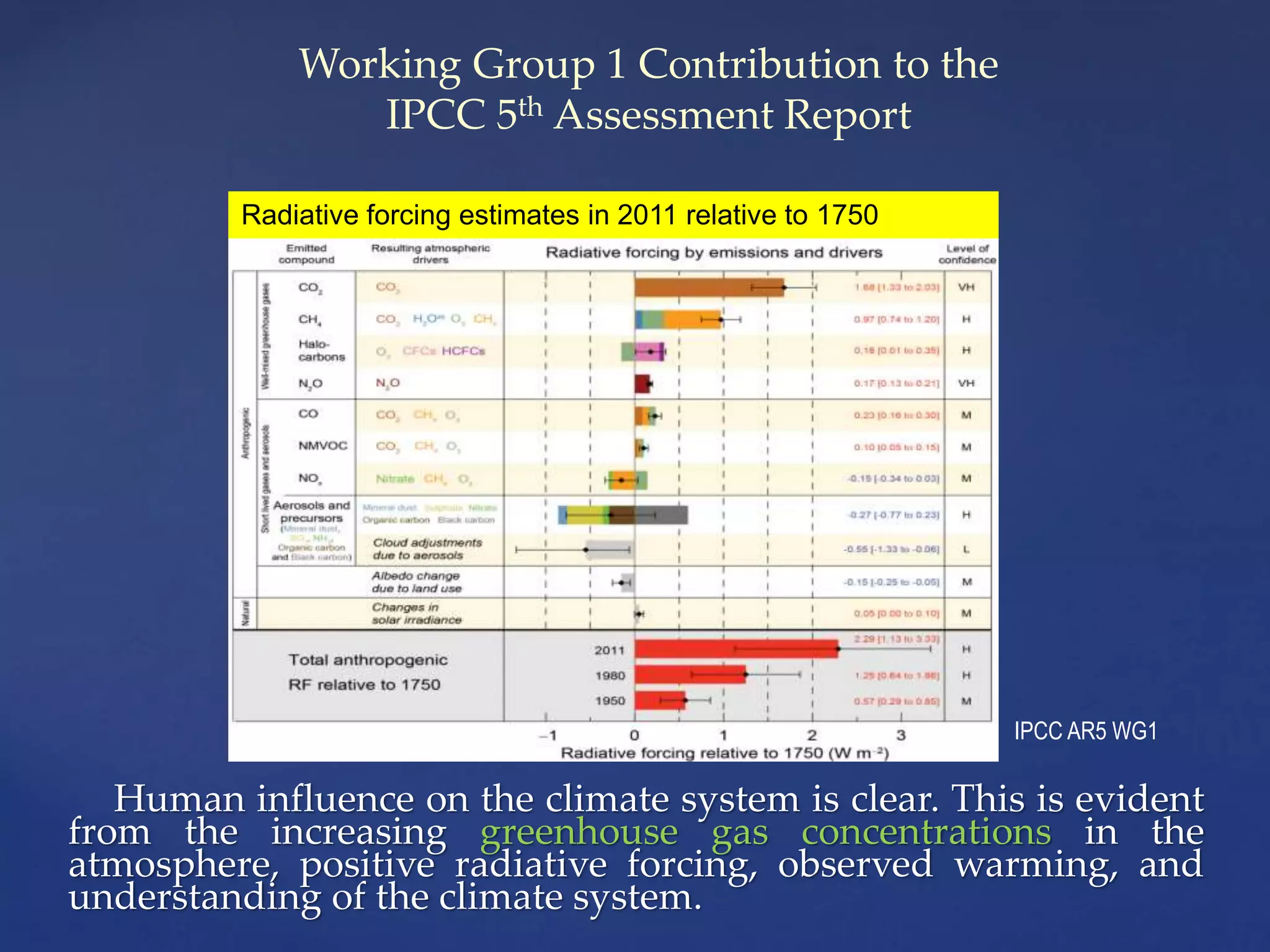
Human influence on the climate system is clear. This is evident
from the increasing greenhouse gas concentrations in the
atmosphere, positive radiative forcing, observed warming, and
understanding of the climate system.
Working Group 1 Contribution to the
IPCC 5th Assessment Report
Radiative forcing estimates in 2011 relative to 1750
IPCC AR5 WG1
Working Group 1 Contribution to the
IPCC 5th Assessment Report
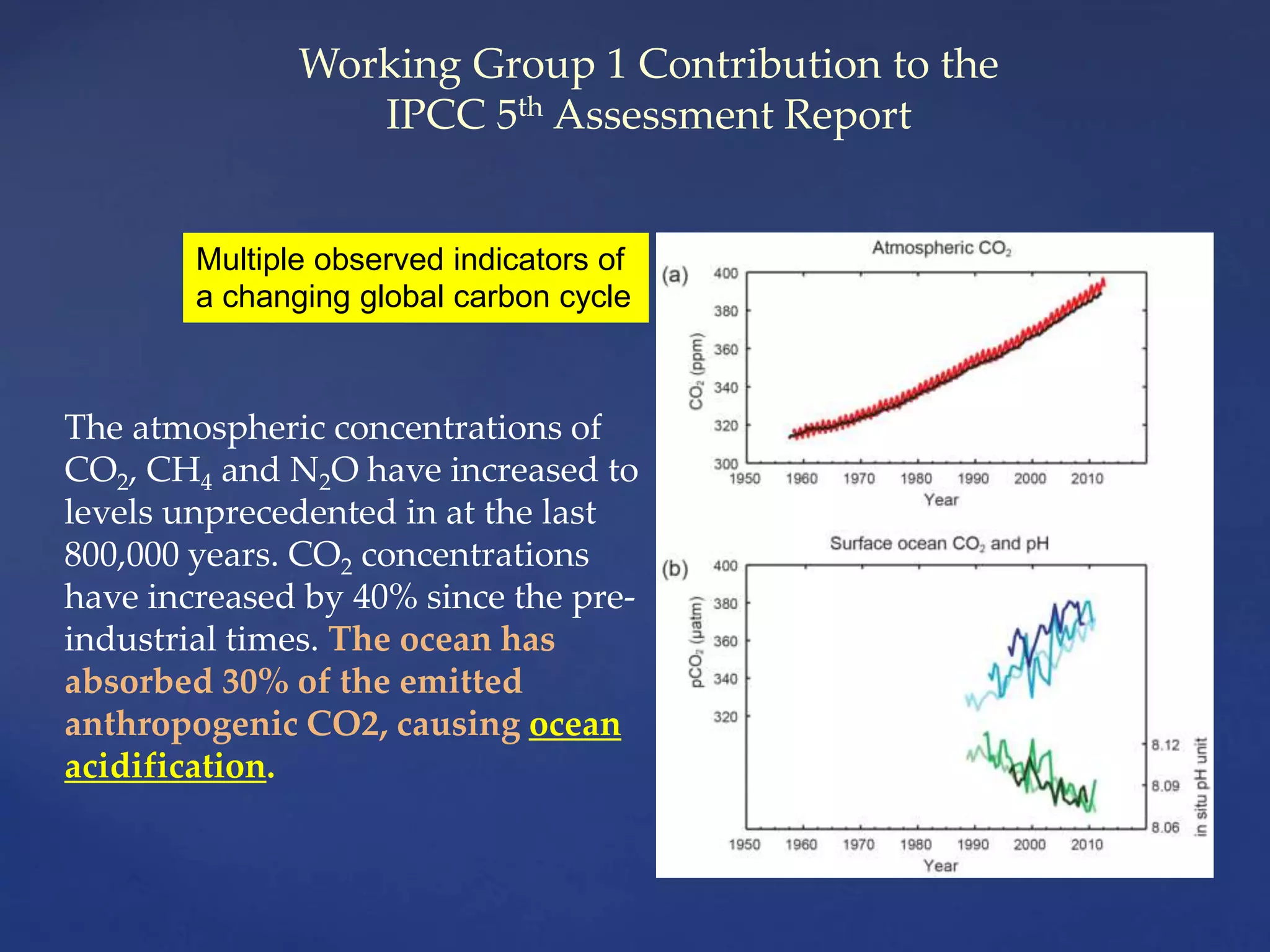
The atmospheric concentrations of
CO2, CH4 and N2O have increased to
levels unprecedented in at the last
800,000 years. CO2 concentrations
have increased by 40% since the pre-
industrial times. The ocean has
absorbed 30% of the emitted
anthropogenic CO2, causing ocean
acidification.
Multiple observed indicators of
a changing global carbon cycle
The globally averaged combined land and ocean surface
temperature data show a warming of 0.85 [0.65 to 1.08°C over the
period 1880-2012. The total increase between the average of the
1850-1900 period and the 2003-2012 period is 0.78 [0.72 to 0.85] °C.
Working Group 1 Contribution to the
IPCC 5th Assessment Report
Observed globally averaged
combined land and ocean
surface temperature
anomaly 1850-2012
IPCC AR5 WG1
 The rate of sea level rise since the
mid-19th century has been larger
then the mean rate during the
previous two millennia. Over the
period 1901 to 2010, global mean
sea level rose by 0.19 [0.17 to .21]
meters.
 Sea level rise will occur mostly as a
result of the thermal expansion of
warming ocean waters, the influx of
freshwater from melting glaciers and
ice, and vertical movements of the
land itself.
IPCC AR5 Working Group 1
Global Mean Sea Level Rise
Working Group 1 Contribution to the
IPCC 5th Assessment Report
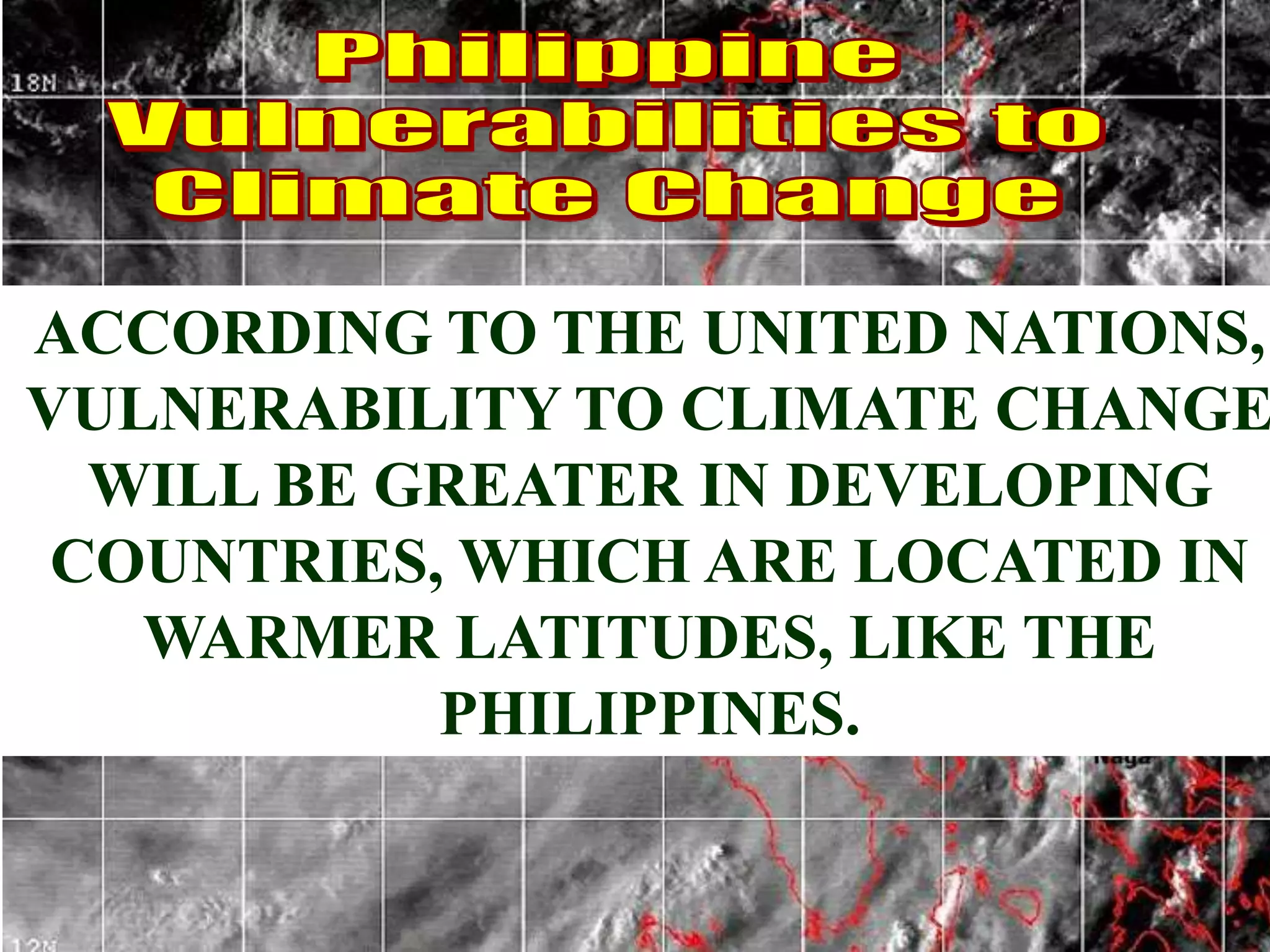
ACCORDING TO THE UNITED NATIONS,
VULNERABILITY TO CLIMATE CHANGE
WILL BE GREATER IN DEVELOPING
COUNTRIES, WHICH ARE LOCATED IN
WARMER LATITUDES, LIKE THE
PHILIPPINES.
9
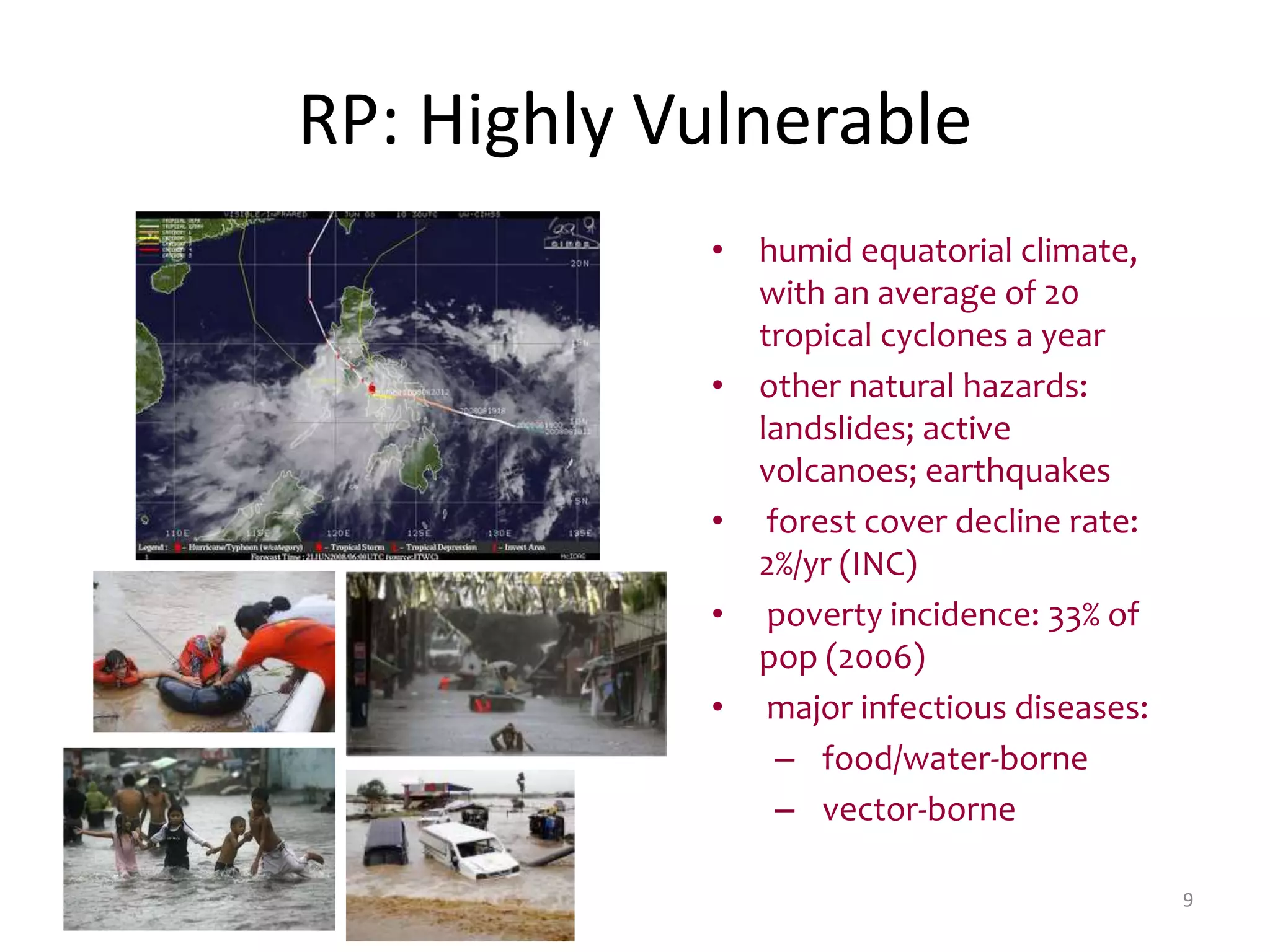
RP: Highly Vulnerable
• humid equatorial climate,
with an average of 20
tropical cyclones a year
• other natural hazards:
landslides; active
volcanoes; earthquakes
• forest cover decline rate:
2%/yr (INC)
• poverty incidence: 33% of
pop (2006)
• major infectious diseases:
– food/water-borne
– vector-borne
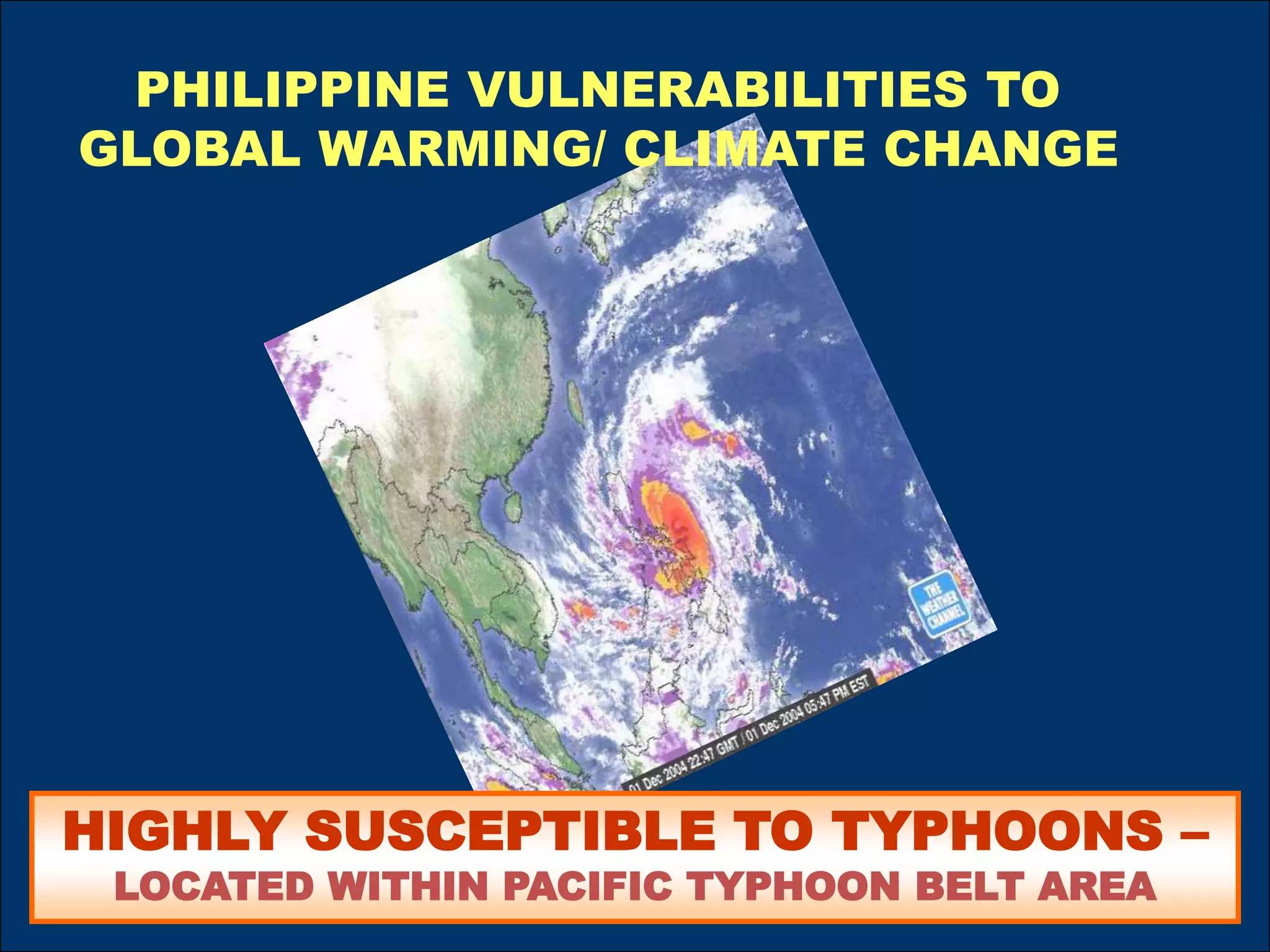
PHILIPPINE VULNERABILITIES TO
GLOBAL WARMING/ CLIMATE CHANGE
HIGHLY SUSCEPTIBLE TO TYPHOONS –
LOCATED WITHIN PACIFIC TYPHOON BELT AREA
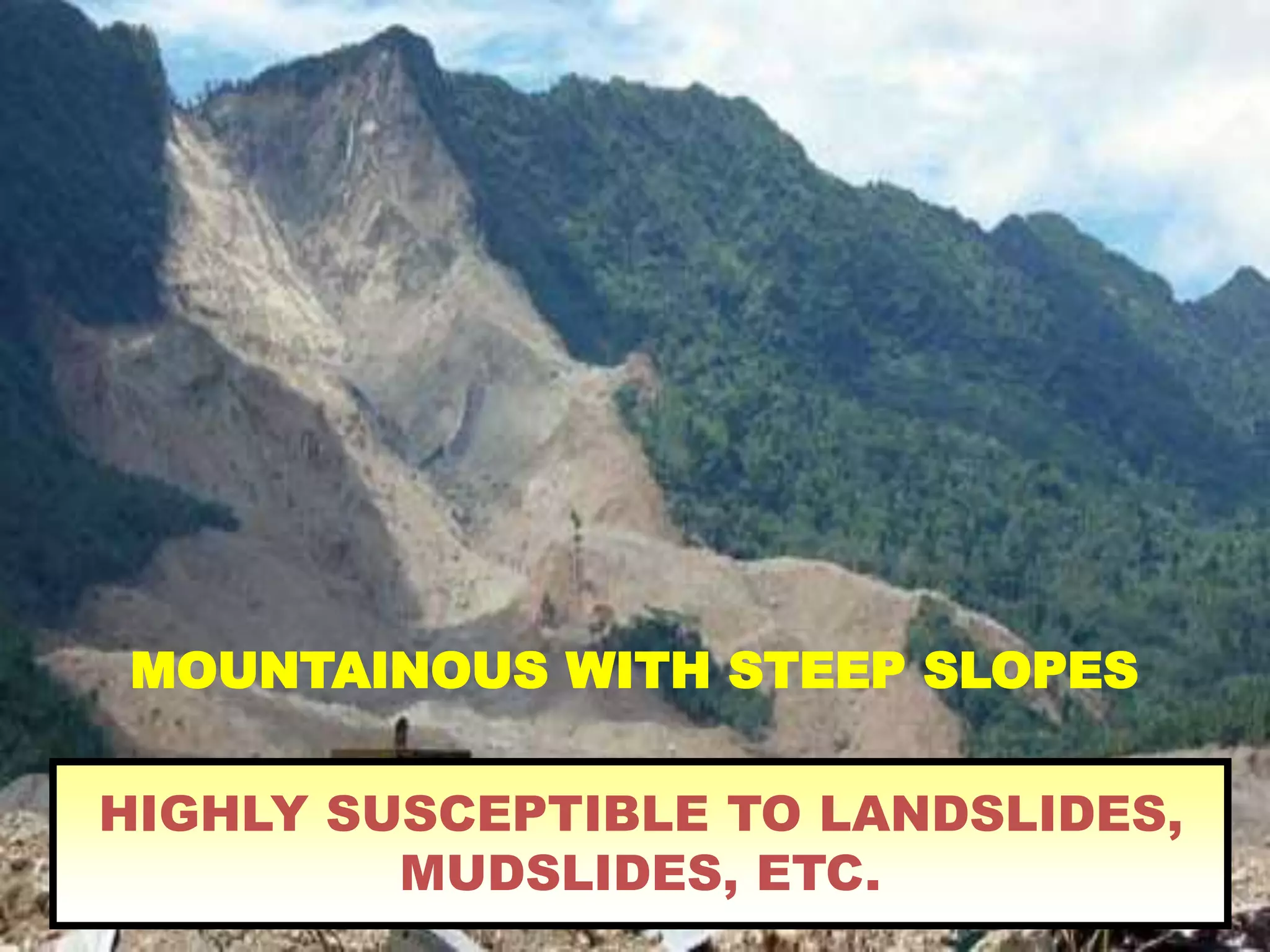
MOUNTAINOUS WITH STEEP SLOPES
HIGHLY SUSCEPTIBLE TO LANDSLIDES,
MUDSLIDES, ETC.
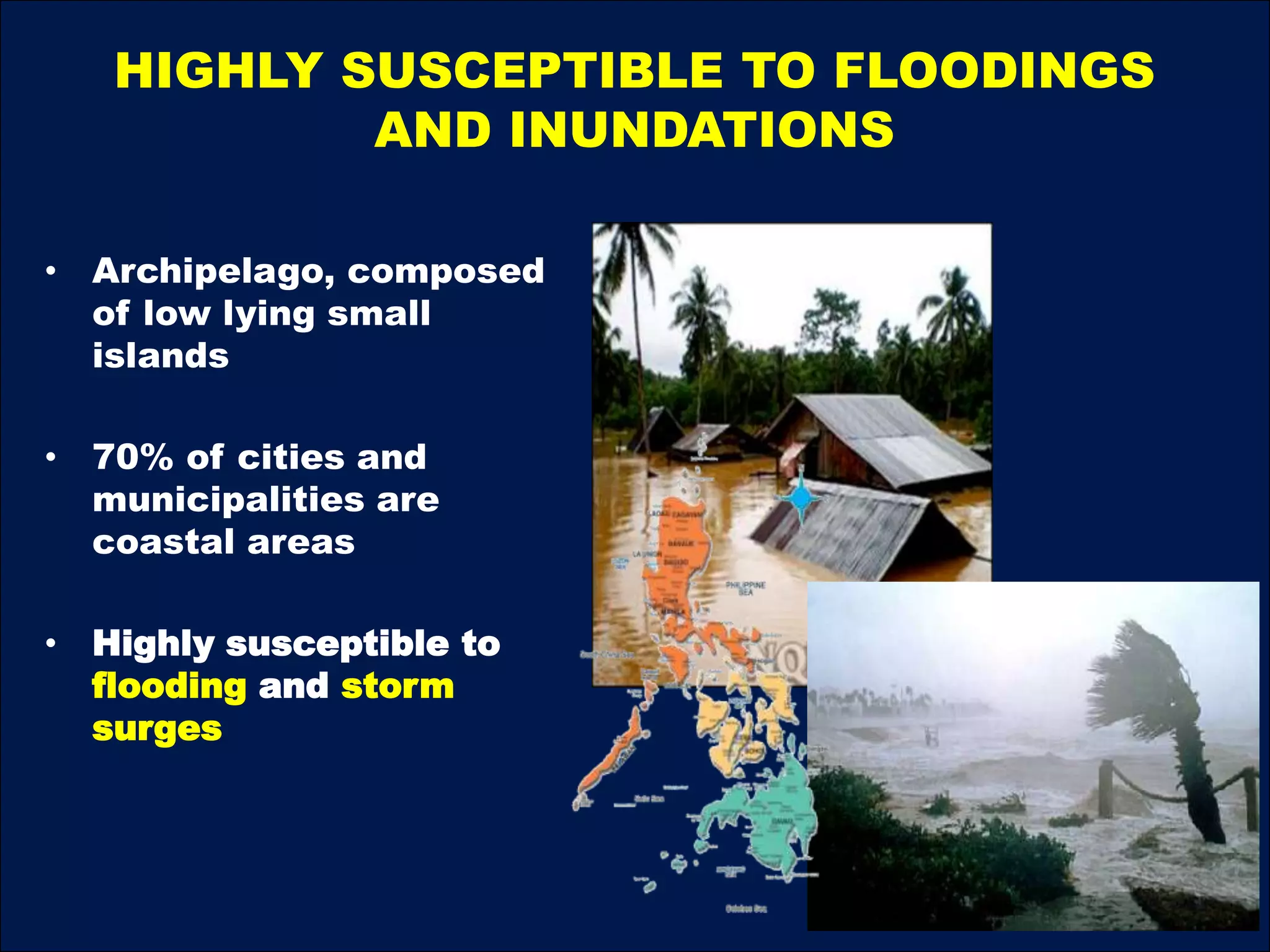
HIGHLY SUSCEPTIBLE TO FLOODINGS
AND INUNDATIONS
• Archipelago, composed
of low lying small
islands
• 70% of cities and
municipalities are
coastal areas
• Highly susceptible to
flooding and storm
surges
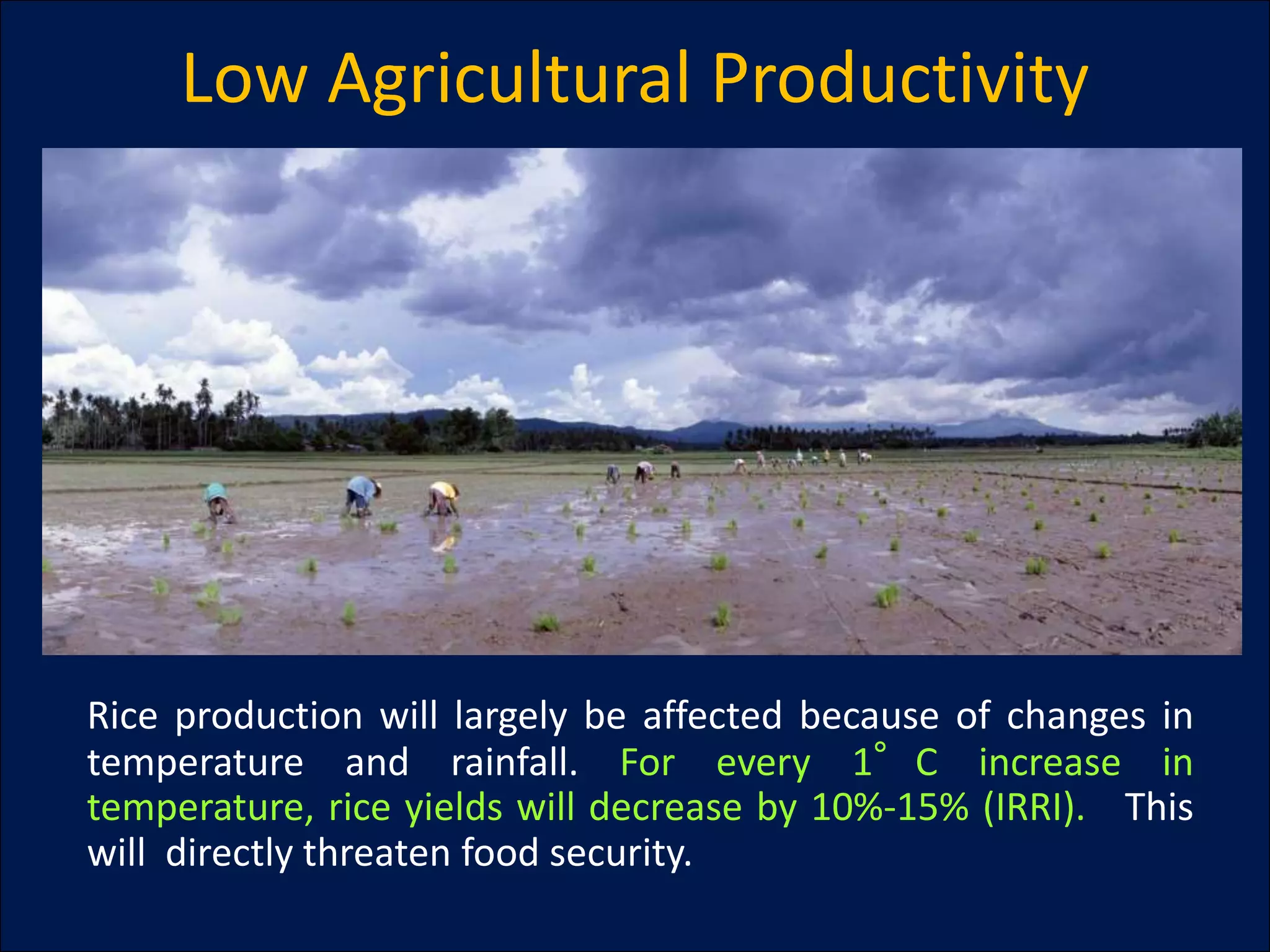
Low Agricultural Productivity
Rice production will largely be affected because of changes in
temperature and rainfall. For every 1°C increase in
temperature, rice yields will decrease by 10%-15% (IRRI). This
will directly threaten food security.
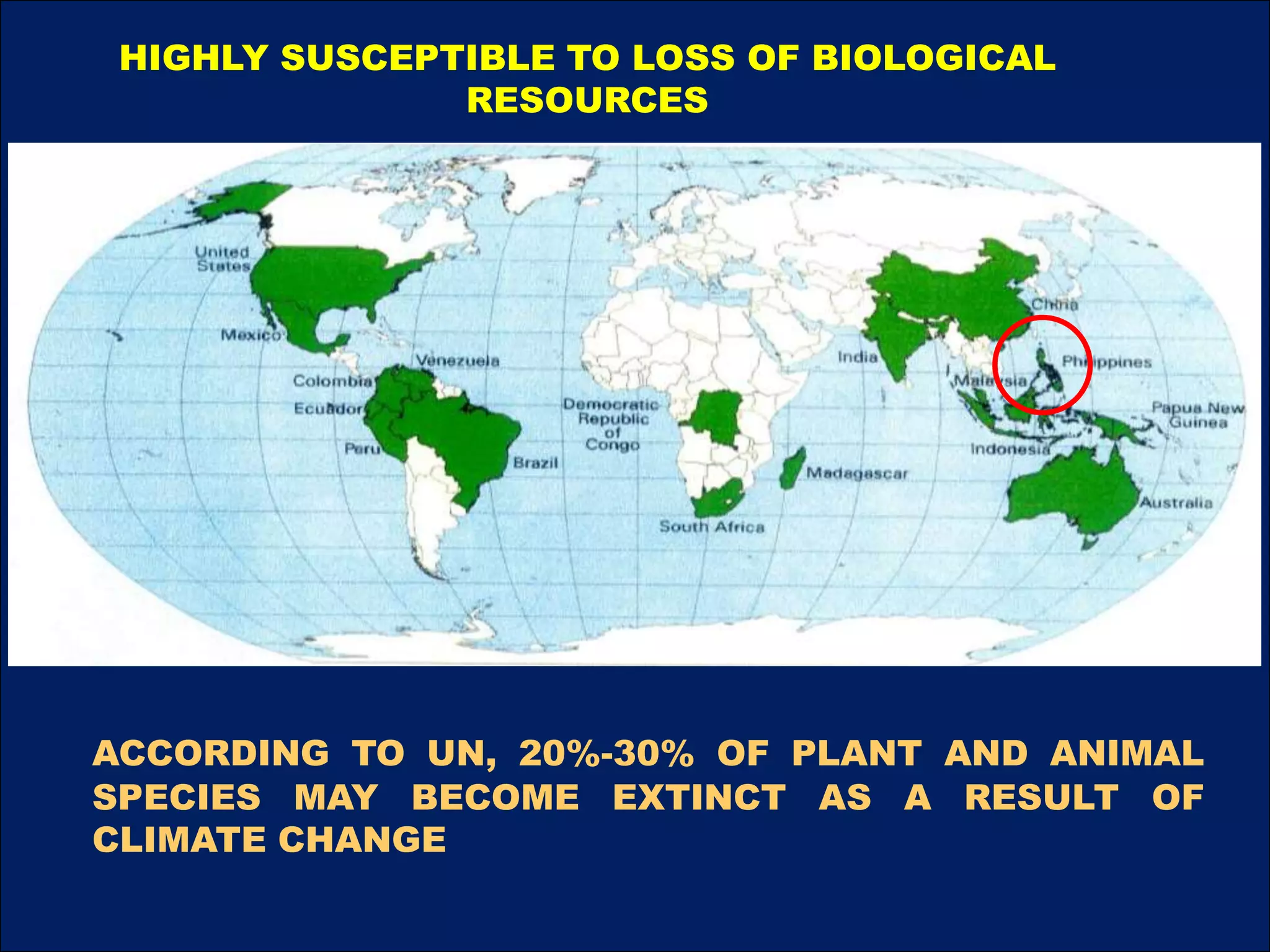
HIGHLY SUSCEPTIBLE TO LOSS OF BIOLOGICAL
RESOURCES
ACCORDING TO UN, 20%-30% OF PLANT AND ANIMAL
SPECIES MAY BECOME EXTINCT AS A RESULT OF
CLIMATE CHANGE
HIGHLY SUSCEPTIBLE TO ILLNESSES
PHILIPPINES AS A TROPICAL COUNTRY
Water-borne and parasitic illnesses will become
prevalent with climate change.
Climate Trends and Projections
for the Philippines
(2020,2050 & 2100)
17
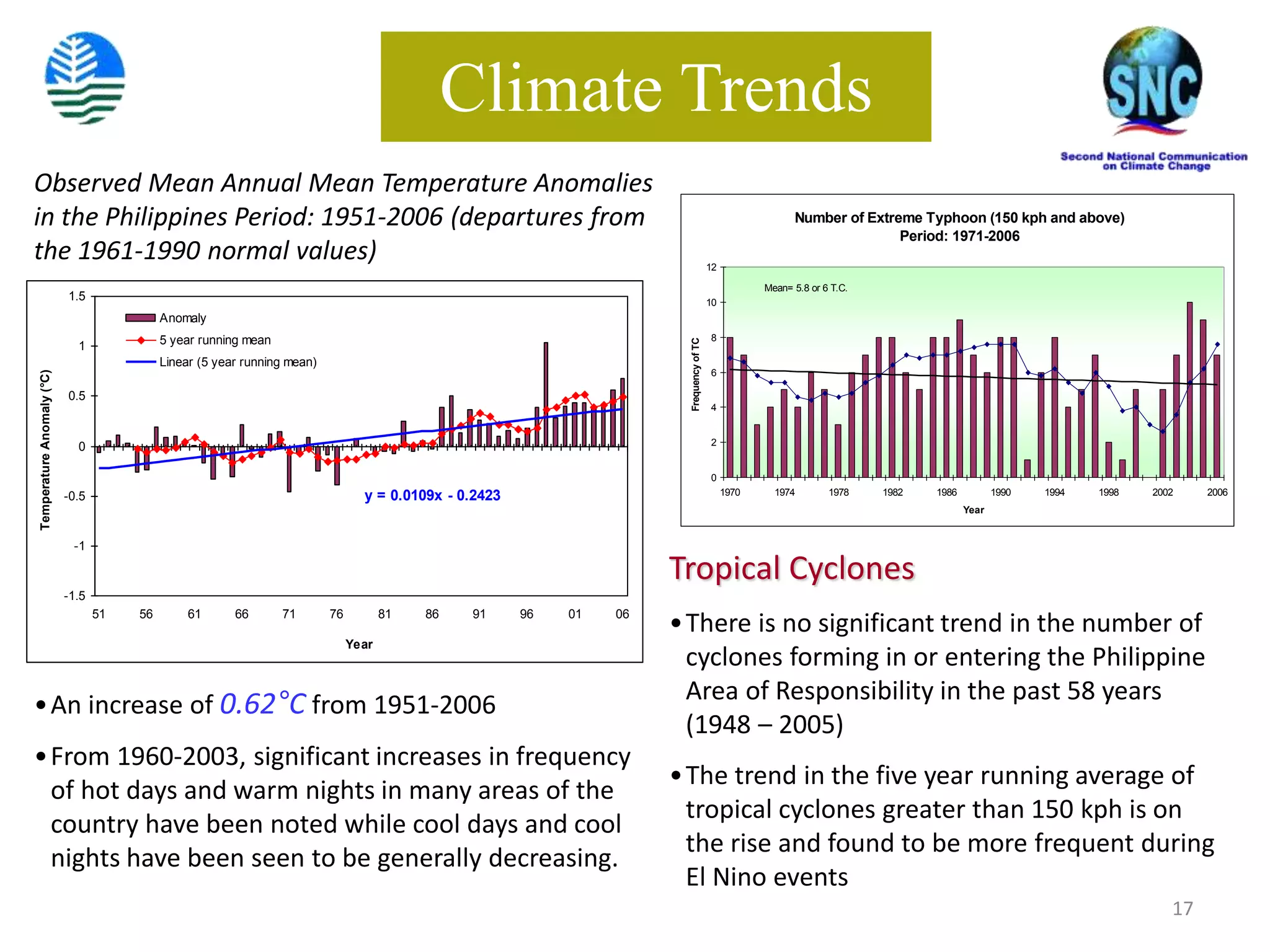
Climate Trends
y = 0.0109x - 0.2423
-1.5
-1
-0.5
0
0.5
1
1.5
51 56 61 66 71 76 81 86 91 96 01 06
Year
TemperatureAnomaly(°C)
Anomaly
5 year running mean
Linear (5 year running mean)
•An increase of 0.62°C from 1951-2006
•From 1960-2003, significant increases in frequency
of hot days and warm nights in many areas of the
country have been noted while cool days and cool
nights have been seen to be generally decreasing.
Observed Mean Annual Mean Temperature Anomalies
in the Philippines Period: 1951-2006 (departures from
the 1961-1990 normal values)
Tropical Cyclones
•There is no significant trend in the number of
cyclones forming in or entering the Philippine
Area of Responsibility in the past 58 years
(1948 – 2005)
•The trend in the five year running average of
tropical cyclones greater than 150 kph is on
the rise and found to be more frequent during
El Nino events
Number of Extreme Typhoon (150 kph and above)
Period: 1971-2006
0
2
4
6
8
10
12
1970 1974 1978 1982 1986 1990 1994 1998 2002 2006
Year
FrequencyofTC
Mean= 5.8 or 6 T.C.
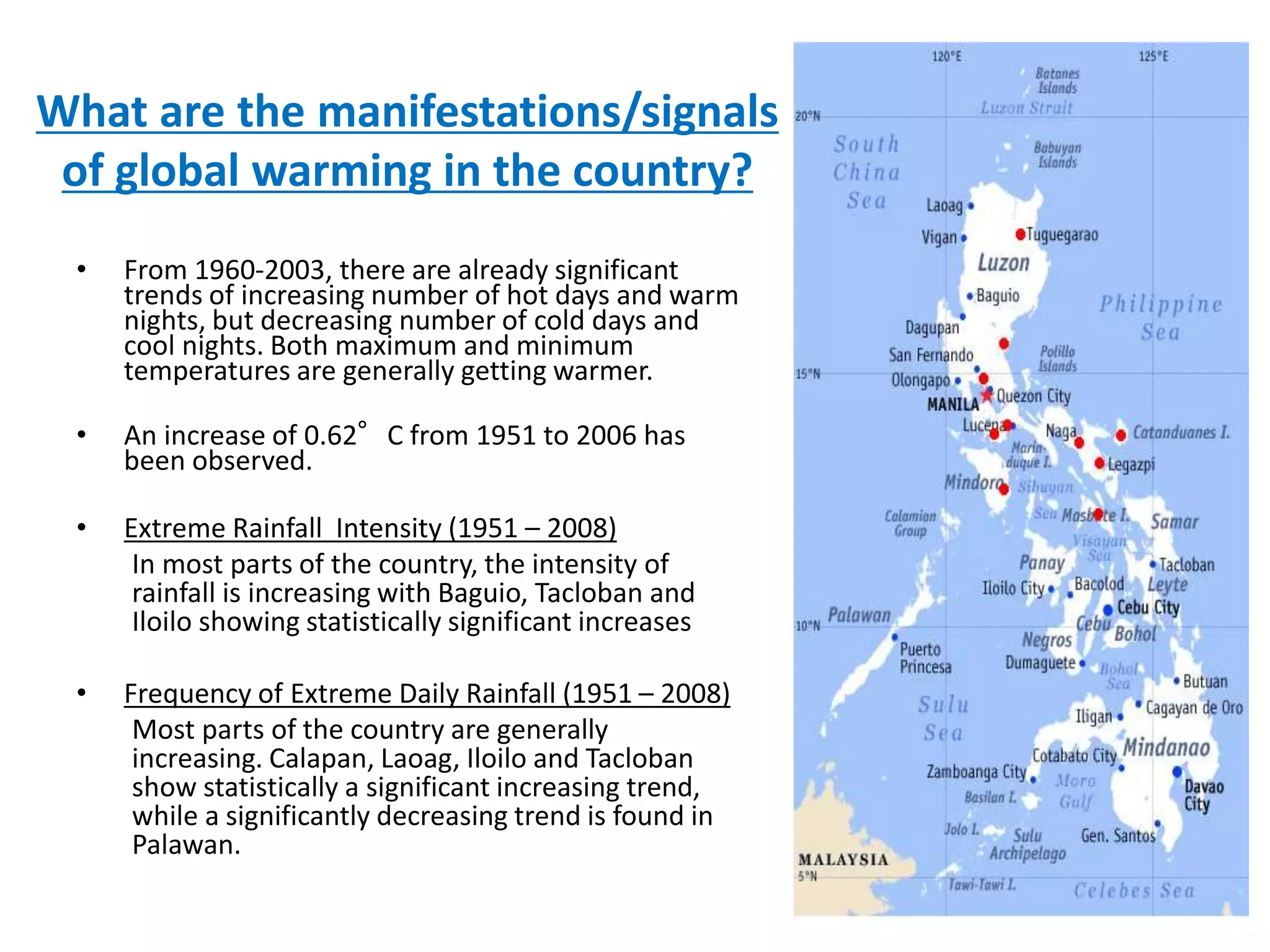
• From 1960-2003, there are already significant
trends of increasing number of hot days and warm
nights, but decreasing number of cold days and
cool nights. Both maximum and minimum
temperatures are generally getting warmer.
• An increase of 0.62°C from 1951 to 2006 has
been observed.
• Extreme Rainfall Intensity (1951 – 2008)
In most parts of the country, the intensity of
rainfall is increasing with Baguio, Tacloban and
Iloilo showing statistically significant increases
• Frequency of Extreme Daily Rainfall (1951 – 2008)
Most parts of the country are generally
increasing. Calapan, Laoag, Iloilo and Tacloban
show statistically a significant increasing trend,
while a significantly decreasing trend is found in
Palawan.
What are the manifestations/signals
of global warming in the country?
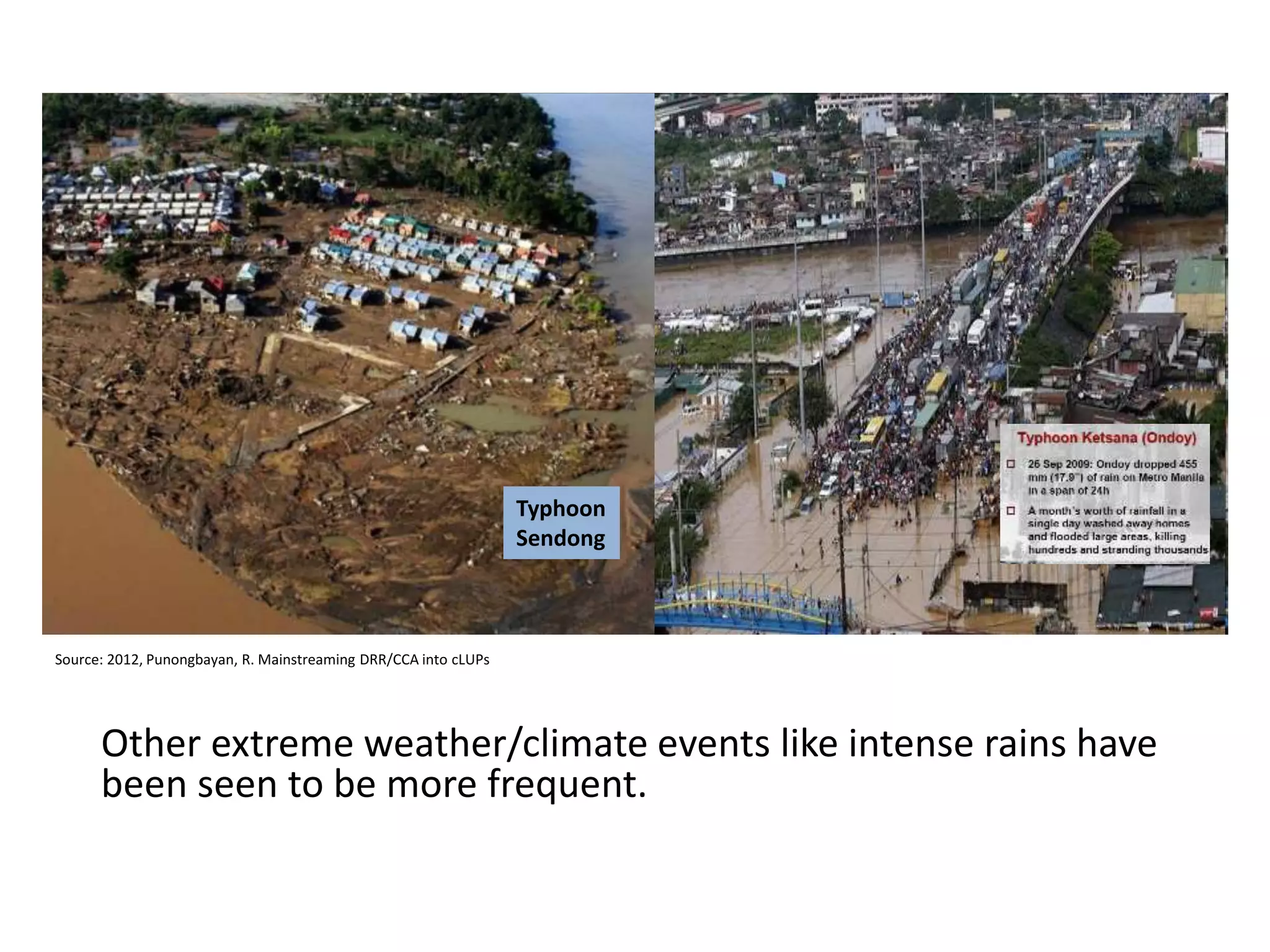
Other extreme weather/climate events like intense rains have
been seen to be more frequent.
Typhoon
Sendong
Source: 2012, Punongbayan, R. Mainstreaming DRR/CCA into cLUPs
20
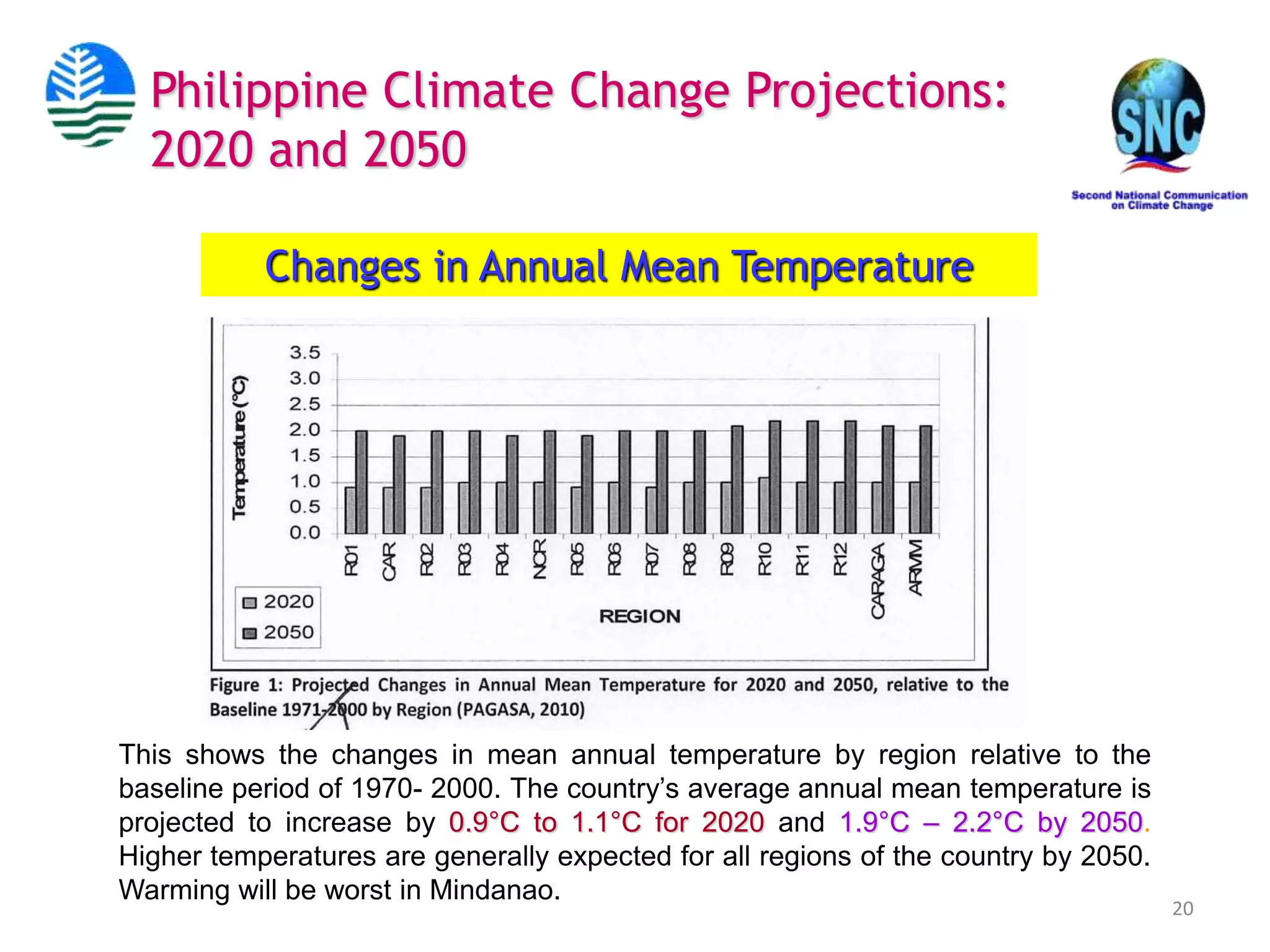
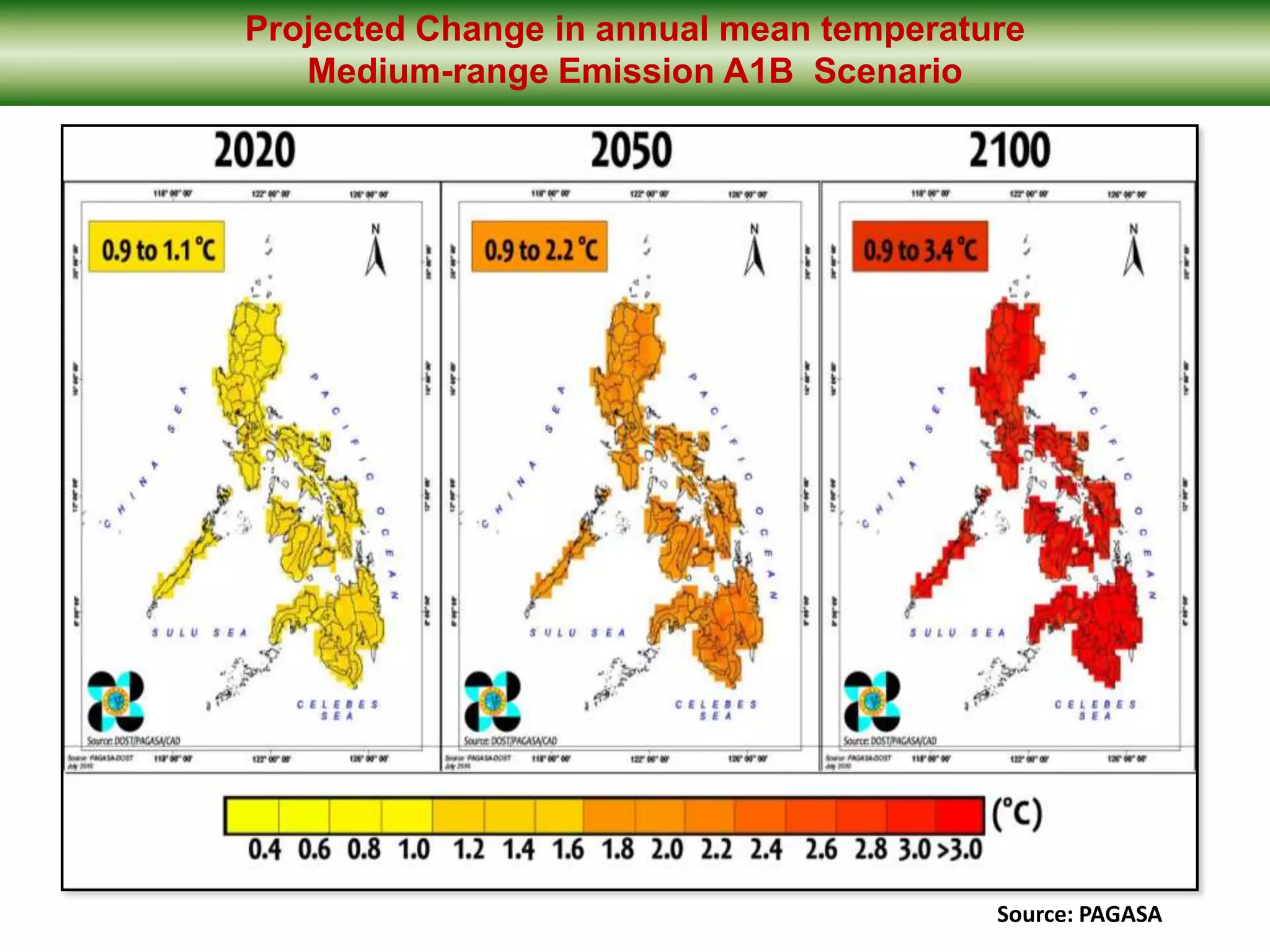
Changes in Annual Mean Temperature
This shows the changes in mean annual temperature by region relative to the
baseline period of 1970- 2000. The country’s average annual mean temperature is
projected to increase by 0.9°C to 1.1°C for 2020 and 1.9°C – 2.2°C by 2050.
Higher temperatures are generally expected for all regions of the country by 2050.
Warming will be worst in Mindanao.
Philippine Climate Change Projections:
2020 and 2050
21
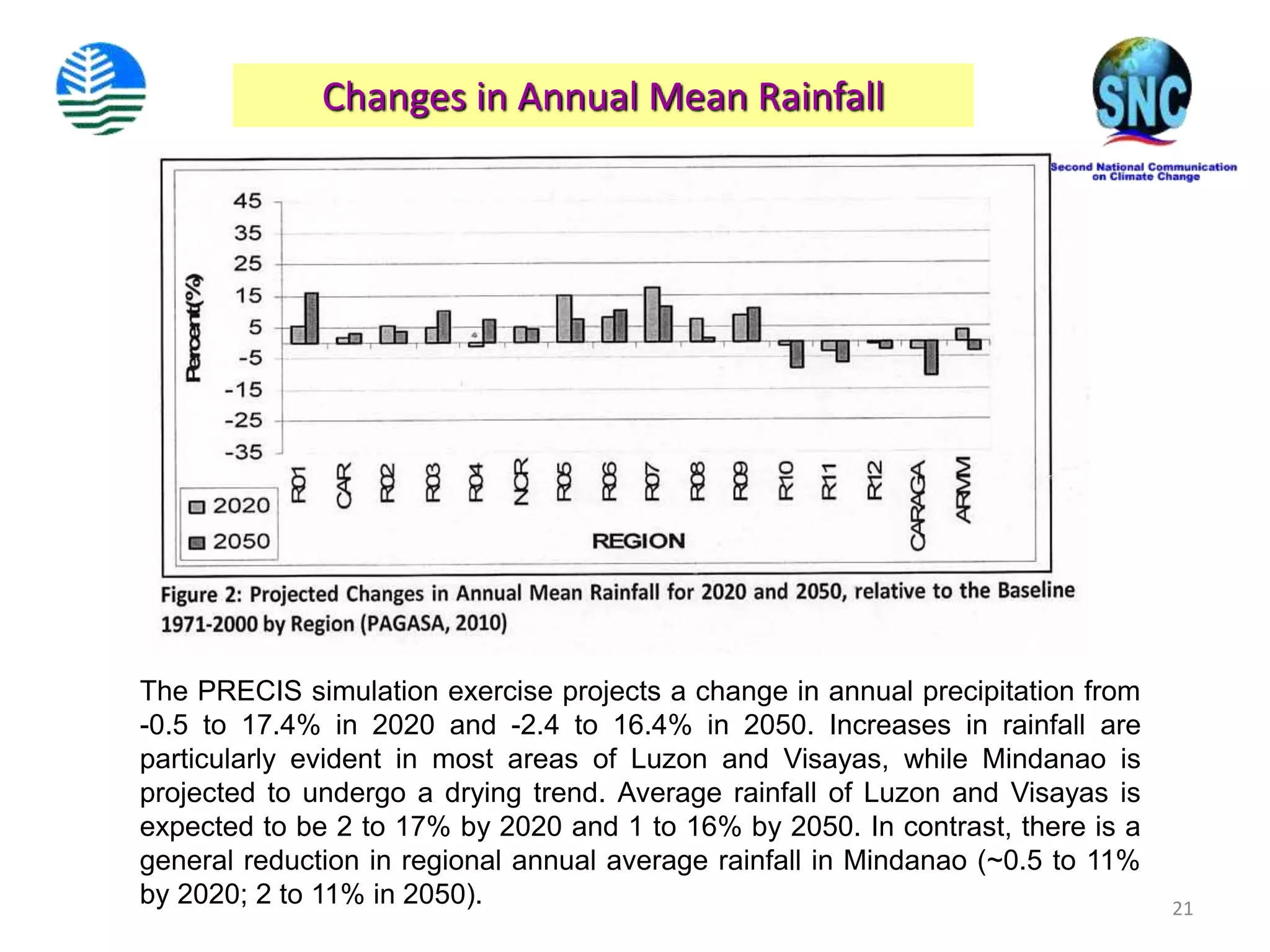
Changes in Annual Mean Rainfall
The PRECIS simulation exercise projects a change in annual precipitation from
-0.5 to 17.4% in 2020 and -2.4 to 16.4% in 2050. Increases in rainfall are
particularly evident in most areas of Luzon and Visayas, while Mindanao is
projected to undergo a drying trend. Average rainfall of Luzon and Visayas is
expected to be 2 to 17% by 2020 and 1 to 16% by 2050. In contrast, there is a
general reduction in regional annual average rainfall in Mindanao (~0.5 to 11%
by 2020; 2 to 11% in 2050).
22
Sea Level Rise
• Sea level rise will increase the risk of flooding and storm damage.
Projected impacts of 1 meter seal level rise in many areas of the
country show vast portions being inundated, affecting coastal
settlements and livelihood.
• According to estimates of the National Mapping and Resource
Information Authority (NAMRIA), a 1 meter sea level rise can
translate to an estimated land loss of 129,114 hectares.
Projected Change in annual mean temperature
Medium-range Emission A1B Scenario
Source: PAGASA
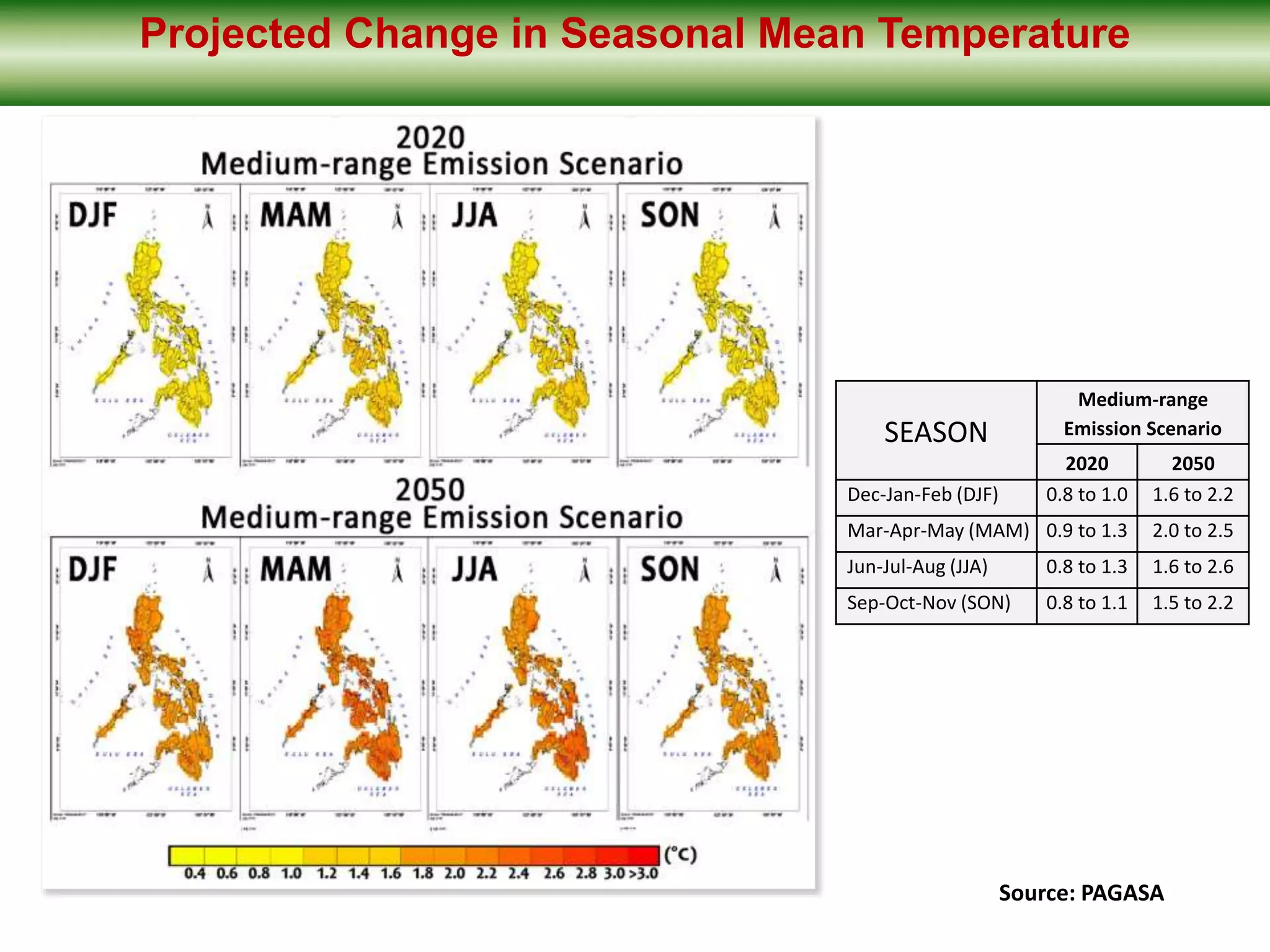
Key Findings
SEASON
Medium-range
Emission Scenario
2020 2050
Dec-Jan-Feb (DJF) 0.8 to 1.0 1.6 to 2.2
Mar-Apr-May (MAM) 0.9 to 1.3 2.0 to 2.5
Jun-Jul-Aug (JJA) 0.8 to 1.3 1.6 to 2.6
Sep-Oct-Nov (SON) 0.8 to 1.1 1.5 to 2.2
Projected Change in Seasonal Mean Temperature
Source: PAGASA
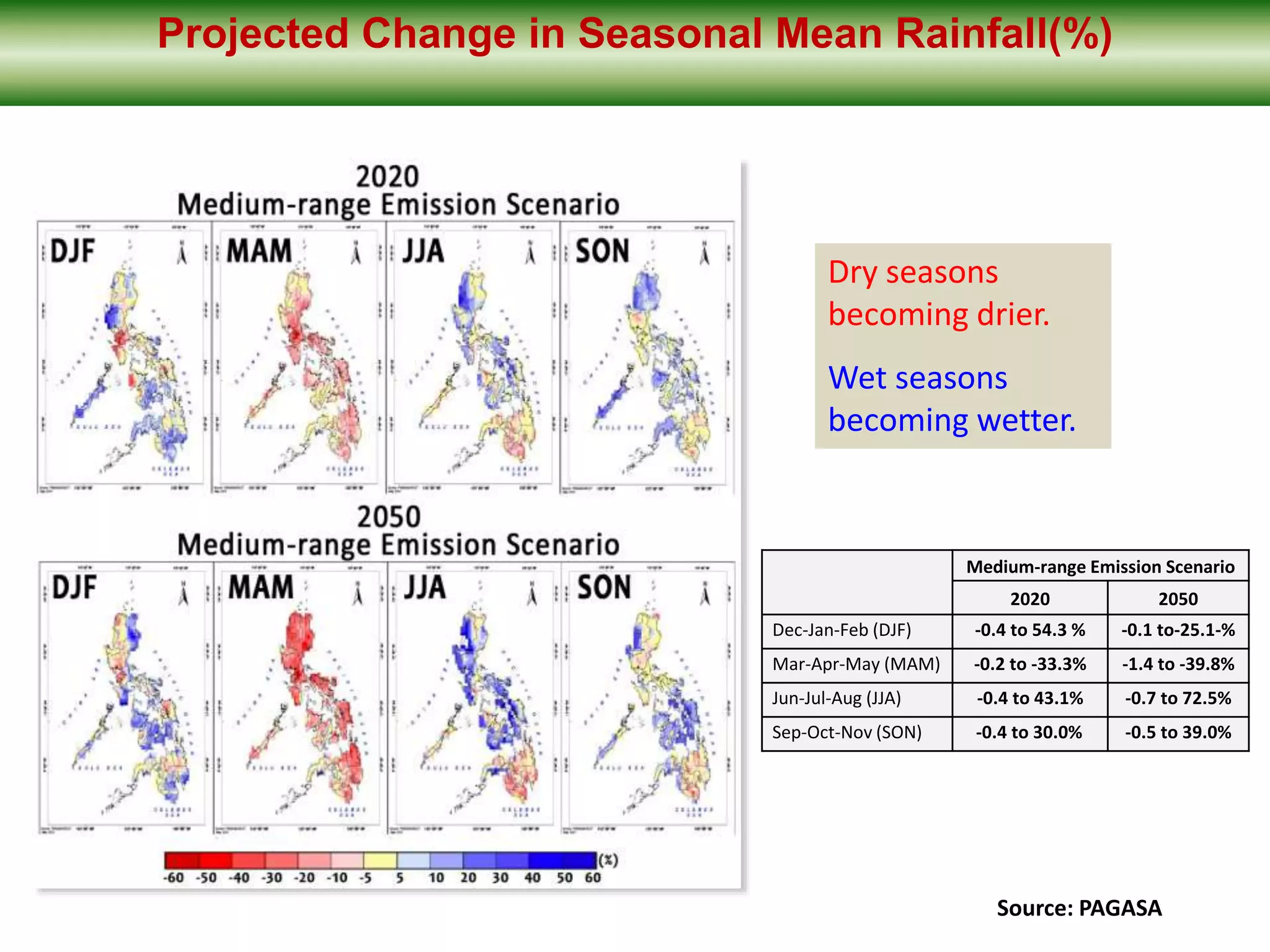
Dry seasons
becoming drier.
Wet seasons
becoming wetter.
Medium-range Emission Scenario
2020 2050
Dec-Jan-Feb (DJF) -0.4 to 54.3 % -0.1 to-25.1-%
Mar-Apr-May (MAM) -0.2 to -33.3% -1.4 to -39.8%
Jun-Jul-Aug (JJA) -0.4 to 43.1% -0.7 to 72.5%
Sep-Oct-Nov (SON) -0.4 to 30.0% -0.5 to 39.0%
Projected Change in Seasonal Mean Rainfall(%)
Source: PAGASA
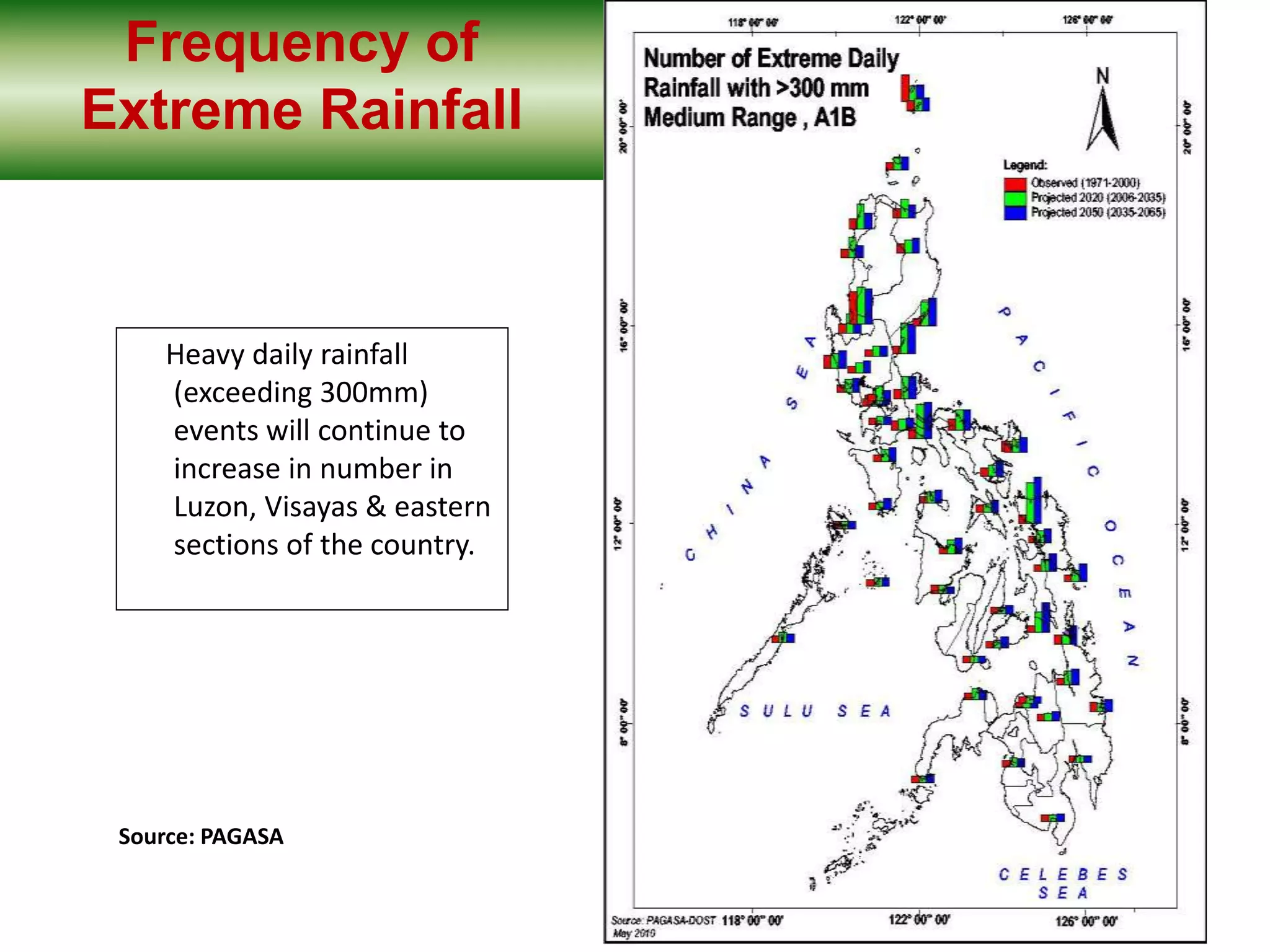
Heavy daily rainfall
(exceeding 300mm)
events will continue to
increase in number in
Luzon, Visayas & eastern
sections of the country.
Frequency of
Extreme Rainfall
Source: PAGASA
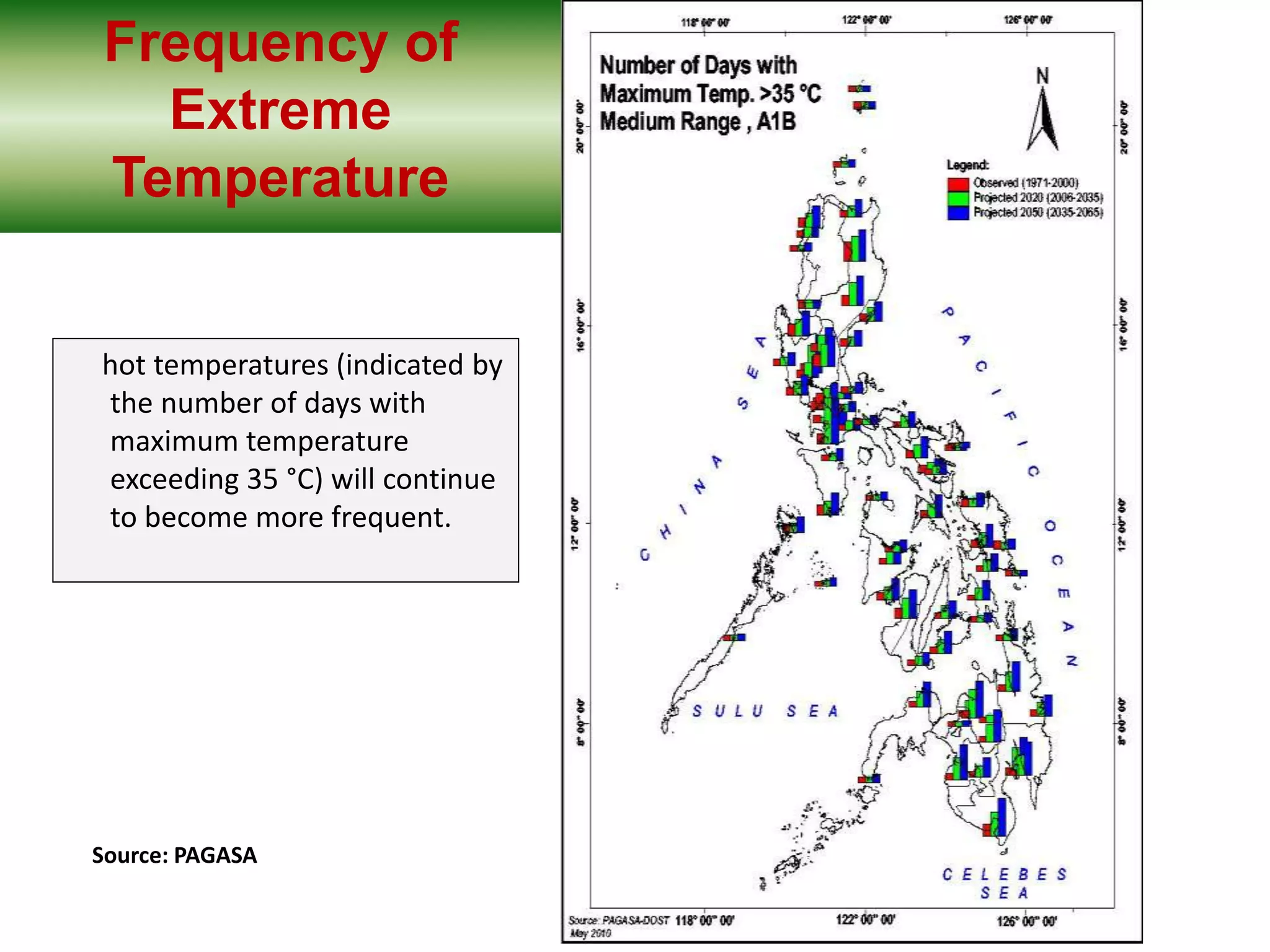
hot temperatures (indicated by
the number of days with
maximum temperature
exceeding 35 °C) will continue
to become more frequent.
Frequency of
Extreme
Temperature
Source: PAGASA
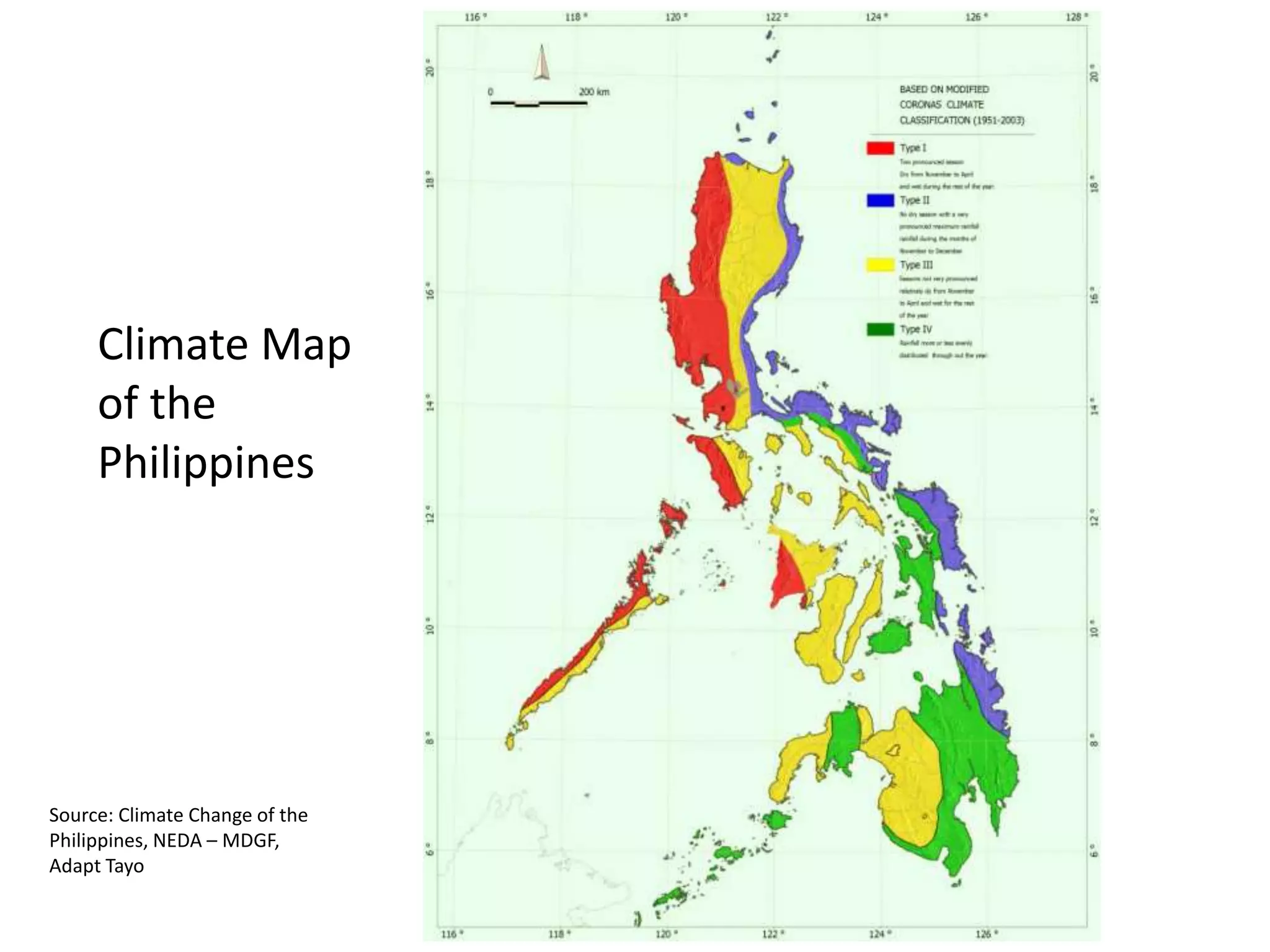
Climate Map
of the
Philippines
Source: Climate Change of the
Philippines, NEDA – MDGF,
Adapt Tayo
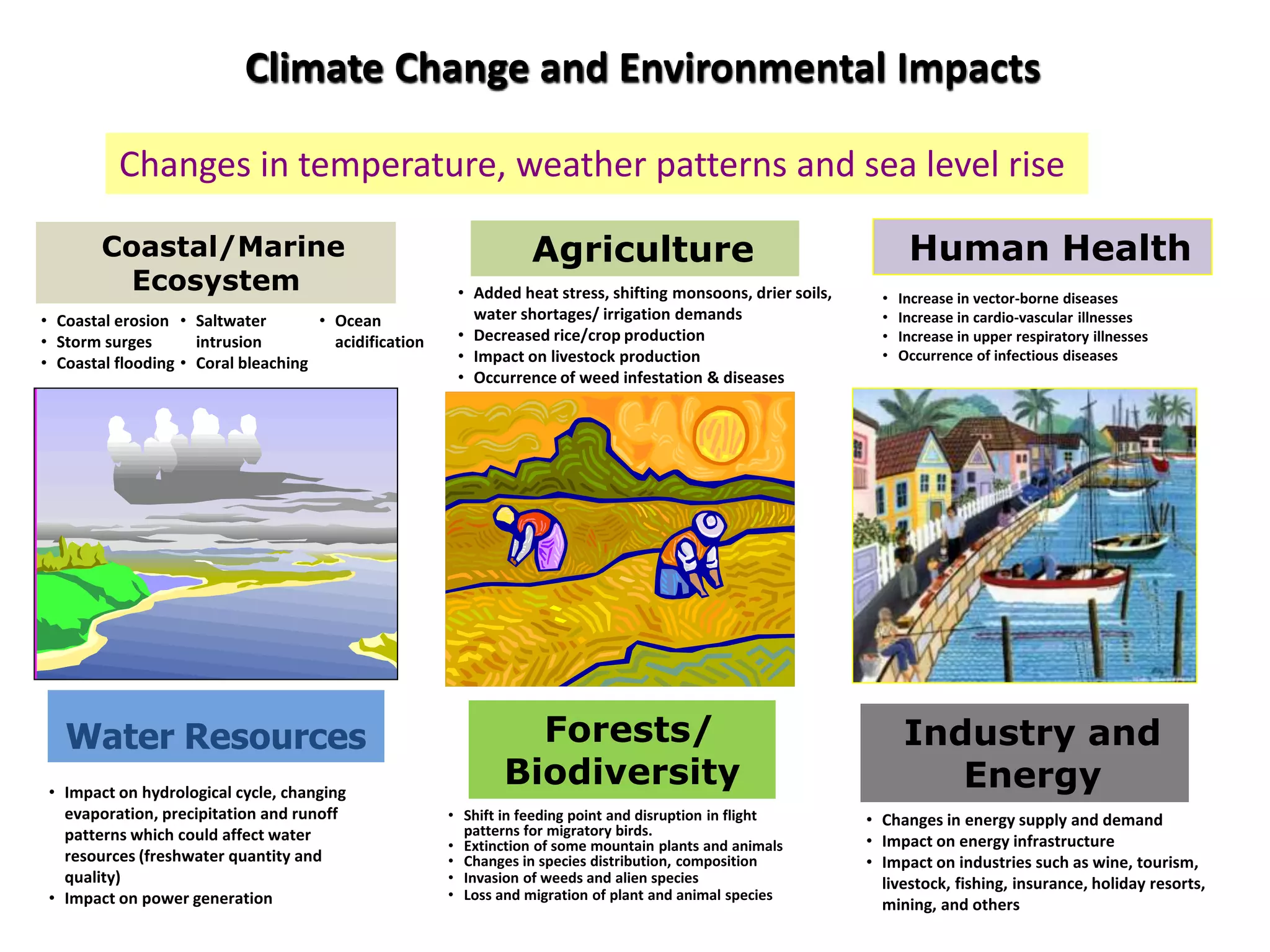
Water Resources
Climate Change and Environmental Impacts
Changes in temperature, weather patterns and sea level rise
Agriculture
Forests/
Biodiversity
Coastal/Marine
Ecosystem
Human Health
Industry and
Energy
• Added heat stress, shifting monsoons, drier soils,
water shortages/ irrigation demands
• Decreased rice/crop production
• Impact on livestock production
• Occurrence of weed infestation & diseases
• Coastal erosion
• Storm surges
• Coastal flooding
• Saltwater
intrusion
• Coral bleaching
• Ocean
acidification
• Increase in vector-borne diseases
• Increase in cardio-vascular illnesses
• Increase in upper respiratory illnesses
• Occurrence of infectious diseases
• Impact on hydrological cycle, changing
evaporation, precipitation and runoff
patterns which could affect water
resources (freshwater quantity and
quality)
• Impact on power generation
• Shift in feeding point and disruption in flight
patterns for migratory birds.
• Extinction of some mountain plants and animals
• Changes in species distribution, composition
• Invasion of weeds and alien species
• Loss and migration of plant and animal species
• Changes in energy supply and demand
• Impact on energy infrastructure
• Impact on industries such as wine, tourism,
livestock, fishing, insurance, holiday resorts,
mining, and others
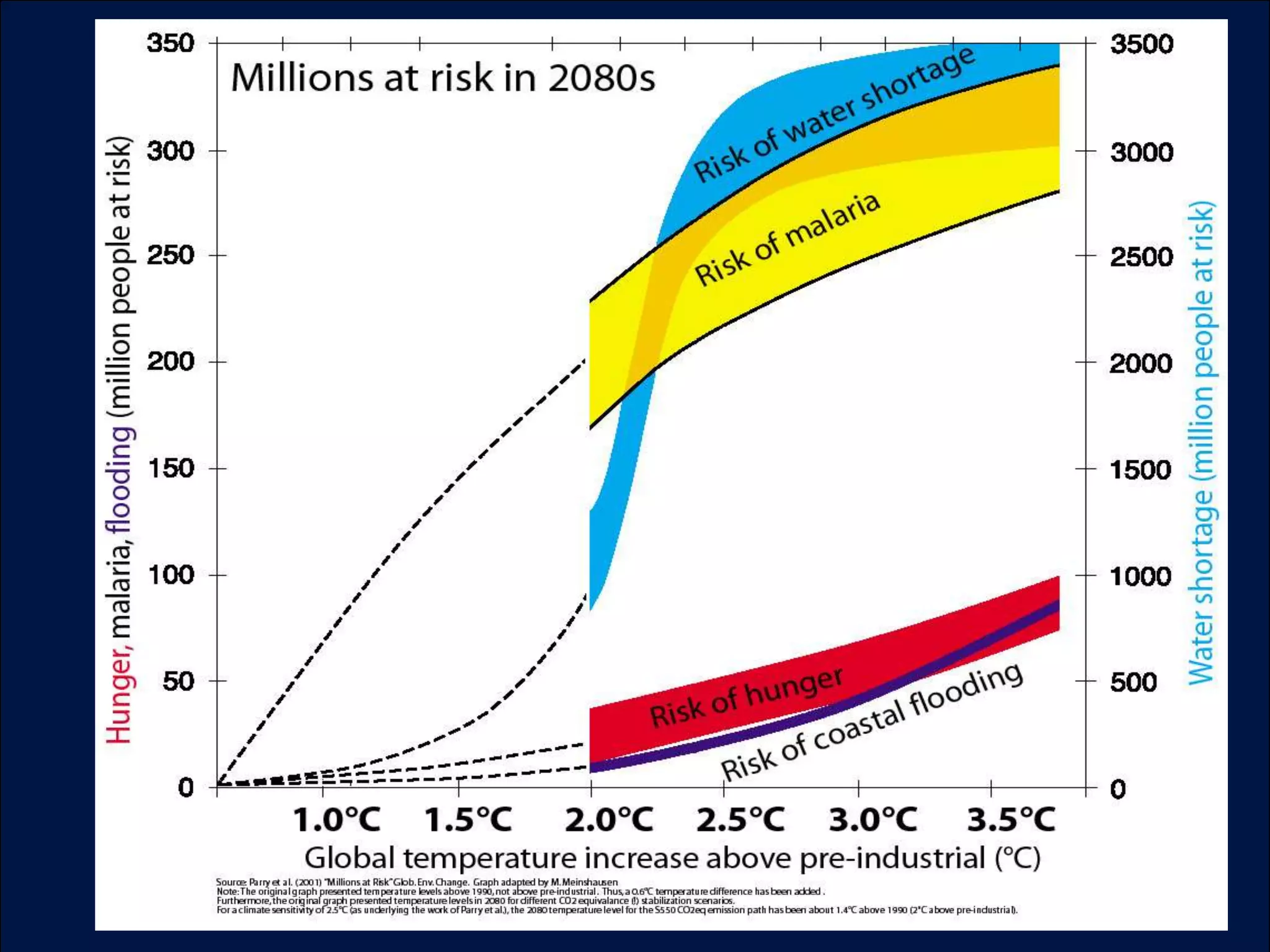
The starting point
for WWF’s analysis was
the strong scientific consensus that
any human-induced warming
greater than two degrees Celsius
above pre-industrial levels
would have a dangerous
and highly damaging impact
on both human societies
and their economies
and the global environment
as a whole.
2ºC
Peak 475 ppm
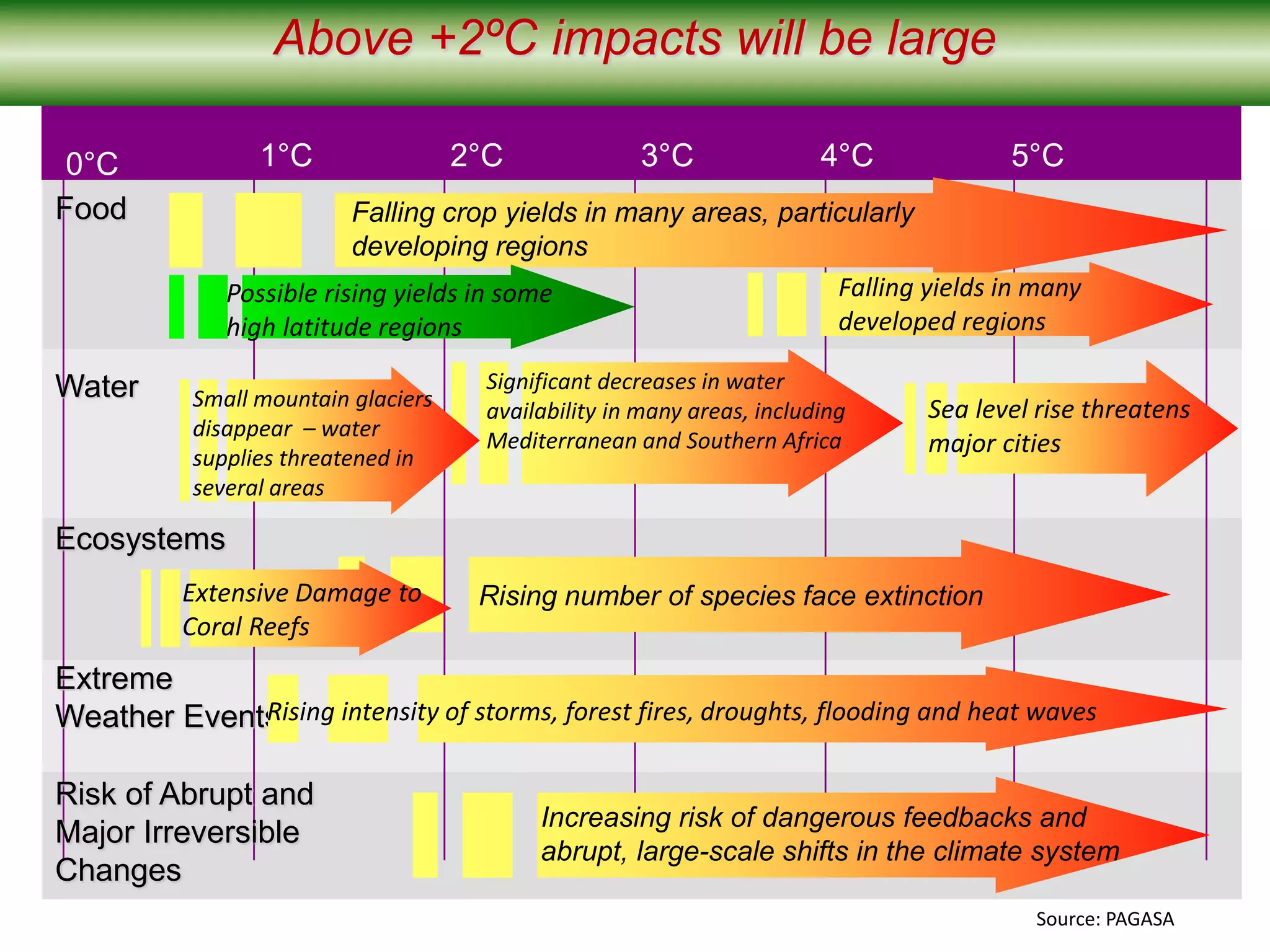
1°C 2°C 5°C4°C3°C
Sea level rise threatens
major cities
Falling crop yields in many areas, particularly
developing regions
Food
Water
Ecosystems
Risk of Abrupt and
Major Irreversible
Changes
0°C
Falling yields in many
developed regions
Rising number of species face extinction
Increasing risk of dangerous feedbacks and
abrupt, large-scale shifts in the climate system
Significant decreases in water
availability in many areas, including
Mediterranean and Southern Africa
Small mountain glaciers
disappear – water
supplies threatened in
several areas
Extensive Damage to
Coral Reefs
Extreme
Weather EventsRising intensity of storms, forest fires, droughts, flooding and heat waves
Possible rising yields in some
high latitude regions
Above +2ºC impacts will be large
Source: PAGASA
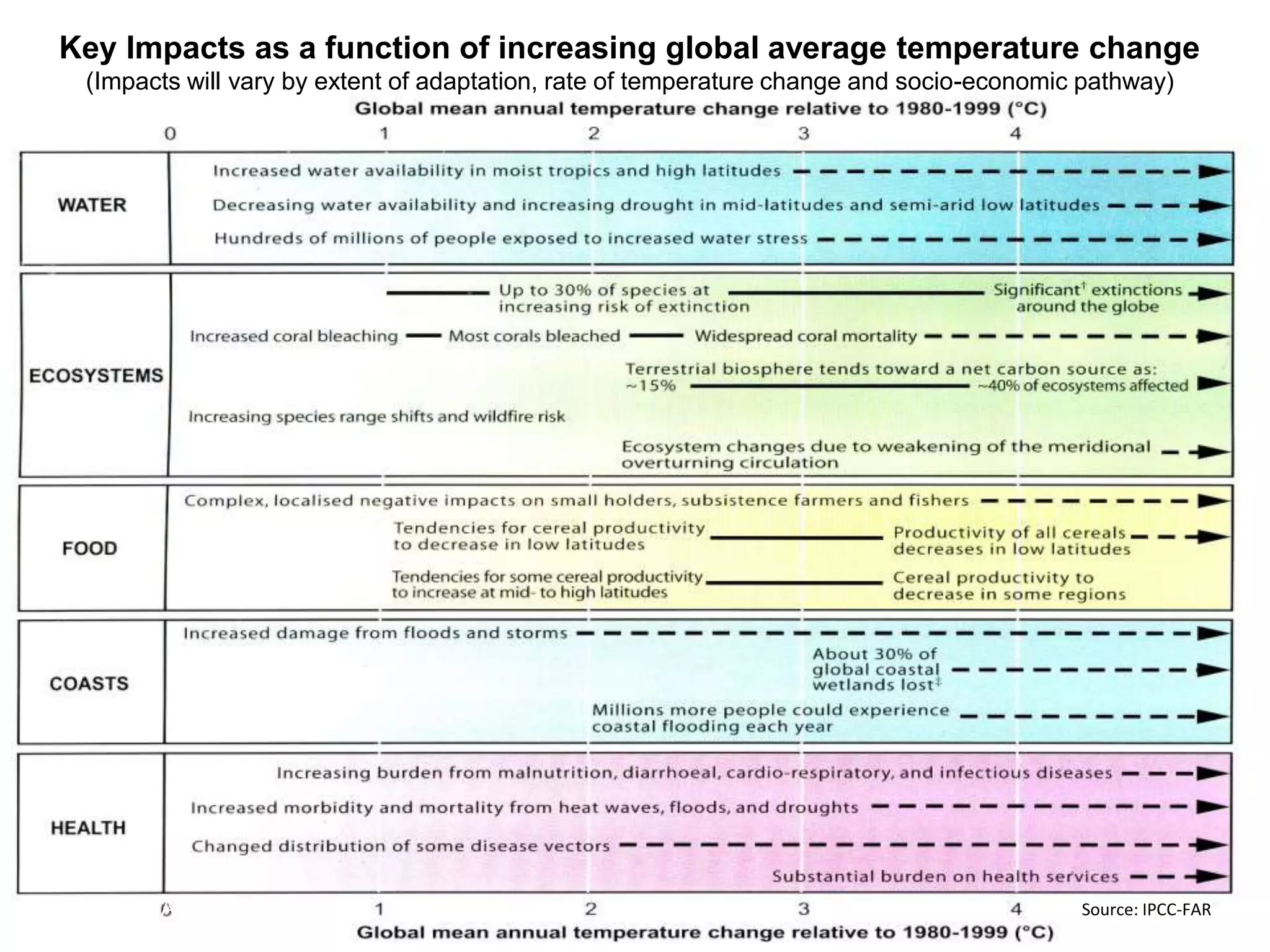
Key Impacts as a function of increasing global average temperature change
(Impacts will vary by extent of adaptation, rate of temperature change and socio-economic pathway)
Source: IPCC-FAR Source: IPCC-FAR
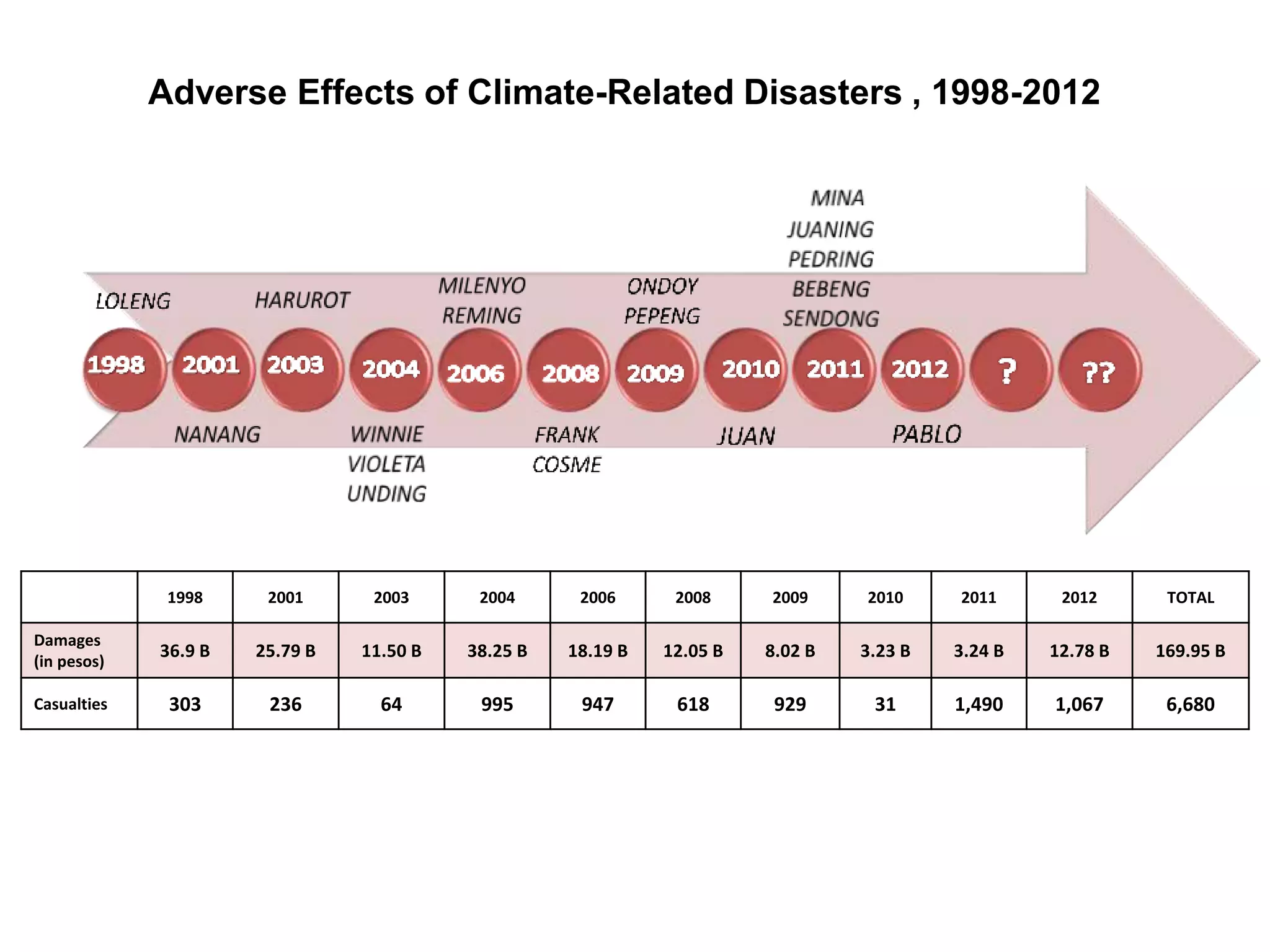
1998 2001 2003 2004 2006 2008 2009 2010 2011 2012 TOTAL
Damages
(in pesos)
36.9 B 25.79 B 11.50 B 38.25 B 18.19 B 12.05 B 8.02 B 3.23 B 3.24 B 12.78 B 169.95 B
Casualties 303 236 64 995 947 618 929 31 1,490 1,067 6,680
Adverse Effects of Climate-Related Disasters , 1998-2012
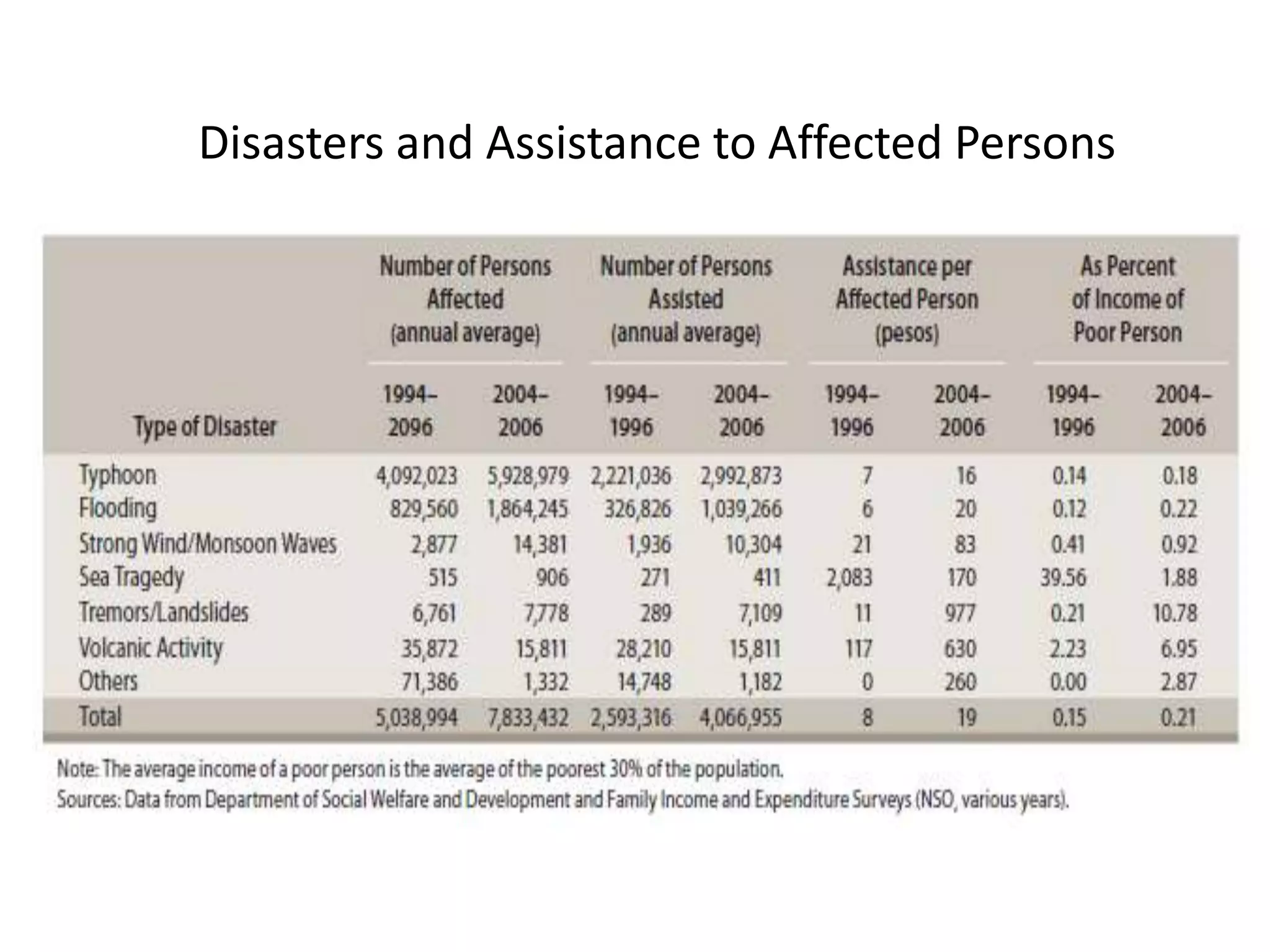
Disasters and Assistance to Affected Persons
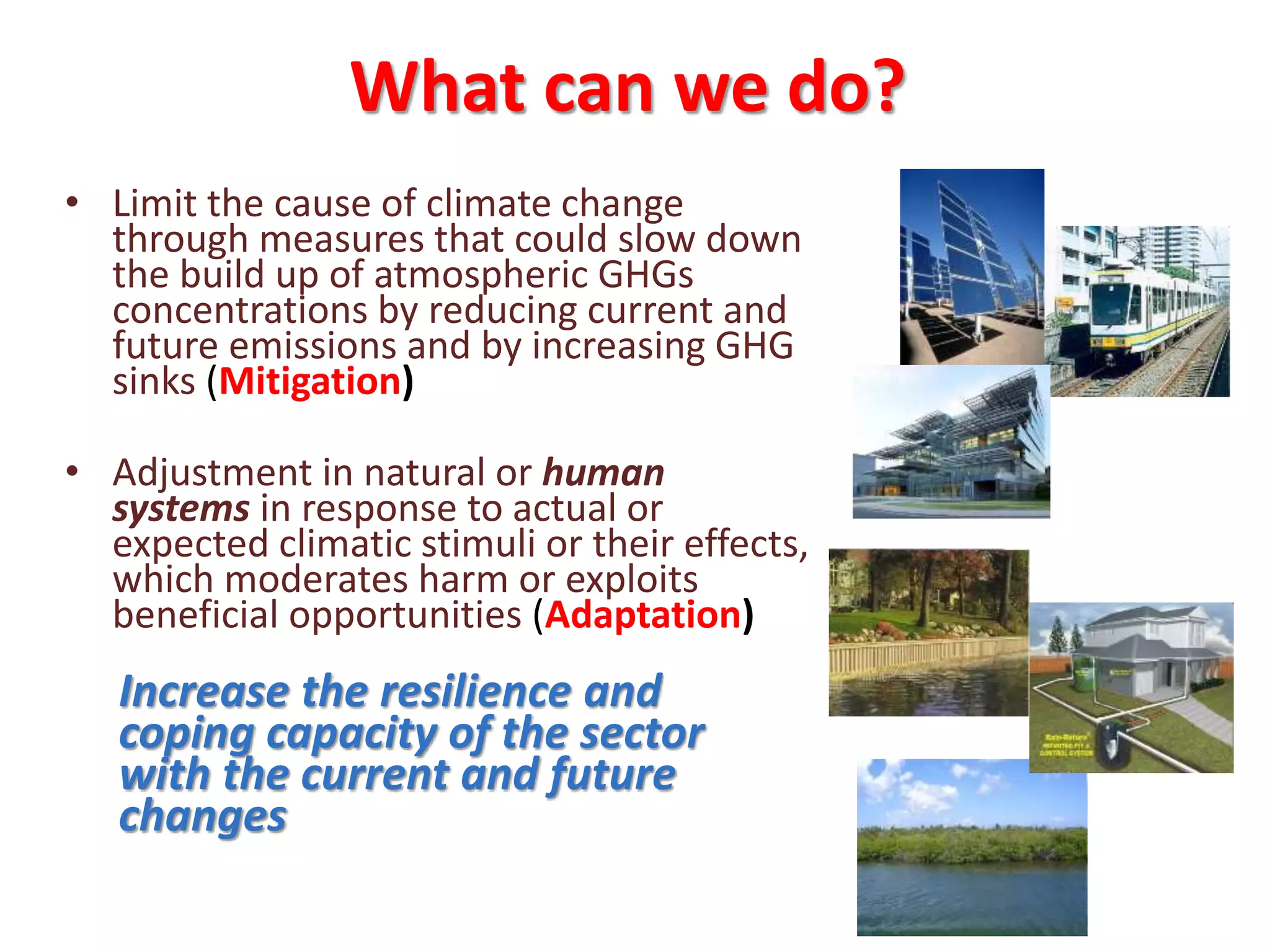
What can we do?
• Limit the cause of climate change
through measures that could slow down
the build up of atmospheric GHGs
concentrations by reducing current and
future emissions and by increasing GHG
sinks (Mitigation)
• Adjustment in natural or human
systems in response to actual or
expected climatic stimuli or their effects,
which moderates harm or exploits
beneficial opportunities (Adaptation)
Increase the resilience and
coping capacity of the sector
with the current and future
changes
 Adjustment in natural or human systems in response to actual or
expected climatic stimuli or their effects, which moderates harm or
exploits beneficial opportunities (IPCC-FAR)
 Practical steps to protect countries and communities from the likely
disruption and damage that will result from effects of climate change.
For example, flood walls should be built and in numerous cases it is
probably advisable to move human settlements out of flood plains and
other low-lying areas…” (Website of the UNFCCC Secretariat)
 Is a process by which strategies to moderate, cope with and take
advantage of the consequences of climatic events are enhanced,
developed, and implemented. (UNDP, 2005)
 The process or outcome of a process that leads to a reduction in harm
or risk of harm, or realisation of benefits associated with climate
variability and climate change. (UK Climate Impact Programme
(UKCIP, 2003)
Source: OECD, Adaptation to Climate Change: Key Terms, 2006
What is adaptation?
 Climate change has the potential to push developing countries
back into the poverty trap and to undo many achievements that
have been made to date with regard to the Millennium
Development Goals (MDGs).
 Even an immediate and dramatic cut in global greenhouse gas
emissions would not fully prevent climate change impacts.
 The most vulnerable ecological and socio-economic systems are
those with the greatest sensitivity to climate change and the least
ability to adapt.
 Ecosystems that are already under stress are particularly
vulnerable.
 Social and economic systems tend to be more vulnerable in
developing countries with weaker economies and institutions.
Why do we need to adapt?
Types of Adaptation
 Various types of adaptation exist, e.g.
anticipatory and reactive, private and public, and
autonomous and planned.
 Anticipatory adaptation (proactive) – takes places
before impacts of climate change are observed.
 Autonomous adaptation (spontaneous) – does not
constitute a conscious response to climate stimuli but
is triggered by ecological changes in natural systems
and by market or welfare changes in human systems.
 Planned adaptation – is a result of a deliberate policy
decision, based on awareness that conditions have
changed or are about to change and that action is
required to return to, maintain, or achieve a desired
state.
Current and Potential Options
for Adapting to Climate Change
in Vulnerable Sectors
(IPCC-FAR)
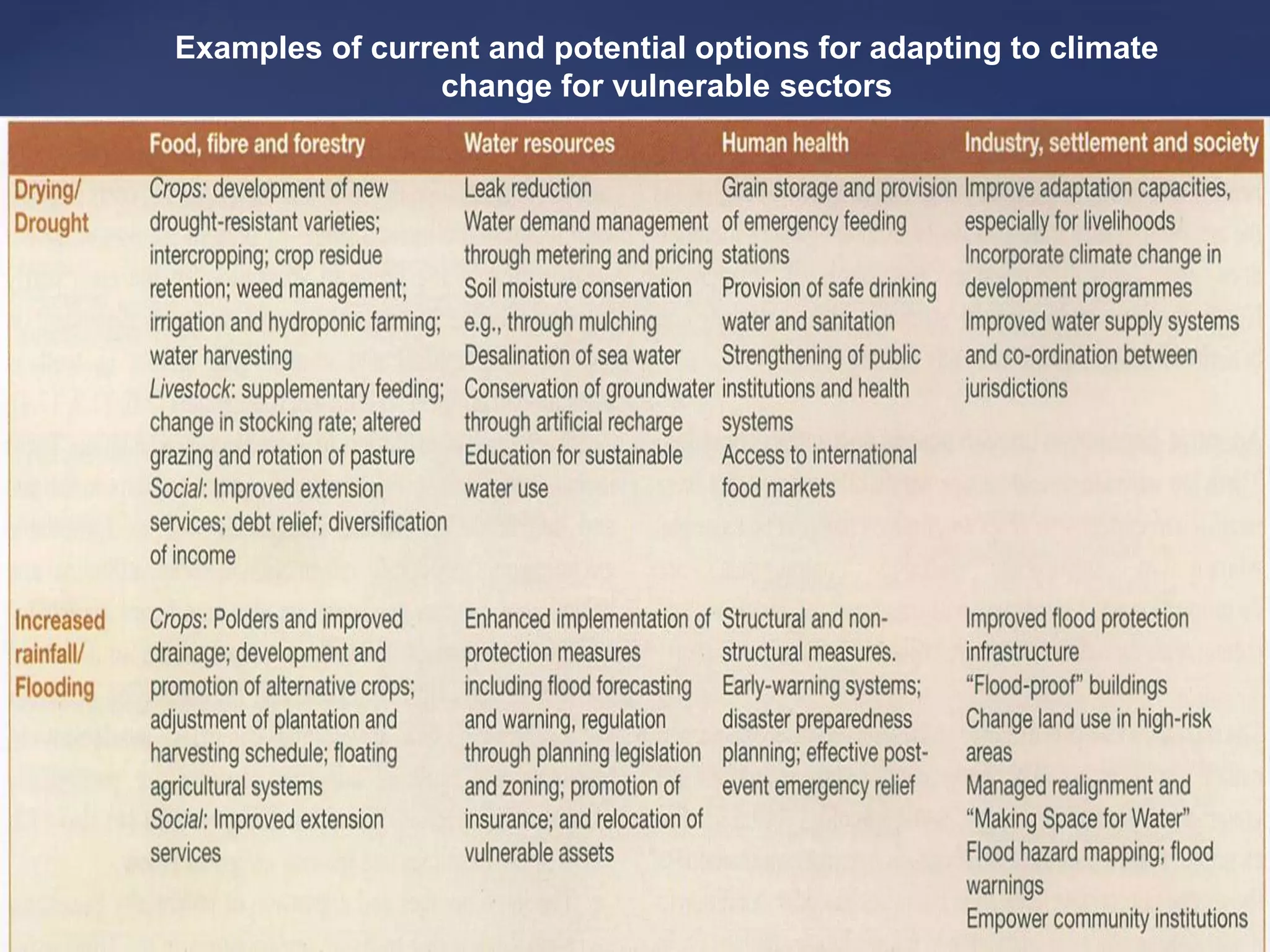
Examples of current and potential options for adapting to climate
change for vulnerable sectors
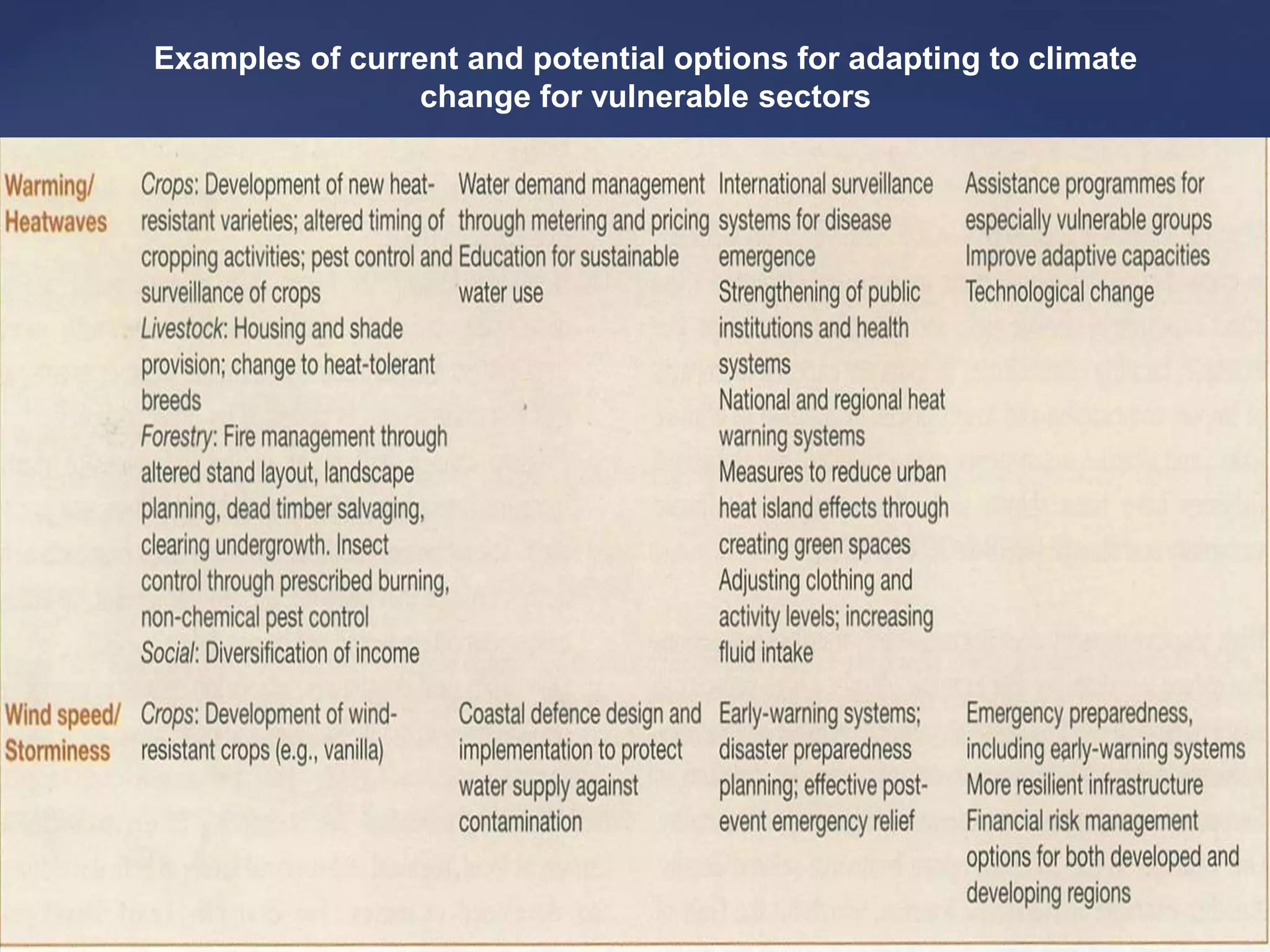
Examples of current and potential options for adapting to climate
change for vulnerable sectors
Adaptation Measures
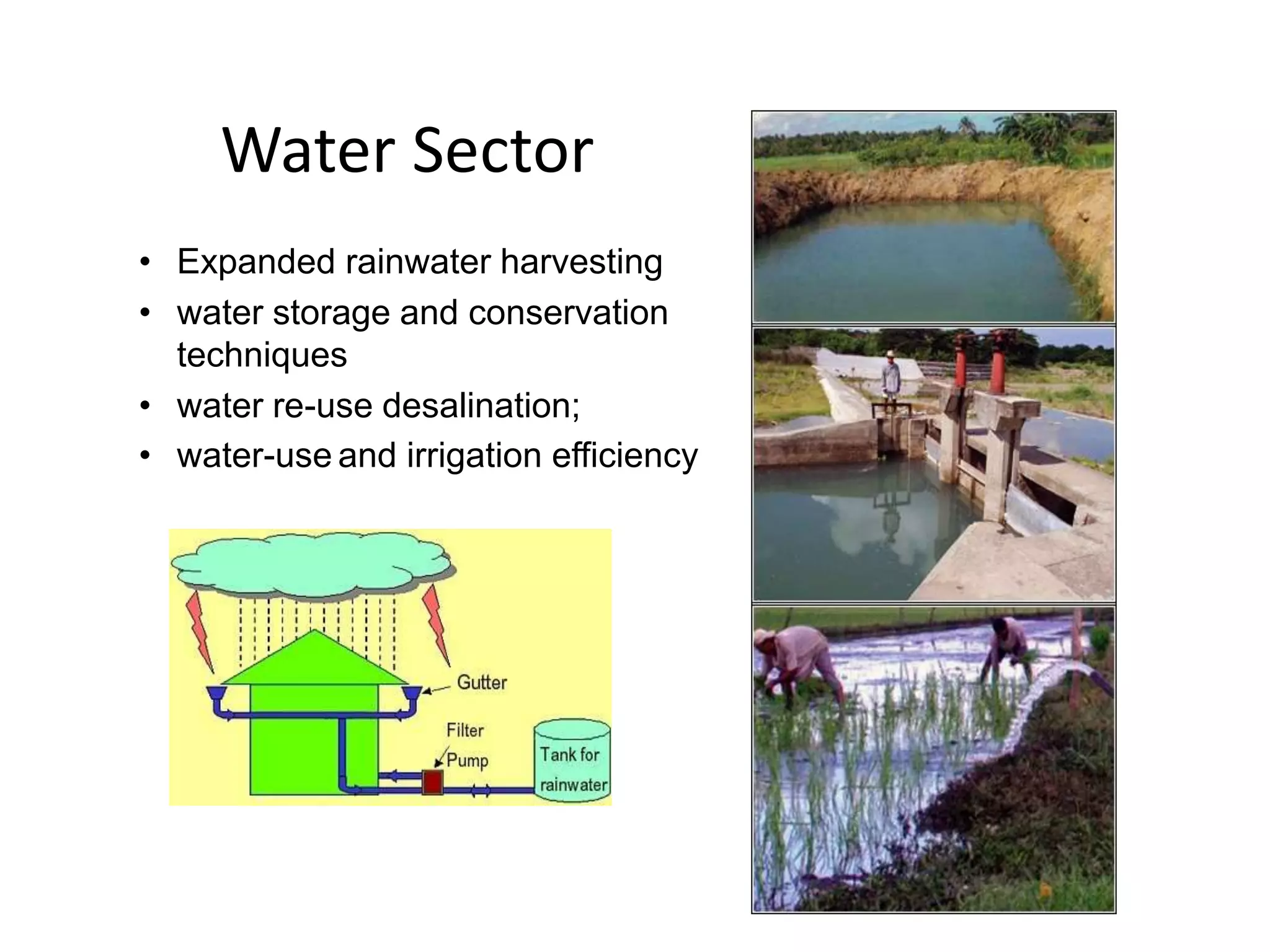
Water Sector
• Expanded rainwater harvesting
• water storage and conservation
techniques
• water re-use desalination;
• water-use and irrigation efficiency
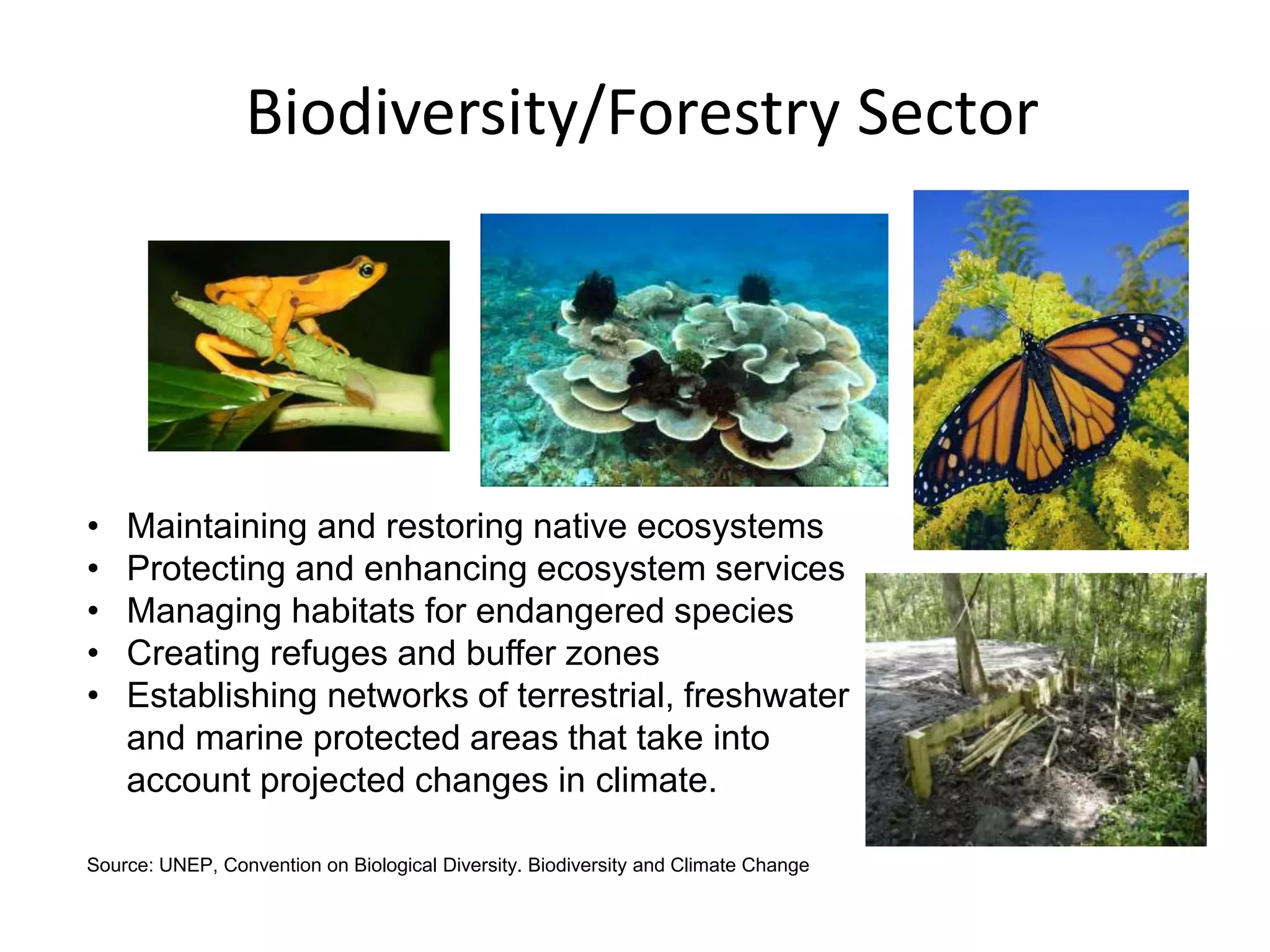
• Maintaining and restoring native ecosystems
• Protecting and enhancing ecosystem services
• Managing habitats for endangered species
• Creating refuges and buffer zones
• Establishing networks of terrestrial, freshwater
and marine protected areas that take into
account projected changes in climate.
Source: UNEP, Convention on Biological Diversity. Biodiversity and Climate Change
Biodiversity/Forestry Sector
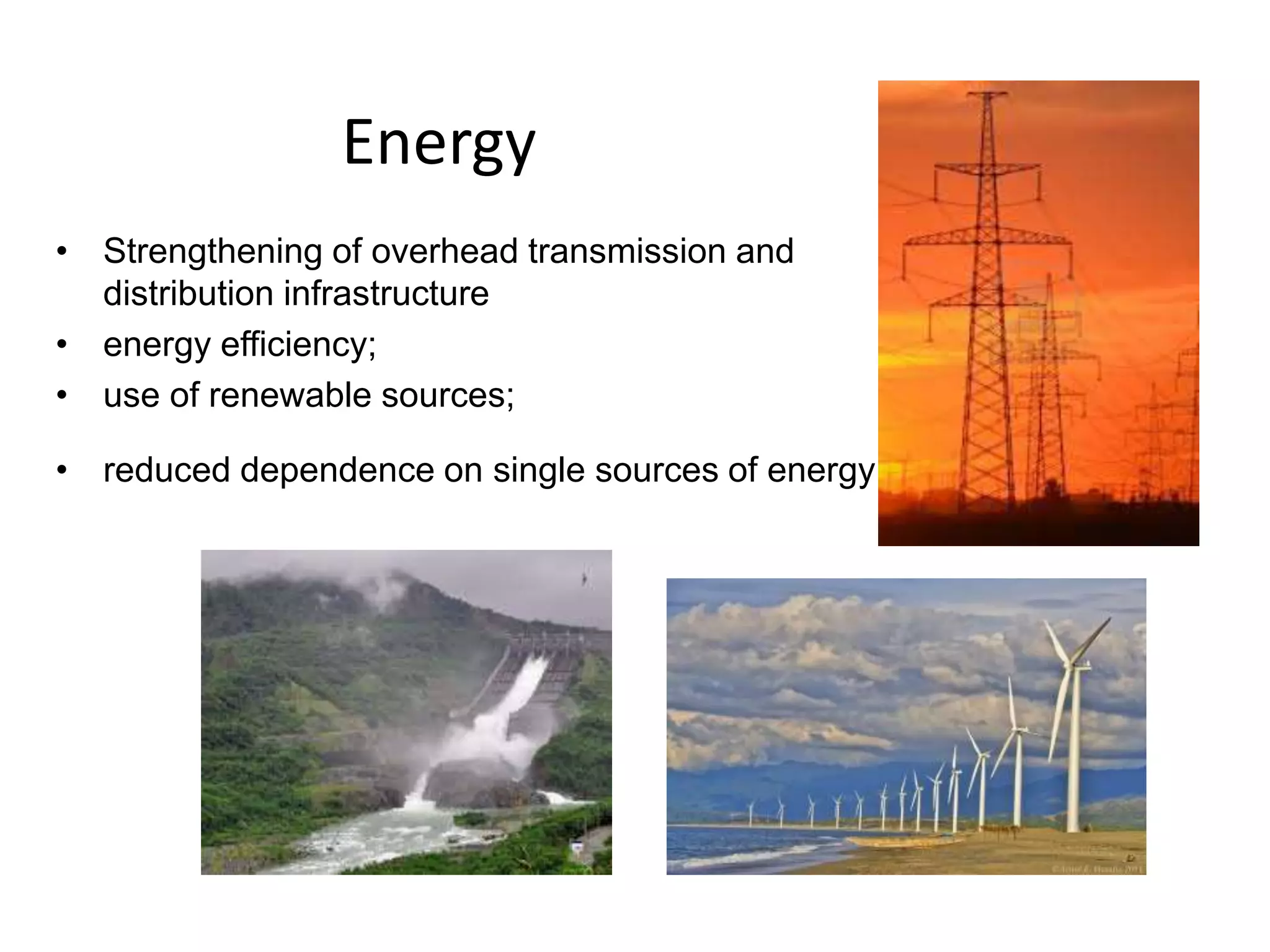
Energy
• Strengthening of overhead transmission and
distribution infrastructure
• energy efficiency;
• use of renewable sources;
• reduced dependence on single sources of energy
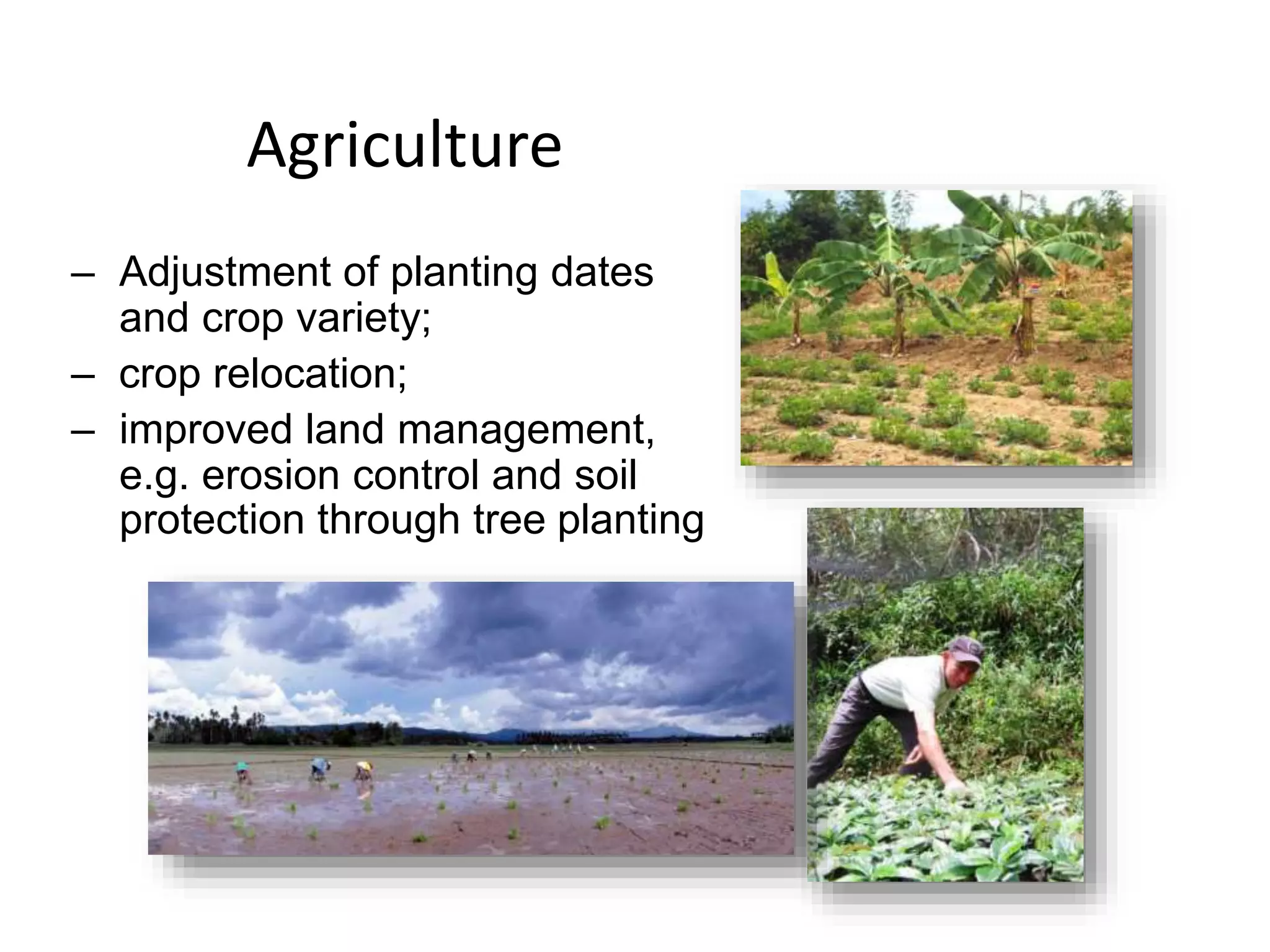
Agriculture
– Adjustment of planting dates
and crop variety;
– crop relocation;
– improved land management,
e.g. erosion control and soil
protection through tree planting
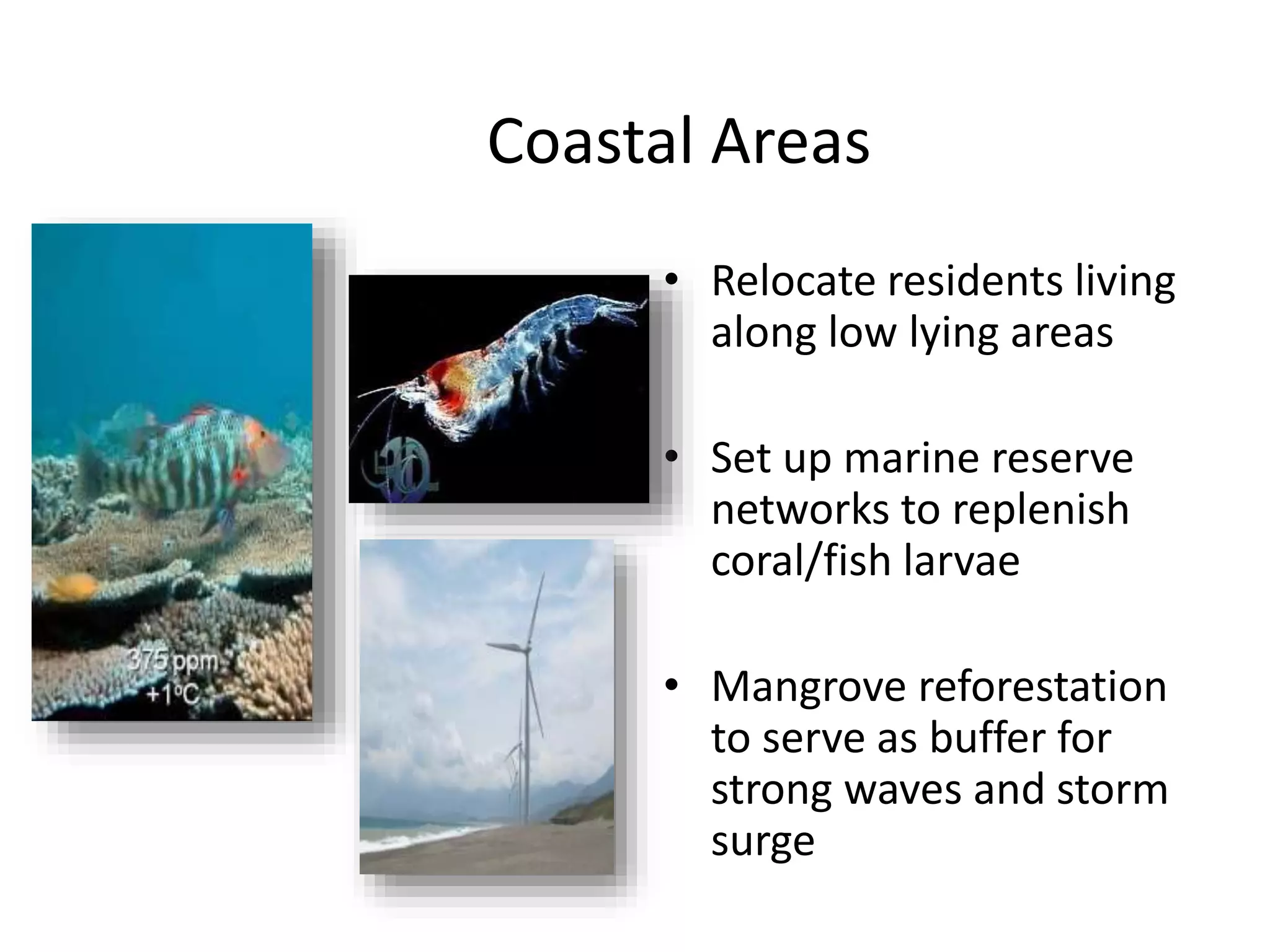
Coastal Areas
• Relocate residents living
along low lying areas
• Set up marine reserve
networks to replenish
coral/fish larvae
• Mangrove reforestation
to serve as buffer for
strong waves and storm
surge
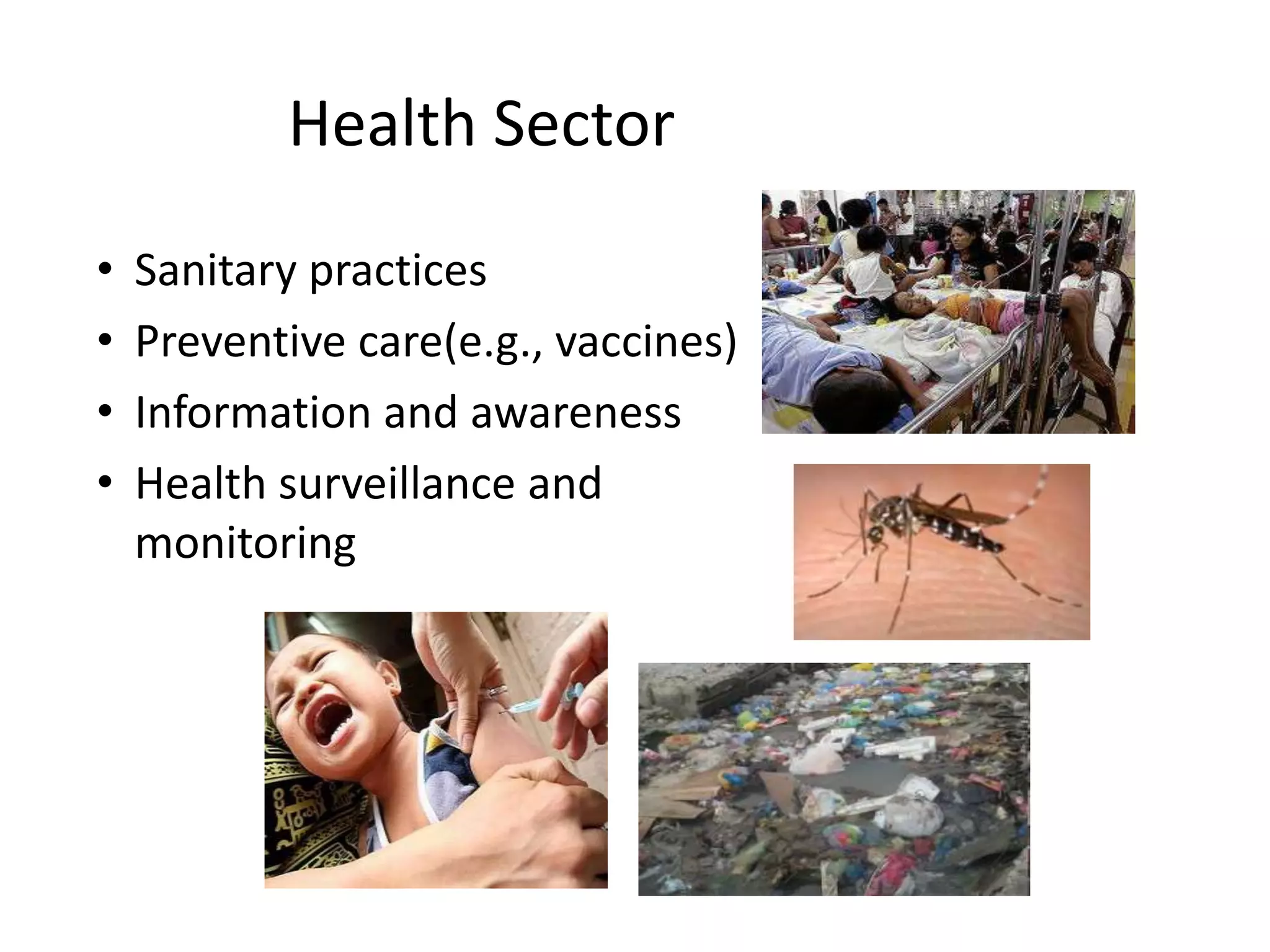
Health Sector
• Sanitary practices
• Preventive care(e.g., vaccines)
• Information and awareness
• Health surveillance and
monitoring
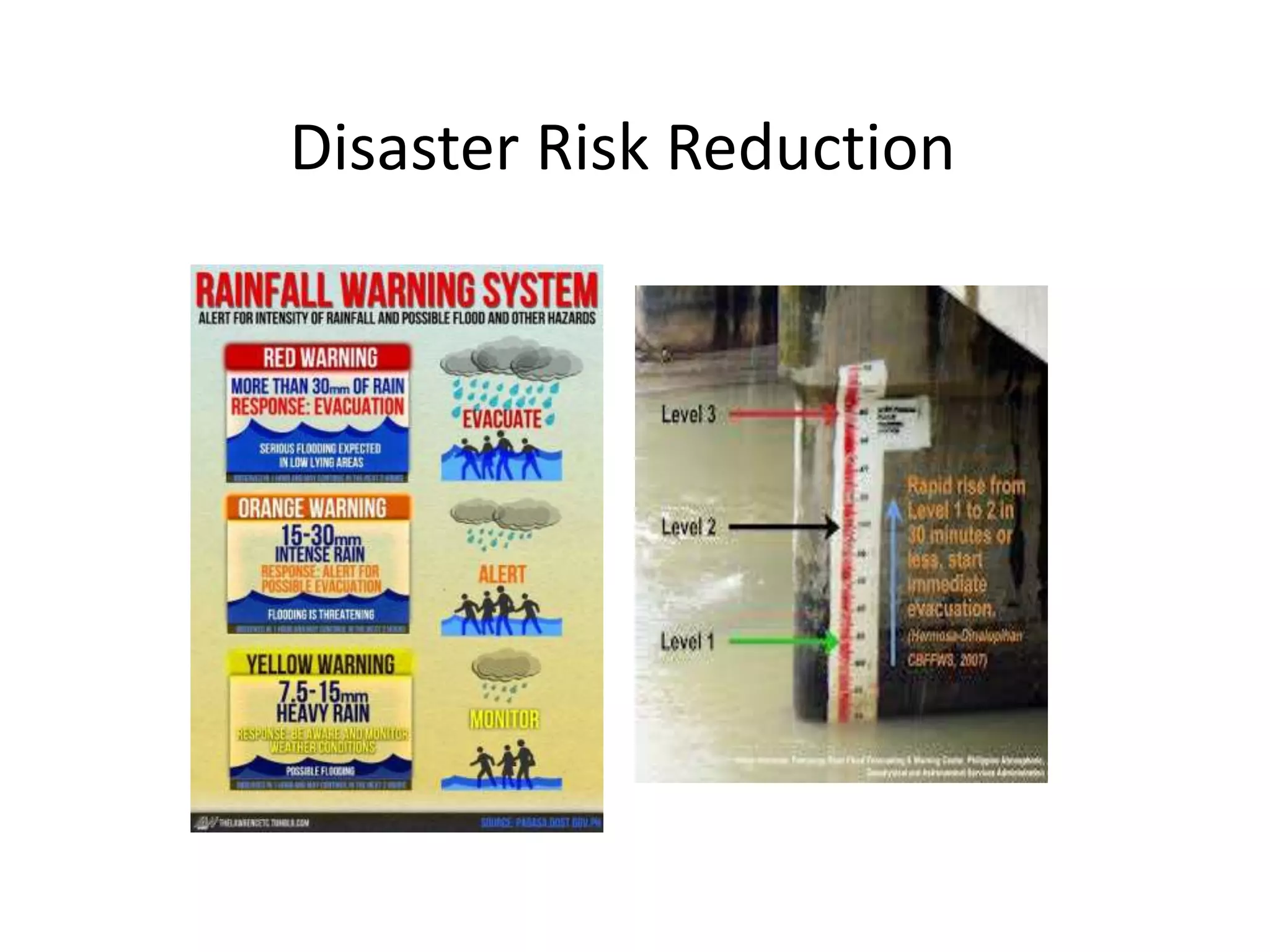
Disaster Risk Reduction
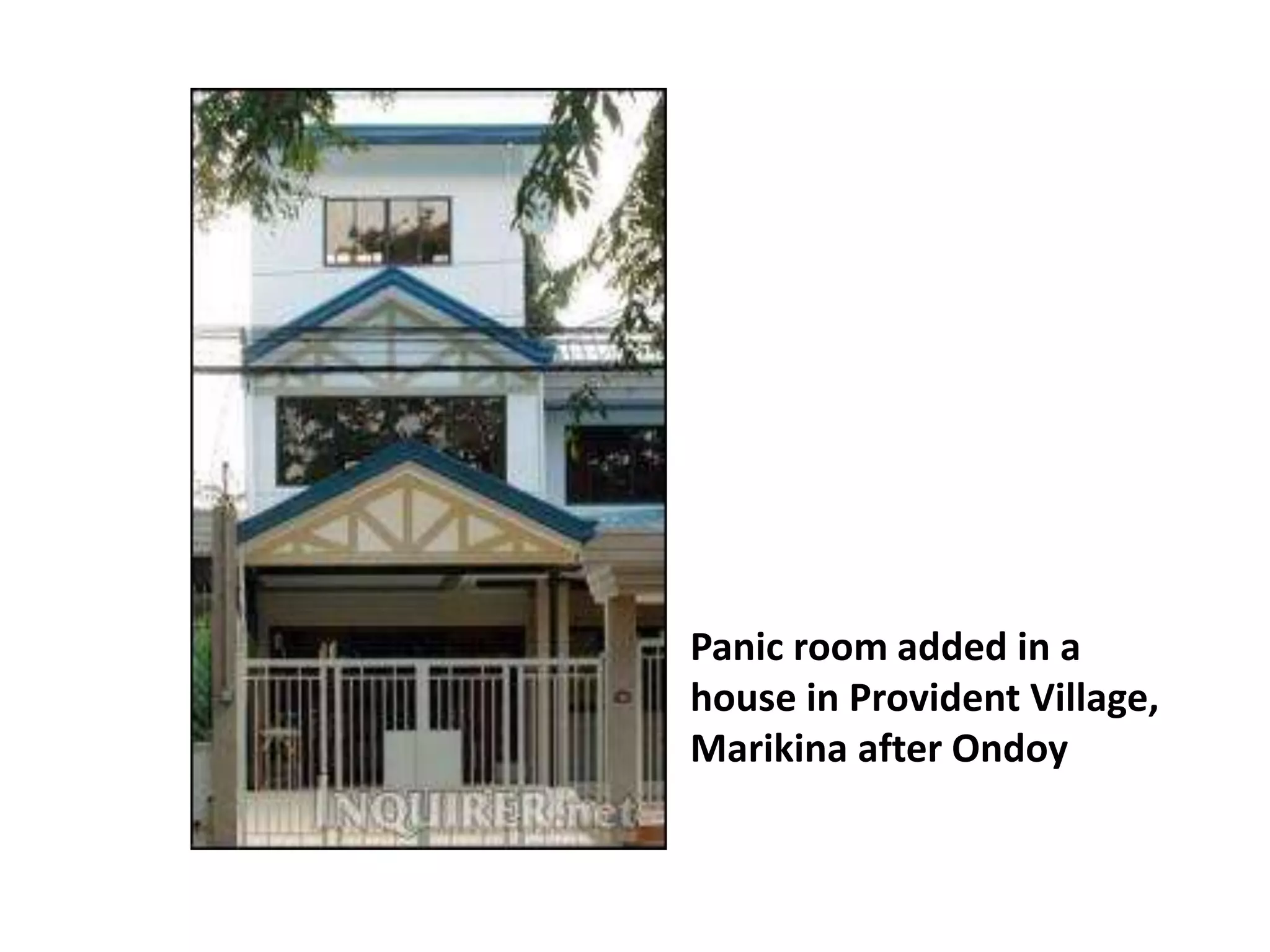
Panic room added in a
house in Provident Village,
Marikina after Ondoy
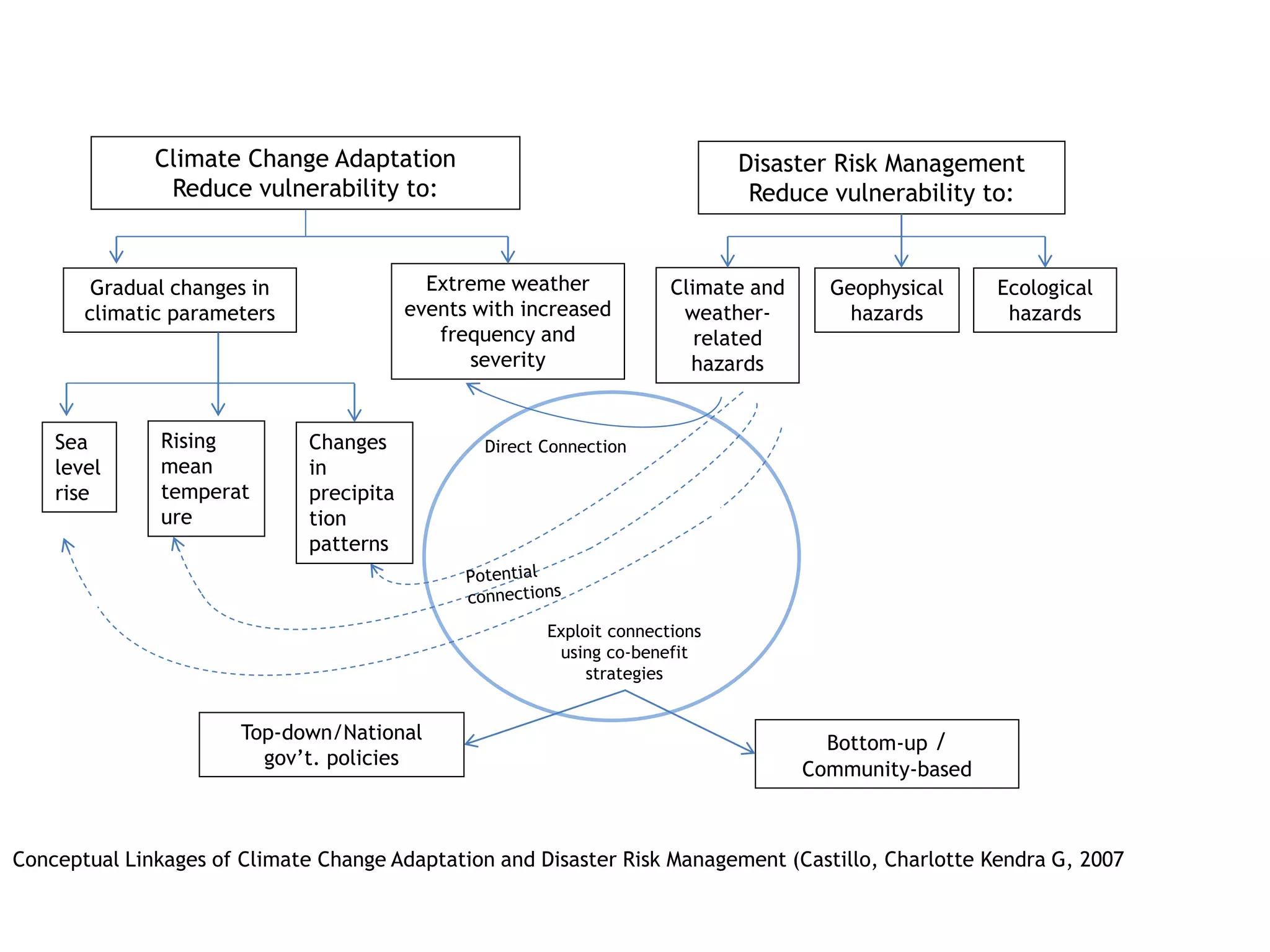
Climate Change Adaptation
Reduce vulnerability to:
Disaster Risk Management
Reduce vulnerability to:
Gradual changes in
climatic parameters
Geophysical
hazards
Extreme weather
events with increased
frequency and
severity
Ecological
hazards
Climate and
weather-
related
hazards
Sea
level
rise
Rising
mean
temperat
ure
Changes
in
precipita
tion
patterns
Top-down/National
gov’t. policies
Bottom-up /
Community-based
Direct Connection
Exploit connections
using co-benefit
strategies
Conceptual Linkages of Climate Change Adaptation and Disaster Risk Management (Castillo, Charlotte Kendra G, 2007
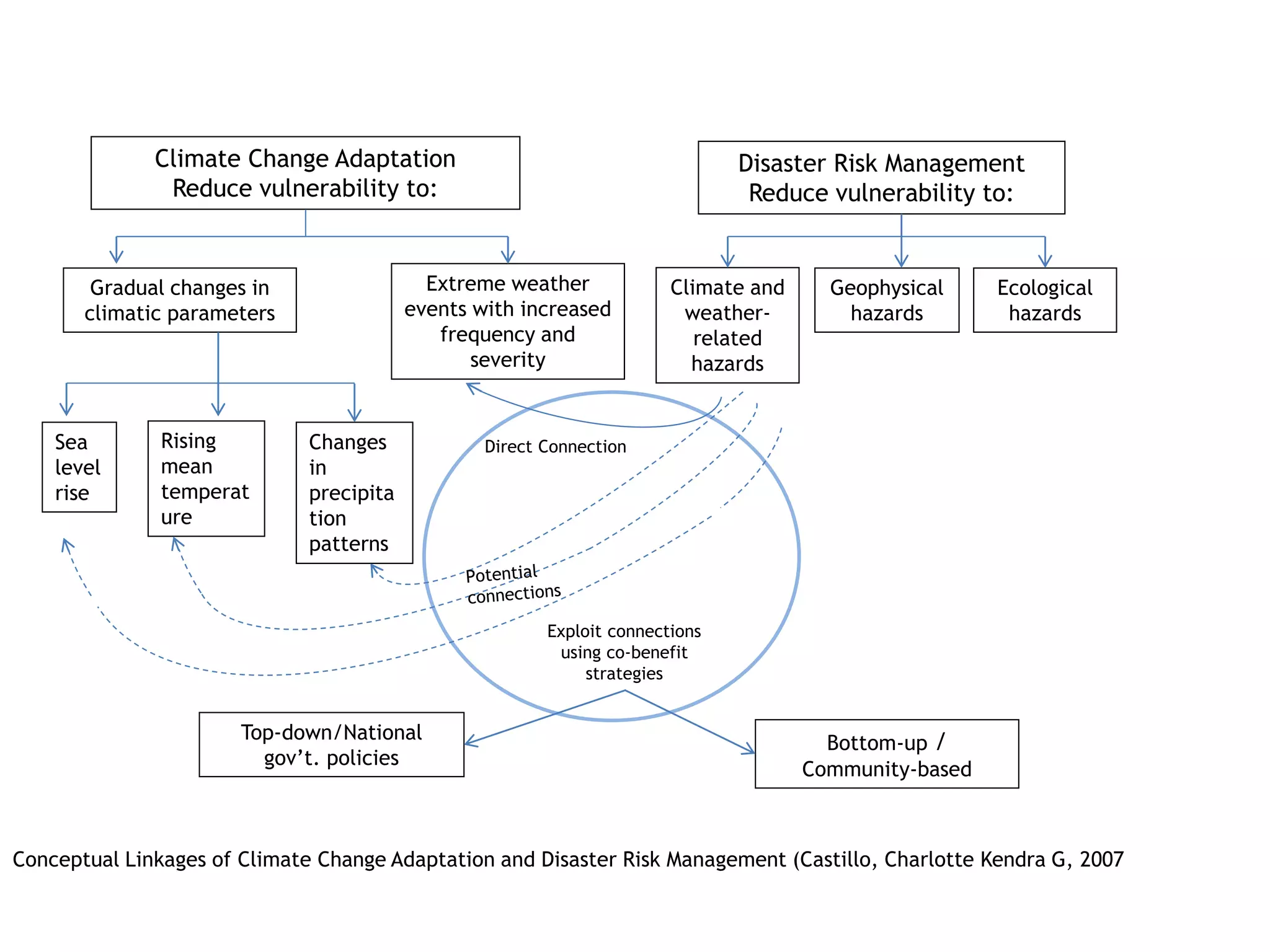
Climate Change Adaptation
Reduce vulnerability to:
Disaster Risk Management
Reduce vulnerability to:
Gradual changes in
climatic parameters
Geophysical
hazards
Extreme weather
events with increased
frequency and
severity
Ecological
hazards
Climate and
weather-
related
hazards
Sea
level
rise
Rising
mean
temperat
ure
Changes
in
precipita
tion
patterns
Top-down/National
gov’t. policies
Bottom-up /
Community-based
Direct Connection
Exploit connections
using co-benefit
strategies
Conceptual Linkages of Climate Change Adaptation and Disaster Risk Management (Castillo, Charlotte Kendra G, 2007
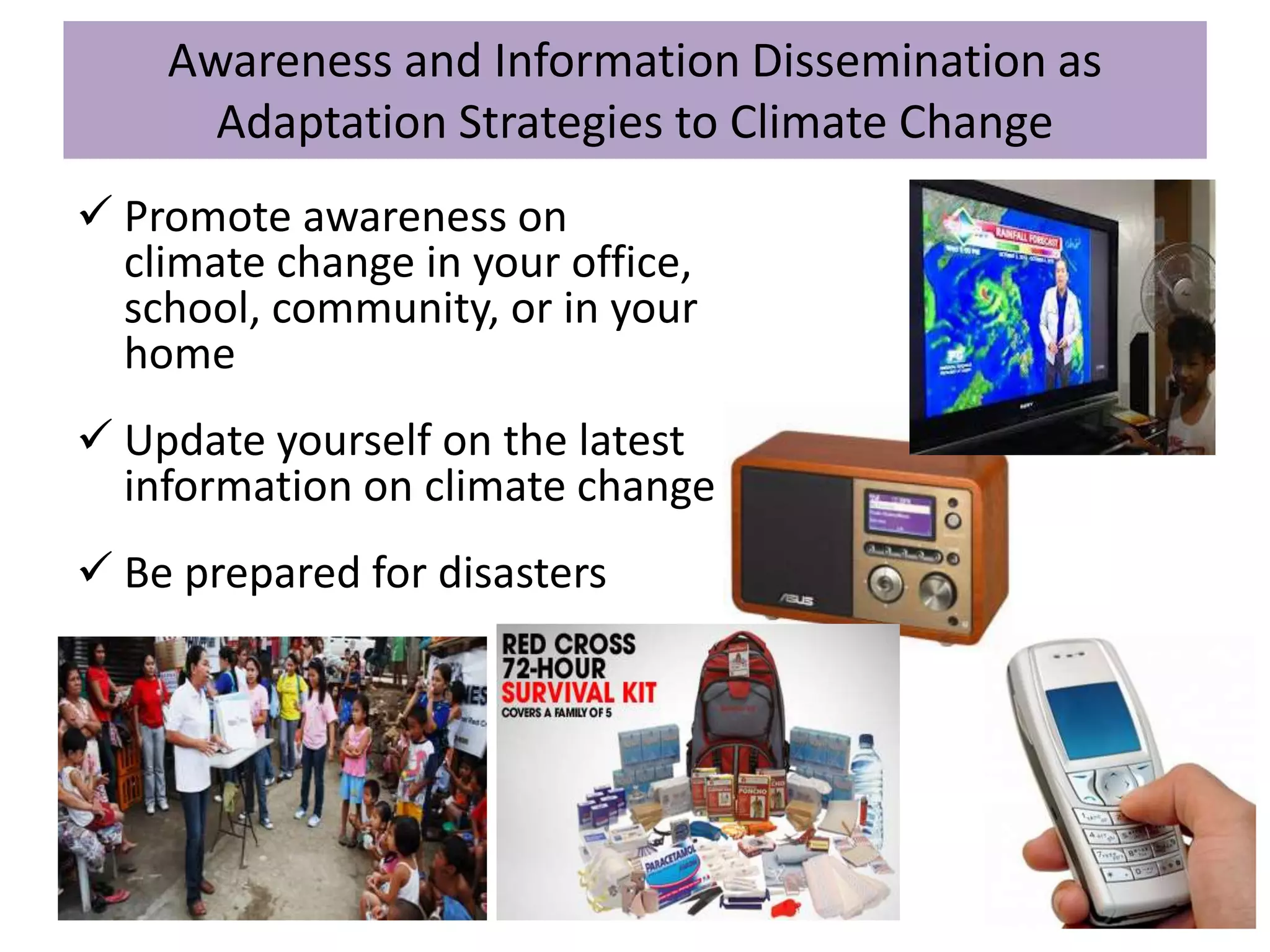
Awareness and Information Dissemination as
Adaptation Strategies to Climate Change
 Promote awareness on
climate change in your office,
school, community, or in your
home
 Update yourself on the latest
information on climate change
 Be prepared for disasters
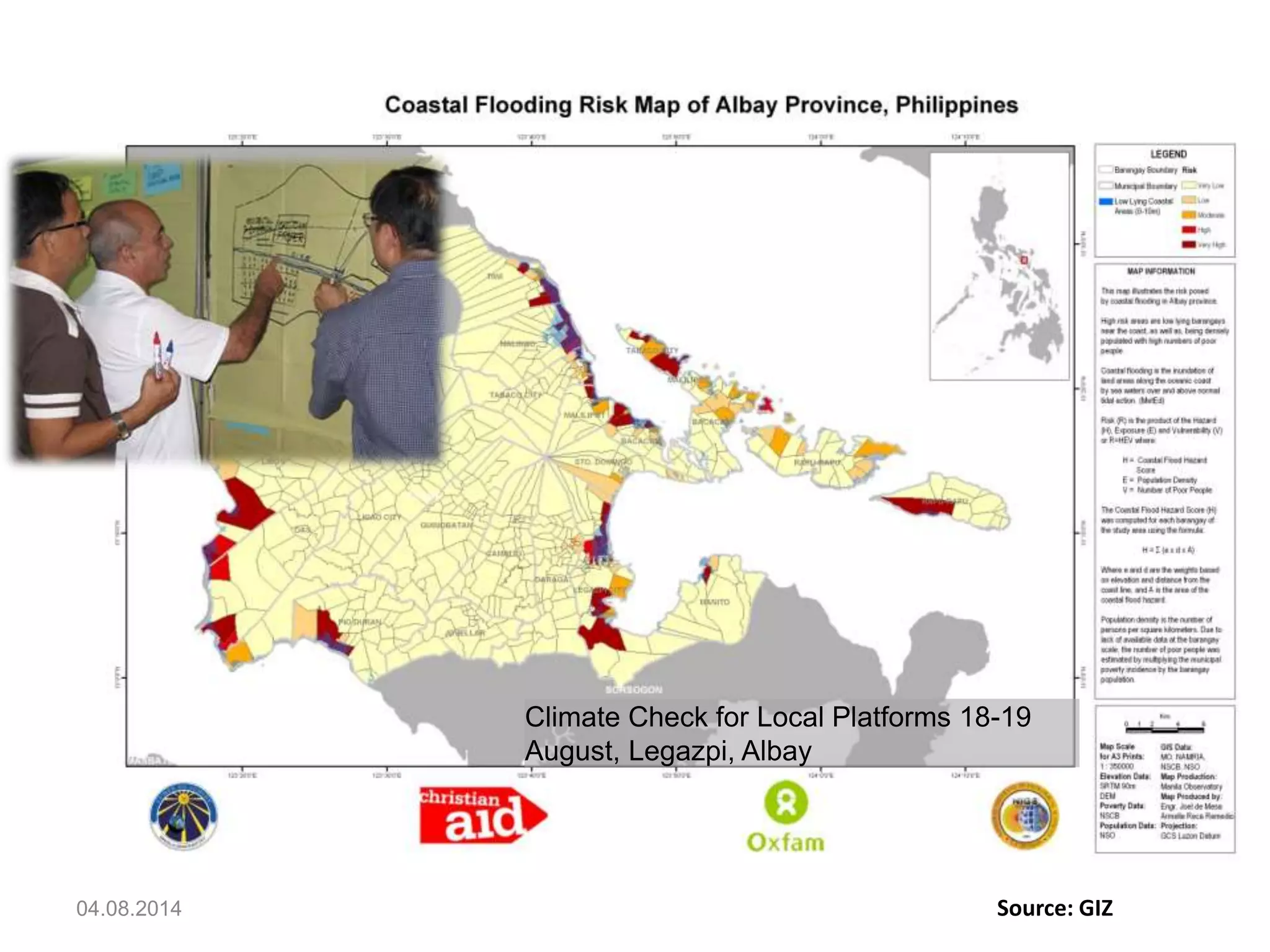
04.08.2014
Climate Check for Local Platforms 18-19
August, Legazpi, Albay
Source: GIZ
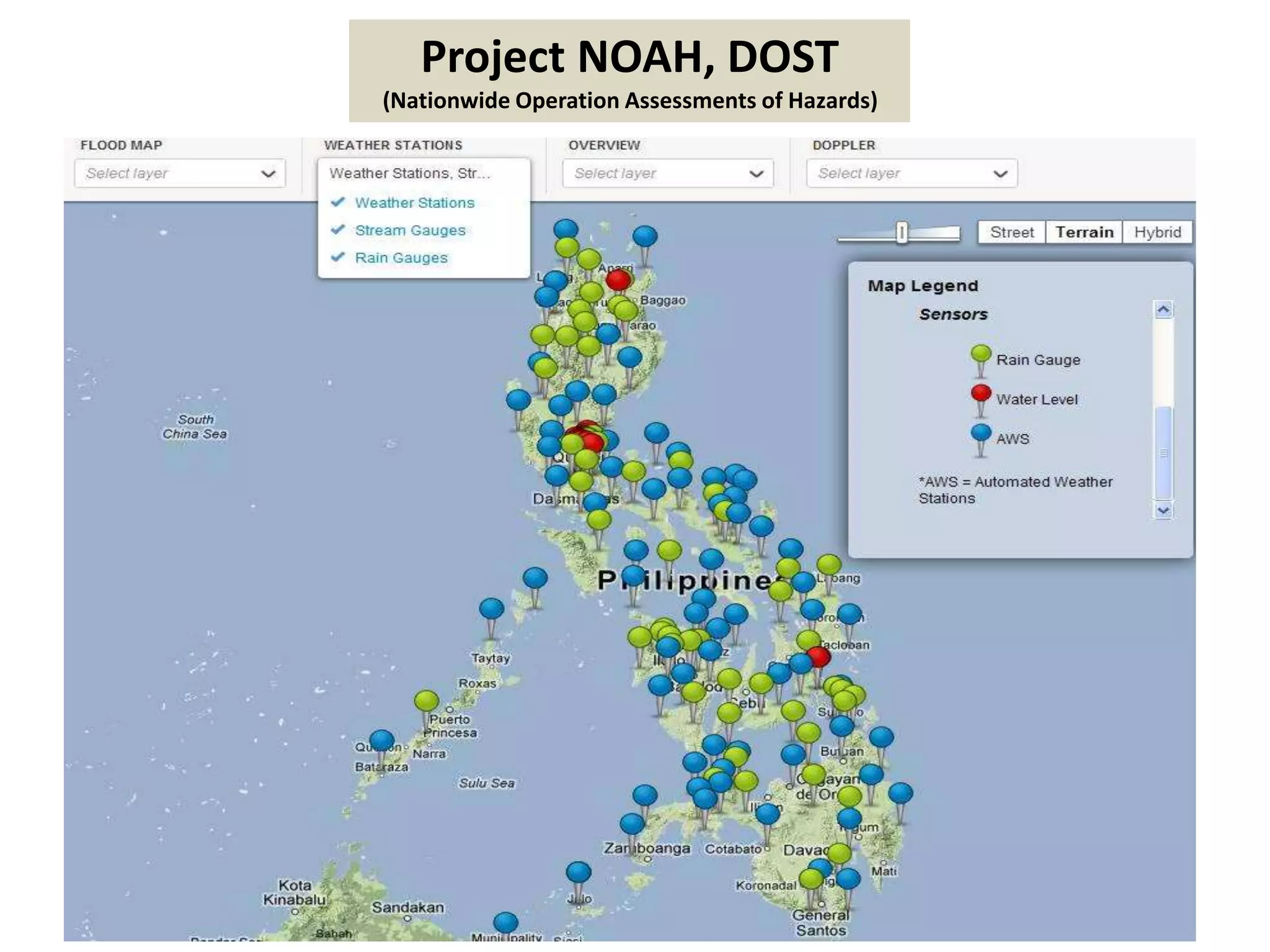
Project NOAH, DOST
(Nationwide Operation Assessments of Hazards)
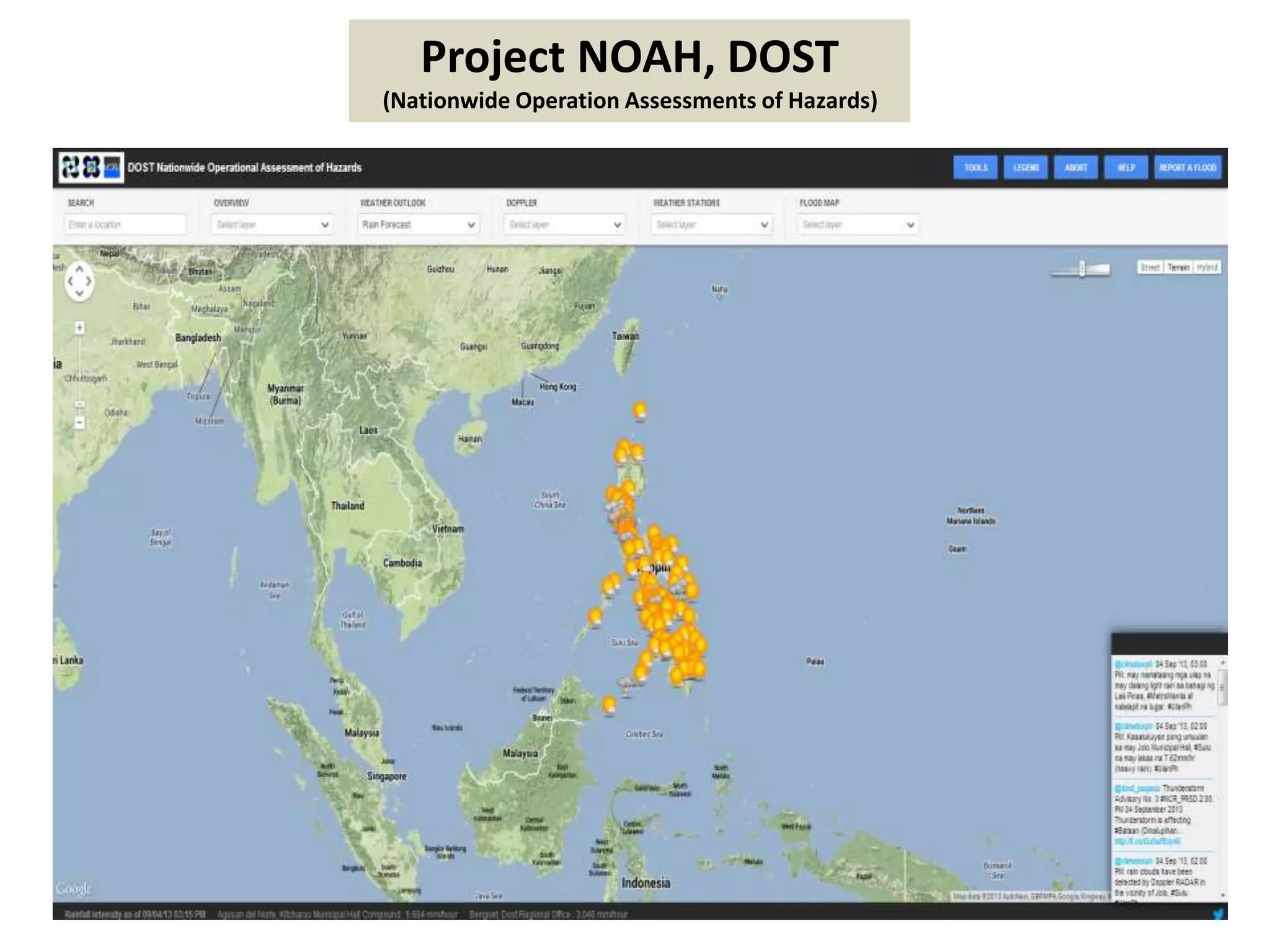
Project NOAH, DOST
(Nationwide Operation Assessments of Hazards)
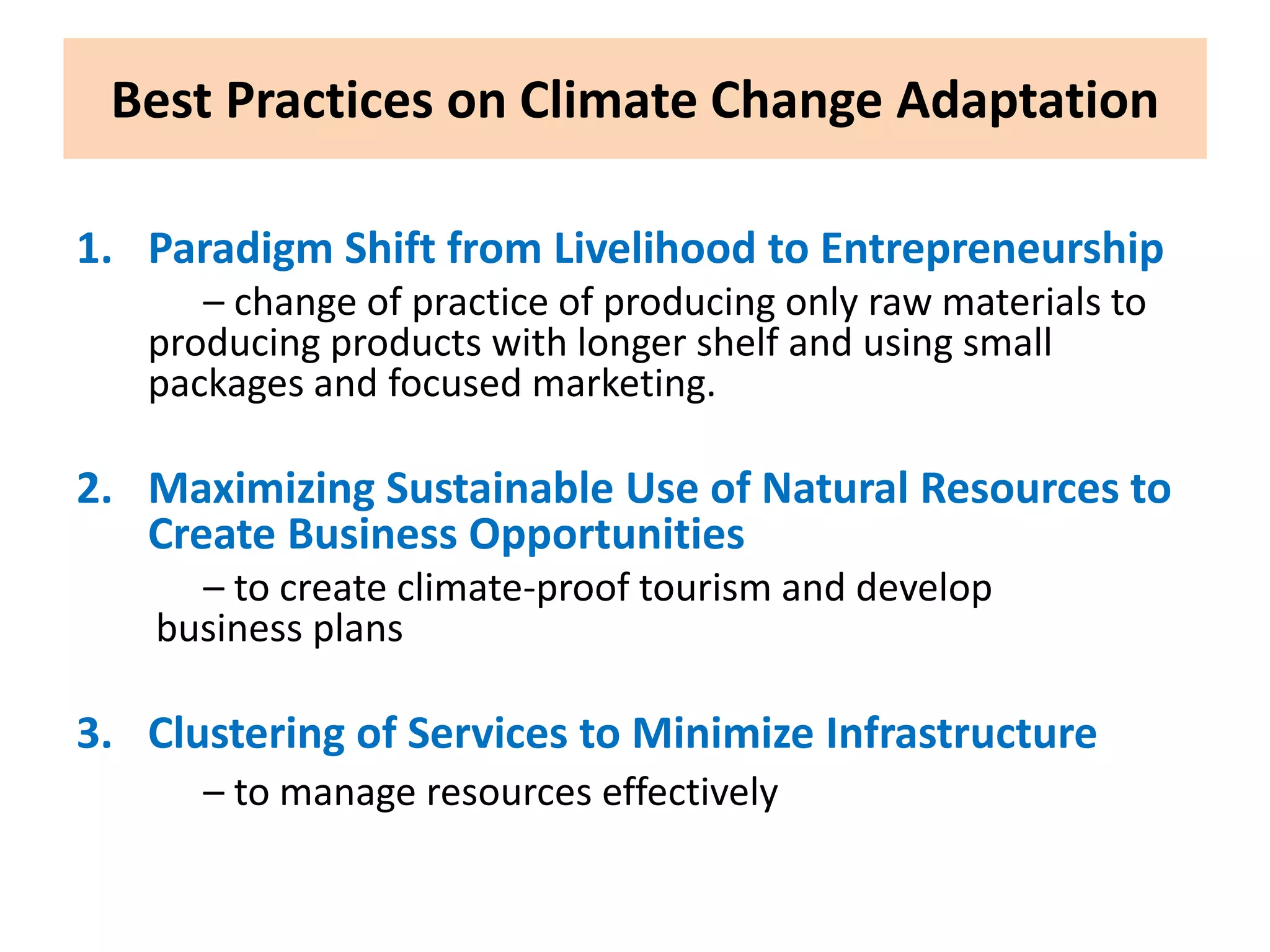
Best Practices on Climate Change Adaptation
1. Paradigm Shift from Livelihood to Entrepreneurship
– change of practice of producing only raw materials to
producing products with longer shelf and using small
packages and focused marketing.
2. Maximizing Sustainable Use of Natural Resources to
Create Business Opportunities
– to create climate-proof tourism and develop
business plans
3. Clustering of Services to Minimize Infrastructure
– to manage resources effectively
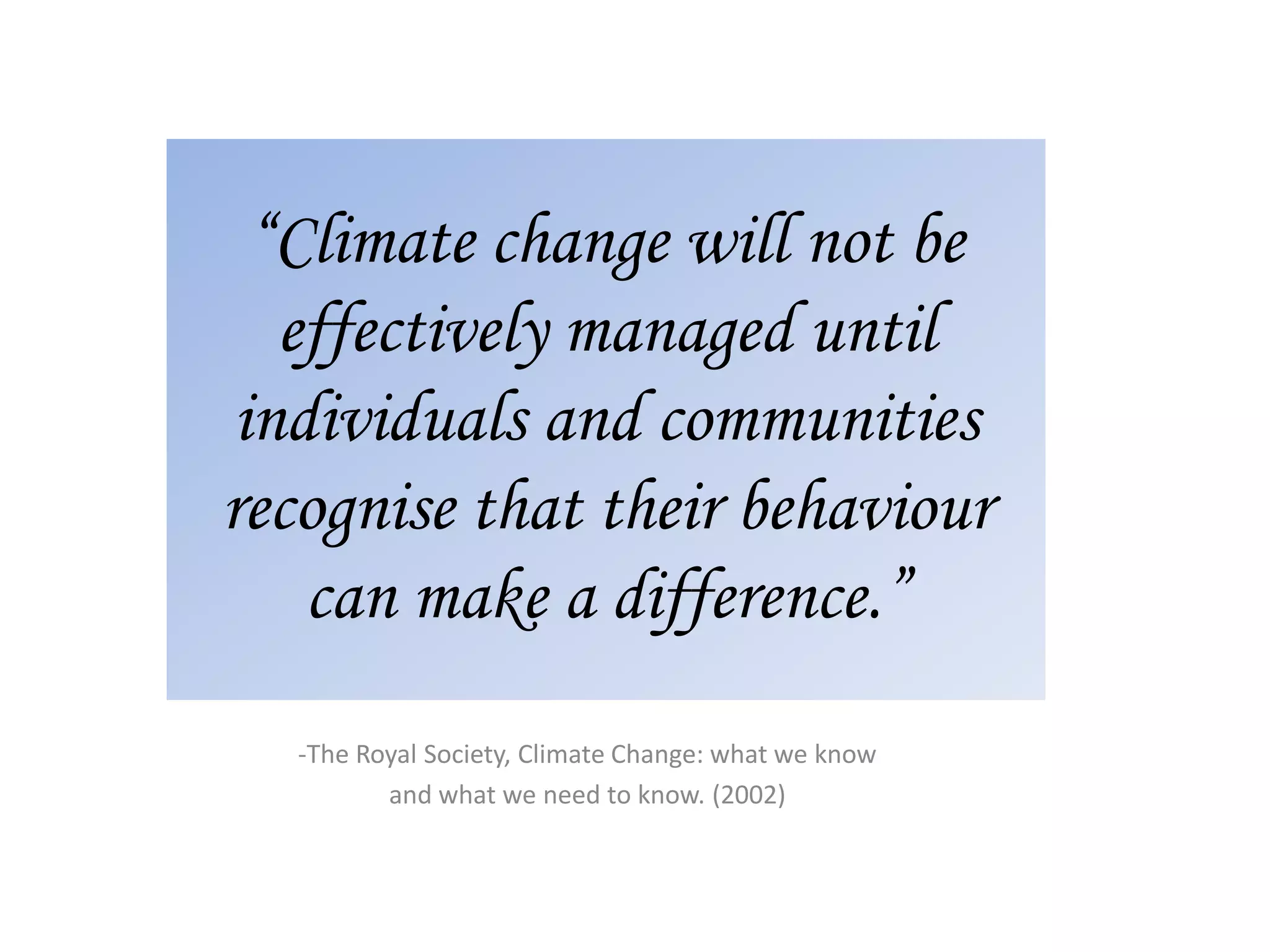
“Climate change will not be
effectively managed until
individuals and communities
recognise that their behaviour
can make a difference.”
-The Royal Society, Climate Change: what we know
and what we need to know. (2002)
Thank you
For your questions / queries:
Climate Change Office (CCO)
DNA - CDM Secretariat Office
Environmental Management Bureau
DENR Compound, Visayas Avenue, Diliman, Quezon City
Telefax: (+63-2) 920-2251; 928-4674
Website: www.emb.gov.ph; cdmdna.emb.gov.ph
gmerilo@yahoo.com

Cca phil setting pagba apr2014

  • 1.
    Climate Change Adaptation inthe Philippine Setting Ms. Ma. Gerarda Asuncion D. Merilo Climate Change Office Environmental Management Bureau Department of Environment and Natural Resources
  • 2.
    A recent reportby the Working Group 1 to the Fifth Assessment Report of the Intergovernmental Panel on Climate Change (IPCC-AR5)), a global group of experts on climate studies had recently been released in September 2013. “Warming of the climate system is unequivocal, and since the 1950s, many of the observed changes are unprecedented over decades to millenia. The atmosphere and ocean have warmed, the amounts of snow and ice have diminished, sea level has risen, and the concentrations of greenhouse gases have increased.” (IPCC-AR5 ) What is happening?
  • 3.
    Human influence onthe climate system is clear. This is evident from the increasing greenhouse gas concentrations in the atmosphere, positive radiative forcing, observed warming, and understanding of the climate system. Working Group 1 Contribution to the IPCC 5th Assessment Report Radiative forcing estimates in 2011 relative to 1750 IPCC AR5 WG1
  • 4.
    Working Group 1Contribution to the IPCC 5th Assessment Report The atmospheric concentrations of CO2, CH4 and N2O have increased to levels unprecedented in at the last 800,000 years. CO2 concentrations have increased by 40% since the pre- industrial times. The ocean has absorbed 30% of the emitted anthropogenic CO2, causing ocean acidification. Multiple observed indicators of a changing global carbon cycle
  • 5.
    The globally averagedcombined land and ocean surface temperature data show a warming of 0.85 [0.65 to 1.08°C over the period 1880-2012. The total increase between the average of the 1850-1900 period and the 2003-2012 period is 0.78 [0.72 to 0.85] °C. Working Group 1 Contribution to the IPCC 5th Assessment Report Observed globally averaged combined land and ocean surface temperature anomaly 1850-2012 IPCC AR5 WG1
  • 6.
     The rateof sea level rise since the mid-19th century has been larger then the mean rate during the previous two millennia. Over the period 1901 to 2010, global mean sea level rose by 0.19 [0.17 to .21] meters.  Sea level rise will occur mostly as a result of the thermal expansion of warming ocean waters, the influx of freshwater from melting glaciers and ice, and vertical movements of the land itself. IPCC AR5 Working Group 1 Global Mean Sea Level Rise Working Group 1 Contribution to the IPCC 5th Assessment Report
  • 8.
    ACCORDING TO THEUNITED NATIONS, VULNERABILITY TO CLIMATE CHANGE WILL BE GREATER IN DEVELOPING COUNTRIES, WHICH ARE LOCATED IN WARMER LATITUDES, LIKE THE PHILIPPINES.
  • 9.
    9 RP: Highly Vulnerable •humid equatorial climate, with an average of 20 tropical cyclones a year • other natural hazards: landslides; active volcanoes; earthquakes • forest cover decline rate: 2%/yr (INC) • poverty incidence: 33% of pop (2006) • major infectious diseases: – food/water-borne – vector-borne
  • 10.
    PHILIPPINE VULNERABILITIES TO GLOBALWARMING/ CLIMATE CHANGE HIGHLY SUSCEPTIBLE TO TYPHOONS – LOCATED WITHIN PACIFIC TYPHOON BELT AREA
  • 11.
    MOUNTAINOUS WITH STEEPSLOPES HIGHLY SUSCEPTIBLE TO LANDSLIDES, MUDSLIDES, ETC.
  • 12.
    HIGHLY SUSCEPTIBLE TOFLOODINGS AND INUNDATIONS • Archipelago, composed of low lying small islands • 70% of cities and municipalities are coastal areas • Highly susceptible to flooding and storm surges
  • 13.
    Low Agricultural Productivity Riceproduction will largely be affected because of changes in temperature and rainfall. For every 1°C increase in temperature, rice yields will decrease by 10%-15% (IRRI). This will directly threaten food security.
  • 14.
    HIGHLY SUSCEPTIBLE TOLOSS OF BIOLOGICAL RESOURCES ACCORDING TO UN, 20%-30% OF PLANT AND ANIMAL SPECIES MAY BECOME EXTINCT AS A RESULT OF CLIMATE CHANGE
  • 15.
    HIGHLY SUSCEPTIBLE TOILLNESSES PHILIPPINES AS A TROPICAL COUNTRY Water-borne and parasitic illnesses will become prevalent with climate change.
  • 16.
    Climate Trends andProjections for the Philippines (2020,2050 & 2100)
  • 17.
    17 Climate Trends y =0.0109x - 0.2423 -1.5 -1 -0.5 0 0.5 1 1.5 51 56 61 66 71 76 81 86 91 96 01 06 Year TemperatureAnomaly(°C) Anomaly 5 year running mean Linear (5 year running mean) •An increase of 0.62°C from 1951-2006 •From 1960-2003, significant increases in frequency of hot days and warm nights in many areas of the country have been noted while cool days and cool nights have been seen to be generally decreasing. Observed Mean Annual Mean Temperature Anomalies in the Philippines Period: 1951-2006 (departures from the 1961-1990 normal values) Tropical Cyclones •There is no significant trend in the number of cyclones forming in or entering the Philippine Area of Responsibility in the past 58 years (1948 – 2005) •The trend in the five year running average of tropical cyclones greater than 150 kph is on the rise and found to be more frequent during El Nino events Number of Extreme Typhoon (150 kph and above) Period: 1971-2006 0 2 4 6 8 10 12 1970 1974 1978 1982 1986 1990 1994 1998 2002 2006 Year FrequencyofTC Mean= 5.8 or 6 T.C.
  • 18.
    • From 1960-2003,there are already significant trends of increasing number of hot days and warm nights, but decreasing number of cold days and cool nights. Both maximum and minimum temperatures are generally getting warmer. • An increase of 0.62°C from 1951 to 2006 has been observed. • Extreme Rainfall Intensity (1951 – 2008) In most parts of the country, the intensity of rainfall is increasing with Baguio, Tacloban and Iloilo showing statistically significant increases • Frequency of Extreme Daily Rainfall (1951 – 2008) Most parts of the country are generally increasing. Calapan, Laoag, Iloilo and Tacloban show statistically a significant increasing trend, while a significantly decreasing trend is found in Palawan. What are the manifestations/signals of global warming in the country?
  • 19.
    Other extreme weather/climateevents like intense rains have been seen to be more frequent. Typhoon Sendong Source: 2012, Punongbayan, R. Mainstreaming DRR/CCA into cLUPs
  • 20.
    20 Changes in AnnualMean Temperature This shows the changes in mean annual temperature by region relative to the baseline period of 1970- 2000. The country’s average annual mean temperature is projected to increase by 0.9°C to 1.1°C for 2020 and 1.9°C – 2.2°C by 2050. Higher temperatures are generally expected for all regions of the country by 2050. Warming will be worst in Mindanao. Philippine Climate Change Projections: 2020 and 2050
  • 21.
    21 Changes in AnnualMean Rainfall The PRECIS simulation exercise projects a change in annual precipitation from -0.5 to 17.4% in 2020 and -2.4 to 16.4% in 2050. Increases in rainfall are particularly evident in most areas of Luzon and Visayas, while Mindanao is projected to undergo a drying trend. Average rainfall of Luzon and Visayas is expected to be 2 to 17% by 2020 and 1 to 16% by 2050. In contrast, there is a general reduction in regional annual average rainfall in Mindanao (~0.5 to 11% by 2020; 2 to 11% in 2050).
  • 22.
    22 Sea Level Rise •Sea level rise will increase the risk of flooding and storm damage. Projected impacts of 1 meter seal level rise in many areas of the country show vast portions being inundated, affecting coastal settlements and livelihood. • According to estimates of the National Mapping and Resource Information Authority (NAMRIA), a 1 meter sea level rise can translate to an estimated land loss of 129,114 hectares.
  • 23.
    Projected Change inannual mean temperature Medium-range Emission A1B Scenario Source: PAGASA
  • 24.
    Key Findings SEASON Medium-range Emission Scenario 20202050 Dec-Jan-Feb (DJF) 0.8 to 1.0 1.6 to 2.2 Mar-Apr-May (MAM) 0.9 to 1.3 2.0 to 2.5 Jun-Jul-Aug (JJA) 0.8 to 1.3 1.6 to 2.6 Sep-Oct-Nov (SON) 0.8 to 1.1 1.5 to 2.2 Projected Change in Seasonal Mean Temperature Source: PAGASA
  • 25.
    Dry seasons becoming drier. Wetseasons becoming wetter. Medium-range Emission Scenario 2020 2050 Dec-Jan-Feb (DJF) -0.4 to 54.3 % -0.1 to-25.1-% Mar-Apr-May (MAM) -0.2 to -33.3% -1.4 to -39.8% Jun-Jul-Aug (JJA) -0.4 to 43.1% -0.7 to 72.5% Sep-Oct-Nov (SON) -0.4 to 30.0% -0.5 to 39.0% Projected Change in Seasonal Mean Rainfall(%) Source: PAGASA
  • 26.
    Heavy daily rainfall (exceeding300mm) events will continue to increase in number in Luzon, Visayas & eastern sections of the country. Frequency of Extreme Rainfall Source: PAGASA
  • 27.
    hot temperatures (indicatedby the number of days with maximum temperature exceeding 35 °C) will continue to become more frequent. Frequency of Extreme Temperature Source: PAGASA
  • 28.
    Climate Map of the Philippines Source:Climate Change of the Philippines, NEDA – MDGF, Adapt Tayo
  • 29.
    Water Resources Climate Changeand Environmental Impacts Changes in temperature, weather patterns and sea level rise Agriculture Forests/ Biodiversity Coastal/Marine Ecosystem Human Health Industry and Energy • Added heat stress, shifting monsoons, drier soils, water shortages/ irrigation demands • Decreased rice/crop production • Impact on livestock production • Occurrence of weed infestation & diseases • Coastal erosion • Storm surges • Coastal flooding • Saltwater intrusion • Coral bleaching • Ocean acidification • Increase in vector-borne diseases • Increase in cardio-vascular illnesses • Increase in upper respiratory illnesses • Occurrence of infectious diseases • Impact on hydrological cycle, changing evaporation, precipitation and runoff patterns which could affect water resources (freshwater quantity and quality) • Impact on power generation • Shift in feeding point and disruption in flight patterns for migratory birds. • Extinction of some mountain plants and animals • Changes in species distribution, composition • Invasion of weeds and alien species • Loss and migration of plant and animal species • Changes in energy supply and demand • Impact on energy infrastructure • Impact on industries such as wine, tourism, livestock, fishing, insurance, holiday resorts, mining, and others
  • 30.
    The starting point forWWF’s analysis was the strong scientific consensus that any human-induced warming greater than two degrees Celsius above pre-industrial levels would have a dangerous and highly damaging impact on both human societies and their economies and the global environment as a whole. 2ºC Peak 475 ppm
  • 32.
    1°C 2°C 5°C4°C3°C Sealevel rise threatens major cities Falling crop yields in many areas, particularly developing regions Food Water Ecosystems Risk of Abrupt and Major Irreversible Changes 0°C Falling yields in many developed regions Rising number of species face extinction Increasing risk of dangerous feedbacks and abrupt, large-scale shifts in the climate system Significant decreases in water availability in many areas, including Mediterranean and Southern Africa Small mountain glaciers disappear – water supplies threatened in several areas Extensive Damage to Coral Reefs Extreme Weather EventsRising intensity of storms, forest fires, droughts, flooding and heat waves Possible rising yields in some high latitude regions Above +2ºC impacts will be large Source: PAGASA
  • 33.
    Key Impacts asa function of increasing global average temperature change (Impacts will vary by extent of adaptation, rate of temperature change and socio-economic pathway) Source: IPCC-FAR Source: IPCC-FAR
  • 34.
    1998 2001 20032004 2006 2008 2009 2010 2011 2012 TOTAL Damages (in pesos) 36.9 B 25.79 B 11.50 B 38.25 B 18.19 B 12.05 B 8.02 B 3.23 B 3.24 B 12.78 B 169.95 B Casualties 303 236 64 995 947 618 929 31 1,490 1,067 6,680 Adverse Effects of Climate-Related Disasters , 1998-2012
  • 35.
    Disasters and Assistanceto Affected Persons
  • 36.
    What can wedo? • Limit the cause of climate change through measures that could slow down the build up of atmospheric GHGs concentrations by reducing current and future emissions and by increasing GHG sinks (Mitigation) • Adjustment in natural or human systems in response to actual or expected climatic stimuli or their effects, which moderates harm or exploits beneficial opportunities (Adaptation) Increase the resilience and coping capacity of the sector with the current and future changes
  • 37.
     Adjustment innatural or human systems in response to actual or expected climatic stimuli or their effects, which moderates harm or exploits beneficial opportunities (IPCC-FAR)  Practical steps to protect countries and communities from the likely disruption and damage that will result from effects of climate change. For example, flood walls should be built and in numerous cases it is probably advisable to move human settlements out of flood plains and other low-lying areas…” (Website of the UNFCCC Secretariat)  Is a process by which strategies to moderate, cope with and take advantage of the consequences of climatic events are enhanced, developed, and implemented. (UNDP, 2005)  The process or outcome of a process that leads to a reduction in harm or risk of harm, or realisation of benefits associated with climate variability and climate change. (UK Climate Impact Programme (UKCIP, 2003) Source: OECD, Adaptation to Climate Change: Key Terms, 2006 What is adaptation?
  • 38.
     Climate changehas the potential to push developing countries back into the poverty trap and to undo many achievements that have been made to date with regard to the Millennium Development Goals (MDGs).  Even an immediate and dramatic cut in global greenhouse gas emissions would not fully prevent climate change impacts.  The most vulnerable ecological and socio-economic systems are those with the greatest sensitivity to climate change and the least ability to adapt.  Ecosystems that are already under stress are particularly vulnerable.  Social and economic systems tend to be more vulnerable in developing countries with weaker economies and institutions. Why do we need to adapt?
  • 39.
    Types of Adaptation Various types of adaptation exist, e.g. anticipatory and reactive, private and public, and autonomous and planned.  Anticipatory adaptation (proactive) – takes places before impacts of climate change are observed.  Autonomous adaptation (spontaneous) – does not constitute a conscious response to climate stimuli but is triggered by ecological changes in natural systems and by market or welfare changes in human systems.  Planned adaptation – is a result of a deliberate policy decision, based on awareness that conditions have changed or are about to change and that action is required to return to, maintain, or achieve a desired state.
  • 40.
    Current and PotentialOptions for Adapting to Climate Change in Vulnerable Sectors (IPCC-FAR)
  • 41.
    Examples of currentand potential options for adapting to climate change for vulnerable sectors
  • 42.
    Examples of currentand potential options for adapting to climate change for vulnerable sectors
  • 43.
  • 44.
    Water Sector • Expandedrainwater harvesting • water storage and conservation techniques • water re-use desalination; • water-use and irrigation efficiency
  • 45.
    • Maintaining andrestoring native ecosystems • Protecting and enhancing ecosystem services • Managing habitats for endangered species • Creating refuges and buffer zones • Establishing networks of terrestrial, freshwater and marine protected areas that take into account projected changes in climate. Source: UNEP, Convention on Biological Diversity. Biodiversity and Climate Change Biodiversity/Forestry Sector
  • 46.
    Energy • Strengthening ofoverhead transmission and distribution infrastructure • energy efficiency; • use of renewable sources; • reduced dependence on single sources of energy
  • 47.
    Agriculture – Adjustment ofplanting dates and crop variety; – crop relocation; – improved land management, e.g. erosion control and soil protection through tree planting
  • 48.
    Coastal Areas • Relocateresidents living along low lying areas • Set up marine reserve networks to replenish coral/fish larvae • Mangrove reforestation to serve as buffer for strong waves and storm surge
  • 49.
    Health Sector • Sanitarypractices • Preventive care(e.g., vaccines) • Information and awareness • Health surveillance and monitoring
  • 50.
  • 51.
    Panic room addedin a house in Provident Village, Marikina after Ondoy
  • 52.
    Climate Change Adaptation Reducevulnerability to: Disaster Risk Management Reduce vulnerability to: Gradual changes in climatic parameters Geophysical hazards Extreme weather events with increased frequency and severity Ecological hazards Climate and weather- related hazards Sea level rise Rising mean temperat ure Changes in precipita tion patterns Top-down/National gov’t. policies Bottom-up / Community-based Direct Connection Exploit connections using co-benefit strategies Conceptual Linkages of Climate Change Adaptation and Disaster Risk Management (Castillo, Charlotte Kendra G, 2007
  • 53.
    Climate Change Adaptation Reducevulnerability to: Disaster Risk Management Reduce vulnerability to: Gradual changes in climatic parameters Geophysical hazards Extreme weather events with increased frequency and severity Ecological hazards Climate and weather- related hazards Sea level rise Rising mean temperat ure Changes in precipita tion patterns Top-down/National gov’t. policies Bottom-up / Community-based Direct Connection Exploit connections using co-benefit strategies Conceptual Linkages of Climate Change Adaptation and Disaster Risk Management (Castillo, Charlotte Kendra G, 2007
  • 54.
    Awareness and InformationDissemination as Adaptation Strategies to Climate Change  Promote awareness on climate change in your office, school, community, or in your home  Update yourself on the latest information on climate change  Be prepared for disasters
  • 55.
    04.08.2014 Climate Check forLocal Platforms 18-19 August, Legazpi, Albay Source: GIZ
  • 56.
    Project NOAH, DOST (NationwideOperation Assessments of Hazards)
  • 57.
    Project NOAH, DOST (NationwideOperation Assessments of Hazards)
  • 58.
    Best Practices onClimate Change Adaptation 1. Paradigm Shift from Livelihood to Entrepreneurship – change of practice of producing only raw materials to producing products with longer shelf and using small packages and focused marketing. 2. Maximizing Sustainable Use of Natural Resources to Create Business Opportunities – to create climate-proof tourism and develop business plans 3. Clustering of Services to Minimize Infrastructure – to manage resources effectively
  • 59.
    “Climate change willnot be effectively managed until individuals and communities recognise that their behaviour can make a difference.” -The Royal Society, Climate Change: what we know and what we need to know. (2002)
  • 60.
    Thank you For yourquestions / queries: Climate Change Office (CCO) DNA - CDM Secretariat Office Environmental Management Bureau DENR Compound, Visayas Avenue, Diliman, Quezon City Telefax: (+63-2) 920-2251; 928-4674 Website: www.emb.gov.ph; cdmdna.emb.gov.ph gmerilo@yahoo.com