Kabul University
Engineering Faculty
Mechanical Engineering department
Prepared by
Ahmad Nasher Sarwary
March 2020
Overview and study of Smart Actuators
Engineering Faculty of kabul university, Afghanistan
Table of contents
 What are actuators?
 Types of actuators
 What are smart actuators?
 Components of Smart actuators
 Smart actuators working mechanism
 Application of smart actuators
 Advantages and disadvantages
 Conclusion
Engineering Faculty of kabul university, Afghanistan
What are actuators?
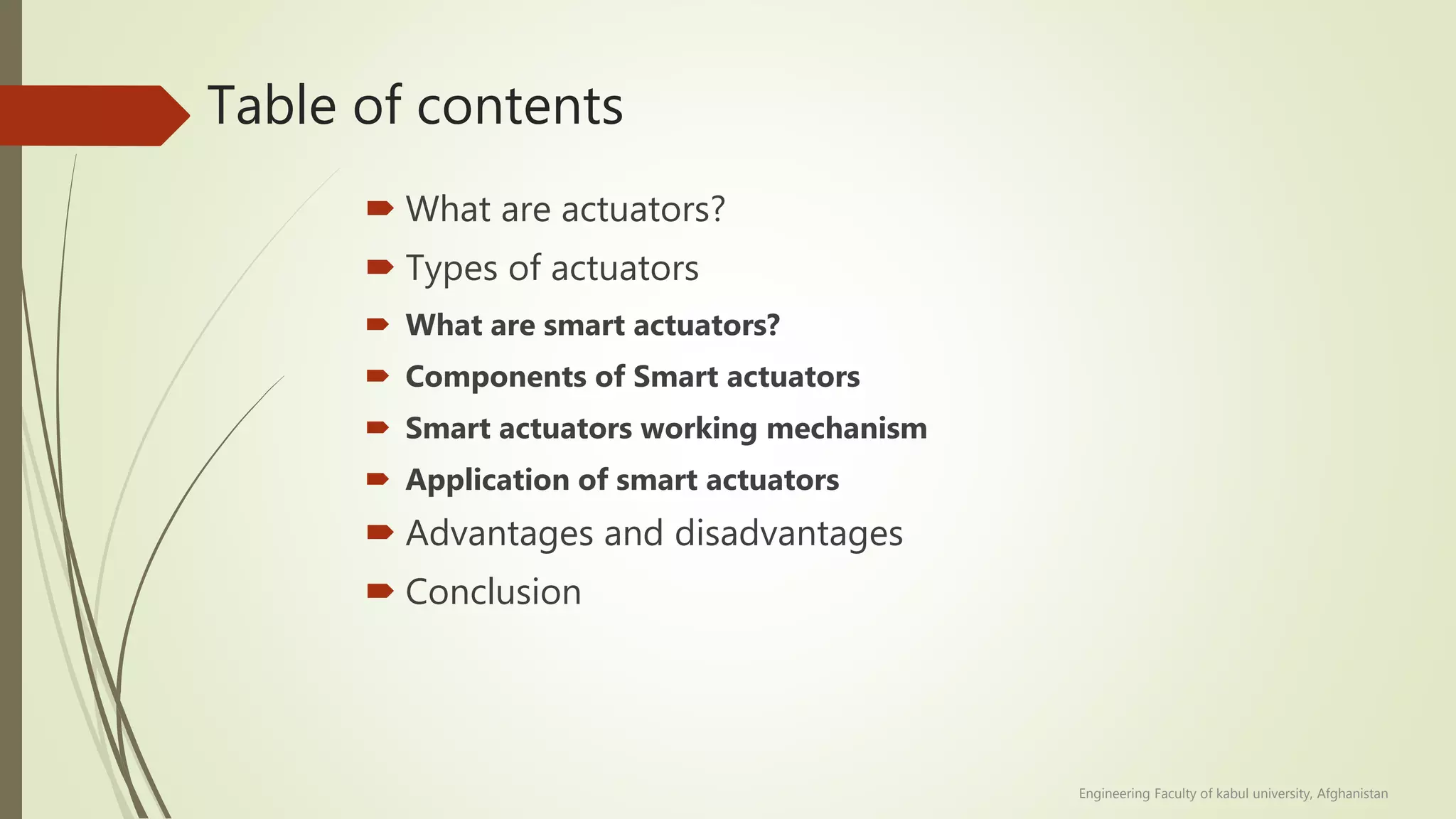
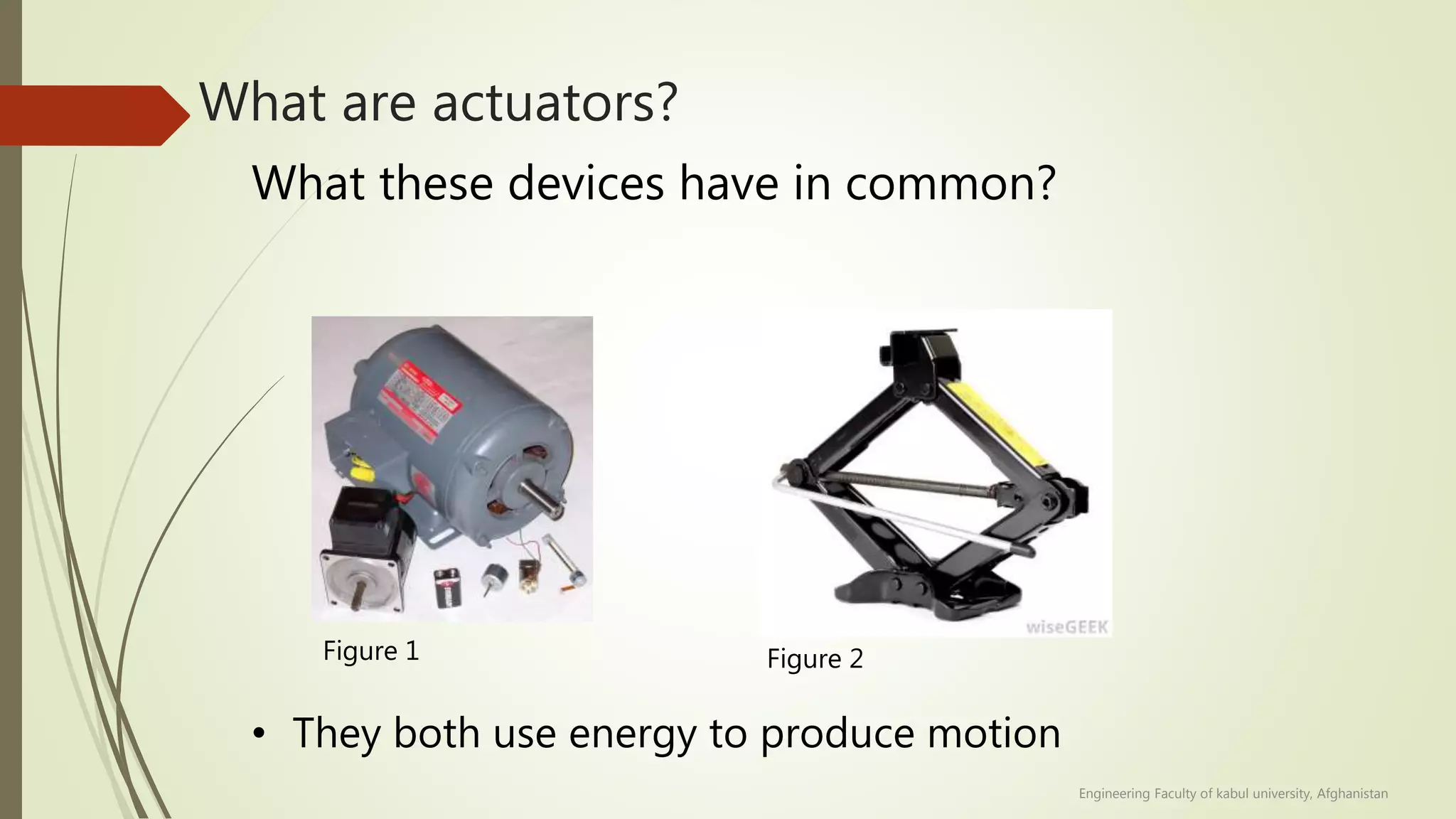
What these devices have in common?
• They both use energy to produce motion
Figure 1 Figure 2
Engineering Faculty of kabul university, Afghanistan
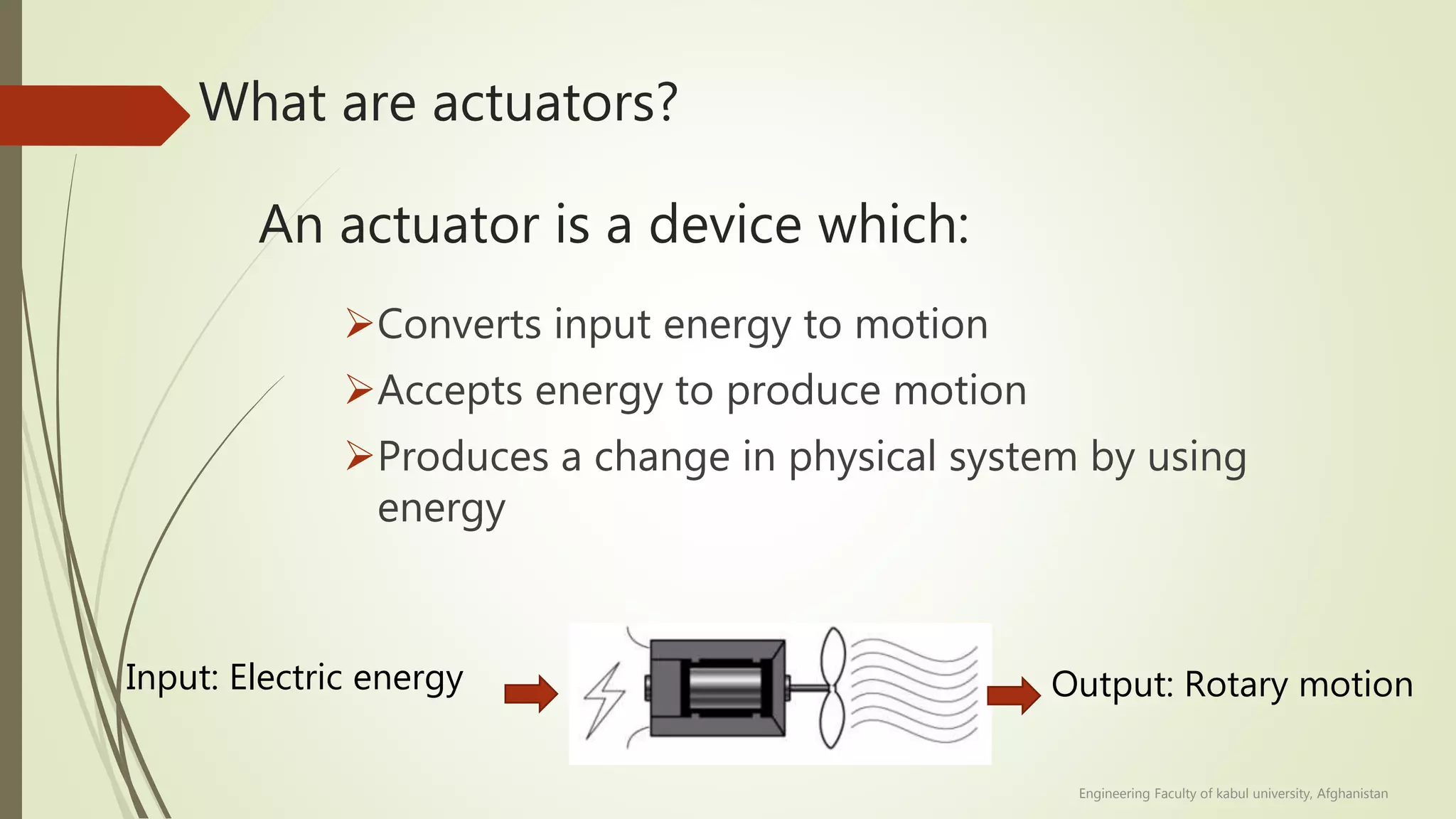
An actuator is a device which:
Converts input energy to motion
Accepts energy to produce motion
Produces a change in physical system by using
energy
What are actuators?
Input: Electric energy Output: Rotary motion
Engineering Faculty of kabul university, Afghanistan
Types of actuators
According to input energy:
Mechanical ( screw jacks, bimetals, Pneumatic tank)
Electrical ( motor, diodes, transistors )
According to control:
Manually controlled actuators ( ceiling fans )
Smart Actuators (self controlled)…
Engineering Faculty of kabul university, Afghanistan
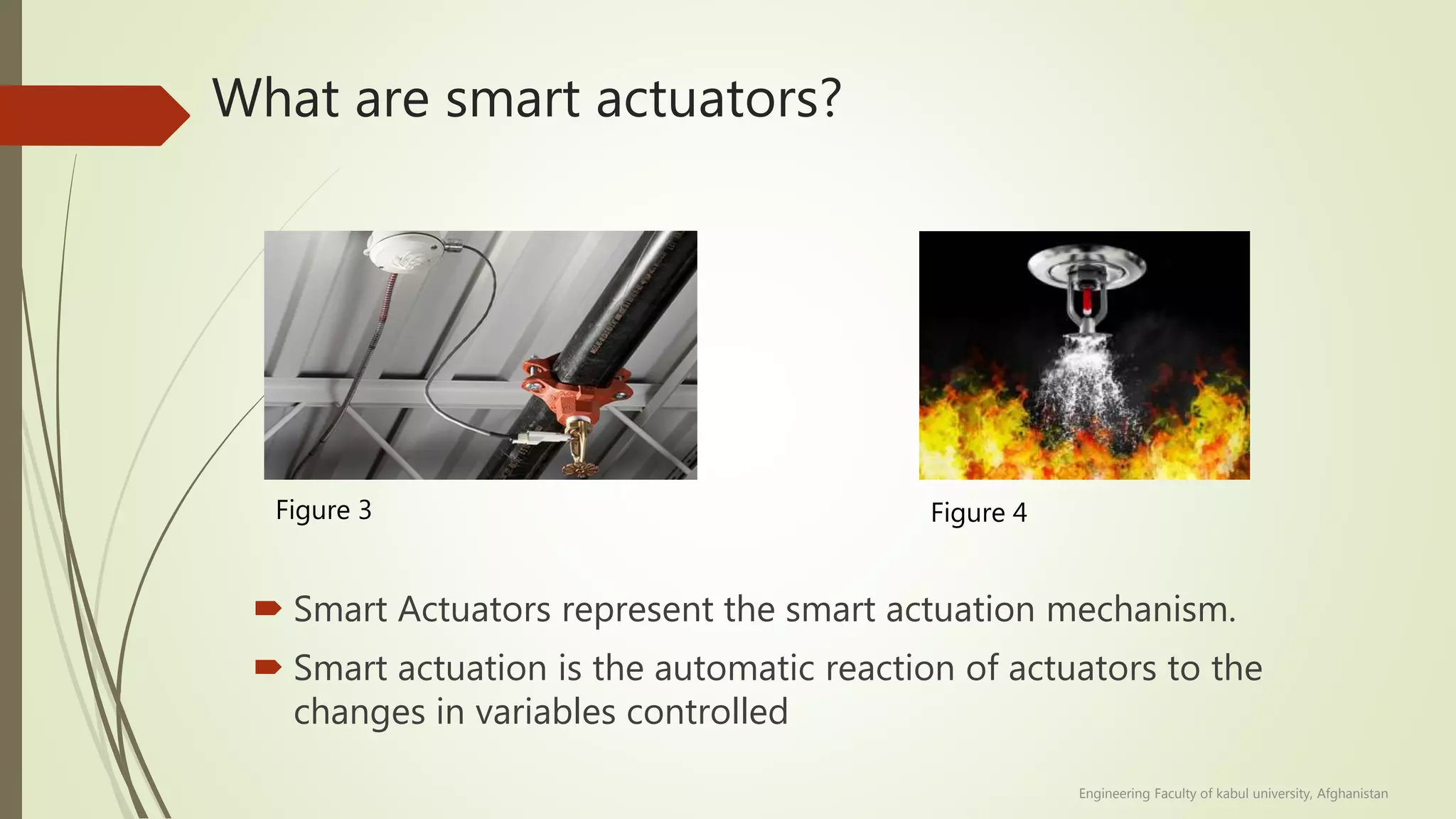
What are smart actuators?
 Smart Actuators represent the smart actuation mechanism.
 Smart actuation is the automatic reaction of actuators to the
changes in variables controlled
Figure 3 Figure 4
Engineering Faculty of kabul university, Afghanistan
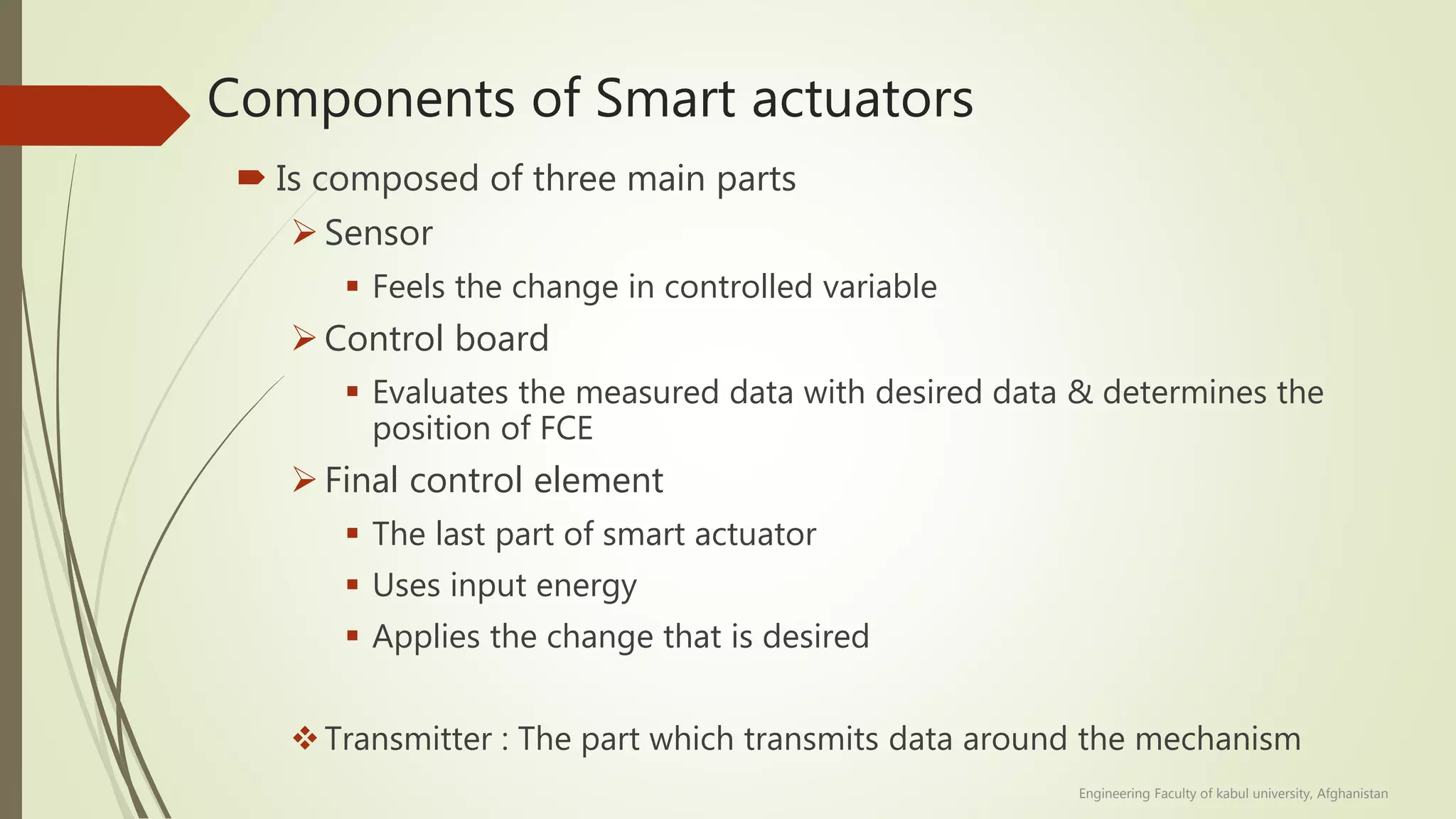
Components of Smart actuators
 Is composed of three main parts
Sensor
 Feels the change in controlled variable
Control board
 Evaluates the measured data with desired data & determines the
position of FCE
Final control element
 The last part of smart actuator
 Uses input energy
 Applies the change that is desired
Transmitter : The part which transmits data around the mechanism
Engineering Faculty of kabul university, Afghanistan
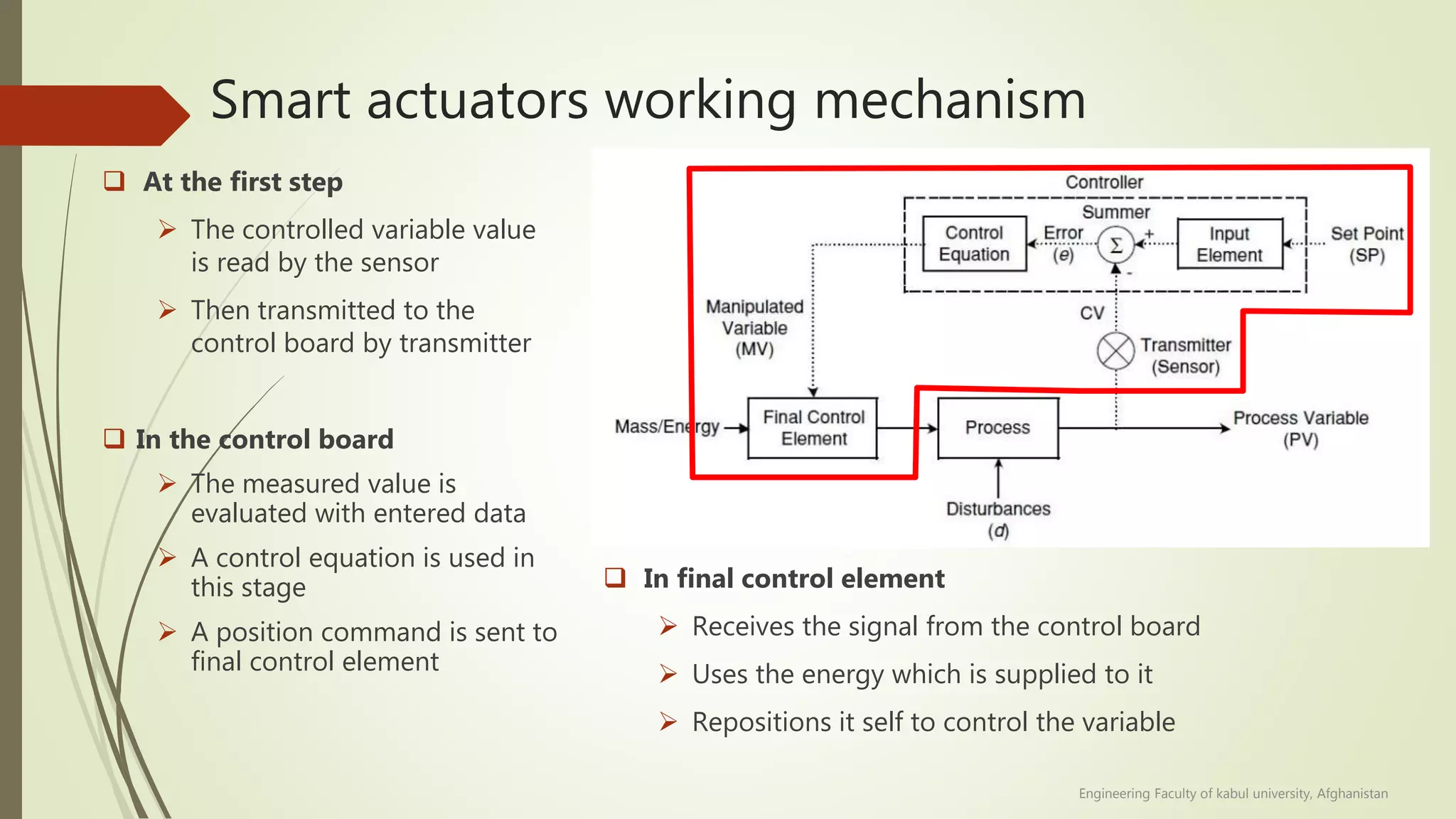
Smart actuators working mechanism
 At the first step
 The controlled variable value
is read by the sensor
 Then transmitted to the
control board by transmitter
 In the control board
 The measured value is
evaluated with entered data
 A control equation is used in
this stage
 A position command is sent to
final control element
 In final control element
 Receives the signal from the control board
 Uses the energy which is supplied to it
 Repositions it self to control the variable
Engineering Faculty of kabul university, Afghanistan
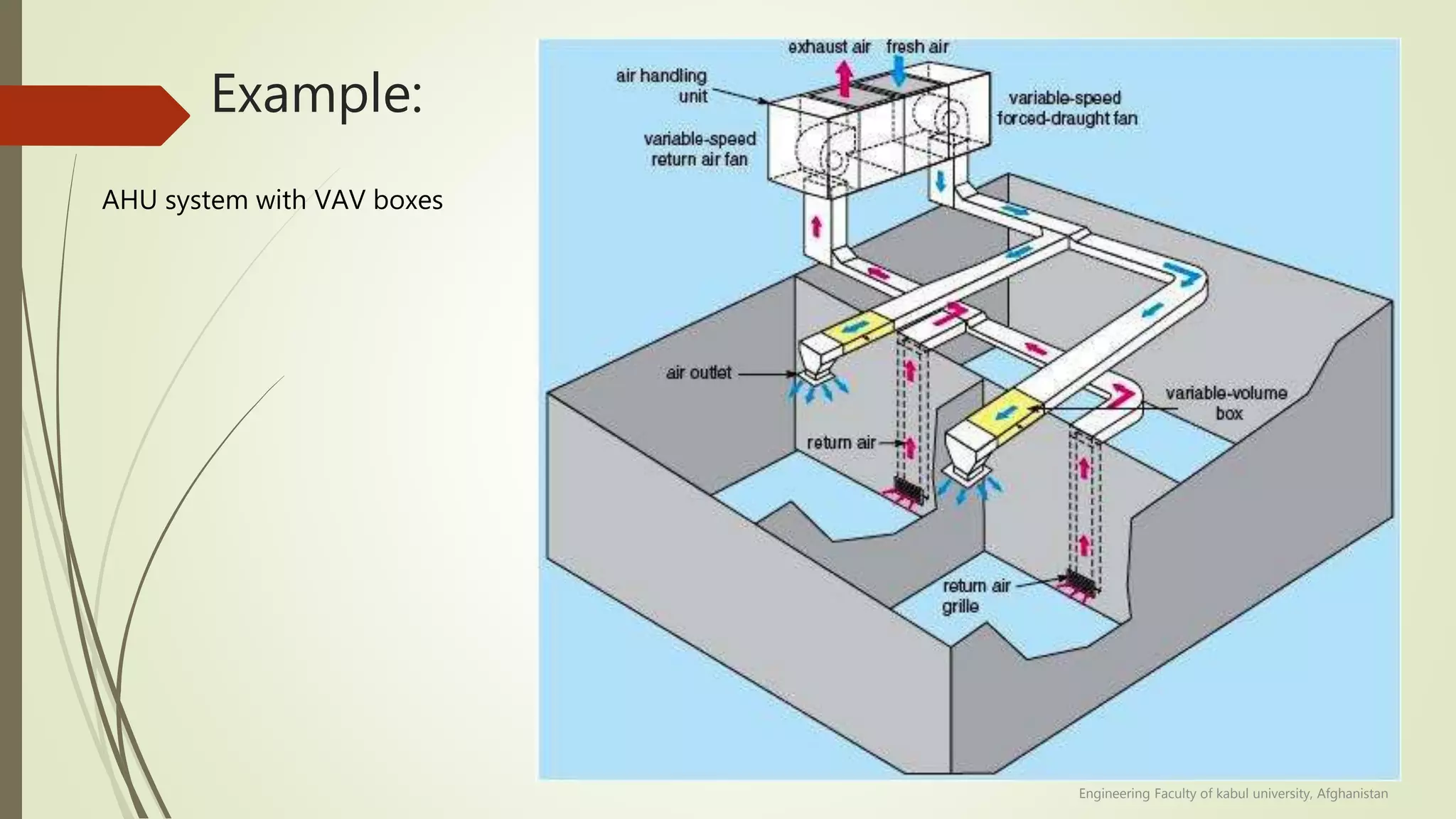
Example:
AHU system with VAV boxes
Engineering Faculty of kabul university, Afghanistan
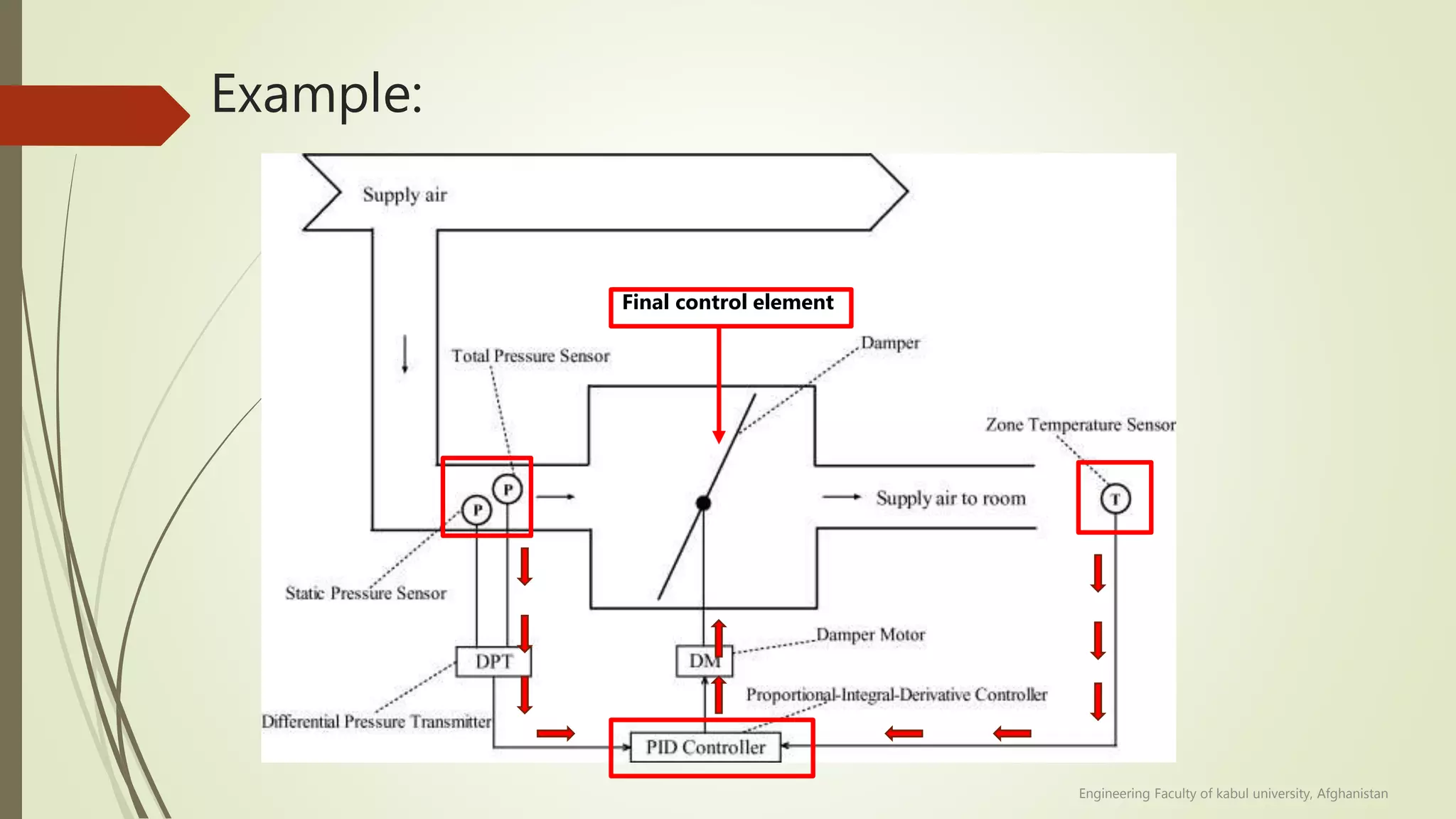
Example:
Final control element
Engineering Faculty of kabul university, Afghanistan
Application of smart actuators
 Smart actuators are used in all aspects of life
Health care ( automatic insulin injection device )
Automations ( auto driving cars )
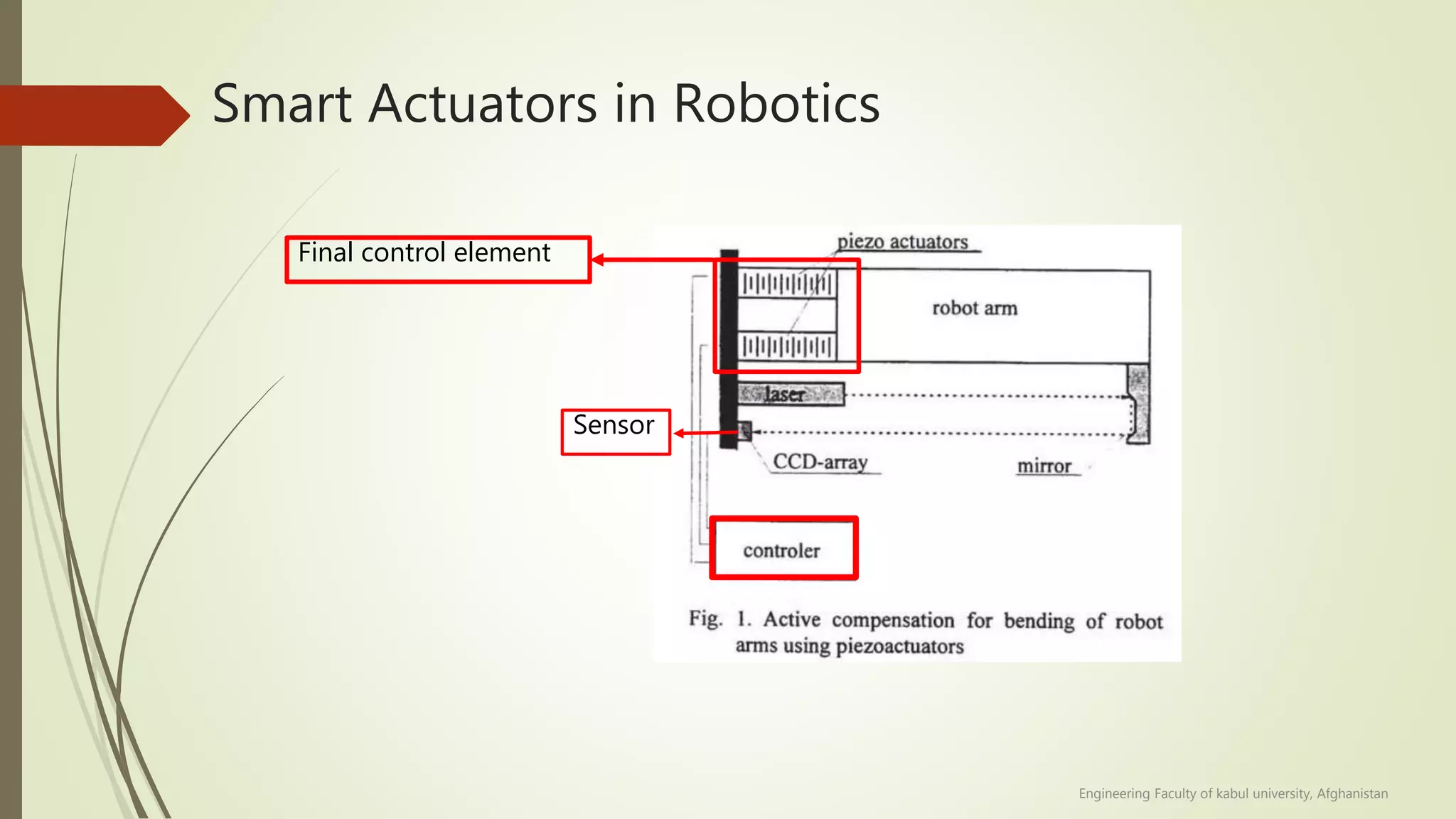
Robotics ( robot arm controls )
Manufacturing processes ( measuring levels )
Laboratories ( measuring amounts )
Engineering Faculty of kabul university, Afghanistan
Smart Actuators in Robotics
Sensor
Final control element
Engineering Faculty of kabul university, Afghanistan
Advantages and disadvantages
 Advantages
 Increased energy efficiency
 Increased safety
 increased uptime and lower overall operating costs
 Precise control over a process
 Large coverage area
 Efficient time management
 Disadvantages
 Higher initial cost
 Required maintenance
Engineering Faculty of kabul university, Afghanistan
Conclusion
 Smart actuators are great devices to control processes
 They are more efficient than other kinds of control systems
 Smart actuators play a great role in making the world smart
 Smart actuators has caused improvement in many aspects of life
 Have made the human life easier
 Lots of studies have been done on it, but needs more researches
Engineering Faculty of kabul university, Afghanistan
References
 Introduction to Sensors and Actuators, M. Anjanappa, K. Datta, and T. Song,
Sensors • Actuators, 2002
 Introduction to Transducers, Sensors and Actuators, Southwest Center for
Microsystems Education (SCME), 2011
 Smart Actuators for Innovative Biomedical Applications: An Interactive
Overview, Rajeev Agrawal, Nitish Kaushik, January 2019
 Actuators for Smart Applications, Alexandre Paternoster, Remko Akkerman,
Andre de Boer, University of Twente, January 2010
 SMART ACTUATORS IN ROBOTICS, Niko Herakovi~ and Tomaf Perme, University
of Ljubljana, Faculty of Mechanical Engineering, Laboratory for Handling, Assembly
and Pneumatics, 1998
Engineering Faculty of kabul university, Afghanistan
Questions?
“Look for the answer inside your question” Rumi Engineering Faculty of kabul university, Afghanistan

Overview and study of smart actuators

  • 1.
    Kabul University Engineering Faculty MechanicalEngineering department Prepared by Ahmad Nasher Sarwary March 2020 Overview and study of Smart Actuators Engineering Faculty of kabul university, Afghanistan
  • 2.
    Table of contents What are actuators?  Types of actuators  What are smart actuators?  Components of Smart actuators  Smart actuators working mechanism  Application of smart actuators  Advantages and disadvantages  Conclusion Engineering Faculty of kabul university, Afghanistan
  • 3.
    What are actuators? Whatthese devices have in common? • They both use energy to produce motion Figure 1 Figure 2 Engineering Faculty of kabul university, Afghanistan
  • 4.
    An actuator isa device which: Converts input energy to motion Accepts energy to produce motion Produces a change in physical system by using energy What are actuators? Input: Electric energy Output: Rotary motion Engineering Faculty of kabul university, Afghanistan
  • 5.
    Types of actuators Accordingto input energy: Mechanical ( screw jacks, bimetals, Pneumatic tank) Electrical ( motor, diodes, transistors ) According to control: Manually controlled actuators ( ceiling fans ) Smart Actuators (self controlled)… Engineering Faculty of kabul university, Afghanistan
  • 6.
    What are smartactuators?  Smart Actuators represent the smart actuation mechanism.  Smart actuation is the automatic reaction of actuators to the changes in variables controlled Figure 3 Figure 4 Engineering Faculty of kabul university, Afghanistan
  • 7.
    Components of Smartactuators  Is composed of three main parts Sensor  Feels the change in controlled variable Control board  Evaluates the measured data with desired data & determines the position of FCE Final control element  The last part of smart actuator  Uses input energy  Applies the change that is desired Transmitter : The part which transmits data around the mechanism Engineering Faculty of kabul university, Afghanistan
  • 8.
    Smart actuators workingmechanism  At the first step  The controlled variable value is read by the sensor  Then transmitted to the control board by transmitter  In the control board  The measured value is evaluated with entered data  A control equation is used in this stage  A position command is sent to final control element  In final control element  Receives the signal from the control board  Uses the energy which is supplied to it  Repositions it self to control the variable Engineering Faculty of kabul university, Afghanistan
  • 9.
    Example: AHU system withVAV boxes Engineering Faculty of kabul university, Afghanistan
  • 10.
    Example: Final control element EngineeringFaculty of kabul university, Afghanistan
  • 11.
    Application of smartactuators  Smart actuators are used in all aspects of life Health care ( automatic insulin injection device ) Automations ( auto driving cars ) Robotics ( robot arm controls ) Manufacturing processes ( measuring levels ) Laboratories ( measuring amounts ) Engineering Faculty of kabul university, Afghanistan
  • 12.
    Smart Actuators inRobotics Sensor Final control element Engineering Faculty of kabul university, Afghanistan
  • 13.
    Advantages and disadvantages Advantages  Increased energy efficiency  Increased safety  increased uptime and lower overall operating costs  Precise control over a process  Large coverage area  Efficient time management  Disadvantages  Higher initial cost  Required maintenance Engineering Faculty of kabul university, Afghanistan
  • 14.
    Conclusion  Smart actuatorsare great devices to control processes  They are more efficient than other kinds of control systems  Smart actuators play a great role in making the world smart  Smart actuators has caused improvement in many aspects of life  Have made the human life easier  Lots of studies have been done on it, but needs more researches Engineering Faculty of kabul university, Afghanistan
  • 15.
    References  Introduction toSensors and Actuators, M. Anjanappa, K. Datta, and T. Song, Sensors • Actuators, 2002  Introduction to Transducers, Sensors and Actuators, Southwest Center for Microsystems Education (SCME), 2011  Smart Actuators for Innovative Biomedical Applications: An Interactive Overview, Rajeev Agrawal, Nitish Kaushik, January 2019  Actuators for Smart Applications, Alexandre Paternoster, Remko Akkerman, Andre de Boer, University of Twente, January 2010  SMART ACTUATORS IN ROBOTICS, Niko Herakovi~ and Tomaf Perme, University of Ljubljana, Faculty of Mechanical Engineering, Laboratory for Handling, Assembly and Pneumatics, 1998 Engineering Faculty of kabul university, Afghanistan
  • 16.
    Questions? “Look for theanswer inside your question” Rumi Engineering Faculty of kabul university, Afghanistan