
Module 3:
Overcoming the Organizational Challenge
Leah van Zelm
Principal Consultant
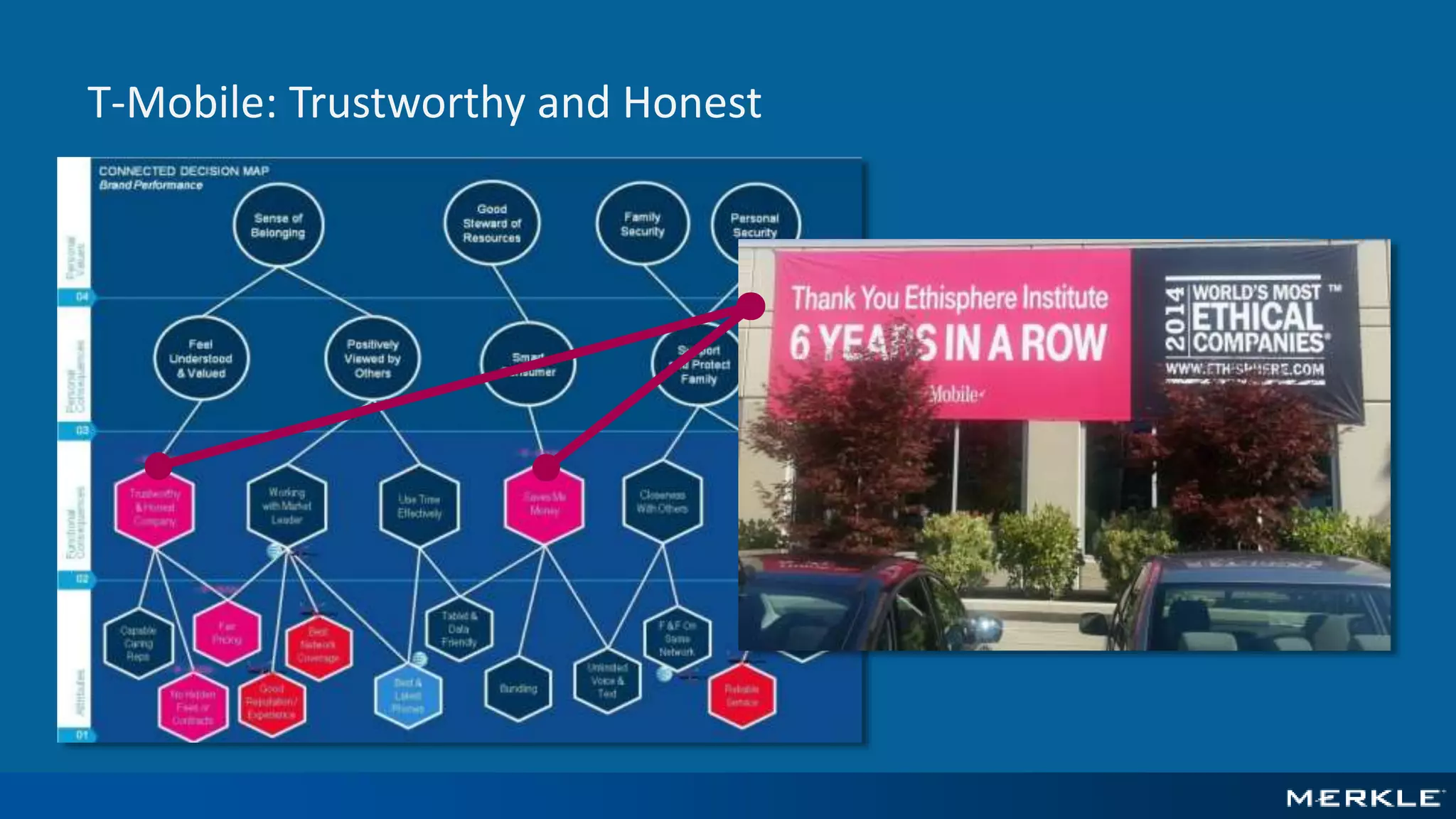
T-Mobile: Trustworthy and Honest
Introduction
Building an enterprise-wide, customer-centric strategy that is able to drive investment
decisions across the organization is critical to success.
But today’s organization does not enable a positive customer experience because it
does not have the operating model in place to exploit customer centricity.
What’s needed is an Experience Enabling Operating Model designed around
what’s right for the consumer, NOT what’s easy for the organization.
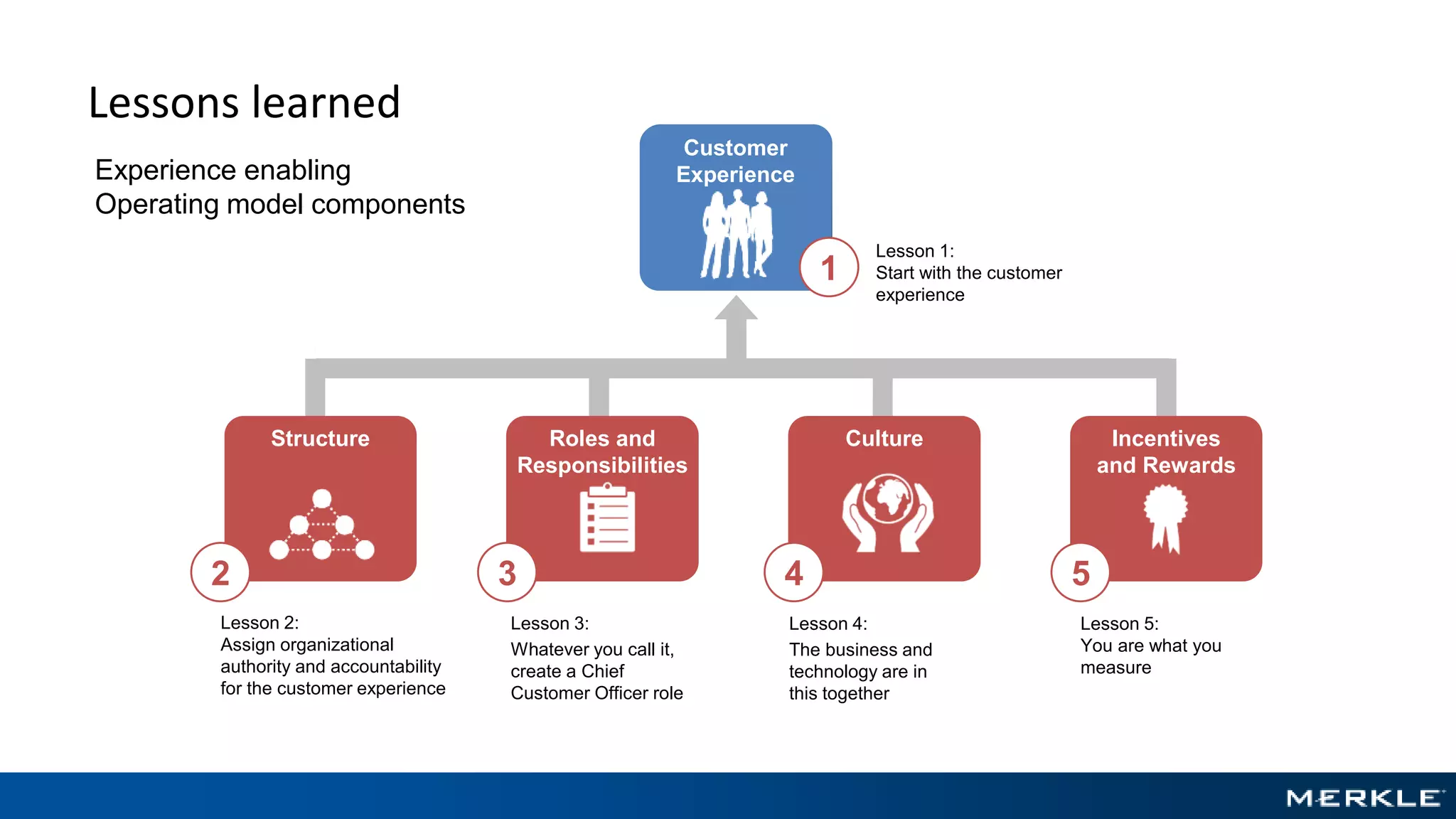
Lessons learned
KPIs
CultureStructure Roles and
Responsibilities
Incentives
and Rewards
Lesson 3:
Whatever you call it,
create a Chief
Customer Officer role
Lesson 5:
You are what you
measure
Lesson 4:
The business and
technology are in
this together
Lesson 1:
Start with the customer
experience
Customer
Experience
Lesson 2:
Assign organizational
authority and accountability
for the customer experience
Experience enabling
Operating model components
1
2 3 4 5
Lesson 1:
Start with the customer experience
KPIs
Customer
Experience
1
Lesson 1
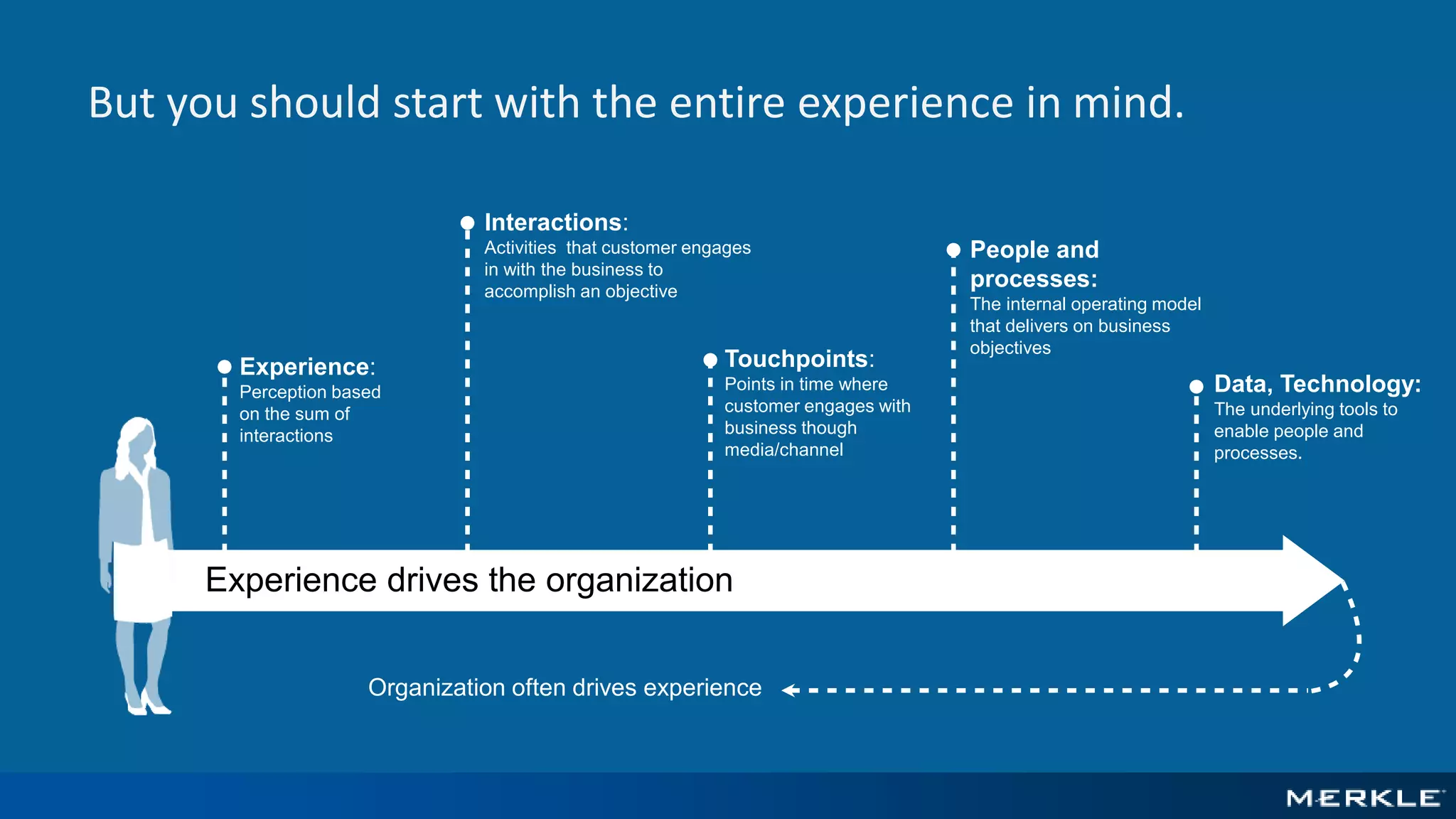
Data, Technology:
The underlying tools to
enable people and
processes.
People and
processes:
The internal operating model
that delivers on business
objectives
Touchpoints:
Points in time where
customer engages with
business though
media/channel
Interactions:
Activities that customer engages
in with the business to
accomplish an objective
Experience:
Perception based
on the sum of
interactions
Experience drives the organization
Organization often drives experience
But you should start with the entire experience in mind.
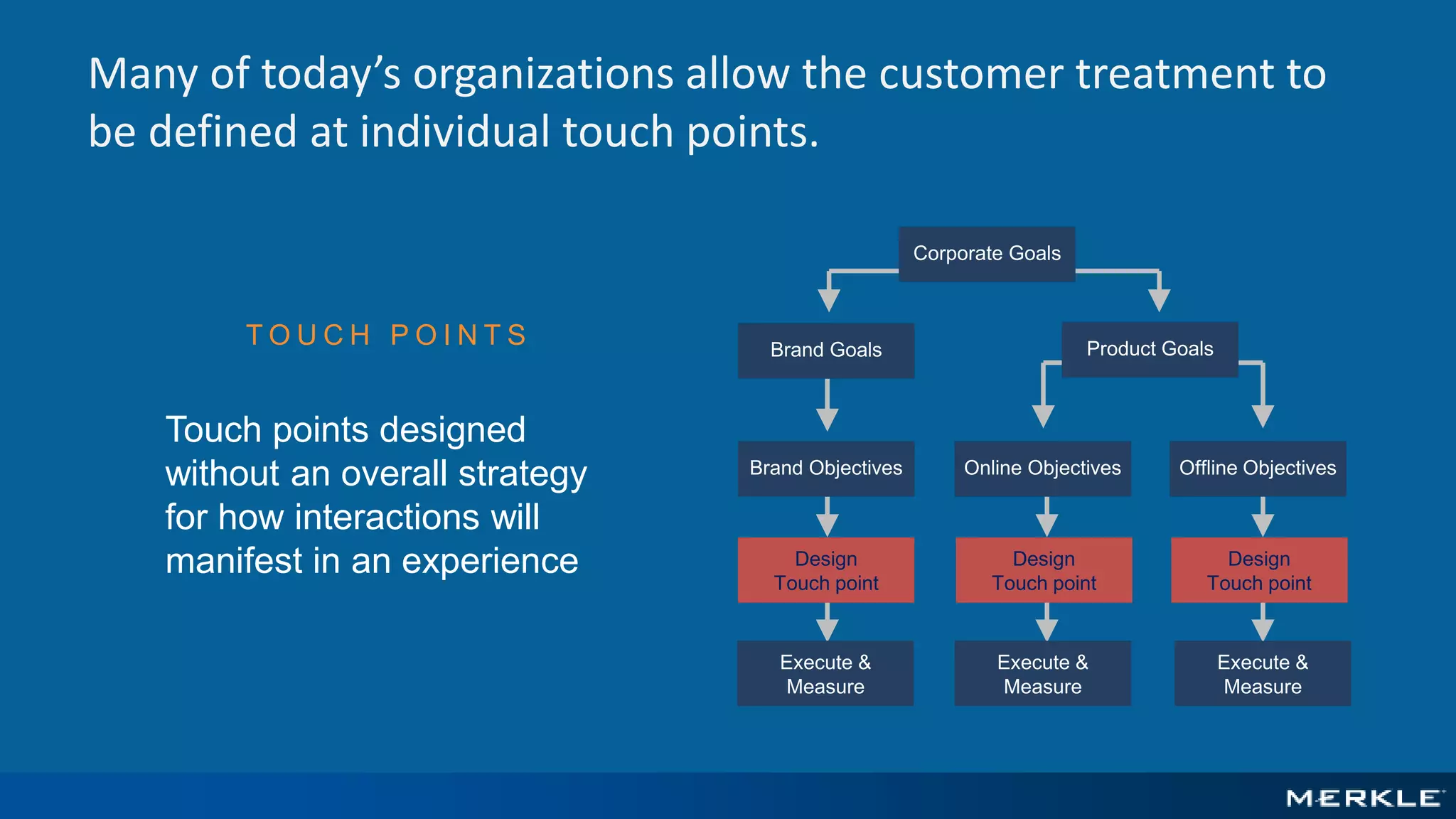
T O U C H P O I N T S
Touch points designed
without an overall strategy
for how interactions will
manifest in an experience
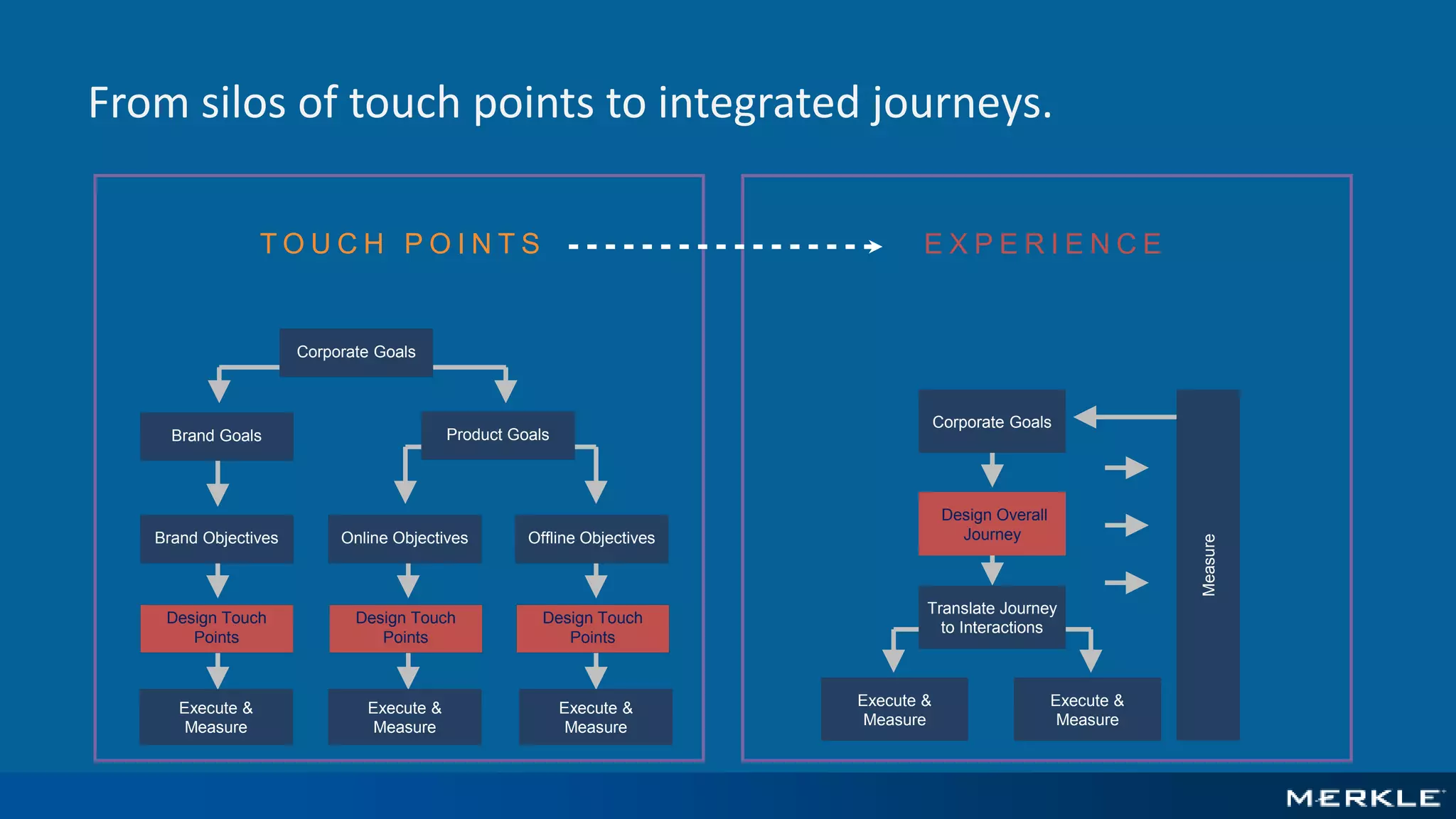
Many of today’s organizations allow the customer treatment to
be defined at individual touch points.
Product Goals
Corporate Goals
Brand Goals
Brand Objectives
Design
Touch point
Online Objectives
Design
Touch point
Offline Objectives
Design
Touch point
Execute &
Measure
Execute &
Measure
Execute &
Measure
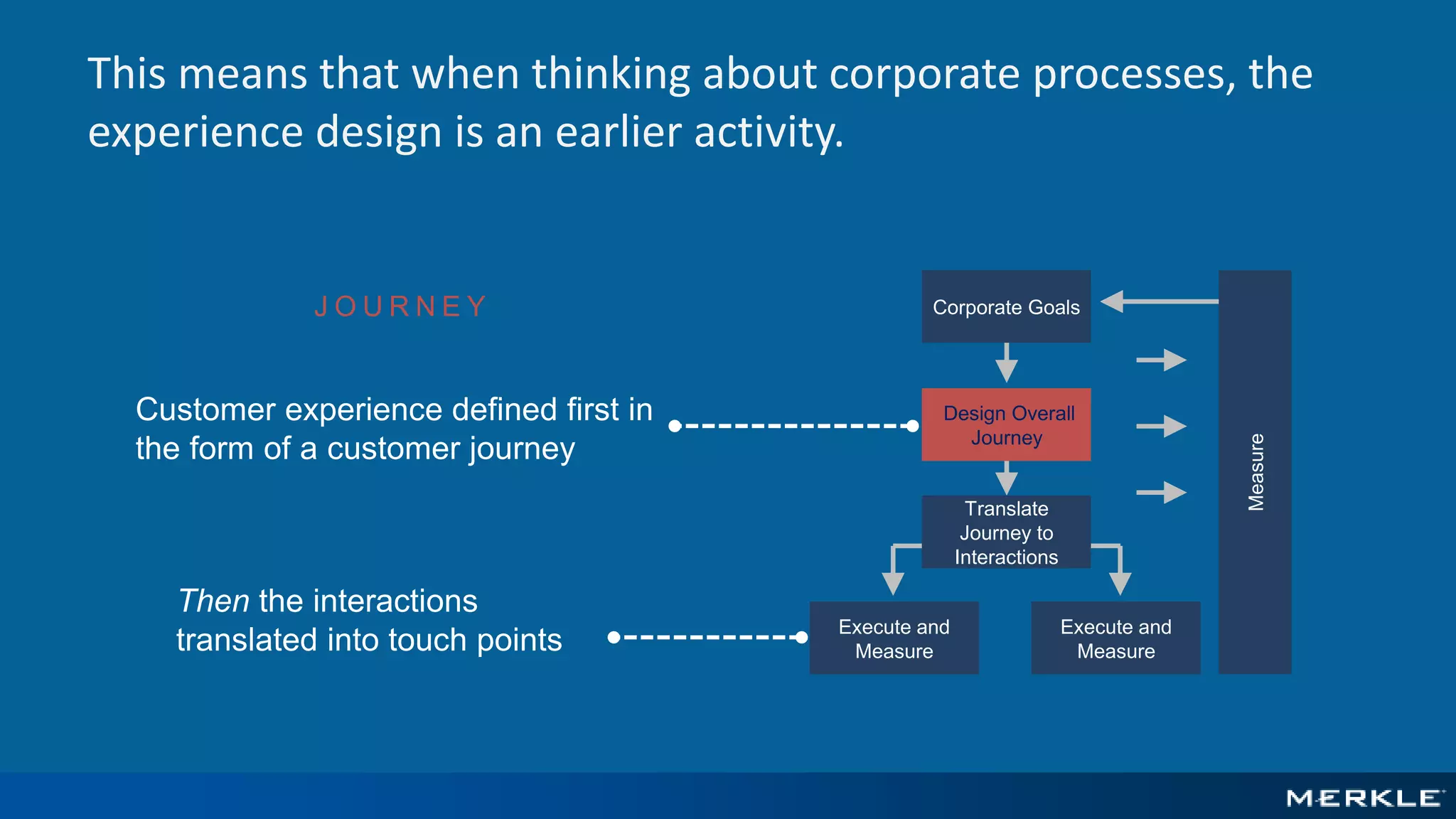
This means that when thinking about corporate processes, the
experience design is an earlier activity.
J O U R N E Y
Customer experience defined first in
the form of a customer journey
Then the interactions
translated into touch points
Execute and
Measure
Translate
Journey to
Interactions
Execute and
Measure
Design Overall
Journey
Corporate Goals
Measure
From silos of touch points to integrated journeys.
Product Goals
Corporate Goals
Brand Goals
Brand Objectives
Design Touch
Points
Online Objectives
Design Touch
Points
Offline Objectives
Design Touch
Points
Execute &
Measure
Execute &
Measure
Execute &
Measure
Execute &
Measure
Translate Journey
to Interactions
Execute &
Measure
Design Overall
Journey
Corporate Goals
Measure
E X P E R I E N C ET O U C H P O I N T S
Lesson 2
Lesson 2:
Assign organizational authority and accountability
for the customer experience
2
Structure
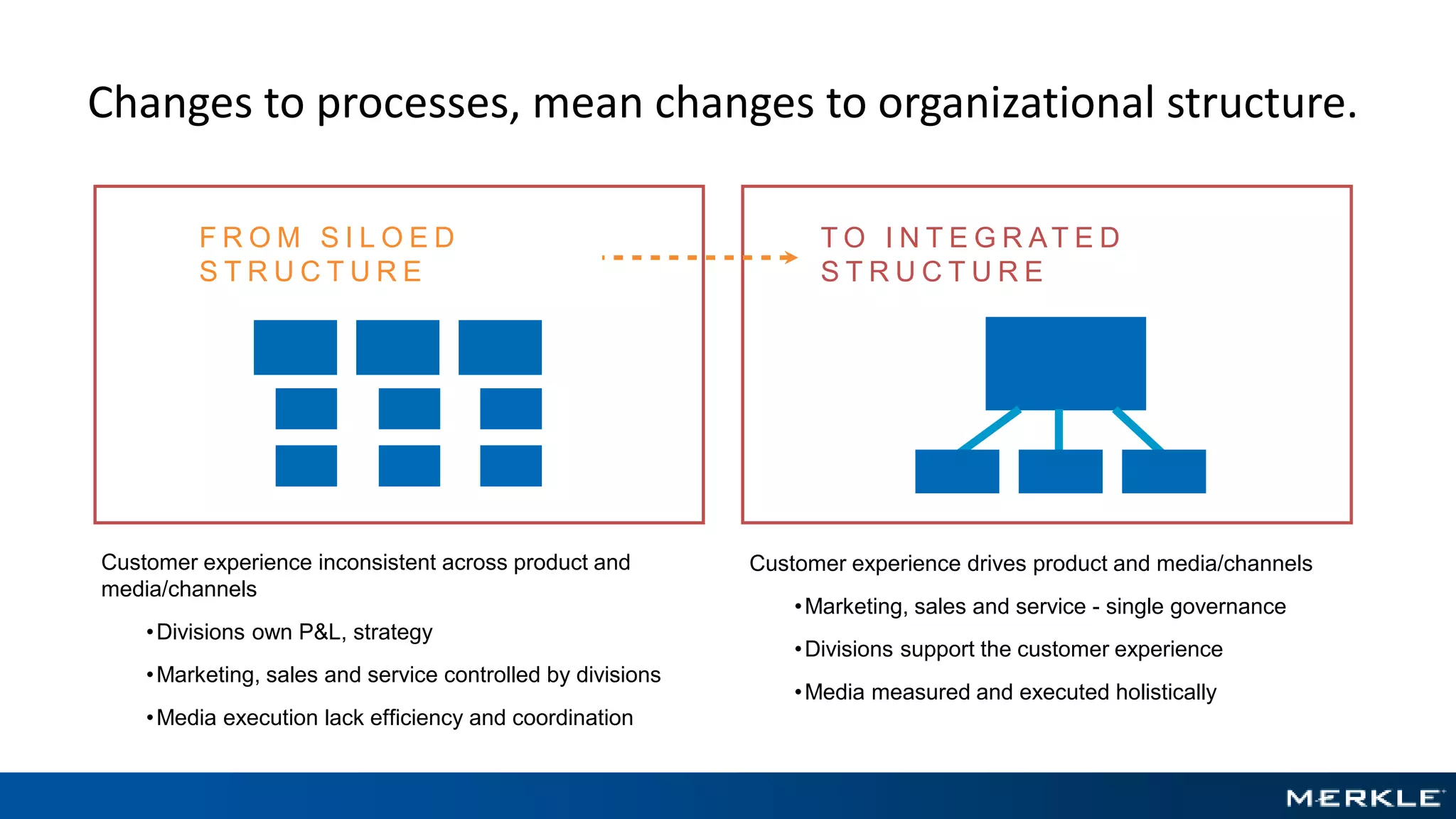
Customer experience inconsistent across product and
media/channels
•Divisions own P&L, strategy
•Marketing, sales and service controlled by divisions
•Media execution lack efficiency and coordination
Customer experience drives product and media/channels
•Marketing, sales and service - single governance
•Divisions support the customer experience
•Media measured and executed holistically
Changes to processes, mean changes to organizational structure.
T O I N T E G R AT E D
S T R U C T U R E
F R O M S I L O E D
S T R U C T U R E
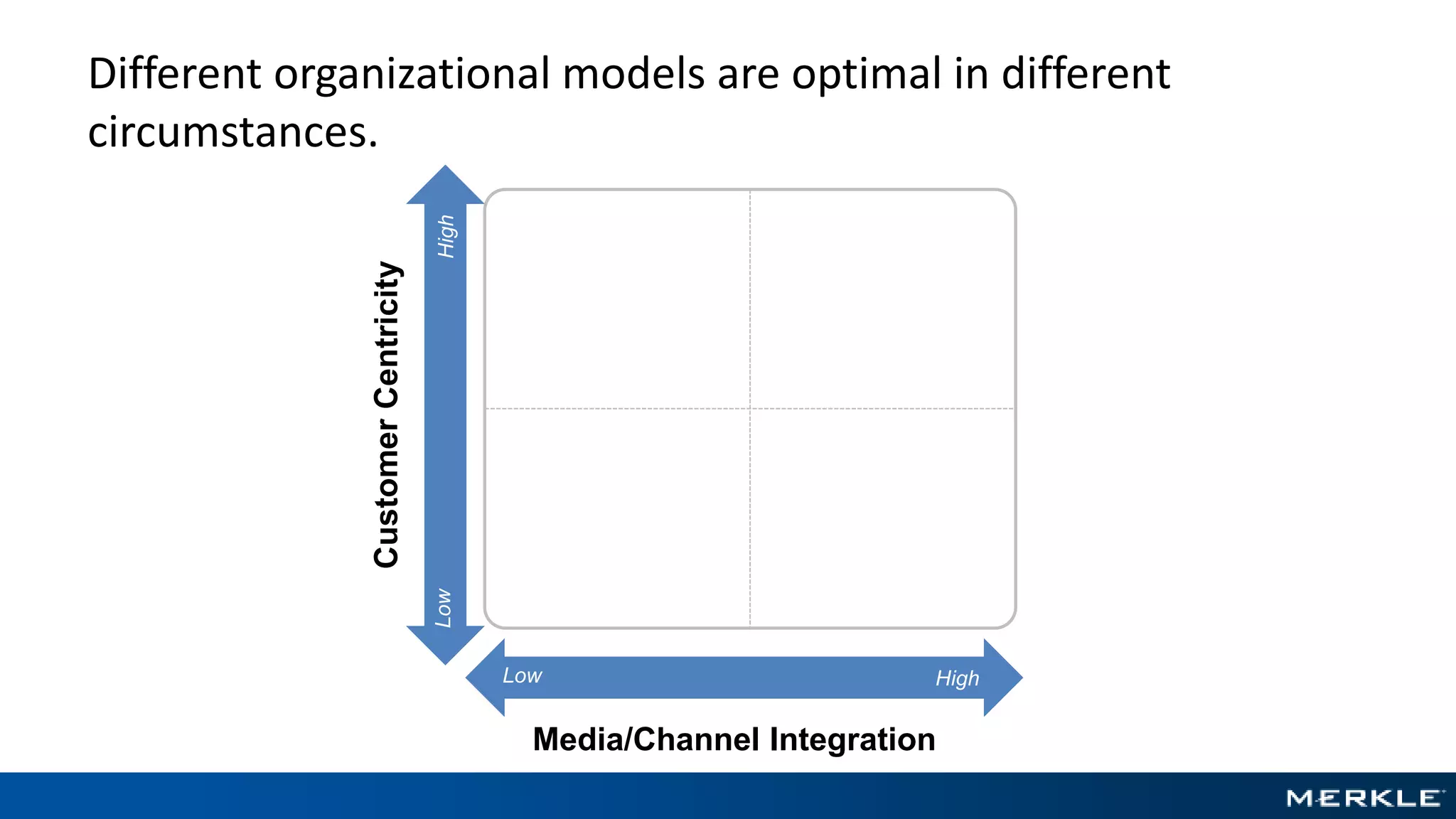
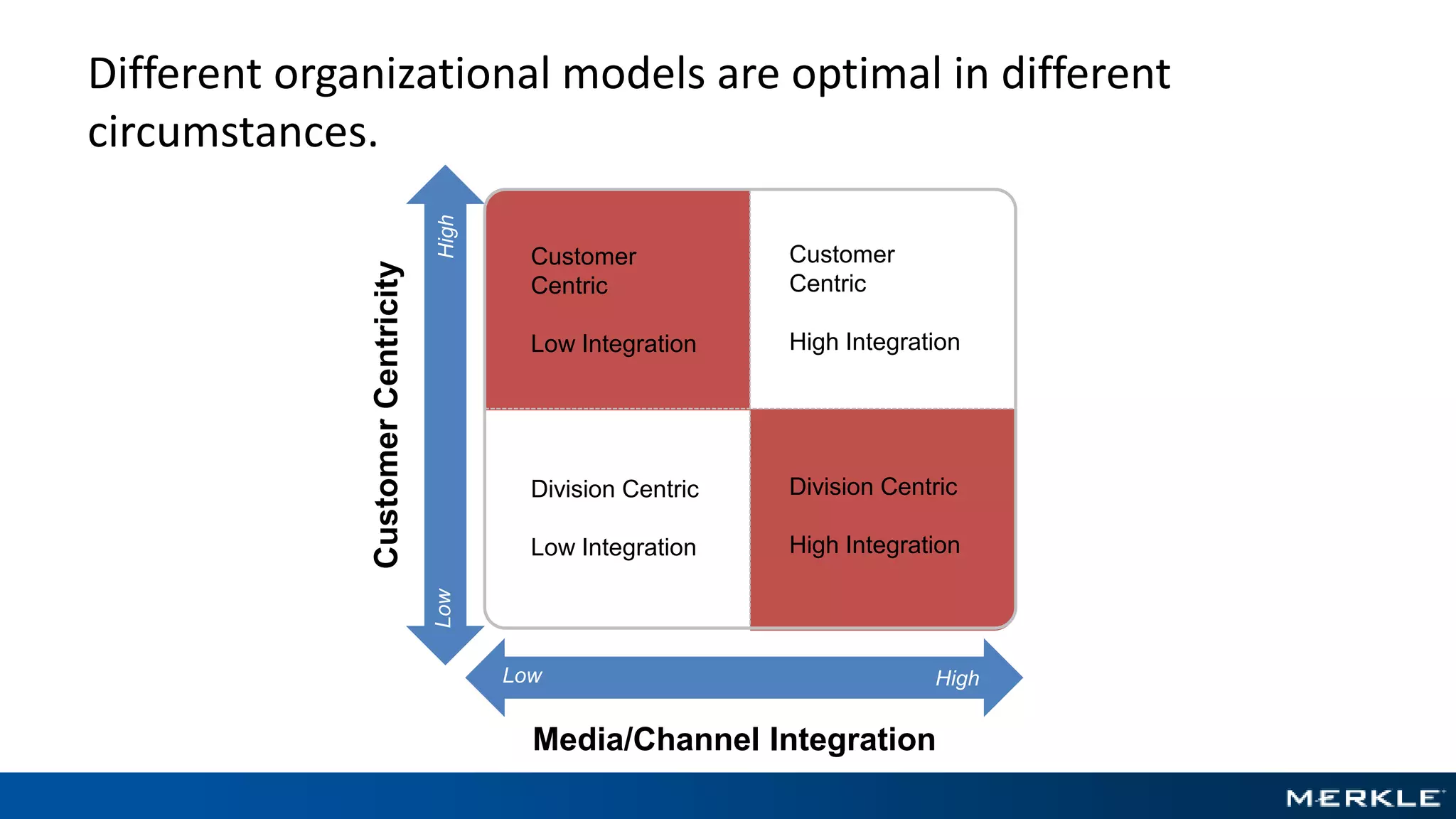
Different organizational models are optimal in different
circumstances.
HighLow
CustomerCentricity
HighLow
Media/Channel Integration
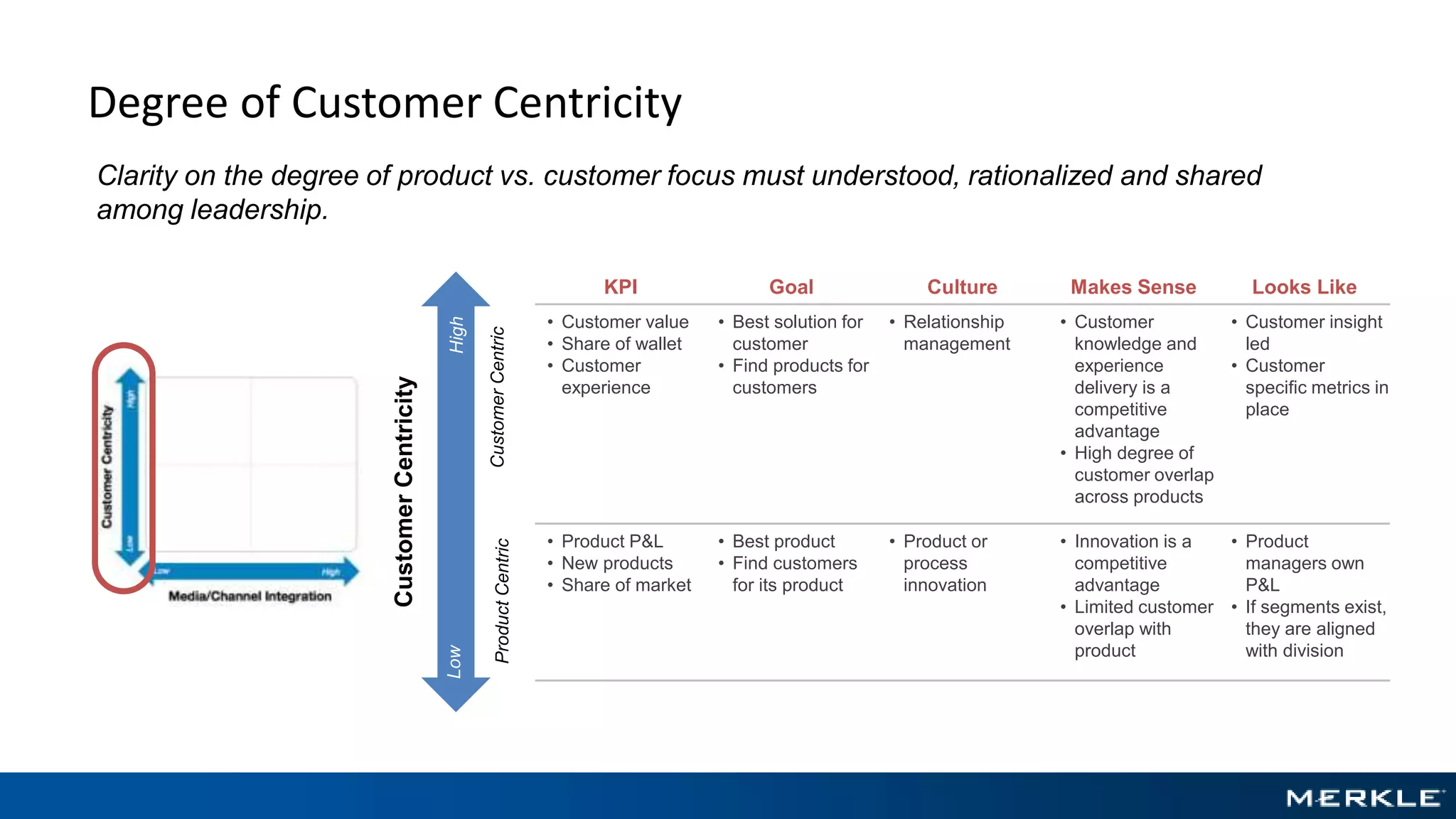
Degree of Customer Centricity
CustomerCentricProductCentric
KPI Goal Culture Makes Sense Looks Like
• Customer value
• Share of wallet
• Customer
experience
• Best solution for
customer
• Find products for
customers
• Relationship
management
• Customer
knowledge and
experience
delivery is a
competitive
advantage
• High degree of
customer overlap
across products
• Customer insight
led
• Customer
specific metrics in
place
• Product P&L
• New products
• Share of market
• Best product
• Find customers
for its product
• Product or
process
innovation
• Innovation is a
competitive
advantage
• Limited customer
overlap with
product
• Product
managers own
P&L
• If segments exist,
they are aligned
with division
Clarity on the degree of product vs. customer focus must understood, rationalized and shared
among leadership.
HighLow
CustomerCentricity
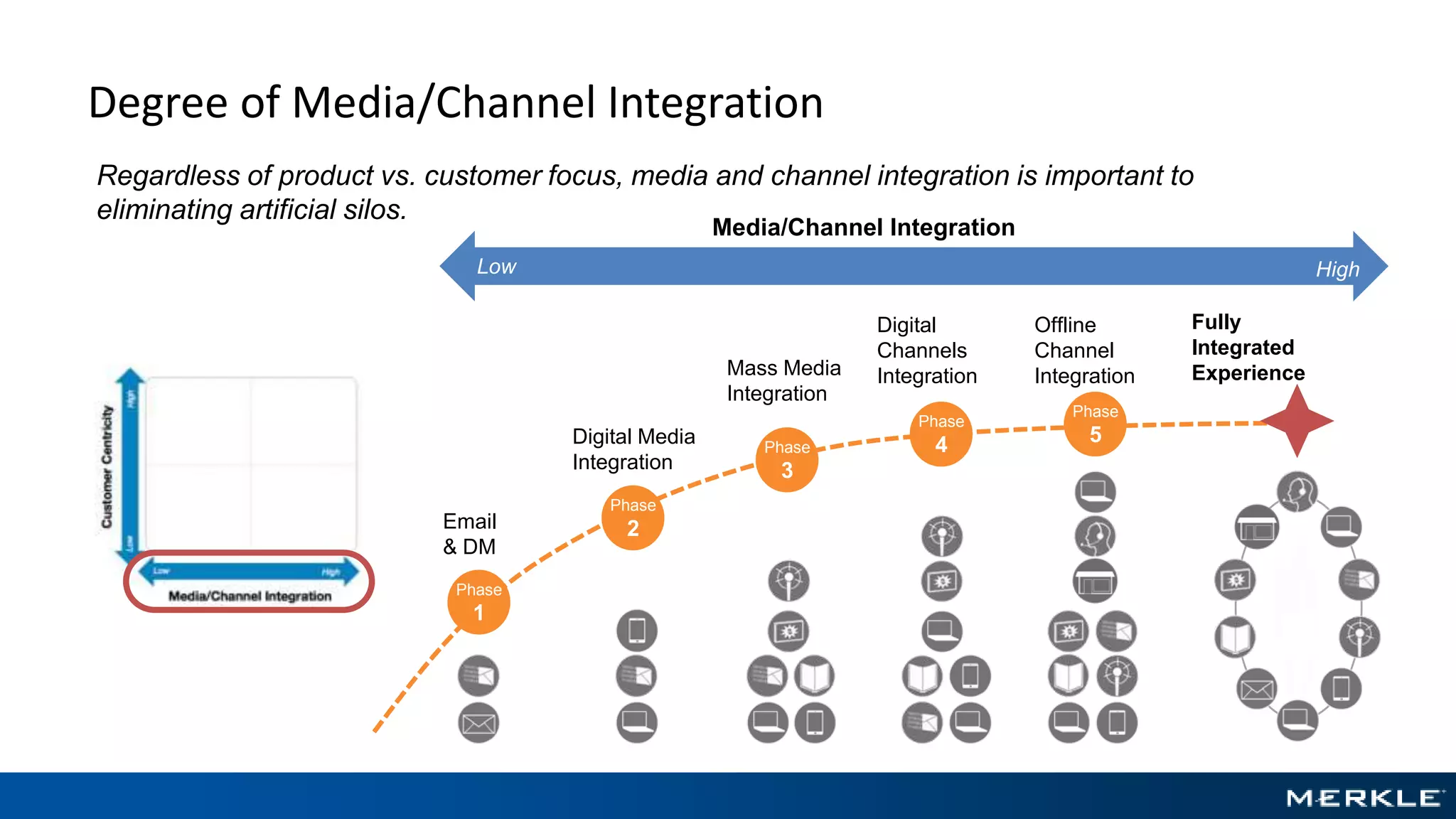
Degree of Media/Channel Integration
Regardless of
product vs.
customer focus,
media and
channel
integration is
important to
eliminating
artificial silos.
Phase
1
Phase
2
Phase
3
Phase
4
Phase
5
Email
& DM
Digital Media
Integration
Mass Media
Integration
Digital
Channels
Integration
Offline
Channel
Integration
Fully
Integrated
Experience
Regardless of product vs. customer focus, media and channel integration is important to
eliminating artificial silos.
HighLow
Media/Channel Integration
Different organizational models are optimal in different
circumstances.
HighLow
CustomerCentricity
HighLow
Media/Channel Integration
Division Centric
Low Integration
Customer
Centric
Low Integration
Customer
Centric
High Integration
Division Centric
High Integration
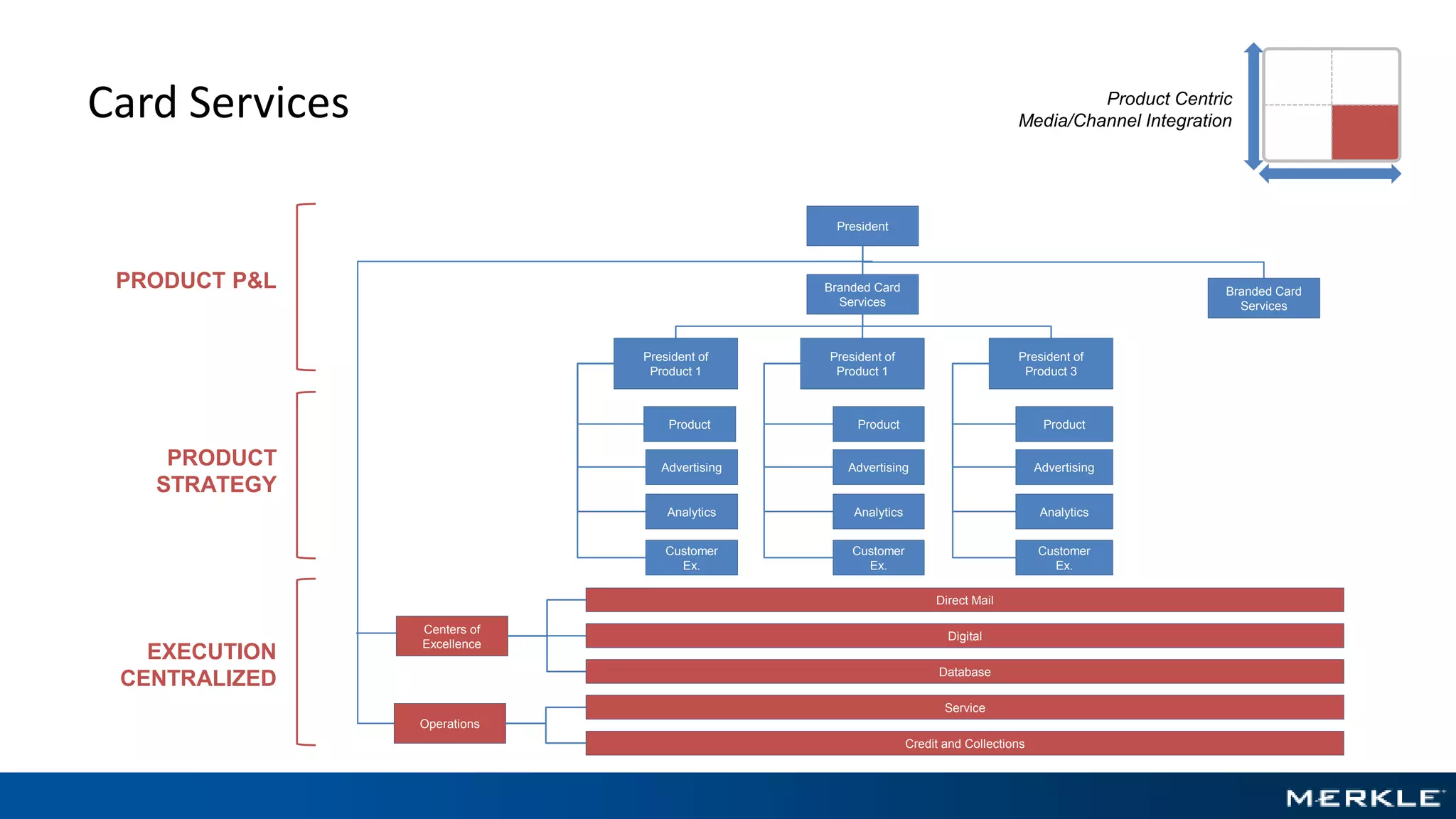
Card Services
President
Branded Card
Services
President of
Product 1
Product
Advertising
Analytics
Customer
Ex.
President of
Product 3
Product
Advertising
Analytics
Customer
Ex.
Centers of
Excellence
Operations
Direct Mail
Digital
Database
Service
Credit and Collections
Product Centric
Media/Channel Integration
Branded Card
Services
PRODUCT
STRATEGY
EXECUTION
CENTRALIZED
PRODUCT P&L
President of
Product 1
Product
Advertising
Analytics
Customer
Ex.
Centers of
Excellence
Operations
Direct Mail
Digital
Database
Service
Credit and Collections
Lesson 3
Lesson 3:
Whatever you call it, create a Chief Customer
Officer role
3
Roles &
Responsibilities
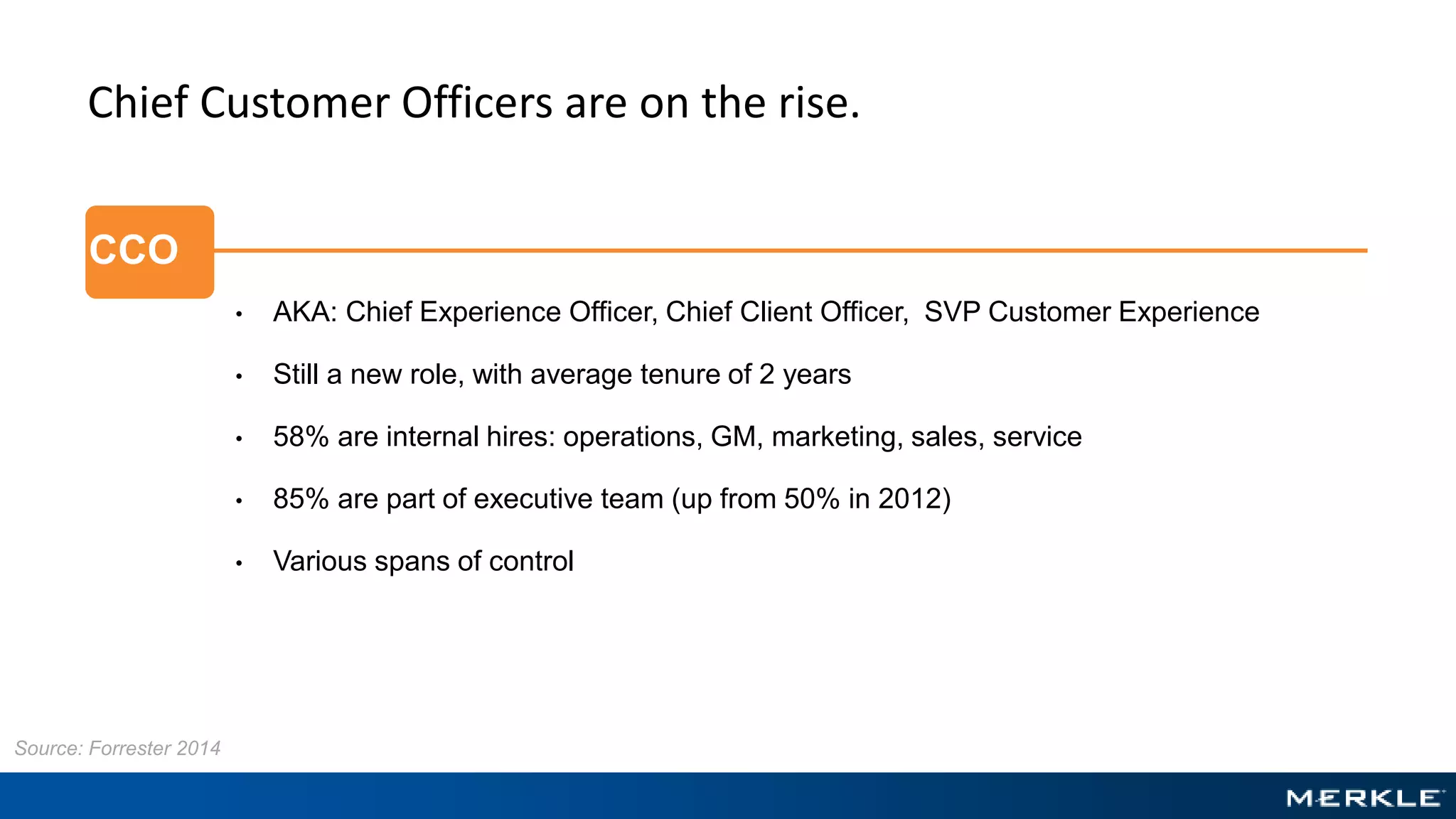
Source: Forrester 2014
Chief Customer Officers are on the rise.
• AKA: Chief Experience Officer, Chief Client Officer, SVP Customer Experience
• Still a new role, with average tenure of 2 years
• 58% are internal hires: operations, GM, marketing, sales, service
• 85% are part of executive team (up from 50% in 2012)
• Various spans of control
CCO
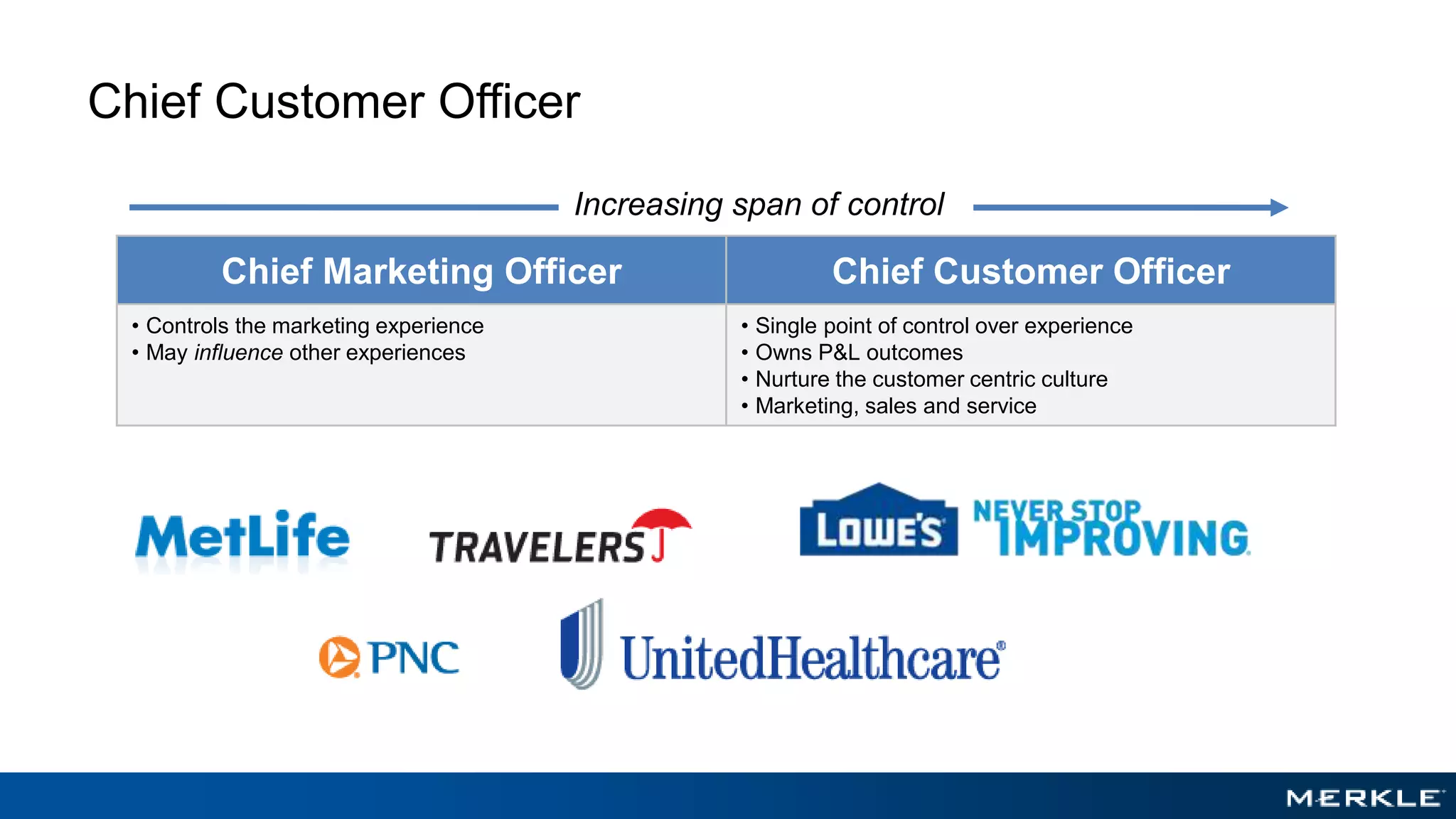
Chief Customer Officer
Chief Marketing Officer Chief Customer Officer
• Controls the marketing experience
• May influence other experiences
• Single point of control over experience
• Owns P&L outcomes
• Nurture the customer centric culture
• Marketing, sales and service
Increasing span of control
Lesson 4
Lesson 4:
The business and technology are in this together4
Culture
Culture
People /
Organization
Culture
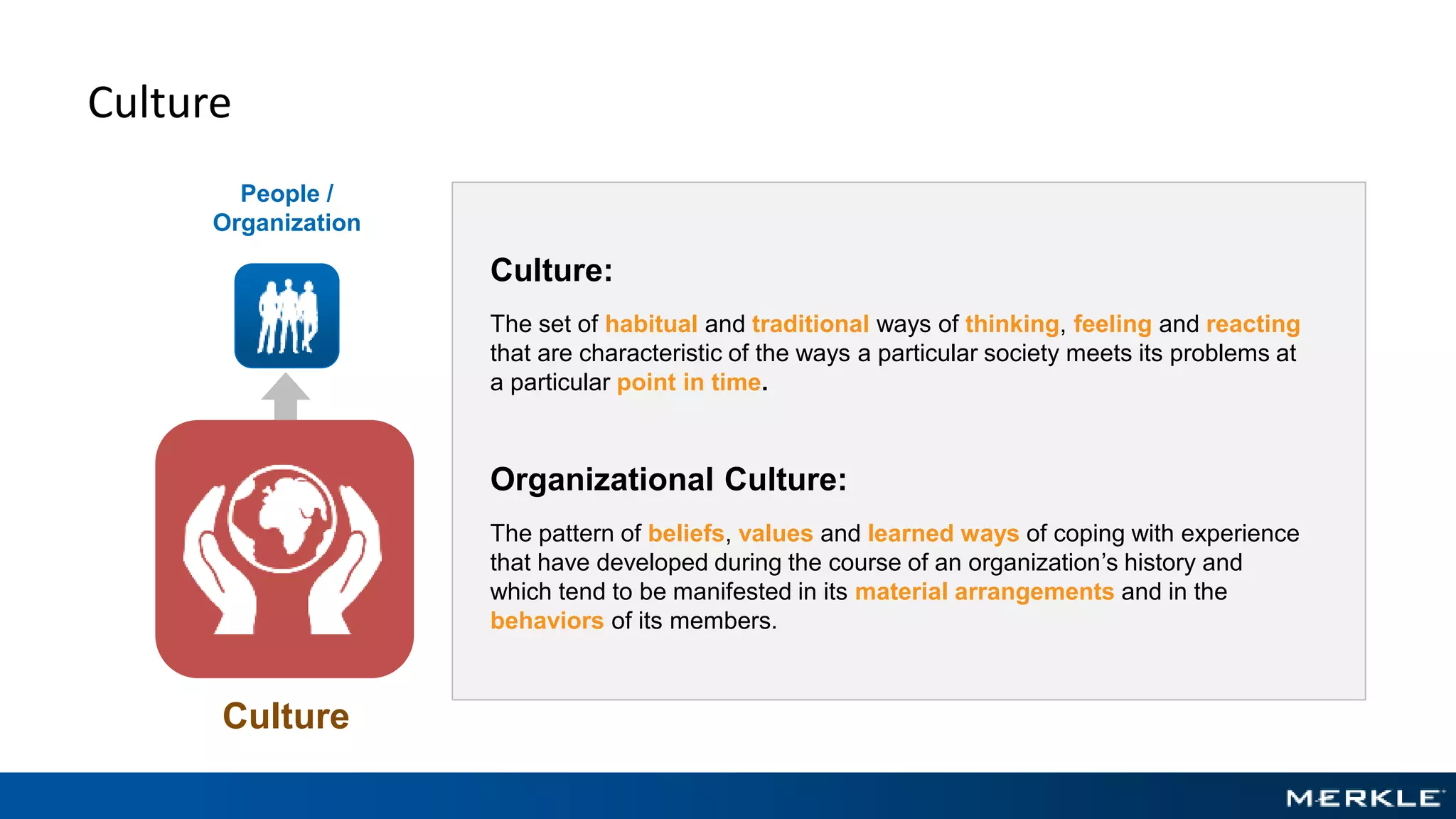
Culture:
The set of habitual and traditional ways of thinking, feeling and reacting
that are characteristic of the ways a particular society meets its problems at
a particular point in time.
Organizational Culture:
The pattern of beliefs, values and learned ways of coping with experience
that have developed during the course of an organization’s history and
which tend to be manifested in its material arrangements and in the
behaviors of its members.
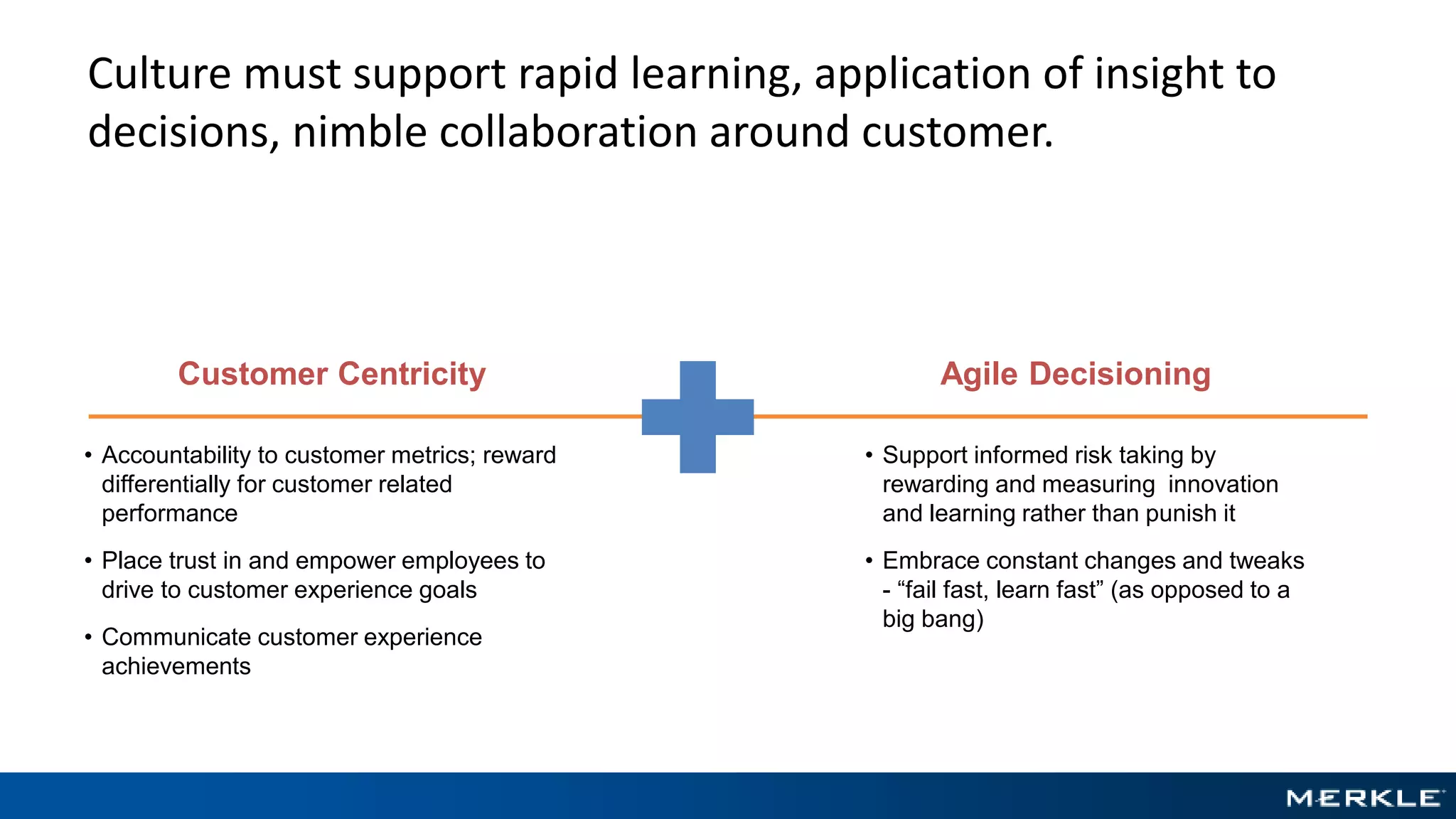
Culture must support rapid learning, application of insight to
decisions, nimble collaboration around customer.
• Accountability to customer metrics; reward
differentially for customer related
performance
• Place trust in and empower employees to
drive to customer experience goals
• Communicate customer experience
achievements
Customer Centricity
• Support informed risk taking by
rewarding and measuring innovation
and learning rather than punish it
• Embrace constant changes and tweaks
- “fail fast, learn fast” (as opposed to a
big bang)
Agile Decisioning
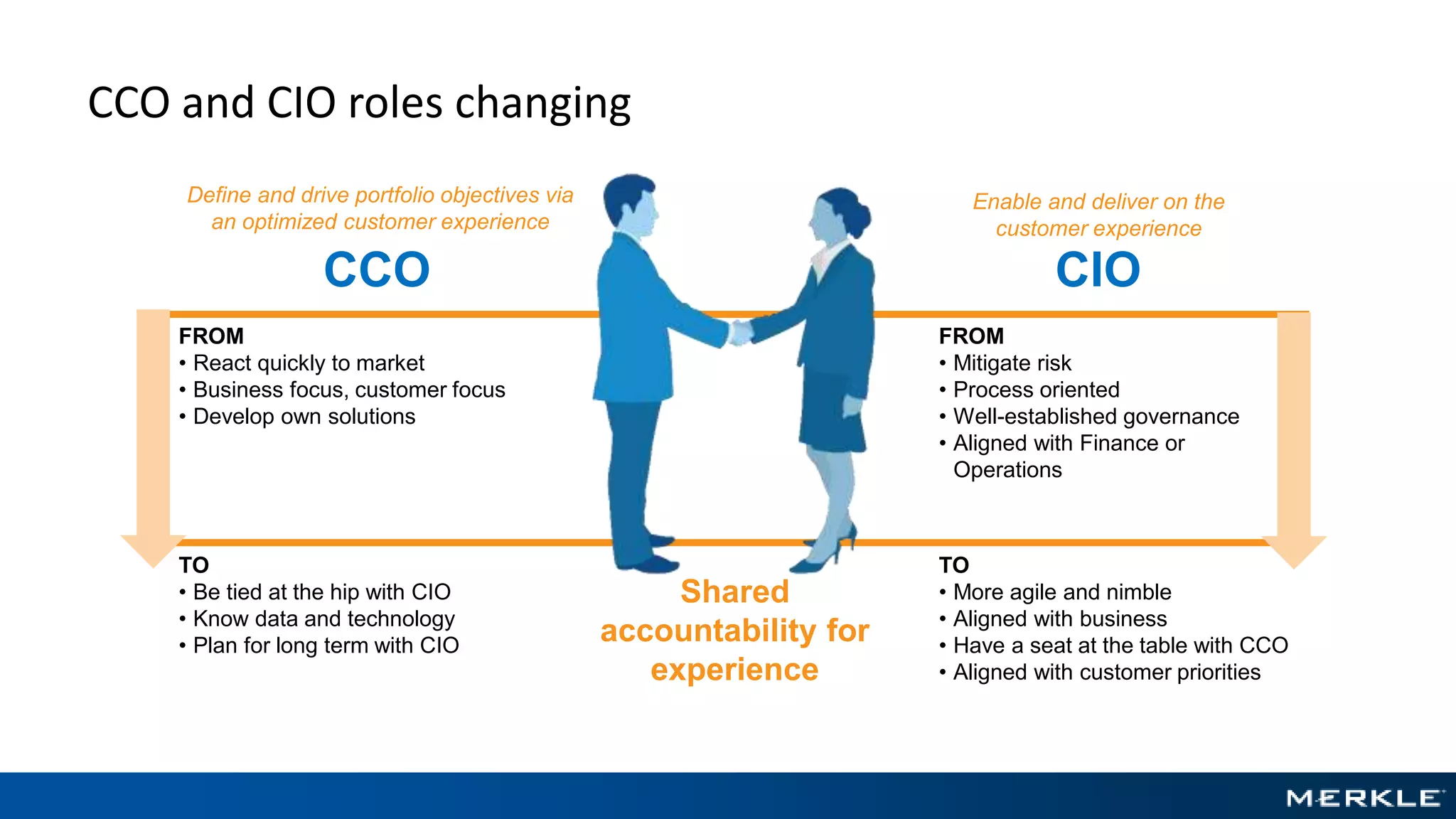
CCO and CIO roles changing
Shared
accountability for
experience
Define and drive portfolio objectives via
an optimized customer experience
Enable and deliver on the
customer experience
CCO CIO
FROM
• React quickly to market
• Business focus, customer focus
• Develop own solutions
TO
• Be tied at the hip with CIO
• Know data and technology
• Plan for long term with CIO
FROM
• Mitigate risk
• Process oriented
• Well-established governance
• Aligned with Finance or
Operations
TO
• More agile and nimble
• Aligned with business
• Have a seat at the table with CCO
• Aligned with customer priorities
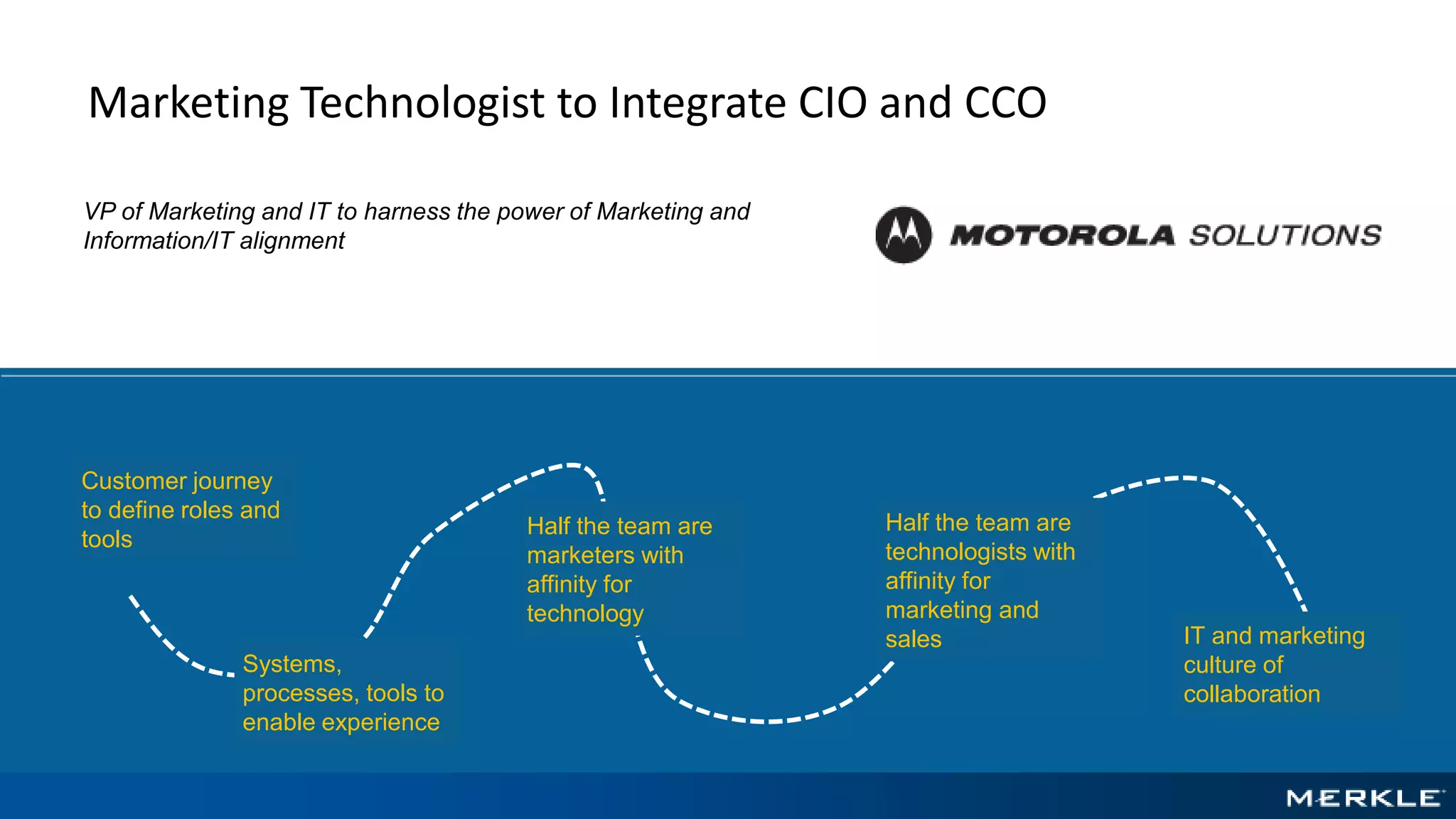
Marketing Technologist to Integrate CIO and CCO
VP of Marketing and IT to harness the power of Marketing and
Information/IT alignment
Customer journey
to define roles and
tools
Systems,
processes, tools to
enable experience
Half the team are
marketers with
affinity for
technology
Half the team are
technologists with
affinity for
marketing and
sales IT and marketing
culture of
collaboration
Lesson 5
Lesson 5:
You are what you measure5
Incentives &
Rewards
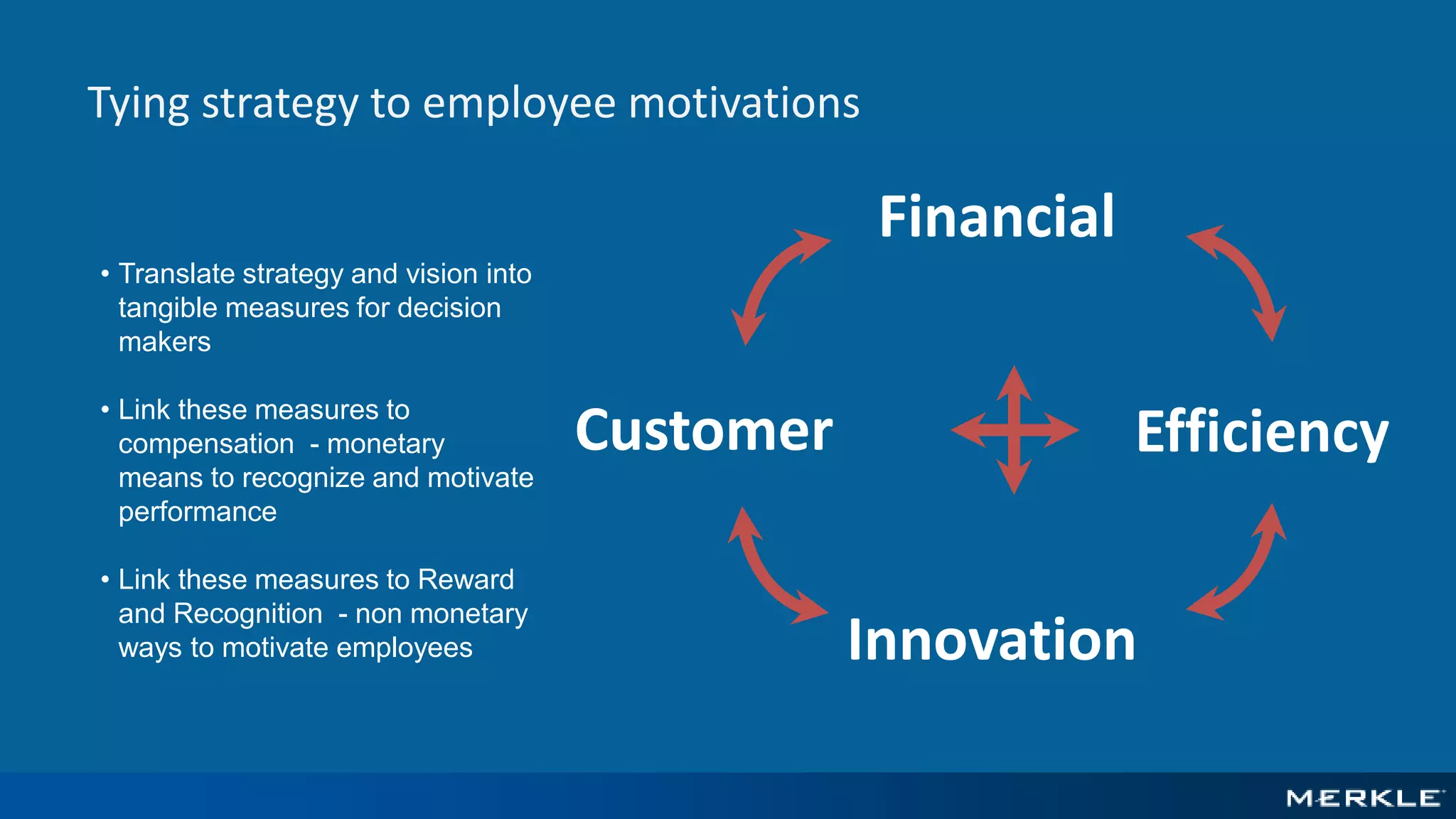
Tying strategy to employee motivations
Financial
• Translate strategy and vision into
tangible measures for decision
makers
• Link these measures to
compensation - monetary
means to recognize and motivate
performance
• Link these measures to Reward
and Recognition - non monetary
ways to motivate employees
Customer
Innovation
Efficiency
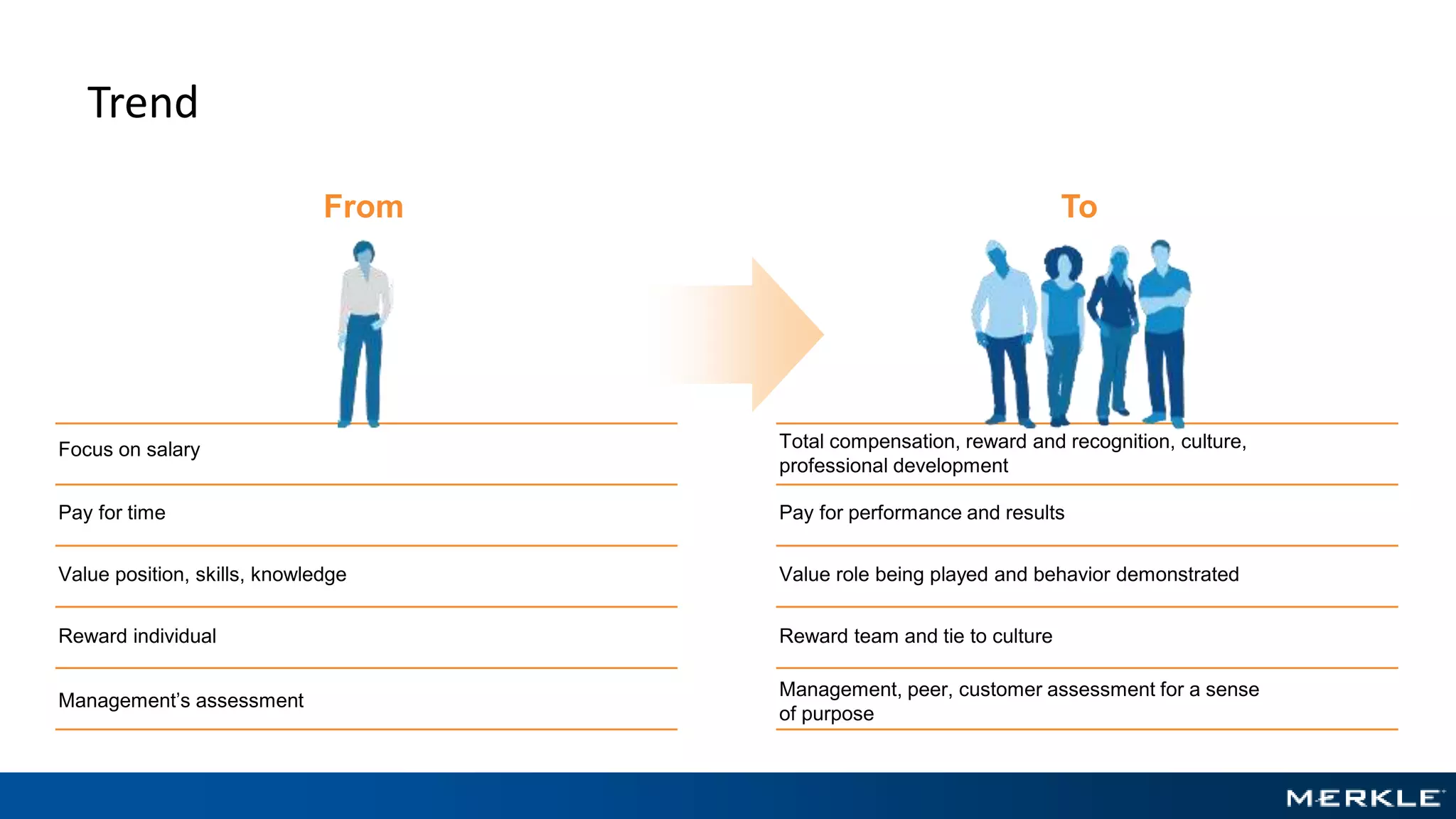
Trend
From
Focus on salary
Pay for time
Value position, skills, knowledge
Reward individual
To
Total compensation, reward and recognition, culture,
professional development
Pay for performance and results
Value role being played and behavior demonstrated
Reward team and tie to culture
Management’s assessment
Management, peer, customer assessment for a sense
of purpose
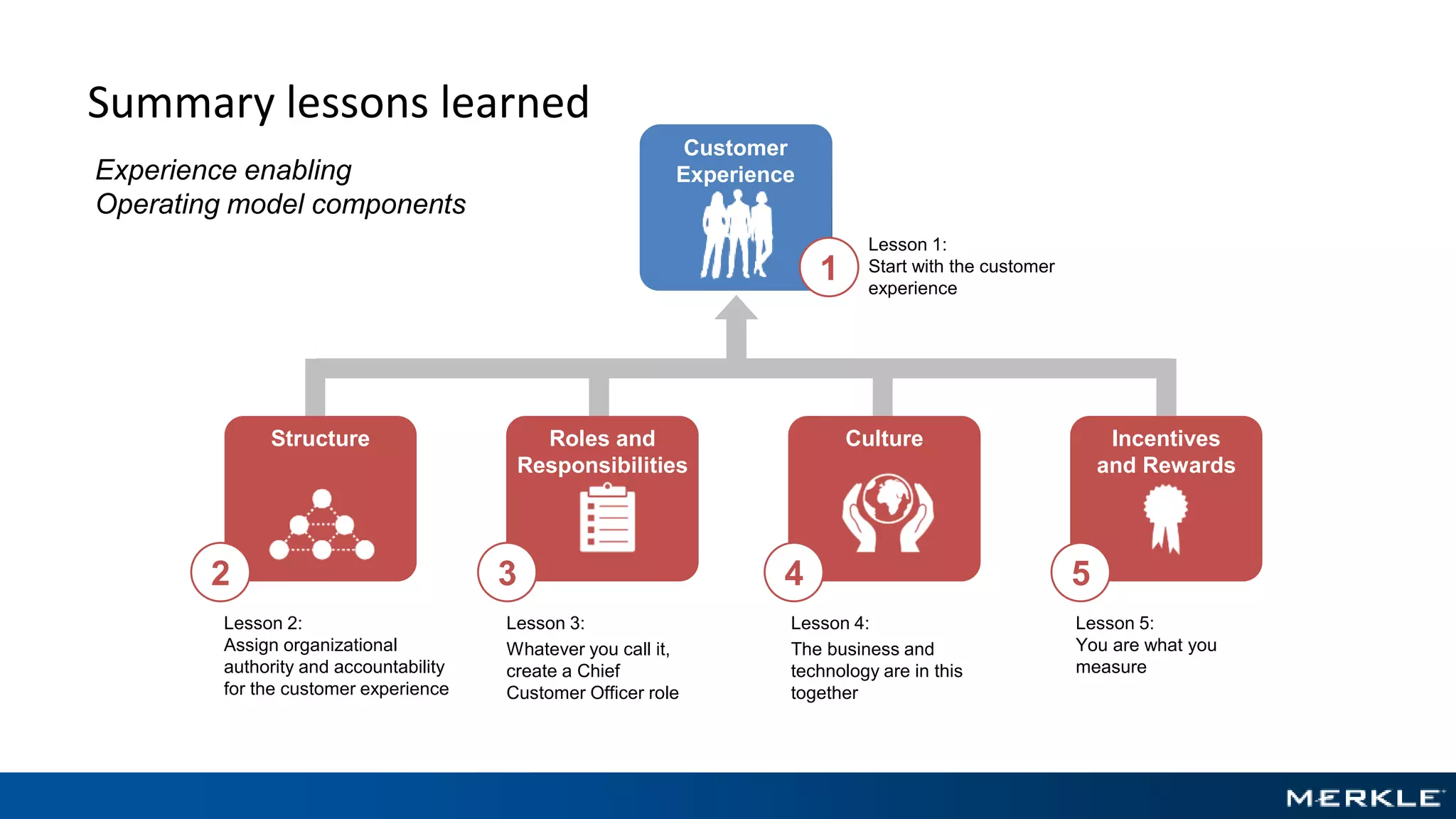
Summary lessons learned
KPIs
CultureStructure Roles and
Responsibilities
Incentives
and Rewards
Lesson 3:
Whatever you call it,
create a Chief
Customer Officer role
Lesson 5:
You are what you
measure
Lesson 4:
The business and
technology are in this
together
Lesson 1:
Start with the customer
experience
Customer
Experience
Lesson 2:
Assign organizational
authority and accountability
for the customer experience
Experience enabling
Operating model components
1
2 3 4 5
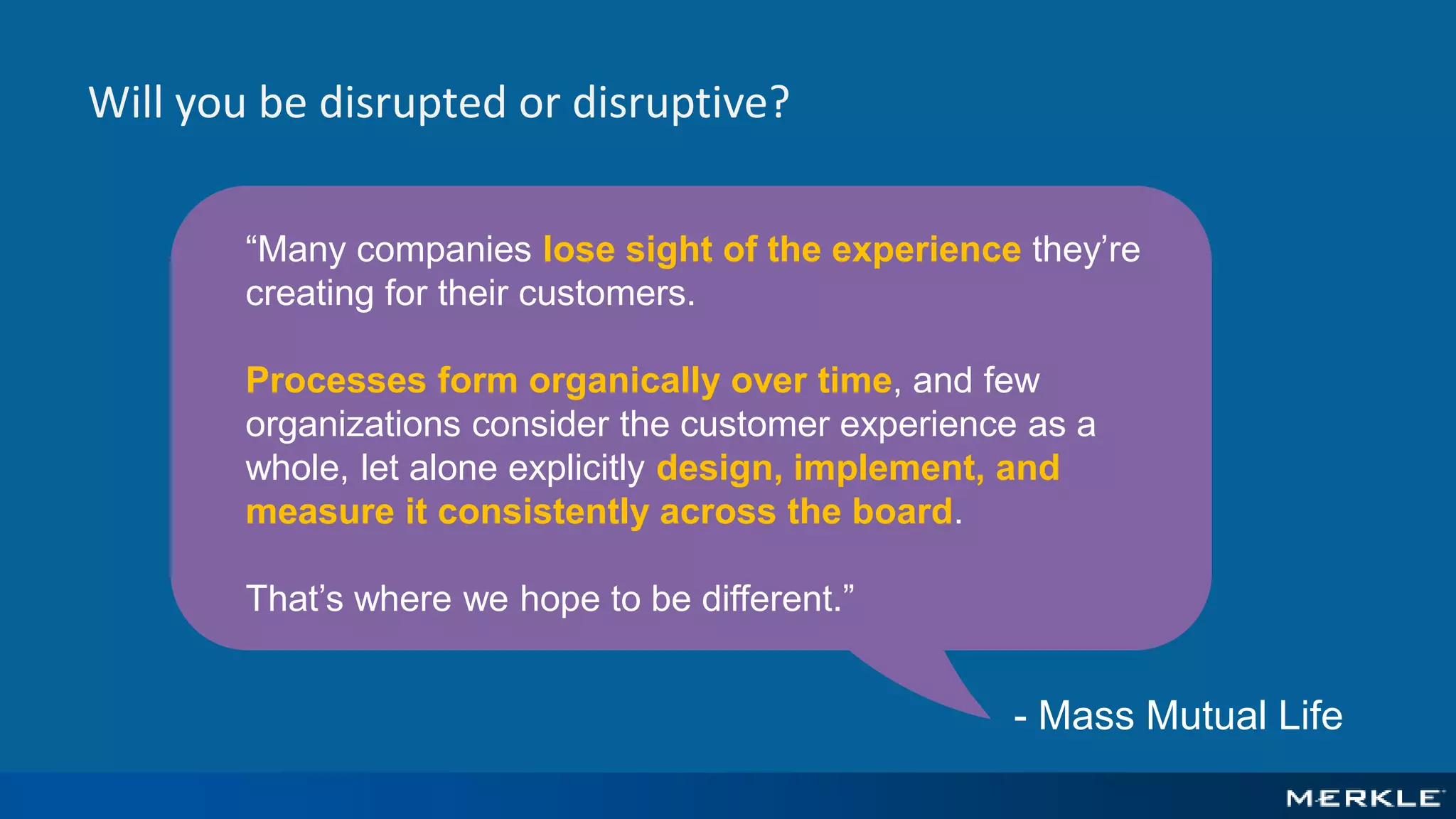
“Many companies lose sight of the experience they’re
creating for their customers.
Processes form organically over time, and few
organizations consider the customer experience as a
whole, let alone explicitly design, implement, and
measure it consistently across the board.
That’s where we hope to be different.”
Will you be disrupted or disruptive?
- Mass Mutual Life
Discussion
1. What’s the biggest organizational barrier (to delivering an above average customer
experience) that currently encounter?
2. How can structure and process help overcome barriers?
3. How customer centric is your organization? How agile?
4. What roles need to be clarified or created in your organization to advance the customer
experience?
5. What can you change starting this month to improve organizational performance with
regards to the addressable experience
Thank You!
To watch the full webinar presentation, please head here:
http://bit.ly/1vJ2YvZ

Overcoming the Organizational Challenge

  • 1.
    Module 3: Overcoming theOrganizational Challenge Leah van Zelm Principal Consultant
  • 2.
  • 3.
    Introduction Building an enterprise-wide,customer-centric strategy that is able to drive investment decisions across the organization is critical to success. But today’s organization does not enable a positive customer experience because it does not have the operating model in place to exploit customer centricity. What’s needed is an Experience Enabling Operating Model designed around what’s right for the consumer, NOT what’s easy for the organization.
  • 4.
    Lessons learned KPIs CultureStructure Rolesand Responsibilities Incentives and Rewards Lesson 3: Whatever you call it, create a Chief Customer Officer role Lesson 5: You are what you measure Lesson 4: The business and technology are in this together Lesson 1: Start with the customer experience Customer Experience Lesson 2: Assign organizational authority and accountability for the customer experience Experience enabling Operating model components 1 2 3 4 5
  • 5.
    Lesson 1: Start withthe customer experience KPIs Customer Experience 1 Lesson 1
  • 6.
    Data, Technology: The underlyingtools to enable people and processes. People and processes: The internal operating model that delivers on business objectives Touchpoints: Points in time where customer engages with business though media/channel Interactions: Activities that customer engages in with the business to accomplish an objective Experience: Perception based on the sum of interactions Experience drives the organization Organization often drives experience But you should start with the entire experience in mind.
  • 7.
    T O UC H P O I N T S Touch points designed without an overall strategy for how interactions will manifest in an experience Many of today’s organizations allow the customer treatment to be defined at individual touch points. Product Goals Corporate Goals Brand Goals Brand Objectives Design Touch point Online Objectives Design Touch point Offline Objectives Design Touch point Execute & Measure Execute & Measure Execute & Measure
  • 8.
    This means thatwhen thinking about corporate processes, the experience design is an earlier activity. J O U R N E Y Customer experience defined first in the form of a customer journey Then the interactions translated into touch points Execute and Measure Translate Journey to Interactions Execute and Measure Design Overall Journey Corporate Goals Measure
  • 9.
    From silos oftouch points to integrated journeys. Product Goals Corporate Goals Brand Goals Brand Objectives Design Touch Points Online Objectives Design Touch Points Offline Objectives Design Touch Points Execute & Measure Execute & Measure Execute & Measure Execute & Measure Translate Journey to Interactions Execute & Measure Design Overall Journey Corporate Goals Measure E X P E R I E N C ET O U C H P O I N T S
  • 10.
    Lesson 2 Lesson 2: Assignorganizational authority and accountability for the customer experience 2 Structure
  • 11.
    Customer experience inconsistentacross product and media/channels •Divisions own P&L, strategy •Marketing, sales and service controlled by divisions •Media execution lack efficiency and coordination Customer experience drives product and media/channels •Marketing, sales and service - single governance •Divisions support the customer experience •Media measured and executed holistically Changes to processes, mean changes to organizational structure. T O I N T E G R AT E D S T R U C T U R E F R O M S I L O E D S T R U C T U R E
  • 12.
    Different organizational modelsare optimal in different circumstances. HighLow CustomerCentricity HighLow Media/Channel Integration
  • 13.
    Degree of CustomerCentricity CustomerCentricProductCentric KPI Goal Culture Makes Sense Looks Like • Customer value • Share of wallet • Customer experience • Best solution for customer • Find products for customers • Relationship management • Customer knowledge and experience delivery is a competitive advantage • High degree of customer overlap across products • Customer insight led • Customer specific metrics in place • Product P&L • New products • Share of market • Best product • Find customers for its product • Product or process innovation • Innovation is a competitive advantage • Limited customer overlap with product • Product managers own P&L • If segments exist, they are aligned with division Clarity on the degree of product vs. customer focus must understood, rationalized and shared among leadership. HighLow CustomerCentricity
  • 14.
    Degree of Media/ChannelIntegration Regardless of product vs. customer focus, media and channel integration is important to eliminating artificial silos. Phase 1 Phase 2 Phase 3 Phase 4 Phase 5 Email & DM Digital Media Integration Mass Media Integration Digital Channels Integration Offline Channel Integration Fully Integrated Experience Regardless of product vs. customer focus, media and channel integration is important to eliminating artificial silos. HighLow Media/Channel Integration
  • 15.
    Different organizational modelsare optimal in different circumstances. HighLow CustomerCentricity HighLow Media/Channel Integration Division Centric Low Integration Customer Centric Low Integration Customer Centric High Integration Division Centric High Integration
  • 16.
    Card Services President Branded Card Services Presidentof Product 1 Product Advertising Analytics Customer Ex. President of Product 3 Product Advertising Analytics Customer Ex. Centers of Excellence Operations Direct Mail Digital Database Service Credit and Collections Product Centric Media/Channel Integration Branded Card Services PRODUCT STRATEGY EXECUTION CENTRALIZED PRODUCT P&L President of Product 1 Product Advertising Analytics Customer Ex. Centers of Excellence Operations Direct Mail Digital Database Service Credit and Collections
  • 17.
    Lesson 3 Lesson 3: Whateveryou call it, create a Chief Customer Officer role 3 Roles & Responsibilities
  • 18.
    Source: Forrester 2014 ChiefCustomer Officers are on the rise. • AKA: Chief Experience Officer, Chief Client Officer, SVP Customer Experience • Still a new role, with average tenure of 2 years • 58% are internal hires: operations, GM, marketing, sales, service • 85% are part of executive team (up from 50% in 2012) • Various spans of control CCO
  • 19.
    Chief Customer Officer ChiefMarketing Officer Chief Customer Officer • Controls the marketing experience • May influence other experiences • Single point of control over experience • Owns P&L outcomes • Nurture the customer centric culture • Marketing, sales and service Increasing span of control
  • 20.
    Lesson 4 Lesson 4: Thebusiness and technology are in this together4 Culture
  • 21.
    Culture People / Organization Culture Culture: The setof habitual and traditional ways of thinking, feeling and reacting that are characteristic of the ways a particular society meets its problems at a particular point in time. Organizational Culture: The pattern of beliefs, values and learned ways of coping with experience that have developed during the course of an organization’s history and which tend to be manifested in its material arrangements and in the behaviors of its members.
  • 22.
    Culture must supportrapid learning, application of insight to decisions, nimble collaboration around customer. • Accountability to customer metrics; reward differentially for customer related performance • Place trust in and empower employees to drive to customer experience goals • Communicate customer experience achievements Customer Centricity • Support informed risk taking by rewarding and measuring innovation and learning rather than punish it • Embrace constant changes and tweaks - “fail fast, learn fast” (as opposed to a big bang) Agile Decisioning
  • 23.
    CCO and CIOroles changing Shared accountability for experience Define and drive portfolio objectives via an optimized customer experience Enable and deliver on the customer experience CCO CIO FROM • React quickly to market • Business focus, customer focus • Develop own solutions TO • Be tied at the hip with CIO • Know data and technology • Plan for long term with CIO FROM • Mitigate risk • Process oriented • Well-established governance • Aligned with Finance or Operations TO • More agile and nimble • Aligned with business • Have a seat at the table with CCO • Aligned with customer priorities
  • 24.
    Marketing Technologist toIntegrate CIO and CCO VP of Marketing and IT to harness the power of Marketing and Information/IT alignment Customer journey to define roles and tools Systems, processes, tools to enable experience Half the team are marketers with affinity for technology Half the team are technologists with affinity for marketing and sales IT and marketing culture of collaboration
  • 25.
    Lesson 5 Lesson 5: Youare what you measure5 Incentives & Rewards
  • 26.
    Tying strategy toemployee motivations Financial • Translate strategy and vision into tangible measures for decision makers • Link these measures to compensation - monetary means to recognize and motivate performance • Link these measures to Reward and Recognition - non monetary ways to motivate employees Customer Innovation Efficiency
  • 27.
    Trend From Focus on salary Payfor time Value position, skills, knowledge Reward individual To Total compensation, reward and recognition, culture, professional development Pay for performance and results Value role being played and behavior demonstrated Reward team and tie to culture Management’s assessment Management, peer, customer assessment for a sense of purpose
  • 28.
    Summary lessons learned KPIs CultureStructureRoles and Responsibilities Incentives and Rewards Lesson 3: Whatever you call it, create a Chief Customer Officer role Lesson 5: You are what you measure Lesson 4: The business and technology are in this together Lesson 1: Start with the customer experience Customer Experience Lesson 2: Assign organizational authority and accountability for the customer experience Experience enabling Operating model components 1 2 3 4 5
  • 29.
    “Many companies losesight of the experience they’re creating for their customers. Processes form organically over time, and few organizations consider the customer experience as a whole, let alone explicitly design, implement, and measure it consistently across the board. That’s where we hope to be different.” Will you be disrupted or disruptive? - Mass Mutual Life
  • 30.
    Discussion 1. What’s thebiggest organizational barrier (to delivering an above average customer experience) that currently encounter? 2. How can structure and process help overcome barriers? 3. How customer centric is your organization? How agile? 4. What roles need to be clarified or created in your organization to advance the customer experience? 5. What can you change starting this month to improve organizational performance with regards to the addressable experience
  • 31.
    Thank You! To watchthe full webinar presentation, please head here: http://bit.ly/1vJ2YvZ

Editor's Notes

  • #3 Why you should care
  • #4 To deliver experience, need organization designed for experience
  • #5 5 lessons on how to deliver on customer experience
  • #7 Hard to deliver on customer experience when touch points aren’t aligned
  • #8 Examples: Call centers have their own business rules for customer prioritization IVR offers defined by call center team Branch has their own way of delivering an experience Marketing defines their own treatment strategy Brand and direct marketing processes completely separate Corporate objectives translated into product objectives, which are translated into media/channel objectives. Consumer experience defined very narrowly (for a product within a media/channel) Result is a disjoined experience Measurement and optimization limited to narrowly defined experiences. Lack a true view of experience measurement and investment contribution Results in sub-optimal budget allocation
  • #9 Example: USAA has identified approximately 100 keyexperiences associated with customer journeys like buying a car or preparing to deploy abroad, all of which have owners and cross-functional teams held accountable for underlying processes. Steve Jobs: Design is a funny word. Some people think design means how it looks, but of course, if you dig deeper, it’s really how it works”
  • #10 Customer strategy and associated experience defined up front and holistically. Cross experience KPIs developed and tied to individual performance goals – accountability Coordinated development and execution of the customer experience across media/channels Seamless and positive experience Efficiencies realized through media/channel integration Measurement across the experience and across the organization
  • #12 Reminder: not one size fits all
  • #13 Framework to think about components of your organization - highlight 2 dimensions
  • #14 It’s a continuum, rarely black and white. Ask what’s going to give you competitive edge Product innovation Customer and brand experience
  • #15 Hard to deliver on customer experience without integration at thouch points – this can mean formal organizaiton or other ways of alignment
  • #16 Framework to think about components of your organization - highlight 2 dimensions
  • #17 Example of Product focus with strong media/channel integration
  • #18 Who should be responsible for the experience?
  • #23 Dogs Ass – agility example. Define the behaviors that you need to enforce. Culture can be polarizing (either feel natural or wont enjoy). Merkle culture guide – intentional . Example – safety vs. agility (every meeting started with tailgate meeting that included a safety story) VS disney Zappos – see call center connections as marketing opportunity not operational How do you take disparate functions and ask to work cross functionally – resistance Evolve vs revolution? (Big change at best buy book) – introduced playbooks to unfreeze/refreeze
  • #24 Key message: Moving to a modern marketing organization means developing processes that drive agility and collaboration Majority of the processes in the PM context are those that support decisioning within CCO and CIO organizations. The joint decisioning has emerged from the digital world - the world where customer engagement relies on technology to supplement traditional touch points. Example: Mike Collins, travelers
  • #27 Examples Google - financial and efficiency outcomes : monetary - innovation: provide time to innovate
  • #28 Objective Retain high performers Drive needed financial results and associated behavior Support agility in organizaiton