Organizational Theory, Design, and Change Fifth Edition Gareth R. Jones Chapter 6 Designing Organizational Structure: Specialization and Coordination
Organizational Design Proper design should lead to organizational efficiency and effectiveness. Involves decisions about the grouping of individuals/tasks into work units, departments, or divisions of the organization. Organizations must differentiate and coordinate.
What is Organizational Structure? The structure of an organization can be defined simply as the sum total of the ways in which its labor is divided into distinct tasks and then its coordination is achieved among these tasks.
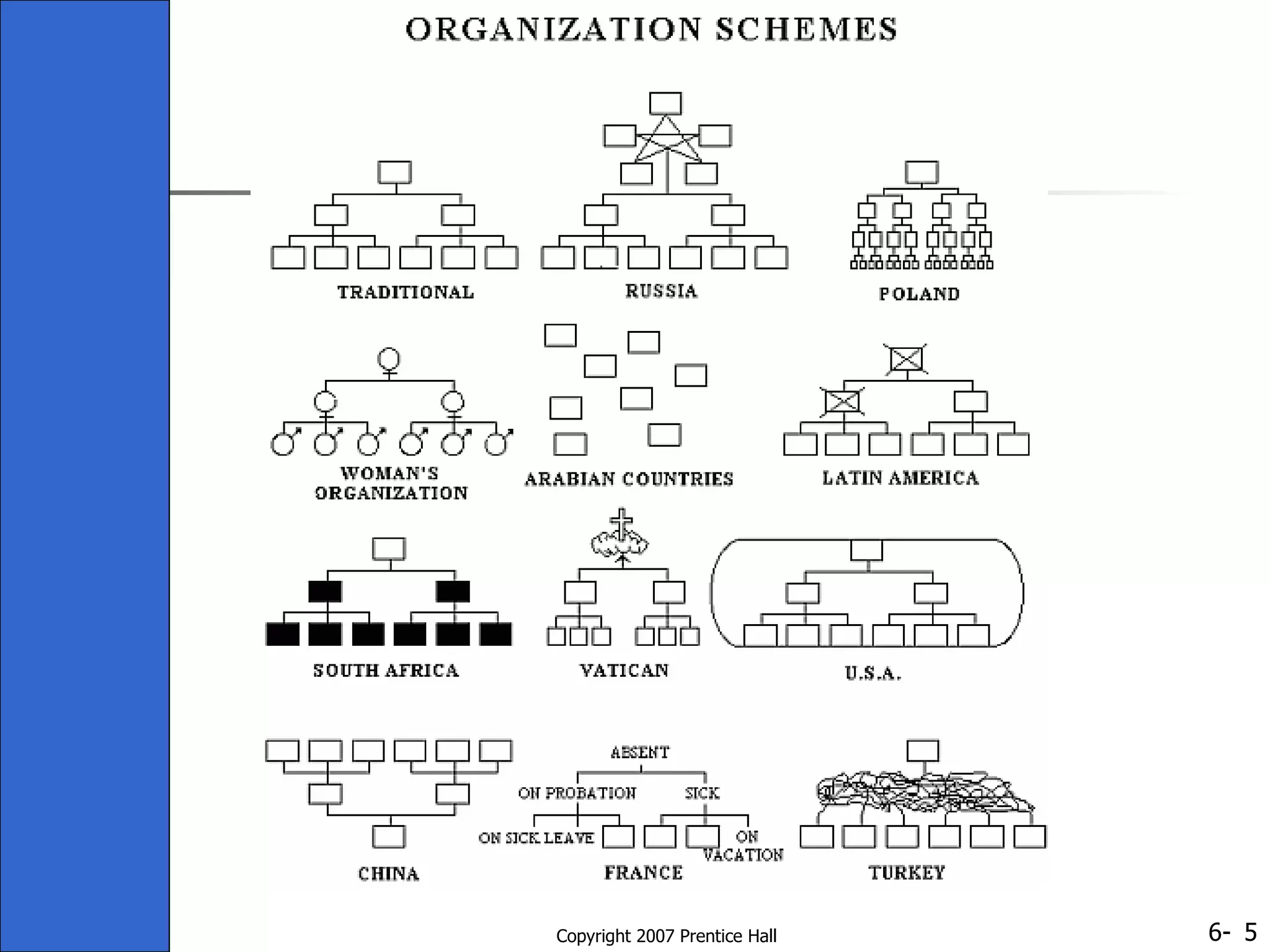
What is an Organizational Chart? Boxes show how work and responsibilities are clustered into units such as divisions, departments, sections, and teams. Lines show the management structure: Who reports to whom, how the boxes relate to each other in the hierarchy.
 
 
Why Organizational Structure Matters? Structure affects: What employees pay attention to Ease of coordinating activities Speed of producing goods/services Cost of running the business Nature and extent of supervision required Whom employees interact and build relationships with
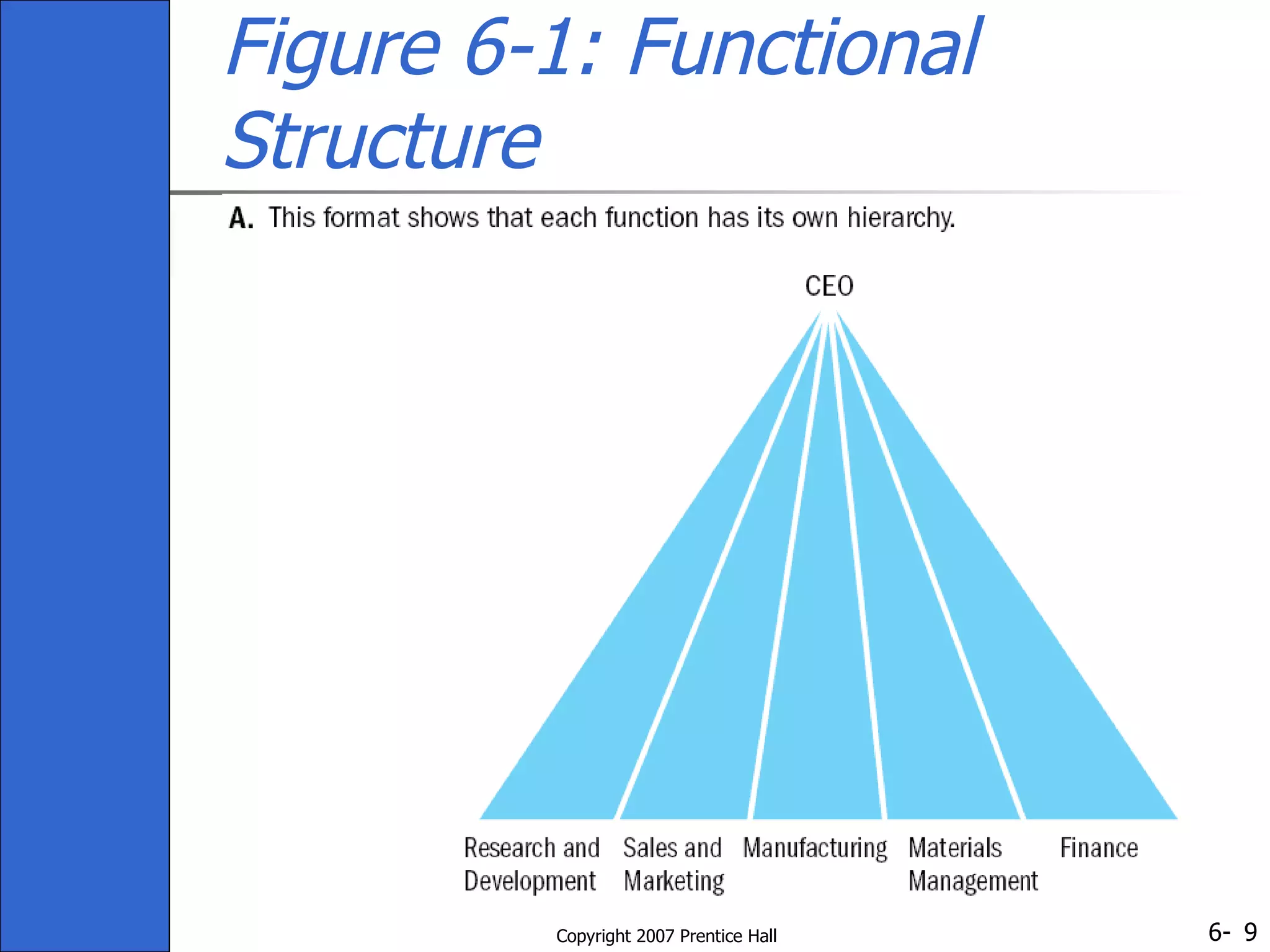
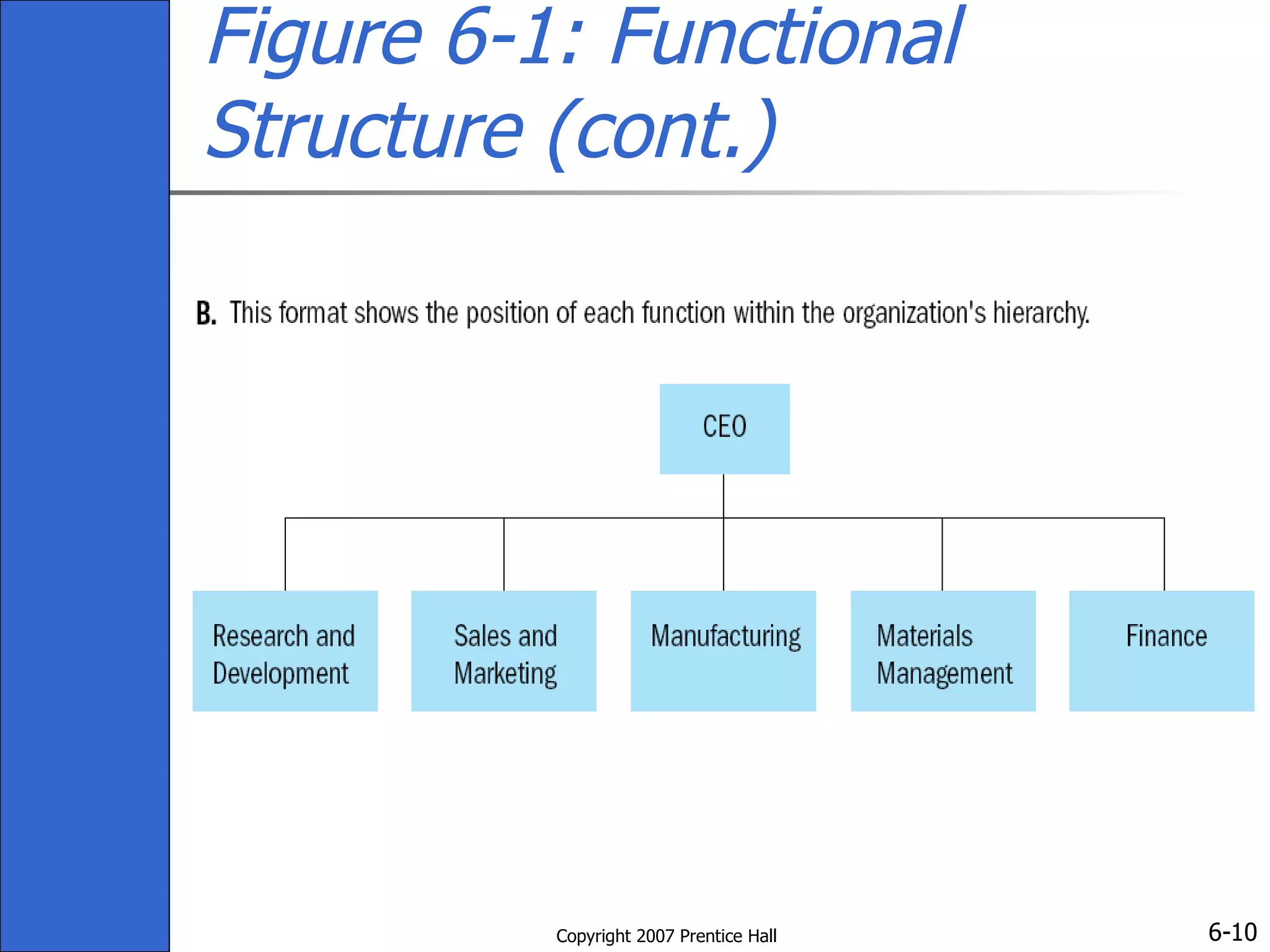
Functional Structure A functional structure is a design that groups people on the basis of their common skills, expertise, or resources they use Functional structure is the bedrock of horizontal differentiation An organization groups tasks into functions to increase the effectiveness with which it achieves its goals
Figure 6-1: Functional Structure
Figure 6-1: Functional Structure (cont.)
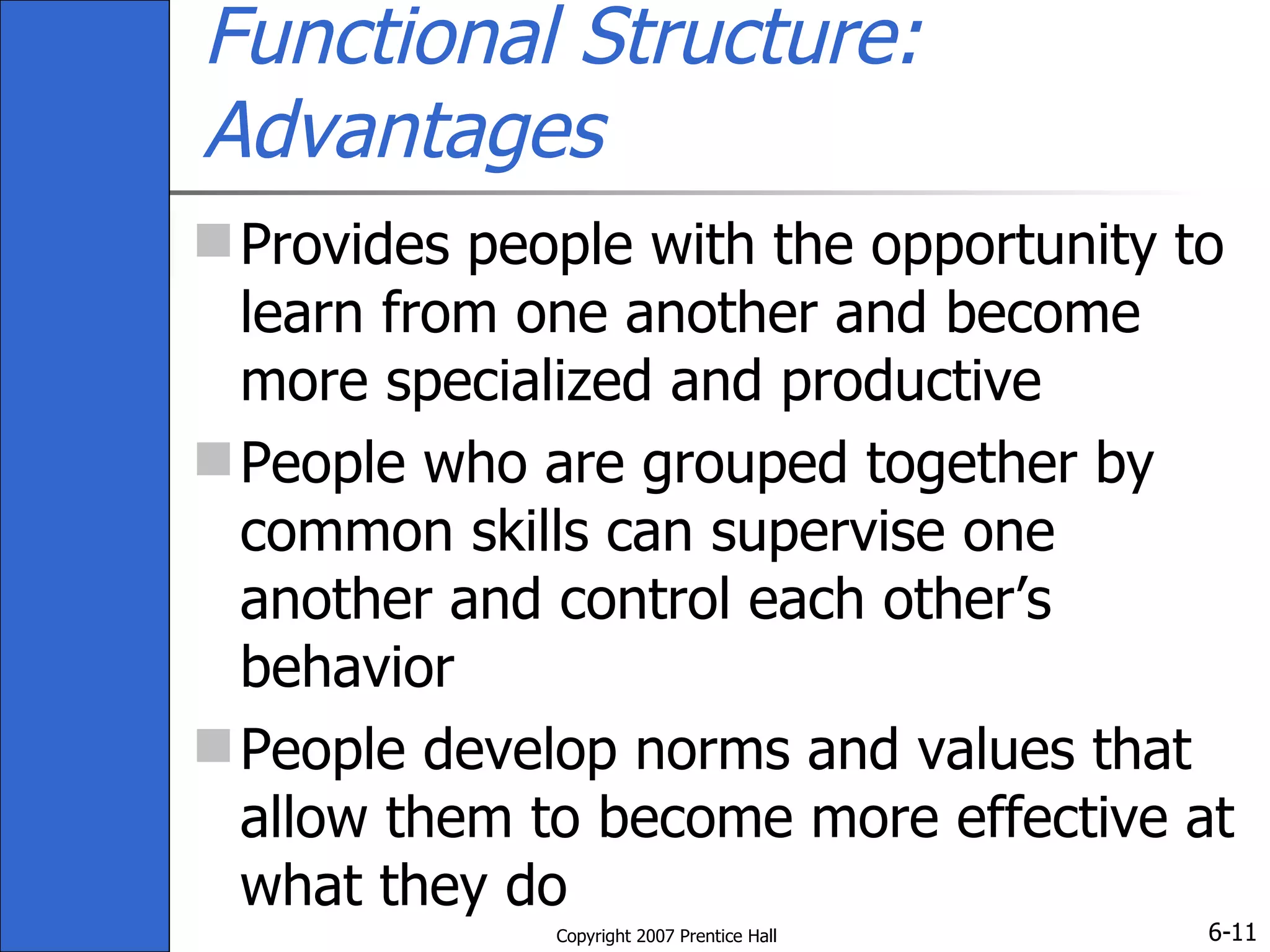
Functional Structure: Advantages Provides people with the opportunity to learn from one another and become more specialized and productive People who are grouped together by common skills can supervise one another and control each other’s behavior People develop norms and values that allow them to become more effective at what they do
Control Problems in a Functional Structure Communication Problems: as more organizational functions develop, each with their own hierarchy, they become increasingly distant from one another Measurement Problems: information needed to measure the profitability of any functional group is difficult to obtain Location Problems: centralized control hinders ability to satisfy the special needs in different geographic regions
Control Problems in a Functional Structure (cont.) Customer Problems: servicing the needs of new kinds of customers and tailoring products to suit them is relatively difficult  Strategic Problems: top managers spend too much time finding ways to improve coordination
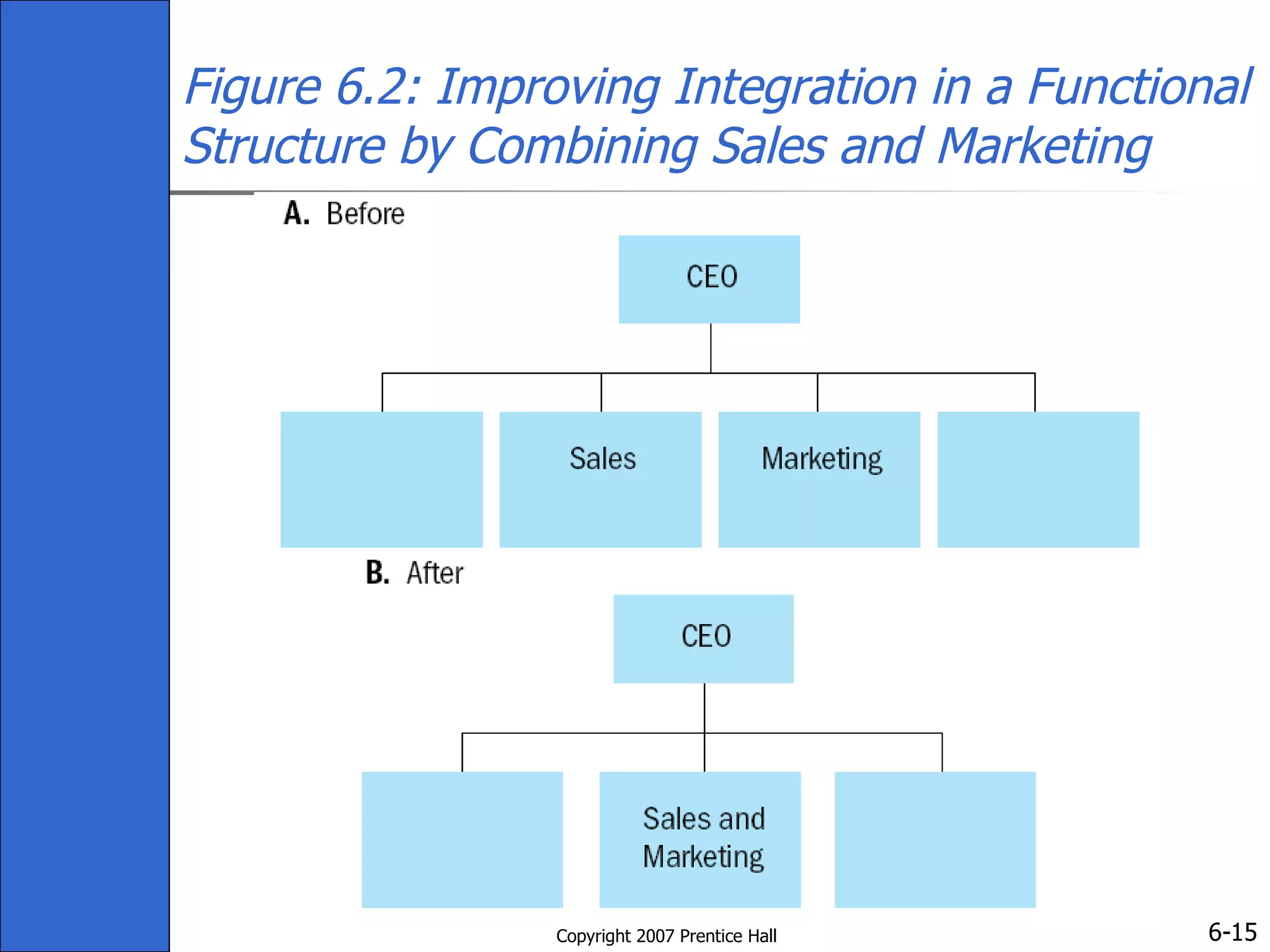
Solving the Control Problem Managers can solve control problems by redesigning the functional structure to increase integration between functions
Figure 6.2: Improving Integration in a Functional Structure by Combining Sales and Marketing
From Functional Structure to Divisional Structure Functional structure is appropriate if the organization:  Limits itself to producing a small number of similar products Produces those products in one or a few locations Sells them to only one general type of client or customer
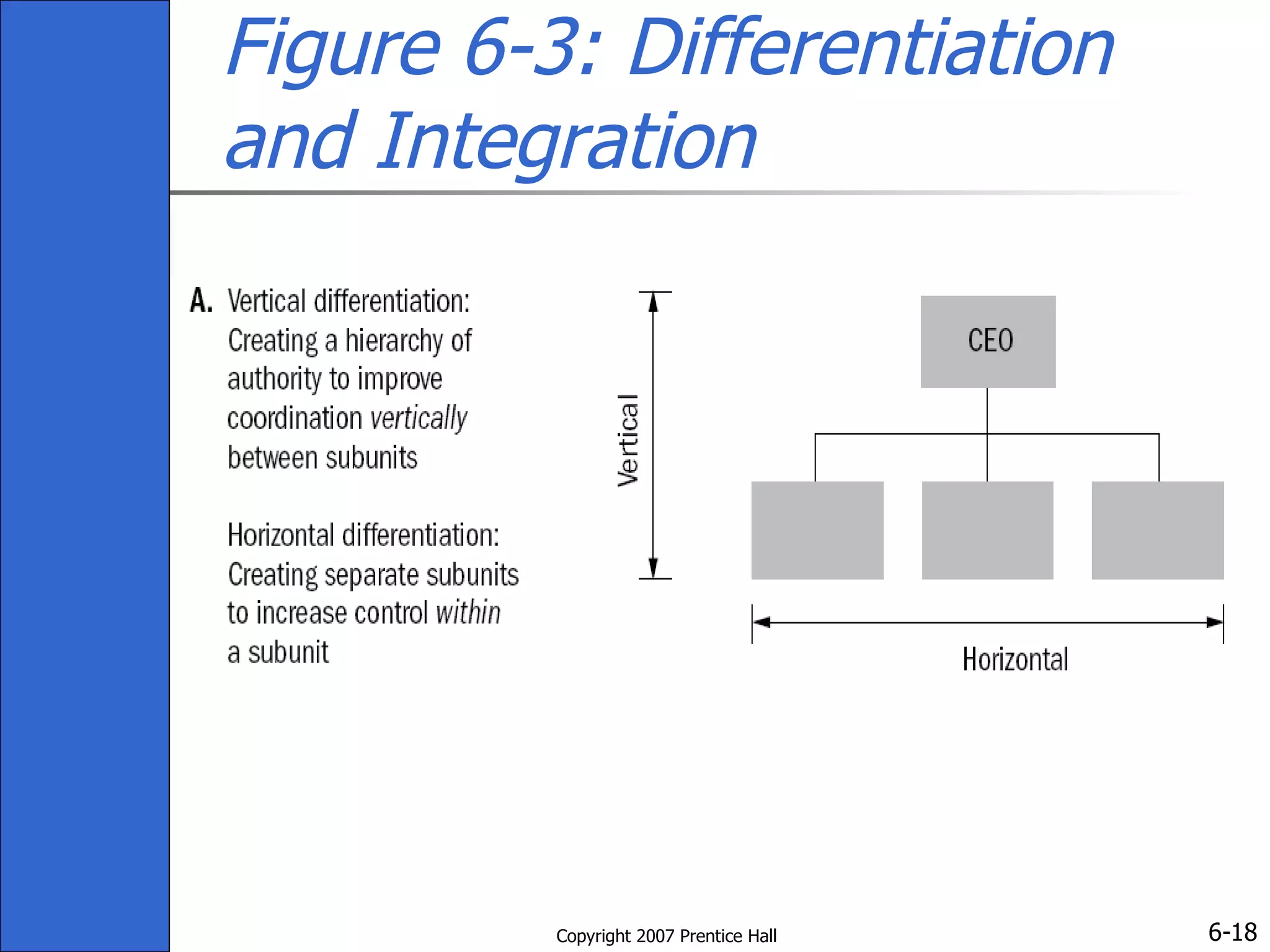
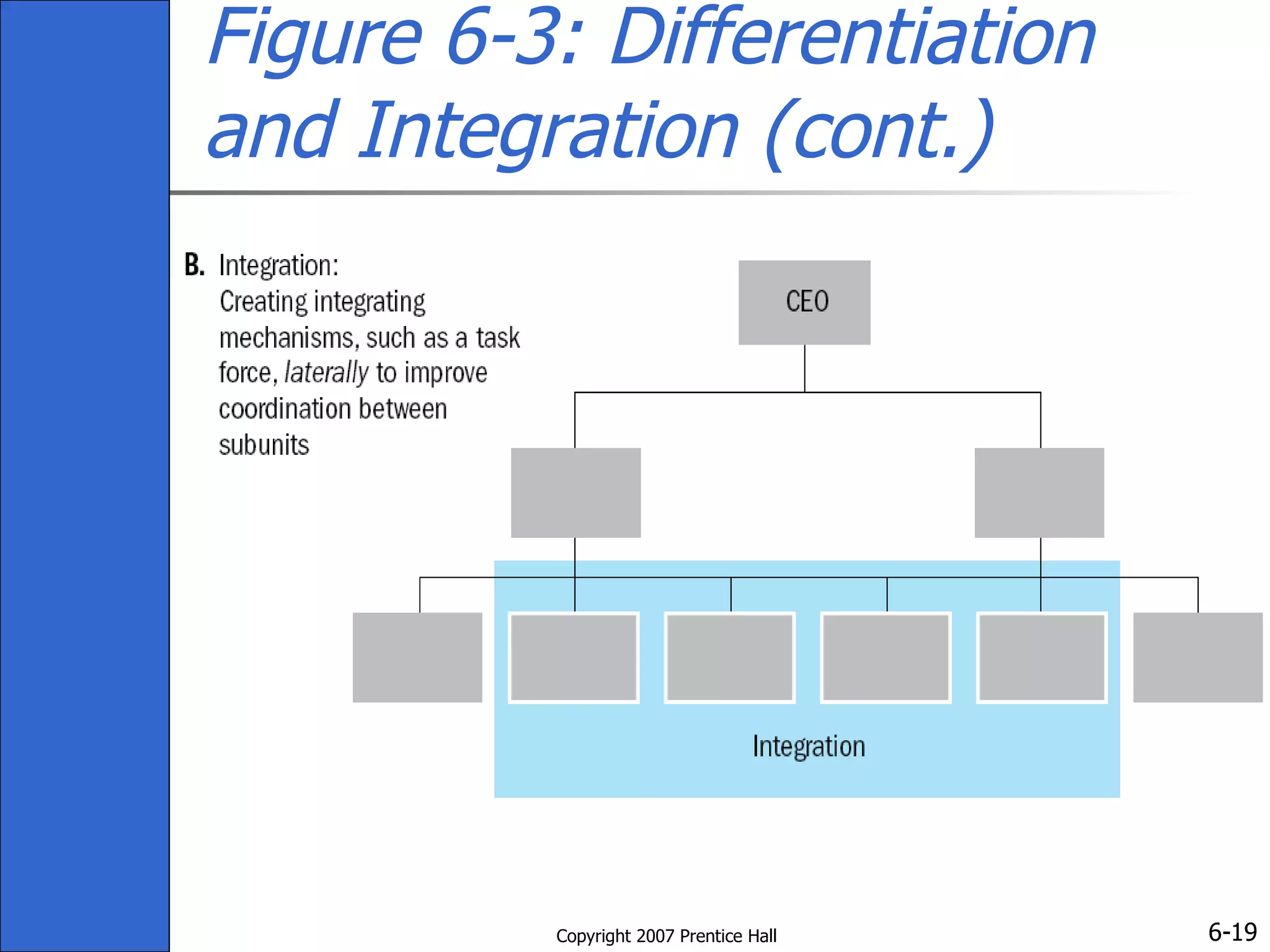
From Functional Structure to Divisional Structure (cont.) As organizations grow, they begin to produce more products that may be different from one another Organizations also increase production at a number of locations to serve many different types of customers More complex structure is based on: Increasing vertical differentiation Increasing horizontal differentiation Increasing integration
Figure 6-3: Differentiation and Integration
Figure 6-3: Differentiation and Integration (cont.)
Moving to a Divisional Structure Organizations most commonly adopt the divisional structure to solve control problems that arise with too many products, regions, or customers Divisional structure is dependent on control problem to be solved Create smaller, more manageable subunits Product structure Geographic structure Market structure
Product Structure Product structure : a divisional structure in which products (goods or services) are grouped into separate divisions according to their similarities or differences Organizations need to decide how to coordinate its product activities with support functions Leads to three kinds of product structure
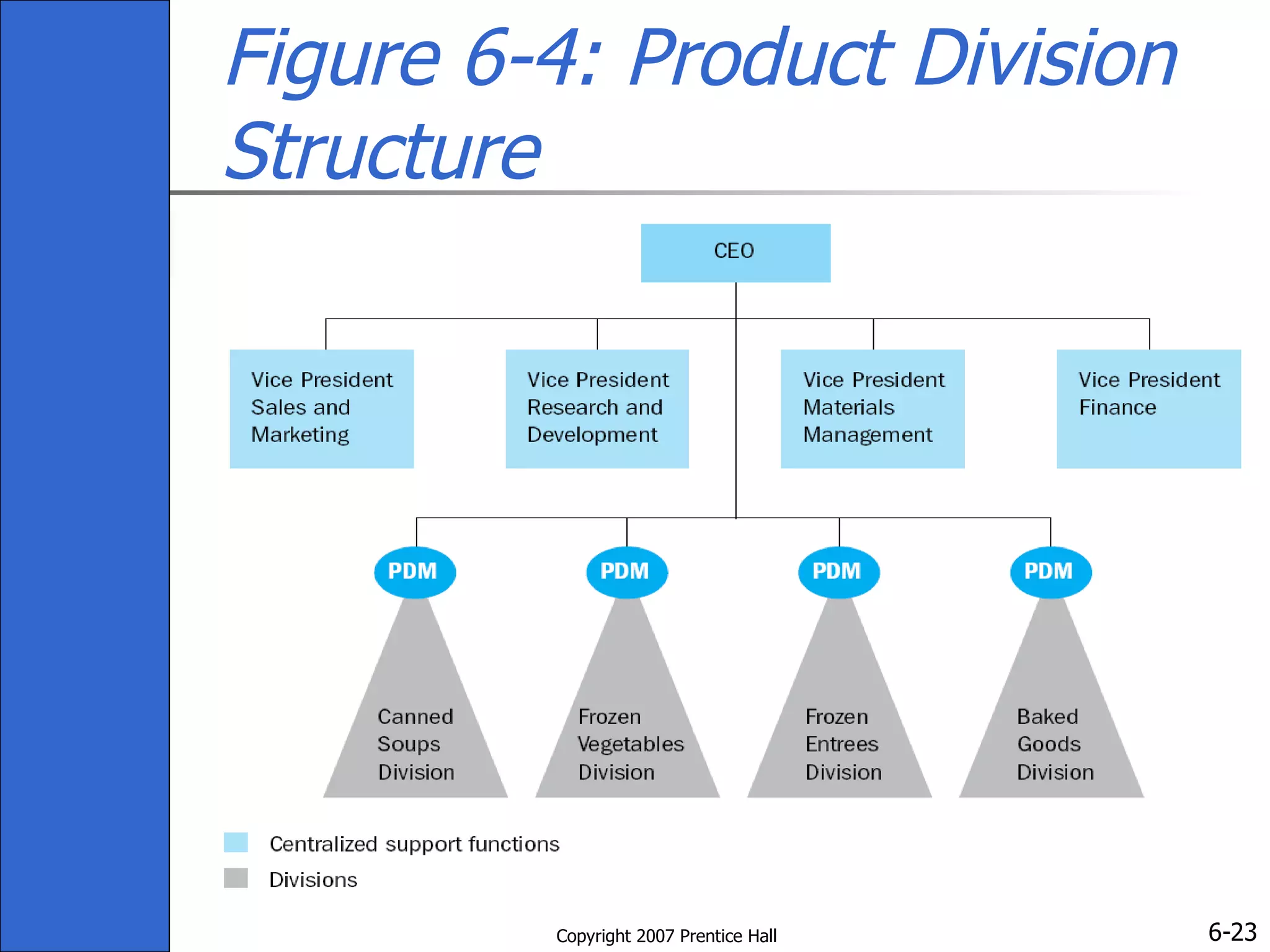
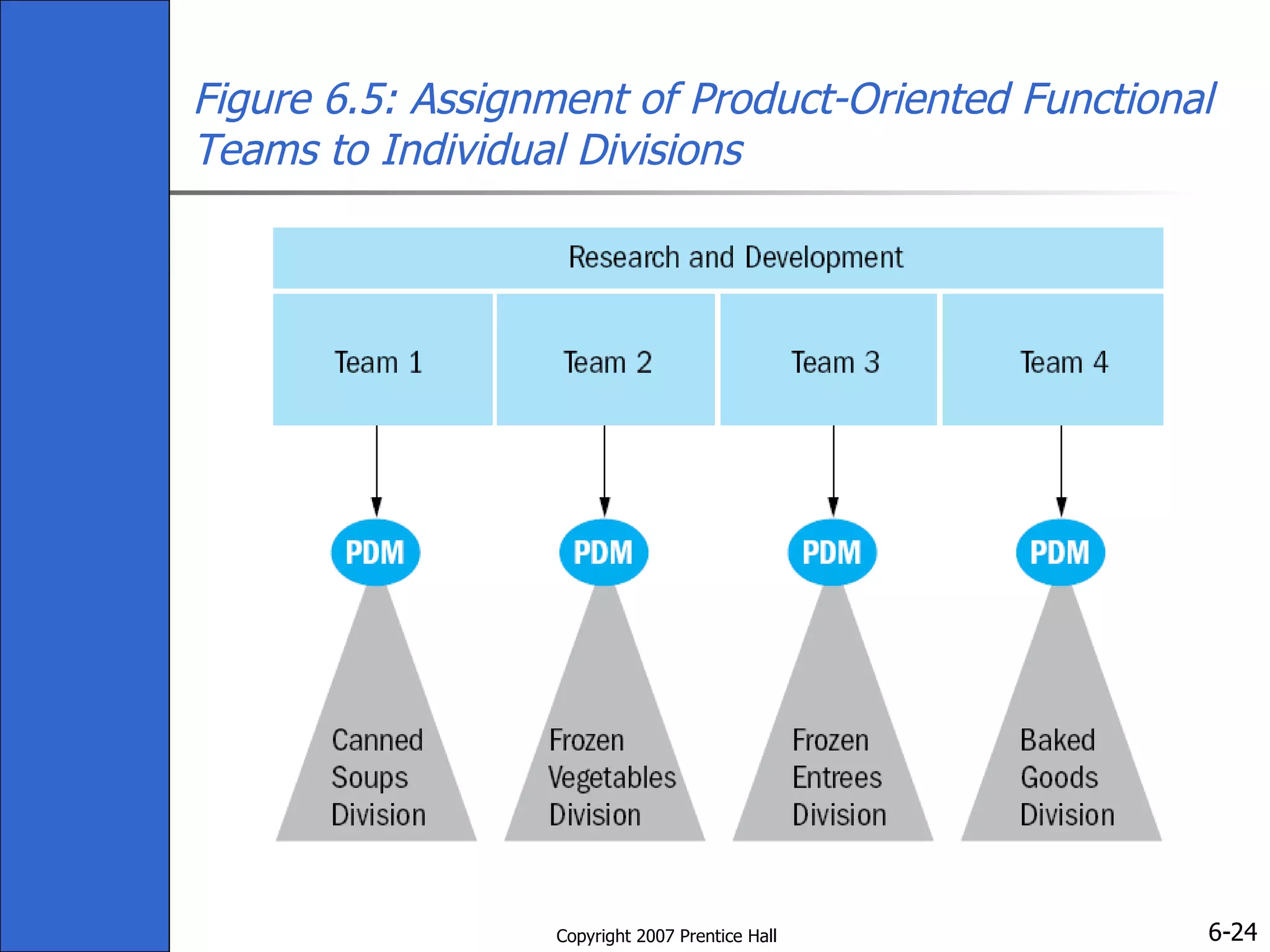
Product Structure (cont.) Product division structure : a structure in which a centralized set of support functions service the needs of a number of different product lines Support function is divided into product-oriented teams of functional specialists who focus on the needs of one particular product division
Figure 6-4: Product Division Structure
Figure 6.5: Assignment of Product-Oriented Functional Teams to Individual Divisions
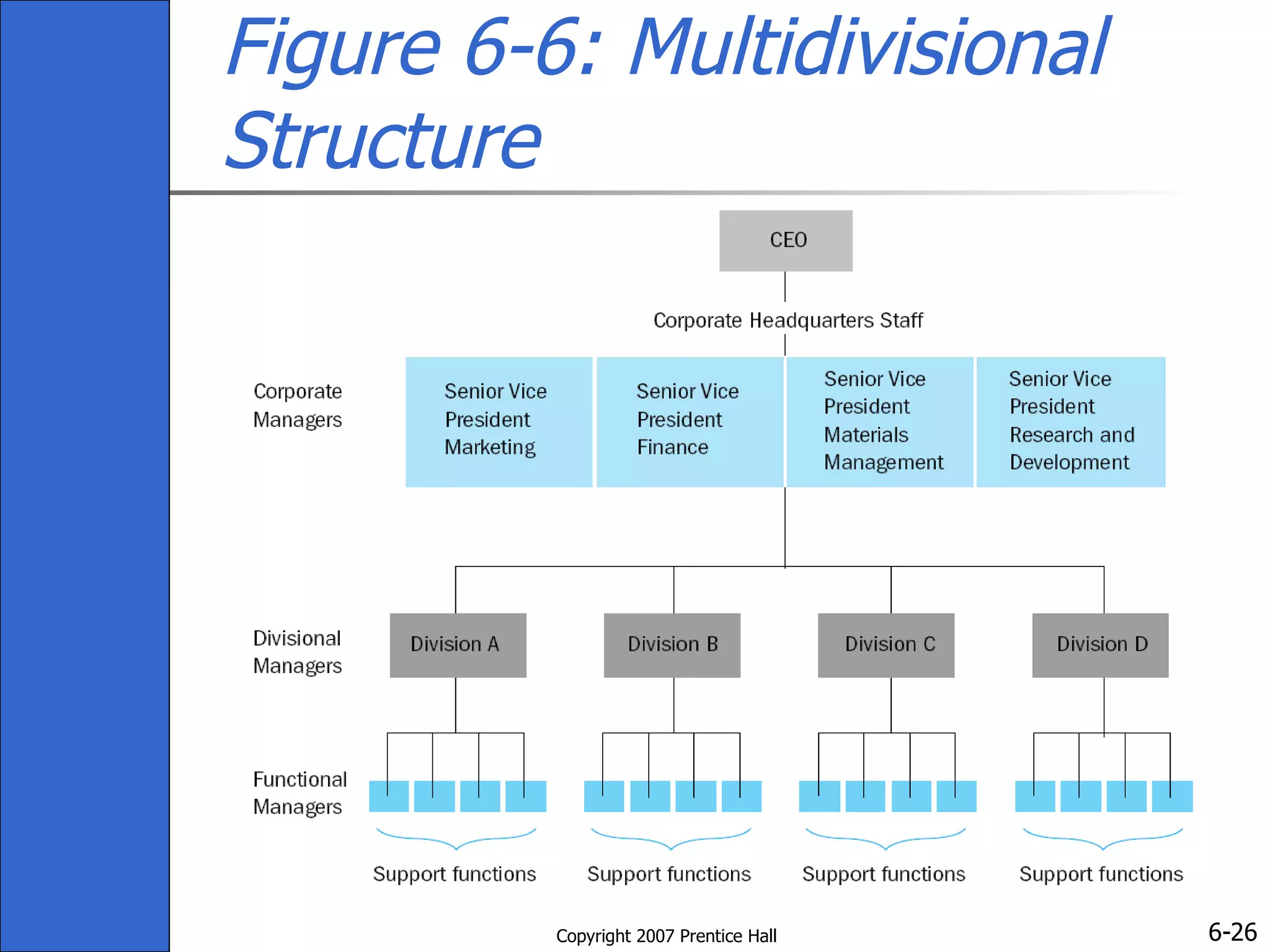
Product Structure (cont.) Multidivisional structure:  A structure in which support functions are placed in self-contained divisions Each division has its own set of support functions and controls its own value  Corporate headquarters staff:  responsible for overseeing the activities of the managers heading each division  Allows a company to operate in many different businesses
Figure 6-6: Multidivisional Structure
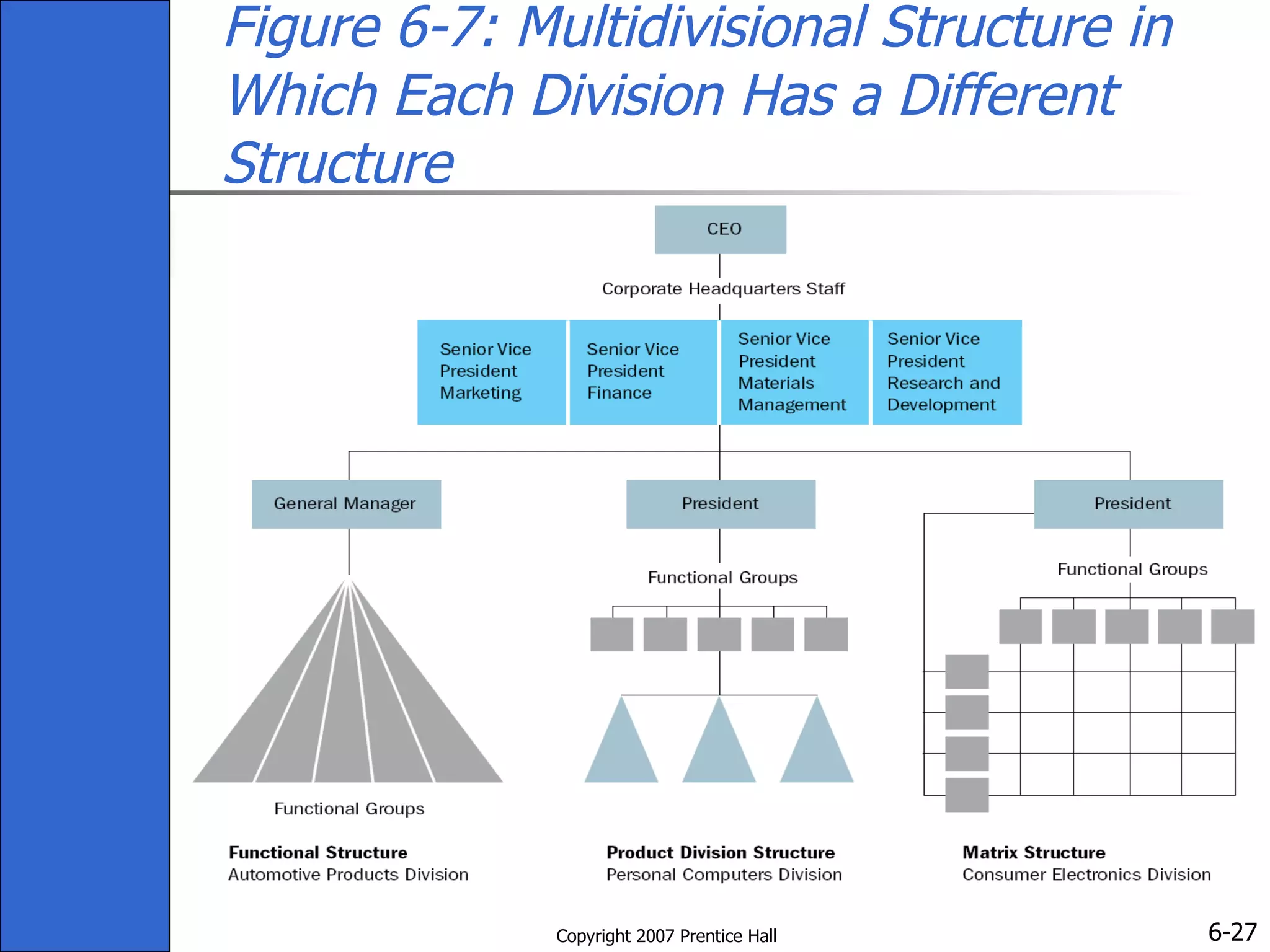
Figure 6-7: Multidivisional Structure in Which Each Division Has a Different Structure
Advantages of a Multidivisional Structure Increased organizational effectiveness: clear division of labor between corporate and divisional managers generally increases organizational effectiveness  Increased control: extra control provided by the corporate office can encourage the stronger pursuit of internal organizational efficiency by divisional managers
Advantages of a Multidivisional Structure (cont.) Profitable growth: when each division is its own profit center, individual profitability can be clearly evaluated Internal labor market: the most able divisional managers are promoted to become corporate managers
Disadvantages of a Multidivisional Structure Managing the corporate-divisional relationship: finding the balance between centralization and decentralization Coordination problems between divisions: divisions start competing for resources and coordination problems arise between divisions
Disadvantages of a Multidivisional Structure (cont.) Transfer pricing: problems between divisions often revolve around the  transfer price , i.e., the price at which one division sells a product or information about innovations to another division Bureaucratic costs: multidivisional structures are very expensive to operate  Communication problems: tall hierarchies tend to have communication problems, particularly the distortion of information
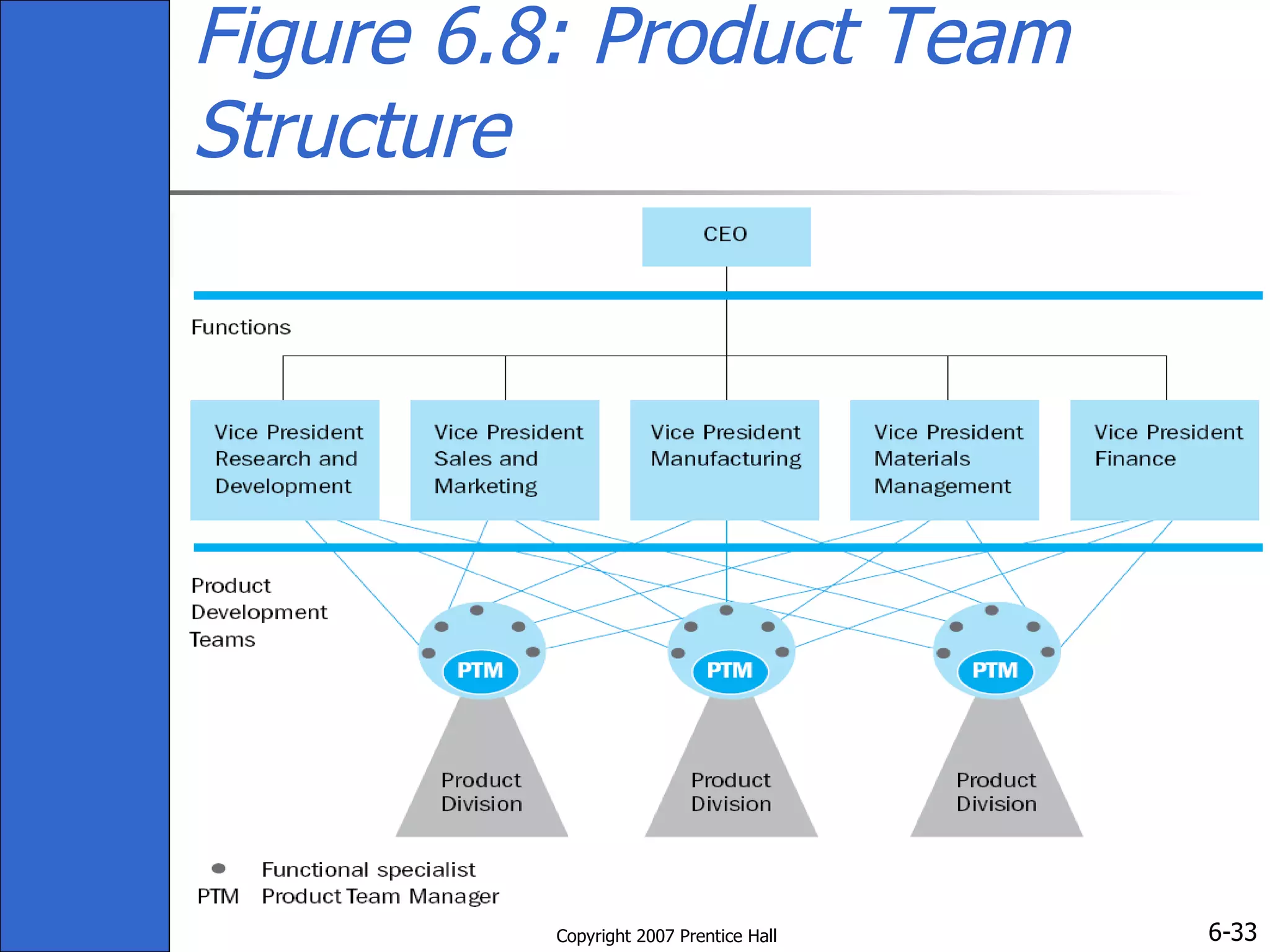
Product Structure (cont.) Product team structure : specialists from the support functions are created that specialize in the needs of particular kind of product Focus on the needs of one product (or client) or a few related products A product team structure is more decentralized than a functional structure or a product division structure, and specialists in the various product teams are permitted to make on-the spot decisions
Figure 6.8: Product Team Structure
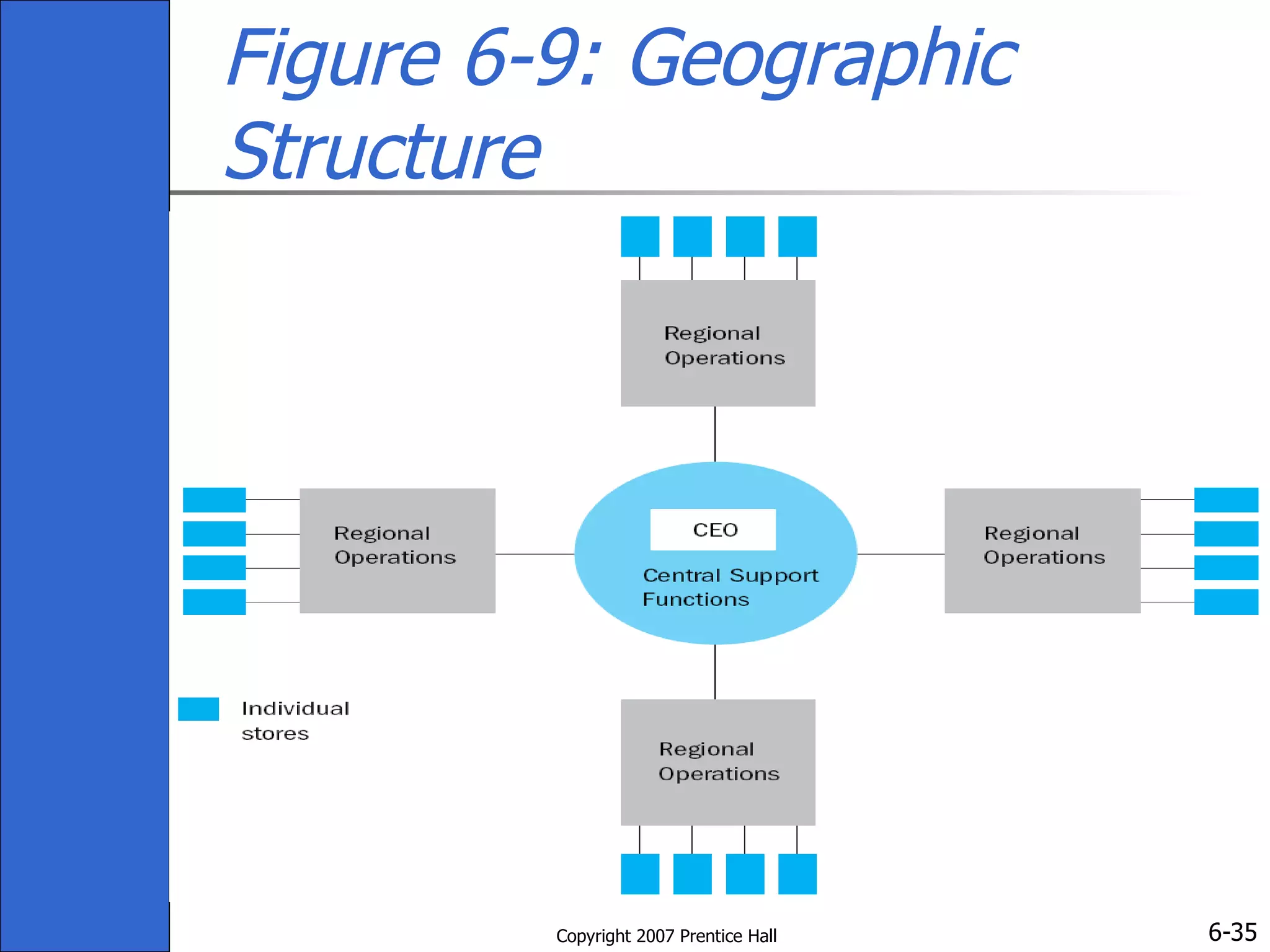
Divisional Structure II: Geographic Structure When the control problems that companies experience are a function of geography, a geographic divisional structure is appropriate Allows the organization to adjust its structure to align its core competences with the needs of customers in different geographic regions Allows some functions to be centralized and others decentralized
Figure 6-9: Geographic Structure
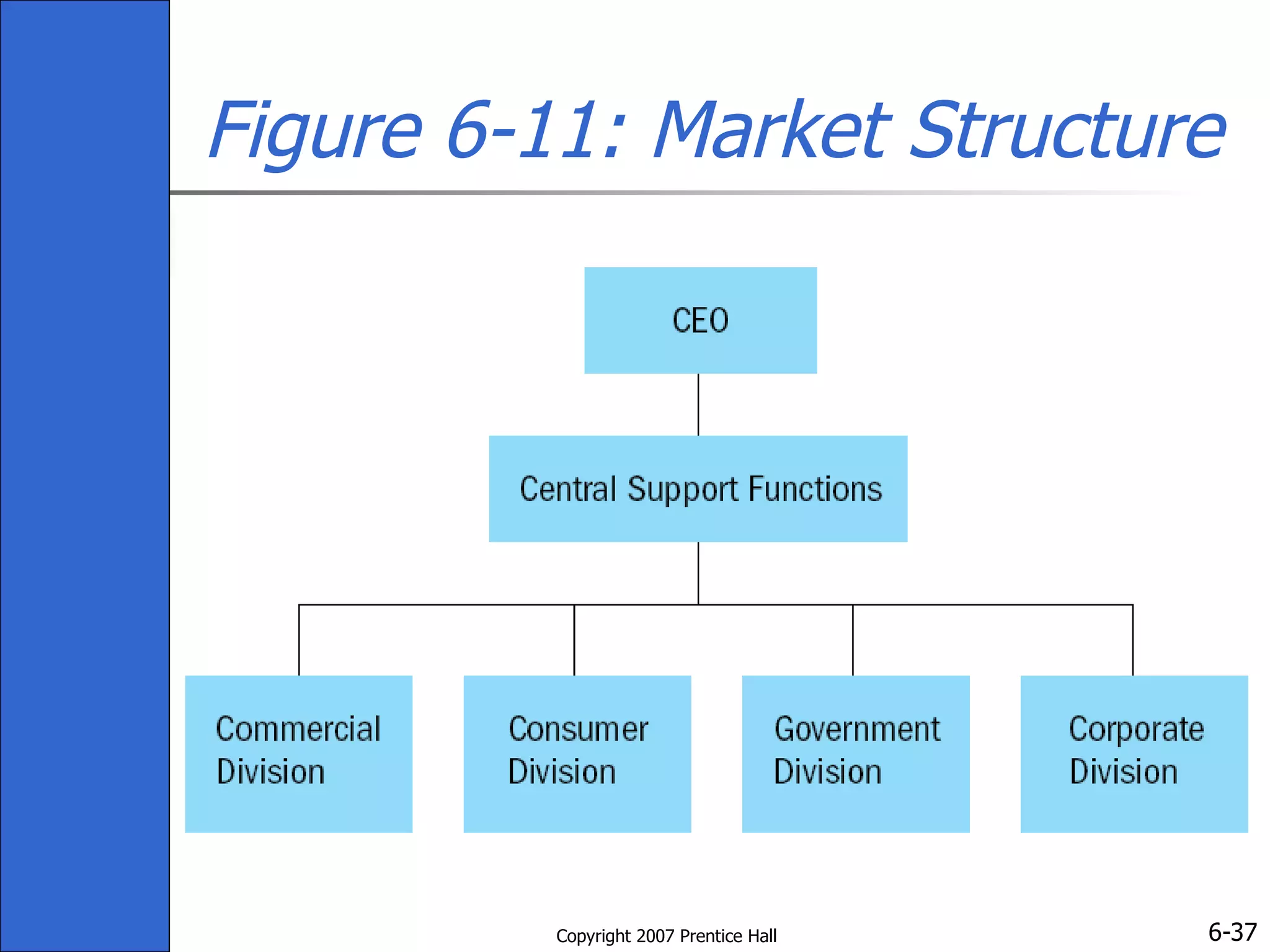
Divisional Structure III : Market Structure A market structure aligns functional skills and activities with the needs of different customer groups Each customer group has a different marketing focus, and the job of each group is to develop products to suit the needs of its specific customers Each customer group makes use of centralized support function
Figure 6-11: Market Structure
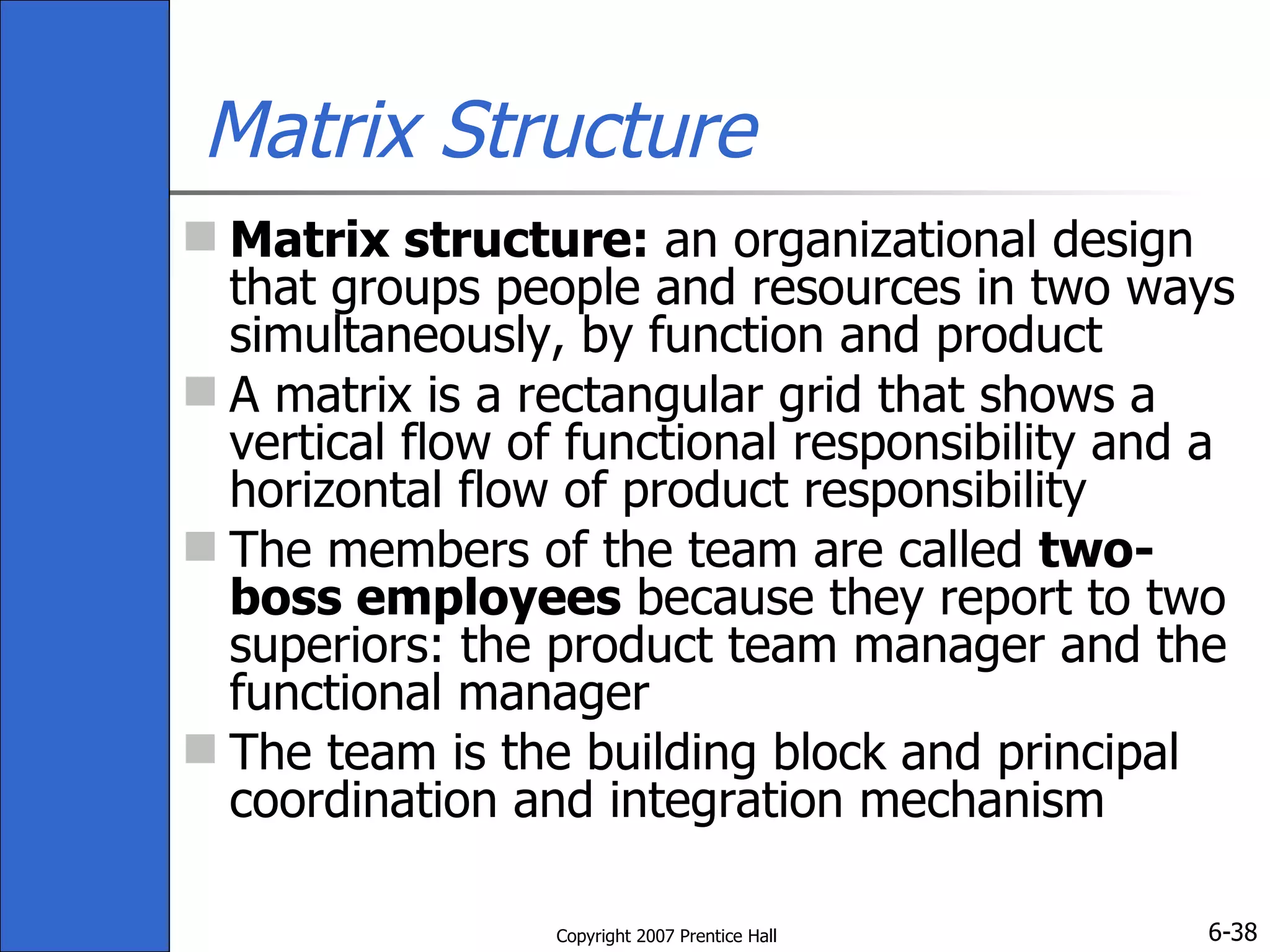
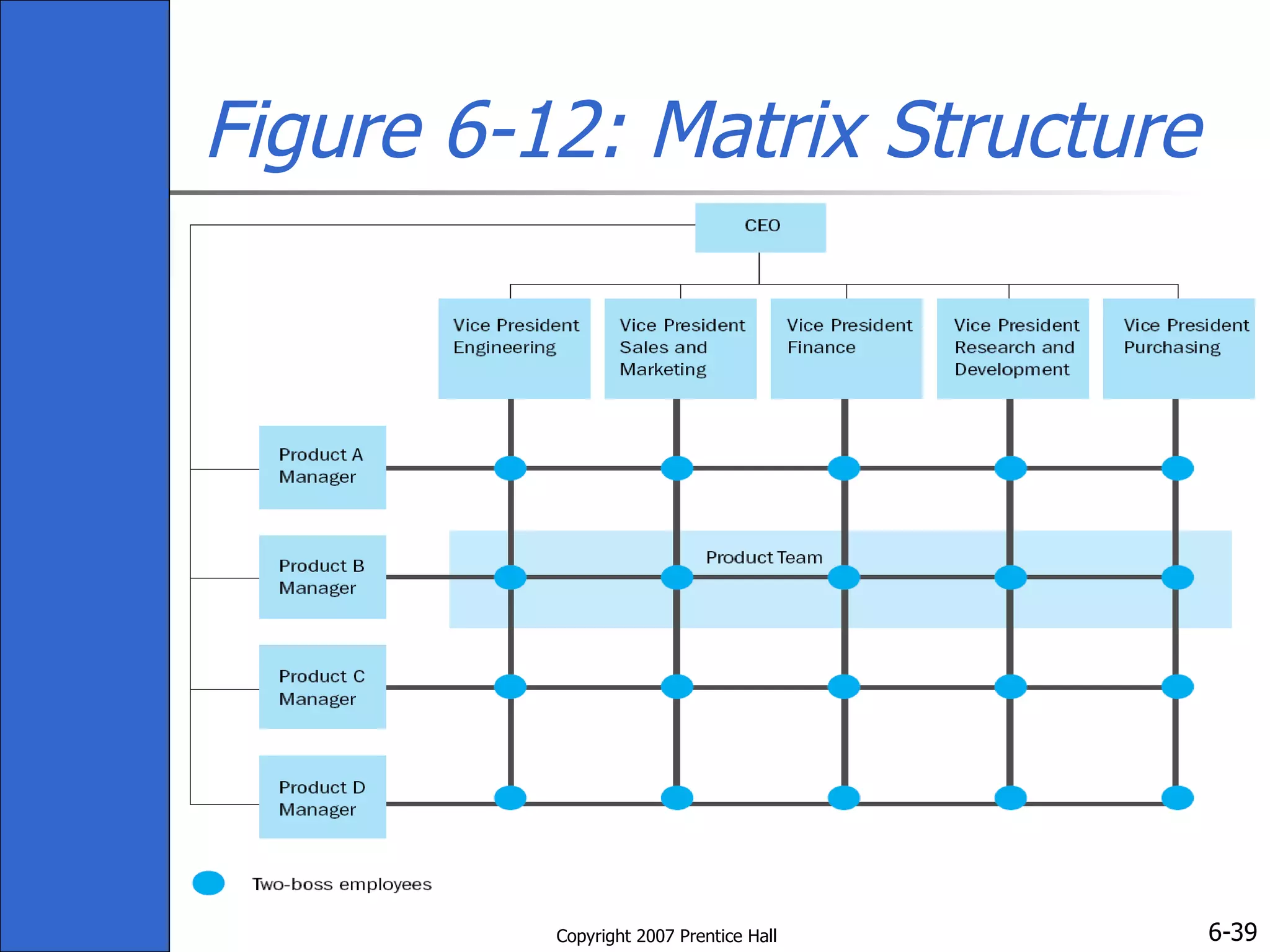
Matrix Structure Matrix structure:  an organizational design that groups people and resources in two ways simultaneously, by function and product A matrix is a rectangular grid that shows a vertical flow of functional responsibility and a horizontal flow of product responsibility The members of the team are called  two-boss employees  because they report to two superiors: the product team manager and the functional manager The team is the building block and principal coordination and integration mechanism
Figure 6-12: Matrix Structure
Advantages of a Matrix Structure The use of cross-functional teams reduces functional barriers and subunit orientation. Opens communication between functional specialists  The matrix enables an organization to maximize its use of skilled professionals, who move from product to product as needed The dual functional and product focus promotes concern for both cost and quality
Disadvantages of a Matrix Structure Matrix lacks a control structure that leads employees to develop stable expectations of one another The lack of a clearly defined hierarchy of authority can also lead to conflict between functions and product teams over the use of resources People are likely to experience a vacuum of authority and responsibility  People then create their own informal organization to provide themselves with some sense of structure and stability
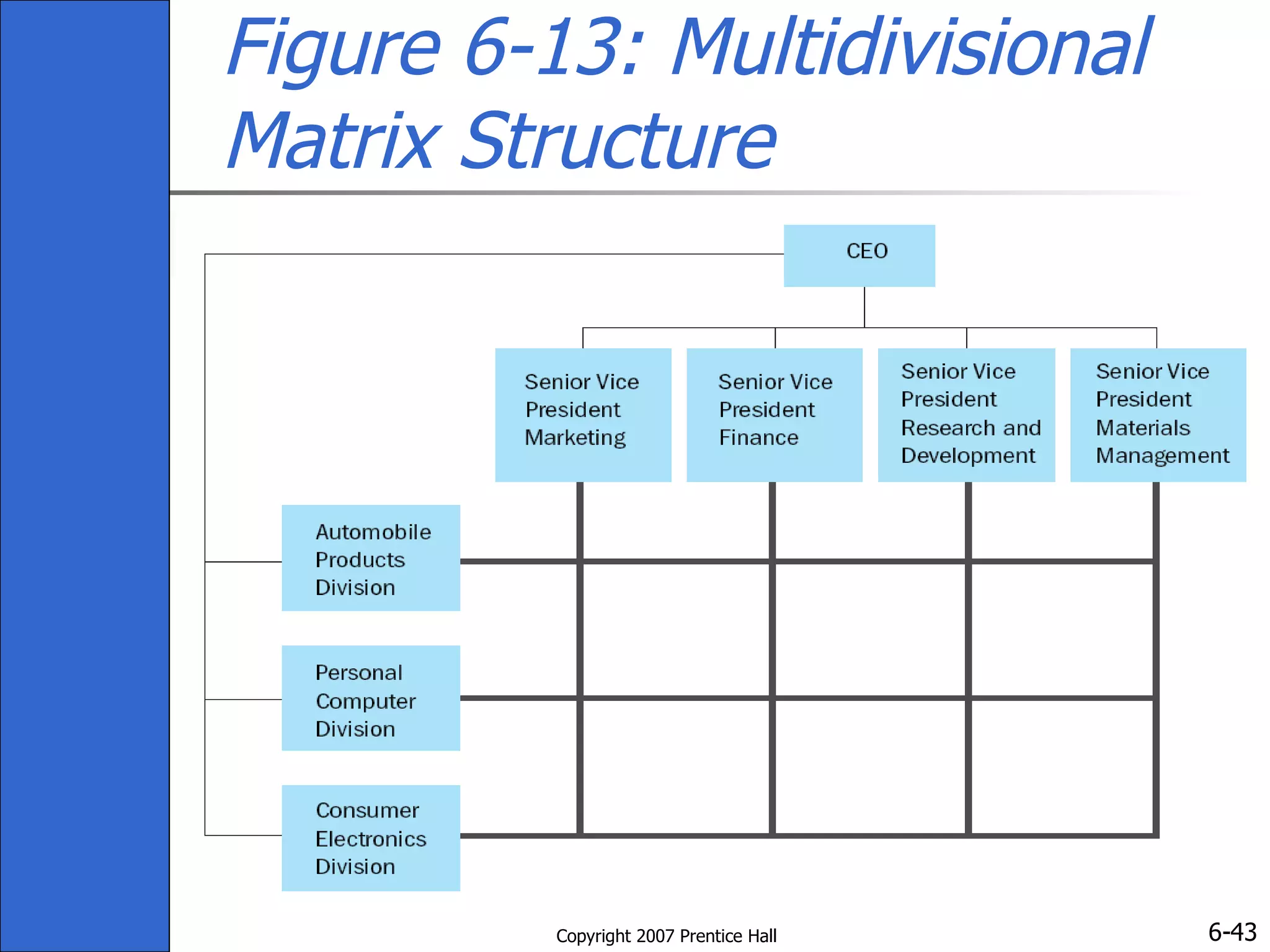
The Multidivisional Matrix Structure Multidivisional matrix structure : a structure that provides for more integration between corporate and divisional managers and between divisional managers Makes it easier for top executives from divisions and corporate headquarters to cooperate and jointly coordinate organizational activities
Figure 6-13: Multidivisional Matrix Structure
Network Structure Network structure:  a cluster of different organizations whose actions are coordinated by contracts and agreements rather than through a formal hierarchy of authority Very complex as companies form agreements with many suppliers, manufacturers, and distributors Such agreements are necessary as the organization outsources many of the value creation activities involved in production and marketing goods and services
Advantages of Network Structures To the degree that a network partner can perform a specific functional activity reliably, and at a lower cost, production costs are reduced Avoids the high bureaucratic costs of operating a complex organizational structure Allows an organization to act in an organic way Network partners can be replaced if they do not perform up to standards
Disadvantages of Network Structures A considerable level of mutual adjustment is needed to allow the groups to interact so that they can learn from one another and constantly improve the product  Ability to control a complex value- creation process is difficult because managers lack the means to effectively coordinate and motivate the various network partners
The Boundaryless Organization Boundaryless organization:  composed of people who are linked by computers, faxes, CAD systems and video conferencing The use of outsourcing and the development of network organization are increasing rapidly as organizations recognize the many opportunities they offer to reduce costs and increase flexibility

Ch06_2 - Organisation theory design and change gareth jones

  • 1.
    Organizational Theory, Design,and Change Fifth Edition Gareth R. Jones Chapter 6 Designing Organizational Structure: Specialization and Coordination
  • 2.
    Organizational Design Properdesign should lead to organizational efficiency and effectiveness. Involves decisions about the grouping of individuals/tasks into work units, departments, or divisions of the organization. Organizations must differentiate and coordinate.
  • 3.
    What is OrganizationalStructure? The structure of an organization can be defined simply as the sum total of the ways in which its labor is divided into distinct tasks and then its coordination is achieved among these tasks.
  • 4.
    What is anOrganizational Chart? Boxes show how work and responsibilities are clustered into units such as divisions, departments, sections, and teams. Lines show the management structure: Who reports to whom, how the boxes relate to each other in the hierarchy.
  • 5.
  • 6.
  • 7.
    Why Organizational StructureMatters? Structure affects: What employees pay attention to Ease of coordinating activities Speed of producing goods/services Cost of running the business Nature and extent of supervision required Whom employees interact and build relationships with
  • 8.
    Functional Structure Afunctional structure is a design that groups people on the basis of their common skills, expertise, or resources they use Functional structure is the bedrock of horizontal differentiation An organization groups tasks into functions to increase the effectiveness with which it achieves its goals
  • 9.
  • 10.
    Figure 6-1: FunctionalStructure (cont.)
  • 11.
    Functional Structure: AdvantagesProvides people with the opportunity to learn from one another and become more specialized and productive People who are grouped together by common skills can supervise one another and control each other’s behavior People develop norms and values that allow them to become more effective at what they do
  • 12.
    Control Problems ina Functional Structure Communication Problems: as more organizational functions develop, each with their own hierarchy, they become increasingly distant from one another Measurement Problems: information needed to measure the profitability of any functional group is difficult to obtain Location Problems: centralized control hinders ability to satisfy the special needs in different geographic regions
  • 13.
    Control Problems ina Functional Structure (cont.) Customer Problems: servicing the needs of new kinds of customers and tailoring products to suit them is relatively difficult Strategic Problems: top managers spend too much time finding ways to improve coordination
  • 14.
    Solving the ControlProblem Managers can solve control problems by redesigning the functional structure to increase integration between functions
  • 15.
    Figure 6.2: ImprovingIntegration in a Functional Structure by Combining Sales and Marketing
  • 16.
    From Functional Structureto Divisional Structure Functional structure is appropriate if the organization: Limits itself to producing a small number of similar products Produces those products in one or a few locations Sells them to only one general type of client or customer
  • 17.
    From Functional Structureto Divisional Structure (cont.) As organizations grow, they begin to produce more products that may be different from one another Organizations also increase production at a number of locations to serve many different types of customers More complex structure is based on: Increasing vertical differentiation Increasing horizontal differentiation Increasing integration
  • 18.
  • 19.
    Figure 6-3: Differentiationand Integration (cont.)
  • 20.
    Moving to aDivisional Structure Organizations most commonly adopt the divisional structure to solve control problems that arise with too many products, regions, or customers Divisional structure is dependent on control problem to be solved Create smaller, more manageable subunits Product structure Geographic structure Market structure
  • 21.
    Product Structure Productstructure : a divisional structure in which products (goods or services) are grouped into separate divisions according to their similarities or differences Organizations need to decide how to coordinate its product activities with support functions Leads to three kinds of product structure
  • 22.
    Product Structure (cont.)Product division structure : a structure in which a centralized set of support functions service the needs of a number of different product lines Support function is divided into product-oriented teams of functional specialists who focus on the needs of one particular product division
  • 23.
    Figure 6-4: ProductDivision Structure
  • 24.
    Figure 6.5: Assignmentof Product-Oriented Functional Teams to Individual Divisions
  • 25.
    Product Structure (cont.)Multidivisional structure: A structure in which support functions are placed in self-contained divisions Each division has its own set of support functions and controls its own value Corporate headquarters staff: responsible for overseeing the activities of the managers heading each division Allows a company to operate in many different businesses
  • 26.
  • 27.
    Figure 6-7: MultidivisionalStructure in Which Each Division Has a Different Structure
  • 28.
    Advantages of aMultidivisional Structure Increased organizational effectiveness: clear division of labor between corporate and divisional managers generally increases organizational effectiveness Increased control: extra control provided by the corporate office can encourage the stronger pursuit of internal organizational efficiency by divisional managers
  • 29.
    Advantages of aMultidivisional Structure (cont.) Profitable growth: when each division is its own profit center, individual profitability can be clearly evaluated Internal labor market: the most able divisional managers are promoted to become corporate managers
  • 30.
    Disadvantages of aMultidivisional Structure Managing the corporate-divisional relationship: finding the balance between centralization and decentralization Coordination problems between divisions: divisions start competing for resources and coordination problems arise between divisions
  • 31.
    Disadvantages of aMultidivisional Structure (cont.) Transfer pricing: problems between divisions often revolve around the transfer price , i.e., the price at which one division sells a product or information about innovations to another division Bureaucratic costs: multidivisional structures are very expensive to operate Communication problems: tall hierarchies tend to have communication problems, particularly the distortion of information
  • 32.
    Product Structure (cont.)Product team structure : specialists from the support functions are created that specialize in the needs of particular kind of product Focus on the needs of one product (or client) or a few related products A product team structure is more decentralized than a functional structure or a product division structure, and specialists in the various product teams are permitted to make on-the spot decisions
  • 33.
    Figure 6.8: ProductTeam Structure
  • 34.
    Divisional Structure II:Geographic Structure When the control problems that companies experience are a function of geography, a geographic divisional structure is appropriate Allows the organization to adjust its structure to align its core competences with the needs of customers in different geographic regions Allows some functions to be centralized and others decentralized
  • 35.
  • 36.
    Divisional Structure III: Market Structure A market structure aligns functional skills and activities with the needs of different customer groups Each customer group has a different marketing focus, and the job of each group is to develop products to suit the needs of its specific customers Each customer group makes use of centralized support function
  • 37.
  • 38.
    Matrix Structure Matrixstructure: an organizational design that groups people and resources in two ways simultaneously, by function and product A matrix is a rectangular grid that shows a vertical flow of functional responsibility and a horizontal flow of product responsibility The members of the team are called two-boss employees because they report to two superiors: the product team manager and the functional manager The team is the building block and principal coordination and integration mechanism
  • 39.
  • 40.
    Advantages of aMatrix Structure The use of cross-functional teams reduces functional barriers and subunit orientation. Opens communication between functional specialists The matrix enables an organization to maximize its use of skilled professionals, who move from product to product as needed The dual functional and product focus promotes concern for both cost and quality
  • 41.
    Disadvantages of aMatrix Structure Matrix lacks a control structure that leads employees to develop stable expectations of one another The lack of a clearly defined hierarchy of authority can also lead to conflict between functions and product teams over the use of resources People are likely to experience a vacuum of authority and responsibility People then create their own informal organization to provide themselves with some sense of structure and stability
  • 42.
    The Multidivisional MatrixStructure Multidivisional matrix structure : a structure that provides for more integration between corporate and divisional managers and between divisional managers Makes it easier for top executives from divisions and corporate headquarters to cooperate and jointly coordinate organizational activities
  • 43.
  • 44.
    Network Structure Networkstructure: a cluster of different organizations whose actions are coordinated by contracts and agreements rather than through a formal hierarchy of authority Very complex as companies form agreements with many suppliers, manufacturers, and distributors Such agreements are necessary as the organization outsources many of the value creation activities involved in production and marketing goods and services
  • 45.
    Advantages of NetworkStructures To the degree that a network partner can perform a specific functional activity reliably, and at a lower cost, production costs are reduced Avoids the high bureaucratic costs of operating a complex organizational structure Allows an organization to act in an organic way Network partners can be replaced if they do not perform up to standards
  • 46.
    Disadvantages of NetworkStructures A considerable level of mutual adjustment is needed to allow the groups to interact so that they can learn from one another and constantly improve the product Ability to control a complex value- creation process is difficult because managers lack the means to effectively coordinate and motivate the various network partners
  • 47.
    The Boundaryless OrganizationBoundaryless organization: composed of people who are linked by computers, faxes, CAD systems and video conferencing The use of outsourcing and the development of network organization are increasing rapidly as organizations recognize the many opportunities they offer to reduce costs and increase flexibility