OVER VIEW ON SYSTEMATIC
REVIEW
Peter D. Daud
Kibong’oto Infectious Diseases
Hospital
8/21/2020 S/R KIDH 2020
Overview of steps in SRMA
 Introduction
Steps in systematic review
Data extraction
 Quality assessment
Analysis and interpretation
Report & writing
Publishing
Challenges/drawbacks
8/21/2020 S/R KIDH 2020
Systematic review
• Is defined as a review using a systematic methods to
summarize evidence on pre defined question with a
detailed and comprehensive plan of study.
• A systematic review attempts to collate all empirical
evidence that fits pre-specified eligibility criteria in
order to answer a specific research question.
• It uses explicit, systematic methods that are selected
with a view to minimizing bias, thus providing more
reliable findings from which conclusions can be drawn
and decisions made.
8/21/2020 S/R KIDH 2020
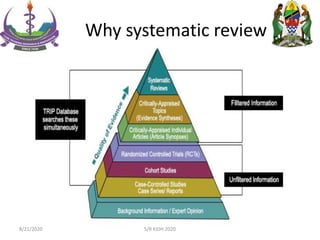
Why Systematic review??
• The amount of evidence from (health science) research is massive.
massive abundance of studies has incresed strickingly over the last
decade, a well conducted SR is a feasible considered solution for
keeping clinician with current evidence based medicine.
8/21/2020 S/R KIDH 2020
Why systematic review
8/21/2020 S/R KIDH 2020
Key characteristics
 A clearly stated set of objectives with pre-defined eligibility criteria
for studies
 An explicit, reproducible methodology
 A systematic search that attempts to identify all studies that would
meet the eligibility criteria
 An assessment of the validity of the findings of the included studies,
for example through the assessment of risk of bias
 A systematic presentation, and synthesis, of the characteristics and
findings of the included studies
8/21/2020 S/R KIDH 2020
Meta-analysis
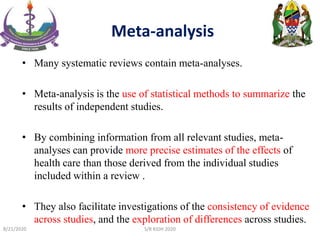
• Many systematic reviews contain meta-analyses.
• Meta-analysis is the use of statistical methods to summarize the
results of independent studies.
• By combining information from all relevant studies, meta-
analyses can provide more precise estimates of the effects of
health care than those derived from the individual studies
included within a review .
• They also facilitate investigations of the consistency of evidence
across studies, and the exploration of differences across studies.
8/21/2020 S/R KIDH 2020
Step 1:Team formation & topic
selection
Like any other study design, the formation of a
team is crucial before the start of the study.
The team must formulate a review/search
question
The formulated qn should be :- feasible,
interesting, noval, ethical and relevant,logical.
-common tools used ( PICO/SPIDER).
Qualitative study: SPIDER is valid
PICO: SR/MA.
8/21/2020 S/R KIDH 2020
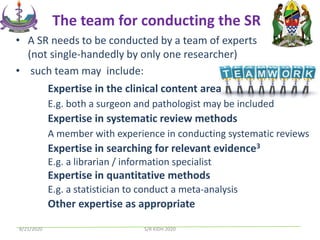
• A SR needs to be conducted by a team of experts
(not single-handedly by only one researcher)
• such team may include:
Expertise in the clinical content area
E.g. both a surgeon and pathologist may be included
Expertise in systematic review methods
A member with experience in conducting systematic reviews
Expertise in searching for relevant evidence3
E.g. a librarian / information specialist
Expertise in quantitative methods
E.g. a statistician to conduct a meta-analysis
Other expertise as appropriate
The team for conducting the SR
8/21/2020 S/R KIDH 2020
SR team
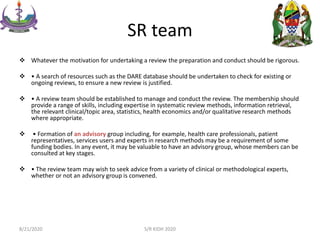
 Whatever the motivation for undertaking a review the preparation and conduct should be rigorous.
 • A search of resources such as the DARE database should be undertaken to check for existing or
ongoing reviews, to ensure a new review is justified.
 • A review team should be established to manage and conduct the review. The membership should
provide a range of skills, including expertise in systematic review methods, information retrieval,
the relevant clinical/topic area, statistics, health economics and/or qualitative research methods
where appropriate.
 • Formation of an advisory group including, for example, health care professionals, patient
representatives, services users and experts in research methods may be a requirement of some
funding bodies. In any event, it may be valuable to have an advisory group, whose members can be
consulted at key stages.
 • The review team may wish to seek advice from a variety of clinical or methodological experts,
whether or not an advisory group is convened.
8/21/2020 S/R KIDH 2020
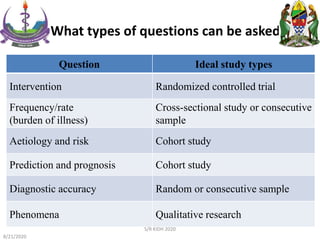
What types of questions can be asked?
Question Ideal study types
Intervention Randomized controlled trial
Frequency/rate
(burden of illness)
Cross-sectional study or consecutive
sample
Aetiology and risk Cohort study
Prediction and prognosis Cohort study
Diagnostic accuracy Random or consecutive sample
Phenomena Qualitative research
8/21/2020
S/R KIDH 2020
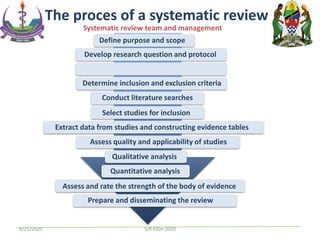
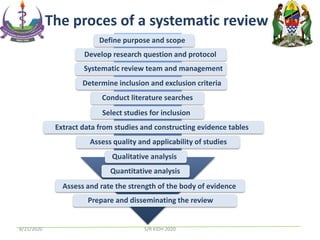
The proces of a systematic review
Define purpose and scope
Develop research question and protocol
Systematic review team and management
Determine inclusion and exclusion criteria
Conduct literature searches
Select studies for inclusion
Extract data from studies and constructing evidence tables
Assess quality and applicability of studies
Qualitative analysis
Quantitative analysis
Assess and rate the strength of the body of evidence
Prepare and disseminating the review
8/21/2020 S/R KIDH 2020
Considerations before conducting a SR
Topic and scope
• Is a systematic review of the given topic relevant
(will it provide or update necessary evidence)?
(Cholera: what isthe genetic diversity of vc in E/A)
• Have recent (high quality) SR been published or
initiated (does protocols exist)?
(DARE, CDSR, PROSPERO, PubMed ect.)
Purpose, topic and scope of the SR
8/21/2020 S/R KIDH 2020
II: Preliminary search and idea
validation
• It is recommended to do a preliminary search to identify
relevant articles, ensure the validity of the proposed idea
Avoid duplication of previous idea/qn.
• Ensure that we have enough articles for analysis.
• Ensure themes is focusing on relevant important h/care
issues, consider global needs, reflect current sciences.
• To do this you can start a simple search in (Pubmed, google
scholar,research gate …etc.
8/21/2020 S/R KIDH 2020
III: Inclusion& Exclusion criteria
Any systematic review it is clear to have a well
defined ( Ex/incl criteria)
Eligibility criteria are based on PICO/SPIDER
approach, study design and date .
Exclusion criteria are unrelated, duplicated,
unavailable full text, care report, case series,
abstruct only papers.
8/21/2020 S/R KIDH 2020
III:Search Strategy
• A standard search strategy is used in Pubmed
then later it is modified according to each specific
databases to get the best relevant results.
• Search strategy are constructed to include free
text terms ( eg in the tittle & abstruct and any
appropriate subject index eg MeSH)
• The improvement of search terms is made while
doing a trial search & looking for another relevant
terms
8/21/2020 S/R KIDH 2020
Search strategy
Search ((cholera) AND (((waves) OR
("lineage"[All Fields])) OR (biotypes))) AND
(((((((("east africa"[All Fields]) OR
("tanzania"[All Fields])) OR ("rwanda"[All
Fields])) OR ("south sudan"[All Fields])) OR
("kenya"[All Fields])) OR ("uganda"[All
Fields])) OR (burundi)) OR (zanzibar))
8/21/2020 S/R KIDH 2020
IV: Search databases, import all
results to a library:
• According to AMSTRA guidelines at least two
data bases has to be used in the SR/MA
• As you increase the number of data bases you
increases the yield and accurace.
• The ordering of data bases pendends mostly
on the review qn.
• NB: Riviews sholud consider to choose
relevant data bases according to the topic.
8/21/2020 S/R KIDH 2020
Proposed data based:
1. Pub Med
2. Scopus
3. Web of science
4. EMBASE
5. GHL
6. VHL
7. Cochrane
8. Google scholar
9. mRCT
10. POPLINE
11. Clinical trial.gov
12. SIGLE
8/21/2020 S/R KIDH 2020
Studies can be located using a
combination of the following
approaches
 Searching electronic databases
 Visually scanning reference lists from relevant studies
 Hand searching key journals and conference
proceedings
 Contacting study authors, experts, manufacturers, and
other organizations
 Searching relevant Internet resources
 Citation searching
 Using a project Internet site to canvas for studies
8/21/2020 S/R KIDH 2020
Drawbacks and limitations
• Systematic reviews can be conducted badly
• Bias in the selection of included papers (e.g.
Language)
• Not conducting a comprehensive search in the
most relevant databases, including grey
literature, hand searching
• No properly combining results of different
studies.
8/21/2020 S/R KIDH 2020
Challenges in doing SRMA
• Seems a daunting task
• Seems difficult to understand
• Consumes time
• Lack of guidance
• Many unforeseen obstacles
8/21/2020 S/R KIDH 2020
Systematic review protocol
 Preparation of a SR protocol can help minimize potential bias in the review process
(e.g. Cochrane requires publication of the protocol – any changes must be documented
and reported in a specific section of the completed review)
 The Cochrane Handbook1 and IOM2 both have standards / requirements for SR protocols
 Developing the protocol is an iterative proces
 It is recommended that researchers send it to the principal investigator (PI) to
revise it, then upload it to registry sites
 Protocal registration at aealy stage guarantee transparency in the reseach process.
CAMP BELL COLLABORATION/ PROSPERO
S/R protocols writting & registration
8/21/2020 S/R KIDH 2020
Systematic review protocol may include descriptions
of*:
• The context and rationale for the SR
• Inclusion / exclusion criteria
• Outcomes, time points, intervention and
comparison groups
• Search strategy
• Procedures for study selection
• Data extraction strategy
Contents of S/R protocols
8/21/2020 S/R KIDH 2020
Systematic review protocol may include descriptions of:
• Process for identifying and resolving disagreements
between researchers in study selection and data
extraction decisions
• The approach for critically appraising individual studies
• The method for evaluating the body of evidence
• Planned analyses of differential treatment effects
according to according to patient subgroups
• A timetable for conducting the review
*
Contents of SR protocols
8/21/2020 S/R KIDH 2020
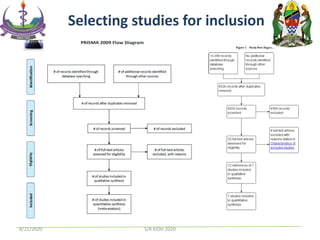
Selecting studies for inclusion
8/21/2020 S/R KIDH 2020
Extracting data and constructing
evidence tables
• Data extraction: the process of selecting and recording
relevant data from primary publications
• Data extraction errors are frequent and can compromise
the results
• Common problems: erroneous number of patients,
means, standard deviations, and sign for the effect
estimate
• Recommendations
– Two reviewers, working independently, to extract quantitative and
other critical data
– Link publications from the same study to avoid including data from
the same study more than once
– Use standard data extraction forms
– Pilot test the forms and process
8/21/2020 S/R KIDH 2020
What to extract?
• For analysis , Study ID , Location, year , Study
design • Sample size , PICO (TS)
• Confounders adjusted , Effect size (95% CI)
Subgroup results ,Other relevant For quality
assessment
• Risk of bias , Selection (Allocation concealment,
Sequence, Randomization) ,Blinding,
Measurement bias ,Attrition
• Reporting , Sample size adequacy,
Representativenes
8/21/2020 S/R KIDH 2020
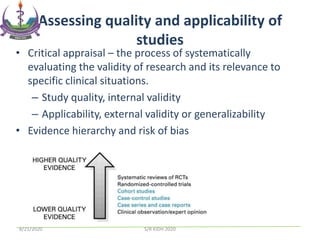
Assessing quality and applicability of
studies
• Critical appraisal – the process of systematically
evaluating the validity of research and its relevance to
specific clinical situations.
– Study quality, internal validity
– Applicability, external validity or generalizability
• Evidence hierarchy and risk of bias
8/21/2020 S/R KIDH 2020
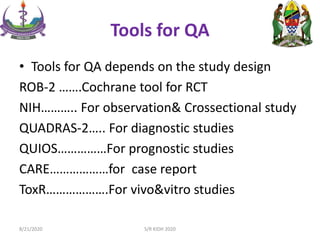
Tools for QA
• Tools for QA depends on the study design
ROB-2 …….Cochrane tool for RCT
NIH……….. For observation& Crossectional study
QUADRAS-2….. For diagnostic studies
QUIOS……………For prognostic studies
CARE………………for case report
ToxR……………….For vivo&vitro studies
8/21/2020 S/R KIDH 2020
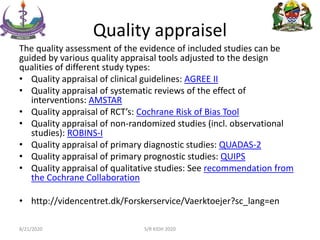
Quality appraisel
The quality assessment of the evidence of included studies can be
guided by various quality appraisal tools adjusted to the design
qualities of different study types:
• Quality appraisal of clinical guidelines: AGREE II
• Quality appraisal of systematic reviews of the effect of
interventions: AMSTAR
• Quality appraisal of RCT’s: Cochrane Risk of Bias Tool
• Quality appraisal of non-randomized studies (incl. observational
studies): ROBINS-I
• Quality appraisal of primary diagnostic studies: QUADAS-2
• Quality appraisal of primary prognostic studies: QUIPS
• Quality appraisal of qualitative studies: See recommendation from
the Cochrane Collaboration
• http://videncentret.dk/Forskerservice/Vaerktoejer?sc_lang=en
8/21/2020 S/R KIDH 2020
Qualitative analysis
• Little guidance on how to perform a good qualitative
analysis
• The clinical context of a study includes the participants,
setting, interventions and their administration, and
outcomes and their determination
– Interpreting clinical characteristics of the studies
(subgroup analysis may be necessary)
– Interpreting methodological characteristics of studies
• In-depth understanding of the studies
• Nelson, H. D. (2014). Systematic Reviews to Answer
Health Care Questions. Lippincott Williams & Wilkins
8/21/2020 S/R KIDH 2020
Quantitative analysis
• Decision to combine studies
• Choice of effect measures differs by the type of outcome
data
• Assessing statistical heterogeneity (graphical methods)
• Models for combining studies (most commonly used:
fixed effects or random effects)
• Exploring heterogeneity when present
• Publication bias assessed
• Sensitivity analysis to evaluate the impact of decisions
and assumptions
8/21/2020 S/R KIDH 2020
Data analysis
Reviews use different methods for combining and
summarizing findings of the included studies.
Before summarinzing there is important step :
Data cleaning in extraction sheet/online library
Analyst orgnanise data in extraction sheet in a
form that can be read by analytical software.
8/21/2020 S/R KIDH 2020
Be aware of predatory journals
• The number of predatory journals has risen dramatically
during the past 5 or 10 years. Predatory journals have
increased their publication volumes from 53,000 in 2010 to an
estimated 420,000 articles in 2014 (Shen and Bjork, 2015).
• Unscrupulous publishers are exploiting the open-access (OA)
publishing model by producing fake, scam, unscholarly and
deceptive journals.
• The peer review process in these journals is corrupted and is
either non-existent or minimal. Huge profits are made on the
basis of author publication fees, which seem to be the main
criteria for publication.
8/21/2020 S/R KIDH 2020
Manuscript writing/Revision and
submission to journals
Before preparing the findings for public
consumption ( Posters/conferences etc.
Do the following:-
• Send to PI
• PI to Reveiws ( reply to comments)
• Send to appropriate journals
8/21/2020 S/R KIDH 2020
The proces of a systematic review
Define purpose and scope
Develop research question and protocol
Systematic review team and management
Determine inclusion and exclusion criteria
Conduct literature searches
Select studies for inclusion
Extract data from studies and constructing evidence tables
Assess quality and applicability of studies
Qualitative analysis
Quantitative analysis
Assess and rate the strength of the body of evidence
Prepare and disseminating the review
8/21/2020 S/R KIDH 2020
• Any SR/MA must follow the widely accepted
Preferred Reporting Items for Systematic
Review and Meta-analysis statement (PRISMA
checklist 2009)
8/21/2020 S/R KIDH 2020
Useful resources – systematic reviews
• Cochrane Collaboration
– http://www.cochrane.org/
– http://www.cochrane.org/docs/irmg.htm
• Centre for Reviews and Dissemination
http://www.york.ac.uk/inst/crd/
handbook for conducting systematic reviews,
– http://www.york.ac.uk/inst/crd/methods.htm
– Searching for systematic reviews
http://www.york.ac.uk/inst/crd/revs.htm
• EPPI-Centre – Stages of a review
– http://eppi.ioe.ac.uk/cms/Default.aspx?tabid=89
• SCIE - The conduct of systematic research reviews for SCIE knowledge
reviews
– http://www.scie.org.uk/publications/details.asp?pubID=111
8/21/2020 S/R KIDH 2020

Over view on systematic review

  • 1.
    OVER VIEW ONSYSTEMATIC REVIEW Peter D. Daud Kibong’oto Infectious Diseases Hospital 8/21/2020 S/R KIDH 2020
  • 2.
    Overview of stepsin SRMA  Introduction Steps in systematic review Data extraction  Quality assessment Analysis and interpretation Report & writing Publishing Challenges/drawbacks 8/21/2020 S/R KIDH 2020
  • 3.
    Systematic review • Isdefined as a review using a systematic methods to summarize evidence on pre defined question with a detailed and comprehensive plan of study. • A systematic review attempts to collate all empirical evidence that fits pre-specified eligibility criteria in order to answer a specific research question. • It uses explicit, systematic methods that are selected with a view to minimizing bias, thus providing more reliable findings from which conclusions can be drawn and decisions made. 8/21/2020 S/R KIDH 2020
  • 4.
    Why Systematic review?? •The amount of evidence from (health science) research is massive. massive abundance of studies has incresed strickingly over the last decade, a well conducted SR is a feasible considered solution for keeping clinician with current evidence based medicine. 8/21/2020 S/R KIDH 2020
  • 5.
  • 6.
    Key characteristics  Aclearly stated set of objectives with pre-defined eligibility criteria for studies  An explicit, reproducible methodology  A systematic search that attempts to identify all studies that would meet the eligibility criteria  An assessment of the validity of the findings of the included studies, for example through the assessment of risk of bias  A systematic presentation, and synthesis, of the characteristics and findings of the included studies 8/21/2020 S/R KIDH 2020
  • 7.
    Meta-analysis • Many systematicreviews contain meta-analyses. • Meta-analysis is the use of statistical methods to summarize the results of independent studies. • By combining information from all relevant studies, meta- analyses can provide more precise estimates of the effects of health care than those derived from the individual studies included within a review . • They also facilitate investigations of the consistency of evidence across studies, and the exploration of differences across studies. 8/21/2020 S/R KIDH 2020
  • 8.
    Step 1:Team formation& topic selection Like any other study design, the formation of a team is crucial before the start of the study. The team must formulate a review/search question The formulated qn should be :- feasible, interesting, noval, ethical and relevant,logical. -common tools used ( PICO/SPIDER). Qualitative study: SPIDER is valid PICO: SR/MA. 8/21/2020 S/R KIDH 2020
  • 9.
    • A SRneeds to be conducted by a team of experts (not single-handedly by only one researcher) • such team may include: Expertise in the clinical content area E.g. both a surgeon and pathologist may be included Expertise in systematic review methods A member with experience in conducting systematic reviews Expertise in searching for relevant evidence3 E.g. a librarian / information specialist Expertise in quantitative methods E.g. a statistician to conduct a meta-analysis Other expertise as appropriate The team for conducting the SR 8/21/2020 S/R KIDH 2020
  • 10.
    SR team  Whateverthe motivation for undertaking a review the preparation and conduct should be rigorous.  • A search of resources such as the DARE database should be undertaken to check for existing or ongoing reviews, to ensure a new review is justified.  • A review team should be established to manage and conduct the review. The membership should provide a range of skills, including expertise in systematic review methods, information retrieval, the relevant clinical/topic area, statistics, health economics and/or qualitative research methods where appropriate.  • Formation of an advisory group including, for example, health care professionals, patient representatives, services users and experts in research methods may be a requirement of some funding bodies. In any event, it may be valuable to have an advisory group, whose members can be consulted at key stages.  • The review team may wish to seek advice from a variety of clinical or methodological experts, whether or not an advisory group is convened. 8/21/2020 S/R KIDH 2020
  • 11.
    What types ofquestions can be asked? Question Ideal study types Intervention Randomized controlled trial Frequency/rate (burden of illness) Cross-sectional study or consecutive sample Aetiology and risk Cohort study Prediction and prognosis Cohort study Diagnostic accuracy Random or consecutive sample Phenomena Qualitative research 8/21/2020 S/R KIDH 2020
  • 12.
    The proces ofa systematic review Define purpose and scope Develop research question and protocol Systematic review team and management Determine inclusion and exclusion criteria Conduct literature searches Select studies for inclusion Extract data from studies and constructing evidence tables Assess quality and applicability of studies Qualitative analysis Quantitative analysis Assess and rate the strength of the body of evidence Prepare and disseminating the review 8/21/2020 S/R KIDH 2020
  • 13.
    Considerations before conductinga SR Topic and scope • Is a systematic review of the given topic relevant (will it provide or update necessary evidence)? (Cholera: what isthe genetic diversity of vc in E/A) • Have recent (high quality) SR been published or initiated (does protocols exist)? (DARE, CDSR, PROSPERO, PubMed ect.) Purpose, topic and scope of the SR 8/21/2020 S/R KIDH 2020
  • 14.
    II: Preliminary searchand idea validation • It is recommended to do a preliminary search to identify relevant articles, ensure the validity of the proposed idea Avoid duplication of previous idea/qn. • Ensure that we have enough articles for analysis. • Ensure themes is focusing on relevant important h/care issues, consider global needs, reflect current sciences. • To do this you can start a simple search in (Pubmed, google scholar,research gate …etc. 8/21/2020 S/R KIDH 2020
  • 15.
    III: Inclusion& Exclusioncriteria Any systematic review it is clear to have a well defined ( Ex/incl criteria) Eligibility criteria are based on PICO/SPIDER approach, study design and date . Exclusion criteria are unrelated, duplicated, unavailable full text, care report, case series, abstruct only papers. 8/21/2020 S/R KIDH 2020
  • 16.
    III:Search Strategy • Astandard search strategy is used in Pubmed then later it is modified according to each specific databases to get the best relevant results. • Search strategy are constructed to include free text terms ( eg in the tittle & abstruct and any appropriate subject index eg MeSH) • The improvement of search terms is made while doing a trial search & looking for another relevant terms 8/21/2020 S/R KIDH 2020
  • 17.
    Search strategy Search ((cholera)AND (((waves) OR ("lineage"[All Fields])) OR (biotypes))) AND (((((((("east africa"[All Fields]) OR ("tanzania"[All Fields])) OR ("rwanda"[All Fields])) OR ("south sudan"[All Fields])) OR ("kenya"[All Fields])) OR ("uganda"[All Fields])) OR (burundi)) OR (zanzibar)) 8/21/2020 S/R KIDH 2020
  • 18.
    IV: Search databases,import all results to a library: • According to AMSTRA guidelines at least two data bases has to be used in the SR/MA • As you increase the number of data bases you increases the yield and accurace. • The ordering of data bases pendends mostly on the review qn. • NB: Riviews sholud consider to choose relevant data bases according to the topic. 8/21/2020 S/R KIDH 2020
  • 19.
    Proposed data based: 1.Pub Med 2. Scopus 3. Web of science 4. EMBASE 5. GHL 6. VHL 7. Cochrane 8. Google scholar 9. mRCT 10. POPLINE 11. Clinical trial.gov 12. SIGLE 8/21/2020 S/R KIDH 2020
  • 20.
    Studies can belocated using a combination of the following approaches  Searching electronic databases  Visually scanning reference lists from relevant studies  Hand searching key journals and conference proceedings  Contacting study authors, experts, manufacturers, and other organizations  Searching relevant Internet resources  Citation searching  Using a project Internet site to canvas for studies 8/21/2020 S/R KIDH 2020
  • 21.
    Drawbacks and limitations •Systematic reviews can be conducted badly • Bias in the selection of included papers (e.g. Language) • Not conducting a comprehensive search in the most relevant databases, including grey literature, hand searching • No properly combining results of different studies. 8/21/2020 S/R KIDH 2020
  • 22.
    Challenges in doingSRMA • Seems a daunting task • Seems difficult to understand • Consumes time • Lack of guidance • Many unforeseen obstacles 8/21/2020 S/R KIDH 2020
  • 23.
    Systematic review protocol Preparation of a SR protocol can help minimize potential bias in the review process (e.g. Cochrane requires publication of the protocol – any changes must be documented and reported in a specific section of the completed review)  The Cochrane Handbook1 and IOM2 both have standards / requirements for SR protocols  Developing the protocol is an iterative proces  It is recommended that researchers send it to the principal investigator (PI) to revise it, then upload it to registry sites  Protocal registration at aealy stage guarantee transparency in the reseach process. CAMP BELL COLLABORATION/ PROSPERO S/R protocols writting & registration 8/21/2020 S/R KIDH 2020
  • 24.
    Systematic review protocolmay include descriptions of*: • The context and rationale for the SR • Inclusion / exclusion criteria • Outcomes, time points, intervention and comparison groups • Search strategy • Procedures for study selection • Data extraction strategy Contents of S/R protocols 8/21/2020 S/R KIDH 2020
  • 25.
    Systematic review protocolmay include descriptions of: • Process for identifying and resolving disagreements between researchers in study selection and data extraction decisions • The approach for critically appraising individual studies • The method for evaluating the body of evidence • Planned analyses of differential treatment effects according to according to patient subgroups • A timetable for conducting the review * Contents of SR protocols 8/21/2020 S/R KIDH 2020
  • 26.
    Selecting studies forinclusion 8/21/2020 S/R KIDH 2020
  • 27.
    Extracting data andconstructing evidence tables • Data extraction: the process of selecting and recording relevant data from primary publications • Data extraction errors are frequent and can compromise the results • Common problems: erroneous number of patients, means, standard deviations, and sign for the effect estimate • Recommendations – Two reviewers, working independently, to extract quantitative and other critical data – Link publications from the same study to avoid including data from the same study more than once – Use standard data extraction forms – Pilot test the forms and process 8/21/2020 S/R KIDH 2020
  • 28.
    What to extract? •For analysis , Study ID , Location, year , Study design • Sample size , PICO (TS) • Confounders adjusted , Effect size (95% CI) Subgroup results ,Other relevant For quality assessment • Risk of bias , Selection (Allocation concealment, Sequence, Randomization) ,Blinding, Measurement bias ,Attrition • Reporting , Sample size adequacy, Representativenes 8/21/2020 S/R KIDH 2020
  • 29.
    Assessing quality andapplicability of studies • Critical appraisal – the process of systematically evaluating the validity of research and its relevance to specific clinical situations. – Study quality, internal validity – Applicability, external validity or generalizability • Evidence hierarchy and risk of bias 8/21/2020 S/R KIDH 2020
  • 30.
    Tools for QA •Tools for QA depends on the study design ROB-2 …….Cochrane tool for RCT NIH……….. For observation& Crossectional study QUADRAS-2….. For diagnostic studies QUIOS……………For prognostic studies CARE………………for case report ToxR……………….For vivo&vitro studies 8/21/2020 S/R KIDH 2020
  • 31.
    Quality appraisel The qualityassessment of the evidence of included studies can be guided by various quality appraisal tools adjusted to the design qualities of different study types: • Quality appraisal of clinical guidelines: AGREE II • Quality appraisal of systematic reviews of the effect of interventions: AMSTAR • Quality appraisal of RCT’s: Cochrane Risk of Bias Tool • Quality appraisal of non-randomized studies (incl. observational studies): ROBINS-I • Quality appraisal of primary diagnostic studies: QUADAS-2 • Quality appraisal of primary prognostic studies: QUIPS • Quality appraisal of qualitative studies: See recommendation from the Cochrane Collaboration • http://videncentret.dk/Forskerservice/Vaerktoejer?sc_lang=en 8/21/2020 S/R KIDH 2020
  • 32.
    Qualitative analysis • Littleguidance on how to perform a good qualitative analysis • The clinical context of a study includes the participants, setting, interventions and their administration, and outcomes and their determination – Interpreting clinical characteristics of the studies (subgroup analysis may be necessary) – Interpreting methodological characteristics of studies • In-depth understanding of the studies • Nelson, H. D. (2014). Systematic Reviews to Answer Health Care Questions. Lippincott Williams & Wilkins 8/21/2020 S/R KIDH 2020
  • 33.
    Quantitative analysis • Decisionto combine studies • Choice of effect measures differs by the type of outcome data • Assessing statistical heterogeneity (graphical methods) • Models for combining studies (most commonly used: fixed effects or random effects) • Exploring heterogeneity when present • Publication bias assessed • Sensitivity analysis to evaluate the impact of decisions and assumptions 8/21/2020 S/R KIDH 2020
  • 34.
    Data analysis Reviews usedifferent methods for combining and summarizing findings of the included studies. Before summarinzing there is important step : Data cleaning in extraction sheet/online library Analyst orgnanise data in extraction sheet in a form that can be read by analytical software. 8/21/2020 S/R KIDH 2020
  • 35.
    Be aware ofpredatory journals • The number of predatory journals has risen dramatically during the past 5 or 10 years. Predatory journals have increased their publication volumes from 53,000 in 2010 to an estimated 420,000 articles in 2014 (Shen and Bjork, 2015). • Unscrupulous publishers are exploiting the open-access (OA) publishing model by producing fake, scam, unscholarly and deceptive journals. • The peer review process in these journals is corrupted and is either non-existent or minimal. Huge profits are made on the basis of author publication fees, which seem to be the main criteria for publication. 8/21/2020 S/R KIDH 2020
  • 36.
    Manuscript writing/Revision and submissionto journals Before preparing the findings for public consumption ( Posters/conferences etc. Do the following:- • Send to PI • PI to Reveiws ( reply to comments) • Send to appropriate journals 8/21/2020 S/R KIDH 2020
  • 37.
    The proces ofa systematic review Define purpose and scope Develop research question and protocol Systematic review team and management Determine inclusion and exclusion criteria Conduct literature searches Select studies for inclusion Extract data from studies and constructing evidence tables Assess quality and applicability of studies Qualitative analysis Quantitative analysis Assess and rate the strength of the body of evidence Prepare and disseminating the review 8/21/2020 S/R KIDH 2020
  • 38.
    • Any SR/MAmust follow the widely accepted Preferred Reporting Items for Systematic Review and Meta-analysis statement (PRISMA checklist 2009) 8/21/2020 S/R KIDH 2020
  • 39.
    Useful resources –systematic reviews • Cochrane Collaboration – http://www.cochrane.org/ – http://www.cochrane.org/docs/irmg.htm • Centre for Reviews and Dissemination http://www.york.ac.uk/inst/crd/ handbook for conducting systematic reviews, – http://www.york.ac.uk/inst/crd/methods.htm – Searching for systematic reviews http://www.york.ac.uk/inst/crd/revs.htm • EPPI-Centre – Stages of a review – http://eppi.ioe.ac.uk/cms/Default.aspx?tabid=89 • SCIE - The conduct of systematic research reviews for SCIE knowledge reviews – http://www.scie.org.uk/publications/details.asp?pubID=111 8/21/2020 S/R KIDH 2020

Editor's Notes

  • #10 1PICOTS description are are from Heidi Nelson ”Systematic Reviews to answer health care questions”, 1st ed. Wolters Kluwer (2014). 2IOM: Institute of Medicine. Finding What Works in Health Care Standards for Systematic Reviews (2011). 3Koffel JB. Use of Recommended Search Strategies in Systematic Reviews and the Impact of Librarian Involvement: A Cross-Sectional Survey of Recent Authors. PLoS ONE (2015). 10(5): e0125931.
  • #14 DARE: Database of Abstracts of Reviews of Effects. contains details of systematic reviews that evaluate the effects of healthcare interventions and the delivery and organisation of health services. DARE also contains reviews of the wider determinants of health such as housing, transport, and social care where these impact directly on health, or have the potential to impact on health. DARE complements The Cochrane Database of Systematic Reviews (CDSR), by including systematic reviews that have not been carried out by the Cochrane Collaboration. DARE contains details of all Cochrane Reviews, Protocols for Cochrane Reviews, and other publications based on Cochrane Reviews. Details of Campbell Reviews (prepared by The Campbell Collaboration) are included where the interventions evaluated impact directly on health or have the potential to impact on health. DARE was produced by the NIHR Centre for Reviews and Dissemination (CRD) at the University of York, UK. NIHR funding to produce DARE ceased at the end of March 2015. However, the database can still be accessed via the Cochrane Library. Searches of MEDLINE, Embase, CINAHL, PsycINFO and PubMed were continued until the end of the 2014. Bibliographic records were published on DARE and NHS EED until 31 March 2015 and included in Issue 4, 2015 on the Cochrane Library. Information on DARE is taken rom the Cochrane Community webpage: http://community.cochrane.org/editorial-and-publishing-policy-resource/database-abstracts-reviews-effects-dare CDSR: Cochrane Database of Systematic Reviews. The Cochrane Database of Systematic Reviews (CDSR) is the leading resource for systematic reviews in health care. The CDSR includes Cochrane Reviews (the systematic reviews) and protocols for Cochrane Reviews as well as editorials. The CDSR also has occasional supplements. Protocols for Cochrane Reviews are peer reviewed articles that describe the rationale for the review, the objectives, and the methods that will be used to locate, select, and critically appraise studies, and to collect and analyse data from the included studies. There are four types of Cochrane Review published in the CDSR: intervention; methodology; diagnostic test accuracy; and overviews of reviews. Most reviews in the CDSR are intervention reviews, methodology reviews are prepared by one Cochrane Review Group, and the other two types are newer additions to the CDSR. Information on DARE is taken from the Cochrane Community webpage: http://community.cochrane.org/editorial-and-publishing-policy-resource/cochrane-database-systematic-reviews-cdsr PROSPERO: PROSPERO is an international database of prospectively registered systematic reviews in health and social care. Key features from the review protocol are recorded and maintained as a permanent record. PROSPERO aims to provide a comprehensive listing of systematic reviews registered at inception to help avoid unplanned duplication and enable comparison of reported review methods with what was planned in the protocol. The development and ongoing management of PROSPERO is supported by CRD’s core work programme which is funded by the National Institute for Health Research, England; the Department of Health, Public Health Agency, Northern Ireland and the National Institute for Social Care and Health Research, Welsh Government. Information is taken from the PROSPERO webpage: http://www.crd.york.ac.uk/PROSPERO/
  • #24 1Cochrane Handbook v5.1.0 (2011). 2IOM: Institute of Medicine. Finding What Works in Health Care Standards for Systematic Reviews (2011).
  • #25 1IOM: Institute of Medicine. Finding What Works in Health Care Standards for Systematic Reviews (2011) – Standard 2.6. Læg evt. 15 og 16 sammen
  • #26 1IOM: Institute of Medicine. Finding What Works in Health Care Standards for Systematic Reviews (2011) – Standard 2.6.
  • #27 PRISMA Flowchart: Moher D, Liberati A, Tetzlaff J, Altman DG, Group P. Preferred reporting items for systematic reviews and meta-analyses: the PRISMA Statement. Int J Surg. 2010; 8(5): 336- 341. Example is from the previously mentioned systematic review by Gurusamy et al. Cochr Database Syst Rev (2014).
  • #28 References: Gøtzsche, P. C., Hróbjartsson, A., Marić, K., & Tendal, B. (2007). Data extraction errors in meta-analyses that use standardized mean differences. JAMA, 298(4), 430-437. Nelson, H. D. (2014). Systematic Reviews to Answer Health Care Questions. Lippincott Williams & Wilkins. Buscemi, N., Hartling, L., Vandermeer, B., Tjosvold, L., & Klassen, T. P. (2006). Single data extraction generated more errors than double data extraction in systematic reviews. Journal of clinical epidemiology, 59(7), 697-703.
  • #30 References: Guyatt, G. H., Sackett, D. L., Sinclair, J. C., Hayward, R., Cook, D. J., Cook, R. J., ... & Wilson, M. (1995). Users' guides to the medical literature: IX. A method for grading health care recommendations. Jama, 274(22), 1800-1804. Hoppe, D. J., Schemitsch, E. H., Morshed, S., Tornetta, P., & Bhandari, M. (2009). Hierarchy of evidence: where observational studies fit in and why we need them. The Journal of Bone & Joint Surgery, 91(Supplement 3), 2-9.
  • #33 Reference: