MADE BY : DEEPIKA OJHA
 Outsourcing
 Types of outsourcing
 BPO-Business Process Outsourcing
 KPO-Knowledge Process Outsourcing
 LPO-Language Process Outsourcing
 Location Analysis
 Outsourcing in India
 Reverse Outsourcing
 Future Trends in Outsourcing
What is outsourcing ?
 “Outsourcing refers to the practice of transferring
activities traditionally done within a firm to third
party providers within the country.”

 Definition :
 Outsourcing is a practice used by different
companies to reduce costs by transferring portions of
work to outside suppliers rather than completing it
internally.
 Outsourcing is an effective cost-saving strategy
when used properly.
Outsourcing - Typologies
• People , the facilities , the equipment &
technology transferred to service provider.Conventional
• Company buys new services provider (Make
Vs Buy)Greenfield
• Problem – Solving mentally. Outsource
Company & People both.
Tactical
• Structured Outsource , to align with companies
long – terms Process.Strategical
Motivation for Outsourcing
 Cost-Driven Outsource : Reduce & save cost
 Strategy- Driven Outsource: Focus on core-
competencies Functions.
 Politically – Driven Outsource: Outsource By
Public Organizations.
Outsource Decision Framework
Drivers Vs Risks
DRIVERS
• Cost savings
• Reduced Capital Expenditures
• Capital Infusion
• Transfer fixed costs to variable
• Quality Improvement
• Increased speed
• Greater flexibility
• Access to latest technology /
Infrastructure
• Access to skills and talents
• Augment staff
• Increase focus on core functions
• Legal compliance
• Better accountability / management
POTENTIAL RISKS
• Unrealized savings or hidden cost
• Less flexibility
• Poor contract or poor selection of
partner
• Loss of control/core competencies
• Power shift to supplier
• Losing customers ,opportunities .or
reputation
• Uncertainty /changing environment
• Poor morale/employee issues
• Supplier Problems(poor performance
, bad relations)
Types of outsource
BPO
BUSSINESS
PROCESS
OUTSOURCING
KPO
KNOWLEDGE
PROCESS
OUTSOURCING
LPO
LEGAL PROCESS
OUTSOURCING
OUTSOURCE
BPO-BUSINESS PROCESS
OUTSOURCE
 Business process outsourcing (BPO) is a subset
of outsourcing that involves the contracting of
the operations and responsibilities of a specific
business process to a third-party service
provider.
BPO CATGEGORIES
 Back- office Outsourcing : - it includes internal office functions
i.e.
 HR
 Accounting
 Finance / Payroll
 Front-office Outsourcing:- It includes customer related services
i.e.
 Tech support
 Contact –center
 marketing
Back – Office Front – Office
Outsourcing of business done within
companies own country
Outsourcing of business done in
outside country
Outsourcing of business done with
Companies neighboring
countries
ONSHORE
OFFSHORE
NEARSHORE
KEY FACTORS-OUTSOURCING
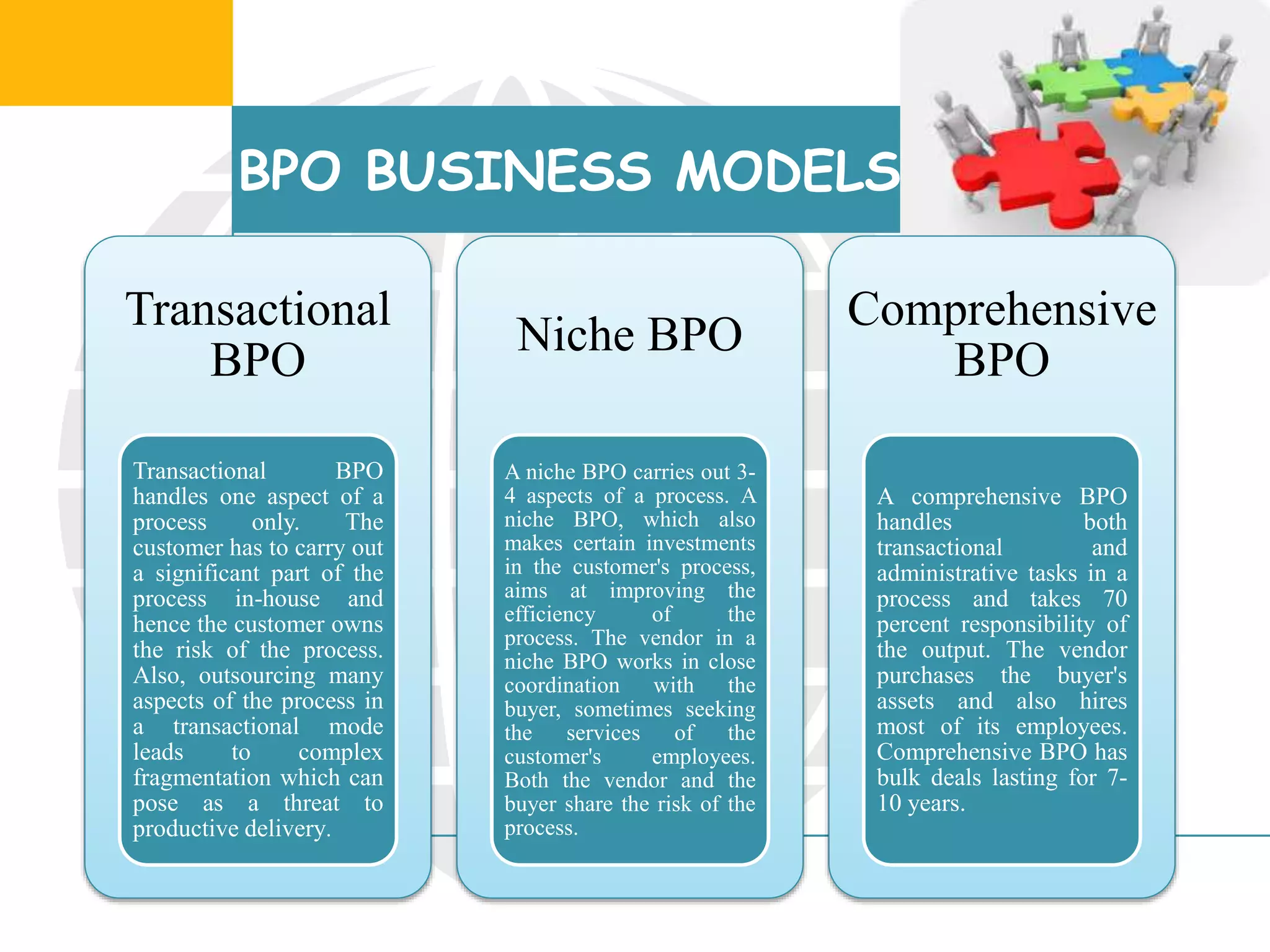
BPO BUSINESS MODELS
Transactional
BPO
Transactional BPO
handles one aspect of a
process only. The
customer has to carry out
a significant part of the
process in-house and
hence the customer owns
the risk of the process.
Also, outsourcing many
aspects of the process in
a transactional mode
leads to complex
fragmentation which can
pose as a threat to
productive delivery.
Niche BPO
A niche BPO carries out 3-
4 aspects of a process. A
niche BPO, which also
makes certain investments
in the customer's process,
aims at improving the
efficiency of the
process. The vendor in a
niche BPO works in close
coordination with the
buyer, sometimes seeking
the services of the
customer's employees.
Both the vendor and the
buyer share the risk of the
process.
Comprehensive
BPO
A comprehensive BPO
handles both
transactional and
administrative tasks in a
process and takes 70
percent responsibility of
the output. The vendor
purchases the buyer's
assets and also hires
most of its employees.
Comprehensive BPO has
bulk deals lasting for 7-
10 years.
BPO SERVICES
 Administrative support
 Customer relationship management
 Document processes
 Finance and accounting
 HR & training
 IPR documentation
 Legal Services –LPO
 Medical transcriptions
 Payroll Management
 Product Development
 Publishing
 Research & Analysis
 Sales & Marketing
 Security
 Supply Chain Management
KPO – KNOWLEDGE PROCESS
OUTSOURCING
 Knowledge process outsourcing (KPO)
describes the outsourcing of core information-
related business activities which are
competitively important or form an integral part
of a company's value chain . KPO requires
advanced analytical and technical skills as well
as a high degree of specialist expertise.
 Increase in specialized Knowledge
 Additional Value Creation
 Cost reduction
 Shortage of skilled labor
 Demand of Quality Product
 KPO firm require more skilled labors than BPO.
 Experts works in KPO keeps learning & have more incomes
than BPO
 In KPO Customer is amid the whole execution process
BPO VS KPO
Drivers of KPO:
KPO-Benefits Vs Risk
Benefit
• Cost reduction
• Shortage of skilled employees
• Provides many graduates at very
low cost
• High end services are provided at a
lower cost to decrease
unemployment and benefit their
economy
• Provide flexibility in terms of
HRM & time management
Risk
• Security- Classified information about
the company can be lost
• Key talent retention
• The character of the employee and the
quality of the work cannot be assured
• KPO is time consuming and cannot
provide a quick fix to the company
seeking immediate results.
• Lack of communication between
partners due to legal, language and
cultural barriers can lead to
complications
• Research & Development
• Financial Consultancy and Services
• Advanced Web Applications
• Business and Technical Analysis
• Learning Solutions
• Animation & Design
• Business & Market Research
• Pharmaceuticals and Biotechnology
• Medical Services
• Writing & Content Development
• Legal Services
• Intellectual Property (IP) Research
• Data Analytics
• Network Management
• Training & Consultancy
KPO SERVICES
 Legal outsourcing, also known as legal process
outsourcing (LPO) refers to the practice of a law firm or
corporation obtaining legal support services from an
outside law firm or legal support services company
(LPO provider).
 Legal Process Outsourcing (LPO) is the industry in
which in-house legal departments or organizations
outsource legal work from areas where it is costly to
perform, such as the United States or Europe to areas
where it can be performed at a significantly decreased
cost, primarily India. Legal Process Outsourcing is a high
end industry that has been growing rapidly in the recent
years.
LPO – LEGAL PROCESS
OUTSOURCING
Why Lpo?
Legal process outsourcing or LPO is the exporting of legal
services to low-wage markets overseas. An increasing number of
companies, large and small, are outsourcing legal work to
destinations across the globe.
A number of factors have fueled the legal process outsourcing
trend, including:
 Globalization
 Economic changes and the rising cost of legal services
 The growth of the Internet
 Increased automation of legal processes
 Developments in data security
 New technology tools
 Cost-Saving – biggest attraction
Lpo Methods
Various Methods to initiate Lpo Process
Direct Contract
This is the most
straight forward
means of establishing
contact. The firm
needing legal
services directly
approaches the legal
process outsourcing
vendor.
Managed
Outsourcing
This is a case where
the firm establishes
contact with a legal
process outsourcing
vendor and retains a
traditional law firm
to coordinate the
vendor's activities
and to ensure quality
control.
Required
Outsourcing:
This form of
outsourcing occurs
when the firm
mandates a certain
level of outsourcing
in the legal process,
either to reduce costs
or to fulfil statutory
requirements.
Multi-sourcing
This involves
segregating the work
assigned to LPO
providers in order to
reduce risk and take
advantage of each
provider's strengths.
This approach is
helpful in cases
where expertise is
required on matters
of jurisdiction and
merits.
LPO Services
 Contract Drafting Services & Contract Monitoring /
Management
 Document review / drafting, electronic discovery
 Medico-Legal Support Services
 Litigation- Document Management
 Bankruptcy Filings , Pleadings & Documentation
 Legal Research/ outsourcing/publication
 Paralegal Support Services
 Patent drafting
 Simple legal filings
 Proof reading
 Legal billing activities like preparation of invoices,
collation of time sheets etc.
 Intellectual property research--substantive and
administrative
 Administrative and secretarial activities like
following up with clients, etc.
Outsourcing Services
Location Analysis
 Countries which are attracting for
Outsourcing Destination:
0%
10%
20%
30%
40%
38%
6% 5% 5% 5% 5% 4% 4% 4%
Outsourcing Destination
Outsourcing In India
 Why India most Preferred?
India produces over 75,000 IT graduates and 20 lacs
English-speaking graduates annually.
The government favors IT foreign ownership and
imposes no export taxes.
In India with redundant telecom and utility
infrastructure, there is very good reliability within India's special
IT parks.
In India Application development, maintenance,
financial processing. Experts see India becoming a hotbed for
more critical analytical jobs.
Labor Pool
Knowledge full /
Expertise
Government
Policies
Infrastructure
Typical salaries range from $5,000 to $12,000 for
technical staff, while back-office salaries range from $3,500 to
$7,500.
Cost Benefits
Top Outsourcing IT Companies
24 / 7 Customers
APTARA
(TECHBOOKS)
Evalueserve
EXL Service
Genpact
Pangea3
WNS Global
Services
ICICI OneSource
Wipro BPO
Tata Consultancy
Services(TCS)
HCL BPO
IBM DAKSH
ACCENTURE
COGNIZANT
Firstsource
Solutions
Bodhi Global
Services (P), Ltd.
Clutch Group.
Cobra Legal
Solutions, LLC.
CPA Global Ltd.
Integreon Managed
Solutions, Inc.
Mindcrest.
Trustman
KPO
BPO LPO
SWOT Analysis in India
•
•Solid History of
software development
•English Proficiency
•Government Support
•Process and Quality
Focus
•Skilled, Educated
Resources
• Entrepreneurialism
Strength
• Infrastructure
•Cultural Differences
•Distance from US
•Feud over Pakistan
•Legal System
Weakness
• BPO and Call
Centers
• Expansion of
Existing
Relationships
•Emerging Chinese
Market
•Indian Domestic
Market Growth
Opportunities
• Competition for
Resources
•Over Promise/Under
Deliver
•Rising Costs
•Competition from
Other Countries
•Corruption, Piracy,
Trust
Threats
Reverse Outsourcing
 ‘Reverse Outsourcing’ is the latest trend in outsourcing.
Now ,those countries companies which are earlier chosen for
outsourcing like India & other Asian countries will now
create jobs in the western countries
 This phenomenon which is gathering pace in recent times is
known as ‘Reverse Outsourcing’ or the trend of Indian ITES
and BPO companies opening offices in the US and Europe
to outsource there work some are
 TCS
 WIPRO
 HCL
Outsourcing: Who’s Benefit?
“Even the harshest
critics of
outsourcing agree
that it can benefit
the firm itself;
after all, the firm
wouldn’t choose
buying over
making unless it
saved money.”
Future Direction -
outsourcing
 High Competition – market
 More offshoring outsourcing
 More nearshore outsourcing
 In Bpo:
 Cost savings is one of the most important drivers now.
Information security, execution capability and
financial stability are important considerations while
selecting a vendor.
 Latest trend of offshore insourcing , in which firms
establish their own offshore captive centers. These
captive centers are generally shared service centers
and allow the firms to retain control over the
processes.
Twitter connect @Ojha_Deepika
Download – This PPT – Link1
Best Cloud File Sharing Platform - 2
Best Cloud File Sharing Platform - 1
Refer Links:-
Download – This PPT – Link2

Outsourcing-all in one Solution

  • 2.
    MADE BY :DEEPIKA OJHA
  • 3.
     Outsourcing  Typesof outsourcing  BPO-Business Process Outsourcing  KPO-Knowledge Process Outsourcing  LPO-Language Process Outsourcing  Location Analysis  Outsourcing in India  Reverse Outsourcing  Future Trends in Outsourcing
  • 4.
    What is outsourcing?  “Outsourcing refers to the practice of transferring activities traditionally done within a firm to third party providers within the country.”   Definition :  Outsourcing is a practice used by different companies to reduce costs by transferring portions of work to outside suppliers rather than completing it internally.  Outsourcing is an effective cost-saving strategy when used properly.
  • 5.
    Outsourcing - Typologies •People , the facilities , the equipment & technology transferred to service provider.Conventional • Company buys new services provider (Make Vs Buy)Greenfield • Problem – Solving mentally. Outsource Company & People both. Tactical • Structured Outsource , to align with companies long – terms Process.Strategical
  • 6.
    Motivation for Outsourcing Cost-Driven Outsource : Reduce & save cost  Strategy- Driven Outsource: Focus on core- competencies Functions.  Politically – Driven Outsource: Outsource By Public Organizations.
  • 7.
  • 9.
    Drivers Vs Risks DRIVERS •Cost savings • Reduced Capital Expenditures • Capital Infusion • Transfer fixed costs to variable • Quality Improvement • Increased speed • Greater flexibility • Access to latest technology / Infrastructure • Access to skills and talents • Augment staff • Increase focus on core functions • Legal compliance • Better accountability / management POTENTIAL RISKS • Unrealized savings or hidden cost • Less flexibility • Poor contract or poor selection of partner • Loss of control/core competencies • Power shift to supplier • Losing customers ,opportunities .or reputation • Uncertainty /changing environment • Poor morale/employee issues • Supplier Problems(poor performance , bad relations)
  • 10.
  • 11.
    BPO-BUSINESS PROCESS OUTSOURCE  Businessprocess outsourcing (BPO) is a subset of outsourcing that involves the contracting of the operations and responsibilities of a specific business process to a third-party service provider.
  • 12.
    BPO CATGEGORIES  Back-office Outsourcing : - it includes internal office functions i.e.  HR  Accounting  Finance / Payroll  Front-office Outsourcing:- It includes customer related services i.e.  Tech support  Contact –center  marketing Back – Office Front – Office
  • 13.
    Outsourcing of businessdone within companies own country Outsourcing of business done in outside country Outsourcing of business done with Companies neighboring countries ONSHORE OFFSHORE NEARSHORE KEY FACTORS-OUTSOURCING
  • 14.
    BPO BUSINESS MODELS Transactional BPO TransactionalBPO handles one aspect of a process only. The customer has to carry out a significant part of the process in-house and hence the customer owns the risk of the process. Also, outsourcing many aspects of the process in a transactional mode leads to complex fragmentation which can pose as a threat to productive delivery. Niche BPO A niche BPO carries out 3- 4 aspects of a process. A niche BPO, which also makes certain investments in the customer's process, aims at improving the efficiency of the process. The vendor in a niche BPO works in close coordination with the buyer, sometimes seeking the services of the customer's employees. Both the vendor and the buyer share the risk of the process. Comprehensive BPO A comprehensive BPO handles both transactional and administrative tasks in a process and takes 70 percent responsibility of the output. The vendor purchases the buyer's assets and also hires most of its employees. Comprehensive BPO has bulk deals lasting for 7- 10 years.
  • 15.
    BPO SERVICES  Administrativesupport  Customer relationship management  Document processes  Finance and accounting  HR & training  IPR documentation  Legal Services –LPO  Medical transcriptions  Payroll Management  Product Development  Publishing  Research & Analysis  Sales & Marketing  Security  Supply Chain Management
  • 16.
    KPO – KNOWLEDGEPROCESS OUTSOURCING  Knowledge process outsourcing (KPO) describes the outsourcing of core information- related business activities which are competitively important or form an integral part of a company's value chain . KPO requires advanced analytical and technical skills as well as a high degree of specialist expertise.
  • 17.
     Increase inspecialized Knowledge  Additional Value Creation  Cost reduction  Shortage of skilled labor  Demand of Quality Product  KPO firm require more skilled labors than BPO.  Experts works in KPO keeps learning & have more incomes than BPO  In KPO Customer is amid the whole execution process BPO VS KPO Drivers of KPO:
  • 18.
    KPO-Benefits Vs Risk Benefit •Cost reduction • Shortage of skilled employees • Provides many graduates at very low cost • High end services are provided at a lower cost to decrease unemployment and benefit their economy • Provide flexibility in terms of HRM & time management Risk • Security- Classified information about the company can be lost • Key talent retention • The character of the employee and the quality of the work cannot be assured • KPO is time consuming and cannot provide a quick fix to the company seeking immediate results. • Lack of communication between partners due to legal, language and cultural barriers can lead to complications
  • 19.
    • Research &Development • Financial Consultancy and Services • Advanced Web Applications • Business and Technical Analysis • Learning Solutions • Animation & Design • Business & Market Research • Pharmaceuticals and Biotechnology • Medical Services • Writing & Content Development • Legal Services • Intellectual Property (IP) Research • Data Analytics • Network Management • Training & Consultancy KPO SERVICES
  • 20.
     Legal outsourcing,also known as legal process outsourcing (LPO) refers to the practice of a law firm or corporation obtaining legal support services from an outside law firm or legal support services company (LPO provider).  Legal Process Outsourcing (LPO) is the industry in which in-house legal departments or organizations outsource legal work from areas where it is costly to perform, such as the United States or Europe to areas where it can be performed at a significantly decreased cost, primarily India. Legal Process Outsourcing is a high end industry that has been growing rapidly in the recent years. LPO – LEGAL PROCESS OUTSOURCING
  • 21.
    Why Lpo? Legal processoutsourcing or LPO is the exporting of legal services to low-wage markets overseas. An increasing number of companies, large and small, are outsourcing legal work to destinations across the globe. A number of factors have fueled the legal process outsourcing trend, including:  Globalization  Economic changes and the rising cost of legal services  The growth of the Internet  Increased automation of legal processes  Developments in data security  New technology tools  Cost-Saving – biggest attraction
  • 22.
    Lpo Methods Various Methodsto initiate Lpo Process Direct Contract This is the most straight forward means of establishing contact. The firm needing legal services directly approaches the legal process outsourcing vendor. Managed Outsourcing This is a case where the firm establishes contact with a legal process outsourcing vendor and retains a traditional law firm to coordinate the vendor's activities and to ensure quality control. Required Outsourcing: This form of outsourcing occurs when the firm mandates a certain level of outsourcing in the legal process, either to reduce costs or to fulfil statutory requirements. Multi-sourcing This involves segregating the work assigned to LPO providers in order to reduce risk and take advantage of each provider's strengths. This approach is helpful in cases where expertise is required on matters of jurisdiction and merits.
  • 23.
    LPO Services  ContractDrafting Services & Contract Monitoring / Management  Document review / drafting, electronic discovery  Medico-Legal Support Services  Litigation- Document Management  Bankruptcy Filings , Pleadings & Documentation  Legal Research/ outsourcing/publication  Paralegal Support Services  Patent drafting  Simple legal filings  Proof reading  Legal billing activities like preparation of invoices, collation of time sheets etc.  Intellectual property research--substantive and administrative  Administrative and secretarial activities like following up with clients, etc.
  • 24.
  • 25.
    Location Analysis  Countrieswhich are attracting for Outsourcing Destination: 0% 10% 20% 30% 40% 38% 6% 5% 5% 5% 5% 4% 4% 4% Outsourcing Destination
  • 26.
    Outsourcing In India Why India most Preferred? India produces over 75,000 IT graduates and 20 lacs English-speaking graduates annually. The government favors IT foreign ownership and imposes no export taxes. In India with redundant telecom and utility infrastructure, there is very good reliability within India's special IT parks. In India Application development, maintenance, financial processing. Experts see India becoming a hotbed for more critical analytical jobs. Labor Pool Knowledge full / Expertise Government Policies Infrastructure Typical salaries range from $5,000 to $12,000 for technical staff, while back-office salaries range from $3,500 to $7,500. Cost Benefits
  • 27.
    Top Outsourcing ITCompanies 24 / 7 Customers APTARA (TECHBOOKS) Evalueserve EXL Service Genpact Pangea3 WNS Global Services ICICI OneSource Wipro BPO Tata Consultancy Services(TCS) HCL BPO IBM DAKSH ACCENTURE COGNIZANT Firstsource Solutions Bodhi Global Services (P), Ltd. Clutch Group. Cobra Legal Solutions, LLC. CPA Global Ltd. Integreon Managed Solutions, Inc. Mindcrest. Trustman KPO BPO LPO
  • 28.
    SWOT Analysis inIndia • •Solid History of software development •English Proficiency •Government Support •Process and Quality Focus •Skilled, Educated Resources • Entrepreneurialism Strength • Infrastructure •Cultural Differences •Distance from US •Feud over Pakistan •Legal System Weakness • BPO and Call Centers • Expansion of Existing Relationships •Emerging Chinese Market •Indian Domestic Market Growth Opportunities • Competition for Resources •Over Promise/Under Deliver •Rising Costs •Competition from Other Countries •Corruption, Piracy, Trust Threats
  • 29.
    Reverse Outsourcing  ‘ReverseOutsourcing’ is the latest trend in outsourcing. Now ,those countries companies which are earlier chosen for outsourcing like India & other Asian countries will now create jobs in the western countries  This phenomenon which is gathering pace in recent times is known as ‘Reverse Outsourcing’ or the trend of Indian ITES and BPO companies opening offices in the US and Europe to outsource there work some are  TCS  WIPRO  HCL
  • 30.
    Outsourcing: Who’s Benefit? “Eventhe harshest critics of outsourcing agree that it can benefit the firm itself; after all, the firm wouldn’t choose buying over making unless it saved money.”
  • 32.
    Future Direction - outsourcing High Competition – market  More offshoring outsourcing  More nearshore outsourcing  In Bpo:  Cost savings is one of the most important drivers now. Information security, execution capability and financial stability are important considerations while selecting a vendor.  Latest trend of offshore insourcing , in which firms establish their own offshore captive centers. These captive centers are generally shared service centers and allow the firms to retain control over the processes.
  • 33.
    Twitter connect @Ojha_Deepika Download– This PPT – Link1 Best Cloud File Sharing Platform - 2 Best Cloud File Sharing Platform - 1 Refer Links:- Download – This PPT – Link2