Our Environment
Subject:
Subject:
Subject: Biology
Biology
Biology
Topic:Our environment
Name: Naman Sharma
Name: Naman Sharma
Name: Naman Sharma
Class: Xth
Class: Xth
Class: Xth
Section: A
Section: A
Section: A
Roll no. :
Roll no. :
Roll no. :
Eco system and it's
components
Food chain and
Webs
Ozone layer
How ozone layer is
depleted
Managing the
garbage we produce
Acknowledgement
Sub Topics
Eco-system
An ecosystem is a geographic area where
plants, animals, and other organisms, as well
as weather and landscape, work together to
form a bubble of life
An ecosystem consists of biotic components
comprising living organisms and abiotic
components comprising physical factors like
temperature, rainfall, wind, soil and minerals.
I t ' s c o m p o n e n t s
O r g a n i s m s c a n b e g r o u p e d a s
p r o d u c e r s , c o n s u m e r s a n d
d e c o m p o s e r s a c c o r d i n g t o t h e
m a n n e r i n w h i c h t h e y o b t a i n
t h e i r s u s t e n a n c e f r o m t h e
e n v i r o n m e n t .
A l l g r e e n p l a n t s a n d c e r t a i n
b a c t e r i a w h i c h c a n p r o d u c e
f o o d b y p h o t o s y n t h e s i s c o m e
u n d e r t h i s c a t e g o r y a n d a r e
c a l l e d t h e p r o d u c e r s .
Producers
Consumers
Herbivores are organisms that feed exclusively
on plants.
Carnivores are organisms that depend on other
animals for their food.
Omnivores are organisms that depend on both
plants and animals for their food.
Parasite is an organism that lives on or in a
host organism and gets its food from its host.
Organisms which consume the food
produced,either directly from producers or
indirectly by feeding on other consumers are the
consumers.
Consumers can be classed variously as herbivores,
carnivores, omnivores and parasites.
Decomposers
Micro-organisms such as dacteria and fungi
break-down the complex organic
substances into simple inorganic
substances that go into the soil and are
used up once more by the plants.
Food chains
This series or organisms tahing part at
various biotic levels from food chain.
Each step or level of the food chain forms
a trophic level. The autotrophs or the
producers are at the first trophic level.
They fix up the solar energy and make it
available for heterotrophs or the
consumers.
The herbivorous or thr primary consumers,
small carnivores or the secondary
consumers at the third and the larger
carnivores or the tertiary consumers form
the fourth tropical level
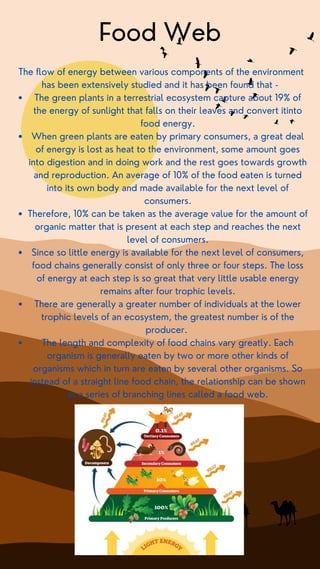
Food Web
The green plants in a terrestrial ecosystem capture about 19% of
the energy of sunlight that falls on their leaves and convert itinto
food energy.
When green plants are eaten by primary consumers, a great deal
of energy is lost as heat to the environment, some amount goes
into digestion and in doing work and the rest goes towards growth
and reproduction. An average of 10% of the food eaten is turned
into its own body and made available for the next level of
consumers.
Therefore, 10% can be taken as the average value for the amount of
organic matter that is present at each step and reaches the next
level of consumers.
Since so little energy is available for the next level of consumers,
food chains generally consist of only three or four steps. The loss
of energy at each step is so great that very little usable energy
remains after four trophic levels.
There are generally a greater number of individuals at the lower
trophic levels of an ecosystem, the greatest number is of the
producer.
The length and complexity of food chains vary greatly. Each
organism is generally eaten by two or more other kinds of
organisms which in turn are eaten by several other organisms. So
instead of a straight line food chain, the relationship can be shown
as a series of branching lines called a food web.
The flow of energy between various components of the environment
has been extensively studied and it has been found that -
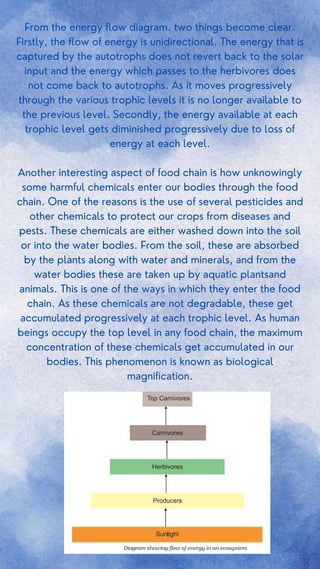
From the energy flow diagram. two things become clear.
Firstly, the flow of energy is unidirectional. The energy that is
captured by the autotrophs does not revert back to the solar
input and the energy which passes to the herbivores does
not come back to autotrophs. As it moves progressively
through the various trophic levels it is no longer available to
the previous level. Secondly, the energy available at each
trophic level gets diminished progressively due to loss of
energy at each level.
Another interesting aspect of food chain is how unknowingly
some harmful chemicals enter our bodies through the food
chain. One of the reasons is the use of several pesticides and
other chemicals to protect our crops from diseases and
pests. These chemicals are either washed down into the soil
or into the water bodies. From the soil, these are absorbed
by the plants along with water and minerals, and from the
water bodies these are taken up by aquatic plantsand
animals. This is one of the ways in which they enter the food
chain. As these chemicals are not degradable, these get
accumulated progressively at each trophic level. As human
beings occupy the top level in any food chain, the maximum
concentration of these chemicals get accumulated in our
bodies. This phenomenon is known as biological
magnification.
Ozone layer
Ozone (O ) is a molecule formed by three atoms of
oxygen. While O.. which we normally refer to as oxygen, is
essential for all aerobic forms of life Ozone, is a deadly
poison. However, at the higher levels of the atmosphere,
ozone performs an essential function. It shields the
surface of the earth from ultraviolet (UV) radiation from
the Sun. This radiationis highly to organisms, for
example, it known to cause skin cancer in human beings.
Ozone at the higher levels of the atmosphere is a product
of UV radiation acting on oxygen (0) molecule. The higher
energy UV radiations split apart some moleculer oxygen
(O) into free oxygen (O) atoms. These atoms then combine
with the molecular oxygen to form ozone as shown-
How ozone layer is getting depleted
The amount of ozone in the atmosphere began to
drop sharply in the 1980s. This decrease has been
linked to synthetic chemicals like
chlorofluorocarbons (CFCs) which are used as
refrigerants and in fire extinguishers. In 1987, the
United Nations Environment Programme (UNEP)
succeeded in forging an agreement to freeze CFC
production at 1986 levels. It is now mandatory for all
the manufacturing companies. to make CFC-free
refrigerators throughout the world.
3
O ------> O + O
O +O ---> O
(Ozone)
UV
2 3
2
Managing the Garbage
we Produce
Substances that are broken down by biological
processes are said to be biodegradable.
Substances that are not broken down in this
manner are said to be non-biodegradable. These
substances may be inert and simply persist in the
environment for a long time or may harm the
various members of the eco-system.
The usage of dust bins must be followed
daily.
Reduce the usage if plastics when buying
vegetables or other household things while
going to market
Make sure that reusable things are not
disposed and recycled according to the
procedures
Left over food items should be packed in a
proper container and make sure that they
are not dumped in the public places or any
other sides
Improvements in our life-style have resulted in
greater amounts of waste material generation.
Changes in attitude also have a role to play,
with more and more things we use becoming
disposable. Changes in packaging have resulted
in much of our waste becoming non-
biodegradable.
I WOULD LIKE TO
EXPRESS MY SPECIAL
THANKS OF GRATITUDE
TO MY DEVYANI PATIL
MAM, WHO GAVE ME THE
GOLDEN OPPORTUNITY TO
DO THIS WONDERFUL
PROJECT ON THE TOPIC
OUR ENVIRONMENT,
WHICH ALSO HELP ME TO
GOING A LOT OF
RESEARCH AND I CAME
TO KNOW ABOUT SO
MANY THINGS. I AM
REALLY THANKFUL TO
THEM
Acknowledgment

Our environment class 10

  • 1.
  • 2.
    Subject: Subject: Subject: Biology Biology Biology Topic:Our environment Topic:Ourenvironment Topic:Our environment Name: Naman Sharma Name: Naman Sharma Name: Naman Sharma Class: Xth Class: Xth Class: Xth Section: A Section: A Section: A Roll no. : Roll no. : Roll no. :
  • 3.
    Eco system andit's components Food chain and Webs Ozone layer How ozone layer is depleted Managing the garbage we produce Acknowledgement Sub Topics
  • 4.
    Eco-system An ecosystem isa geographic area where plants, animals, and other organisms, as well as weather and landscape, work together to form a bubble of life An ecosystem consists of biotic components comprising living organisms and abiotic components comprising physical factors like temperature, rainfall, wind, soil and minerals. I t ' s c o m p o n e n t s O r g a n i s m s c a n b e g r o u p e d a s p r o d u c e r s , c o n s u m e r s a n d d e c o m p o s e r s a c c o r d i n g t o t h e m a n n e r i n w h i c h t h e y o b t a i n t h e i r s u s t e n a n c e f r o m t h e e n v i r o n m e n t . A l l g r e e n p l a n t s a n d c e r t a i n b a c t e r i a w h i c h c a n p r o d u c e f o o d b y p h o t o s y n t h e s i s c o m e u n d e r t h i s c a t e g o r y a n d a r e c a l l e d t h e p r o d u c e r s . Producers
  • 5.
    Consumers Herbivores are organismsthat feed exclusively on plants. Carnivores are organisms that depend on other animals for their food. Omnivores are organisms that depend on both plants and animals for their food. Parasite is an organism that lives on or in a host organism and gets its food from its host. Organisms which consume the food produced,either directly from producers or indirectly by feeding on other consumers are the consumers. Consumers can be classed variously as herbivores, carnivores, omnivores and parasites. Decomposers Micro-organisms such as dacteria and fungi break-down the complex organic substances into simple inorganic substances that go into the soil and are used up once more by the plants.
  • 6.
    Food chains This seriesor organisms tahing part at various biotic levels from food chain. Each step or level of the food chain forms a trophic level. The autotrophs or the producers are at the first trophic level. They fix up the solar energy and make it available for heterotrophs or the consumers. The herbivorous or thr primary consumers, small carnivores or the secondary consumers at the third and the larger carnivores or the tertiary consumers form the fourth tropical level
  • 7.
    Food Web The greenplants in a terrestrial ecosystem capture about 19% of the energy of sunlight that falls on their leaves and convert itinto food energy. When green plants are eaten by primary consumers, a great deal of energy is lost as heat to the environment, some amount goes into digestion and in doing work and the rest goes towards growth and reproduction. An average of 10% of the food eaten is turned into its own body and made available for the next level of consumers. Therefore, 10% can be taken as the average value for the amount of organic matter that is present at each step and reaches the next level of consumers. Since so little energy is available for the next level of consumers, food chains generally consist of only three or four steps. The loss of energy at each step is so great that very little usable energy remains after four trophic levels. There are generally a greater number of individuals at the lower trophic levels of an ecosystem, the greatest number is of the producer. The length and complexity of food chains vary greatly. Each organism is generally eaten by two or more other kinds of organisms which in turn are eaten by several other organisms. So instead of a straight line food chain, the relationship can be shown as a series of branching lines called a food web. The flow of energy between various components of the environment has been extensively studied and it has been found that -
  • 8.
    From the energyflow diagram. two things become clear. Firstly, the flow of energy is unidirectional. The energy that is captured by the autotrophs does not revert back to the solar input and the energy which passes to the herbivores does not come back to autotrophs. As it moves progressively through the various trophic levels it is no longer available to the previous level. Secondly, the energy available at each trophic level gets diminished progressively due to loss of energy at each level. Another interesting aspect of food chain is how unknowingly some harmful chemicals enter our bodies through the food chain. One of the reasons is the use of several pesticides and other chemicals to protect our crops from diseases and pests. These chemicals are either washed down into the soil or into the water bodies. From the soil, these are absorbed by the plants along with water and minerals, and from the water bodies these are taken up by aquatic plantsand animals. This is one of the ways in which they enter the food chain. As these chemicals are not degradable, these get accumulated progressively at each trophic level. As human beings occupy the top level in any food chain, the maximum concentration of these chemicals get accumulated in our bodies. This phenomenon is known as biological magnification.
  • 9.
    Ozone layer Ozone (O) is a molecule formed by three atoms of oxygen. While O.. which we normally refer to as oxygen, is essential for all aerobic forms of life Ozone, is a deadly poison. However, at the higher levels of the atmosphere, ozone performs an essential function. It shields the surface of the earth from ultraviolet (UV) radiation from the Sun. This radiationis highly to organisms, for example, it known to cause skin cancer in human beings. Ozone at the higher levels of the atmosphere is a product of UV radiation acting on oxygen (0) molecule. The higher energy UV radiations split apart some moleculer oxygen (O) into free oxygen (O) atoms. These atoms then combine with the molecular oxygen to form ozone as shown- How ozone layer is getting depleted The amount of ozone in the atmosphere began to drop sharply in the 1980s. This decrease has been linked to synthetic chemicals like chlorofluorocarbons (CFCs) which are used as refrigerants and in fire extinguishers. In 1987, the United Nations Environment Programme (UNEP) succeeded in forging an agreement to freeze CFC production at 1986 levels. It is now mandatory for all the manufacturing companies. to make CFC-free refrigerators throughout the world. 3 O ------> O + O O +O ---> O (Ozone) UV 2 3 2
  • 10.
    Managing the Garbage weProduce Substances that are broken down by biological processes are said to be biodegradable. Substances that are not broken down in this manner are said to be non-biodegradable. These substances may be inert and simply persist in the environment for a long time or may harm the various members of the eco-system. The usage of dust bins must be followed daily. Reduce the usage if plastics when buying vegetables or other household things while going to market Make sure that reusable things are not disposed and recycled according to the procedures Left over food items should be packed in a proper container and make sure that they are not dumped in the public places or any other sides Improvements in our life-style have resulted in greater amounts of waste material generation. Changes in attitude also have a role to play, with more and more things we use becoming disposable. Changes in packaging have resulted in much of our waste becoming non- biodegradable.
  • 11.
    I WOULD LIKETO EXPRESS MY SPECIAL THANKS OF GRATITUDE TO MY DEVYANI PATIL MAM, WHO GAVE ME THE GOLDEN OPPORTUNITY TO DO THIS WONDERFUL PROJECT ON THE TOPIC OUR ENVIRONMENT, WHICH ALSO HELP ME TO GOING A LOT OF RESEARCH AND I CAME TO KNOW ABOUT SO MANY THINGS. I AM REALLY THANKFUL TO THEM Acknowledgment