
Northland’s Coast and Us
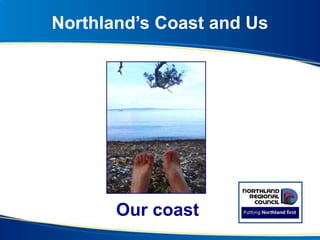
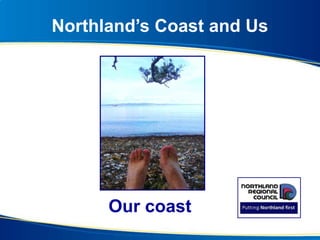
Our coast
Where is Northland’s coast?
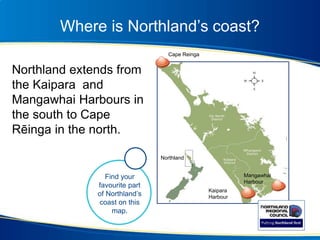
Northland extends from
the Kaipara and
Mangawhai Harbours in
the south to Cape
Rēinga in the north.
Find your
favourite part
of Northland’s
coast on this
map.
Northland
Cape Reinga
Mangawhai
Harbour
Kaipara
Harbour
What is Northland’s coast?
• inlets and estuaries
• sand dunes, rocky shores and sandy beaches
• two marine reserves and 17 harbours
Northland’s coast is a 3200
kilometre zipper joining the land
and the sea. It includes;
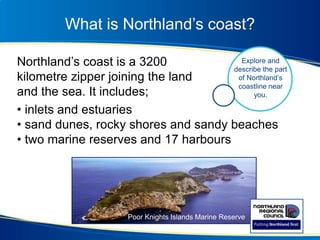
Poor Knights Islands Marine Reserve
Explore and
describe the part
of Northland’s
coastline near
you.
What’s special about Northland’s
west coast?
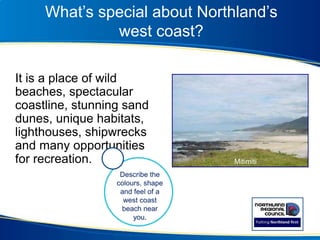
It is a place of wild
beaches, spectacular
coastline, stunning sand
dunes, unique habitats,
lighthouses, shipwrecks
and many opportunities
for recreation.
Hokianga Harbour
Describe the colours,
shape and feel of the
West Coast beach nearest
to you.
Mitimiti
Describe the
colours, shape
and feel of a
west coast
beach near
you.
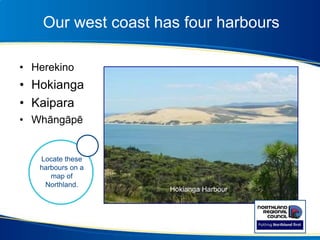
Our west coast has four harbours
• Herekino
• Hokianga
• Kaipara
• Whāngāpē
Hokianga Harbour
Locate these
harbours on a
map of
Northland.
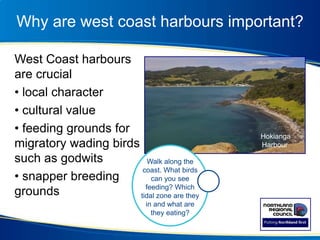
Why are west coast harbours important?
West Coast harbours
are crucial
• local character
• cultural value
• feeding grounds for
migratory wading birds
such as godwits
• snapper breeding
grounds
Walk along the
coast. What birds
can you see
feeding? Which
tidal zone are they
in and what are
they eating?
Hokianga
Harbour
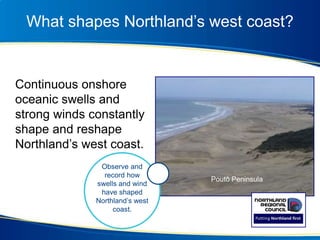
What shapes Northland’s west coast?
Continuous onshore
oceanic swells and
strong winds constantly
shape and reshape
Northland’s west coast.
Poutō Peninsula
Observe and
record how
swells and wind
have shaped
Northland’s west
coast.
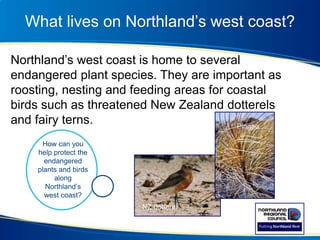
What lives on Northland’s west coast?
Northland’s west coast is home to several
endangered plant species. They are important as
roosting, nesting and feeding areas for coastal
birds such as threatened New Zealand dotterels
and fairy terns.
NZ dotterel
How can you
help protect the
endangered
plants and birds
along
Northland’s
west coast?
Pingao
What’s special about Northland’s
east coast?
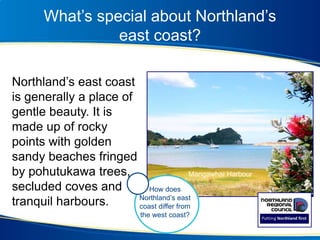
Northland’s east coast
is generally a place of
gentle beauty. It is
made up of rocky
points with golden
sandy beaches fringed
by pohutukawa trees,
secluded coves and
tranquil harbours.
Mangawhai Harbour
How does
Northland’s east
coast differ from
the west coast?
What’s special about the east coast?
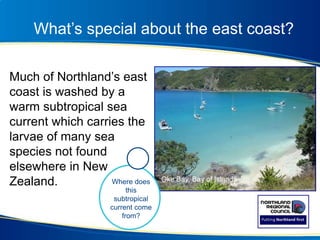
Much of Northland’s east
coast is washed by a
warm subtropical sea
current which carries the
larvae of many sea
species not found
elsewhere in New
Zealand. Oke Bay, Bay of IslandsWhere does
this
subtropical
current come
from?
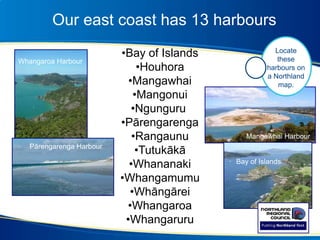
Our east coast has 13 harbours
•Bay of Islands
•Houhora
•Mangawhai
•Mangonui
•Ngunguru
•Pārengarenga
•Rangaunu
•Tutukākā
•Whananaki
•Whangamumu
•Whāngārei
•Whangaroa
•Whangaruru
What
harbours are
near you?
Whangaroa Harbour
Mangawhai Harbour
Pārengarenga Harbour
Bay of Islands
Locate
these
harbours on
a Northland
map.
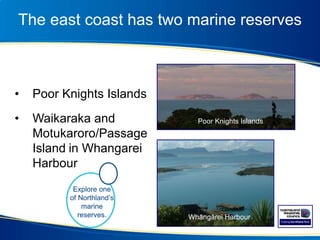
The east coast has two marine reserves
• Poor Knights Islands
• Waikaraka and
Motukaroro/Passage
Island in Whangarei
Harbour
Explore one
of Northland’s
marine
reserves. Whāngārei Harbour
Poor Knights Islands
The east coast has two marine reserves
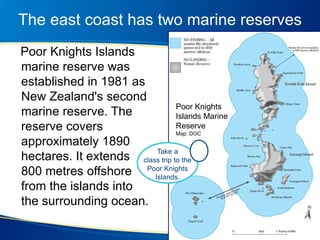
Poor Knights Islands
marine reserve was
established in 1981 as
New Zealand's second
marine reserve. The
reserve covers
approximately 1890
hectares. It extends
800 metres offshore
from the islands into
the surrounding ocean.
Take a
class trip to the
Poor Knights
Islands.
Poor Knights
Islands Marine
Reserve
Map: DOC
Whangarei Harbour
Marine Reserve
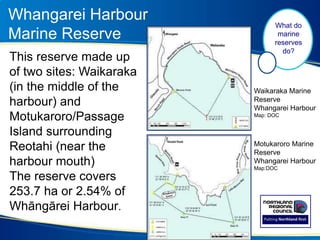
This reserve made up
of two sites: Waikaraka
(in the middle of the
harbour) and
Motukaroro/Passage
Island surrounding
Reotahi (near the
harbour mouth)
The reserve covers
253.7 ha or 2.54% of
Whāngārei Harbour.
What do
marine
reserves
do?
Waikaraka Marine
Reserve
Whangarei Harbour
Map: DOC
Motukaroro Marine
Reserve
Whangarei Harbour
Map:DOC
What shapes Northland’s east coast?
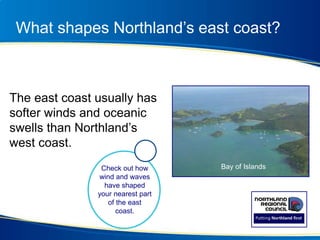
The east coast usually has
softer winds and oceanic
swells than Northland’s
west coast.
Bay of IslandsCheck out how
wind and waves
have shaped
your nearest part
of the east
coast.
What lives on Northland’s east coast?
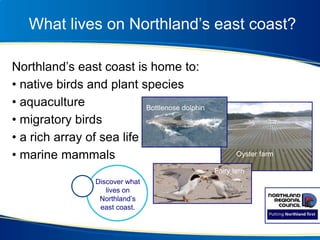
Northland’s east coast is home to:
• native birds and plant species
• aquaculture
• migratory birds
• a rich array of sea life
• marine mammals Oyster farm
Fairy tern
Bottlenose dolphin
Discover what
lives on
Northland’s
east coast.
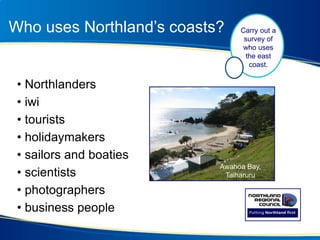
Who uses Northland’s coasts?
• Northlanders
• iwi
• tourists
• holidaymakers
• sailors and boaties
• scientists
• photographers
• business people
Awahoa Bay,
Taiharuru
Carry out a
survey of
who uses
the east
coast.
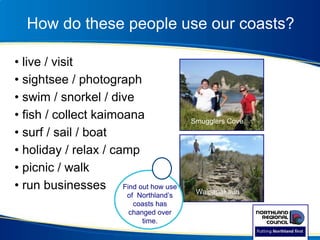
How do these people use our coasts?
• live / visit
• sightsee / photograph
• swim / snorkel / dive
• fish / collect kaimoana
• surf / sail / boat
• holiday / relax / camp
• picnic / walk
• run businesses
Smugglers Cove
Find out how use
of Northland’s
coasts has
changed over
time.
Waipapakauri
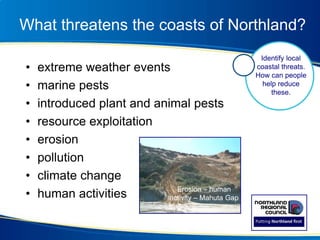
What threatens the coasts of Northland?
• extreme weather events
• marine pests
• introduced plant and animal pests
• resource exploitation
• erosion
• pollution
• climate change
• human activities
Identify local
coastal threats.
How can people
help reduce
these.
Erosion – human
activity – Mahuta Gap
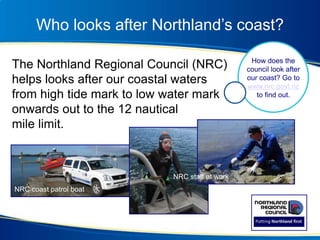
Who looks after Northland’s coast?
The Northland Regional Council (NRC)
helps looks after our coastal waters
from high tide mark to low water mark
onwards out to the 12 nautical
mile limit.
NRC coast patrol boat
How does the
council look after
our coast? Go to
www.nrc.govt.nz
to find out.
NRC staff at work
Who looks after Northland’s coast?
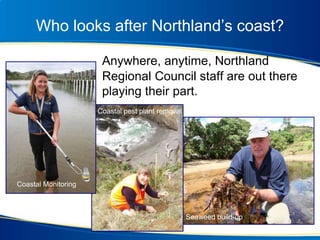
Anywhere, anytime, Northland
Regional Council staff are out there
playing their part.
Coastal Monitoring
Coastal pest plant removal
Seaweed build-up
Who looks after Northland’s coast?
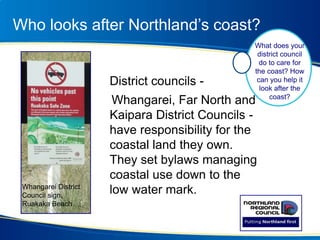
District councils -
Whangarei, Far North and
Kaipara District Councils -
have responsibility for the
coastal land they own.
They set bylaws managing
coastal use down to the
low water mark.
What does your
district council
do to care for
the coast? How
can you help it
look after the
coast?
Whangarei District
Council sign,
Ruakaka Beach
Who looks after Northland’s coast?
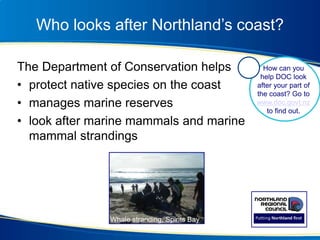
The Department of Conservation helps
• protect native species on the coast
• manages marine reserves
• look after marine mammals and marine
mammal strandings
How can you
help DOC look
after your part of
the coast? Go to
www.doc.govt.nz
to find out.
Whale stranding, Spirits Bay
Who looks after Northland’s coast?
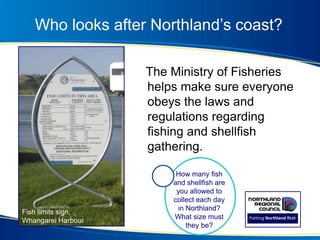
The Ministry of Fisheries
helps make sure everyone
obeys the laws and
regulations regarding
fishing and shellfish
gathering.
How many fish
and shellfish are
you allowed to
collect each day
in Northland?
What size must
they be?
Fish limits sign,
Whangarei Harbour
Who looks after Northland’s coast?
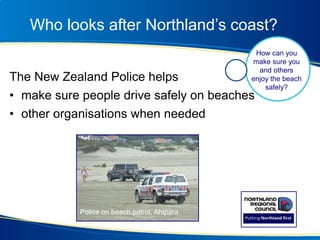
The New Zealand Police helps
• make sure people drive safely on beaches
• other organisations when needed
Awahoa Bay
How can you
make sure you
and others
enjoy the beach
safely?
Police on beach patrol, Ahipara
Who looks after Northland’s coast?
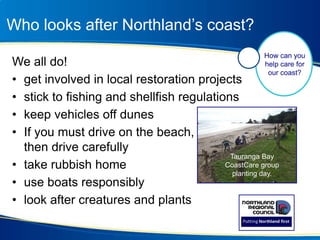
We all do!
• get involved in local restoration projects
• stick to fishing and shellfish regulations
• keep vehicles off dunes
• If you must drive on the beach,
then drive carefully
• take rubbish home
• use boats responsibly
• look after creatures and plants
How can you
help care for
our coast?
Tauranga Bay
CoastCare group
planting day.
Who looks after Northland’s coast?
• keep pollutants out of drains
• keep dogs on leashes, collect their waste and
only take them to beaches if permitted
• keep beaches and dunes free of garden waste
• leave pebbles and shells on the beach
• fence stock in paddocks
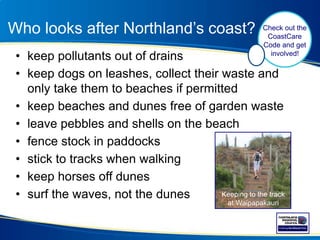
• stick to tracks when walking
• keep horses off dunes
• surf the waves, not the dunes
Check out the
CoastCare
Code and get
involved!
Keeping to the track
at Waipapakauri
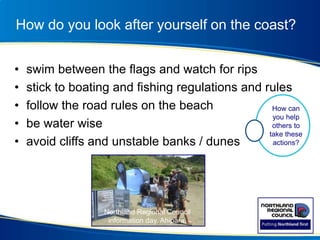
How do you look after yourself on the coast?
• swim between the flags and watch for rips
• stick to boating and fishing regulations and rules
• follow the road rules on the beach
• be water wise
• avoid cliffs and unstable banks / dunes
Northland Regional Council
information day, Ahipara.
How can
you help
others to
take these
actions?
Northland’s Coast and Us
Our coast
have you clicked on yet?
www.nrc.govt.nz
Northland’s Coast and Us
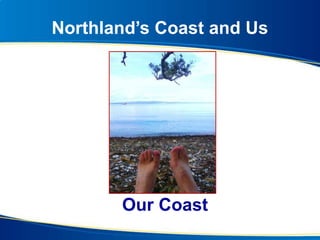
Our Coast

Our coast

  • 1.
  • 2.
    Where is Northland’scoast? Northland extends from the Kaipara and Mangawhai Harbours in the south to Cape Rēinga in the north. Find your favourite part of Northland’s coast on this map. Northland Cape Reinga Mangawhai Harbour Kaipara Harbour
  • 3.
    What is Northland’scoast? • inlets and estuaries • sand dunes, rocky shores and sandy beaches • two marine reserves and 17 harbours Northland’s coast is a 3200 kilometre zipper joining the land and the sea. It includes; Poor Knights Islands Marine Reserve Explore and describe the part of Northland’s coastline near you.
  • 4.
    What’s special aboutNorthland’s west coast? It is a place of wild beaches, spectacular coastline, stunning sand dunes, unique habitats, lighthouses, shipwrecks and many opportunities for recreation. Hokianga Harbour Describe the colours, shape and feel of the West Coast beach nearest to you. Mitimiti Describe the colours, shape and feel of a west coast beach near you.
  • 5.
    Our west coasthas four harbours • Herekino • Hokianga • Kaipara • Whāngāpē Hokianga Harbour Locate these harbours on a map of Northland.
  • 6.
    Why are westcoast harbours important? West Coast harbours are crucial • local character • cultural value • feeding grounds for migratory wading birds such as godwits • snapper breeding grounds Walk along the coast. What birds can you see feeding? Which tidal zone are they in and what are they eating? Hokianga Harbour
  • 7.
    What shapes Northland’swest coast? Continuous onshore oceanic swells and strong winds constantly shape and reshape Northland’s west coast. Poutō Peninsula Observe and record how swells and wind have shaped Northland’s west coast.
  • 8.
    What lives onNorthland’s west coast? Northland’s west coast is home to several endangered plant species. They are important as roosting, nesting and feeding areas for coastal birds such as threatened New Zealand dotterels and fairy terns. NZ dotterel How can you help protect the endangered plants and birds along Northland’s west coast? Pingao
  • 9.
    What’s special aboutNorthland’s east coast? Northland’s east coast is generally a place of gentle beauty. It is made up of rocky points with golden sandy beaches fringed by pohutukawa trees, secluded coves and tranquil harbours. Mangawhai Harbour How does Northland’s east coast differ from the west coast?
  • 10.
    What’s special aboutthe east coast? Much of Northland’s east coast is washed by a warm subtropical sea current which carries the larvae of many sea species not found elsewhere in New Zealand. Oke Bay, Bay of IslandsWhere does this subtropical current come from?
  • 11.
    Our east coasthas 13 harbours •Bay of Islands •Houhora •Mangawhai •Mangonui •Ngunguru •Pārengarenga •Rangaunu •Tutukākā •Whananaki •Whangamumu •Whāngārei •Whangaroa •Whangaruru What harbours are near you? Whangaroa Harbour Mangawhai Harbour Pārengarenga Harbour Bay of Islands Locate these harbours on a Northland map.
  • 12.
    The east coasthas two marine reserves • Poor Knights Islands • Waikaraka and Motukaroro/Passage Island in Whangarei Harbour Explore one of Northland’s marine reserves. Whāngārei Harbour Poor Knights Islands
  • 13.
    The east coasthas two marine reserves Poor Knights Islands marine reserve was established in 1981 as New Zealand's second marine reserve. The reserve covers approximately 1890 hectares. It extends 800 metres offshore from the islands into the surrounding ocean. Take a class trip to the Poor Knights Islands. Poor Knights Islands Marine Reserve Map: DOC
  • 14.
    Whangarei Harbour Marine Reserve Thisreserve made up of two sites: Waikaraka (in the middle of the harbour) and Motukaroro/Passage Island surrounding Reotahi (near the harbour mouth) The reserve covers 253.7 ha or 2.54% of Whāngārei Harbour. What do marine reserves do? Waikaraka Marine Reserve Whangarei Harbour Map: DOC Motukaroro Marine Reserve Whangarei Harbour Map:DOC
  • 15.
    What shapes Northland’seast coast? The east coast usually has softer winds and oceanic swells than Northland’s west coast. Bay of IslandsCheck out how wind and waves have shaped your nearest part of the east coast.
  • 16.
    What lives onNorthland’s east coast? Northland’s east coast is home to: • native birds and plant species • aquaculture • migratory birds • a rich array of sea life • marine mammals Oyster farm Fairy tern Bottlenose dolphin Discover what lives on Northland’s east coast.
  • 17.
    Who uses Northland’scoasts? • Northlanders • iwi • tourists • holidaymakers • sailors and boaties • scientists • photographers • business people Awahoa Bay, Taiharuru Carry out a survey of who uses the east coast.
  • 18.
    How do thesepeople use our coasts? • live / visit • sightsee / photograph • swim / snorkel / dive • fish / collect kaimoana • surf / sail / boat • holiday / relax / camp • picnic / walk • run businesses Smugglers Cove Find out how use of Northland’s coasts has changed over time. Waipapakauri
  • 19.
    What threatens thecoasts of Northland? • extreme weather events • marine pests • introduced plant and animal pests • resource exploitation • erosion • pollution • climate change • human activities Identify local coastal threats. How can people help reduce these. Erosion – human activity – Mahuta Gap
  • 20.
    Who looks afterNorthland’s coast? The Northland Regional Council (NRC) helps looks after our coastal waters from high tide mark to low water mark onwards out to the 12 nautical mile limit. NRC coast patrol boat How does the council look after our coast? Go to www.nrc.govt.nz to find out. NRC staff at work
  • 21.
    Who looks afterNorthland’s coast? Anywhere, anytime, Northland Regional Council staff are out there playing their part. Coastal Monitoring Coastal pest plant removal Seaweed build-up
  • 22.
    Who looks afterNorthland’s coast? District councils - Whangarei, Far North and Kaipara District Councils - have responsibility for the coastal land they own. They set bylaws managing coastal use down to the low water mark. What does your district council do to care for the coast? How can you help it look after the coast? Whangarei District Council sign, Ruakaka Beach
  • 23.
    Who looks afterNorthland’s coast? The Department of Conservation helps • protect native species on the coast • manages marine reserves • look after marine mammals and marine mammal strandings How can you help DOC look after your part of the coast? Go to www.doc.govt.nz to find out. Whale stranding, Spirits Bay
  • 24.
    Who looks afterNorthland’s coast? The Ministry of Fisheries helps make sure everyone obeys the laws and regulations regarding fishing and shellfish gathering. How many fish and shellfish are you allowed to collect each day in Northland? What size must they be? Fish limits sign, Whangarei Harbour
  • 25.
    Who looks afterNorthland’s coast? The New Zealand Police helps • make sure people drive safely on beaches • other organisations when needed Awahoa Bay How can you make sure you and others enjoy the beach safely? Police on beach patrol, Ahipara
  • 26.
    Who looks afterNorthland’s coast? We all do! • get involved in local restoration projects • stick to fishing and shellfish regulations • keep vehicles off dunes • If you must drive on the beach, then drive carefully • take rubbish home • use boats responsibly • look after creatures and plants How can you help care for our coast? Tauranga Bay CoastCare group planting day.
  • 27.
    Who looks afterNorthland’s coast? • keep pollutants out of drains • keep dogs on leashes, collect their waste and only take them to beaches if permitted • keep beaches and dunes free of garden waste • leave pebbles and shells on the beach • fence stock in paddocks • stick to tracks when walking • keep horses off dunes • surf the waves, not the dunes Check out the CoastCare Code and get involved! Keeping to the track at Waipapakauri
  • 28.
    How do youlook after yourself on the coast? • swim between the flags and watch for rips • stick to boating and fishing regulations and rules • follow the road rules on the beach • be water wise • avoid cliffs and unstable banks / dunes Northland Regional Council information day, Ahipara. How can you help others to take these actions?
  • 29.
  • 30.
    have you clickedon yet? www.nrc.govt.nz
  • 31.