2 Beaches Ash
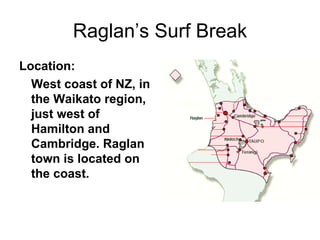
Raglan’s Surf Break Location: West coast of NZ, in the Waikato region, just west of Hamilton and Cambridge. Raglan town is located on the coast.
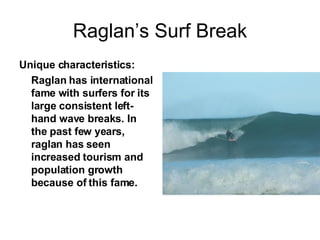
Raglan’s Surf Break Unique characteristics: Raglan has international fame with surfers for its large consistent left-hand wave breaks. In the past few years, raglan has seen increased tourism and population growth because of this fame.
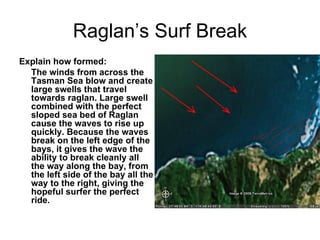
Raglan’s Surf Break Explain how formed: The winds from across the Tasman Sea blow and create large swells that travel towards raglan. Large swell combined with the perfect sloped sea bed of Raglan cause the waves to rise up quickly. Because the waves break on the left edge of the bays, it gives the wave the ability to break cleanly all the way along the bay, from the left side of the bay all the way to the right, giving the hopeful surfer the perfect ride.
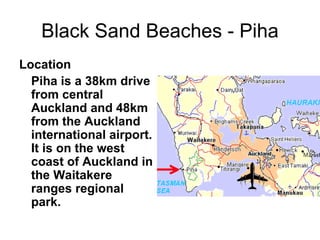
Black Sand Beaches - Piha Location Piha is a 38km drive from central Auckland and 48km from the Auckland international airport. It is on the west coast of Auckland in the Waitakere ranges regional park.
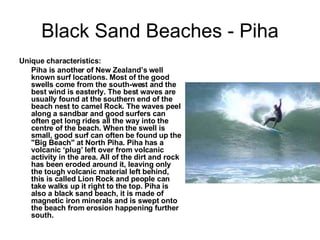
Black Sand Beaches - Piha Unique characteristics: Piha is another of New Zealand’s well known surf locations. Most of the good swells come from the south-west and the best wind is easterly. The best waves are usually found at the southern end of the beach nest to camel Rock. The waves peel along a sandbar and good surfers can often get long rides all the way into the centre of the beach. When the swell is small, good surf can often be found up the "Big Beach" at North Piha. Piha has a volcanic ‘plug’ left over from volcanic activity in the area. All of the dirt and rock has been eroded around it, leaving only the tough volcanic material left behind, this is called Lion Rock and people can take walks up it right to the top. Piha is also a black sand beach, it is made of magnetic iron minerals and is swept onto the beach from erosion happening further south.
Black Sand Beaches - Piha Explain how formed: The Waitakere Ranges were formed around 20 million years ago caused by a violent volcanic upheaval under the sea. These massive segments of volcanic rock have eroded to become today a dissected volcanic plateau, the eastern most slopes of which are the Waitakere Ranges as we know them today. The Range is now a dominant feature of Auckland’s western skyline.  The Waitakere’s are home to a few well known geological formations such as Lion Rock of Piha which is a remnant of a volcanic plug.  The beaches around Piha feature black sand that has been formed by a magnetic iron oxide mineral that has eroded from volcanic ash further south and swept up the coast.

Ashley's Caostal Landforms

  • 1.
  • 2.
    Raglan’s Surf BreakLocation: West coast of NZ, in the Waikato region, just west of Hamilton and Cambridge. Raglan town is located on the coast.
  • 3.
    Raglan’s Surf BreakUnique characteristics: Raglan has international fame with surfers for its large consistent left-hand wave breaks. In the past few years, raglan has seen increased tourism and population growth because of this fame.
  • 4.
    Raglan’s Surf BreakExplain how formed: The winds from across the Tasman Sea blow and create large swells that travel towards raglan. Large swell combined with the perfect sloped sea bed of Raglan cause the waves to rise up quickly. Because the waves break on the left edge of the bays, it gives the wave the ability to break cleanly all the way along the bay, from the left side of the bay all the way to the right, giving the hopeful surfer the perfect ride.
  • 5.
    Black Sand Beaches- Piha Location Piha is a 38km drive from central Auckland and 48km from the Auckland international airport. It is on the west coast of Auckland in the Waitakere ranges regional park.
  • 6.
    Black Sand Beaches- Piha Unique characteristics: Piha is another of New Zealand’s well known surf locations. Most of the good swells come from the south-west and the best wind is easterly. The best waves are usually found at the southern end of the beach nest to camel Rock. The waves peel along a sandbar and good surfers can often get long rides all the way into the centre of the beach. When the swell is small, good surf can often be found up the "Big Beach" at North Piha. Piha has a volcanic ‘plug’ left over from volcanic activity in the area. All of the dirt and rock has been eroded around it, leaving only the tough volcanic material left behind, this is called Lion Rock and people can take walks up it right to the top. Piha is also a black sand beach, it is made of magnetic iron minerals and is swept onto the beach from erosion happening further south.
  • 7.
    Black Sand Beaches- Piha Explain how formed: The Waitakere Ranges were formed around 20 million years ago caused by a violent volcanic upheaval under the sea. These massive segments of volcanic rock have eroded to become today a dissected volcanic plateau, the eastern most slopes of which are the Waitakere Ranges as we know them today. The Range is now a dominant feature of Auckland’s western skyline.  The Waitakere’s are home to a few well known geological formations such as Lion Rock of Piha which is a remnant of a volcanic plug.  The beaches around Piha feature black sand that has been formed by a magnetic iron oxide mineral that has eroded from volcanic ash further south and swept up the coast.