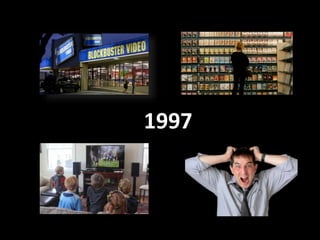
1997
Abhinav Ankit Chiren Sumeet
Agenda
• Origins
• Disrupting the Business Model
• Backward Integration – Reinventing the Business
• Saturating Markets
• Challenges
• Recommendations
Netflix
“Netflix in the beginning was a new
technology company, but based on the
oldest technology possible: the US post
office”
- Robert Thompson
The Story 2007-2011 2011-2015 2015 onwards Conclusion
Origin
• Founded by Reed Hastings and Mitch
Lowe
• Launched as a DVD-by-mail service in
1999
• Subscription model - No Shipping Fees
& No Late Charges
The Story 2007-2011 2011-2015 2015 onwards Conclusion
ENTERTAINMENT, CONVENIENCE, SELECTION, AND
VALUE
• Value Proposition : Customers order from the comfort of
home and the DVD comes in the mailbox. Single
subscription fees covers all costs.
• Profit Proposition: No Retail store or overhead costs due
to staff.
• Technology: Internet and Transition from VHS to DVD
• Competition: Blockbuster
The Story 2007-2011 2011-2015 2015 onwards Conclusion
Extending The Competitive Advantage
• Online Recommendation Engine – Improved Customer
Experience
• Customer Wish list – Accurate forecast of Demand &
Customer Preferences
• Partnership with USPS
The Story 2007-2011 2011-2015 2015 onwards Conclusion
Disrupting the Industry
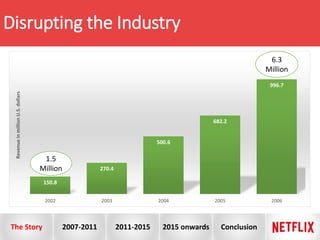
150.8
270.4
500.6
682.2
996.7
2002 2003 2004 2005 2006
RevenueinmillionU.S.dollars
6.3
Million
1.5
Million
The Story 2007-2011 2011-2015 2015 onwards Conclusion
DestroyYourBusiness.com(streaming)
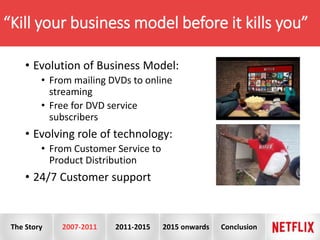
“Kill your business model before it kills you”
• Evolution of Business Model:
• From mailing DVDs to online
streaming
• Free for DVD service
subscribers
• Evolving role of technology:
• From Customer Service to
Product Distribution
• 24/7 Customer support
The Story 2007-2011 2011-2015 2015 onwards Conclusion
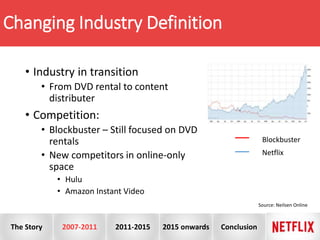
Changing Industry Definition
• Industry in transition
• From DVD rental to content
distributer
• Competition:
• Blockbuster – Still focused on DVD
rentals
• New competitors in online-only
space
• Hulu
• Amazon Instant Video
Blockbuster
Netflix
The Story 2007-2011 2011-2015 2015 onwards Conclusion
Source: Neilsen Online
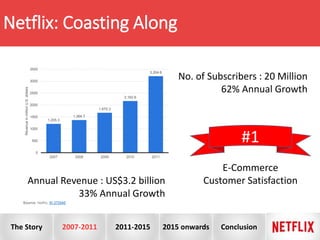
Netflix: Coasting Along
#1
E-Commerce
Customer SatisfactionAnnual Revenue : US$3.2 billion
33% Annual Growth
1,205.3
1,364.7
1,670.3
2,162.6
3,204.6
0
500
1000
1500
2000
2500
3000
3500
2007 2008 2009 2010 2011
RevenueinmillionU.S.dollars
No. of Subscribers : 20 Million
62% Annual Growth
Source: Netflix; ID 272545
The Story 2007-2011 2011-2015 2015 onwards Conclusion
Backward Integration(Content creation)
Netflix comes up with a new BHAG
“Our goal is to become HBO faster than
HBO can become us”
- Ted Sarandos
Chief Content Officer Netflix
The Story 2007-2011 2011-2015 2015 onwards Conclusion
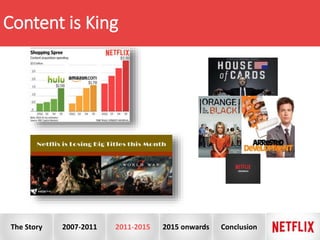
Content is King
The Story 2007-2011 2011-2015 2015 onwards Conclusion
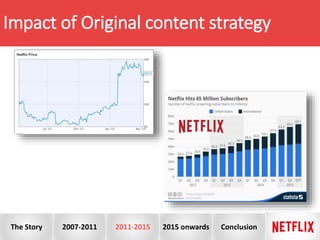
Impact of Original content strategy
The Story 2007-2011 2011-2015 2015 onwards Conclusion
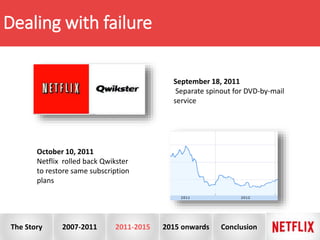
Dealing with failure
September 18, 2011
Separate spinout for DVD-by-mail
service
October 10, 2011
Netflix rolled back Qwikster
to restore same subscription
plans
The Story 2007-2011 2011-2015 2015 onwards Conclusion
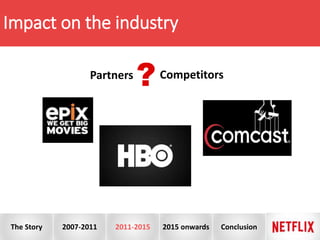
Impact on the industry
Partners Competitors
?
The Story 2007-2011 2011-2015 2015 onwards Conclusion
Impact on the industry(contd.)
• Industry attractiveness increased
• Rise of niche market players
• Decreasing margin due to industry fragmentation
The Story 2007-2011 2011-2015 2015 onwards Conclusion
Seeking New Markets(Internationalization)
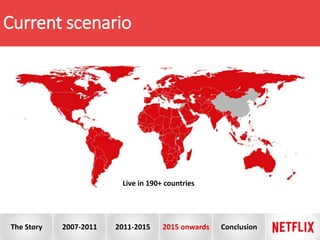
Live in 190+ countries
Current scenario
The Story 2007-2011 2011-2015 2015 onwards Conclusion
Reasons for going forgoingabroad
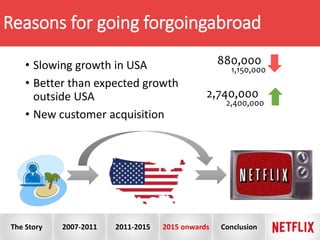
• Slowing growth in USA
• Better than expected growth
outside USA
• New customer acquisition
880,000
1,150,000
2,740,000
2,400,000
The Story 2007-2011 2011-2015 2015 onwards Conclusion
Challenges ahead
• Content
• Need locally relevant content
• High licensing costs
• Technology
• Piracy
• Less favorable foreign IP laws
• Pricing Issues
The Story 2007-2011 2011-2015 2015 onwards Conclusion
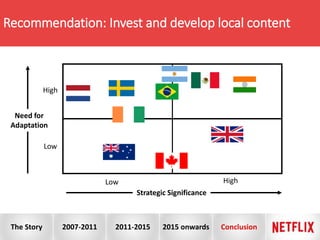
Recommendation: Invest and develop local content
Strategic Significance
Need for
Adaptation
Low High
High
Low
The Story 2007-2011 2011-2015 2015 onwards Conclusion
• Government Collaboration
“Believe it or not, the government really wants to
help you succeed” – Michael Etinson
• Work with governments to ensure IP
law implementation
• Purchasing Power Parity(PPP) Based
Pricing
• A dollar is not worth a dollar in every
country
Recommendations (contd.)
The Story 2007-2011 2011-2015 2015 onwards Conclusion
“Your success in life isn’t based on your ability to simply change. It is based
on your ability to change faster than your competition, customers and
business” – Mark Sanborn

Netflix

  • 1.
  • 2.
  • 3.
    Agenda • Origins • Disruptingthe Business Model • Backward Integration – Reinventing the Business • Saturating Markets • Challenges • Recommendations
  • 4.
    Netflix “Netflix in thebeginning was a new technology company, but based on the oldest technology possible: the US post office” - Robert Thompson The Story 2007-2011 2011-2015 2015 onwards Conclusion
  • 5.
    Origin • Founded byReed Hastings and Mitch Lowe • Launched as a DVD-by-mail service in 1999 • Subscription model - No Shipping Fees & No Late Charges The Story 2007-2011 2011-2015 2015 onwards Conclusion
  • 6.
    ENTERTAINMENT, CONVENIENCE, SELECTION,AND VALUE • Value Proposition : Customers order from the comfort of home and the DVD comes in the mailbox. Single subscription fees covers all costs. • Profit Proposition: No Retail store or overhead costs due to staff. • Technology: Internet and Transition from VHS to DVD • Competition: Blockbuster The Story 2007-2011 2011-2015 2015 onwards Conclusion
  • 7.
    Extending The CompetitiveAdvantage • Online Recommendation Engine – Improved Customer Experience • Customer Wish list – Accurate forecast of Demand & Customer Preferences • Partnership with USPS The Story 2007-2011 2011-2015 2015 onwards Conclusion
  • 8.
    Disrupting the Industry 150.8 270.4 500.6 682.2 996.7 20022003 2004 2005 2006 RevenueinmillionU.S.dollars 6.3 Million 1.5 Million The Story 2007-2011 2011-2015 2015 onwards Conclusion
  • 9.
  • 10.
    “Kill your businessmodel before it kills you” • Evolution of Business Model: • From mailing DVDs to online streaming • Free for DVD service subscribers • Evolving role of technology: • From Customer Service to Product Distribution • 24/7 Customer support The Story 2007-2011 2011-2015 2015 onwards Conclusion
  • 11.
    Changing Industry Definition •Industry in transition • From DVD rental to content distributer • Competition: • Blockbuster – Still focused on DVD rentals • New competitors in online-only space • Hulu • Amazon Instant Video Blockbuster Netflix The Story 2007-2011 2011-2015 2015 onwards Conclusion Source: Neilsen Online
  • 12.
    Netflix: Coasting Along #1 E-Commerce CustomerSatisfactionAnnual Revenue : US$3.2 billion 33% Annual Growth 1,205.3 1,364.7 1,670.3 2,162.6 3,204.6 0 500 1000 1500 2000 2500 3000 3500 2007 2008 2009 2010 2011 RevenueinmillionU.S.dollars No. of Subscribers : 20 Million 62% Annual Growth Source: Netflix; ID 272545 The Story 2007-2011 2011-2015 2015 onwards Conclusion
  • 13.
  • 14.
    Netflix comes upwith a new BHAG “Our goal is to become HBO faster than HBO can become us” - Ted Sarandos Chief Content Officer Netflix The Story 2007-2011 2011-2015 2015 onwards Conclusion
  • 15.
    Content is King TheStory 2007-2011 2011-2015 2015 onwards Conclusion
  • 16.
    Impact of Originalcontent strategy The Story 2007-2011 2011-2015 2015 onwards Conclusion
  • 17.
    Dealing with failure September18, 2011 Separate spinout for DVD-by-mail service October 10, 2011 Netflix rolled back Qwikster to restore same subscription plans The Story 2007-2011 2011-2015 2015 onwards Conclusion
  • 18.
    Impact on theindustry Partners Competitors ? The Story 2007-2011 2011-2015 2015 onwards Conclusion
  • 19.
    Impact on theindustry(contd.) • Industry attractiveness increased • Rise of niche market players • Decreasing margin due to industry fragmentation The Story 2007-2011 2011-2015 2015 onwards Conclusion
  • 20.
  • 21.
    Live in 190+countries Current scenario The Story 2007-2011 2011-2015 2015 onwards Conclusion
  • 22.
    Reasons for goingforgoingabroad • Slowing growth in USA • Better than expected growth outside USA • New customer acquisition 880,000 1,150,000 2,740,000 2,400,000 The Story 2007-2011 2011-2015 2015 onwards Conclusion
  • 23.
    Challenges ahead • Content •Need locally relevant content • High licensing costs • Technology • Piracy • Less favorable foreign IP laws • Pricing Issues The Story 2007-2011 2011-2015 2015 onwards Conclusion
  • 24.
    Recommendation: Invest anddevelop local content Strategic Significance Need for Adaptation Low High High Low The Story 2007-2011 2011-2015 2015 onwards Conclusion
  • 25.
    • Government Collaboration “Believeit or not, the government really wants to help you succeed” – Michael Etinson • Work with governments to ensure IP law implementation • Purchasing Power Parity(PPP) Based Pricing • A dollar is not worth a dollar in every country Recommendations (contd.) The Story 2007-2011 2011-2015 2015 onwards Conclusion
  • 26.
    “Your success inlife isn’t based on your ability to simply change. It is based on your ability to change faster than your competition, customers and business” – Mark Sanborn

Editor's Notes

  • #2 I want you to time travel with me back to 1997. The eventful 90s. Imagine being university students back then. The winter semester has just ended and you and your friends are getting ready for the break. Lets say you plan to get your friends together to “binge” watch a movie or 2 at your place. How would you have gone about it? Well, The usual process would be that you would go to the local video rental store, search through the available titles and after much internal debating on what the group would like , you finally settle on something. Lets just say everyone enjoyed the movie and a few days pass by. Until one day you realise that you missed the deadline to return the VHS to the local store and would now end up paying more than double considering the fines. When a guy named Reed Hastings faced this scenario, he decided that there had to be a better way. And the company he founded, forever changed the way entertainment was distributed and consumed.
  • #3 Good Evening! I am Ankit and together with my team Abhinav, Chiren and Sumeet, I want to take you through the journey called Netflix.
  • #4 The story of Netflix is anything but a house of cards. It is a story about the continuous evolution of its business model and we will break this story up into key moments in time where the strategic decisions were made that changed the company’s direction. Using concepts that we learnt here, we will try and analyze each of these defining moments and understand why a particular decision was made? What were the factors that made it successful and what are the challenges that it faces. Finally, we would propose our own recommendations for the immediate future. But just like any great story, it must begin with the origins. Because that is where the company’s culture is established.
  • #5 Quote hain. Padh lo.
  • #6 Netflix was founded in 1998 and launched its service in 99 as a pay-per-rental service. However, it quickly simplified its business to a Pay-per-month subscription that allowed them to stabilize their revenues. This became the core model of the business going forward.
  • #7 Any great business strategy is rooted in creating a unique value proposition for its customers and a sustainable profit proposition for its investors. The Netflix model took advantage of two emergent technology trends of the time: the extensive reach of the internet and the transition from VHS to DVD. By utilizing the internet, Netflix created a superior value proposition for the customers that was far superior to any that existed back then. Its major competitor Blockbuster was still heavily investing in expansion of its brick and mortar stores. By choosing to skip that model, Netflix was able to lower its cost and increase its margins.
  • #8 As we learned in the case of Zara or SouthWest, the truly unique competitive advantage lies in the intangible parts of the system. Netflix was one of the first companies to offer movie recommendations to users by analyzing the data it collected through purchase history, user reviews and past trends. They also implemented a concept of customer wish list which allowed them to accurately predict the customer preferences and trends. Invested in a mutually beneficial relationship with USPS. All these strategic moves shifted the competitive advantage to the more intangible parts of the business making it difficult for the likes of Blockbuster to imitate.
  • #9 Right from its IPO in 2002 till 2006, Netflix saw a significant growth both in revenues and subscriber base. The business was working and successfully outperforming its rivals. So, shouldn’t the CEO continue doing what's selling and improve the margins? I will hand it over to Sumeet to tell us what happened after this.
  • #10 Netflix followed a concept first articulated by the great Jack Welch himself – Destroy your business .com – and executed it to perfection
  • #11 They introduced the concept of online streaming. You could watch the movies online instantly without having to wait for the delivery of a DVD. This service was available for free to the subscribers of the DVD delivery service. Netflix had always been a company at the forefront of technology – traditionally content discovery, and this time they employed technology to deliver their product – entertainment Being a new service, there were bound to be hiccups, and Netflix anticipating this started a 24/7 customer support.
  • #12 The very definition of the industry was in flux – While the competition was still stuck in the mentality of a DVD rental business, Netflix had moved on to thinking about itself as a content distributor. This was reflected in the stock market. Blockbuster saw its stock price slowly crash to nothing, Netflix’s stock increased to 300%
  • #21 They decided to go global.
  • #22 And they did so in style. Netflix launched in 130+ countries taking their total serviceable market to more than 190 countries. Except for china they are operating in almost all the countries where the US govt does not restrict them. In china they are still working with the govt but given the tight media control it could be a tough task . So other than margins what were the reasons for Netflix to grow at such a fast pace Not available in Crimea, North Korea and Syria due to U.S. government restrictions on American companies http://variety.com/2015/digital/news/netflix-wants-the-world-can-it-really-expand-to-200-countries-in-2-years-1201411740/ http://www.slideshare.net/IsabelleSmith2/netflix-international-business-strategy-plan
  • #23 First, the growth in US was way below expectations. Instead of 1.15million they were able to get only 60% of that ie. 880 thousand Whereas outside US , growth was exceeding the company’s expectations. They projected around 2.4 million new subscribers, instead they registered 2.7million new customers. And Lastly, Netflix observed that there was an increasing no. of subscribers who were using Virtual Private Networks (VPNs) to access the service from countries where Netflix was not present. So before Netflix went global, a customer would use VPNs to connect to US servers of Netflix to watch their shows. Market research showed that there was a huge chunk of people in these countries who were willing to pay for the services but lacked interest or skills to jump through hoops necessary to circumvent geoblocking. Because of all these reasons Netflix decided to go global but they face many challenges ahead. http://www.thedailybeast.com/articles/2016/01/09/netflix-without-borders-why-the-streaming-service-going-global-is-a-big-deal.html http://www.wsj.com/articles/netflix-subscriber-growth-disappoints-in-u-s-1444853723
  • #24 First is Content. Netflix needs to have local content but the catch here is that they are already paying 10.9Billion dollars as licensing fees for streaming content from other entertainment houses. Second, piracy and lax IP laws in countries could play a spoilsport in Netflix’s vision And lastly, Netflix need to adapt its pricing according to the geographies. Keeping these into mind we recommend the following course of action.
  • #25 First, Netflix should invest and develop local content And to decide the countries we can use this 2 by 2. For example, Britain would need very less content adaptation as compared to say India. And both these market are of high importance mainly because of their size.
  • #26 In the words of Michael Etinson, a dear friend of our professor: “Believe it or not, the government really wants to help you succeed”