NETFLIX (NFLX)
Marcos, Tessa, Hannah
Company History and Market Description
-Marc Randolph and Reed Hastings started Netflix as a movie rental service
based out of Scotts Valley, California, and would mail movies to customers for
their use, and the movies would be sent back after being used
-They upgraded to a subscription model shortly after, but with the same mailing
process
-In 2007, Netflix introduced the streaming platform that many know today, which
started to change everything and introduced a new market to which they now are
a part of
-The market that Netflix operates in is called the video streaming services market,
and is a market that is seen across the globe
Top Competitors
-Netflix happens to be the leader in its industry of video streaming services
-Hulu, Amazon Prime Video, Apple+, and Disney Plus are the only real
competition at the moment
-Youtube could be categorized as competition, but competition is a very loose
term in this case due to the type of video streaming that youtube provides
compared to the streaming of full movies and TV shows that Netflix provides
Revenue Streams
Netflix generates income primarily through its subscription based business model
where users pay a monthly price to use the services that Netflix provides
The streaming subscription revenue can also be split into International and
Domestic
Domestic streaming (US) accounted for 46% of revenue with $3.3 billion
International streaming accounted for 53% of revenue with $1.6 billion
DVD Rental services are still operational and accounted for 1% with $174 million
Competition Structure
-Netflix, Hulu, Amazon Prime Video, and Disney Plus make up the majority of the
streaming services market (HBO Go is another service but is also offered as an
add-on for Amazon Prime which is why it might not be considered a direct
competition)
-Each streaming service has different titles that they advertise as exclusive to their
streaming service, which in turn presents users with a decision to make on what
shows and movies are more important to them
-The structure of the market that these 4 competitors make up is very evidently an
Oligopoly simply due to the fact that the only contenders in this market are Netflix,
Hulu, Prime Video, and Disney Plus
IV. Factors Affecting Demand
Consumer’s Income: I think that for Netflix the change of the potential consumer’s income could greatly affect the demand.
Netflix’s $12.99 fees per month are not cheap. The less they earn the less Netflix will be in demand because people cannot
afford their monthly fee. On the flip side, the more income they earn, the higher the demand goes up because they can
afford the fee.
Price of Related Goods: Some substitutes to Netflix would be Hulu & Disney Plus. Hulu costs $7.99 per month. Disney
Plus costs $6.99 per month, if you do not have the free 1 year plan with Verizon. A raise in the competitor’s price would
cause the demand for Netflix to go up. This is because the Netflix fee would then be cheaper/more affordable than Hulu or
Disney. If they lowered their price Netflix’s demand would go down because the competitors would have the better price.
IV. Factors Affecting Demand
Tastes Within the Market: I think the trends/changes we should watch out for is the type/genre of shows that are
popular or that people are interested in. I also think that the Netflix original shows/movies and how those are
doing is something to pay attention to as well. That way, you can make improvements using consumer feedback
and the show would be successful again. I also think the style of show that is trending is also a factor to be taken
into account. For example , recently I think adult-humor cartoons are really popular right now with that, Netflix
has released original adult cartoons such as Big Mouth, Paradise PD, etc. This shows Netflix pays attention to
trends within the market.
Expectations Within the Market: Consumer’s main concern with the future of Netflix as of right now is running
out of new content or content to upload in general. Movie sets have been closed and most if not all film production
has completely stopped due to the shut down. This could really hurt the company as the demand would decrease
rapidly as it is the streaming service many people use. However, Netflix promised their subscribers they will keep
uploading new, fresh content. Netflix are confident enough that they have enough content to last through 2020
without having to reduce the speed of releases. This affects their buying habit by continuing to pay for the service if
they continue delivering content, but possibly changing streamers if they do not.
IV. Factors Affecting Demand
Number of Buyers: What may increase the amount of potential customers for Netflix would be improving older original
shows of theirs and re-releasing them, Adding new content/removing old, and releasing new seasons of shows that are
strongly-anticipated. Now would be the perfect time to do so with stay home, stay safe. What may decrease the amount of
potential customers is if Netflix does not keep their promise of uploading content and not running out. Subscribers will not
only be disappointed, but they’ll feel lied to and you’ll lose customers. In addition to that, if they don’t continue to pay
attention to trends and what their consumers want, they’re going to get bored and watch something somewhere else.
Elasticity: Raising or lowering the price could strongly affect the business. By raising them, it goes back to consumers not
being able to afford it. Actually in December 2019 Netflix raised their price by 13-18%. They notified subscribers 30 days
prior to it taking place. Still, the channels/creators of the content that isn’t a Netflix original may not be able to pay Netflix to
have their show streamed. This means less shows, less shows means less consumers, then there would be no Netflix. If
Netflix lowered their price it could benefit them greatly by gaining many more customers as it is more affordable & there
can be more shows added. The key factors on the consumer side that affects elasticity is their income, how many people
are in their house on their plan/, price, if Netflix has what shows they like, and how much content and or new content. On
the business side the factors are how many shows are being produced, how much content is in the platform and what/how
much needs to go up, and paying employers & streaming rights, and pricing.
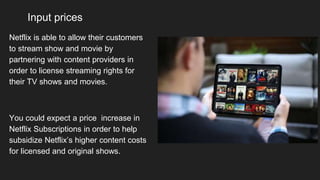
Input prices
Netflix is able to allow their customers
to stream show and movie by
partnering with content providers in
order to license streaming rights for
their TV shows and movies.
You could expect a price increase in
Netflix Subscriptions in order to help
subsidize Netflix’s higher content costs
for licensed and original shows.
Technology
The biggest advantage of Netflix is that it’s a tech savvy company,
which means it’s constantly improving ways to cut costs for the
company, but deliver even better quality to their customers.
The company currently has over 137 million accounts across the
world, which it competes with other online streaming services and TV
networks. As Netflix continues to grow across the competitive
entertainment market, it faces continuous challenges that almost
require advanced learning technology to keep up. Challenges such
as, increases in consumer demand for personalized content,
diversity of customers needs and preferences, and closing
competition on content licensing.
Expectations
Netflix expects the market of consumers to increase with the
recent outbreak of COVID-19. With people forced to stay
home the number of subscribers has already increased well
over 15 million and is expected to continue to grow.
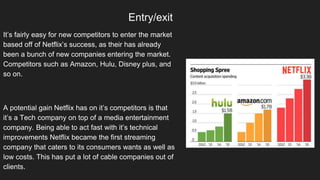
Entry/exit
It’s fairly easy for new competitors to enter the market
based off of Netflix’s success, as their has already
been a bunch of new companies entering the market.
Competitors such as Amazon, Hulu, Disney plus, and
so on.
A potential gain Netflix has on it’s competitors is that
it’s a Tech company on top of a media entertainment
company. Being able to act fast with it’s technical
improvements Netflix became the first streaming
company that caters to its consumers wants as well as
low costs. This has put a lot of cable companies out of
clients.
Wrap up
Netflix is a very relevant company to us. We’ve been
using Netflix before it became a world wide streaming
company. Growing up watching Netflix’s success,
we’re very interested in seeing what innovations and
steps they take in the future to progress further.
While the future is unknown, I think Netflix will continue
to grow. Netflix has been able to stay at the top using
their knowledge of technology to combat natural
disasters events and competition.
References
(Slides 9-13)
● Taylor Telford, S. (2019, January 15). Netflix raises prices to pay for original content. Retrieved May 18, 2020, from
https://www.washingtonpost.com/business/2019/01/15/netflix-raises-prices-pay-original-content/
● Pierce, D. (2019, February 03). Free, Easy and Legal: How to Stream Great TV and Movies Without Spending a Dime.
Retrieved May 18, 2020, from https://www.wsj.com/articles/free-easy-and-legal-how-to-stream-great-tv-and-movies-without-
spending-a-dime-11549202400
● Alvarez, E. (2020, March 06). Netflix's real advantage is that it's a tech company first. Retrieved May 18, 2020, from
https://www.engadget.com/2018-03-10-netflix-streaming-tech-hollywood.html
● Eltom. (n.d.). Netflix Uses Machine Learning to Cut Costs and Retain Customers. Retrieved May 18, 2020, from
https://digital.hbs.edu/platform-rctom/submission/netflix-uses-machine-learning-to-cut-costs-and-retain-customers/
● Login. (n.d.). Retrieved May 18, 2020, from https://simple-pdh.com/how-learning-is-different-today/
● Netflix doubles expected tally of new subscribers amid Covid-19 lockdown. (2020, April 21). Retrieved May 18, 2020, from
https://www.theguardian.com/media/2020/apr/21/netflix-new-subscribers-covid-19-lockdown
● Netflix gains nearly 16M subscribers as quarantine binging boosts profits. (2020, April 22). Retrieved May 18, 2020, from
https://www.post-gazette.com/business/tech-news/2020/04/22/Netflix-subscribers-Q1-earnings-coronavirus-adds-16-million-
new-Tiger-King/stories/202004220076
● How Netflix Became a $100 Billion Company in 20 Years. (2018, April 30). Retrieved May 18, 2020, from
https://producthabits.com/how-netflix-became-a-100-billion-company-in-20-years/
● Variety. (2019, July 17). Netflix Stock Falls After Losing Subscribers for the First Time. Retrieved May 17, 2020, from
https://decider.com/2019/07/17/netflix-loses-subscribers-first-time/
References
Alexander, J. (2020, April 22). Netflix Promises Subscribers It Won't Run Out Of New Content. In The Verge. Retrieved from
https://www.theverge.com/2020/4/22/21231023/netflix-tv-shows-movies-new-2020-pandemic-production-disney-universal-warner-bros-sony
Leonhardt, M. (2019, December 30). How Netflix Compares to Other Streaming Services. In CNBC. Retrieved from
https://www.cnbc.com/2019/01/15/how-netflix-compares-to-other-streaming-services-after-raising-prices.html
Reiff, N. (2020, April 3). How Netflix Makes Money: international streaming is growing fastest. Retrieved from
https://www.investopedia.com/insights/how-netflix-makes-money/
McFadden, C. (2020, April 10). The Fascinating History of Netflix. Retrieved from https://interestingengineering.com/the-fascinating-
history-of-netflix
Answers Ltd. (2019, March 18). Microeconomic Analysis of Netflix. Retrieved from
https://www.ukessays.com/essays/economics/netflix-microeconomic-analysis-9322.php
Netflix Inc. (n.d.). Retrieved from https://csimarket.com/stocks/NFLX-Business-Description.html

Netflix

  • 1.
  • 2.
    Company History andMarket Description -Marc Randolph and Reed Hastings started Netflix as a movie rental service based out of Scotts Valley, California, and would mail movies to customers for their use, and the movies would be sent back after being used -They upgraded to a subscription model shortly after, but with the same mailing process -In 2007, Netflix introduced the streaming platform that many know today, which started to change everything and introduced a new market to which they now are a part of -The market that Netflix operates in is called the video streaming services market, and is a market that is seen across the globe
  • 3.
    Top Competitors -Netflix happensto be the leader in its industry of video streaming services -Hulu, Amazon Prime Video, Apple+, and Disney Plus are the only real competition at the moment -Youtube could be categorized as competition, but competition is a very loose term in this case due to the type of video streaming that youtube provides compared to the streaming of full movies and TV shows that Netflix provides
  • 4.
    Revenue Streams Netflix generatesincome primarily through its subscription based business model where users pay a monthly price to use the services that Netflix provides The streaming subscription revenue can also be split into International and Domestic Domestic streaming (US) accounted for 46% of revenue with $3.3 billion International streaming accounted for 53% of revenue with $1.6 billion DVD Rental services are still operational and accounted for 1% with $174 million
  • 5.
    Competition Structure -Netflix, Hulu,Amazon Prime Video, and Disney Plus make up the majority of the streaming services market (HBO Go is another service but is also offered as an add-on for Amazon Prime which is why it might not be considered a direct competition) -Each streaming service has different titles that they advertise as exclusive to their streaming service, which in turn presents users with a decision to make on what shows and movies are more important to them -The structure of the market that these 4 competitors make up is very evidently an Oligopoly simply due to the fact that the only contenders in this market are Netflix, Hulu, Prime Video, and Disney Plus
  • 6.
    IV. Factors AffectingDemand Consumer’s Income: I think that for Netflix the change of the potential consumer’s income could greatly affect the demand. Netflix’s $12.99 fees per month are not cheap. The less they earn the less Netflix will be in demand because people cannot afford their monthly fee. On the flip side, the more income they earn, the higher the demand goes up because they can afford the fee. Price of Related Goods: Some substitutes to Netflix would be Hulu & Disney Plus. Hulu costs $7.99 per month. Disney Plus costs $6.99 per month, if you do not have the free 1 year plan with Verizon. A raise in the competitor’s price would cause the demand for Netflix to go up. This is because the Netflix fee would then be cheaper/more affordable than Hulu or Disney. If they lowered their price Netflix’s demand would go down because the competitors would have the better price.
  • 7.
    IV. Factors AffectingDemand Tastes Within the Market: I think the trends/changes we should watch out for is the type/genre of shows that are popular or that people are interested in. I also think that the Netflix original shows/movies and how those are doing is something to pay attention to as well. That way, you can make improvements using consumer feedback and the show would be successful again. I also think the style of show that is trending is also a factor to be taken into account. For example , recently I think adult-humor cartoons are really popular right now with that, Netflix has released original adult cartoons such as Big Mouth, Paradise PD, etc. This shows Netflix pays attention to trends within the market. Expectations Within the Market: Consumer’s main concern with the future of Netflix as of right now is running out of new content or content to upload in general. Movie sets have been closed and most if not all film production has completely stopped due to the shut down. This could really hurt the company as the demand would decrease rapidly as it is the streaming service many people use. However, Netflix promised their subscribers they will keep uploading new, fresh content. Netflix are confident enough that they have enough content to last through 2020 without having to reduce the speed of releases. This affects their buying habit by continuing to pay for the service if they continue delivering content, but possibly changing streamers if they do not.
  • 8.
    IV. Factors AffectingDemand Number of Buyers: What may increase the amount of potential customers for Netflix would be improving older original shows of theirs and re-releasing them, Adding new content/removing old, and releasing new seasons of shows that are strongly-anticipated. Now would be the perfect time to do so with stay home, stay safe. What may decrease the amount of potential customers is if Netflix does not keep their promise of uploading content and not running out. Subscribers will not only be disappointed, but they’ll feel lied to and you’ll lose customers. In addition to that, if they don’t continue to pay attention to trends and what their consumers want, they’re going to get bored and watch something somewhere else. Elasticity: Raising or lowering the price could strongly affect the business. By raising them, it goes back to consumers not being able to afford it. Actually in December 2019 Netflix raised their price by 13-18%. They notified subscribers 30 days prior to it taking place. Still, the channels/creators of the content that isn’t a Netflix original may not be able to pay Netflix to have their show streamed. This means less shows, less shows means less consumers, then there would be no Netflix. If Netflix lowered their price it could benefit them greatly by gaining many more customers as it is more affordable & there can be more shows added. The key factors on the consumer side that affects elasticity is their income, how many people are in their house on their plan/, price, if Netflix has what shows they like, and how much content and or new content. On the business side the factors are how many shows are being produced, how much content is in the platform and what/how much needs to go up, and paying employers & streaming rights, and pricing.
  • 9.
    Input prices Netflix isable to allow their customers to stream show and movie by partnering with content providers in order to license streaming rights for their TV shows and movies. You could expect a price increase in Netflix Subscriptions in order to help subsidize Netflix’s higher content costs for licensed and original shows.
  • 10.
    Technology The biggest advantageof Netflix is that it’s a tech savvy company, which means it’s constantly improving ways to cut costs for the company, but deliver even better quality to their customers. The company currently has over 137 million accounts across the world, which it competes with other online streaming services and TV networks. As Netflix continues to grow across the competitive entertainment market, it faces continuous challenges that almost require advanced learning technology to keep up. Challenges such as, increases in consumer demand for personalized content, diversity of customers needs and preferences, and closing competition on content licensing.
  • 11.
    Expectations Netflix expects themarket of consumers to increase with the recent outbreak of COVID-19. With people forced to stay home the number of subscribers has already increased well over 15 million and is expected to continue to grow.
  • 12.
    Entry/exit It’s fairly easyfor new competitors to enter the market based off of Netflix’s success, as their has already been a bunch of new companies entering the market. Competitors such as Amazon, Hulu, Disney plus, and so on. A potential gain Netflix has on it’s competitors is that it’s a Tech company on top of a media entertainment company. Being able to act fast with it’s technical improvements Netflix became the first streaming company that caters to its consumers wants as well as low costs. This has put a lot of cable companies out of clients.
  • 13.
    Wrap up Netflix isa very relevant company to us. We’ve been using Netflix before it became a world wide streaming company. Growing up watching Netflix’s success, we’re very interested in seeing what innovations and steps they take in the future to progress further. While the future is unknown, I think Netflix will continue to grow. Netflix has been able to stay at the top using their knowledge of technology to combat natural disasters events and competition.
  • 14.
    References (Slides 9-13) ● TaylorTelford, S. (2019, January 15). Netflix raises prices to pay for original content. Retrieved May 18, 2020, from https://www.washingtonpost.com/business/2019/01/15/netflix-raises-prices-pay-original-content/ ● Pierce, D. (2019, February 03). Free, Easy and Legal: How to Stream Great TV and Movies Without Spending a Dime. Retrieved May 18, 2020, from https://www.wsj.com/articles/free-easy-and-legal-how-to-stream-great-tv-and-movies-without- spending-a-dime-11549202400 ● Alvarez, E. (2020, March 06). Netflix's real advantage is that it's a tech company first. Retrieved May 18, 2020, from https://www.engadget.com/2018-03-10-netflix-streaming-tech-hollywood.html ● Eltom. (n.d.). Netflix Uses Machine Learning to Cut Costs and Retain Customers. Retrieved May 18, 2020, from https://digital.hbs.edu/platform-rctom/submission/netflix-uses-machine-learning-to-cut-costs-and-retain-customers/ ● Login. (n.d.). Retrieved May 18, 2020, from https://simple-pdh.com/how-learning-is-different-today/ ● Netflix doubles expected tally of new subscribers amid Covid-19 lockdown. (2020, April 21). Retrieved May 18, 2020, from https://www.theguardian.com/media/2020/apr/21/netflix-new-subscribers-covid-19-lockdown ● Netflix gains nearly 16M subscribers as quarantine binging boosts profits. (2020, April 22). Retrieved May 18, 2020, from https://www.post-gazette.com/business/tech-news/2020/04/22/Netflix-subscribers-Q1-earnings-coronavirus-adds-16-million- new-Tiger-King/stories/202004220076 ● How Netflix Became a $100 Billion Company in 20 Years. (2018, April 30). Retrieved May 18, 2020, from https://producthabits.com/how-netflix-became-a-100-billion-company-in-20-years/ ● Variety. (2019, July 17). Netflix Stock Falls After Losing Subscribers for the First Time. Retrieved May 17, 2020, from https://decider.com/2019/07/17/netflix-loses-subscribers-first-time/
  • 15.
    References Alexander, J. (2020,April 22). Netflix Promises Subscribers It Won't Run Out Of New Content. In The Verge. Retrieved from https://www.theverge.com/2020/4/22/21231023/netflix-tv-shows-movies-new-2020-pandemic-production-disney-universal-warner-bros-sony Leonhardt, M. (2019, December 30). How Netflix Compares to Other Streaming Services. In CNBC. Retrieved from https://www.cnbc.com/2019/01/15/how-netflix-compares-to-other-streaming-services-after-raising-prices.html Reiff, N. (2020, April 3). How Netflix Makes Money: international streaming is growing fastest. Retrieved from https://www.investopedia.com/insights/how-netflix-makes-money/ McFadden, C. (2020, April 10). The Fascinating History of Netflix. Retrieved from https://interestingengineering.com/the-fascinating- history-of-netflix Answers Ltd. (2019, March 18). Microeconomic Analysis of Netflix. Retrieved from https://www.ukessays.com/essays/economics/netflix-microeconomic-analysis-9322.php Netflix Inc. (n.d.). Retrieved from https://csimarket.com/stocks/NFLX-Business-Description.html