www.otpresearch.com
FLASH REPORT – GOVERNMENT DEFICIT
FLASH REPORT
7 July 2017
Massive Q1 surplus confirms favourable fiscal trends;
rising cash deficit in Q2 is largely due to advances on EU funds,
but the underlying fiscal position remains strong
 The budget amassed a record high surplus in 17Q1, confirming our view that the 2017
deficit was entirely due to year-end one-offs; 12-month rolling ESA deficit is 1.7%.
 Despite tax cuts, revenues continued to grow in Q1 briskly thanks to strong GDP
growth and a robust labour market. Expenditures were contained in 17Q1.
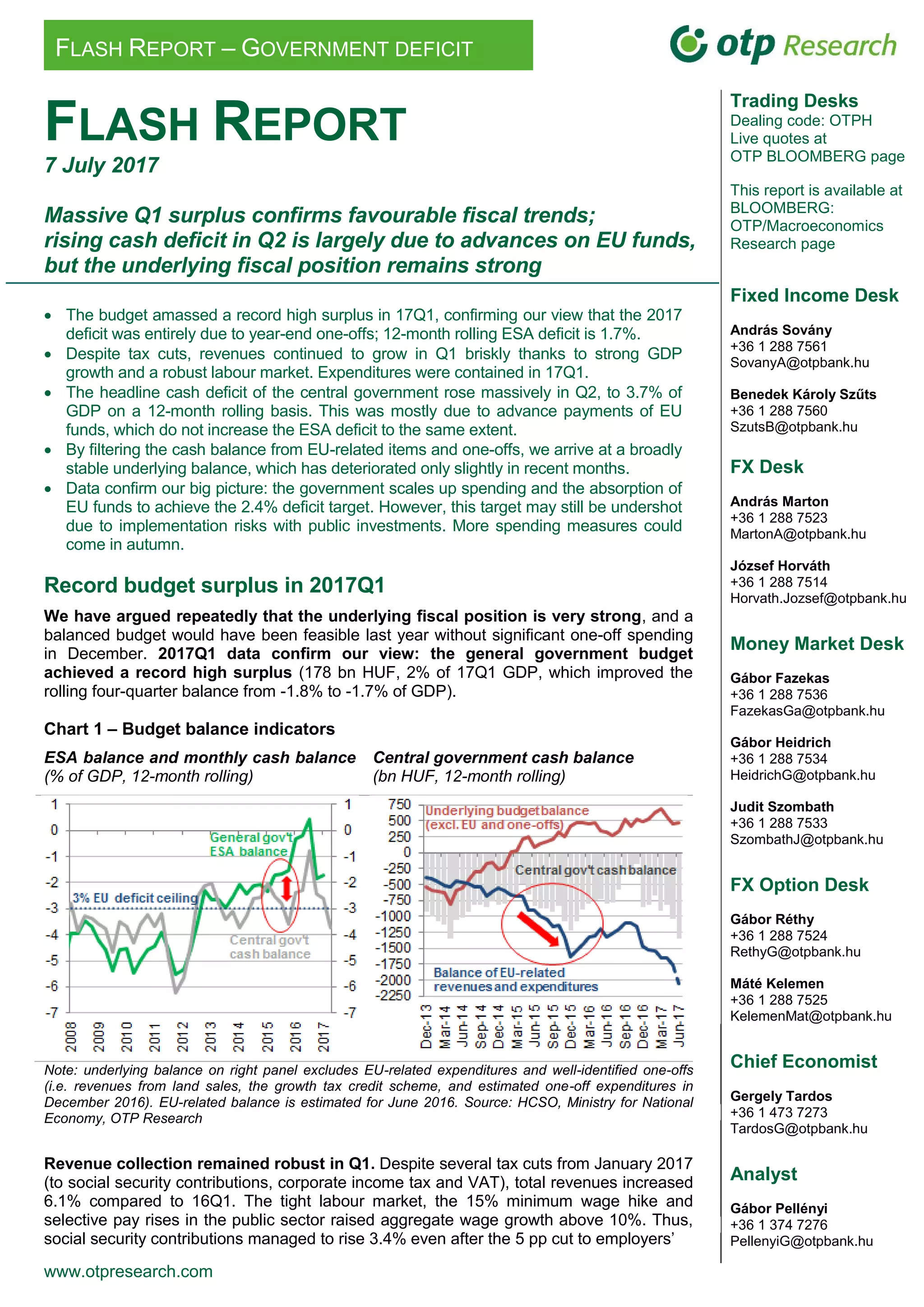
 The headline cash deficit of the central government rose massively in Q2, to 3.7% of
GDP on a 12-month rolling basis. This was mostly due to advance payments of EU
funds, which do not increase the ESA deficit to the same extent.
 By filtering the cash balance from EU-related items and one-offs, we arrive at a broadly
stable underlying balance, which has deteriorated only slightly in recent months.
 Data confirm our big picture: the government scales up spending and the absorption of
EU funds to achieve the 2.4% deficit target. However, this target may still be undershot
due to implementation risks with public investments. More spending measures could
come in autumn.
Record budget surplus in 2017Q1
We have argued repeatedly that the underlying fiscal position is very strong, and a
balanced budget would have been feasible last year without significant one-off spending
in December. 2017Q1 data confirm our view: the general government budget
achieved a record high surplus (178 bn HUF, 2% of 17Q1 GDP, which improved the
rolling four-quarter balance from -1.8% to -1.7% of GDP).
Chart 1 – Budget balance indicators
ESA balance and monthly cash balance
(% of GDP, 12-month rolling)
Central government cash balance
(bn HUF, 12-month rolling)
Note: underlying balance on right panel excludes EU-related expenditures and well-identified one-offs
(i.e. revenues from land sales, the growth tax credit scheme, and estimated one-off expenditures in
December 2016). EU-related balance is estimated for June 2016. Source: HCSO, Ministry for National
Economy, OTP Research
Revenue collection remained robust in Q1. Despite several tax cuts from January 2017
(to social security contributions, corporate income tax and VAT), total revenues increased
6.1% compared to 16Q1. The tight labour market, the 15% minimum wage hike and
selective pay rises in the public sector raised aggregate wage growth above 10%. Thus,
social security contributions managed to rise 3.4% even after the 5 pp cut to employers’
Trading Desks
Dealing code: OTPH
Live quotes at
OTP BLOOMBERG page
This report is available at
BLOOMBERG:
OTP/Macroeconomics
Research page
Fixed Income Desk
András Sovány
+36 1 288 7561
SovanyA@otpbank.hu
Benedek Károly Szűts
+36 1 288 7560
SzutsB@otpbank.hu
FX Desk
András Marton
+36 1 288 7523
MartonA@otpbank.hu
József Horváth
+36 1 288 7514
Horvath.Jozsef@otpbank.hu
Money Market Desk
Gábor Fazekas
+36 1 288 7536
FazekasGa@otpbank.hu
Gábor Heidrich
+36 1 288 7534
HeidrichG@otpbank.hu
Judit Szombath
+36 1 288 7533
SzombathJ@otpbank.hu
FX Option Desk
Gábor Réthy
+36 1 288 7524
RethyG@otpbank.hu
Máté Kelemen
+36 1 288 7525
KelemenMat@otpbank.hu
Chief Economist
Gergely Tardos
+36 1 473 7273
TardosG@otpbank.hu
Analyst
Gábor Pellényi
+36 1 374 7276
PellenyiG@otpbank.hu
www.otpresearch.com
FLASH REPORT – GOVERNMENT DEFICIT
contributions; meanwhile, taxes on income jumped 12.4%. VAT revenues were up 7.9% compared to 16Q1,
driven by strong consumption, rising housing and public investments. One-off revenues from land sales
amounted to 121 bn HUF (0.3% of GDP) in Q1; this item will fade in Q2 according to monthly data.
Expenditures grew at a slower pace than revenues (+5.1% compared to 16Q1). Interest expenditures
contracted thanks to exceptionally low interest rates. Its four-quarter average reached a historic low, 3.1% of
GDP. Surprisingly, intermediate consumption (purchases of goods and services) fell by 6.1%, even though
the 2017 budget expects this item to rise by a quarter compared to 2016. Social benefits grew at a modest
2.6%, mainly due to the indexation of pensions. However, the number of pensioners also decreased by 1%
compared to 16Q1, reflecting longer demographic trends. On the other hand, labour compensation was up
9% due to previously announced wage increases for selected public sector employees. Investments rose
55% compared to an abysmal 16Q1, and capital transfers (investment grants) also increased significantly.
Rising cash deficit in Q2 will not necessarily worsen the ESA balance
This week the Ministry of National Economy also published cash flow based data for June, which show that
the central government cash deficit is on the rise: in 17H1 was 911 bn HUF compared to 402 bn HUF in
the same period last year.
The rise in the cash deficit is mostly due to the increase in the EU-related deficit, which reflects a gap
between the cash-based and accrual-based accounting of EU funds. The amount of EU-related spending
rose by 579 bn HUF (approx. 1.5% of GDP) in 17H1 compared to 16H1. Advances paid to the private sector
and local governments may have been the main reason for rising EU-related expenditures. Meanwhile, the
accrual-based take-up of EU funds (which includes the own contribution of the government to EU-funded
projects) remained low, financing only 17% of public investments in 17Q1 according to quarterly ESA data.
According to the ESA methodology, the majority of advance payments will not appear in the ESA deficit (only
co-payments be the government will). A similar episode happened in 2015 (highlighted on Chart 1): the
government accelerated EU-related expenditures but actual capital inflows from the EU lagged behind. The
cash deficit rose, but this did not prevent the ESA balance from improving substantially.
To gain a clearer picture of underlying budget developments, we exclude the EU-related balance from the
cash deficit, and also filter out some one-offs. One-off revenues have increased since last year: land sales
started only in 16Q3 but lasted well into 17Q2. We also consider most of the cash deficit in December 2016
as a one-off because it was influenced by a last-minute discretionary spending spree, which does not reflect
longer-term budgetary trends. The resulting underlying balance remained broadly stable in 17H1
compared to 16H1, although 17Q2 brought a slight deterioration compared to 17Q1. This quarterly fall
in the underlying balance may signal a turning point in the spending behaviour of the government. After last
year’s surprisingly strong budget outturn, the public sector may scale up spending to approach the 2.4%
deficit target.
Downside risks to the 2.4% ESA deficit target
The government is committed to achieving its deficit target; with the 2018 elections around the corner, it has
every reason to pump up spending. However, the deficit may still turn out lower than the 2.4% target:
 We see implementation risks to public investments. The reconstruction of M3 metro line in
Budapest (worth around 0.4% of GDP) is a case in point. Works were initially expected to begin in late
2016, but due to internal debates about the financing of the project, the kick-off date was postponed to
June 2017 last November. A week into July, even the contract has not been signed (it is expected by
the end of the month). Meanwhile, technical issues have arisen with the refurbished carriages (worth
another 0.2% of GDP), which may delay their launch.
 Apart from procedural risks, widespread and well-publicized capacity shortages in the construction
sector may also delay public investment projects, resulting in lower than projected expenditures.
 We also note that actual budget outturns have been significantly better than government
forecasts in recent years. Since 2012, government nowcasts (as presented each spring in the
annual convergence programmes) have overestimated the current-year deficit by 0.4pp on average.
In light of the implementation risks and the recent track record of government deficit plans, we
maintain that there remains some room for manoeuvre in the 2017 budget. Additional spending
measures may arrive in the autumn.
www.otpresearch.com
FLASH REPORT – GOVERNMENT DEFICIT
Disclaimer
OTP Bank Plc (in Hungarian: OTP Bank Nyrt.) (“OTP Bank”) does not intend to present this document as an objective or independent
explanation of the matters contained therein. This document (a) has not been prepared in accordance with legal requirements
designed to promote the independence of investment research, and (b) is not subject to any prohibition on dealing ahead of the
dissemination of investment research. OTP Bank may hold a position or act as market maker in the financial instrument of any issuer
discussed herein or act as advisor or lender to such issuer.
Although the information in this document has been prepared in good faith from sources, which OTP Bank reasonably believes to be reliable,
we do not represent or warrant its accuracy and such information may be incomplete or condensed. Opinions and estimates constitute our
judgment only and are subject to change without notice.
This communication does not contain a comprehensive analysis of the described issues. This material is for informational purposes only. This
document is not intended to provide the basis for any evaluation of the financial instruments discussed herein. In particular, information in this
document regarding any issue of new financial instruments should be regarded as indicative, preliminary and for illustrative purposes only, and
evaluation of any such financial instruments is made solely on the basis of information contained in the relevant offering circular and pricing
supplement when available. OTP Bank does not act as a fiduciary for or an advisor to any prospective purchaser of the financial instruments
discussed herein and is not responsible for determining the legality or suitability of an investment in the financial instruments by any prospective
purchaser. This communication is not intended as investment advice, an offer or solicitation for the purchase or sale of any financial instrument,
and it does not constitute legal, tax or accounting advice.
Information herein reflects the market situation at the time of writing. It provides only momentary information and may change as market
conditions and circumstances develop. Additional information may be available on request. Where a figure relates to a period on or before the
date of communication, the figure relates to the past and indicates a historic data. Past performance is not a reliable indicator of future results
and shall be not treated as such. OTP Bank makes no representation or warranty, express or implied, is made regarding future performance of
any financial instrument mentioned in this communication. OTP Bank shall have no liability for the information contained in this for any loss or
damage whether direct, indirect, financial, economic, or consequential, whether or not caused by the negligent act or omission of OTP Bank,
provided that such limitation of liability shall not apply to any liability which cannot be excluded or limited under the applicable law.
Before purchasing or selling financial instruments or engaging investment services, please examine the prospectuses, regulations, terms,
agreements, notices, fee letters, and any other relevant documents regarding financial instruments or investment services described herein in
order to be capable of making a well-advised investment decision. Please also speak to a competent financial adviser for advice on the risks,
fees, taxes, potential losses and any other relevant conditions before you make your investment decision regarding financial instruments or
investment services described herein. The financial instruments mentioned in this communication may not be suitable for all types of investors.
This communication does not take into account the investment objectives, financial situation or specific needs of any specific client. This
communication and any of the financial instruments and information contained herein are not intended for the use of private investors in the UK.
Any individual decision or investment made based on this publication is made solely at the risk of the client and OTP Bank shall not be held
responsible for the success of the investment decisions or for attaining the Client's target.
OTP Bank Plc. (registered seat: Nádor utca 16., Budapest H-1051, Hungary; authorised by the Hungarian Financial Supervisory Authority
(Pénzügyi Szervezetek Állami Felügyelete; (the “PSZÁF”), with PSZÁF licence numbers: III/41.003-22/2002 and E-III/456/2008. Supervisory
authority: Magyar Nemzeti Bank (National Bank of Hungary – H-1013 Budapest, Krisztina krt. 39.sz. For more information, please refer to the
website: https://www.otpbank.hu/portal/hu/Megtakaritas/Ertekpapir/MIFID). All rights reserved. The copyright of this publication is exclusively
owned by OTP Bank Plc and no part of this material can be reproduced, re-used or disseminated without the prior written consent of OTP Bank
Plc. The terms and conditions of this disclaimer shall be governed by and construed in accordance with English law.
If you received this document from OTP Bank Plc, then it was sent to you with your previous consent. You may withdraw this permission by
sending an e-mail to research@otpbank.hu or writing a letter addressed to "Research Center”, Hungary 1051, Budapest Nádor utca 21. Please
refer to your name and e-mail address in both cases.

OTP Bank_Flash report 20170707_hu_deficit

  • 1.
    www.otpresearch.com FLASH REPORT –GOVERNMENT DEFICIT FLASH REPORT 7 July 2017 Massive Q1 surplus confirms favourable fiscal trends; rising cash deficit in Q2 is largely due to advances on EU funds, but the underlying fiscal position remains strong  The budget amassed a record high surplus in 17Q1, confirming our view that the 2017 deficit was entirely due to year-end one-offs; 12-month rolling ESA deficit is 1.7%.  Despite tax cuts, revenues continued to grow in Q1 briskly thanks to strong GDP growth and a robust labour market. Expenditures were contained in 17Q1.  The headline cash deficit of the central government rose massively in Q2, to 3.7% of GDP on a 12-month rolling basis. This was mostly due to advance payments of EU funds, which do not increase the ESA deficit to the same extent.  By filtering the cash balance from EU-related items and one-offs, we arrive at a broadly stable underlying balance, which has deteriorated only slightly in recent months.  Data confirm our big picture: the government scales up spending and the absorption of EU funds to achieve the 2.4% deficit target. However, this target may still be undershot due to implementation risks with public investments. More spending measures could come in autumn. Record budget surplus in 2017Q1 We have argued repeatedly that the underlying fiscal position is very strong, and a balanced budget would have been feasible last year without significant one-off spending in December. 2017Q1 data confirm our view: the general government budget achieved a record high surplus (178 bn HUF, 2% of 17Q1 GDP, which improved the rolling four-quarter balance from -1.8% to -1.7% of GDP). Chart 1 – Budget balance indicators ESA balance and monthly cash balance (% of GDP, 12-month rolling) Central government cash balance (bn HUF, 12-month rolling) Note: underlying balance on right panel excludes EU-related expenditures and well-identified one-offs (i.e. revenues from land sales, the growth tax credit scheme, and estimated one-off expenditures in December 2016). EU-related balance is estimated for June 2016. Source: HCSO, Ministry for National Economy, OTP Research Revenue collection remained robust in Q1. Despite several tax cuts from January 2017 (to social security contributions, corporate income tax and VAT), total revenues increased 6.1% compared to 16Q1. The tight labour market, the 15% minimum wage hike and selective pay rises in the public sector raised aggregate wage growth above 10%. Thus, social security contributions managed to rise 3.4% even after the 5 pp cut to employers’ Trading Desks Dealing code: OTPH Live quotes at OTP BLOOMBERG page This report is available at BLOOMBERG: OTP/Macroeconomics Research page Fixed Income Desk András Sovány +36 1 288 7561 SovanyA@otpbank.hu Benedek Károly Szűts +36 1 288 7560 SzutsB@otpbank.hu FX Desk András Marton +36 1 288 7523 MartonA@otpbank.hu József Horváth +36 1 288 7514 Horvath.Jozsef@otpbank.hu Money Market Desk Gábor Fazekas +36 1 288 7536 FazekasGa@otpbank.hu Gábor Heidrich +36 1 288 7534 HeidrichG@otpbank.hu Judit Szombath +36 1 288 7533 SzombathJ@otpbank.hu FX Option Desk Gábor Réthy +36 1 288 7524 RethyG@otpbank.hu Máté Kelemen +36 1 288 7525 KelemenMat@otpbank.hu Chief Economist Gergely Tardos +36 1 473 7273 TardosG@otpbank.hu Analyst Gábor Pellényi +36 1 374 7276 PellenyiG@otpbank.hu
  • 2.
    www.otpresearch.com FLASH REPORT –GOVERNMENT DEFICIT contributions; meanwhile, taxes on income jumped 12.4%. VAT revenues were up 7.9% compared to 16Q1, driven by strong consumption, rising housing and public investments. One-off revenues from land sales amounted to 121 bn HUF (0.3% of GDP) in Q1; this item will fade in Q2 according to monthly data. Expenditures grew at a slower pace than revenues (+5.1% compared to 16Q1). Interest expenditures contracted thanks to exceptionally low interest rates. Its four-quarter average reached a historic low, 3.1% of GDP. Surprisingly, intermediate consumption (purchases of goods and services) fell by 6.1%, even though the 2017 budget expects this item to rise by a quarter compared to 2016. Social benefits grew at a modest 2.6%, mainly due to the indexation of pensions. However, the number of pensioners also decreased by 1% compared to 16Q1, reflecting longer demographic trends. On the other hand, labour compensation was up 9% due to previously announced wage increases for selected public sector employees. Investments rose 55% compared to an abysmal 16Q1, and capital transfers (investment grants) also increased significantly. Rising cash deficit in Q2 will not necessarily worsen the ESA balance This week the Ministry of National Economy also published cash flow based data for June, which show that the central government cash deficit is on the rise: in 17H1 was 911 bn HUF compared to 402 bn HUF in the same period last year. The rise in the cash deficit is mostly due to the increase in the EU-related deficit, which reflects a gap between the cash-based and accrual-based accounting of EU funds. The amount of EU-related spending rose by 579 bn HUF (approx. 1.5% of GDP) in 17H1 compared to 16H1. Advances paid to the private sector and local governments may have been the main reason for rising EU-related expenditures. Meanwhile, the accrual-based take-up of EU funds (which includes the own contribution of the government to EU-funded projects) remained low, financing only 17% of public investments in 17Q1 according to quarterly ESA data. According to the ESA methodology, the majority of advance payments will not appear in the ESA deficit (only co-payments be the government will). A similar episode happened in 2015 (highlighted on Chart 1): the government accelerated EU-related expenditures but actual capital inflows from the EU lagged behind. The cash deficit rose, but this did not prevent the ESA balance from improving substantially. To gain a clearer picture of underlying budget developments, we exclude the EU-related balance from the cash deficit, and also filter out some one-offs. One-off revenues have increased since last year: land sales started only in 16Q3 but lasted well into 17Q2. We also consider most of the cash deficit in December 2016 as a one-off because it was influenced by a last-minute discretionary spending spree, which does not reflect longer-term budgetary trends. The resulting underlying balance remained broadly stable in 17H1 compared to 16H1, although 17Q2 brought a slight deterioration compared to 17Q1. This quarterly fall in the underlying balance may signal a turning point in the spending behaviour of the government. After last year’s surprisingly strong budget outturn, the public sector may scale up spending to approach the 2.4% deficit target. Downside risks to the 2.4% ESA deficit target The government is committed to achieving its deficit target; with the 2018 elections around the corner, it has every reason to pump up spending. However, the deficit may still turn out lower than the 2.4% target:  We see implementation risks to public investments. The reconstruction of M3 metro line in Budapest (worth around 0.4% of GDP) is a case in point. Works were initially expected to begin in late 2016, but due to internal debates about the financing of the project, the kick-off date was postponed to June 2017 last November. A week into July, even the contract has not been signed (it is expected by the end of the month). Meanwhile, technical issues have arisen with the refurbished carriages (worth another 0.2% of GDP), which may delay their launch.  Apart from procedural risks, widespread and well-publicized capacity shortages in the construction sector may also delay public investment projects, resulting in lower than projected expenditures.  We also note that actual budget outturns have been significantly better than government forecasts in recent years. Since 2012, government nowcasts (as presented each spring in the annual convergence programmes) have overestimated the current-year deficit by 0.4pp on average. In light of the implementation risks and the recent track record of government deficit plans, we maintain that there remains some room for manoeuvre in the 2017 budget. Additional spending measures may arrive in the autumn.
  • 3.
    www.otpresearch.com FLASH REPORT –GOVERNMENT DEFICIT Disclaimer OTP Bank Plc (in Hungarian: OTP Bank Nyrt.) (“OTP Bank”) does not intend to present this document as an objective or independent explanation of the matters contained therein. This document (a) has not been prepared in accordance with legal requirements designed to promote the independence of investment research, and (b) is not subject to any prohibition on dealing ahead of the dissemination of investment research. OTP Bank may hold a position or act as market maker in the financial instrument of any issuer discussed herein or act as advisor or lender to such issuer. Although the information in this document has been prepared in good faith from sources, which OTP Bank reasonably believes to be reliable, we do not represent or warrant its accuracy and such information may be incomplete or condensed. Opinions and estimates constitute our judgment only and are subject to change without notice. This communication does not contain a comprehensive analysis of the described issues. This material is for informational purposes only. This document is not intended to provide the basis for any evaluation of the financial instruments discussed herein. In particular, information in this document regarding any issue of new financial instruments should be regarded as indicative, preliminary and for illustrative purposes only, and evaluation of any such financial instruments is made solely on the basis of information contained in the relevant offering circular and pricing supplement when available. OTP Bank does not act as a fiduciary for or an advisor to any prospective purchaser of the financial instruments discussed herein and is not responsible for determining the legality or suitability of an investment in the financial instruments by any prospective purchaser. This communication is not intended as investment advice, an offer or solicitation for the purchase or sale of any financial instrument, and it does not constitute legal, tax or accounting advice. Information herein reflects the market situation at the time of writing. It provides only momentary information and may change as market conditions and circumstances develop. Additional information may be available on request. Where a figure relates to a period on or before the date of communication, the figure relates to the past and indicates a historic data. Past performance is not a reliable indicator of future results and shall be not treated as such. OTP Bank makes no representation or warranty, express or implied, is made regarding future performance of any financial instrument mentioned in this communication. OTP Bank shall have no liability for the information contained in this for any loss or damage whether direct, indirect, financial, economic, or consequential, whether or not caused by the negligent act or omission of OTP Bank, provided that such limitation of liability shall not apply to any liability which cannot be excluded or limited under the applicable law. Before purchasing or selling financial instruments or engaging investment services, please examine the prospectuses, regulations, terms, agreements, notices, fee letters, and any other relevant documents regarding financial instruments or investment services described herein in order to be capable of making a well-advised investment decision. Please also speak to a competent financial adviser for advice on the risks, fees, taxes, potential losses and any other relevant conditions before you make your investment decision regarding financial instruments or investment services described herein. The financial instruments mentioned in this communication may not be suitable for all types of investors. This communication does not take into account the investment objectives, financial situation or specific needs of any specific client. This communication and any of the financial instruments and information contained herein are not intended for the use of private investors in the UK. Any individual decision or investment made based on this publication is made solely at the risk of the client and OTP Bank shall not be held responsible for the success of the investment decisions or for attaining the Client's target. OTP Bank Plc. (registered seat: Nádor utca 16., Budapest H-1051, Hungary; authorised by the Hungarian Financial Supervisory Authority (Pénzügyi Szervezetek Állami Felügyelete; (the “PSZÁF”), with PSZÁF licence numbers: III/41.003-22/2002 and E-III/456/2008. Supervisory authority: Magyar Nemzeti Bank (National Bank of Hungary – H-1013 Budapest, Krisztina krt. 39.sz. For more information, please refer to the website: https://www.otpbank.hu/portal/hu/Megtakaritas/Ertekpapir/MIFID). All rights reserved. The copyright of this publication is exclusively owned by OTP Bank Plc and no part of this material can be reproduced, re-used or disseminated without the prior written consent of OTP Bank Plc. The terms and conditions of this disclaimer shall be governed by and construed in accordance with English law. If you received this document from OTP Bank Plc, then it was sent to you with your previous consent. You may withdraw this permission by sending an e-mail to research@otpbank.hu or writing a letter addressed to "Research Center”, Hungary 1051, Budapest Nádor utca 21. Please refer to your name and e-mail address in both cases.