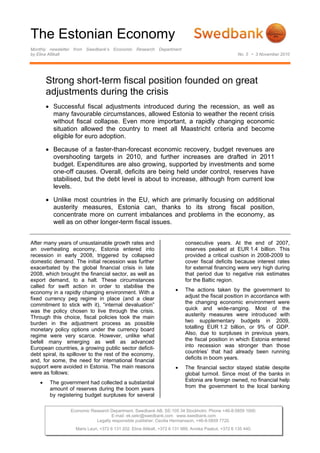
The Estonian Economy
Monthly newsletter from Swedbank’s Economic Research Department
by Elina Allikalt                                                                                     No. 5 • 3 November 2010


        Strong short-term fiscal position founded on great
        adjustments during the crisis
         Successful fiscal adjustments introduced during the recession, as well as
          many favourable circumstances, allowed Estonia to weather the recent crisis
          without fiscal collapse. Even more important, a rapidly changing economic
          situation allowed the country to meet all Maastricht criteria and become
          eligible for euro adoption.

         Because of a faster-than-forecast economic recovery, budget revenues are
          overshooting targets in 2010, and further increases are drafted in 2011
          budget. Expenditures are also growing, supported by investments and some
          one-off causes. Overall, deficits are being held under control, reserves have
          stabilised, but the debt level is about to increase, although from current low
          levels.

         Unlike most countries in the EU, which are primarily focusing on additional
          austerity measures, Estonia can, thanks to its strong fiscal position,
          concentrate more on current imbalances and problems in the economy, as
          well as on other longer-term fiscal issues.


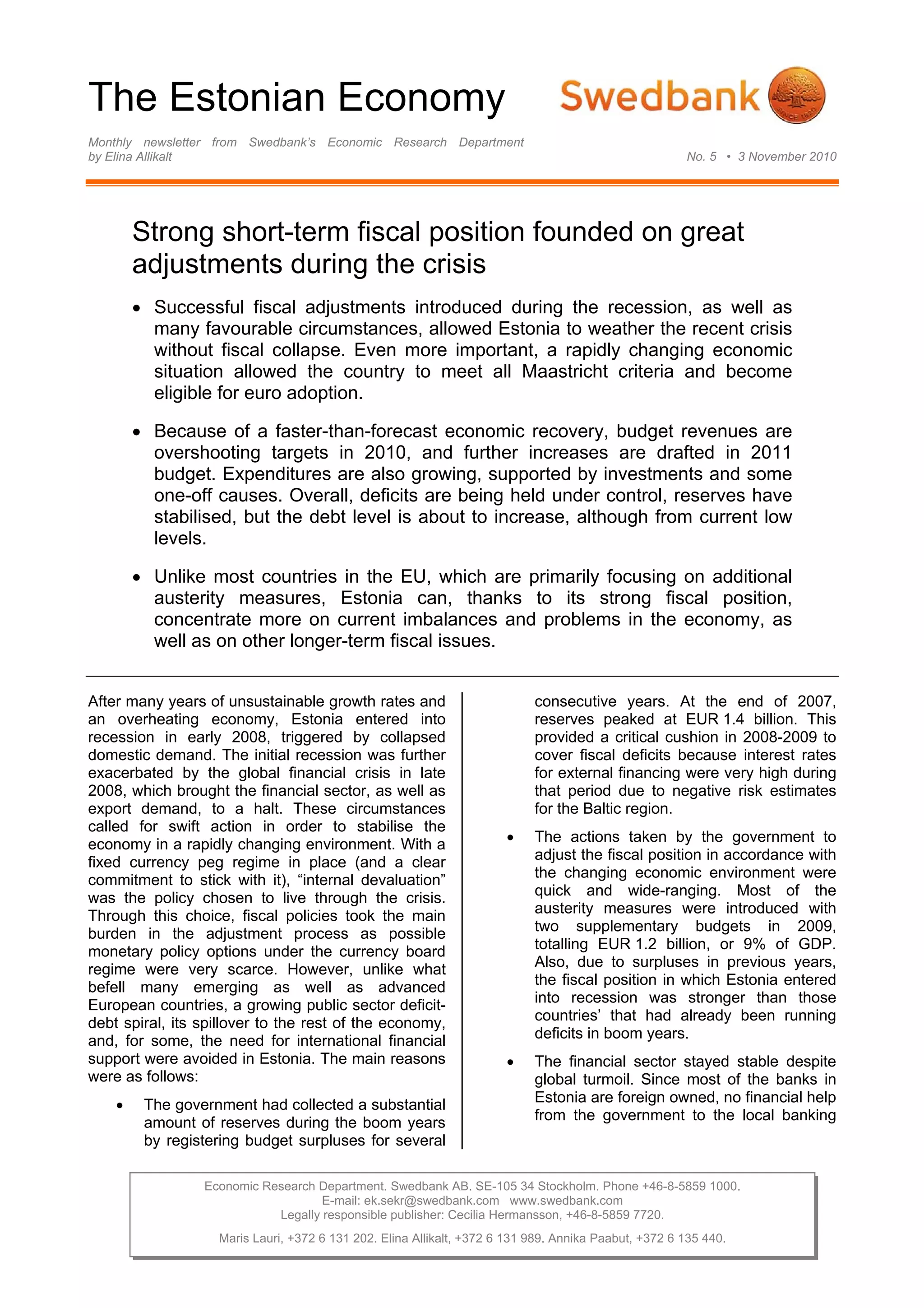
After many years of unsustainable growth rates and                         consecutive years. At the end of 2007,
an overheating economy, Estonia entered into                               reserves peaked at EUR 1.4 billion. This
recession in early 2008, triggered by collapsed                            provided a critical cushion in 2008-2009 to
domestic demand. The initial recession was further                         cover fiscal deficits because interest rates
exacerbated by the global financial crisis in late                         for external financing were very high during
2008, which brought the financial sector, as well as                       that period due to negative risk estimates
export demand, to a halt. These circumstances                              for the Baltic region.
called for swift action in order to stabilise the
economy in a rapidly changing environment. With a                         The actions taken by the government to
fixed currency peg regime in place (and a clear                            adjust the fiscal position in accordance with
commitment to stick with it), “internal devaluation”                       the changing economic environment were
was the policy chosen to live through the crisis.                          quick and wide-ranging. Most of the
Through this choice, fiscal policies took the main                         austerity measures were introduced with
burden in the adjustment process as possible                               two supplementary budgets in 2009,
monetary policy options under the currency board                           totalling EUR 1.2 billion, or 9% of GDP.
regime were very scarce. However, unlike what                              Also, due to surpluses in previous years,
befell many emerging as well as advanced                                   the fiscal position in which Estonia entered
European countries, a growing public sector deficit-                       into recession was stronger than those
debt spiral, its spillover to the rest of the economy,                     countries’ that had already been running
and, for some, the need for international financial                        deficits in boom years.
support were avoided in Estonia. The main reasons                         The financial sector stayed stable despite
were as follows:                                                           global turmoil. Since most of the banks in
        The government had collected a substantial                        Estonia are foreign owned, no financial help
         amount of reserves during the boom years                          from the government to the local banking
         by registering budget surpluses for several

                 Economic Research Department. Swedbank AB. SE-105 34 Stockholm. Phone +46-8-5859 1000.
                                    E-mail: ek.sekr@swedbank.com www.swedbank.com
                            Legally responsible publisher: Cecilia Hermansson, +46-8-5859 7720.
                   Maris Lauri, +372 6 131 202. Elina Allikalt, +372 6 131 989. Annika Paabut, +372 6 135 440.
The Estonian Economy

                         Monthly newsletter from Swedbank’s Economic Research Department, continued

                                                   Nr 5 • 3 November 2010


         sector was needed (in contrast to, e.g., the                   The share and amount of non-tax revenues were
         Parex bank in Latvia).                                         exceptionally large in 2009 (about 25% of total) to
                                                                        offset the drop-off in tax revenues, and this trend
Successful fiscal adjustments led to a budget deficit
                                                                        will continue this year as well. While in the budget
of just 1.7% of GDP in 2009 (down from 2.8% in
                                                                        law non-tax revenues were seen to decline by 7%
2008), allowing the government to further “take
                                                                        this year, these are now expected to increase by
advantage” of the low level of the economic cycle
                                                                        7% (the annual growth at the end of September
and meet all the Maastricht criteria necessary to be
                                                                        was 17%). The biggest impact behind this increase
eligible for euro adoption in 2011.1
                                                                        is a 20% higher inflow of grants. Also, a big
2010 budget – faster economic recovery                                  difference in expectations has been the successful
boosts revenues                                                         selling of Assigned Amount Units (AAUs) under the
                                                                        Kyoto protocol. At the same time, expectations are
The 2010 budget law was passed by the Parliament                        lower with respect to fines revenues (-32% annually
in December last year, based on a much more                             at the end of September).
negative economic outlook than was the overall
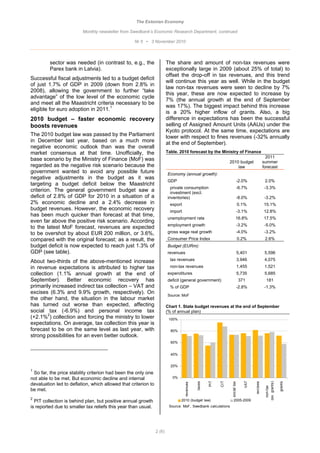
market consensus at that time. Unofficially, the                        Table. 2010 forecast by the Ministry of Finance
                                                                                                                                                     2011
base scenario by the Ministry of Finance (MoF) was                                                                2010 budget                      summer
regarded as the negative risk scenario because the                                                                    law                          forecast
government wanted to avoid any possible future                          Economy (annual growth):
negative adjustments in the budget as it was
                                                                        GDP                                                 -2.0%                   2.0%
targeting a budget deficit below the Maastricht
                                                                          private consumption                               -6.7%                   -3.3%
criterion. The general government budget saw a                            investment (excl.
deficit of 2.8% of GDP for 2010 in a situation of a                     inventories)                                        -8.0%                   -3.2%
2% economic decline and a 2.4% decrease in                                export                                                0.1%               15.1%
budget revenues. However, the economic recovery                           import                                            -3.1%                  12.8%
has been much quicker than forecast at that time,
                                                                        unemployment rate                                  16.8%                   17.5%
even far above the positive risk scenario. According
                                                                        employment growth                                   -3.2%                   -5.0%
to the latest MoF forecast, revenues are expected
to be overshot by about EUR 200 million, or 3.6%,                       gross wage real growth                              -4.0%                   -3.2%
compared with the original forecast; as a result, the                   Consumer Price Index                                    0.2%                2.6%
budget deficit is now expected to reach just 1.3% of                    Budget (EURm):
GDP (see table).                                                        revenues                                                5,401               5,596

About two-thirds of the above-mentioned increase                          tax revenues                                          3,946               4,075
in revenue expectations is attributed to higher tax                       non-tax revenues                                      1,455               1,521
collection (1.1% annual growth at the end of                            expenditures                                            5,735               5,685
September). Better economic recovery has                                deficit (general government)                            371                  181
primarily increased indirect tax collection – VAT and                     % of GDP                                          -2.8%                   -1.3%
excises (6.3% and 9.9% growth, respectively). On
                                                                        Source: MoF
the other hand, the situation in the labour market
has turned out worse than expected, affecting                           Chart 1. State budget revenues at the end of September
social tax (-6.9%) and personal income tax                              (% of annual plan)
(+2.1%2) collection and forcing the ministry to lower                    100%
expectations. On average, tax collection this year is
forecast to be on the same level as last year, with                       80%
strong possibilities for an even better outlook.
                                                                          60%


                                                                          40%


                                                                          20%
1
 So far, the price stability criterion had been the only one
not able to be met. But economic decline and internal                      0%
                                                                                                      PIT


                                                                                                            CIT


                                                                                                                                   VAT


                                                                                                                                                    (ex. grants)
                                                                                              taxes


                                                                                                                   social tax


                                                                                                                                         excises


                                                                                                                                                                   grants
                                                                                   revenues


devaluation led to deflation, which allowed that criterion to
                                                                                                                                                      non-tax


be met.
2                                                                               2010 (budget law)                    2005-2009
  PIT collection is behind plan, but positive annual growth
is reported due to smaller tax reliefs this year than usual.             Source: MoF, Swedbank calculations


                                                                2 (6)
The Estonian Economy

                          Monthly newsletter from Swedbank’s Economic Research Department, continued

                                                        Nr 5 • 3 November 2010


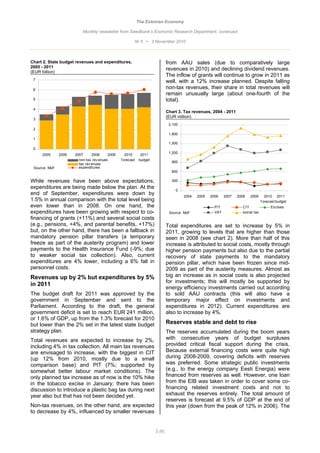
Chart 2. State budget revenues and expenditures,                              from AAU sales (due to comparatively large
2005 - 2011
                                                                              revenues in 2010) and declining dividend revenues.
(EUR billion)
                                                                              The inflow of grants will continue to grow in 2011 as
 7
                                                                              well, with a 12% increase planned. Despite falling
 6                                                                            non-tax revenues, their share in total revenues will
                                                                              remain unusually large (about one-fourth of the
 5                                                                            total).
 4
                                                                              Chart 3. Tax revenues, 2004 - 2011
                                                                              (EUR million)
 3
                                                                               2,100
 2
                                                                               1,800
 1
                                                                               1,500
 0
                                                                               1,200
     2005      2006   2007      2008     2009      2010       2011
                        non-tax rev enues       f orecast    budget
                                                                                900
                        tax rev enues
 Source: MoF            expenditures
                                                                                600

While revenues have been above expectations,                                    300
expenditures are being made below the plan. At the                                0
end of September, expenditures were down by                                            2004   2005   2006    2007   2008   2009        2010 2011
1.5% in annual comparison with the total level being                                                                                f orecast budget
even lower than in 2008. On one hand, the                                                              PIT             CIT                Excises
expenditures have been growing with respect to co-                             Source: MoF             VAT             social tax
financing of grants (+11%) and several social costs
(e.g., pensions, +4%, and parental benefits, +17%)                            Total expenditures are set to increase by 5% in
but, on the other hand, there has been a fallback in                          2011, growing to levels that are higher than those
mandatory pension pillar transfers (a temporary                               seen in 2008 (see chart 2). More than half of this
freeze as part of the austerity program) and lower                            increase is attributed to social costs, mostly through
payments to the Health Insurance Fund (-9%; due                               higher pension payments but also due to the partial
to weaker social tax collection). Also, current                               recovery of state payments to the mandatory
expenditures are 4% lower, including a 6% fall in                             pension pillar, which have been frozen since mid-
personnel costs.                                                              2009 as part of the austerity measures. Almost as
Revenues up by 2% but expenditures by 5%                                      big an increase as in social costs is also projected
                                                                              for investments; this will mostly be supported by
in 2011
                                                                              energy efficiency investments carried out according
The budget draft for 2011 was approved by the                                 to sold AAU contracts (this will also have a
government in September and sent to the                                       temporary major effect on investments and
Parliament. According to the draft, the general                               expenditures in 2012). Current expenditures are
government deficit is set to reach EUR 241 million,                           also to increase by 4%.
or 1.6% of GDP, up from the 1.3% forecast for 2010
but lower than the 2% set in the latest state budget                          Reserves stable and debt to rise
strategy plan.                                                                The reserves accumulated during the boom years
Total revenues are expected to increase by 2%,                                with consecutive years of budget surpluses
including 4% in tax collection. All main tax revenues                         provided critical fiscal support during the crisis.
are envisaged to increase, with the biggest in CIT                            Because external financing costs were quite high
(up 12% from 2010, mostly due to a small                                      during 2008-2009, covering deficits with reserves
comparison base) and PIT (7%; supported by                                    was preferred. Some strategic public investments
somewhat better labour market conditions). The                                (e.g., to the energy company Eesti Energia) were
only planned tax increase as of now is the 10% hike                           financed from reserves as well. However, one loan
in the tobacco excise in January; there has been                              from the EIB was taken in order to cover some co-
discussion to introduce a plastic bag tax during next                         financing related investment costs and not to
year also but that has not been decided yet.                                  exhaust the reserves entirely. The total amount of
                                                                              reserves is forecast at 9.5% of GDP at the end of
Non-tax revenues, on the other hand, are expected                             this year (down from the peak of 12% in 2006). The
to decrease by 4%, influenced by smaller revenues


                                                                      3 (6)
The Estonian Economy

                                   Monthly newsletter from Swedbank’s Economic Research Department, continued

                                                              Nr 5 • 3 November 2010


budget deficits both this year and next are mostly                               reaching balance or a small surplus in 2014.4.The
planned to be financed by reserves. The current                                  current government says that budget surpluses
government has also not ruled out the possibility of                             must be restored as soon as possible in order to
taking a loan to cover some investments, but this                                start increasing reserves again, which were being
will depend on whether it can get that loan with                                 exhausted during the deficit years. One coalition
lower interest costs than the interest revenue                                   partner recently even went so far as to propose that
earned from current reserves.                                                    a mandatory budget surplus requirement should be
                                                                                 written into the constitution, but as of now that idea
Chart 4. General government reserves and public debt,                            has not gained wider support. Estonia’s
2006 - 2014                                                                      conservative fiscal policies are regarded as its
(% of GDP)
                                                                                 biggest strength and are strongly linked to its
    20%                                                                          overall credibility.

                                                                                 Chart 5. General government budget balance forecast
    15%                                                                          according to current state budget strategy, 2005 – 2014
                                                                                 (% of GDP)
                                                                                     4%
    10%
                                                                                     3%

    5%                                                                               2%

                                                                                     1%

    0%                                                                               0%
          2006   2007       2008   2009   2010 2011f 2012f 2013f 2014f
                                                                                           2005

                                                                                                   2006


                                                                                                            2007


                                                                                                                   2008

                                                                                                                          2009


                                                                                                                                   2010f

                                                                                                                                           2011f


                                                                                                                                                   2012f

                                                                                                                                                           2013f


                                                                                                                                                                   2014f
                   reserv es                debt                                     -1%

    Source: MoF f orecast                                                            -2%

                                                                                     -3%
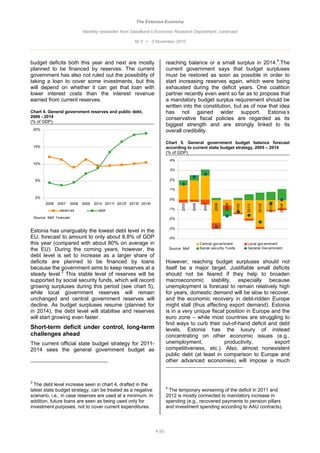
Estonia has unarguably the lowest debt level in the
EU, forecast to amount to only about 8.8% of GDP                                     -4%
this year (compared with about 80% on average in                                                          Central gov ernment              Local gov ernment
the EU). During the coming years, however, the                                       Source: MoF          Social security f unds           General Gov ernment

debt level is set to increase as a larger share of
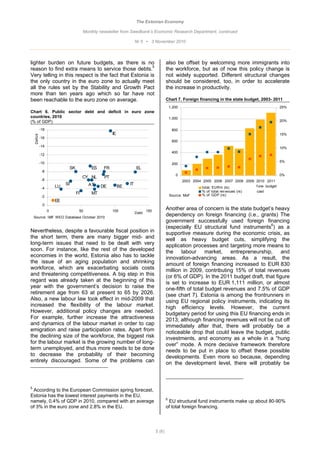
deficits are planned to be financed by loans                                     However, reaching budget surpluses should not
because the government aims to keep reserves at a                                itself be a major target. Justifiable small deficits
steady level.3 This stable level of reserves will be                             should not be feared if they help to broaden
supported by social security funds, which will record                            macroeconomic stability, especially because
growing surpluses during this period (see chart 5),                              unemployment is forecast to remain relatively high
while local government reserves will remain                                      for years, domestic demand will be slow to recover,
unchanged and central government reserves will                                   and the economic recovery in debt-ridden Europe
decline. As budget surpluses resume (planned for                                 might stall (thus affecting export demand). Estonia
in 2014), the debt level will stabilise and reserves                             is in a very unique fiscal position in Europe and the
will start growing even faster.                                                  euro zone – while most countries are struggling to
                                                                                 find ways to curb their out-of-hand deficit and debt
Short-term deficit under control, long-term                                      levels, Estonia has the luxury of instead
challenges ahead                                                                 concentrating on other economic issues (e.g.,
The current official state budget strategy for 2011-                             unemployment,             productivity,        export
2014 sees the general government budget as                                       competitiveness, etc.). Also, almost nonexistent
                                                                                 public debt (at least in comparison to Europe and
                                                                                 other advanced economies) will impose a much


3
  The debt level increase seen in chart 4, drafted in the
                                                                                 4
latest state budget strategy, can be treated as a negative                        The temporary worsening of the deficit in 2011 and
scenario, i.e., in case reserves are used at a minimum. In                       2012 is mostly connected to mandatory increase in
addition, future loans are seen as being used only for                           spending (e.g., recovered payments to pension pillars
investment purposes, not to cover current expenditures.                          and investment spending according to AAU contracts).


                                                                         4 (6)
The Estonian Economy

                                        Monthly newsletter from Swedbank’s Economic Research Department, continued

                                                                      Nr 5 • 3 November 2010


lighter burden on future budgets, as there is no                                           also be offset by welcoming more immigrants into
reason to find extra means to service those debts.5                                        the workforce, but as of now this policy change is
Very telling in this respect is the fact that Estonia is                                   not widely supported. Different structural changes
the only country in the euro zone to actually meet                                         should be considered, too, in order to accelerate
all the rules set by the Stability and Growth Pact                                         the increase in productivity.
more than ten years ago which so far have not
been reachable to the euro zone on average.                                                Chart 7. Foreign financing in the state budget, 2003- 2011
                                                                                               1,200                                                      25%
Chart 6. Public sector debt and deficit in euro zone
countries, 2010                                                                                1,000
(% of GDP)                                                                                                                                                20%

              -18                                                                               800
                                                       IE                                                                                                 15%
    Deficit


              -16
                                                                                                600
              -14                                                                                                                                         10%
                                                                                                400
              -12

              -10                                                                                                                                         5%
                                                                                                200
                              SK            ES    FR                  EL
               -8
                                                                                                  0                                                       0%
                                        CY NL     PT
               -6                                                                                     2003 2004 2005 2006 2007 2008 2009 2010 2011
                             SI           AT                     IT
               -4       LU                       DE         BE                                                  total, EURm (ls)          f ore- budget
                                                                                                                % of total rev enues (rs) cast
                                   FI       MT                                                 Source: MoF      % of GDP (rs)
               -2
                        EE
               0
                    0               50                 100                   150
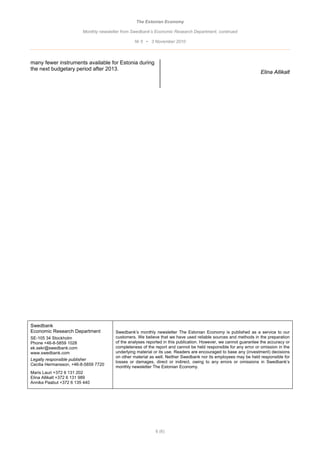
                                                                                           Another area of concern is the state budget’s heavy
                                                                      Debt
    Source: IMF WEO Database October 2010
                                                                                           dependency on foreign financing (i.e., grants) The
                                                                                           government successfully used foreign financing
                                                                                           (especially EU structural fund instruments6) as a
Nevertheless, despite a favourable fiscal position in                                      supportive measure during the economic crisis, as
the short term, there are many bigger mid- and                                             well as heavy budget cuts, simplifying the
long-term issues that need to be dealt with very                                           application processes and targeting more means to
soon. For instance, like the rest of the developed                                         the    labour      market, entrepreneurship, and
economies in the world, Estonia also has to tackle                                         innovation-advancing areas. As a result, the
the issue of an aging population and shrinking                                             amount of foreign financing increased to EUR 830
workforce, which are exacerbating socials costs                                            million in 2009, contributing 15% of total revenues
and threatening competitiveness. A big step in this                                        (or 6% of GDP). In the 2011 budget draft, that figure
regard was already taken at the beginning of this                                          is set to increase to EUR 1,111 million, or almost
year with the government’s decision to raise the                                           one-fifth of total budget revenues and 7.5% of GDP
retirement age from 63 at present to 65 by 2026.                                           (see chart 7). Estonia is among the frontrunners in
Also, a new labour law took effect in mid-2009 that                                        using EU regional policy instruments, indicating its
increased the flexibility of the labour market.                                            high efficiency levels. However, the current
However, additional policy changes are needed.                                             budgetary period for using this EU financing ends in
For example, further increase the attractiveness                                           2013; although financing revenues will not be cut off
and dynamics of the labour market in order to cap                                          immediately after that, there will probably be a
emigration and raise participation rates. Apart from                                       noticeable drop that could leave the budget, public
the declining size of the workforce, the biggest risk                                      investments, and economy as a whole in a “hung
for the labour market is the growing number of long-                                       over” mode. A more decisive framework therefore
term unemployed, and thus more needs to be done                                            needs to be put in place to offset these possible
to decrease the probability of their becoming                                              developments. Even more so because, depending
entirely discouraged. Some of the problems can                                             on the development level, there will probably be


5
 According to the European Commission spring forecast,
Estonia has the lowest interest payments in the EU,
                                                                                           6
namely, 0.4% of GDP in 2010, compared with an average                                       EU structural fund instruments make up about 80-90%
of 3% in the euro zone and 2.8% in the EU.                                                 of total foreign financing.


                                                                                   5 (6)
The Estonian Economy

                         Monthly newsletter from Swedbank’s Economic Research Department, continued

                                                 Nr 5 • 3 November 2010


many fewer instruments available for Estonia during
the next budgetary period after 2013.
                                                                                                                  Elina Allikalt


Swedbank
Economic Research Department            Swedbank’s monthly newsletter The Estonian Economy is published as a service to our
SE-105 34 Stockholm                     customers. We believe that we have used reliable sources and methods in the preparation
Phone +46-8-5859 1028                   of the analyses reported in this publication. However, we cannot guarantee the accuracy or
ek.sekr@swedbank.com                    completeness of the report and cannot be held responsible for any error or omission in the
www.swedbank.com                        underlying material or its use. Readers are encouraged to base any (investment) decisions
                                        on other material as well. Neither Swedbank nor its employees may be held responsible for
Legally responsible publisher
                                        losses or damages, direct or indirect, owing to any errors or omissions in Swedbank’s
Cecilia Hermansson, +46-8-5859 7720
                                        monthly newsletter The Estonian Economy.
Maris Lauri +372 6 131 202
Elina Allikalt +372 6 131 989
Annika Paabut +372 6 135 440


                                                            6 (6)

The Estonian Economy

  • 1.
    The Estonian Economy Monthlynewsletter from Swedbank’s Economic Research Department by Elina Allikalt No. 5 • 3 November 2010 Strong short-term fiscal position founded on great adjustments during the crisis  Successful fiscal adjustments introduced during the recession, as well as many favourable circumstances, allowed Estonia to weather the recent crisis without fiscal collapse. Even more important, a rapidly changing economic situation allowed the country to meet all Maastricht criteria and become eligible for euro adoption.  Because of a faster-than-forecast economic recovery, budget revenues are overshooting targets in 2010, and further increases are drafted in 2011 budget. Expenditures are also growing, supported by investments and some one-off causes. Overall, deficits are being held under control, reserves have stabilised, but the debt level is about to increase, although from current low levels.  Unlike most countries in the EU, which are primarily focusing on additional austerity measures, Estonia can, thanks to its strong fiscal position, concentrate more on current imbalances and problems in the economy, as well as on other longer-term fiscal issues. After many years of unsustainable growth rates and consecutive years. At the end of 2007, an overheating economy, Estonia entered into reserves peaked at EUR 1.4 billion. This recession in early 2008, triggered by collapsed provided a critical cushion in 2008-2009 to domestic demand. The initial recession was further cover fiscal deficits because interest rates exacerbated by the global financial crisis in late for external financing were very high during 2008, which brought the financial sector, as well as that period due to negative risk estimates export demand, to a halt. These circumstances for the Baltic region. called for swift action in order to stabilise the economy in a rapidly changing environment. With a  The actions taken by the government to fixed currency peg regime in place (and a clear adjust the fiscal position in accordance with commitment to stick with it), “internal devaluation” the changing economic environment were was the policy chosen to live through the crisis. quick and wide-ranging. Most of the Through this choice, fiscal policies took the main austerity measures were introduced with burden in the adjustment process as possible two supplementary budgets in 2009, monetary policy options under the currency board totalling EUR 1.2 billion, or 9% of GDP. regime were very scarce. However, unlike what Also, due to surpluses in previous years, befell many emerging as well as advanced the fiscal position in which Estonia entered European countries, a growing public sector deficit- into recession was stronger than those debt spiral, its spillover to the rest of the economy, countries’ that had already been running and, for some, the need for international financial deficits in boom years. support were avoided in Estonia. The main reasons  The financial sector stayed stable despite were as follows: global turmoil. Since most of the banks in  The government had collected a substantial Estonia are foreign owned, no financial help amount of reserves during the boom years from the government to the local banking by registering budget surpluses for several Economic Research Department. Swedbank AB. SE-105 34 Stockholm. Phone +46-8-5859 1000. E-mail: ek.sekr@swedbank.com www.swedbank.com Legally responsible publisher: Cecilia Hermansson, +46-8-5859 7720. Maris Lauri, +372 6 131 202. Elina Allikalt, +372 6 131 989. Annika Paabut, +372 6 135 440.
  • 2.
    The Estonian Economy Monthly newsletter from Swedbank’s Economic Research Department, continued Nr 5 • 3 November 2010 sector was needed (in contrast to, e.g., the The share and amount of non-tax revenues were Parex bank in Latvia). exceptionally large in 2009 (about 25% of total) to offset the drop-off in tax revenues, and this trend Successful fiscal adjustments led to a budget deficit will continue this year as well. While in the budget of just 1.7% of GDP in 2009 (down from 2.8% in law non-tax revenues were seen to decline by 7% 2008), allowing the government to further “take this year, these are now expected to increase by advantage” of the low level of the economic cycle 7% (the annual growth at the end of September and meet all the Maastricht criteria necessary to be was 17%). The biggest impact behind this increase eligible for euro adoption in 2011.1 is a 20% higher inflow of grants. Also, a big 2010 budget – faster economic recovery difference in expectations has been the successful boosts revenues selling of Assigned Amount Units (AAUs) under the Kyoto protocol. At the same time, expectations are The 2010 budget law was passed by the Parliament lower with respect to fines revenues (-32% annually in December last year, based on a much more at the end of September). negative economic outlook than was the overall market consensus at that time. Unofficially, the Table. 2010 forecast by the Ministry of Finance 2011 base scenario by the Ministry of Finance (MoF) was 2010 budget summer regarded as the negative risk scenario because the law forecast government wanted to avoid any possible future Economy (annual growth): negative adjustments in the budget as it was GDP -2.0% 2.0% targeting a budget deficit below the Maastricht private consumption -6.7% -3.3% criterion. The general government budget saw a investment (excl. deficit of 2.8% of GDP for 2010 in a situation of a inventories) -8.0% -3.2% 2% economic decline and a 2.4% decrease in export 0.1% 15.1% budget revenues. However, the economic recovery import -3.1% 12.8% has been much quicker than forecast at that time, unemployment rate 16.8% 17.5% even far above the positive risk scenario. According employment growth -3.2% -5.0% to the latest MoF forecast, revenues are expected to be overshot by about EUR 200 million, or 3.6%, gross wage real growth -4.0% -3.2% compared with the original forecast; as a result, the Consumer Price Index 0.2% 2.6% budget deficit is now expected to reach just 1.3% of Budget (EURm): GDP (see table). revenues 5,401 5,596 About two-thirds of the above-mentioned increase tax revenues 3,946 4,075 in revenue expectations is attributed to higher tax non-tax revenues 1,455 1,521 collection (1.1% annual growth at the end of expenditures 5,735 5,685 September). Better economic recovery has deficit (general government) 371 181 primarily increased indirect tax collection – VAT and % of GDP -2.8% -1.3% excises (6.3% and 9.9% growth, respectively). On Source: MoF the other hand, the situation in the labour market has turned out worse than expected, affecting Chart 1. State budget revenues at the end of September social tax (-6.9%) and personal income tax (% of annual plan) (+2.1%2) collection and forcing the ministry to lower 100% expectations. On average, tax collection this year is forecast to be on the same level as last year, with 80% strong possibilities for an even better outlook. 60% 40% 20% 1 So far, the price stability criterion had been the only one not able to be met. But economic decline and internal 0% PIT CIT VAT (ex. grants) taxes social tax excises grants revenues devaluation led to deflation, which allowed that criterion to non-tax be met. 2 2010 (budget law) 2005-2009 PIT collection is behind plan, but positive annual growth is reported due to smaller tax reliefs this year than usual. Source: MoF, Swedbank calculations 2 (6)
  • 3.
    The Estonian Economy Monthly newsletter from Swedbank’s Economic Research Department, continued Nr 5 • 3 November 2010 Chart 2. State budget revenues and expenditures, from AAU sales (due to comparatively large 2005 - 2011 revenues in 2010) and declining dividend revenues. (EUR billion) The inflow of grants will continue to grow in 2011 as 7 well, with a 12% increase planned. Despite falling 6 non-tax revenues, their share in total revenues will remain unusually large (about one-fourth of the 5 total). 4 Chart 3. Tax revenues, 2004 - 2011 (EUR million) 3 2,100 2 1,800 1 1,500 0 1,200 2005 2006 2007 2008 2009 2010 2011 non-tax rev enues f orecast budget 900 tax rev enues Source: MoF expenditures 600 While revenues have been above expectations, 300 expenditures are being made below the plan. At the 0 end of September, expenditures were down by 2004 2005 2006 2007 2008 2009 2010 2011 1.5% in annual comparison with the total level being f orecast budget even lower than in 2008. On one hand, the PIT CIT Excises expenditures have been growing with respect to co- Source: MoF VAT social tax financing of grants (+11%) and several social costs (e.g., pensions, +4%, and parental benefits, +17%) Total expenditures are set to increase by 5% in but, on the other hand, there has been a fallback in 2011, growing to levels that are higher than those mandatory pension pillar transfers (a temporary seen in 2008 (see chart 2). More than half of this freeze as part of the austerity program) and lower increase is attributed to social costs, mostly through payments to the Health Insurance Fund (-9%; due higher pension payments but also due to the partial to weaker social tax collection). Also, current recovery of state payments to the mandatory expenditures are 4% lower, including a 6% fall in pension pillar, which have been frozen since mid- personnel costs. 2009 as part of the austerity measures. Almost as Revenues up by 2% but expenditures by 5% big an increase as in social costs is also projected for investments; this will mostly be supported by in 2011 energy efficiency investments carried out according The budget draft for 2011 was approved by the to sold AAU contracts (this will also have a government in September and sent to the temporary major effect on investments and Parliament. According to the draft, the general expenditures in 2012). Current expenditures are government deficit is set to reach EUR 241 million, also to increase by 4%. or 1.6% of GDP, up from the 1.3% forecast for 2010 but lower than the 2% set in the latest state budget Reserves stable and debt to rise strategy plan. The reserves accumulated during the boom years Total revenues are expected to increase by 2%, with consecutive years of budget surpluses including 4% in tax collection. All main tax revenues provided critical fiscal support during the crisis. are envisaged to increase, with the biggest in CIT Because external financing costs were quite high (up 12% from 2010, mostly due to a small during 2008-2009, covering deficits with reserves comparison base) and PIT (7%; supported by was preferred. Some strategic public investments somewhat better labour market conditions). The (e.g., to the energy company Eesti Energia) were only planned tax increase as of now is the 10% hike financed from reserves as well. However, one loan in the tobacco excise in January; there has been from the EIB was taken in order to cover some co- discussion to introduce a plastic bag tax during next financing related investment costs and not to year also but that has not been decided yet. exhaust the reserves entirely. The total amount of reserves is forecast at 9.5% of GDP at the end of Non-tax revenues, on the other hand, are expected this year (down from the peak of 12% in 2006). The to decrease by 4%, influenced by smaller revenues 3 (6)
  • 4.
    The Estonian Economy Monthly newsletter from Swedbank’s Economic Research Department, continued Nr 5 • 3 November 2010 budget deficits both this year and next are mostly reaching balance or a small surplus in 2014.4.The planned to be financed by reserves. The current current government says that budget surpluses government has also not ruled out the possibility of must be restored as soon as possible in order to taking a loan to cover some investments, but this start increasing reserves again, which were being will depend on whether it can get that loan with exhausted during the deficit years. One coalition lower interest costs than the interest revenue partner recently even went so far as to propose that earned from current reserves. a mandatory budget surplus requirement should be written into the constitution, but as of now that idea Chart 4. General government reserves and public debt, has not gained wider support. Estonia’s 2006 - 2014 conservative fiscal policies are regarded as its (% of GDP) biggest strength and are strongly linked to its 20% overall credibility. Chart 5. General government budget balance forecast 15% according to current state budget strategy, 2005 – 2014 (% of GDP) 4% 10% 3% 5% 2% 1% 0% 0% 2006 2007 2008 2009 2010 2011f 2012f 2013f 2014f 2005 2006 2007 2008 2009 2010f 2011f 2012f 2013f 2014f reserv es debt -1% Source: MoF f orecast -2% -3% Estonia has unarguably the lowest debt level in the EU, forecast to amount to only about 8.8% of GDP -4% this year (compared with about 80% on average in Central gov ernment Local gov ernment the EU). During the coming years, however, the Source: MoF Social security f unds General Gov ernment debt level is set to increase as a larger share of deficits are planned to be financed by loans However, reaching budget surpluses should not because the government aims to keep reserves at a itself be a major target. Justifiable small deficits steady level.3 This stable level of reserves will be should not be feared if they help to broaden supported by social security funds, which will record macroeconomic stability, especially because growing surpluses during this period (see chart 5), unemployment is forecast to remain relatively high while local government reserves will remain for years, domestic demand will be slow to recover, unchanged and central government reserves will and the economic recovery in debt-ridden Europe decline. As budget surpluses resume (planned for might stall (thus affecting export demand). Estonia in 2014), the debt level will stabilise and reserves is in a very unique fiscal position in Europe and the will start growing even faster. euro zone – while most countries are struggling to find ways to curb their out-of-hand deficit and debt Short-term deficit under control, long-term levels, Estonia has the luxury of instead challenges ahead concentrating on other economic issues (e.g., The current official state budget strategy for 2011- unemployment, productivity, export 2014 sees the general government budget as competitiveness, etc.). Also, almost nonexistent public debt (at least in comparison to Europe and other advanced economies) will impose a much 3 The debt level increase seen in chart 4, drafted in the 4 latest state budget strategy, can be treated as a negative The temporary worsening of the deficit in 2011 and scenario, i.e., in case reserves are used at a minimum. In 2012 is mostly connected to mandatory increase in addition, future loans are seen as being used only for spending (e.g., recovered payments to pension pillars investment purposes, not to cover current expenditures. and investment spending according to AAU contracts). 4 (6)
  • 5.
    The Estonian Economy Monthly newsletter from Swedbank’s Economic Research Department, continued Nr 5 • 3 November 2010 lighter burden on future budgets, as there is no also be offset by welcoming more immigrants into reason to find extra means to service those debts.5 the workforce, but as of now this policy change is Very telling in this respect is the fact that Estonia is not widely supported. Different structural changes the only country in the euro zone to actually meet should be considered, too, in order to accelerate all the rules set by the Stability and Growth Pact the increase in productivity. more than ten years ago which so far have not been reachable to the euro zone on average. Chart 7. Foreign financing in the state budget, 2003- 2011 1,200 25% Chart 6. Public sector debt and deficit in euro zone countries, 2010 1,000 (% of GDP) 20% -18 800 IE 15% Deficit -16 600 -14 10% 400 -12 -10 5% 200 SK ES FR EL -8 0 0% CY NL PT -6 2003 2004 2005 2006 2007 2008 2009 2010 2011 SI AT IT -4 LU DE BE total, EURm (ls) f ore- budget % of total rev enues (rs) cast FI MT Source: MoF % of GDP (rs) -2 EE 0 0 50 100 150 Another area of concern is the state budget’s heavy Debt Source: IMF WEO Database October 2010 dependency on foreign financing (i.e., grants) The government successfully used foreign financing (especially EU structural fund instruments6) as a Nevertheless, despite a favourable fiscal position in supportive measure during the economic crisis, as the short term, there are many bigger mid- and well as heavy budget cuts, simplifying the long-term issues that need to be dealt with very application processes and targeting more means to soon. For instance, like the rest of the developed the labour market, entrepreneurship, and economies in the world, Estonia also has to tackle innovation-advancing areas. As a result, the the issue of an aging population and shrinking amount of foreign financing increased to EUR 830 workforce, which are exacerbating socials costs million in 2009, contributing 15% of total revenues and threatening competitiveness. A big step in this (or 6% of GDP). In the 2011 budget draft, that figure regard was already taken at the beginning of this is set to increase to EUR 1,111 million, or almost year with the government’s decision to raise the one-fifth of total budget revenues and 7.5% of GDP retirement age from 63 at present to 65 by 2026. (see chart 7). Estonia is among the frontrunners in Also, a new labour law took effect in mid-2009 that using EU regional policy instruments, indicating its increased the flexibility of the labour market. high efficiency levels. However, the current However, additional policy changes are needed. budgetary period for using this EU financing ends in For example, further increase the attractiveness 2013; although financing revenues will not be cut off and dynamics of the labour market in order to cap immediately after that, there will probably be a emigration and raise participation rates. Apart from noticeable drop that could leave the budget, public the declining size of the workforce, the biggest risk investments, and economy as a whole in a “hung for the labour market is the growing number of long- over” mode. A more decisive framework therefore term unemployed, and thus more needs to be done needs to be put in place to offset these possible to decrease the probability of their becoming developments. Even more so because, depending entirely discouraged. Some of the problems can on the development level, there will probably be 5 According to the European Commission spring forecast, Estonia has the lowest interest payments in the EU, 6 namely, 0.4% of GDP in 2010, compared with an average EU structural fund instruments make up about 80-90% of 3% in the euro zone and 2.8% in the EU. of total foreign financing. 5 (6)
  • 6.
    The Estonian Economy Monthly newsletter from Swedbank’s Economic Research Department, continued Nr 5 • 3 November 2010 many fewer instruments available for Estonia during the next budgetary period after 2013. Elina Allikalt Swedbank Economic Research Department Swedbank’s monthly newsletter The Estonian Economy is published as a service to our SE-105 34 Stockholm customers. We believe that we have used reliable sources and methods in the preparation Phone +46-8-5859 1028 of the analyses reported in this publication. However, we cannot guarantee the accuracy or ek.sekr@swedbank.com completeness of the report and cannot be held responsible for any error or omission in the www.swedbank.com underlying material or its use. Readers are encouraged to base any (investment) decisions on other material as well. Neither Swedbank nor its employees may be held responsible for Legally responsible publisher losses or damages, direct or indirect, owing to any errors or omissions in Swedbank’s Cecilia Hermansson, +46-8-5859 7720 monthly newsletter The Estonian Economy. Maris Lauri +372 6 131 202 Elina Allikalt +372 6 131 989 Annika Paabut +372 6 135 440 6 (6)