A quick introduction to
OTP Applications
using a
Gen_server example
on Erlang/OTP R15B
Baed on the official online manuals and a gen_server example from http://www.rustyrazorblade.
com/2009/04/erlang-understanding-gen_server/
files and source code
0 directories, 5 files
├── demo.script
├── demo_application.app
├── demo_application.erl
├── demo_supervisor.erl
└── demo_gen_server.erl
%% -*- erlang -*-
main(_Strings)->
% compile all the .erl files to .beam files
make:all(),
% start demo_application
application:start(demo_application),
% run demo_gen_server:add/1
Output = demo_gen_server:add(10),
io:format(
"nnInitial demo_gen_server state was 0;
adding 10; returned: ~pnn",
[Output]
),
halt().
demo.script
{ application,
demo_application,
[ { mod,
{ demo_application,
[]
}
},
{ applications,
[ kernel,
stdlib
]
}
]
}.
demo_application.app
-module(demo_application).
-behaviour(application).
-export([start/2, stop/1]).
-compile(native).
start(_Type,_Args) ->
demo_supervisor:start_link().
stop(State) ->
{ok,State}.
demo_application.erl
-module(demo_supervisor).
-behaviour(supervisor).
-export([start_link/0, init/1]).
-compile(native).
start_link() ->
supervisor:start_link(
{ local,
demo_supervisor_instance1
},
demo_supervisor,
[]
).
init(_Args) ->
{ ok,
{ { one_for_one,
1,
60
},
[ { demo_gen_server_child_id,
{ demo_gen_server,
start_link,
[]
},
permanent,
brutal_kill,
worker,
[ demo_gen_server ]
}
]
}
}.
demo_supervisor.erl
-module(demo_gen_server).
-export( [ start_link/0,
add/1,
subtract/1,
init/1,
handle_call/3
]
).
-compile(native).
start_link()->
gen_server:start_link(
{ local,
demo_gen_server_instance2
},
demo_gen_server,
[],
[]
).
init(_Args) -> {ok, 0}.
add(Num) ->
gen_server:call(
demo_gen_server_instance1,
{add, Num}
).
subtract(Num) ->
gen_server:call(
demo_gen_server_instance1,
{subtract, Num}
).
handle_call({add, Num}, _From, State) ->
{reply, State + Num, State + Num};
handle_call({subtract, Num}, _From, State) ->
{reply, State - Num, State - Num}.
demo_gen_server.erl
a quick demo
0 directories, 5 files
├── demo.script
├── demo_application.app
├── demo_application.erl
├── demo_supervisor.erl
└── demo_gen_server.erl
PROMPT: escript demo.script
Recompile: demo_application
Recompile: demo_gen_server
Recompile: demo_supervisor
Initial demo_gen_server state was 0;
adding 10; returned: 10
PROMPT:
PROMPT: erl
Erlang R15B (erts-5.9) [source] [64-bit]
[smp:2:2] [async-threads:0] [hipe]
[kernel-poll:false]
Eshell V5.9 (abort with ^G)
1> make:all().
Recompile: demo_application
Recompile: demo_gen_server
Recompile: demo_supervisor
up_to_date
2> application:start(demo_application).
ok
3> demo_gen_server:add(10).
10
4> q().
ok
5>
PROMPT:
Method 2:
start the Erlang shell,
then manually run the commands from demo.
script.
Method 1:
just run
demo.script.
Current
Working
Directory
tear down
0 directories, 5 files
├── demo.script
├── demo_application.app
├── demo_application.erl
├── demo_supervisor.erl
└── demo_gen_server.erl
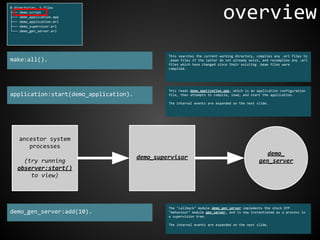
make:all().
This searches the current working directory, compiles any .erl files to
.beam files if the latter do not already exist, and recompiles any .erl
files which have changed since their existing .beam files were
compiled.
application:start(demo_application).
This reads demo_application.app, which is an application configuration
file, then attempts to compile, load, and start the application.
The internal events are expanded on the next slide.
demo_gen_server:add(10).
The "callback" module demo_gen_server implements the stock OTP
"behaviour" module gen_server, and is now instantiated as a process in
a supervision tree.
The internal events are expanded on the next slide.
ancestor system
processes
(try running
observer:start()
to view)
demo_supervisor
demo_
gen_server
overview
0 directories, 5 files
├── demo.script
├── demo_application.app
├── demo_application.erl
├── demo_supervisor.erl
└── demo_gen_server.erl
loading & starting
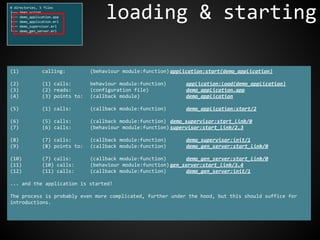
(1) calling: (behaviour module:function) application:start(demo_application)
(2) (1) calls: behaviour module:function) application:load(demo_application)
(3) (2) reads: (configuration file) demo_application.app
(4) (3) points to: (callback module) demo_application
(5) (1) calls: (callback module:function) demo_application:start/2
(6) (5) calls: (callback module:function) demo_supervisor:start_link/0
(7) (6) calls: (behaviour module:function) supervisor:start_link/2,3
(8) (7) calls: (callback module:function) demo_supervisor:init/1
(9) (8) points to: (callback module:function) demo_gen_server:start_link/0
(10) (7) calls: (callback module:function) demo_gen_server:start_link/0
(11) (10) calls: (behaviour module:function) gen_server:start_link/3,4
(12) (11) calls: (callback module:function) demo_gen_server:init/1
... and the application is started!
The process is probably even more complicated, further under the hood, but this should suffice for
introductions.
0 directories, 5 files
├── demo.script
├── demo_application.app
├── demo_application.erl
├── demo_supervisor.erl
└── demo_gen_server.erl
using/calling/doing
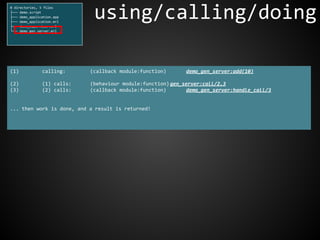
(1) calling: (callback module:function) demo_gen_server:add(10)
(2) (1) calls: (behaviour module:function) gen_server:call/2,3
(3) (2) calls: (callback module:function) demo_gen_server:handle_call/3
... then work is done, and a result is returned!

OTP application (with gen server child) - simple example

  • 1.
    A quick introductionto OTP Applications using a Gen_server example on Erlang/OTP R15B Baed on the official online manuals and a gen_server example from http://www.rustyrazorblade. com/2009/04/erlang-understanding-gen_server/
  • 2.
  • 3.
    0 directories, 5files ├── demo.script ├── demo_application.app ├── demo_application.erl ├── demo_supervisor.erl └── demo_gen_server.erl %% -*- erlang -*- main(_Strings)-> % compile all the .erl files to .beam files make:all(), % start demo_application application:start(demo_application), % run demo_gen_server:add/1 Output = demo_gen_server:add(10), io:format( "nnInitial demo_gen_server state was 0; adding 10; returned: ~pnn", [Output] ), halt(). demo.script { application, demo_application, [ { mod, { demo_application, [] } }, { applications, [ kernel, stdlib ] } ] }. demo_application.app -module(demo_application). -behaviour(application). -export([start/2, stop/1]). -compile(native). start(_Type,_Args) -> demo_supervisor:start_link(). stop(State) -> {ok,State}. demo_application.erl -module(demo_supervisor). -behaviour(supervisor). -export([start_link/0, init/1]). -compile(native). start_link() -> supervisor:start_link( { local, demo_supervisor_instance1 }, demo_supervisor, [] ). init(_Args) -> { ok, { { one_for_one, 1, 60 }, [ { demo_gen_server_child_id, { demo_gen_server, start_link, [] }, permanent, brutal_kill, worker, [ demo_gen_server ] } ] } }. demo_supervisor.erl -module(demo_gen_server). -export( [ start_link/0, add/1, subtract/1, init/1, handle_call/3 ] ). -compile(native). start_link()-> gen_server:start_link( { local, demo_gen_server_instance2 }, demo_gen_server, [], [] ). init(_Args) -> {ok, 0}. add(Num) -> gen_server:call( demo_gen_server_instance1, {add, Num} ). subtract(Num) -> gen_server:call( demo_gen_server_instance1, {subtract, Num} ). handle_call({add, Num}, _From, State) -> {reply, State + Num, State + Num}; handle_call({subtract, Num}, _From, State) -> {reply, State - Num, State - Num}. demo_gen_server.erl
  • 4.
  • 5.
    0 directories, 5files ├── demo.script ├── demo_application.app ├── demo_application.erl ├── demo_supervisor.erl └── demo_gen_server.erl PROMPT: escript demo.script Recompile: demo_application Recompile: demo_gen_server Recompile: demo_supervisor Initial demo_gen_server state was 0; adding 10; returned: 10 PROMPT: PROMPT: erl Erlang R15B (erts-5.9) [source] [64-bit] [smp:2:2] [async-threads:0] [hipe] [kernel-poll:false] Eshell V5.9 (abort with ^G) 1> make:all(). Recompile: demo_application Recompile: demo_gen_server Recompile: demo_supervisor up_to_date 2> application:start(demo_application). ok 3> demo_gen_server:add(10). 10 4> q(). ok 5> PROMPT: Method 2: start the Erlang shell, then manually run the commands from demo. script. Method 1: just run demo.script. Current Working Directory
  • 6.
  • 7.
    0 directories, 5files ├── demo.script ├── demo_application.app ├── demo_application.erl ├── demo_supervisor.erl └── demo_gen_server.erl make:all(). This searches the current working directory, compiles any .erl files to .beam files if the latter do not already exist, and recompiles any .erl files which have changed since their existing .beam files were compiled. application:start(demo_application). This reads demo_application.app, which is an application configuration file, then attempts to compile, load, and start the application. The internal events are expanded on the next slide. demo_gen_server:add(10). The "callback" module demo_gen_server implements the stock OTP "behaviour" module gen_server, and is now instantiated as a process in a supervision tree. The internal events are expanded on the next slide. ancestor system processes (try running observer:start() to view) demo_supervisor demo_ gen_server overview
  • 8.
    0 directories, 5files ├── demo.script ├── demo_application.app ├── demo_application.erl ├── demo_supervisor.erl └── demo_gen_server.erl loading & starting (1) calling: (behaviour module:function) application:start(demo_application) (2) (1) calls: behaviour module:function) application:load(demo_application) (3) (2) reads: (configuration file) demo_application.app (4) (3) points to: (callback module) demo_application (5) (1) calls: (callback module:function) demo_application:start/2 (6) (5) calls: (callback module:function) demo_supervisor:start_link/0 (7) (6) calls: (behaviour module:function) supervisor:start_link/2,3 (8) (7) calls: (callback module:function) demo_supervisor:init/1 (9) (8) points to: (callback module:function) demo_gen_server:start_link/0 (10) (7) calls: (callback module:function) demo_gen_server:start_link/0 (11) (10) calls: (behaviour module:function) gen_server:start_link/3,4 (12) (11) calls: (callback module:function) demo_gen_server:init/1 ... and the application is started! The process is probably even more complicated, further under the hood, but this should suffice for introductions.
  • 9.
    0 directories, 5files ├── demo.script ├── demo_application.app ├── demo_application.erl ├── demo_supervisor.erl └── demo_gen_server.erl using/calling/doing (1) calling: (callback module:function) demo_gen_server:add(10) (2) (1) calls: (behaviour module:function) gen_server:call/2,3 (3) (2) calls: (callback module:function) demo_gen_server:handle_call/3 ... then work is done, and a result is returned!