BUSINESS COMMUNICATION
UNIT – III
REPORTS
MBA – I YEAR | VCEW
SYLLABUS
UNIT – III – REPORTS
Reports – Structure - Formal Report, Informal report - Checklist for
compiling reports - Executive Summary – Comprehension - Agenda,
Minutes of Meeting - Compiling a Press Release.
WHAT IS MEANT BY REPORT?
Reports are important in modern communications. Thousands of
reports formal or informal, special or routine are written every day.
A foreman reports to the manager the progress of the work, a manager
report to the general manager, and the Board of Directors report to the
shareholders
CHARACTERISTICS OF A GOOD REPORT
• Simplicity
• Clarity
• Brevity
• Accuracy
• Relevance
• Reader-orientation
• Grammatical accuracy
STRUCTURE OF REPORT
STRUCTURE OF REPORT
• Title Page
• Executive Summary
• Table of Contents
• Introduction
• Body
• Conclusion
• Recommendations
• References
• Appendices
TYPES OF REPORTS
TYPES OF REPORTS
REPORTS ON THE BASIS OF IMPORTANCE
• Ordinary or Routine Report
• Special Report
REPORTS ON THE BASIS OF LEGAL FORMALITIES
• Formal Report
• Informal Report
REPORTS ON THE BASIS OF FUNCTION
• Informative Report
• Interpretative Report
REPORTS ON THE BASIS OF MEETINGS
• Verbation Reports
• Summarised Report
REPORTS OF COMMITTEES OR SUBCOMMITTEES
• Standing Committee Report
• Adhoc Committee Report
• Minority Report
• Majority Report
CHECKLIST FOR COMPILING REPORTS
Report writing checklist:
• Consider the audience
• Know your brief
• Identify the best structure
• Consider writing an outline/plan and obtaining some feedback
• Gather information
• Write content
• Edit/Proof read.
COMPREHENSION
What is comprehension?
Reading with comprehension helps in understanding the concept,
grasping the important data and acquiring knowledge. As words may
carry different connotation; the direct meaning or the applied meaning
depending on the context, emphasis, etc therefore reading with
comprehension assist in analysing the right meaning of words.
COMPREHENDING PASSAGES:
There are techniques for better comprehension:
• Read the passage to get its general meaning, and note down the main
points.
• Read all the questions attentively and look for answers.
• Be precise and to the point in answering the questions.
• Be cautious about the usage of grammar, spelling and punctuation.
This ability can be acquired through intensive and disciplined practice.
Different types of reading aims to aid you in various ways; acquiring
knowledge, defining, listing things, describing, identifying specific
material, showing or quoting any specific matter. To be familiar with this
entire thing one should assess the overall purpose of the text, the central
idea or theme, and logical organization of the ideas. The reading
materials are generally newspapers, magazines, books, encyclopaedias
etc.
AGENDA, MINUTES OF MEETING
WHAT IS MEANT BY AGENDA ?
Agenda is a document that outlines the contents of a forthcoming
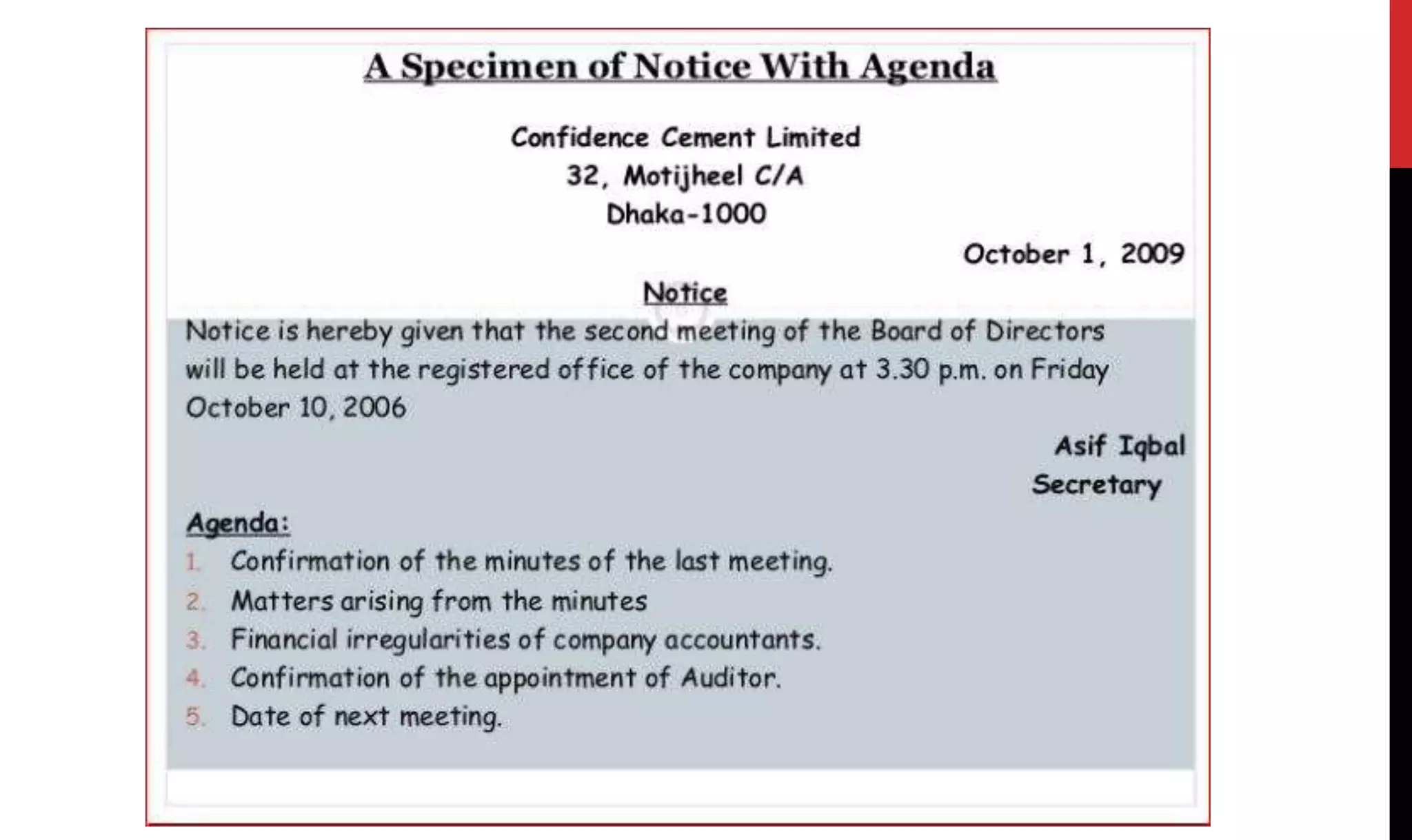
meeting. It is usually sent along with the notice of the meeting. Basically
agenda is a statement of business or assignment to be discussed in the
meeting on which minutes and decisions are taken thereafter. Agenda
should be specific and clear to all authorized person.
IMPORTANCE AND NEED OF AGENDA
Agenda is an official list of things to be done or dealt with at a particular
meeting. It is drawn up by the secretary consultation with the Chairman.
The importance or necessity of agenda is pointed out below:
1. It informs the persons to be attended at the meeting
2. Free discussion is possible
3. Decisions are taken easily
4. Exchange of opinions is possible before meeting
5. It ensures that only matters relevant to that particular meeting are
discussed
6. It facilitates the preparation of the minutes.
MINUTES
WHAT IS MEANT BY MINUTES?
Minutes is a chronological written statement of resolutions taken in
meeting. It is taken on the elaborate discussion of the agenda. It is a list of
motions and resolutions adopted after detailed discussion of persons
attended in the meeting, preserved it for decision making and policy
implementation.
It is to be mentioned that the minutes requires to be approved by the
participating members of the meeting. The minutes must be concluded by
the signatures of the Chairman, secretary, and other authorized person of
the meeting.
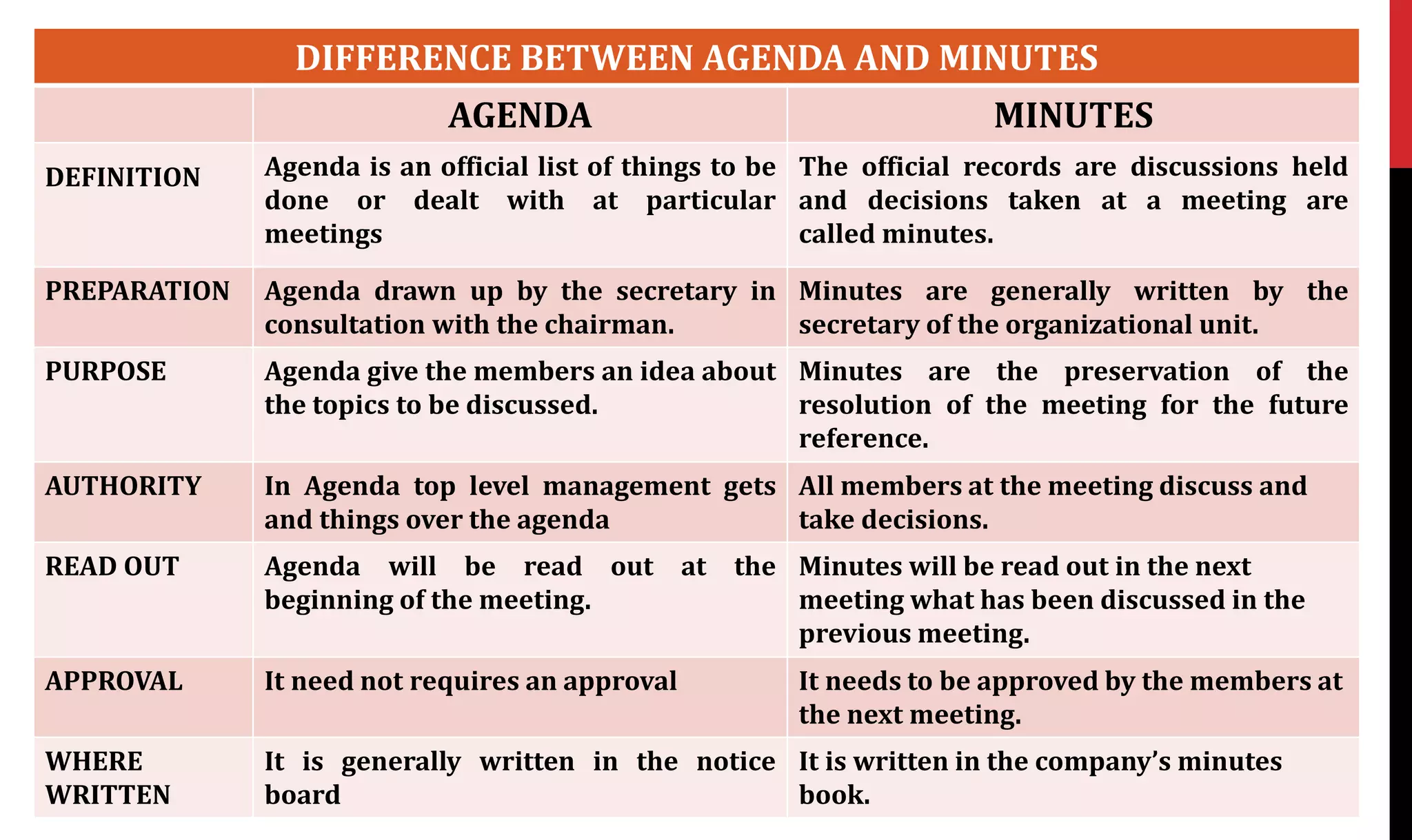
DIFFERENCE BETWEEN AGENDA AND MINUTES
AGENDA MINUTES
DEFINITION Agenda is an official list of things to be
done or dealt with at particular
meetings
The official records are discussions held
and decisions taken at a meeting are
called minutes.
PREPARATION Agenda drawn up by the secretary in
consultation with the chairman.
Minutes are generally written by the
secretary of the organizational unit.
PURPOSE Agenda give the members an idea about
the topics to be discussed.
Minutes are the preservation of the
resolution of the meeting for the future
reference.
AUTHORITY In Agenda top level management gets
and things over the agenda
All members at the meeting discuss and
take decisions.
READ OUT Agenda will be read out at the
beginning of the meeting.
Minutes will be read out in the next
meeting what has been discussed in the
previous meeting.
APPROVAL It need not requires an approval It needs to be approved by the members at
the next meeting.
WHERE
WRITTEN
It is generally written in the notice
board
It is written in the company’s minutes
book.
SPECIMEN OF MINUTES
COMPILING A PRESS RELEASE
What is press release?
A press release is a written communication that reports specific but
brief information about an event, circumstance, product launch, or
other happening. It's typically tied to a business or organization and
provided to media through a variety of means.
KEY ELEMENTS OF PRESS RELEASE
 Headline
 Dateline
 Introduction
 Body
 Boilerplate
 Call To Action
 Media Contact Details
THANK YOU

BC Unit - 3

  • 1.
    BUSINESS COMMUNICATION UNIT –III REPORTS MBA – I YEAR | VCEW
  • 2.
    SYLLABUS UNIT – III– REPORTS Reports – Structure - Formal Report, Informal report - Checklist for compiling reports - Executive Summary – Comprehension - Agenda, Minutes of Meeting - Compiling a Press Release.
  • 3.
    WHAT IS MEANTBY REPORT? Reports are important in modern communications. Thousands of reports formal or informal, special or routine are written every day. A foreman reports to the manager the progress of the work, a manager report to the general manager, and the Board of Directors report to the shareholders
  • 4.
    CHARACTERISTICS OF AGOOD REPORT • Simplicity • Clarity • Brevity • Accuracy • Relevance • Reader-orientation • Grammatical accuracy
  • 5.
  • 6.
    STRUCTURE OF REPORT •Title Page • Executive Summary • Table of Contents • Introduction • Body • Conclusion • Recommendations • References • Appendices
  • 7.
  • 8.
    TYPES OF REPORTS REPORTSON THE BASIS OF IMPORTANCE • Ordinary or Routine Report • Special Report REPORTS ON THE BASIS OF LEGAL FORMALITIES • Formal Report • Informal Report
  • 9.
    REPORTS ON THEBASIS OF FUNCTION • Informative Report • Interpretative Report REPORTS ON THE BASIS OF MEETINGS • Verbation Reports • Summarised Report
  • 10.
    REPORTS OF COMMITTEESOR SUBCOMMITTEES • Standing Committee Report • Adhoc Committee Report • Minority Report • Majority Report
  • 11.
  • 12.
    CHECKLIST FOR COMPILINGREPORTS Report writing checklist: • Consider the audience • Know your brief • Identify the best structure • Consider writing an outline/plan and obtaining some feedback • Gather information • Write content • Edit/Proof read.
  • 13.
    COMPREHENSION What is comprehension? Readingwith comprehension helps in understanding the concept, grasping the important data and acquiring knowledge. As words may carry different connotation; the direct meaning or the applied meaning depending on the context, emphasis, etc therefore reading with comprehension assist in analysing the right meaning of words.
  • 14.
    COMPREHENDING PASSAGES: There aretechniques for better comprehension: • Read the passage to get its general meaning, and note down the main points. • Read all the questions attentively and look for answers. • Be precise and to the point in answering the questions. • Be cautious about the usage of grammar, spelling and punctuation. This ability can be acquired through intensive and disciplined practice.
  • 15.
    Different types ofreading aims to aid you in various ways; acquiring knowledge, defining, listing things, describing, identifying specific material, showing or quoting any specific matter. To be familiar with this entire thing one should assess the overall purpose of the text, the central idea or theme, and logical organization of the ideas. The reading materials are generally newspapers, magazines, books, encyclopaedias etc.
  • 16.
  • 17.
    WHAT IS MEANTBY AGENDA ? Agenda is a document that outlines the contents of a forthcoming meeting. It is usually sent along with the notice of the meeting. Basically agenda is a statement of business or assignment to be discussed in the meeting on which minutes and decisions are taken thereafter. Agenda should be specific and clear to all authorized person.
  • 19.
    IMPORTANCE AND NEEDOF AGENDA Agenda is an official list of things to be done or dealt with at a particular meeting. It is drawn up by the secretary consultation with the Chairman. The importance or necessity of agenda is pointed out below: 1. It informs the persons to be attended at the meeting 2. Free discussion is possible 3. Decisions are taken easily
  • 20.
    4. Exchange ofopinions is possible before meeting 5. It ensures that only matters relevant to that particular meeting are discussed 6. It facilitates the preparation of the minutes.
  • 21.
  • 22.
    WHAT IS MEANTBY MINUTES? Minutes is a chronological written statement of resolutions taken in meeting. It is taken on the elaborate discussion of the agenda. It is a list of motions and resolutions adopted after detailed discussion of persons attended in the meeting, preserved it for decision making and policy implementation. It is to be mentioned that the minutes requires to be approved by the participating members of the meeting. The minutes must be concluded by the signatures of the Chairman, secretary, and other authorized person of the meeting.
  • 23.
    DIFFERENCE BETWEEN AGENDAAND MINUTES AGENDA MINUTES DEFINITION Agenda is an official list of things to be done or dealt with at particular meetings The official records are discussions held and decisions taken at a meeting are called minutes. PREPARATION Agenda drawn up by the secretary in consultation with the chairman. Minutes are generally written by the secretary of the organizational unit. PURPOSE Agenda give the members an idea about the topics to be discussed. Minutes are the preservation of the resolution of the meeting for the future reference. AUTHORITY In Agenda top level management gets and things over the agenda All members at the meeting discuss and take decisions. READ OUT Agenda will be read out at the beginning of the meeting. Minutes will be read out in the next meeting what has been discussed in the previous meeting. APPROVAL It need not requires an approval It needs to be approved by the members at the next meeting. WHERE WRITTEN It is generally written in the notice board It is written in the company’s minutes book.
  • 24.
  • 25.
  • 26.
    COMPILING A PRESSRELEASE What is press release? A press release is a written communication that reports specific but brief information about an event, circumstance, product launch, or other happening. It's typically tied to a business or organization and provided to media through a variety of means.
  • 27.
    KEY ELEMENTS OFPRESS RELEASE  Headline  Dateline  Introduction  Body  Boilerplate  Call To Action  Media Contact Details
  • 28.