Serge Ferrari
Service and Laboratory of Bone Diseases
Geneva University Hospital
and Faculty of Medicine
Switzerland
Diabetes and bone fragility:
challenges and opportunities
Diabetes increases with age and longevity
Cornier, Endo Rev 2008; Yach, Nat med 2006
Bone fragility in diabetics – A historical perspective
► Decreased skeletal mass and bone development in children with longstanding
diabetes (Morrison LB & Bogan IK. Am J Med Sci 1927)
► Cases of diabetes associated with vertebral crush fractures from the Joslin clinic
(Root HF, White P & Marble A. Arch Intern Med 1934)
► Bone fragility in diabetic patients (Albright F & Reifenstein EC. Parathyroid glands
and metabolic bone disease: selected studies. Baltimore: Williams and Wilkins 1948)
► Osteoporosis in cadaveric bones more severe in young adults with diabetes
(Hernberg CA. Acta Med Scand 1952)
► Diabetes increases fracture risk (Alffram PA. An Epidemiologic Study of Cervical
and Trochanteric Fractures of the Femur in an Urban Population. Analysis of 1,664
Cases with Special Reference to Etiologic Factors. Acta Orthop Scand Suppl 1968)
► Decreased elastic response of bone in vivo by ulnar resonant frequency in
osteoporotic, diabetic and normal subjects (Jurist JM. Phys Med Biol 1970)
► BMD 36-48% lower in insulin-requiring diabetics (Ringe JD, Kuhlencordt F & Kruse
HP. AJR Am J Roentgenol 1976).
Diabetes mellitus and Fracture Risk
Type 1 Diabetes Type 2 Diabetes
Any fracture 1.30 (1.16, 1.46) 1.19 (1.11, 1.27)
Hip fracture 1.70 (1.31, 2.21) 1.38 (1.18, 1.60)
Wrist fracture 1.04 (0.76, 1.44) 1.21 (1.01, 1.45)
Spine fracture 2.48 (1.33, 4.62) 1.34 (0.97, 1.86)
Vestergaard et al, Diabetologia 2005, 48: 1292
Case-control study (Denmark)
N=124‘655 cases, n=373‘962 controls (age 43 yrs)
*Adjusted for multiple clinical covariables
Type 1 and fractures – meta-analysis
Shah, Diabet Med 2015
Life-long increased fracture risk in Type 1 diabetes
in the UK
Weber, Diab Care 2015
Low BMD in type 1 diabetes
Bonemass
10 20
yrs
Diabetes
Adapted from Sylvester, Inflamm Bow Dis 2005
Decreased bone formation in children with Diabetes
Maggio, JPEM 2010
Decreased bone size in children/adolescent T1D -
pQCT
Saha, OI 2009
Bechtold , Diabetes Care 2007
Females
Males
MVC: Correlation to microvascular disease
GC: Correlation to glucose control Hough, Ferrari et al., Eur J Endocrinol 2016
Microstructural alterations in young adults with
T1D– micro-MRI
Abdalrahaman , JBMR 2015
Mean age 22 yrs
Significantly lower IGF-1
(Increased bone marrow adiposity)
Group A
PA< PROT<
(N=40)
Group B
PA > PROT <
(N=26)
Group C
PA < PROT >
(N=24)
Group D
PA> PROT >
(N=34)
P
Total vBMD (mg HA/cm2
) 245 ± 46 264 ± 54 276 ± 43 267 ± 40 0.747
Cortical vBMD (mg HA/cm2
) 726 ± 56 736 ± 54 739 ± 54 731 ± 56 0.807
Trabecular vBMD (mg HA/cm2
) 199 ± 27 195 ± 31 205 ± 25 205 ± 27 0.413
BV/TV (%) 16.6 ± 2.2 16.3 ± 2.6 17.1 ± 2.1 17.1 ± 2.2 0.415
Tb.N (mm-1
) 2.04 ± 0.23 2.00 ± 0.23 2.10 ± 0.25 2.21 ± 0.35 0.015
Tb.Th (µm) 81.6 ± 10.5 81.6 ± 12.0 82.3 ± 10.9 78.3 ± 10.9 0.474
Tb.Sp (µm) 415 ± 50 424 ± 57 402 ± 61 385 ± 65 0.044
Ct.Th (µm) 798 ± 324 832 ± 367 878 ± 321 814 ± 298 0.809
CSA (mm2
) 833 ± 126 854 ± 120 847 ± 111 955 ± 172 0.001
Impact of Physical Activity and Protein Intake on Bone
Density and Microstructure at Distal Tibia in Healthy
Adolescent Boys
HR-pQCT
Chevalley et al, JBMR 2014
PA : Physical activity
PROT: Protein Intake
Low turnover, Higher non-enzymatic collagen
crosslinks and degreee of mineralization in T1D
Farlay, JBMR 2015
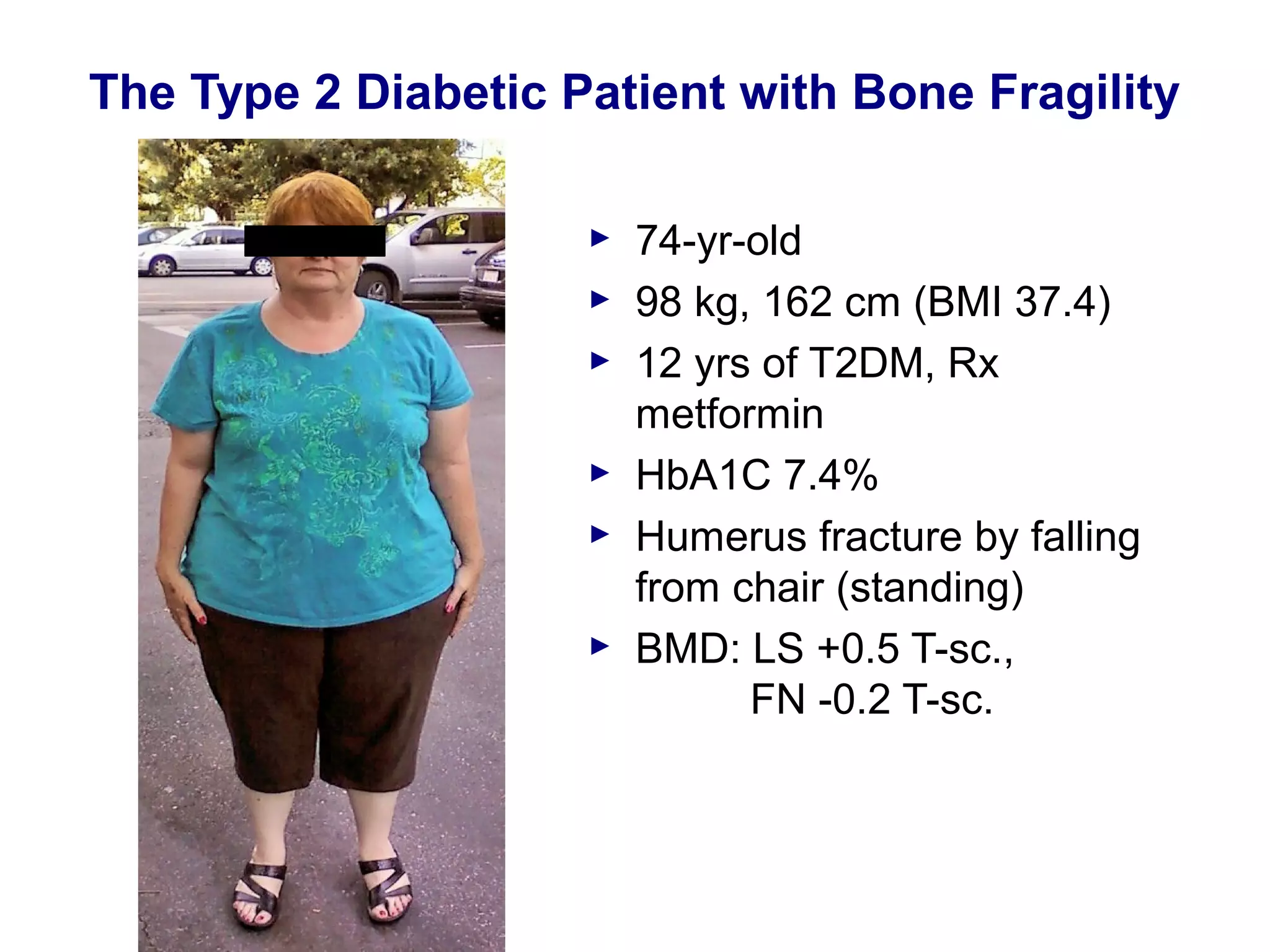
The Type 2 Diabetic Patient with Bone Fragility
► 74-yr-old
► 98 kg, 162 cm (BMI 37.4)
► 12 yrs of T2DM, Rx
metformin
► HbA1C 7.4%
► Humerus fracture by falling
from chair (standing)
► BMD: LS +0.5 T-sc.,
FN -0.2 T-sc.
Fracture Risk in Type 2 Diabetes: WHI
RR (95%CI)*
Any fracture 1.20 (1.11, 1.30)
Hip, pelvis, upper leg 1.46 (1.17, 1.83)
Lower leg, ankle, knee 1.13 (0.95, 1.34)
Foot 1.32 (1.07, 1.62)
Upper arm, shoulder 1.13 (0.90, 1.41)
Lower arm, wrist, hand 1.02 (0.85, 1.22)
Spine 1.27 (1.00, 1.61)
*adjusted for age, ethnicity, weight, height, fall history, previous fracture, history of osteoporosis, smokung, alcohol,
exercise, medication incl. Calcium, vitamin d estrogen and bisphosphonates
Bonds et al, J Clin Endocrinol Metab 2006, 91: 3404
Women‘s Health Initiative Observational Study
(follow-up 7 yrs)
n=93‘676, age at baseline 64 yrs (DM2, n=5285)
Linear increase in hip fracture incidence with
increasing HbA1c.
Li et al.
J Bone Miner Res 2015 30:
1338–46.
A1c>10
A1c<6
Hip fracture risk in Diabetes:
9 years Cohort study of 35’000 subjects 50+ from
Norway
Forsen, Diabetologia 1999
Impact of Antidiabetic Therapy on Bone
Palermo, OI 2015
BMD in Type 2 Diabetes: WHI
likely to have used oral steroid hormones. Women with
diabetes were shorter at baseline and heavier (Table 1) and,
for the subset that underwent BMD measurements at base-
line, had a higher hip and spine BMD (Table 2).
After an average of 7 yr of total follow-up, there was a
higher rate of fracture among women with diabetes (Table 3).
When fractures were broken down by location, women with
diabetes had a higher rate of hip/pelvis/upper leg, lower
leg/ankle/knee, foot, upper arm/shoulder/elbow, and
spine/tailbone fractures. There was an equal rate of fracture
of the lower arm/wrist/hand reported by both groups.
Women with diabetes were 29% more likely to have suf
fered a fracture during the follow-up period (Table 4). Thi
increased risk remained after adjustment for other baselin
differences in the multivariate adjusted model, our primar
outcome. When fractures by region were compared, wome
with diabetes had a significantly increased risk of the hip/
pelvis/upper leg, foot, and spine/tailbone fracture (Table 4
There was also an increased risk of lower leg/ankle/kne
and upper arm/shoulder/elbow fractures that did not mee
statistical significance.
In sensitivity analyses, we reran the above analyses usin
TABLE 2. B M D measur ements at spine and hipa
S pine B M D (g/cm2
) H ip B M D (g/cm2
)
Diabetic women (n) Nondiabetic women (n) Diabetic women (n) N ondiabetic women (n)
B aselineb
1.04 0.19 (472) 0.97 0.17 (5922) 0.90 0.16 (469) 0.84 0.14 (5915)
Year 3 1.06 0.20 (331) 0.99 0.17 (4839) 0.89 0.16 (331) 0.84 0.13 (4831)
Year 6 1.07 0.21 (253) 1.00 0.18 (4203) 0.87 0.16 (261) 0.84 0.13 (4262)
Year 9 1.12 0.24 (91) 1.02 0.18 (1608) 0.88 0.17 (92) 0.82 0.13 (1606)
a
All compar isons of diabetic women vs. nondiabetic women wer e P 0.01.
b
Cor r ected for the use of multiple scanner s and the longitudinal natur e of the data.
The Endocrine Society. Downloaded from press.endocrine.org by [${individualUser.displayName}] on 07 April 2016. at 02:56 For personal use only. No other uses without permission. . All rights reserved.
Bonds et al, J Clin Endocrinol Metab 2006, 91: 3404
BMD 5-10% higher in diabetics
10-yrs fracture risk higher at every BMD level in
diabetics
A Schwartz et al.,
JAMA 2011
MOF – FRAX with BMD
Age 40+, 6455 Diabetic vs 55,958 Non-diabetic
Without diabetes With diabetes
MODEL 1 HR (95% CI) HR (95% CI) p-interaction
Age (per 10 y) 1.43 (1.38-1.47) 1.39 (1.27-1.53) 0.781
Sex (male vs female) 0.90 (0.79-1.02) 1.04 (0.78-1.39) 0.407
BMI (per 5 kg/m2) 0.98 (0.95-1.02) 0.90 (0.83-0.98) 0.080
Current smoking 1.31 (1.06-1.64) 1.75 (1.06-2.87) 0.392
Parental hip fracture 0.82 (0.64-1.04) 0.69 (0.37-1.29) 0.584
Glucocorticoid use 1.30 (1.14-1.48) 1.13 (0.83-1.54) 0.398
Rheumatoid arthritis 1.43 (1.24-1.64) 1.74 (1.21-2.49) 0.325
High alcohol use 2.02 (1.70-2.41) 1.98 (1.27-3.09) 0.941
Any prior fracture 1.62 (1.51-1.74) 1.72 (1.42-2.07) 0.588
Femoral neck T-score 1.68 (1.61-1.75) 1.60 (1.44-1.79) 0.456
omnibus test of all interactions: p-value 0.140
Leslie WD. Osteoporos Int. 2014; 25:2817
FRAX estimated vs observed hip fracture risk in
T2DM
Schwartz, JAMA 2011 Giangregorio , JBMR 2012
Clinical Implications
► Fracture prediction tools in diabetes can still use
conventional risk factors:
– Lower BMD increases risk for fracture in DM
– Higher BMI protective for fracture in DM
► Diabetes was a risk factor for fracture:
– MOF adjusted HR 1.32 [95% CI 1.20-1.46]
Leslie WD. Osteoporos Int. 2014; 25:2817
Is TBS Helpful in Diabetes?
29,407 women ≥50 years with baseline DXA
BMD (g/cm2
)
Diabetes – No diabetes
Mean (95% CI)
Lumbar spine
+0.031
(+0.024 : +0.038)
Femoral neck
+0.012
(+0.007 : +0.016)
Trochanter
+0.008
(+0.003 : +0.013)
Total hip
+0.019
(+0.014 : +0.025)
TBS
-0.051
(-0.056 : -0.046)
* Adjusted for age, BMI, glucocorticoids, prior major fracture, rheumatoid
arthritis, COPD, alcohol abuse and osteoporosis therapy.
Leslie WD et al. JCEM 2013.
TBS predicted incident
major OP fractures
- With DM: aHR 1.27
- Without DM: aHR 1.31
- No interaction
FRAX ± TBS in T2D
With TBS 1.15, fracture probability 16% (hip 1%)
Country: Switzerland Name/ID:
1. Age (between 40 and 90 years) or Date of Birth
Age:
69 Y: M: D:
Date of Birth:
2. Sex Male Female
3. Weight (kg) 88
4. Height (cm) 162
5. Previous Fracture No Yes
6. Parent Fractured Hip No Yes
7. Current Smoking No Yes
8. Glucocorticoids No Yes
9. Rheumatoid arthritis No Yes
Questionnaire: 10. Secondary osteoporosis No Yes
11. Alcohol 3 or more units/day No Yes
12. Femoral neck BMD (g/cm2
)
T-Score -0.2
If you have a TBS value, click here: Adjust with TBS
Clear Calculate
Calculation Tool
Please answer the questions below to calculate the ten year probability of fracture with BMD.
Risk factors
w ith BMD
BMI: 33.5
The ten year probability of fracture (%)
Major osteoporotic 13
Hip Fracture 0.7
Influence of fat
on TBS
Amnuaywattakom et al., BMC Musculoskel Dis 2016
Trunk fat mass and TBS in GERICO
(n=738 post-menopausal women)
Conceptual framework for diabetes and
fractures
-6 -5 -4 -3 -2 -1 0 1
RelativeriskMOF
BMD T-score
No DM DM
DIO=diabetes
induced
osteoporosis
Osteoporosis
unrelated
to DM
DBD=diabetic
bone
disease
Adapted from Leslie WD. Osteoporos Int. 2014; 25:2817
Increased cortical porosity in T2DM with fractures
(HR-pQCT)
Patsch, JBMR 2013urghardt, JCEM 2010
Increased cortical porosity in T2DM is associated
with microvascular disease
Radius (HR-pQCT)
Shanbhogue, Eur J Endocrinol 2016
Altered bone material strength in diabetes
Farr, JBMR 2014
Merlotti 2010
Algorithm for Management of Osteoporosis in Postmenopausal women and
men over 50 years with T 2DM IOF/CSA Working Group-in preparation
Rapid BMD loss on follow-up
Adjusted Frax probability (TBS?) / Lower intervention
thresholds
New Markers ?
Women & men
with T2DM
No
Measure BMD (T-score
Typical osteoporotic fracture*
> -2.5
Consider specific anti-fracture medication Life-style measures onlyYes
Yes
≤ -2.5
NoIGF-1
AGEs
?
*Fracture of spine,
hip, pelvis or
humerus
# CRFs, substitute RA with T2DM
•Advanced age
•Prior #
•F/H of hip #
•Alcohol, smoking
•GCs, hypogonadism
•High fall propensity
•Insulin therapy
?
Conclusions
► Diabetes increases the risk of fragility fractures (T1D > T2D)
► Bone fragility in diabetes is characterized by predominant alterations
of bone quality (microarchitecture, material properties) with or without
reductions of BMD (T1D < T2D)
– In T2D bone quality alterations overcome the higher BMD
► Bone fragility increases with poor glucose control, diabetes duration,
microvascular complications, need of insulin and some antidiabetics
(glitazones, ? Canaglifozin,..)
► New markers of fracture risk in diabetes, specially type 2, which reflect
alterations in « bone quality » need to be developed and evaluated
► The effects of osteoporosis drugs on reducing bone fragility in
diabetes remain to be prospectively evaluated
Acknowledgements
IOF Diabetes & Bone WG:
Stephen Hough (co-chair)
Bo Abrahamsen
Mohammed-Salleh Ardawi
Massimo Benedetti
Manju Chandran
Cyrus Cooper
Richard Eastell
Ghada Eli Hajj Fullheihan
Bob Josse
David Kendler
Marius Kraenzlin
Bill Leslie
Nicola Napoli
Dominique Pierroz
Atsushi Suzuki
Ann Schwartz
Geneva Bone Diseases
Clinical Research group:
Emmanuel Biver
Thierry Chevalley
René Rizzoli
Fanny Merminod
Anne Sigaud
Magaly Hars
Chantal Genet
Julio Conicella

Osteoporosis 2016 | Diabetes and bone: Prof. Serge Ferrari #osteo2016

  • 1.
    Serge Ferrari Service andLaboratory of Bone Diseases Geneva University Hospital and Faculty of Medicine Switzerland Diabetes and bone fragility: challenges and opportunities
  • 2.
    Diabetes increases withage and longevity Cornier, Endo Rev 2008; Yach, Nat med 2006
  • 3.
    Bone fragility indiabetics – A historical perspective ► Decreased skeletal mass and bone development in children with longstanding diabetes (Morrison LB & Bogan IK. Am J Med Sci 1927) ► Cases of diabetes associated with vertebral crush fractures from the Joslin clinic (Root HF, White P & Marble A. Arch Intern Med 1934) ► Bone fragility in diabetic patients (Albright F & Reifenstein EC. Parathyroid glands and metabolic bone disease: selected studies. Baltimore: Williams and Wilkins 1948) ► Osteoporosis in cadaveric bones more severe in young adults with diabetes (Hernberg CA. Acta Med Scand 1952) ► Diabetes increases fracture risk (Alffram PA. An Epidemiologic Study of Cervical and Trochanteric Fractures of the Femur in an Urban Population. Analysis of 1,664 Cases with Special Reference to Etiologic Factors. Acta Orthop Scand Suppl 1968) ► Decreased elastic response of bone in vivo by ulnar resonant frequency in osteoporotic, diabetic and normal subjects (Jurist JM. Phys Med Biol 1970) ► BMD 36-48% lower in insulin-requiring diabetics (Ringe JD, Kuhlencordt F & Kruse HP. AJR Am J Roentgenol 1976).
  • 4.
    Diabetes mellitus andFracture Risk Type 1 Diabetes Type 2 Diabetes Any fracture 1.30 (1.16, 1.46) 1.19 (1.11, 1.27) Hip fracture 1.70 (1.31, 2.21) 1.38 (1.18, 1.60) Wrist fracture 1.04 (0.76, 1.44) 1.21 (1.01, 1.45) Spine fracture 2.48 (1.33, 4.62) 1.34 (0.97, 1.86) Vestergaard et al, Diabetologia 2005, 48: 1292 Case-control study (Denmark) N=124‘655 cases, n=373‘962 controls (age 43 yrs) *Adjusted for multiple clinical covariables
  • 5.
    Type 1 andfractures – meta-analysis Shah, Diabet Med 2015
  • 6.
    Life-long increased fracturerisk in Type 1 diabetes in the UK Weber, Diab Care 2015
  • 7.
    Low BMD intype 1 diabetes Bonemass 10 20 yrs Diabetes Adapted from Sylvester, Inflamm Bow Dis 2005
  • 8.
    Decreased bone formationin children with Diabetes Maggio, JPEM 2010
  • 9.
    Decreased bone sizein children/adolescent T1D - pQCT Saha, OI 2009 Bechtold , Diabetes Care 2007 Females Males
  • 10.
    MVC: Correlation tomicrovascular disease GC: Correlation to glucose control Hough, Ferrari et al., Eur J Endocrinol 2016
  • 11.
    Microstructural alterations inyoung adults with T1D– micro-MRI Abdalrahaman , JBMR 2015 Mean age 22 yrs Significantly lower IGF-1 (Increased bone marrow adiposity)
  • 12.
    Group A PA< PROT< (N=40) GroupB PA > PROT < (N=26) Group C PA < PROT > (N=24) Group D PA> PROT > (N=34) P Total vBMD (mg HA/cm2 ) 245 ± 46 264 ± 54 276 ± 43 267 ± 40 0.747 Cortical vBMD (mg HA/cm2 ) 726 ± 56 736 ± 54 739 ± 54 731 ± 56 0.807 Trabecular vBMD (mg HA/cm2 ) 199 ± 27 195 ± 31 205 ± 25 205 ± 27 0.413 BV/TV (%) 16.6 ± 2.2 16.3 ± 2.6 17.1 ± 2.1 17.1 ± 2.2 0.415 Tb.N (mm-1 ) 2.04 ± 0.23 2.00 ± 0.23 2.10 ± 0.25 2.21 ± 0.35 0.015 Tb.Th (µm) 81.6 ± 10.5 81.6 ± 12.0 82.3 ± 10.9 78.3 ± 10.9 0.474 Tb.Sp (µm) 415 ± 50 424 ± 57 402 ± 61 385 ± 65 0.044 Ct.Th (µm) 798 ± 324 832 ± 367 878 ± 321 814 ± 298 0.809 CSA (mm2 ) 833 ± 126 854 ± 120 847 ± 111 955 ± 172 0.001 Impact of Physical Activity and Protein Intake on Bone Density and Microstructure at Distal Tibia in Healthy Adolescent Boys HR-pQCT Chevalley et al, JBMR 2014 PA : Physical activity PROT: Protein Intake
  • 13.
    Low turnover, Highernon-enzymatic collagen crosslinks and degreee of mineralization in T1D Farlay, JBMR 2015
  • 14.
    The Type 2Diabetic Patient with Bone Fragility ► 74-yr-old ► 98 kg, 162 cm (BMI 37.4) ► 12 yrs of T2DM, Rx metformin ► HbA1C 7.4% ► Humerus fracture by falling from chair (standing) ► BMD: LS +0.5 T-sc., FN -0.2 T-sc.
  • 15.
    Fracture Risk inType 2 Diabetes: WHI RR (95%CI)* Any fracture 1.20 (1.11, 1.30) Hip, pelvis, upper leg 1.46 (1.17, 1.83) Lower leg, ankle, knee 1.13 (0.95, 1.34) Foot 1.32 (1.07, 1.62) Upper arm, shoulder 1.13 (0.90, 1.41) Lower arm, wrist, hand 1.02 (0.85, 1.22) Spine 1.27 (1.00, 1.61) *adjusted for age, ethnicity, weight, height, fall history, previous fracture, history of osteoporosis, smokung, alcohol, exercise, medication incl. Calcium, vitamin d estrogen and bisphosphonates Bonds et al, J Clin Endocrinol Metab 2006, 91: 3404 Women‘s Health Initiative Observational Study (follow-up 7 yrs) n=93‘676, age at baseline 64 yrs (DM2, n=5285)
  • 16.
    Linear increase inhip fracture incidence with increasing HbA1c. Li et al. J Bone Miner Res 2015 30: 1338–46. A1c>10 A1c<6
  • 17.
    Hip fracture riskin Diabetes: 9 years Cohort study of 35’000 subjects 50+ from Norway Forsen, Diabetologia 1999
  • 18.
    Impact of AntidiabeticTherapy on Bone Palermo, OI 2015
  • 19.
    BMD in Type2 Diabetes: WHI likely to have used oral steroid hormones. Women with diabetes were shorter at baseline and heavier (Table 1) and, for the subset that underwent BMD measurements at base- line, had a higher hip and spine BMD (Table 2). After an average of 7 yr of total follow-up, there was a higher rate of fracture among women with diabetes (Table 3). When fractures were broken down by location, women with diabetes had a higher rate of hip/pelvis/upper leg, lower leg/ankle/knee, foot, upper arm/shoulder/elbow, and spine/tailbone fractures. There was an equal rate of fracture of the lower arm/wrist/hand reported by both groups. Women with diabetes were 29% more likely to have suf fered a fracture during the follow-up period (Table 4). Thi increased risk remained after adjustment for other baselin differences in the multivariate adjusted model, our primar outcome. When fractures by region were compared, wome with diabetes had a significantly increased risk of the hip/ pelvis/upper leg, foot, and spine/tailbone fracture (Table 4 There was also an increased risk of lower leg/ankle/kne and upper arm/shoulder/elbow fractures that did not mee statistical significance. In sensitivity analyses, we reran the above analyses usin TABLE 2. B M D measur ements at spine and hipa S pine B M D (g/cm2 ) H ip B M D (g/cm2 ) Diabetic women (n) Nondiabetic women (n) Diabetic women (n) N ondiabetic women (n) B aselineb 1.04 0.19 (472) 0.97 0.17 (5922) 0.90 0.16 (469) 0.84 0.14 (5915) Year 3 1.06 0.20 (331) 0.99 0.17 (4839) 0.89 0.16 (331) 0.84 0.13 (4831) Year 6 1.07 0.21 (253) 1.00 0.18 (4203) 0.87 0.16 (261) 0.84 0.13 (4262) Year 9 1.12 0.24 (91) 1.02 0.18 (1608) 0.88 0.17 (92) 0.82 0.13 (1606) a All compar isons of diabetic women vs. nondiabetic women wer e P 0.01. b Cor r ected for the use of multiple scanner s and the longitudinal natur e of the data. The Endocrine Society. Downloaded from press.endocrine.org by [${individualUser.displayName}] on 07 April 2016. at 02:56 For personal use only. No other uses without permission. . All rights reserved. Bonds et al, J Clin Endocrinol Metab 2006, 91: 3404 BMD 5-10% higher in diabetics
  • 20.
    10-yrs fracture riskhigher at every BMD level in diabetics A Schwartz et al., JAMA 2011
  • 21.
    MOF – FRAXwith BMD Age 40+, 6455 Diabetic vs 55,958 Non-diabetic Without diabetes With diabetes MODEL 1 HR (95% CI) HR (95% CI) p-interaction Age (per 10 y) 1.43 (1.38-1.47) 1.39 (1.27-1.53) 0.781 Sex (male vs female) 0.90 (0.79-1.02) 1.04 (0.78-1.39) 0.407 BMI (per 5 kg/m2) 0.98 (0.95-1.02) 0.90 (0.83-0.98) 0.080 Current smoking 1.31 (1.06-1.64) 1.75 (1.06-2.87) 0.392 Parental hip fracture 0.82 (0.64-1.04) 0.69 (0.37-1.29) 0.584 Glucocorticoid use 1.30 (1.14-1.48) 1.13 (0.83-1.54) 0.398 Rheumatoid arthritis 1.43 (1.24-1.64) 1.74 (1.21-2.49) 0.325 High alcohol use 2.02 (1.70-2.41) 1.98 (1.27-3.09) 0.941 Any prior fracture 1.62 (1.51-1.74) 1.72 (1.42-2.07) 0.588 Femoral neck T-score 1.68 (1.61-1.75) 1.60 (1.44-1.79) 0.456 omnibus test of all interactions: p-value 0.140 Leslie WD. Osteoporos Int. 2014; 25:2817
  • 22.
    FRAX estimated vsobserved hip fracture risk in T2DM Schwartz, JAMA 2011 Giangregorio , JBMR 2012
  • 23.
    Clinical Implications ► Fractureprediction tools in diabetes can still use conventional risk factors: – Lower BMD increases risk for fracture in DM – Higher BMI protective for fracture in DM ► Diabetes was a risk factor for fracture: – MOF adjusted HR 1.32 [95% CI 1.20-1.46] Leslie WD. Osteoporos Int. 2014; 25:2817
  • 24.
    Is TBS Helpfulin Diabetes? 29,407 women ≥50 years with baseline DXA BMD (g/cm2 ) Diabetes – No diabetes Mean (95% CI) Lumbar spine +0.031 (+0.024 : +0.038) Femoral neck +0.012 (+0.007 : +0.016) Trochanter +0.008 (+0.003 : +0.013) Total hip +0.019 (+0.014 : +0.025) TBS -0.051 (-0.056 : -0.046) * Adjusted for age, BMI, glucocorticoids, prior major fracture, rheumatoid arthritis, COPD, alcohol abuse and osteoporosis therapy. Leslie WD et al. JCEM 2013. TBS predicted incident major OP fractures - With DM: aHR 1.27 - Without DM: aHR 1.31 - No interaction
  • 25.
    FRAX ± TBSin T2D With TBS 1.15, fracture probability 16% (hip 1%) Country: Switzerland Name/ID: 1. Age (between 40 and 90 years) or Date of Birth Age: 69 Y: M: D: Date of Birth: 2. Sex Male Female 3. Weight (kg) 88 4. Height (cm) 162 5. Previous Fracture No Yes 6. Parent Fractured Hip No Yes 7. Current Smoking No Yes 8. Glucocorticoids No Yes 9. Rheumatoid arthritis No Yes Questionnaire: 10. Secondary osteoporosis No Yes 11. Alcohol 3 or more units/day No Yes 12. Femoral neck BMD (g/cm2 ) T-Score -0.2 If you have a TBS value, click here: Adjust with TBS Clear Calculate Calculation Tool Please answer the questions below to calculate the ten year probability of fracture with BMD. Risk factors w ith BMD BMI: 33.5 The ten year probability of fracture (%) Major osteoporotic 13 Hip Fracture 0.7
  • 26.
    Influence of fat onTBS Amnuaywattakom et al., BMC Musculoskel Dis 2016
  • 27.
    Trunk fat massand TBS in GERICO (n=738 post-menopausal women)
  • 28.
    Conceptual framework fordiabetes and fractures -6 -5 -4 -3 -2 -1 0 1 RelativeriskMOF BMD T-score No DM DM DIO=diabetes induced osteoporosis Osteoporosis unrelated to DM DBD=diabetic bone disease Adapted from Leslie WD. Osteoporos Int. 2014; 25:2817
  • 29.
    Increased cortical porosityin T2DM with fractures (HR-pQCT) Patsch, JBMR 2013urghardt, JCEM 2010
  • 30.
    Increased cortical porosityin T2DM is associated with microvascular disease Radius (HR-pQCT) Shanbhogue, Eur J Endocrinol 2016
  • 31.
    Altered bone materialstrength in diabetes Farr, JBMR 2014 Merlotti 2010
  • 32.
    Algorithm for Managementof Osteoporosis in Postmenopausal women and men over 50 years with T 2DM IOF/CSA Working Group-in preparation Rapid BMD loss on follow-up Adjusted Frax probability (TBS?) / Lower intervention thresholds New Markers ? Women & men with T2DM No Measure BMD (T-score Typical osteoporotic fracture* > -2.5 Consider specific anti-fracture medication Life-style measures onlyYes Yes ≤ -2.5 NoIGF-1 AGEs ? *Fracture of spine, hip, pelvis or humerus # CRFs, substitute RA with T2DM •Advanced age •Prior # •F/H of hip # •Alcohol, smoking •GCs, hypogonadism •High fall propensity •Insulin therapy ?
  • 33.
    Conclusions ► Diabetes increasesthe risk of fragility fractures (T1D > T2D) ► Bone fragility in diabetes is characterized by predominant alterations of bone quality (microarchitecture, material properties) with or without reductions of BMD (T1D < T2D) – In T2D bone quality alterations overcome the higher BMD ► Bone fragility increases with poor glucose control, diabetes duration, microvascular complications, need of insulin and some antidiabetics (glitazones, ? Canaglifozin,..) ► New markers of fracture risk in diabetes, specially type 2, which reflect alterations in « bone quality » need to be developed and evaluated ► The effects of osteoporosis drugs on reducing bone fragility in diabetes remain to be prospectively evaluated
  • 34.
    Acknowledgements IOF Diabetes &Bone WG: Stephen Hough (co-chair) Bo Abrahamsen Mohammed-Salleh Ardawi Massimo Benedetti Manju Chandran Cyrus Cooper Richard Eastell Ghada Eli Hajj Fullheihan Bob Josse David Kendler Marius Kraenzlin Bill Leslie Nicola Napoli Dominique Pierroz Atsushi Suzuki Ann Schwartz Geneva Bone Diseases Clinical Research group: Emmanuel Biver Thierry Chevalley René Rizzoli Fanny Merminod Anne Sigaud Magaly Hars Chantal Genet Julio Conicella