Osteomyelitis
• Osseus (Latin): bony
• Greek: osteon = bone; myelos = marrow; itis =
inflammation.
• Osteomyelitis (OML) is meant to indicate an
inflammatory process of bone.
• “An inflammatory condition of the bone that begins as
an infection of medullary cavity and haversian systems of
the cortex and extends to involve the periosteum of the
affected area.”
(NA Malik)
• OML of the jaws: a common and dreaded disease some
time back.
• Prolonged therapy, disfigurement and dysfunction.
• Modern world: incidence of OML of the jaws is less.
• Newer antimicrobials, better awareness, and better
dental health care.
• However, emergence of resistant microbial strains;
worldwide epidemic of AIDS and other
immunocompromised states resurgence of OML.
Classification
Hudson’s Classification
• Acute OML (suppurative or non-suppurative)
▫ Contiguous focus
▫ Progressive
▫ Hematogenous (metastatic)
• Chronic OML
▫ Recurrent multifocal
▫ Garre’s OML
▫ Suppurative or non-suppurative
▫ Diffuse sclerosing
Classification and staging of OML [Cierny
(1985) and Vibhagool (1993)]
• Stage I – Medullary OML. Involves medullary bone.
• Stage II – Superficial OML. Cortex involved.
• Stage III – Localized OML. Less than 2cm defect on
radiograph. Cortical plates not involved.
• Stage IV – Diffuse OML. Greater than 2cm defect;
pathological fracture, infection, non-union.
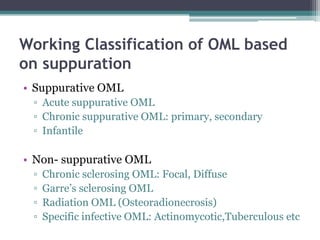
Working Classification of OML based
on suppuration
• Suppurative OML
▫ Acute suppurative OML
▫ Chronic suppurative OML: primary, secondary
▫ Infantile
• Non- suppurative OML
▫ Chronic sclerosing OML: Focal, Diffuse
▫ Garre’s sclerosing OML
▫ Radiation OML (Osteoradionecrosis)
▫ Specific infective OML: Actinomycotic,Tuberculous etc
Etiology
• Odontogenic infections
• Trauma
• Orofacial infections
• Hematogenous spread
Microbiology
• Commonly implicated bacteriae: aerobic or α-H
streptococci, peptostreptococci, fusobacteria and
bacteriodes.
• Staphylocooci in OML of jaws: usually not the primary
offending organisms.
• Polymicrobial infective process with Gram +ve and –ve
organisms obtained in cultures.
• Specific forms of OML can be caused by particular
species of bacteriae.
Predisposing Factors
• Conditions that alter host defence:
▫ chronic debilitating systemic diseases like DM
▫ leukemia, anemia, malnutrition, AIDS etc.
• Conditions that alter vascularity of bone:
▫ Therapeutic irradiation, osteoporosis, paget’s disease,
fibrous dysplasia, bone malignancies etc.
▫ Mandible – vascular supply from a single major blood
vessel. So more prone to OML
• Virulence of organisms:
▫ High virulence microbes C.T degrading enzymes like
hyaluronidase.
▫ Low virulence microbes: sclerosing OML
Pathogenesis
Suppurative OML
• Entry of microbes into cancellous bone.
• Acute inflammatory reaction: hyperaemia, vascular dilatation,
granulocyte migration.
• Susceptible host: cannot eliminate the infection.
• Bacterial growth; lysosomal degradation of host tissue (bone).
• Formation of microthrombi and stasis of blood flow to the
region.
• No blood flow – ischaemia. Bone becomes necrotic + cut-off
from further blood-borne immune defence reactions.
• Further spread of infection; more bone destruction, pus
formation.
Non-suppurative OML (Sclerosing OML)
• Unusual type of inflammatory reaction of the body.
• Invasion by organisms of low virulence which the body
cannot eliminate.
• Individuals with high levels of immunity.
• Bone formation instead of the bone resorption.
• Infection acts as a stimulant rather than an irritant.
Acute Suppurative OML
• Serious sequela of periapical infection.
• Diffuse spread of infection throughout the
medullary spaces.
• Necrosis of a variable amount of bone.
Clinical Features
• In maxilla: localized infection.
• In mandible: diffuse and widespread.
• The disease may occur at any age.
• Pain, swelling, elevation of temperature, regional
lymphadenopathy.
• The teeth are loose and tender.
• Mandible: paresthesia or anesthesia of the lip.
Roentgenographic Features
• Acute OML: no X-ray findings.
• A minimum of 30-60% bone destruction has to be
present for it to be detected on radiographs.
• Diffuse lytic changes; individual trabeculae become fuzzy
and indistinct.
• Ill defined radiolucency. “moth-eaten appearance”
• Separation of necrotic bone from viable bone:
“Sequestrum”.
Histologic Features
• Inflammatory exudate in medullary spaces.
• Neutrophils: main inflammatory cells.
• Degenerating bone: No osteoblastic rimming of
trabeculae; resorption bays with osteoclasts ;
Lesser number of osteocytes; empty lacunae.
• Marrow replaced by a fibrocollagenous tissue.
Diagnosis of Acute Suppurative OML
• History
• Clinical examination and radiography
• Lab Investigations: CBC, Microbial culture and
sensitivity.
Treatment and Prognosis of
Suppurative OML
• Supportive care.
• Control of pain and adequate nutrition and hydration.
• Antimicrobial therapy.
• HBO therapy.
• Surgical management.
Treatment guidelines for
suppurative OML (Marx 1992)
• Disrupt infectious foci.
• Debride any foreign bodies, necrotic tissue, or sequestra.
• Culture and identify specific pathogens for eventual definitive
antibiotic treatment.
• Drain and irrigate the region.
• Begin empiric antibiotics based on Gram stain.
• Stabilize calcified tissue regionally, and
• Consider adjunctive treatments to enhance microvascular
reperfusion.
• Reconstruction: as necessary following resolution of infection.
Chronic Suppurative OML
• Primary or secondary.
• C/F and radiography similar to acute OML but milder.
• Slight increase in WBC count. (lymphocytes)
• Lymphocytes: main inflamm cells.
• Management same as acute OML.
Chronic Focal Sclerosing OML
• Condensing osteitis
• Proliferative reaction of bone to low grade infection, in
persons with high tissue resistance.
• Exclusively seen in young persons.
• Large carious lesion; usually Mand 1st molar.
• Usually no clinical signs or symptoms.
Roentgenographic Features
• IOPA: well-circumscribed radiopaque sclerotic bone
surrounding and extending below root apex.
• The entire root outline is always visible.
• Margin with normal bone may be well-defined or
blurred.
Histologic Features
• Dense mass of bony trabeculae with little
interstitial marrow tissue.
• If interstitial tissue present: generally fibrotic.
• Slight lymphocytic infiltration.
Treatment & Prognosis
• RCT/Extraction of concerned tooth.
• The sclerotic bone may persist in the area.
• Removal not necessary.
Chronic Diffuse Sclerosing
Osteomyelitis
• Analogous to focal sclerosing OML.
• Portal of infection: diffuse periodontal disease.
• More common in older persons.
• No clinical symptoms.
• Occasional acute exacerbations.
• Radiography: diffuse sclerosis of bone. “Cotton-wool
appearance”.
Special forms of OML
• Garre’s OML
• Infantile OML
• Actinomycotic OML
• Tuberculous OML
• Syphilitic OML
Garre’s Chronic Non-suppurative
Sclerosing Osteitis
• Distinct form of chronic OML .
• First described by Garre in 1893.
• Characterized by focal gross thickening of the
periosteum.
• Peripheral reactive bone formation resulting
from mild irritation or infection.
• Periosteal sclerotic process analogous to the
endosteal sclerosis seen in focal or diffuse
sclerosing OML.
• Young persons.
• Tibia: more common. In the jaws, mandibular predilection.
• Asymptomatic swelling.
• Radiograph: subperiosteal new bone deposition in a lamellar
pattern. “Onion-skin appearance”.
• Treated by removal of the offending tooth.
• Periosteal bone will undergo gradual remodeling.
Infantile OML
• A particular form of acute OML in infants and young children.
• Seen almost a few weeks after birth.
• Hematogenous origin or local oral infection.
• Involves the maxilla.
• Serious condition.
• Significant destruction of local structures. Complications:
cavernous sinus thrombosis; permanent optic damage.
Post radiation Osteonecrosis (PRON)
• Osteoradionecrosis
• Complication of high dose radiation.
• Radiation therapy: endarteritis of the blood vessels in the
area. Hypovascular, hypocellular and hypoxic tissue.
• Inability to repair or remodel itself when a challenge occurs.
• Symptoms : discomfort and tenderness at the site, bad taste,
halitosis, paresthesia, draining sinuses, secondary OML and
pathologic fracture.
• Presence of teeth in the area of radiation: possible source of
future infection and risk factor for PRON.
Summary & Conclusion
• OML can be seriously debilitating.
• Life-threatening in some cases.
• Prompt recognition of the symptoms and signs
and immediate management: reduce morbidity
and mortality.
References
• Oral and Maxillofacial Pathology. Neville, Damm, Allen,
Bouquot
• Oral Pathology. Shafer
• Diseases of Tropics
• Textbook of Oral and Maxillofacial Surgery. Neelima A.
Malik
• Oral Medicine. Burket
• Diagnosis and management of bone infections.
Osteomyelitis 1 power point presentations

Osteomyelitis 1 power point presentations

  • 1.
  • 2.
    • Osseus (Latin):bony • Greek: osteon = bone; myelos = marrow; itis = inflammation. • Osteomyelitis (OML) is meant to indicate an inflammatory process of bone. • “An inflammatory condition of the bone that begins as an infection of medullary cavity and haversian systems of the cortex and extends to involve the periosteum of the affected area.” (NA Malik)
  • 3.
    • OML ofthe jaws: a common and dreaded disease some time back. • Prolonged therapy, disfigurement and dysfunction. • Modern world: incidence of OML of the jaws is less. • Newer antimicrobials, better awareness, and better dental health care. • However, emergence of resistant microbial strains; worldwide epidemic of AIDS and other immunocompromised states resurgence of OML.
  • 4.
    Classification Hudson’s Classification • AcuteOML (suppurative or non-suppurative) ▫ Contiguous focus ▫ Progressive ▫ Hematogenous (metastatic) • Chronic OML ▫ Recurrent multifocal ▫ Garre’s OML ▫ Suppurative or non-suppurative ▫ Diffuse sclerosing
  • 5.
    Classification and stagingof OML [Cierny (1985) and Vibhagool (1993)] • Stage I – Medullary OML. Involves medullary bone. • Stage II – Superficial OML. Cortex involved. • Stage III – Localized OML. Less than 2cm defect on radiograph. Cortical plates not involved. • Stage IV – Diffuse OML. Greater than 2cm defect; pathological fracture, infection, non-union.
  • 6.
    Working Classification ofOML based on suppuration • Suppurative OML ▫ Acute suppurative OML ▫ Chronic suppurative OML: primary, secondary ▫ Infantile • Non- suppurative OML ▫ Chronic sclerosing OML: Focal, Diffuse ▫ Garre’s sclerosing OML ▫ Radiation OML (Osteoradionecrosis) ▫ Specific infective OML: Actinomycotic,Tuberculous etc
  • 8.
    Etiology • Odontogenic infections •Trauma • Orofacial infections • Hematogenous spread
  • 10.
    Microbiology • Commonly implicatedbacteriae: aerobic or α-H streptococci, peptostreptococci, fusobacteria and bacteriodes. • Staphylocooci in OML of jaws: usually not the primary offending organisms. • Polymicrobial infective process with Gram +ve and –ve organisms obtained in cultures. • Specific forms of OML can be caused by particular species of bacteriae.
  • 11.
    Predisposing Factors • Conditionsthat alter host defence: ▫ chronic debilitating systemic diseases like DM ▫ leukemia, anemia, malnutrition, AIDS etc. • Conditions that alter vascularity of bone: ▫ Therapeutic irradiation, osteoporosis, paget’s disease, fibrous dysplasia, bone malignancies etc. ▫ Mandible – vascular supply from a single major blood vessel. So more prone to OML • Virulence of organisms: ▫ High virulence microbes C.T degrading enzymes like hyaluronidase. ▫ Low virulence microbes: sclerosing OML
  • 12.
    Pathogenesis Suppurative OML • Entryof microbes into cancellous bone. • Acute inflammatory reaction: hyperaemia, vascular dilatation, granulocyte migration. • Susceptible host: cannot eliminate the infection. • Bacterial growth; lysosomal degradation of host tissue (bone). • Formation of microthrombi and stasis of blood flow to the region. • No blood flow – ischaemia. Bone becomes necrotic + cut-off from further blood-borne immune defence reactions. • Further spread of infection; more bone destruction, pus formation.
  • 14.
    Non-suppurative OML (SclerosingOML) • Unusual type of inflammatory reaction of the body. • Invasion by organisms of low virulence which the body cannot eliminate. • Individuals with high levels of immunity. • Bone formation instead of the bone resorption. • Infection acts as a stimulant rather than an irritant.
  • 16.
    Acute Suppurative OML •Serious sequela of periapical infection. • Diffuse spread of infection throughout the medullary spaces. • Necrosis of a variable amount of bone.
  • 17.
    Clinical Features • Inmaxilla: localized infection. • In mandible: diffuse and widespread. • The disease may occur at any age. • Pain, swelling, elevation of temperature, regional lymphadenopathy. • The teeth are loose and tender. • Mandible: paresthesia or anesthesia of the lip.
  • 19.
    Roentgenographic Features • AcuteOML: no X-ray findings. • A minimum of 30-60% bone destruction has to be present for it to be detected on radiographs. • Diffuse lytic changes; individual trabeculae become fuzzy and indistinct. • Ill defined radiolucency. “moth-eaten appearance” • Separation of necrotic bone from viable bone: “Sequestrum”.
  • 21.
    Histologic Features • Inflammatoryexudate in medullary spaces. • Neutrophils: main inflammatory cells. • Degenerating bone: No osteoblastic rimming of trabeculae; resorption bays with osteoclasts ; Lesser number of osteocytes; empty lacunae. • Marrow replaced by a fibrocollagenous tissue.
  • 23.
    Diagnosis of AcuteSuppurative OML • History • Clinical examination and radiography • Lab Investigations: CBC, Microbial culture and sensitivity.
  • 24.
    Treatment and Prognosisof Suppurative OML • Supportive care. • Control of pain and adequate nutrition and hydration. • Antimicrobial therapy. • HBO therapy. • Surgical management.
  • 25.
    Treatment guidelines for suppurativeOML (Marx 1992) • Disrupt infectious foci. • Debride any foreign bodies, necrotic tissue, or sequestra. • Culture and identify specific pathogens for eventual definitive antibiotic treatment. • Drain and irrigate the region. • Begin empiric antibiotics based on Gram stain. • Stabilize calcified tissue regionally, and • Consider adjunctive treatments to enhance microvascular reperfusion. • Reconstruction: as necessary following resolution of infection.
  • 26.
    Chronic Suppurative OML •Primary or secondary. • C/F and radiography similar to acute OML but milder. • Slight increase in WBC count. (lymphocytes) • Lymphocytes: main inflamm cells. • Management same as acute OML.
  • 27.
    Chronic Focal SclerosingOML • Condensing osteitis • Proliferative reaction of bone to low grade infection, in persons with high tissue resistance. • Exclusively seen in young persons. • Large carious lesion; usually Mand 1st molar. • Usually no clinical signs or symptoms.
  • 28.
    Roentgenographic Features • IOPA:well-circumscribed radiopaque sclerotic bone surrounding and extending below root apex. • The entire root outline is always visible. • Margin with normal bone may be well-defined or blurred.
  • 30.
    Histologic Features • Densemass of bony trabeculae with little interstitial marrow tissue. • If interstitial tissue present: generally fibrotic. • Slight lymphocytic infiltration.
  • 31.
    Treatment & Prognosis •RCT/Extraction of concerned tooth. • The sclerotic bone may persist in the area. • Removal not necessary.
  • 32.
    Chronic Diffuse Sclerosing Osteomyelitis •Analogous to focal sclerosing OML. • Portal of infection: diffuse periodontal disease. • More common in older persons. • No clinical symptoms. • Occasional acute exacerbations. • Radiography: diffuse sclerosis of bone. “Cotton-wool appearance”.
  • 34.
    Special forms ofOML • Garre’s OML • Infantile OML • Actinomycotic OML • Tuberculous OML • Syphilitic OML
  • 35.
    Garre’s Chronic Non-suppurative SclerosingOsteitis • Distinct form of chronic OML . • First described by Garre in 1893. • Characterized by focal gross thickening of the periosteum. • Peripheral reactive bone formation resulting from mild irritation or infection. • Periosteal sclerotic process analogous to the endosteal sclerosis seen in focal or diffuse sclerosing OML.
  • 36.
    • Young persons. •Tibia: more common. In the jaws, mandibular predilection. • Asymptomatic swelling. • Radiograph: subperiosteal new bone deposition in a lamellar pattern. “Onion-skin appearance”. • Treated by removal of the offending tooth. • Periosteal bone will undergo gradual remodeling.
  • 38.
    Infantile OML • Aparticular form of acute OML in infants and young children. • Seen almost a few weeks after birth. • Hematogenous origin or local oral infection. • Involves the maxilla. • Serious condition. • Significant destruction of local structures. Complications: cavernous sinus thrombosis; permanent optic damage.
  • 39.
    Post radiation Osteonecrosis(PRON) • Osteoradionecrosis • Complication of high dose radiation. • Radiation therapy: endarteritis of the blood vessels in the area. Hypovascular, hypocellular and hypoxic tissue. • Inability to repair or remodel itself when a challenge occurs.
  • 40.
    • Symptoms :discomfort and tenderness at the site, bad taste, halitosis, paresthesia, draining sinuses, secondary OML and pathologic fracture. • Presence of teeth in the area of radiation: possible source of future infection and risk factor for PRON.
  • 42.
    Summary & Conclusion •OML can be seriously debilitating. • Life-threatening in some cases. • Prompt recognition of the symptoms and signs and immediate management: reduce morbidity and mortality.
  • 43.
    References • Oral andMaxillofacial Pathology. Neville, Damm, Allen, Bouquot • Oral Pathology. Shafer • Diseases of Tropics • Textbook of Oral and Maxillofacial Surgery. Neelima A. Malik • Oral Medicine. Burket • Diagnosis and management of bone infections.

Editor's Notes

  • #4 Resurgence- rising again into life activity or prominence.
  • #7 Sclerosing- pathological hardening of tissues especially from overgrowth of fibrous tissue or increase in interstitial tissue.
  • #12 Virulence- ability of an organism to infect the host and cause desease.
  • #34 Diffuse- widely spread