OCCUPATIONAL SAFETY
and HEALTH ACT (OSHA)
2
OSHA 1994
An Act to make further provisions for
securing that safety, health and
welfare of persons at work, for
protecting others against risks to
safety or health in connection with
the activities of person at work and
for matters connected therewith.
BACKGROUND
* The Factories and Machinery Act
1967
- Scope
- Prescriptive
- Too dependent on Government
WORKFORCE COVERED UNDER
FACTORIES AND MACHINERY ACT 1967
Factories
Non-Factories
23% Factories
Non-Factories
INTRODUCTION:
OSHA 1994
Title: Act 514
Occupational Safety & Health Act 1994
Royal assent: 15th February 1994
Gazetted: 24th February 1994
There are 15 Parts consisting of 67 Sections and 3 Schedules
INTRODUCTION:
OSHA 1994
GUIDING PRINCIPLES
•Self-regulation
•Consultation
•Workers cooperation and
participation
INTRODUCTION:
OSHA 1994
PHILOSOPHY OF SELF-
REGULATION:
“ Responsibilities to ensure safety
and health at the workplace lies with
those who create the risk and with
those who work with the risk ”
9
Arrangement of OSHA
Consist of;
 15 Parts;
 67 Sections;
 3 Schedules &
 7 Regulations
10
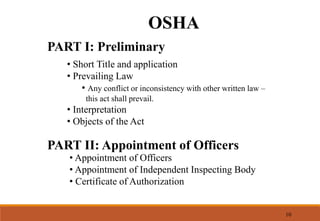
PART I: Preliminary
• Short Title and application
• Prevailing Law
• Any conflict or inconsistency with other written law –
this act shall prevail.
• Interpretation
• Objects of the Act
OSHA
PART II: Appointment of Officers
• Appointment of Officers
• Appointment of Independent Inspecting Body
• Certificate of Authorization
11
PART III: National Council for OSH
• Establishment of the Council
• Membership of the Council
• Powers & Functions of Council
• Committees
• Report
OSHA
PART IV: General Duties of Employers
& Self – Employed Persons
• General Duties to their Employees
• Duty to Formulate Safety and Health Policy
• General Duties to Persons other than their Employee
• Duties of an Occupier of Place of Work to Persons other than
his Employees
•Penalty
12
PART V: General Duties of Designers,
Manufacturer & Suppliers
• General Duties – Plant for Use at Work
• General Duties – Substances for Use at Work
• Penalty
OSHA
PART VI: General Duties of Employees
• General Duties of Employees at Work
• Duty not to Interfere / misuse
• Duty not to Charge Employees for Things Done or Provided
• Discrimination Against Employee
13
PART VII: Safety and Health Organisations
• Medical Surveillance
• Safety and Health Officer
• Safety and Health Committee
• Penalty
OSHA
PART VIII: Notification of Accident, Dangerous
Occurrence, Occupational Poisoning and
Occupational Diseases, and Inquiry
• Notification of Accident….
• Power to Direct Inquiry
14
PART IX: Prohibition Against Use of Plant or
Substance
• Power to Prohibit The use of Plant or Substance
• Aggrieved Person may Appeal
OSHA
PART X: Industry Code of Practice
• Approval
• Use of COP in Preceedings.
15
PART XI: Enforcement and Investigation
• Power for Entry, Inspection, Examination & Seizure
• Entry into Premises with/without Search Warrant
• Power of Forceful Entry
• Power of Investigation
• Power to Examine Witness
• Notice of Improvement & Notice of Prohibition
• Penalty
• Appeal
OSHA
PART XII: Liability for Offences
PART XIII: Appeals
PART XIV: Regulations
PART XV: Miscellanous
16
Schedules;
• First Schedule [Subsection 1(2)]
 Industries Covered by the Act
• Second Schedule [Section 10]
 Provisions for Members of NCOSH
• Third Schedule [Paragraph 28(1)(d)]
 Occupations Involving Special Risk to Health
OSHA
REGULATIONS UNDER OSHA
 Occupational Safety and Health (Employers’ Safety and
Health General Policy Statements)(Exception) Regulations
1995
√ Section 16 of the Act shall apply to every employer and every self-
employed person except those who carry on an undertaking with not
more than five employees.
 Occupational Safety and Health (Control of Industrial
Major Accident Hazards) Regulations 1996
√ Identification & Notification of An Industrial Activity
√ Demonstration of Safe Operation for Non-Major Hazard Installation
√ Report of Industrial Activity and Preparation of Emergency Plan for
Major Hazard Installation
√ Notification of major Hazard Accident
√ Penalty
REGULATIONS UNDER OSHA
 Occupational Safety and Health (Safety and Health
Committee) Regulations 1996
√ Composition of SHC
√ Functions of SHC
√ Meetings of SHC
√ Provisions of Training and Information
√ Penalty
REGULATIONS UNDER OSHA
 Occupational Safety and Health (Classification, Labelling
and Safety Data Sheet of Hazardous Chemicals)
Regulations 2013
 Preliminary
 Classification
 Packaging
 Labelling
 Safety Data Sheet
 Inventory of Hazardous Chemicals
 Confidential Business Information on Hazardous Chemical
 Revocation
REGULATIONS UNDER OSHA
 Occupational Safety and Health (Safety and Health Officer)
Regulations 1997
√ Registration of a SHO
√ Notification of a SHO
√ Duties of an Employer
√ Duties of SHO
√ Miscellaneous
REGULATIONS UNDER OSHA
 Occupational Safety and Health (Use and Standard of
Exposure of Chemicals Hazardous to Health) Regulations
2000
√ Identification of Chemical Hazardous to Health
√ Permissible Exposure Limit
√ Assessment of Risk to Health
√ Action to Control Exposure
√ Labelling & Relabelling
√ Information, Instruction & Training
√ Monitoring of Exposure at the Place of Work
√ Health Surveillance
√ Medical Removal Protection
√ Warning Sign
√ Record Keeping
REGULATIONS UNDER OSHA
 Occupational Safety and Health (Notification of Accident,
Dangerous Occurrence, Occupational Poisoning and
Occupational Disease) Regulations 2004
√ Notification and Reporting of Accident, Dangerous Occurrence,
Occupational Poisoning and Occupational Disease
√ No Interference at Accident or Dangerous Occurrence Scene
√ Maintenance of All Records of Accident, Dangerous Occurrence,
Occupational Poisoning and Occupational Disease
√ Miscellaneous
FIRST SCHEDULE
OSHA 1994
S
C
O
P
E
WHY SELF-REGULATION ?
Apathy on the part of all concerned in industry
- ‘someone else problems’
- ‘the government’s responsibility’
Prescriptive law
- rapid obsolescence
- imposed by external agency
Over dependence on Government
OBJECTS OF THE ACT
•To secure the safety, health & welfare of
persons at work
•To protect person (other than person at work) at
a place of work against hazard
•To promote the occupational environment
adaptable to the person’s physiological &
psychological needs
•To provide the means towards a legislative
system based on regulations & industry codes
of practice in combination with the provisions
of the Act.
SALIENT PROVISIONS
•National Council for OSH
•General duties of employers & self-employed,
designers, manufacturers & suppliers, & employees
•Safety and Health Organisation
•Reporting of accident, dangerous occurrence,
occupational poisoning & disease
•Prohibition of the Use of Plant or Substance
•Industry Code of Practice
•Enforcement and Investigation
•Liability for offences
•Appeals
•Penalties
KEY REQUIREMENTS
FOR COMPLIANCE
General Duties Of Employers & Self-employed Persons
General Duties Of Designers, Manufacturers & Suppliers
General Duties Of Employees
Safety & Health Policy
Safety & Health Committees
Safety & Health Officers
NATIONAL COUNCIL FOR
OCCUPATIONAL SAFETY AND HEALTH
PART III: Sections 8-13
Membership (NCOSH)
•The council shall consist of not less than twelve and not
more than fifteen members who shall be appointed by
Minister
•Three persons representing employers
•Three persons representing employee
•Three or more persons representing Ministries or
Departments whose responsibility is related to OSH
•Three or more persons of whom at least one shall be a
women from professional bodies that related to OSH
•The secretary of the council is from DOSH
NATIONAL COUNCIL FOR
OCCUPATIONAL SAFETY AND HEALTH
PART III: Sections 8-13
Powers and Functions of NCOSH;
•To do all things expedient or reasonably necessary for or
incidental to the carrying out the objects of the Act including;
Changes if considerable desirable to OSHA;
The improvement of the administration and enforcement of OSH
legislation;
The fostering of a cooperation consultative relationship between
management and labour on the safety, health and welfare of persons
at work;
The special problems with respect to OSH of women, handicapped,
persons and other group in the community;
The establishment of adequate methods of control of industrial
chemicals at place of work;
The statistical analysis of occupationally related deaths and injuries;
NATIONAL COUNCIL FOR
OCCUPATIONAL SAFETY AND HEALTH
PART III: Sections 8-13
Powers and Functions of NCOSH;
The provision of health care facilities at a place of work;
The fostering of the development and adoption by law of industry
codes of practice related to OSH and welfare;
The development of rehabilitation plans and facilities to assist
persons injured at a place of work
GENERAL DUTIES OF EMPLOYERS AND
SELF- EMPLOYED PERSONS
PART IV: Sections 15
So far as is practicable -
•provide and maintain plant and system of work
•make arrangements for the safe use, operation, handling,
storage and transportation of substances and plant
•provide information, instruction, training and supervision
•provide and maintain place of work and means of access
to and egress from any place of work
•provide and maintain working environment that is safe and
without health risk and adequate welfare facilities
GENERAL DUTIES OF DESIGNERS,
MANUFACTURERS AND SUPPLIERS
PART V: Sections 20-23
So far as is practicable -
•to ensure plant /substance is designed and
constructed to be safe and without risk to health when
properly used
•arrange for carrying out testing and examination
•availability of adequate information
•for designers and manufacturers - arrange for
research to eliminate or minimize hazards
•safe erection and installation
“PRACTICABLE”
means practicable having regards to
(a) the severity of the hazard or risk in
question;
(b) the state of knowledge about the hazard
or risk and the way of removing or
mitigating the hazard or risk;
(c) the availability and suitability of ways
to remove or mitigate the hazard or risk; &
(d) the cost removing or mitigating the hazard
or risk
GENERAL DUTIES OF EMPLOYEES
PART VI: Sections 24-27
•take reasonable care for safety and health of himself and
others
•co-operate with employer and others
•wear and use PPE
•comply with instructions on OSH
OTHER DUTIES OF AN EMPLOYER,
A SELF-EMPLOYED AND AN OCCUPIER
PART IV: Sections 16-19
•Formulate written statement of his policy on
OSH
•Conduct undertaking in such manner not to
affect other persons not his employees
•Provide information to other persons on ways
his undertaking may affect them
SAFETY & HEALTH POLICY
Section 16
Duty of employers & self-employed person to prepare
& revise written statement of policy
◦ General policy
◦ Organization
◦ Arrangements
Exception for places where 5 or less employees are
employed: OSH (Employers’ General Policy Statements)
(Exception) Regulations 1995
SAFETY & HEALTH COMMITTEE
Section 30
Employer to establish Safety & Health Committee
◦ Employing 40 or more employees
◦ As directed by DG of DOSH
Forum to discuss & resolve safety & health matters arising from work
activities
Details stipulated in OSH (Safety & Health Committee) Regulations 1996
SAFETY & HEALTH OFFICER
Section 29
Occupier of certain industry to employ SHO
◦ SHO to ensure observance of the provisions of the OSHA and any regulations made
under it
Description or class of industries to which this section applies is stipulated in
the OSH (Safety & Health Officer) Order 1997
The appointment & duties of SHO stipulated under OSH (Safety & Health
Officer) Regulations 1997
NOTIFICATION OF ACCIDENTS, DANGEROUS
OCCURRENCE, OCCUPATIONAL POISONING AND
OCCUPATIONAL DISEASE, AND INQUIRY
PART VIII: Sections 32-34
•An employer shall notify the nearest OSH office of any
accident, dangerous occurrence, occupational
poisoning or occupational disease which has
occurred or is likely to occur at the place of work;
•Every registered medical practitioner or medical
officer attending to a patient whom he believes to be
suffering from any of the disease listed in the 3rd
schedule of the Act shall report the matter to the DG;
•The DG may direct inquiry to be held
•Power of OSH officer at inquiry
Interpretation of Act
Occupier
◦ A Person who has the management or control of the place of work.
Employer
◦ The immediate employer or the principle employer or both
Immediate employer
◦ A person who has undertaken the execution at the place of work where the principle
employer is carrying on his business.
Principle employer
◦ The owner of an industry or the person with whom an employee has entered into a
contract of service.
Self-employed person
◦ An individual who works for gain or reward otherwise than under a contract of
employment.
HOW TO COMPLY?
SET GOALS & THE MEANS OF ACHIEVING THEM
◦ SAFETY & HEALTH POLICY
ASSIGN RESPONSIBILITIES
◦ SAFETY & HEALTH ORGANISATION
IDENTIFY HAZARDS & ASSESS RISKS
◦ RISK ASSESSMENT
HOW TO COMPLY?
DETERMINE APPROPRIATE CONTROL MEASURES &
MANAGEMENT STRATEGIES
◦ HIERARCHY OF CONTROL
◦ ‘PRACTICABLE’ CONSIDERATIONS
◦ USE OF INDUSTRY CODES OF PRACTICE & GUIDELINES
HOW TO COMPLY?
IMPLEMENT ACTION PLAN
◦ IMPLEMENT CONTROL MEASURES
◦ DISEMMINATE OSH INFORMATION
◦ TRAINING & SUPERVISION
◦ MONITORING, MEDICAL SURVEILLANCE
◦ EMERGENCY PROCEDURES
◦ REPORTING & INVESTIGATION OF ACCIDENT, DANGEROUS
OCCURRENCE, POISONING & DISEASES
HOW TO COMPLY ?
GET OSH SERVICES/ADVICE
◦ CERTAIN INDUSTRY TO EMPLOY SAFETY & HEALTH OFFICER
◦ COMPETENT PERSONS
◦ OUTSIDE EXPERTISE
GET PARTICIPATION & COOPERATION OF
WORKERS
◦ SAFETY & HEALTH COMMITTEE (IF >40 EMPLOYEES)
CONCLUSION
OSHA is a comprehensive piece of legislation to
protect the safety & health of employees &
other persons who may be affected by the work
based on self-regulation
Self regulation is a new approach to get the risk-
creators & workers to be more responsible,
committed, and cooperate with each other to
achieve a common goal of ensuring safety &
health at the place of work
OCCUPATIONAL SAFETY and HEALTH ACT (OSHA)

OSHA 1994

  • 1.
  • 2.
    2 OSHA 1994 An Actto make further provisions for securing that safety, health and welfare of persons at work, for protecting others against risks to safety or health in connection with the activities of person at work and for matters connected therewith.
  • 3.
    BACKGROUND * The Factoriesand Machinery Act 1967 - Scope - Prescriptive - Too dependent on Government
  • 4.
    WORKFORCE COVERED UNDER FACTORIESAND MACHINERY ACT 1967 Factories Non-Factories 23% Factories Non-Factories
  • 5.
    INTRODUCTION: OSHA 1994 Title: Act514 Occupational Safety & Health Act 1994 Royal assent: 15th February 1994 Gazetted: 24th February 1994 There are 15 Parts consisting of 67 Sections and 3 Schedules
  • 6.
  • 7.
    INTRODUCTION: OSHA 1994 PHILOSOPHY OFSELF- REGULATION: “ Responsibilities to ensure safety and health at the workplace lies with those who create the risk and with those who work with the risk ”
  • 8.
    9 Arrangement of OSHA Consistof;  15 Parts;  67 Sections;  3 Schedules &  7 Regulations
  • 9.
    10 PART I: Preliminary •Short Title and application • Prevailing Law • Any conflict or inconsistency with other written law – this act shall prevail. • Interpretation • Objects of the Act OSHA PART II: Appointment of Officers • Appointment of Officers • Appointment of Independent Inspecting Body • Certificate of Authorization
  • 10.
    11 PART III: NationalCouncil for OSH • Establishment of the Council • Membership of the Council • Powers & Functions of Council • Committees • Report OSHA PART IV: General Duties of Employers & Self – Employed Persons • General Duties to their Employees • Duty to Formulate Safety and Health Policy • General Duties to Persons other than their Employee • Duties of an Occupier of Place of Work to Persons other than his Employees •Penalty
  • 11.
    12 PART V: GeneralDuties of Designers, Manufacturer & Suppliers • General Duties – Plant for Use at Work • General Duties – Substances for Use at Work • Penalty OSHA PART VI: General Duties of Employees • General Duties of Employees at Work • Duty not to Interfere / misuse • Duty not to Charge Employees for Things Done or Provided • Discrimination Against Employee
  • 12.
    13 PART VII: Safetyand Health Organisations • Medical Surveillance • Safety and Health Officer • Safety and Health Committee • Penalty OSHA PART VIII: Notification of Accident, Dangerous Occurrence, Occupational Poisoning and Occupational Diseases, and Inquiry • Notification of Accident…. • Power to Direct Inquiry
  • 13.
    14 PART IX: ProhibitionAgainst Use of Plant or Substance • Power to Prohibit The use of Plant or Substance • Aggrieved Person may Appeal OSHA PART X: Industry Code of Practice • Approval • Use of COP in Preceedings.
  • 14.
    15 PART XI: Enforcementand Investigation • Power for Entry, Inspection, Examination & Seizure • Entry into Premises with/without Search Warrant • Power of Forceful Entry • Power of Investigation • Power to Examine Witness • Notice of Improvement & Notice of Prohibition • Penalty • Appeal OSHA PART XII: Liability for Offences PART XIII: Appeals PART XIV: Regulations PART XV: Miscellanous
  • 15.
    16 Schedules; • First Schedule[Subsection 1(2)]  Industries Covered by the Act • Second Schedule [Section 10]  Provisions for Members of NCOSH • Third Schedule [Paragraph 28(1)(d)]  Occupations Involving Special Risk to Health OSHA
  • 16.
    REGULATIONS UNDER OSHA Occupational Safety and Health (Employers’ Safety and Health General Policy Statements)(Exception) Regulations 1995 √ Section 16 of the Act shall apply to every employer and every self- employed person except those who carry on an undertaking with not more than five employees.  Occupational Safety and Health (Control of Industrial Major Accident Hazards) Regulations 1996 √ Identification & Notification of An Industrial Activity √ Demonstration of Safe Operation for Non-Major Hazard Installation √ Report of Industrial Activity and Preparation of Emergency Plan for Major Hazard Installation √ Notification of major Hazard Accident √ Penalty
  • 17.
    REGULATIONS UNDER OSHA Occupational Safety and Health (Safety and Health Committee) Regulations 1996 √ Composition of SHC √ Functions of SHC √ Meetings of SHC √ Provisions of Training and Information √ Penalty
  • 18.
    REGULATIONS UNDER OSHA Occupational Safety and Health (Classification, Labelling and Safety Data Sheet of Hazardous Chemicals) Regulations 2013  Preliminary  Classification  Packaging  Labelling  Safety Data Sheet  Inventory of Hazardous Chemicals  Confidential Business Information on Hazardous Chemical  Revocation
  • 19.
    REGULATIONS UNDER OSHA Occupational Safety and Health (Safety and Health Officer) Regulations 1997 √ Registration of a SHO √ Notification of a SHO √ Duties of an Employer √ Duties of SHO √ Miscellaneous
  • 20.
    REGULATIONS UNDER OSHA Occupational Safety and Health (Use and Standard of Exposure of Chemicals Hazardous to Health) Regulations 2000 √ Identification of Chemical Hazardous to Health √ Permissible Exposure Limit √ Assessment of Risk to Health √ Action to Control Exposure √ Labelling & Relabelling √ Information, Instruction & Training √ Monitoring of Exposure at the Place of Work √ Health Surveillance √ Medical Removal Protection √ Warning Sign √ Record Keeping
  • 21.
    REGULATIONS UNDER OSHA Occupational Safety and Health (Notification of Accident, Dangerous Occurrence, Occupational Poisoning and Occupational Disease) Regulations 2004 √ Notification and Reporting of Accident, Dangerous Occurrence, Occupational Poisoning and Occupational Disease √ No Interference at Accident or Dangerous Occurrence Scene √ Maintenance of All Records of Accident, Dangerous Occurrence, Occupational Poisoning and Occupational Disease √ Miscellaneous
  • 22.
  • 23.
    WHY SELF-REGULATION ? Apathyon the part of all concerned in industry - ‘someone else problems’ - ‘the government’s responsibility’ Prescriptive law - rapid obsolescence - imposed by external agency Over dependence on Government
  • 24.
    OBJECTS OF THEACT •To secure the safety, health & welfare of persons at work •To protect person (other than person at work) at a place of work against hazard •To promote the occupational environment adaptable to the person’s physiological & psychological needs •To provide the means towards a legislative system based on regulations & industry codes of practice in combination with the provisions of the Act.
  • 25.
    SALIENT PROVISIONS •National Councilfor OSH •General duties of employers & self-employed, designers, manufacturers & suppliers, & employees •Safety and Health Organisation •Reporting of accident, dangerous occurrence, occupational poisoning & disease •Prohibition of the Use of Plant or Substance •Industry Code of Practice •Enforcement and Investigation •Liability for offences •Appeals •Penalties
  • 26.
    KEY REQUIREMENTS FOR COMPLIANCE GeneralDuties Of Employers & Self-employed Persons General Duties Of Designers, Manufacturers & Suppliers General Duties Of Employees Safety & Health Policy Safety & Health Committees Safety & Health Officers
  • 27.
    NATIONAL COUNCIL FOR OCCUPATIONALSAFETY AND HEALTH PART III: Sections 8-13 Membership (NCOSH) •The council shall consist of not less than twelve and not more than fifteen members who shall be appointed by Minister •Three persons representing employers •Three persons representing employee •Three or more persons representing Ministries or Departments whose responsibility is related to OSH •Three or more persons of whom at least one shall be a women from professional bodies that related to OSH •The secretary of the council is from DOSH
  • 28.
    NATIONAL COUNCIL FOR OCCUPATIONALSAFETY AND HEALTH PART III: Sections 8-13 Powers and Functions of NCOSH; •To do all things expedient or reasonably necessary for or incidental to the carrying out the objects of the Act including; Changes if considerable desirable to OSHA; The improvement of the administration and enforcement of OSH legislation; The fostering of a cooperation consultative relationship between management and labour on the safety, health and welfare of persons at work; The special problems with respect to OSH of women, handicapped, persons and other group in the community; The establishment of adequate methods of control of industrial chemicals at place of work; The statistical analysis of occupationally related deaths and injuries;
  • 29.
    NATIONAL COUNCIL FOR OCCUPATIONALSAFETY AND HEALTH PART III: Sections 8-13 Powers and Functions of NCOSH; The provision of health care facilities at a place of work; The fostering of the development and adoption by law of industry codes of practice related to OSH and welfare; The development of rehabilitation plans and facilities to assist persons injured at a place of work
  • 30.
    GENERAL DUTIES OFEMPLOYERS AND SELF- EMPLOYED PERSONS PART IV: Sections 15 So far as is practicable - •provide and maintain plant and system of work •make arrangements for the safe use, operation, handling, storage and transportation of substances and plant •provide information, instruction, training and supervision •provide and maintain place of work and means of access to and egress from any place of work •provide and maintain working environment that is safe and without health risk and adequate welfare facilities
  • 31.
    GENERAL DUTIES OFDESIGNERS, MANUFACTURERS AND SUPPLIERS PART V: Sections 20-23 So far as is practicable - •to ensure plant /substance is designed and constructed to be safe and without risk to health when properly used •arrange for carrying out testing and examination •availability of adequate information •for designers and manufacturers - arrange for research to eliminate or minimize hazards •safe erection and installation
  • 32.
    “PRACTICABLE” means practicable havingregards to (a) the severity of the hazard or risk in question; (b) the state of knowledge about the hazard or risk and the way of removing or mitigating the hazard or risk; (c) the availability and suitability of ways to remove or mitigate the hazard or risk; & (d) the cost removing or mitigating the hazard or risk
  • 33.
    GENERAL DUTIES OFEMPLOYEES PART VI: Sections 24-27 •take reasonable care for safety and health of himself and others •co-operate with employer and others •wear and use PPE •comply with instructions on OSH
  • 34.
    OTHER DUTIES OFAN EMPLOYER, A SELF-EMPLOYED AND AN OCCUPIER PART IV: Sections 16-19 •Formulate written statement of his policy on OSH •Conduct undertaking in such manner not to affect other persons not his employees •Provide information to other persons on ways his undertaking may affect them
  • 35.
    SAFETY & HEALTHPOLICY Section 16 Duty of employers & self-employed person to prepare & revise written statement of policy ◦ General policy ◦ Organization ◦ Arrangements Exception for places where 5 or less employees are employed: OSH (Employers’ General Policy Statements) (Exception) Regulations 1995
  • 36.
    SAFETY & HEALTHCOMMITTEE Section 30 Employer to establish Safety & Health Committee ◦ Employing 40 or more employees ◦ As directed by DG of DOSH Forum to discuss & resolve safety & health matters arising from work activities Details stipulated in OSH (Safety & Health Committee) Regulations 1996
  • 37.
    SAFETY & HEALTHOFFICER Section 29 Occupier of certain industry to employ SHO ◦ SHO to ensure observance of the provisions of the OSHA and any regulations made under it Description or class of industries to which this section applies is stipulated in the OSH (Safety & Health Officer) Order 1997 The appointment & duties of SHO stipulated under OSH (Safety & Health Officer) Regulations 1997
  • 38.
    NOTIFICATION OF ACCIDENTS,DANGEROUS OCCURRENCE, OCCUPATIONAL POISONING AND OCCUPATIONAL DISEASE, AND INQUIRY PART VIII: Sections 32-34 •An employer shall notify the nearest OSH office of any accident, dangerous occurrence, occupational poisoning or occupational disease which has occurred or is likely to occur at the place of work; •Every registered medical practitioner or medical officer attending to a patient whom he believes to be suffering from any of the disease listed in the 3rd schedule of the Act shall report the matter to the DG; •The DG may direct inquiry to be held •Power of OSH officer at inquiry
  • 39.
    Interpretation of Act Occupier ◦A Person who has the management or control of the place of work. Employer ◦ The immediate employer or the principle employer or both Immediate employer ◦ A person who has undertaken the execution at the place of work where the principle employer is carrying on his business. Principle employer ◦ The owner of an industry or the person with whom an employee has entered into a contract of service. Self-employed person ◦ An individual who works for gain or reward otherwise than under a contract of employment.
  • 40.
    HOW TO COMPLY? SETGOALS & THE MEANS OF ACHIEVING THEM ◦ SAFETY & HEALTH POLICY ASSIGN RESPONSIBILITIES ◦ SAFETY & HEALTH ORGANISATION IDENTIFY HAZARDS & ASSESS RISKS ◦ RISK ASSESSMENT
  • 41.
    HOW TO COMPLY? DETERMINEAPPROPRIATE CONTROL MEASURES & MANAGEMENT STRATEGIES ◦ HIERARCHY OF CONTROL ◦ ‘PRACTICABLE’ CONSIDERATIONS ◦ USE OF INDUSTRY CODES OF PRACTICE & GUIDELINES
  • 42.
    HOW TO COMPLY? IMPLEMENTACTION PLAN ◦ IMPLEMENT CONTROL MEASURES ◦ DISEMMINATE OSH INFORMATION ◦ TRAINING & SUPERVISION ◦ MONITORING, MEDICAL SURVEILLANCE ◦ EMERGENCY PROCEDURES ◦ REPORTING & INVESTIGATION OF ACCIDENT, DANGEROUS OCCURRENCE, POISONING & DISEASES
  • 43.
    HOW TO COMPLY? GET OSH SERVICES/ADVICE ◦ CERTAIN INDUSTRY TO EMPLOY SAFETY & HEALTH OFFICER ◦ COMPETENT PERSONS ◦ OUTSIDE EXPERTISE GET PARTICIPATION & COOPERATION OF WORKERS ◦ SAFETY & HEALTH COMMITTEE (IF >40 EMPLOYEES)
  • 44.
    CONCLUSION OSHA is acomprehensive piece of legislation to protect the safety & health of employees & other persons who may be affected by the work based on self-regulation Self regulation is a new approach to get the risk- creators & workers to be more responsible, committed, and cooperate with each other to achieve a common goal of ensuring safety & health at the place of work
  • 45.
    OCCUPATIONAL SAFETY andHEALTH ACT (OSHA)