OSG’s Research-based Pedagogical Model Online School  for   Girls www.onlineschoolforgirls.org
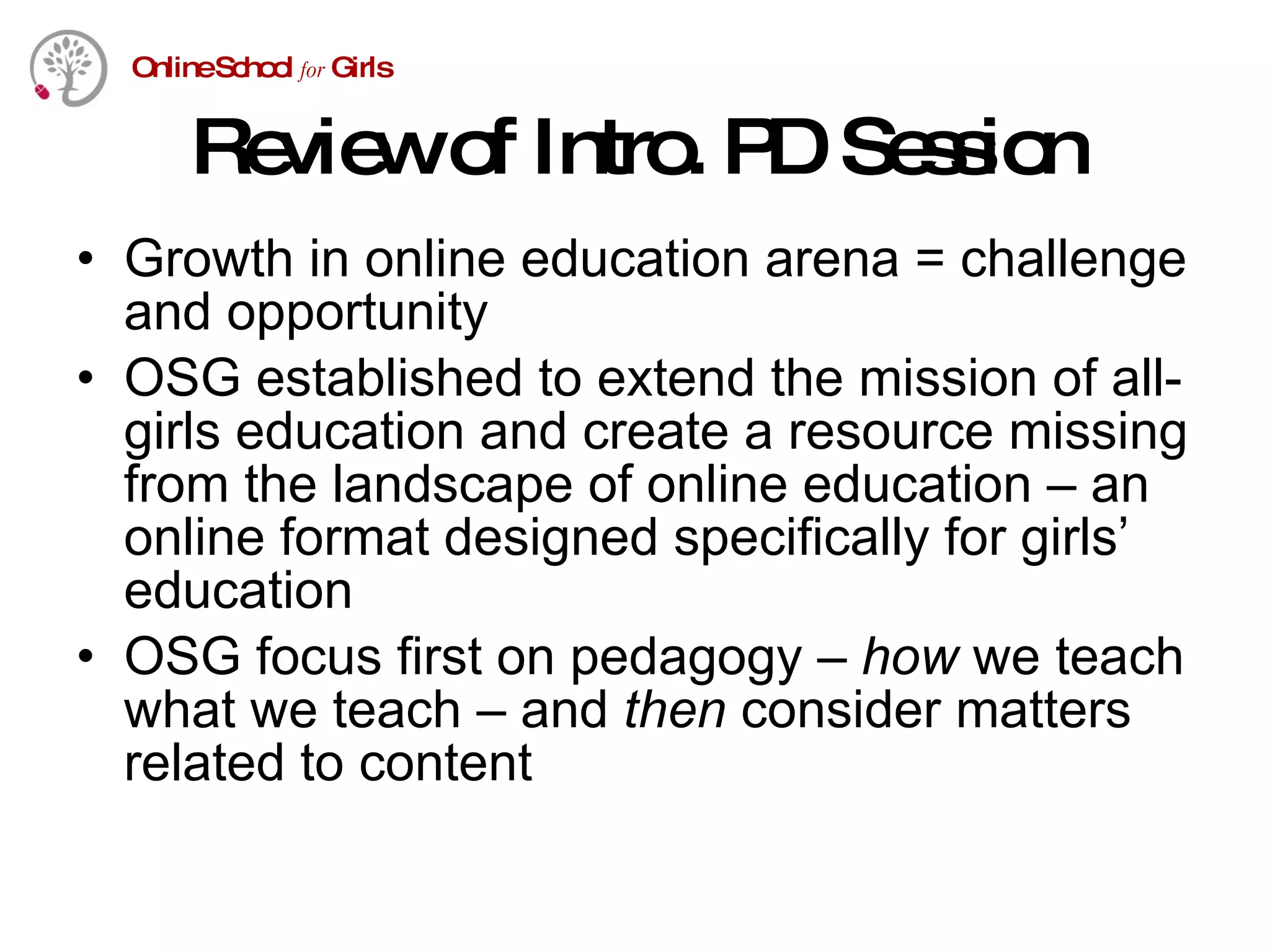
Review of Intro. PD Session Growth in online education arena = challenge and opportunity OSG established to extend the mission of all-girls education and create a resource missing from the landscape of online education – an online format designed specifically for girls’ education OSG focus first on pedagogy –  how  we teach what we teach – and  then  consider matters related to content
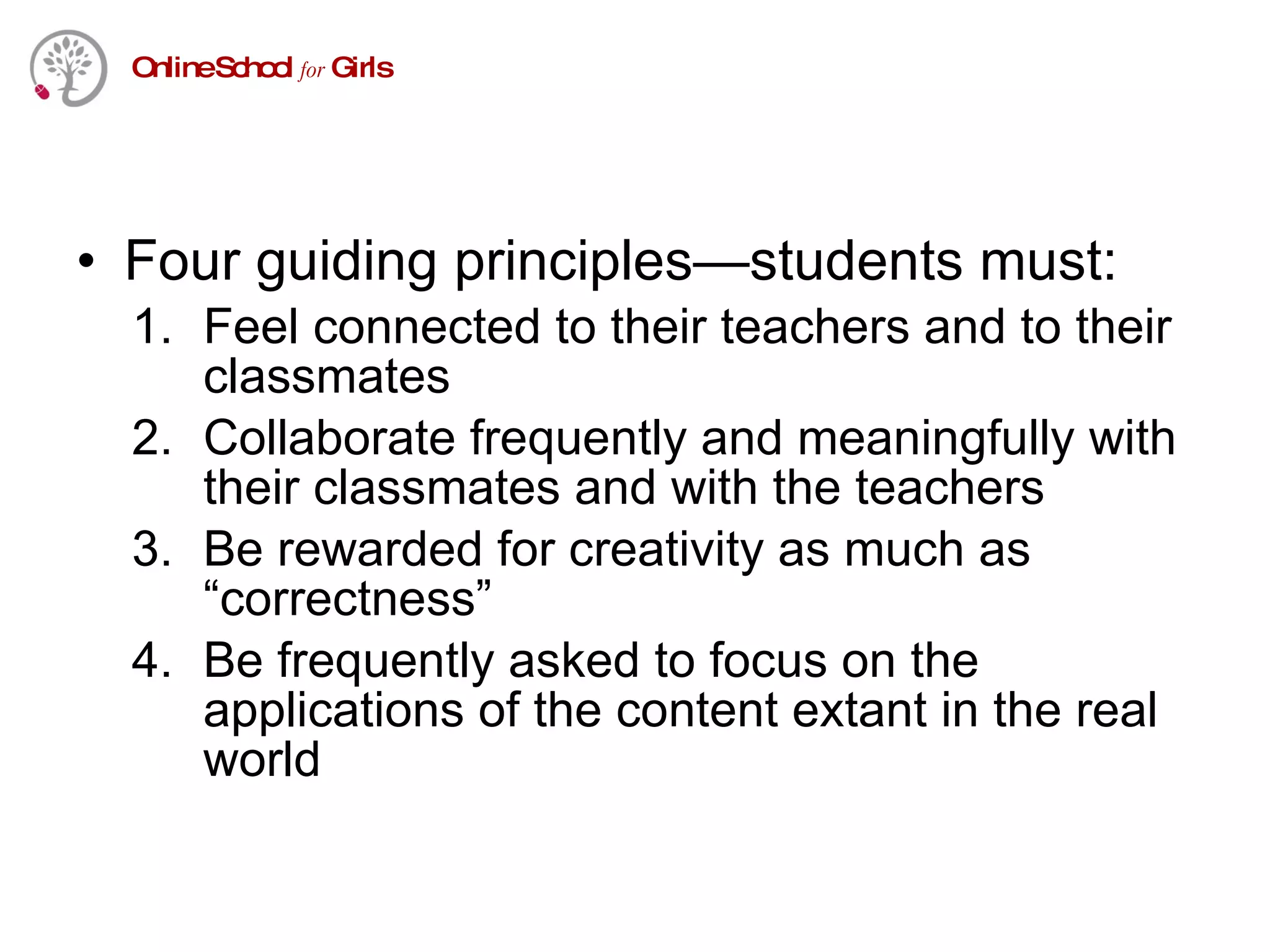
Four guiding principles—students must:  Feel connected to their teachers and to their classmates Collaborate frequently and meaningfully with their classmates and with the teachers Be rewarded for creativity as much as “correctness” Be frequently asked to focus on the applications of the content extant in the real world
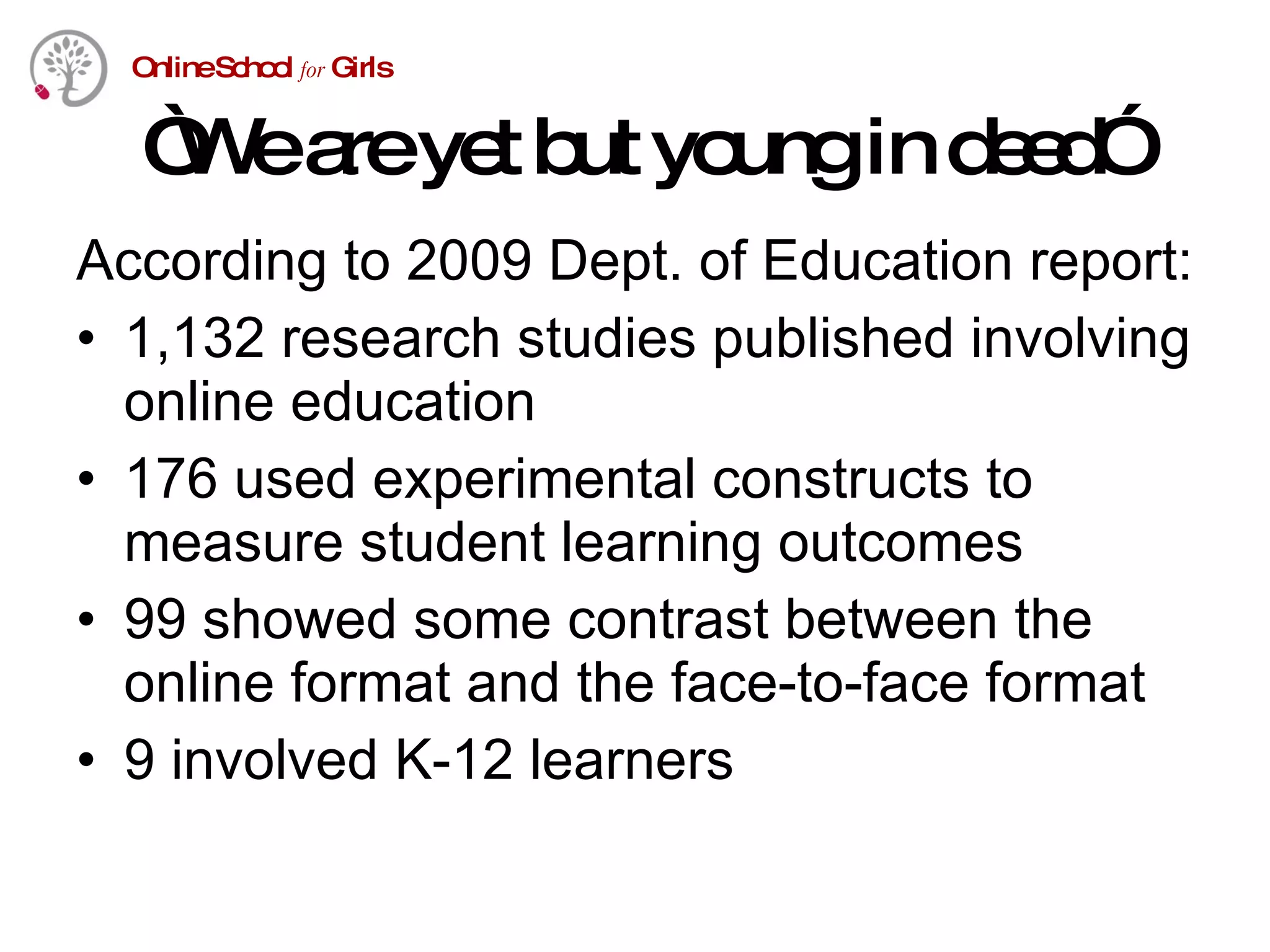
“ We are yet but young in deed” According to 2009 Dept. of Education report: 1,132 research studies published involving online education 176 used experimental constructs to measure student learning outcomes 99 showed some contrast between the online format and the face-to-face format 9 involved K-12 learners
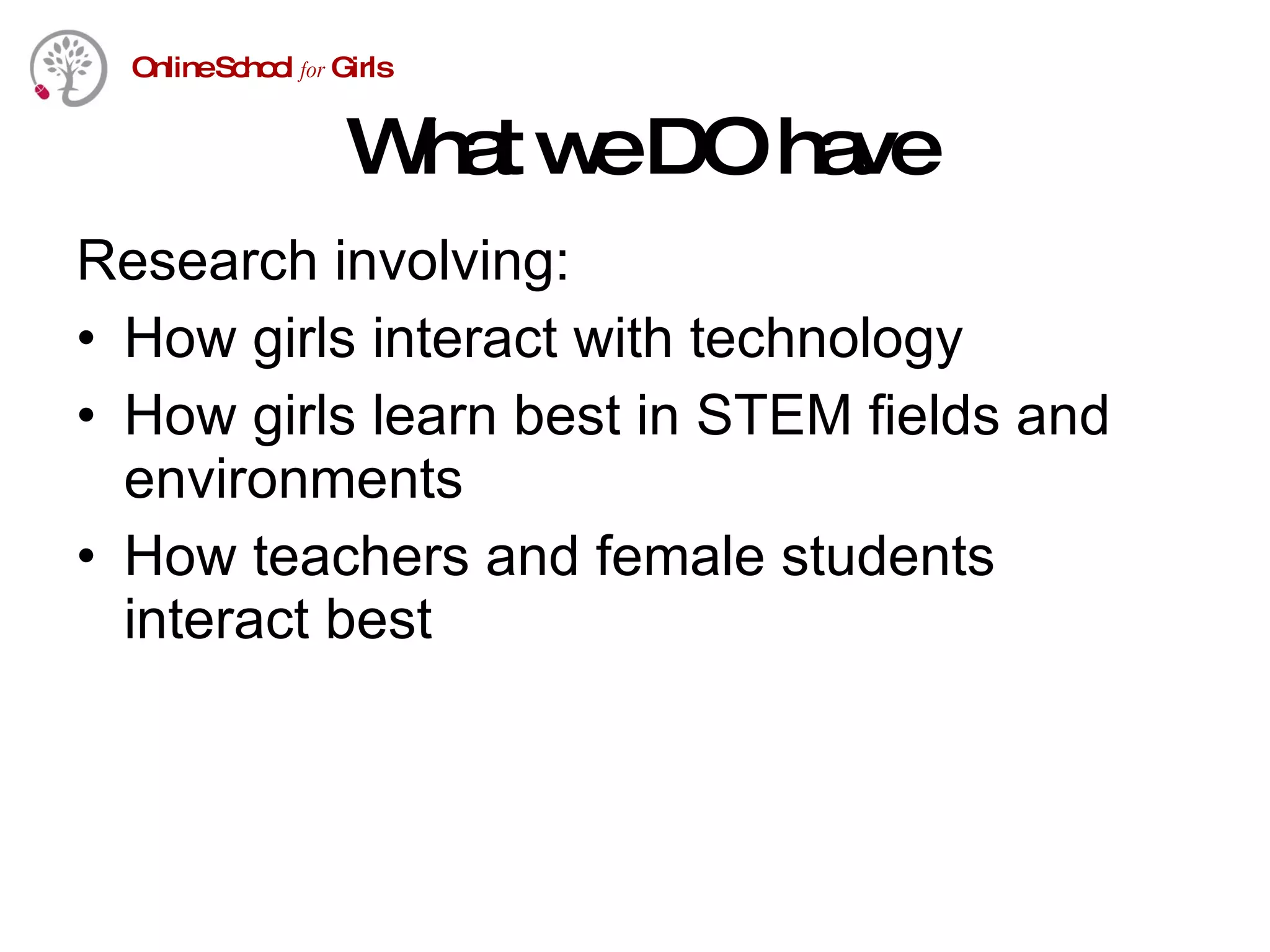
What we DO have Research involving: How girls interact with technology How girls learn best in STEM fields and environments How teachers and female students interact best
First Reading Technology Perceptions by Gender - by Cornelia Brunner and Dorothy Bennett [email_address] tel: (212) 807-4228 fax: (212) 633-8804 Click on this article on the “Readings for session content block on the right-hand side of the Haiku page
From Campbell’s piece: Female learning may occur first and foremost in relation to other human beings and living things, whereas males may arrive at an understanding in relation to things and symbols, a framework on which much computer-based instruction is based. (Elkjaer, 1992; Morrell, 1991). A criticism of learning technology has emerged parallel to the criticisms of objectivist scientific models in this regard (Acker & Oatley, 1993; Balka & Doucette,1994; Bryson & deCastell, 1993; Cockburn & Ormrod, 1993). A typical criticism for this perspective was outlined by Margaret Wylie in  Digital Media:  “Make no mistake about it; the Internet is male territory. Considering its roots are sunk deep in academic and the military-industrial complex, that’s hardly surprising”
Second Reading Executive Summary of  Tech-Savvy - by American Association of University Women www.aauw.org Click on this article on the “Readings for session content block on the right-hand side of the Haiku page (be sure to begin on p.6, the Executive Summary)
From  Tech-Savvy : “ The commission interprets such behavior not as phobia but as a choice that invites a critique of the computing culture. We need a more inclusive computer culture that embraces multiple interests and backgrounds and that reflects the current ubiquity of technology in all aspects of life. As this report describes, girls assert a “we can, but I don’t want to” attitude toward computer technology: They insist on their abilities and skills in this area even as they vividly describe their disenchantment with the field, its careers, and social contexts. Although some of this attitude may be defensive, it is important to take a hard look at what these girls are feeling defensive about.”
Guiding Principle #1: APPLICATION to engage in real-world problems and applications while having students probe the social and ethical dynamics that define and stretch our global society.
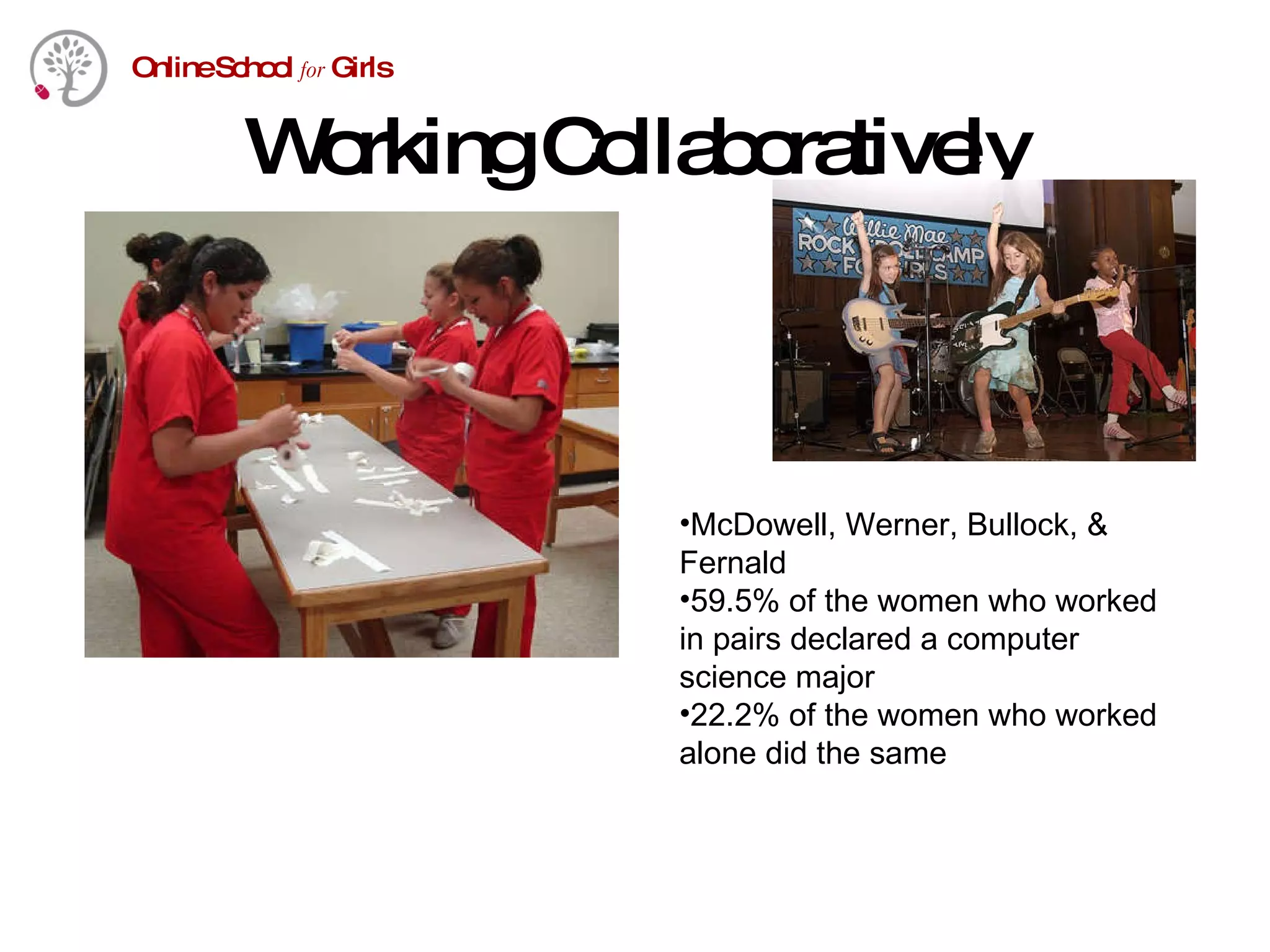
Working Collaboratively McDowell, Werner, Bullock, & Fernald 59.5% of the women who worked in pairs declared a computer science major 22.2% of the women who worked alone did the same
Guiding Principle #2: COLLABORATION a commitment to incorporate collaboration in the learning experience.
Girls Connected Older teenage girls = 70% of participants
Guiding Principle #3: CONNECTION the OSG classroom places great emphasis on enhancing connection among participants
Guiding Principle #4: CREATIVITY the OSG teacher needs to be ever mindful that her/his assessment scheme both values and rewards creativity

Osg’S Research Based Pedagogical Model

  • 1.
    OSG’s Research-based PedagogicalModel Online School for Girls www.onlineschoolforgirls.org
  • 2.
    Review of Intro.PD Session Growth in online education arena = challenge and opportunity OSG established to extend the mission of all-girls education and create a resource missing from the landscape of online education – an online format designed specifically for girls’ education OSG focus first on pedagogy – how we teach what we teach – and then consider matters related to content
  • 3.
    Four guiding principles—studentsmust: Feel connected to their teachers and to their classmates Collaborate frequently and meaningfully with their classmates and with the teachers Be rewarded for creativity as much as “correctness” Be frequently asked to focus on the applications of the content extant in the real world
  • 4.
    “ We areyet but young in deed” According to 2009 Dept. of Education report: 1,132 research studies published involving online education 176 used experimental constructs to measure student learning outcomes 99 showed some contrast between the online format and the face-to-face format 9 involved K-12 learners
  • 5.
    What we DOhave Research involving: How girls interact with technology How girls learn best in STEM fields and environments How teachers and female students interact best
  • 6.
    First Reading TechnologyPerceptions by Gender - by Cornelia Brunner and Dorothy Bennett [email_address] tel: (212) 807-4228 fax: (212) 633-8804 Click on this article on the “Readings for session content block on the right-hand side of the Haiku page
  • 7.
    From Campbell’s piece:Female learning may occur first and foremost in relation to other human beings and living things, whereas males may arrive at an understanding in relation to things and symbols, a framework on which much computer-based instruction is based. (Elkjaer, 1992; Morrell, 1991). A criticism of learning technology has emerged parallel to the criticisms of objectivist scientific models in this regard (Acker & Oatley, 1993; Balka & Doucette,1994; Bryson & deCastell, 1993; Cockburn & Ormrod, 1993). A typical criticism for this perspective was outlined by Margaret Wylie in Digital Media: “Make no mistake about it; the Internet is male territory. Considering its roots are sunk deep in academic and the military-industrial complex, that’s hardly surprising”
  • 8.
    Second Reading ExecutiveSummary of Tech-Savvy - by American Association of University Women www.aauw.org Click on this article on the “Readings for session content block on the right-hand side of the Haiku page (be sure to begin on p.6, the Executive Summary)
  • 9.
    From Tech-Savvy: “ The commission interprets such behavior not as phobia but as a choice that invites a critique of the computing culture. We need a more inclusive computer culture that embraces multiple interests and backgrounds and that reflects the current ubiquity of technology in all aspects of life. As this report describes, girls assert a “we can, but I don’t want to” attitude toward computer technology: They insist on their abilities and skills in this area even as they vividly describe their disenchantment with the field, its careers, and social contexts. Although some of this attitude may be defensive, it is important to take a hard look at what these girls are feeling defensive about.”
  • 10.
    Guiding Principle #1:APPLICATION to engage in real-world problems and applications while having students probe the social and ethical dynamics that define and stretch our global society.
  • 11.
    Working Collaboratively McDowell,Werner, Bullock, & Fernald 59.5% of the women who worked in pairs declared a computer science major 22.2% of the women who worked alone did the same
  • 12.
    Guiding Principle #2:COLLABORATION a commitment to incorporate collaboration in the learning experience.
  • 13.
    Girls Connected Olderteenage girls = 70% of participants
  • 14.
    Guiding Principle #3:CONNECTION the OSG classroom places great emphasis on enhancing connection among participants
  • 15.
    Guiding Principle #4:CREATIVITY the OSG teacher needs to be ever mindful that her/his assessment scheme both values and rewards creativity