Unikernels and Docker: ‹
From Revolution to Evolution
Richard Mortier, @mort___
Anil Madhavapeddy, @avsm
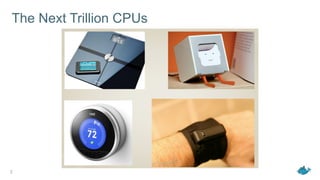
The Next Trillion CPUs
2

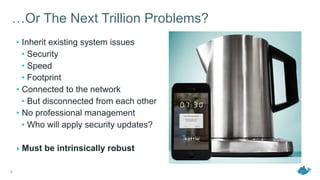
Or The Next Trillion Problems?
‱ Inherit existing system issues
‱ Security
‱ Speed
‱ Footprint
‱ Connected to the network
‱ But disconnected from each other
‱ No professional management
‱ Who will apply security updates?
‣ Must be intrinsically robust
3
New Devices, Old Software
Examples of generational bugs:
‱ Heartbleed
‱ 17% of all Internet secure web servers vulnerable to a single bug,
described as "catastrophic" by Bruce Schneier
‱ ShellShock
‱ CGI, Web, DHCP all vulnerable to code execution
‱ Millions of sites vulnerable
‣ Will never be solved as we cannot physically find all affected IoT devices!
4
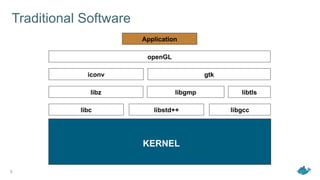
Traditional Software
5
KERNEL
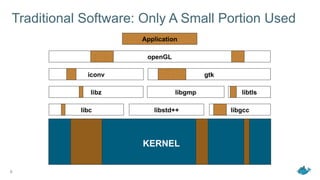
Traditional Software: Only A Small Portion Used
6
KERNEL
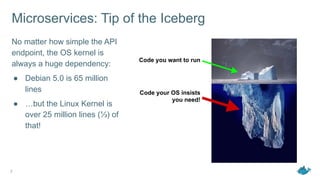
Microservices: Tip of the Iceberg
No matter how simple the API
endpoint, the OS kernel is
always a huge dependency:
● Debian 5.0 is 65 million
lines
● 
but the Linux Kernel is
over 25 million lines (⅓) of
that!
7
Code you want to run
Code your OS insists
you need!
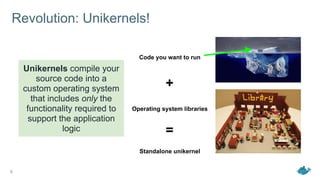
Revolution: Unikernels!
Unikernels compile your
source code into a
custom operating system
that includes only the
functionality required to
support the application
logic
Code you want to run
Operating system libraries
+
Standalone unikernel
=
8
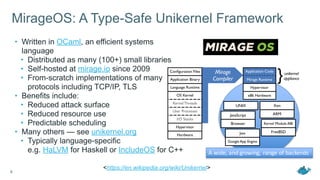
‱ Written in OCaml, an efficient systems
language
‱ Distributed as many (100+) small libraries
‱ Self-hosted at mirage.io since 2009
‱ From-scratch implementations of many
protocols including TCP/IP, TLS
‱ Benefits include:
‱ Reduced attack surface
‱ Reduced resource use
‱ Predictable scheduling
‱ Many others — see unikernel.org
‱ Typically language-specific‹
e.g. HaLVM for Haskell or IncludeOS for C++
MirageOS: A Type-Safe Unikernel Framework
9
<https://en.wikipedia.org/wiki/Unikernel>
9
Xen
ARM
UNIX
JavaScript
Browser Kernel Module ABI
FreeBSDJava
Google App Engine
A	wide,	and	growing,	 range	of	backends
Hardware
Hypervisor
I/O Stacks
User Processes
OS Kernel
Kernel Threads
Language Runtime
Mirage Runtime
x86 Hardware
Hypervisor
Application Code
Application Binary
unikernel
appliance}Mirage
Compiler
ConïŹguration Files
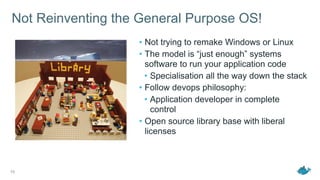
Not Reinventing the General Purpose OS!
‱ Not trying to remake Windows or Linux
‱ The model is “just enough” systems
software to run your application code
‱ Specialisation all the way down the stack
‱ Follow devops philosophy:
‱ Application developer in complete
control
‱ Open source library base with liberal
licenses
10
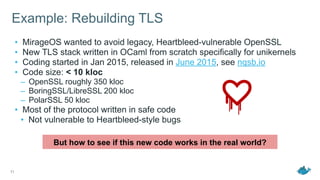
Example: Rebuilding TLS
‱ MirageOS wanted to avoid legacy, Heartbleed-vulnerable OpenSSL
‱ New TLS stack written in OCaml from scratch specifically for unikernels
‱ Coding started in Jan 2015, released in June 2015, see nqsb.io
‱ Code size: < 10 kloc
– OpenSSL roughly 350 kloc
– BoringSSL/LibreSSL 200 kloc
– PolarSSL 50 kloc
‱ Most of the protocol written in safe code
‱ Not vulnerable to Heartbleed-style bugs
11
But how to see if this new code works in the real world?
The Bitcoin Piñata
‱ Put 10 Bitcoins into a unikernel service online built using MirageOS
‱ Invite the Internet to connect and try to break it
‱ If anyone breaks in, they can obtain the Bitcoin wallet and win!
Results?
‱ Hundreds of thousands of attacks against the Bitcoin Piñata
‱ It was crashed — but rebooted in just a few milliseconds
‱ Nobody got the Bitcoins out of the Piñata, though some donated

12
Bitcoin services is just a library, so easy to do this in a unikernel
Imagine trying to build a Bitcoin Linux kernel module!
Unikernels: Benefits of Specialisation
Performance and Size
‱ Simple unikernels can be as small as kilobytes in size
‱ Similar to the “network appliances” that powered early Internet growth
Multi-target
‱ Recompile application logic with different OS libraries for (e.g.,) IoT, JavaScript
‱ Portability as cloud evolves: don’t tie your application down needlessly
Security and Correctness
‱ Type-safety can now infiltrate existing micro-service deployments
‱ Not limited to just application logic — system services too
13
Unikernels: Steps Remain
Management
‱ Unikernel lifecycle management that is application-centric
‱ Clustering support
Deployment
‱ Cloud APIs are not geared towards dust clouds
‱ Image management of unikernel libraries
Ease of build
‱ Remove need for cross-compilation and integrate with IDE ecosystem
‱ Much functionality is exposed as libraries, but not all
14
All of these are solved with Docker!
15
16
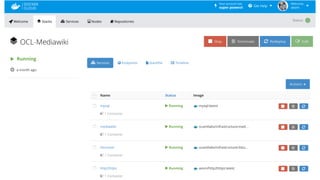
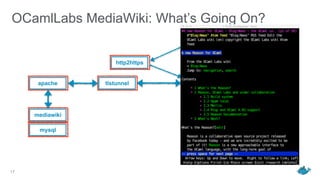
OCamlLabs MediaWiki: What’s Going On?
17
mediawiki
apache
mysql
http2https
tlstunnel
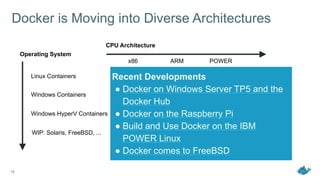
Docker is Moving into Diverse Architectures
Linux Containers
ARM POWERx86
Windows Containers
Windows HyperV Containers
WIP: Solaris, FreeBSD, ...
Operating System
CPU Architecture
18
Recent Developments
● Docker on Windows Server TP5 and the
Docker Hub
● Docker on the Raspberry Pi
● Build and Use Docker on the IBM
POWER Linux
● Docker comes to FreeBSD
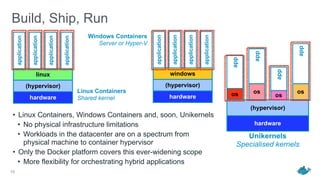
Build, Ship, Run
‱ Linux Containers, Windows Containers and, soon, Unikernels
‱ No physical infrastructure limitations
‱ Workloads in the datacenter are on a spectrum from
physical machine to container hypervisor
‱ Only the Docker platform covers this ever-widening scope
‱ More flexibility for orchestrating hybrid applications
19
hardware
(hypervisor)
windows
application
application
application
application
Windows Containers
Server or Hyper-V
hardware
(hypervisor)
linux
application
application
application
application
Linux Containers
Shared kernel
hardware
(hypervisor)
app
app
app
app
os os
os
os
Unikernels
Specialised kernels
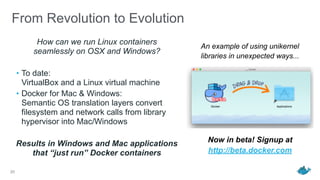
From Revolution to Evolution
How can we run Linux containers ‹
seamlessly on OSX and Windows?
‱ To date:‹
VirtualBox and a Linux virtual machine
‱ Docker for Mac & Windows:‹
Semantic OS translation layers convert
filesystem and network calls from library
hypervisor into Mac/Windows
Results in Windows and Mac applications ‹
that “just run” Docker containers
20
An example of using unikernel
libraries in unexpected ways...
Now in beta! Signup at
http://beta.docker.com
Join Us: Become a Pioneer!
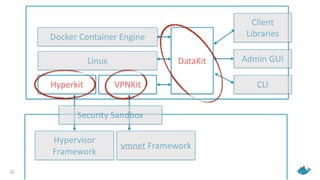
We just open sourced three components
from Docker for Mac and Windows!
‱ HyperKit, a lightweight virtualization
toolkit on OSX
‱ VPNKit, a library toolkit for embedding
virtual networking
‱ DataKit, a modern UNIX pipeline
framework for distributed components
21
Your code here!
22
Join Us: Become a Pioneer!
We just open sourced three components
from Docker for Mac and Windows!
‱ HyperKit, a lightweight virtualization
toolkit on OSX
‱ VPNKit, a library toolkit for embedding
virtual networking
‱ DataKit, a modern UNIX pipeline
framework for distributed components
Come along to the Contribute Docker
session to hack!
Tomorrow, 3—6pm, Meeting Room 6
23
Your code here!
THANK YOU
Particular thanks to the team, and to Hannes Mehnert and
David Kaloper for leading the Bitcoin Piñata effort!
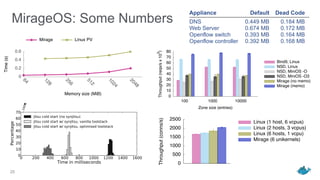
MirageOS: Some Numbers
25
Appliance Default Dead Code
DNS 0.449 MB 0.184 MB
Web Server 0.674 MB 0.172 MB
Openflow switch 0.393 MB 0.164 MB
Openflow controller 0.392 MB 0.168 MB
0
0.2
0.4
0.6
64
128
256
512
1024
2048
Time(s)
Memory size (MiB)
Mirage Linux PV
0
10
20
30
40
50
60
70
80
100 1000 10000
Throughput(reqs/sx10
3
)
Zone size (entries)
Bind9, Linux
NSD, Linux
NSD, MiniOS -O
NSD, MiniOS -O3
Mirage (no memo)
Mirage (memo)
0
500
1000
1500
2000
2500
Throughput(conns/s)
Linux (1 host, 6 vcpus)
Linux (2 hosts, 3 vcpus)
Linux (6 hosts, 1 vcpu)
Mirage (6 unikernels)

OSCON: Unikernels and Docker: From revolution to evolution

  • 1.
    Unikernels and Docker:‹ From Revolution to Evolution Richard Mortier, @mort___ Anil Madhavapeddy, @avsm
  • 2.
  • 3.
    
Or The NextTrillion Problems? ‱ Inherit existing system issues ‱ Security ‱ Speed ‱ Footprint ‱ Connected to the network ‱ But disconnected from each other ‱ No professional management ‱ Who will apply security updates? ‣ Must be intrinsically robust 3
  • 4.
    New Devices, OldSoftware Examples of generational bugs: ‱ Heartbleed ‱ 17% of all Internet secure web servers vulnerable to a single bug, described as "catastrophic" by Bruce Schneier ‱ ShellShock ‱ CGI, Web, DHCP all vulnerable to code execution ‱ Millions of sites vulnerable ‣ Will never be solved as we cannot physically find all affected IoT devices! 4
  • 5.
  • 6.
    Traditional Software: OnlyA Small Portion Used 6 KERNEL
  • 7.
    Microservices: Tip ofthe Iceberg No matter how simple the API endpoint, the OS kernel is always a huge dependency: ● Debian 5.0 is 65 million lines ● 
but the Linux Kernel is over 25 million lines (⅓) of that! 7 Code you want to run Code your OS insists you need!
  • 8.
    Revolution: Unikernels! Unikernels compileyour source code into a custom operating system that includes only the functionality required to support the application logic Code you want to run Operating system libraries + Standalone unikernel = 8
  • 9.
    ‱ Written inOCaml, an efficient systems language ‱ Distributed as many (100+) small libraries ‱ Self-hosted at mirage.io since 2009 ‱ From-scratch implementations of many protocols including TCP/IP, TLS ‱ Benefits include: ‱ Reduced attack surface ‱ Reduced resource use ‱ Predictable scheduling ‱ Many others — see unikernel.org ‱ Typically language-specific‹ e.g. HaLVM for Haskell or IncludeOS for C++ MirageOS: A Type-Safe Unikernel Framework 9 <https://en.wikipedia.org/wiki/Unikernel> 9 Xen ARM UNIX JavaScript Browser Kernel Module ABI FreeBSDJava Google App Engine A wide, and growing, range of backends Hardware Hypervisor I/O Stacks User Processes OS Kernel Kernel Threads Language Runtime Mirage Runtime x86 Hardware Hypervisor Application Code Application Binary unikernel appliance}Mirage Compiler ConïŹguration Files
  • 10.
    Not Reinventing theGeneral Purpose OS! ‱ Not trying to remake Windows or Linux ‱ The model is “just enough” systems software to run your application code ‱ Specialisation all the way down the stack ‱ Follow devops philosophy: ‱ Application developer in complete control ‱ Open source library base with liberal licenses 10
  • 11.
    Example: Rebuilding TLS ‱MirageOS wanted to avoid legacy, Heartbleed-vulnerable OpenSSL ‱ New TLS stack written in OCaml from scratch specifically for unikernels ‱ Coding started in Jan 2015, released in June 2015, see nqsb.io ‱ Code size: < 10 kloc – OpenSSL roughly 350 kloc – BoringSSL/LibreSSL 200 kloc – PolarSSL 50 kloc ‱ Most of the protocol written in safe code ‱ Not vulnerable to Heartbleed-style bugs 11 But how to see if this new code works in the real world?
  • 12.
    The Bitcoin Piñata ‱Put 10 Bitcoins into a unikernel service online built using MirageOS ‱ Invite the Internet to connect and try to break it ‱ If anyone breaks in, they can obtain the Bitcoin wallet and win! Results? ‱ Hundreds of thousands of attacks against the Bitcoin Piñata ‱ It was crashed — but rebooted in just a few milliseconds ‱ Nobody got the Bitcoins out of the Piñata, though some donated
 12 Bitcoin services is just a library, so easy to do this in a unikernel Imagine trying to build a Bitcoin Linux kernel module!
  • 13.
    Unikernels: Benefits ofSpecialisation Performance and Size ‱ Simple unikernels can be as small as kilobytes in size ‱ Similar to the “network appliances” that powered early Internet growth Multi-target ‱ Recompile application logic with different OS libraries for (e.g.,) IoT, JavaScript ‱ Portability as cloud evolves: don’t tie your application down needlessly Security and Correctness ‱ Type-safety can now infiltrate existing micro-service deployments ‱ Not limited to just application logic — system services too 13
  • 14.
    Unikernels: Steps Remain Management ‱Unikernel lifecycle management that is application-centric ‱ Clustering support Deployment ‱ Cloud APIs are not geared towards dust clouds ‱ Image management of unikernel libraries Ease of build ‱ Remove need for cross-compilation and integrate with IDE ecosystem ‱ Much functionality is exposed as libraries, but not all 14 All of these are solved with Docker!
  • 15.
  • 16.
  • 17.
    OCamlLabs MediaWiki: What’sGoing On? 17 mediawiki apache mysql http2https tlstunnel
  • 18.
    Docker is Movinginto Diverse Architectures Linux Containers ARM POWERx86 Windows Containers Windows HyperV Containers WIP: Solaris, FreeBSD, ... Operating System CPU Architecture 18 Recent Developments ● Docker on Windows Server TP5 and the Docker Hub ● Docker on the Raspberry Pi ● Build and Use Docker on the IBM POWER Linux ● Docker comes to FreeBSD
  • 19.
    Build, Ship, Run ‱Linux Containers, Windows Containers and, soon, Unikernels ‱ No physical infrastructure limitations ‱ Workloads in the datacenter are on a spectrum from physical machine to container hypervisor ‱ Only the Docker platform covers this ever-widening scope ‱ More flexibility for orchestrating hybrid applications 19 hardware (hypervisor) windows application application application application Windows Containers Server or Hyper-V hardware (hypervisor) linux application application application application Linux Containers Shared kernel hardware (hypervisor) app app app app os os os os Unikernels Specialised kernels
  • 20.
    From Revolution toEvolution How can we run Linux containers ‹ seamlessly on OSX and Windows? ‱ To date:‹ VirtualBox and a Linux virtual machine ‱ Docker for Mac & Windows:‹ Semantic OS translation layers convert filesystem and network calls from library hypervisor into Mac/Windows Results in Windows and Mac applications ‹ that “just run” Docker containers 20 An example of using unikernel libraries in unexpected ways... Now in beta! Signup at http://beta.docker.com
  • 21.
    Join Us: Becomea Pioneer! We just open sourced three components from Docker for Mac and Windows! ‱ HyperKit, a lightweight virtualization toolkit on OSX ‱ VPNKit, a library toolkit for embedding virtual networking ‱ DataKit, a modern UNIX pipeline framework for distributed components 21 Your code here!
  • 22.
  • 23.
    Join Us: Becomea Pioneer! We just open sourced three components from Docker for Mac and Windows! ‱ HyperKit, a lightweight virtualization toolkit on OSX ‱ VPNKit, a library toolkit for embedding virtual networking ‱ DataKit, a modern UNIX pipeline framework for distributed components Come along to the Contribute Docker session to hack! Tomorrow, 3—6pm, Meeting Room 6 23 Your code here!
  • 24.
    THANK YOU Particular thanksto the team, and to Hannes Mehnert and David Kaloper for leading the Bitcoin Piñata effort!
  • 25.
    MirageOS: Some Numbers 25 ApplianceDefault Dead Code DNS 0.449 MB 0.184 MB Web Server 0.674 MB 0.172 MB Openflow switch 0.393 MB 0.164 MB Openflow controller 0.392 MB 0.168 MB 0 0.2 0.4 0.6 64 128 256 512 1024 2048 Time(s) Memory size (MiB) Mirage Linux PV 0 10 20 30 40 50 60 70 80 100 1000 10000 Throughput(reqs/sx10 3 ) Zone size (entries) Bind9, Linux NSD, Linux NSD, MiniOS -O NSD, MiniOS -O3 Mirage (no memo) Mirage (memo) 0 500 1000 1500 2000 2500 Throughput(conns/s) Linux (1 host, 6 vcpus) Linux (2 hosts, 3 vcpus) Linux (6 hosts, 1 vcpu) Mirage (6 unikernels)