
EXPECTED VALUES OF WAVE POWER ABSORPTION
AROUND THE JAPANESE ISLANDS USING OWC TYPES
WITH PROJECTING WALLS
PRESENTED BY
SHAKKIR T (12NA30019)
Department of Ocean Engineering & Naval Architecture
IIT Kharagpur
Tomoki Ikoma
Dept. of Oceanic Architecture and Engineering
College of Science and Technology (CST),
Nihon University
Funabashi, Chiba, Japan
Hiroyuki Osawa
Dept. of Oceanic Architecture and Engineering
CST, Nihon University
Yokosuka, Kanagawa, Japan
Koichi Masuda
Dept. of Oceanic Architecture and Engineering
CST, Nihon University
Funabashi, Chiba, Japan
Hisaaki Maeda
Dept. of Oceanic Architecture and Engineering
CST, Nihon University
Funabashi, Chiba, Japan
INTRODUCTION
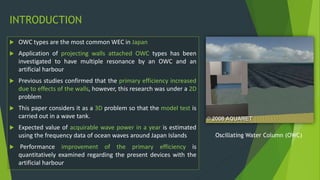
 OWC types are the most common WEC in Japan
 Application of projecting walls attached OWC types has been
investigated to have multiple resonance by an OWC and an
artificial harbour
 Previous studies confirmed that the primary efficiency increased
due to effects of the walls, however, this research was under a 2D
problem
 This paper considers it as a 3D problem so that the model test is
carried out in a wave tank.
 Expected value of acquirable wave power in a year is estimated
using the frequency data of ocean waves around Japan Islands
 Performance improvement of the primary efficiency is
quantitatively examined regarding the present devices with the
artificial harbour
Oscillating Water Column (OWC)
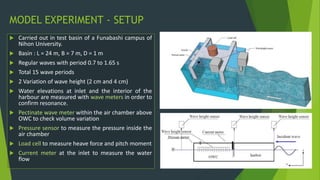
 Carried out in test basin of a Funabashi campus of
Nihon University.
 Basin : L = 24 m, B = 7 m, D = 1 m
 Regular waves with period 0.7 to 1.65 s
 Total 15 wave periods
 2 Variation of wave height (2 cm and 4 cm)
 Water elevations at inlet and the interior of the
harbour are measured with wave meters in order to
confirm resonance.
 Pectinate wave meter within the air chamber above
OWC to check volume variation
 Pressure sensor to measure the pressure inside the
air chamber
 Load cell to measure heave force and pitch moment
 Current meter at the inlet to measure the water
flow
MODEL EXPERIMENT - SETUP
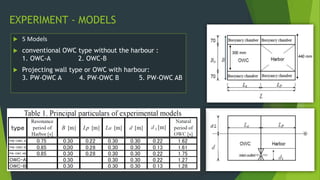
 5 Models
 conventional OWC type without the harbour :
1. OWC-A 2. OWC-B
 Projecting wall type or OWC with harbour:
3. PW-OWC A 4. PW-OWC B 5. PW-OWC AB
EXPERIMENT - MODELS
440 mm
300 mm
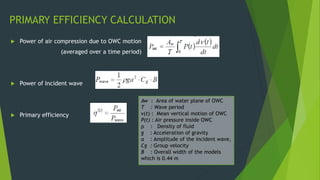
 Power of air compression due to OWC motion
(averaged over a time period)
 Power of Incident wave
 Primary efficiency
Aw : Area of water plane of OWC
T : Wave period
ν(t) : Mean vertical motion of OWC
P(t) : Air pressure inside OWC
ρ : Density of fluid
g : Acceleration of gravity
a : Amplitude of the incident wave,
Cg : Group velocity
B : Overall width of the models
which is 0.44 m
PRIMARY EFFICIENCY CALCULATION
PW-OWC A PW-OWC B PW-OWC AB
OWC A OWC B
RESULTS OF EFFICIENCY OF PRIMARY CONVERSION
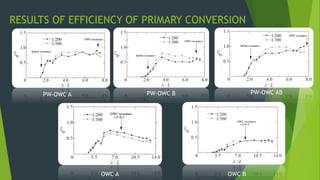
 Primary efficiency of the harbour attached models is clearly higher
 For harbour attached models efficiency doesn’t decrease in long wavelength range
 The nozzle ratio values (1/200 and 1/300) were decided from the results of Ikoma et al
 In case of the harbour attached models, the efficiency of a low nozzle ratio case is
higher than that of a large nozzle ratio one.
 Whereas in case of non harbour models, the tendency is reverse.
RESULTS OF EFFICIENCY OF PRIMARY CONVERSION
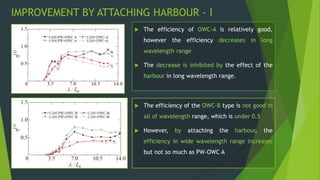
 The efficiency of OWC-A is relatively good,
however the efficiency decreases in long
wavelength range
 The decrease is inhibited by the effect of the
harbour in long wavelength range.
 The efficiency of the OWC-B type is not good in
all of wavelength range, which is under 0.5
 However, by attaching the harbour, the
efficiency in wide wavelength range increases
but not so much as PW-OWC A
IMPROVEMENT BY ATTACHING HARBOUR - I
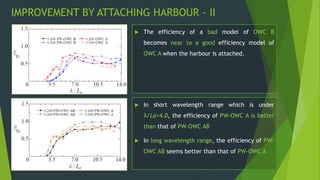
 The efficiency of a bad model of OWC B
becomes near to a good efficiency model of
OWC A when the harbour is attached.
 In short wavelength range which is under
λ/La<4.0, the efficiency of PW-OWC A is better
than that of PW-OWC AB
 In long wavelength range, the efficiency of PW-
OWC AB seems better than that of PW-OWC A
IMPROVEMENT BY ATTACHING HARBOUR - II
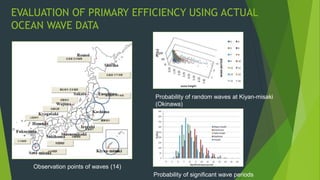
Observation points of waves (14)
Probability of random waves at Kiyan-misaki
(Okinawa)
Probability of significant wave periods
EVALUATION OF PRIMARY EFFICIENCY USING ACTUAL
OCEAN WAVE DATA
The wave power W ( per unit width )can be approximately obtained as
The appearance frequency of ocean waves is now assumed as ψ(H1/3, T1/3) using the significant wave height H1/3
and the significant wave period T1/3.
The year expected value E[Wa], which is in kW/m (kilo
watt per unit width), of the wave power can be expressed
as follows:
Expected values of wave power in every
season in an year at observation points
(unit: kilo watt per unit width)
The year expected value of the acquirable wave power
of the wave generation system is expressed as
Probability density function ϕ(H1/3, T1/3) can be defined as
On discretization
ESTIMATION OF YEAR EXPECTED VALUE OF POTENTIAL CAPACITY OF GENERATION POWER
EVALUATION OF HARBOUR ATTACHED OWC IN ACTUAL SEAS
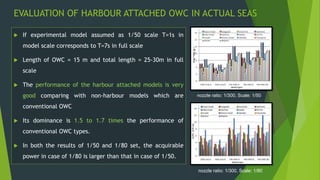
 If experimental model assumed as 1/50 scale T=1s in
model scale corresponds to T=7s in full scale
 Length of OWC = 15 m and total length = 25-30m in full
scale
 The performance of the harbour attached models is very
good comparing with non-harbour models which are
conventional OWC
 Its dominance is 1.5 to 1.7 times the performance of
conventional OWC types.
 In both the results of 1/50 and 1/80 set, the acquirable
power in case of 1/80 is larger than that in case of 1/50.
nozzle ratio: 1/300, Scale: 1/50
nozzle ratio: 1/300, Scale: 1/80
WINTER SEASONSPRING SEASON
SUMMER SEASONAUTUMN SEASON
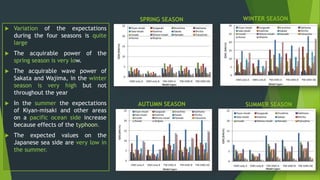
 Variation of the expectations
during the four seasons is quite
large
 The acquirable power of the
spring season is very low.
 The acquirable wave power of
Sakata and Wajima, in the winter
season is very high but not
throughout the year
 In the summer the expectations
of Kiyan-misaki and other areas
on a pacific ocean side increase
because effects of the typhoon.
 The expected values on the
Japanese sea side are very low in
the summer.
CONCLUSIONS
 Effects of the artificial harbour attaching to the conventional OWC type system in order to
improve the primary efficiency was investigated.
 Model experiments were carried out and the evaluation of the performance using the year
expected value of the acquirable wave power were performed
 Installation of the artificial harbour is very much effective in order to improve the primary
efficiency of wave power absorption.
 Using the fixed OWC system proposed, we can get a few kilo watts per unit width around the
Japanese islands.
 Whereas in case of floating systems, it is important to keep a good primary efficiency in wide
wave period range for utilization of wave power on seas around the Japanese islands.
REFERENCES
 Hiroyuki Osawa, Yukihisa Washio, Tsuyoshi Miyazaki,Taira Hotta and Takeaki Miyazaki, “R&D ofTechnologies of
Wave Energy Application - Developmentof Offshore Floating Wave Power Device named Mighty- Whale-,”
JAMSTEC, 2004.
 Kazutaka Toyoda, Shuichi Nagata, and other 4 persons,“Experimental Study on Primary Energy
ConversionCharacteristics of Backward Bent Duct Buoy,” J. ofJASNAOE, Vol. 6, pp.247-255, 2007.
 Hisaaki Maeda, Yasufumi Onishi, Chang-Kyu Rheem,Tomoki Ikoma and other 3 persons, “Flexible Response
Reduction on a Very Large Floating Structure due toOWC Wave Power Devices,” J. of the Society of Naval
Architects of Japan, Vol. 188, pp.279-285, 2000.
 Tomoki Ikoma, Hiroyuki Osawa and other 3 persons,“Improvement of the Primary Conversion of the OWC
system by Attaching the Artificial Harbor for WavePower Absorption,” Procs. of the 21st Ocean Engineering
Symposium, OES21-156, CD-ROM, 2009.
 JAMSTEC, “Technical Manual for OWC Type Wave Power Devices,” 2004.
THANK YOU

Oscillating Water Column (OWC) with Projecting Walls

  • 1.
    EXPECTED VALUES OFWAVE POWER ABSORPTION AROUND THE JAPANESE ISLANDS USING OWC TYPES WITH PROJECTING WALLS PRESENTED BY SHAKKIR T (12NA30019) Department of Ocean Engineering & Naval Architecture IIT Kharagpur Tomoki Ikoma Dept. of Oceanic Architecture and Engineering College of Science and Technology (CST), Nihon University Funabashi, Chiba, Japan Hiroyuki Osawa Dept. of Oceanic Architecture and Engineering CST, Nihon University Yokosuka, Kanagawa, Japan Koichi Masuda Dept. of Oceanic Architecture and Engineering CST, Nihon University Funabashi, Chiba, Japan Hisaaki Maeda Dept. of Oceanic Architecture and Engineering CST, Nihon University Funabashi, Chiba, Japan
  • 2.
    INTRODUCTION  OWC typesare the most common WEC in Japan  Application of projecting walls attached OWC types has been investigated to have multiple resonance by an OWC and an artificial harbour  Previous studies confirmed that the primary efficiency increased due to effects of the walls, however, this research was under a 2D problem  This paper considers it as a 3D problem so that the model test is carried out in a wave tank.  Expected value of acquirable wave power in a year is estimated using the frequency data of ocean waves around Japan Islands  Performance improvement of the primary efficiency is quantitatively examined regarding the present devices with the artificial harbour Oscillating Water Column (OWC)
  • 3.
     Carried outin test basin of a Funabashi campus of Nihon University.  Basin : L = 24 m, B = 7 m, D = 1 m  Regular waves with period 0.7 to 1.65 s  Total 15 wave periods  2 Variation of wave height (2 cm and 4 cm)  Water elevations at inlet and the interior of the harbour are measured with wave meters in order to confirm resonance.  Pectinate wave meter within the air chamber above OWC to check volume variation  Pressure sensor to measure the pressure inside the air chamber  Load cell to measure heave force and pitch moment  Current meter at the inlet to measure the water flow MODEL EXPERIMENT - SETUP
  • 4.
     5 Models conventional OWC type without the harbour : 1. OWC-A 2. OWC-B  Projecting wall type or OWC with harbour: 3. PW-OWC A 4. PW-OWC B 5. PW-OWC AB EXPERIMENT - MODELS 440 mm 300 mm
  • 5.
     Power ofair compression due to OWC motion (averaged over a time period)  Power of Incident wave  Primary efficiency Aw : Area of water plane of OWC T : Wave period ν(t) : Mean vertical motion of OWC P(t) : Air pressure inside OWC ρ : Density of fluid g : Acceleration of gravity a : Amplitude of the incident wave, Cg : Group velocity B : Overall width of the models which is 0.44 m PRIMARY EFFICIENCY CALCULATION
  • 6.
    PW-OWC A PW-OWCB PW-OWC AB OWC A OWC B RESULTS OF EFFICIENCY OF PRIMARY CONVERSION
  • 7.
     Primary efficiencyof the harbour attached models is clearly higher  For harbour attached models efficiency doesn’t decrease in long wavelength range  The nozzle ratio values (1/200 and 1/300) were decided from the results of Ikoma et al  In case of the harbour attached models, the efficiency of a low nozzle ratio case is higher than that of a large nozzle ratio one.  Whereas in case of non harbour models, the tendency is reverse. RESULTS OF EFFICIENCY OF PRIMARY CONVERSION
  • 8.
     The efficiencyof OWC-A is relatively good, however the efficiency decreases in long wavelength range  The decrease is inhibited by the effect of the harbour in long wavelength range.  The efficiency of the OWC-B type is not good in all of wavelength range, which is under 0.5  However, by attaching the harbour, the efficiency in wide wavelength range increases but not so much as PW-OWC A IMPROVEMENT BY ATTACHING HARBOUR - I
  • 9.
     The efficiencyof a bad model of OWC B becomes near to a good efficiency model of OWC A when the harbour is attached.  In short wavelength range which is under λ/La<4.0, the efficiency of PW-OWC A is better than that of PW-OWC AB  In long wavelength range, the efficiency of PW- OWC AB seems better than that of PW-OWC A IMPROVEMENT BY ATTACHING HARBOUR - II
  • 10.
    Observation points ofwaves (14) Probability of random waves at Kiyan-misaki (Okinawa) Probability of significant wave periods EVALUATION OF PRIMARY EFFICIENCY USING ACTUAL OCEAN WAVE DATA
  • 11.
    The wave powerW ( per unit width )can be approximately obtained as The appearance frequency of ocean waves is now assumed as ψ(H1/3, T1/3) using the significant wave height H1/3 and the significant wave period T1/3. The year expected value E[Wa], which is in kW/m (kilo watt per unit width), of the wave power can be expressed as follows: Expected values of wave power in every season in an year at observation points (unit: kilo watt per unit width) The year expected value of the acquirable wave power of the wave generation system is expressed as Probability density function ϕ(H1/3, T1/3) can be defined as On discretization ESTIMATION OF YEAR EXPECTED VALUE OF POTENTIAL CAPACITY OF GENERATION POWER
  • 12.
    EVALUATION OF HARBOURATTACHED OWC IN ACTUAL SEAS  If experimental model assumed as 1/50 scale T=1s in model scale corresponds to T=7s in full scale  Length of OWC = 15 m and total length = 25-30m in full scale  The performance of the harbour attached models is very good comparing with non-harbour models which are conventional OWC  Its dominance is 1.5 to 1.7 times the performance of conventional OWC types.  In both the results of 1/50 and 1/80 set, the acquirable power in case of 1/80 is larger than that in case of 1/50. nozzle ratio: 1/300, Scale: 1/50 nozzle ratio: 1/300, Scale: 1/80
  • 13.
    WINTER SEASONSPRING SEASON SUMMERSEASONAUTUMN SEASON  Variation of the expectations during the four seasons is quite large  The acquirable power of the spring season is very low.  The acquirable wave power of Sakata and Wajima, in the winter season is very high but not throughout the year  In the summer the expectations of Kiyan-misaki and other areas on a pacific ocean side increase because effects of the typhoon.  The expected values on the Japanese sea side are very low in the summer.
  • 14.
    CONCLUSIONS  Effects ofthe artificial harbour attaching to the conventional OWC type system in order to improve the primary efficiency was investigated.  Model experiments were carried out and the evaluation of the performance using the year expected value of the acquirable wave power were performed  Installation of the artificial harbour is very much effective in order to improve the primary efficiency of wave power absorption.  Using the fixed OWC system proposed, we can get a few kilo watts per unit width around the Japanese islands.  Whereas in case of floating systems, it is important to keep a good primary efficiency in wide wave period range for utilization of wave power on seas around the Japanese islands.
  • 15.
    REFERENCES  Hiroyuki Osawa,Yukihisa Washio, Tsuyoshi Miyazaki,Taira Hotta and Takeaki Miyazaki, “R&D ofTechnologies of Wave Energy Application - Developmentof Offshore Floating Wave Power Device named Mighty- Whale-,” JAMSTEC, 2004.  Kazutaka Toyoda, Shuichi Nagata, and other 4 persons,“Experimental Study on Primary Energy ConversionCharacteristics of Backward Bent Duct Buoy,” J. ofJASNAOE, Vol. 6, pp.247-255, 2007.  Hisaaki Maeda, Yasufumi Onishi, Chang-Kyu Rheem,Tomoki Ikoma and other 3 persons, “Flexible Response Reduction on a Very Large Floating Structure due toOWC Wave Power Devices,” J. of the Society of Naval Architects of Japan, Vol. 188, pp.279-285, 2000.  Tomoki Ikoma, Hiroyuki Osawa and other 3 persons,“Improvement of the Primary Conversion of the OWC system by Attaching the Artificial Harbor for WavePower Absorption,” Procs. of the 21st Ocean Engineering Symposium, OES21-156, CD-ROM, 2009.  JAMSTEC, “Technical Manual for OWC Type Wave Power Devices,” 2004.
  • 16.