HY D R O D Y N A M I C S OF TH E IPS BU O Y WA V E EN E R G Y CO N V E R T E R
IN C L U D I N G TH E EF F E C T OF NO N -UN I F O R M AC C E L E R A T I O N TU B E
CR O S S SE C T I O N
A N T Ó N I O F . O . F A L C Ã O
J O S É J . C Â N D I D O
P A U L O A . P . J U S T I N O
J O Ã O C . C . H E N R I Q U E S
IPS Buoy
Abhishek Mondal
IIT Kharagpur
IDMEC, Instituto Superior Técnico, Technical University of Lisbon, 1049-001 Lisbon, Portugal
Laboratório Nacional de Energia e Geologia, Estrada Paço do Lumiar, 1649-038 Lisbon, Portugal
1
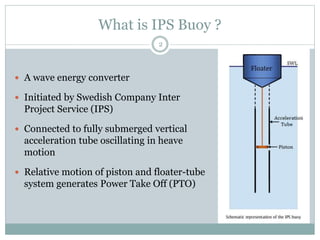
What is IPS Buoy ?
 A wave energy converter
 Initiated by Swedish Company Inter
Project Service (IPS)
 Connected to fully submerged vertical
acceleration tube oscillating in heave
motion
 Relative motion of piston and floater-tube
system generates Power Take Off (PTO)
2
Assumptions
The buoy-tube-piston system is mathematically modelled using the
following assumptions :
 Buoy-tube system has heave motion only
 The tube is sufficiently below the water surface; thus the
excitation & radiation force become negligible.
 Negligible interaction between the wave fields at tube ends
 Flow inside the tube is one dimensional
 Piston has negligible length and mass
3
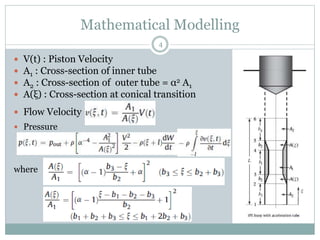
Mathematical Modelling
 V(t) : Piston Velocity
 A1 : Cross-section of inner tube
 A2 : Cross-section of outer tube = α2 A1
 A(ξ) : Cross-section at conical transition
 Flow Velocity
 Pressure
where
4
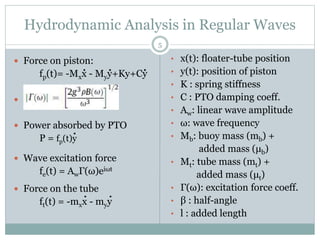
Hydrodynamic Analysis in Regular Waves
 Force on piston:
fp(t)= -Mxx - Myy+Ky+Cy

 Power absorbed by PTO
P = fp(t)y
 Wave excitation force
fe(t) = AwΓ(ω)eiωt
 Force on the tube
ft(t) = -mxx - myy
• x(t): floater-tube position
• y(t): position of piston
• K : spring stiffness
• C : PTO damping coeff.
• Aw: linear wave amplitude
• ω: wave frequency
• Mb: buoy mass (mb) +
added mass (μb)
• Mt: tube mass (mt) +
added mass (μt)
• Γ(ω): excitation force coeff.
• β : half-angle
• l : added length
5
Hydrodynamic Analysis in Regular Waves
6
Where
Mx = ρA1(L+2l)
My = ρA1(b1+α-2(b3+b4+2l)+2b2α-1)
mx = ρA1[0.667b2(α2+α-2) + (α2 -1)(b3+b4+2l)]
my = ρA1[2b2(1 - α-1) + (1 – α-2)
 Equation of motion :
 {x(t), y(t), fe(t)} = {X, Y, Fe}eiωt
(Mb+Mt)x + Bx + ρgSx = fe(t) + ft(t) + fp(t)
Hydrodynamic Analysis in Regular Waves
7
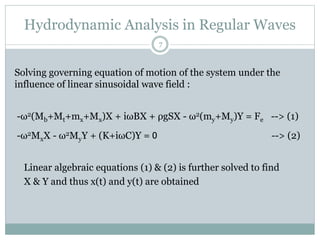
Solving governing equation of motion of the system under the
influence of linear sinusoidal wave field :
-ω2(Mb+Mt+mx+Mx)X + iωBX + ρgSX - ω2(my+My)Y = Fe --> (1)
-ω2MxX - ω2MyY + (K+iωC)Y = 0 --> (2)
Linear algebraic equations (1) & (2) is further solved to find
X & Y and thus x(t) and y(t) are obtained
Numerical Results in Regular Waves
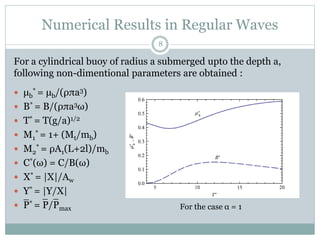
For a cylindrical buoy of radius a submerged upto the depth a,
following non-dimentional parameters are obtained :
 μb
* = μb/(ρπa3)
 B* = B/(ρπa3ω)
 T* = T(g/a)1/2
 M1
* = 1+ (Mt/mb)
 M2
* = ρA1(L+2l)/mb
 C*(ω) = C/B(ω)
 X* = |X|/Aw
 Y* = |Y/X|
 P* = P/Pmax
8
For the case α = 1
_ _ _
Numerical Results in Regular Waves
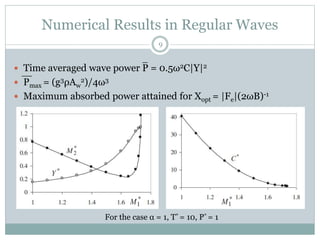
 Time averaged wave power P = 0.5ω2C|Y|2
 Pmax = (g3ρAw
2)/4ω3
 Maximum absorbed power attained for Xopt = |Fe|(2ωB)-1
9
For the case α = 1, T* = 10, P* = 1
_
__
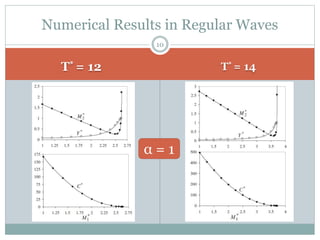
T* = 12 T* = 14
10
Numerical Results in Regular Waves
α = 1
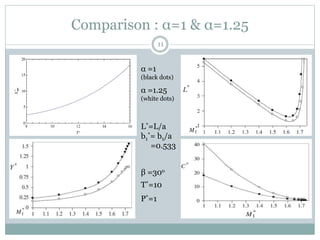
Comparison : α=1 & α=1.25
11
α =1
(black dots)
α =1.25
(white dots)
L*=L/a
b1
*= b1/a
=0.533
β =30o
T*=10
P*=1
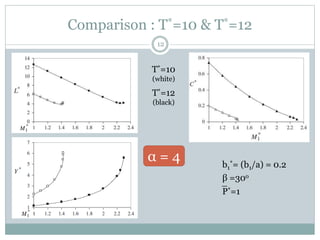
Comparison : T*=10 & T*=12
12
T*=10
(white)
T*=12
(black)
b1
*= (b1/a) = 0.2
β =30o
P*=1
α = 4
_
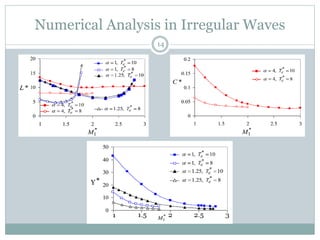
Numerical Analysis in Irregular Waves
 Pierson-Moskowitz spectral distribution :
S(ω) = 526Hs
2 Te
-4 ω-5 exp(-1054 Te
-4 ω-4 )
[ Hs : Significant wave height ; Te: Energy period ]
 Time averaged power in irregular wave :
Pirr(Hs , Te) = ∫ Preg(ω) S(ω) dω
Pirr,max = 149.5 Hs
2 Te
3
 Non-dimensionalized parameters :
Te
* = Te (g/a)1/2 ; Pirr
* = Pirr/Pirr,max ; D2
* = D2/a
13
0
__
__
__
S(ω) = 526Hs
2 Te
-4 ω-5 exp(-1054 Te
-4 ω-4 )
Numerical Analysis in Irregular Waves
14
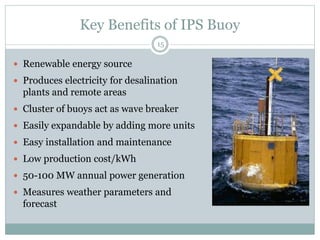
Key Benefits of IPS Buoy
15
 Renewable energy source
 Produces electricity for desalination
plants and remote areas
 Cluster of buoys act as wave breaker
 Easily expandable by adding more units
 Easy installation and maintenance
 Low production cost/kWh
 50-100 MW annual power generation
 Measures weather parameters and
forecast
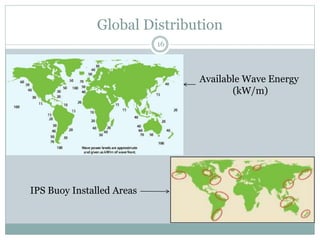
Global Distribution
16
Available Wave Energy
(kW/m)
IPS Buoy Installed Areas
References
17
 Falcão AF de O. Wave energy utilization: a review of the technologies. Renew
Sust Energy Rev 2010; 14:899-918.
 Masuda Y. Wave-activated generator. Int. colloq. exposition oceans, Bordeaux,
France; 1971.
 Noren SA. Apparatus for recovering the kinetic energy of sea waves. US Patent
No. 4,773,221; 1988 [original Swedish Patent No. 8104407; 1981].
 Salter SH, Lin CP. Wide tank efficiency measurements on a model of the sloped
IPS buoy. In: Proc. 3rd European wave energy conf., Patras, Greece; 1998. p.
200-6.
 Evans DV. The oscillating water column wave-energy device. J Inst Math Appl
1978;22:423-33.
 Munson BR, Young DF, Okiishi TH. Fundamentals of fluid mechanics. 2nd ed.
New York: Wiley; 1994
 Falnes J. Optimum control of oscillation of wave-energy converters. Int J
Offshore Polar Eng 2002;12:147-55.
FOR
YOUR
ATTENTION
18
THANKS

IPS Buoy

  • 1.
    HY D RO D Y N A M I C S OF TH E IPS BU O Y WA V E EN E R G Y CO N V E R T E R IN C L U D I N G TH E EF F E C T OF NO N -UN I F O R M AC C E L E R A T I O N TU B E CR O S S SE C T I O N A N T Ó N I O F . O . F A L C Ã O J O S É J . C Â N D I D O P A U L O A . P . J U S T I N O J O Ã O C . C . H E N R I Q U E S IPS Buoy Abhishek Mondal IIT Kharagpur IDMEC, Instituto Superior Técnico, Technical University of Lisbon, 1049-001 Lisbon, Portugal Laboratório Nacional de Energia e Geologia, Estrada Paço do Lumiar, 1649-038 Lisbon, Portugal 1
  • 2.
    What is IPSBuoy ?  A wave energy converter  Initiated by Swedish Company Inter Project Service (IPS)  Connected to fully submerged vertical acceleration tube oscillating in heave motion  Relative motion of piston and floater-tube system generates Power Take Off (PTO) 2
  • 3.
    Assumptions The buoy-tube-piston systemis mathematically modelled using the following assumptions :  Buoy-tube system has heave motion only  The tube is sufficiently below the water surface; thus the excitation & radiation force become negligible.  Negligible interaction between the wave fields at tube ends  Flow inside the tube is one dimensional  Piston has negligible length and mass 3
  • 4.
    Mathematical Modelling  V(t): Piston Velocity  A1 : Cross-section of inner tube  A2 : Cross-section of outer tube = α2 A1  A(ξ) : Cross-section at conical transition  Flow Velocity  Pressure where 4
  • 5.
    Hydrodynamic Analysis inRegular Waves  Force on piston: fp(t)= -Mxx - Myy+Ky+Cy   Power absorbed by PTO P = fp(t)y  Wave excitation force fe(t) = AwΓ(ω)eiωt  Force on the tube ft(t) = -mxx - myy • x(t): floater-tube position • y(t): position of piston • K : spring stiffness • C : PTO damping coeff. • Aw: linear wave amplitude • ω: wave frequency • Mb: buoy mass (mb) + added mass (μb) • Mt: tube mass (mt) + added mass (μt) • Γ(ω): excitation force coeff. • β : half-angle • l : added length 5
  • 6.
    Hydrodynamic Analysis inRegular Waves 6 Where Mx = ρA1(L+2l) My = ρA1(b1+α-2(b3+b4+2l)+2b2α-1) mx = ρA1[0.667b2(α2+α-2) + (α2 -1)(b3+b4+2l)] my = ρA1[2b2(1 - α-1) + (1 – α-2)  Equation of motion :  {x(t), y(t), fe(t)} = {X, Y, Fe}eiωt (Mb+Mt)x + Bx + ρgSx = fe(t) + ft(t) + fp(t)
  • 7.
    Hydrodynamic Analysis inRegular Waves 7 Solving governing equation of motion of the system under the influence of linear sinusoidal wave field : -ω2(Mb+Mt+mx+Mx)X + iωBX + ρgSX - ω2(my+My)Y = Fe --> (1) -ω2MxX - ω2MyY + (K+iωC)Y = 0 --> (2) Linear algebraic equations (1) & (2) is further solved to find X & Y and thus x(t) and y(t) are obtained
  • 8.
    Numerical Results inRegular Waves For a cylindrical buoy of radius a submerged upto the depth a, following non-dimentional parameters are obtained :  μb * = μb/(ρπa3)  B* = B/(ρπa3ω)  T* = T(g/a)1/2  M1 * = 1+ (Mt/mb)  M2 * = ρA1(L+2l)/mb  C*(ω) = C/B(ω)  X* = |X|/Aw  Y* = |Y/X|  P* = P/Pmax 8 For the case α = 1 _ _ _
  • 9.
    Numerical Results inRegular Waves  Time averaged wave power P = 0.5ω2C|Y|2  Pmax = (g3ρAw 2)/4ω3  Maximum absorbed power attained for Xopt = |Fe|(2ωB)-1 9 For the case α = 1, T* = 10, P* = 1 _ __
  • 10.
    T* = 12T* = 14 10 Numerical Results in Regular Waves α = 1
  • 11.
    Comparison : α=1& α=1.25 11 α =1 (black dots) α =1.25 (white dots) L*=L/a b1 *= b1/a =0.533 β =30o T*=10 P*=1
  • 12.
    Comparison : T*=10& T*=12 12 T*=10 (white) T*=12 (black) b1 *= (b1/a) = 0.2 β =30o P*=1 α = 4 _
  • 13.
    Numerical Analysis inIrregular Waves  Pierson-Moskowitz spectral distribution : S(ω) = 526Hs 2 Te -4 ω-5 exp(-1054 Te -4 ω-4 ) [ Hs : Significant wave height ; Te: Energy period ]  Time averaged power in irregular wave : Pirr(Hs , Te) = ∫ Preg(ω) S(ω) dω Pirr,max = 149.5 Hs 2 Te 3  Non-dimensionalized parameters : Te * = Te (g/a)1/2 ; Pirr * = Pirr/Pirr,max ; D2 * = D2/a 13 0 __ __ __ S(ω) = 526Hs 2 Te -4 ω-5 exp(-1054 Te -4 ω-4 )
  • 14.
    Numerical Analysis inIrregular Waves 14
  • 15.
    Key Benefits ofIPS Buoy 15  Renewable energy source  Produces electricity for desalination plants and remote areas  Cluster of buoys act as wave breaker  Easily expandable by adding more units  Easy installation and maintenance  Low production cost/kWh  50-100 MW annual power generation  Measures weather parameters and forecast
  • 16.
    Global Distribution 16 Available WaveEnergy (kW/m) IPS Buoy Installed Areas
  • 17.
    References 17  Falcão AFde O. Wave energy utilization: a review of the technologies. Renew Sust Energy Rev 2010; 14:899-918.  Masuda Y. Wave-activated generator. Int. colloq. exposition oceans, Bordeaux, France; 1971.  Noren SA. Apparatus for recovering the kinetic energy of sea waves. US Patent No. 4,773,221; 1988 [original Swedish Patent No. 8104407; 1981].  Salter SH, Lin CP. Wide tank efficiency measurements on a model of the sloped IPS buoy. In: Proc. 3rd European wave energy conf., Patras, Greece; 1998. p. 200-6.  Evans DV. The oscillating water column wave-energy device. J Inst Math Appl 1978;22:423-33.  Munson BR, Young DF, Okiishi TH. Fundamentals of fluid mechanics. 2nd ed. New York: Wiley; 1994  Falnes J. Optimum control of oscillation of wave-energy converters. Int J Offshore Polar Eng 2002;12:147-55.
  • 18.