 An operating system (OS) is software that
manages computer hardware and software
resources and provides common services for
computer programs.
 Gary Kildall developed the first operating
system for the PC.
 Operating System is a software, which makes
a computer to actually work.
 Written in low-level language.
 Gary Kildall developed the first operating system for the PC, text-
based, he was indeed a pioneer in this regard. He was also an
innovator, he restructured the operating system to be hardware-
independent.
 Gary Kildall was born on May 19, 1942 in Seattle, Washington.
Sadly he is no longer with us, he past away in 1994; but the fruits
of his labour will live on.
 The Operating System was, and still is, quintessential to the
advances and development of the modern computer, without it
there would be no interaction, as we know it, between computer
and usersThus the computer would have remained a one
dimensional, flat system. But for the advent of the first operating
system, for PC, by Gary Kildall , another rung on the ladder
bringing the product closer to a potential, mass market.
 It is unchallengeable, without the Operating System PCs couldn't
'be on every office desk, and in every home', Bill Gates; at least on
the scale it is today
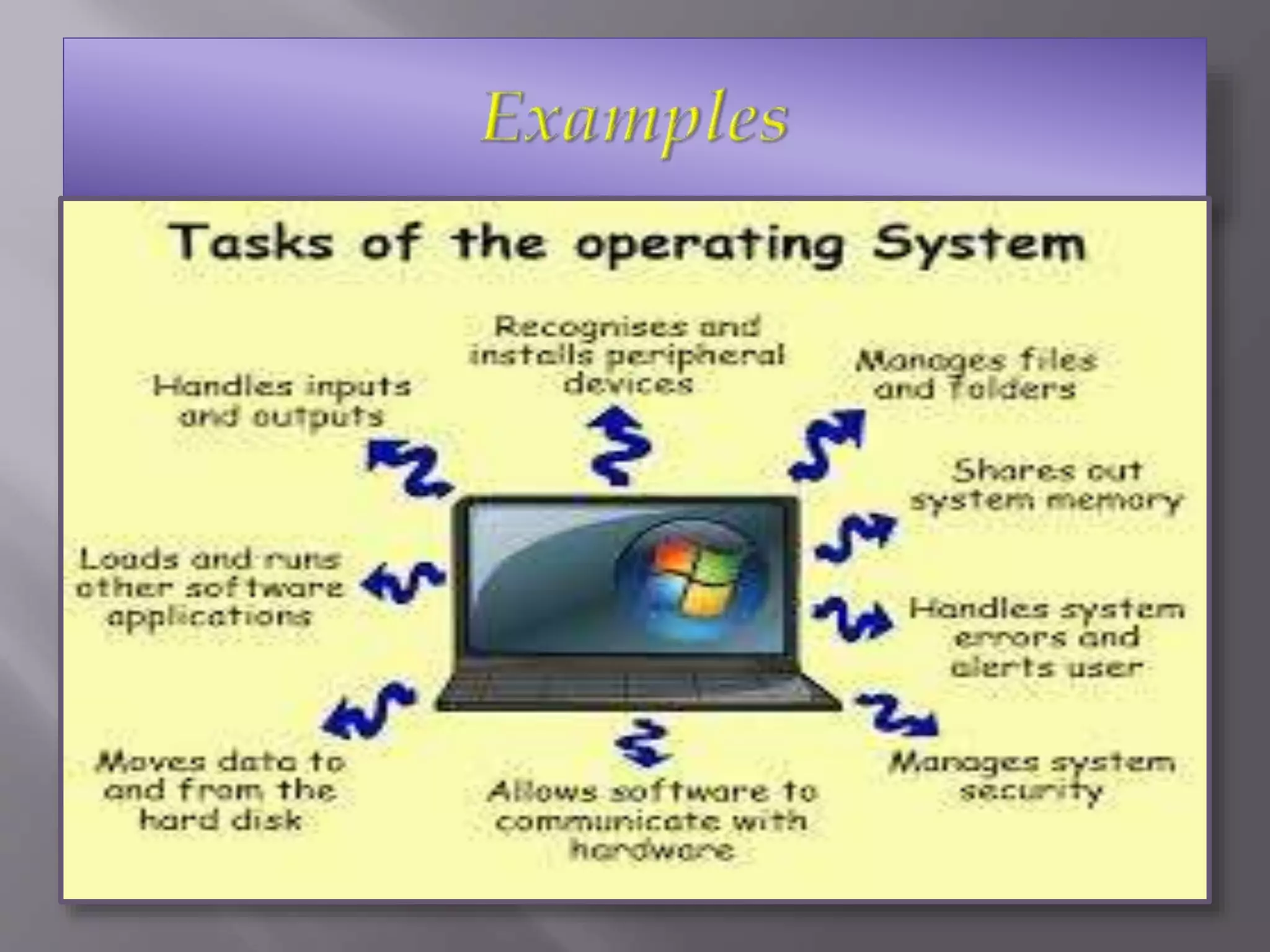
 Device configuration: Controls peripherals devices
connected to the computer.
 Management resources: Transfers files between main
memory and secondary storage,manage use of the
CPU,allocates memory to the requesting processes.
 Interact with the user: Interacts between the
computer and users/operator in a managed way.
 Interface Platform: It allows the computer to run
other applications.
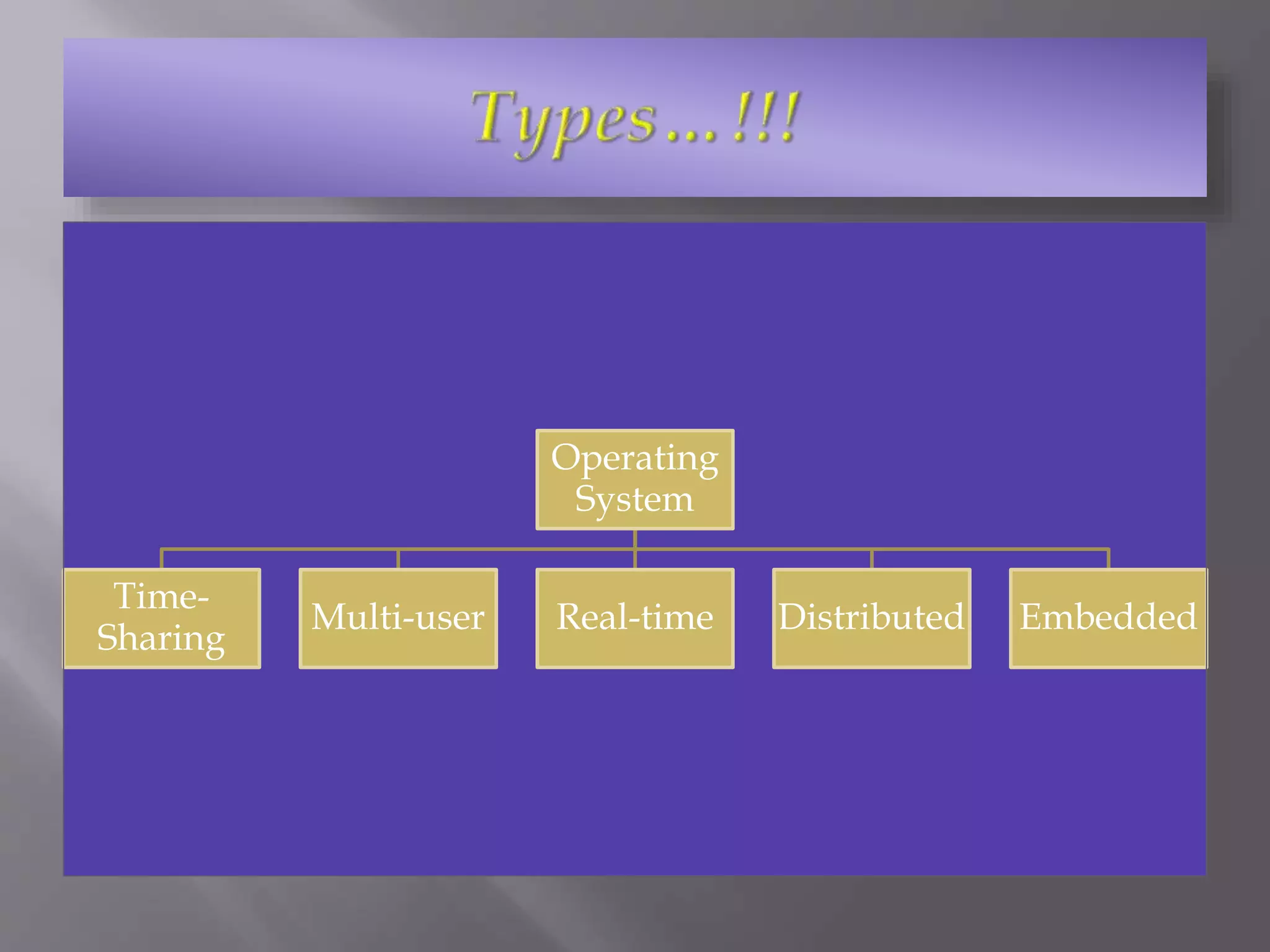
Operating
System
Time-
Sharing
Multi-user Real-time Distributed Embedded
 Time-sharing: Allows more than one program to be
running in concurrency.
 Multi-user: the system permits multiple users to
interact with the system at the same time.
 Real-time: Responds to input instantly.e.g.,interrupt
error in computer systems. General-purpose
operating systems, such as DOS and UNIX, are not
real-time.
 Distributed: A distributed operating system
manages a group of distinct computers and makes
them appear to be a single computer.
 Embedded: Embedded operating systems are
designed to be used in embedded computer systems.
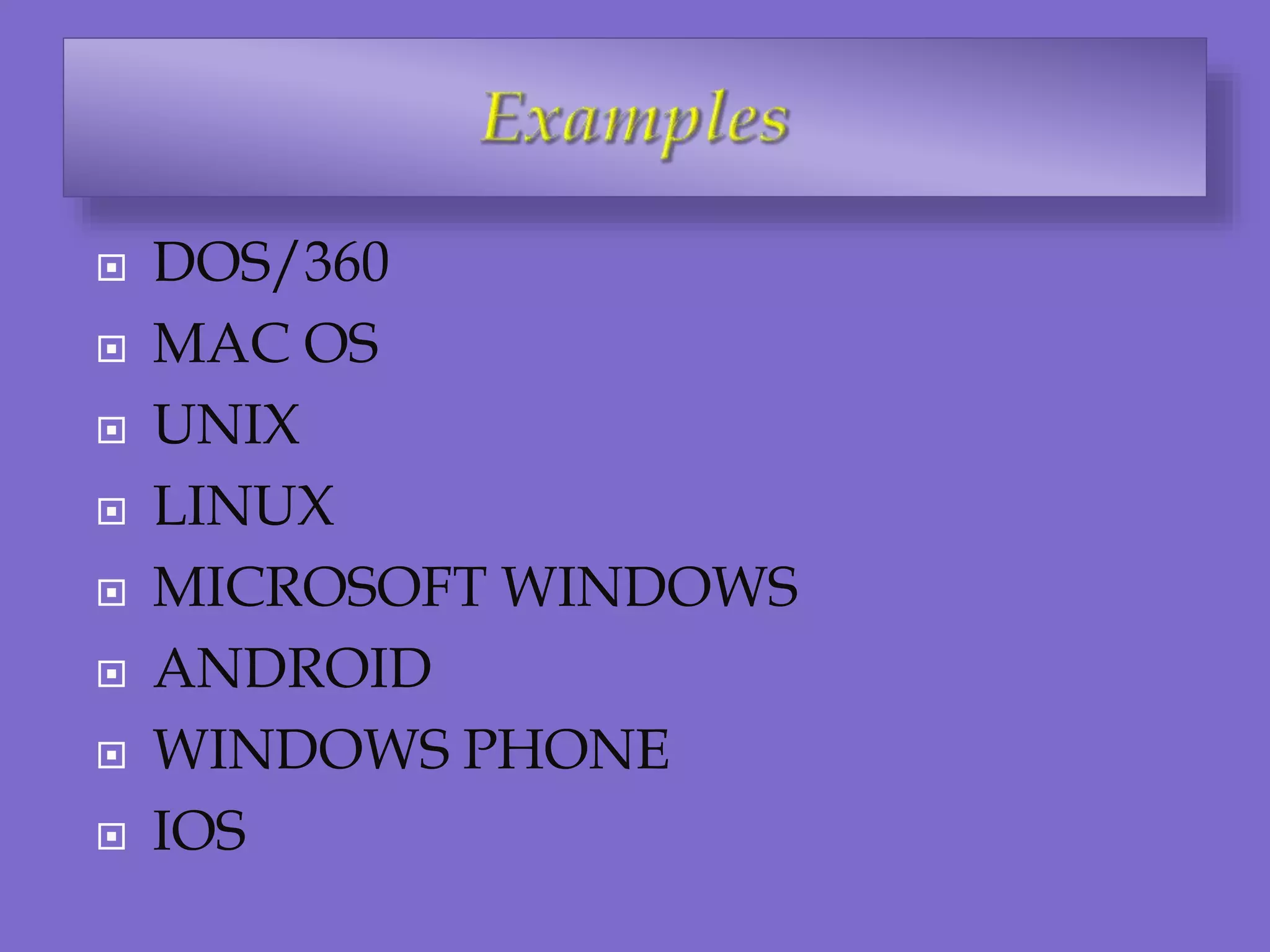
 DOS/360
 MAC OS
 UNIX
 LINUX
 MICROSOFT WINDOWS
 ANDROID
 WINDOWS PHONE
 IOS
OS
Kernel Networking Security
User-
interface
 Kernel: A kernel connects the application software to the
hardware of a computer.
 Networking: Networks can essentially allow a computer's
operating system to access the resources of a remote
computer to support the same functions as it could if those
resources were connected directly to the local computer.
 Security: A modern operating system provides access to a
number of resources, which are available to software
running on the system, and to external devices like
networks via the kernel.
 User-interface: The user interface is usually referred to as
a shell and is essential if human interaction is to be
supported.
It has meant that the computer industry has only three
main contenders in the present market place.
1. The OS sector of the industry has shrunk, and it
appears to have further shrinkage, leaving the way
clear for Apple and Microsoft, OS/2 not in the
running, which means Microsoft will completely
dominate the market. The implication here is,
customers will not have much of a choice.
2. PC manufactures and Software developers, it would
appear, will be at the mercy of Microsoft and its OSs
(range); the implication then, Microsoft would have
exclusive control
(contd...)
of the global market, getting stronger by the day.
3. On each office desktop, and in each home, microsoft
OSs and applications would be running, along with
third party applications, with a common operating
system and application interface, under the directions
of microsoft designs and determined directions. The
implication here is, one large company would have
sole control of the computer industry future; which
cannot be a good thing for the industry nor for its
customer base - it would imply anti-competitive
practices and a strangle hold on software
development.
 Without Operating system the computers cannot run
the application and we cannot do work in the
computer.
 The operating system in its current form empowers
users of all ages, as well as small, medium and large
businesses – from children whose needs are only to
play games and access the internet; to more
specialised, productive and engineer/constructive areas
of work: secretarial, household economies to large
corporations (each member of staff) – in its use and
functions, across a range of platforms/architectures, as
never before.
 1. Richa Pandey
 2. Rohit Singh
 3. Rishav Kumar
 4. Rohan Sarkhel
 5. Rohan Jash
 6. Ravi Kumar
Os presentation
Os presentation

Os presentation

  • 2.
     An operatingsystem (OS) is software that manages computer hardware and software resources and provides common services for computer programs.  Gary Kildall developed the first operating system for the PC.  Operating System is a software, which makes a computer to actually work.  Written in low-level language.
  • 3.
     Gary Kildalldeveloped the first operating system for the PC, text- based, he was indeed a pioneer in this regard. He was also an innovator, he restructured the operating system to be hardware- independent.  Gary Kildall was born on May 19, 1942 in Seattle, Washington. Sadly he is no longer with us, he past away in 1994; but the fruits of his labour will live on.  The Operating System was, and still is, quintessential to the advances and development of the modern computer, without it there would be no interaction, as we know it, between computer and usersThus the computer would have remained a one dimensional, flat system. But for the advent of the first operating system, for PC, by Gary Kildall , another rung on the ladder bringing the product closer to a potential, mass market.  It is unchallengeable, without the Operating System PCs couldn't 'be on every office desk, and in every home', Bill Gates; at least on the scale it is today
  • 5.
     Device configuration:Controls peripherals devices connected to the computer.  Management resources: Transfers files between main memory and secondary storage,manage use of the CPU,allocates memory to the requesting processes.  Interact with the user: Interacts between the computer and users/operator in a managed way.  Interface Platform: It allows the computer to run other applications.
  • 7.
  • 8.
     Time-sharing: Allowsmore than one program to be running in concurrency.  Multi-user: the system permits multiple users to interact with the system at the same time.  Real-time: Responds to input instantly.e.g.,interrupt error in computer systems. General-purpose operating systems, such as DOS and UNIX, are not real-time.  Distributed: A distributed operating system manages a group of distinct computers and makes them appear to be a single computer.  Embedded: Embedded operating systems are designed to be used in embedded computer systems.
  • 9.
     DOS/360  MACOS  UNIX  LINUX  MICROSOFT WINDOWS  ANDROID  WINDOWS PHONE  IOS
  • 10.
  • 11.
     Kernel: Akernel connects the application software to the hardware of a computer.  Networking: Networks can essentially allow a computer's operating system to access the resources of a remote computer to support the same functions as it could if those resources were connected directly to the local computer.  Security: A modern operating system provides access to a number of resources, which are available to software running on the system, and to external devices like networks via the kernel.  User-interface: The user interface is usually referred to as a shell and is essential if human interaction is to be supported.
  • 12.
    It has meantthat the computer industry has only three main contenders in the present market place. 1. The OS sector of the industry has shrunk, and it appears to have further shrinkage, leaving the way clear for Apple and Microsoft, OS/2 not in the running, which means Microsoft will completely dominate the market. The implication here is, customers will not have much of a choice. 2. PC manufactures and Software developers, it would appear, will be at the mercy of Microsoft and its OSs (range); the implication then, Microsoft would have exclusive control (contd...)
  • 13.
    of the globalmarket, getting stronger by the day. 3. On each office desktop, and in each home, microsoft OSs and applications would be running, along with third party applications, with a common operating system and application interface, under the directions of microsoft designs and determined directions. The implication here is, one large company would have sole control of the computer industry future; which cannot be a good thing for the industry nor for its customer base - it would imply anti-competitive practices and a strangle hold on software development.
  • 14.
     Without Operatingsystem the computers cannot run the application and we cannot do work in the computer.  The operating system in its current form empowers users of all ages, as well as small, medium and large businesses – from children whose needs are only to play games and access the internet; to more specialised, productive and engineer/constructive areas of work: secretarial, household economies to large corporations (each member of staff) – in its use and functions, across a range of platforms/architectures, as never before.
  • 15.
     1. RichaPandey  2. Rohit Singh  3. Rishav Kumar  4. Rohan Sarkhel  5. Rohan Jash  6. Ravi Kumar