1
SECURIT
Y
The term operating system (OS) security refers to practices and measures that can
ensure the confidentiality, integrity, and availability (CIA) of operating systems.
GROUP
MEMBERS
3
Group E
Muhammad Abdullah Hashmi 20021519-
016
Muhammad Yaseen 20021519-
051
Eman Mir 20021519-099
Sheharyar Tariq Butt 20021519-108
CRYPTOGRAPHY AS A SECURITY TOOL
• Broadest security tool available
• Source and destination of messages cannot be trusted without cryptography
• Means to constrain potential senders (sources) and / or receivers (destinations) of
messages
• Based on secrets (keys)
4
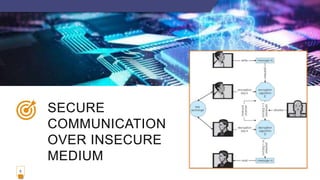
SECURE
COMMUNICATION
OVER INSECURE
MEDIUM
5
ENCRY
PTION
Encryption algorithm consists of
--> Set of K keys
--> Set of M Messages
--> Set of C ciphertexts (encrypted messages)
--> A function E : K → (M→C). That is, for each k K,
E(k) is a function for generating ciphertexts from
messages.
--> Both E and E(k) for any k should be efficiently computable
functions.
--> A function D : K → (C → M). That is, for each k K, D(k) is a
function for generating messages from ciphertexts.
--> Both D and D(k) for any k should be efficiently computable
functions.
6
An encryption algorithm must provide this essential property: Given a
ciphertext c  C, a computer can compute m such that E(k)(m) = c only if it
possesses D(k).
--> Thus, a computer holding D(k) can decrypt ciphertexts to the plaintexts used to produce
them, but a computer not holding D(k) cannot decrypt ciphertexts.
--> Since ciphertexts are generally exposed (for example, sent on the network), it is important that it be
infeasible to derive D(k) from the ciphertexts
SYMMETRIC ENCRYPTION
• Same key used to encrypt and decrypt
• E(k) can be derived from D(k), and vice versa
• DES is most commonly used symmetric block-encryption algorithm (created by US
Govt)
• Encrypts a block of data at a time
• Triple-DES considered more secure
• Advanced Encryption Standard (AES), twofish up and coming
• RC4 is most common symmetric stream cipher, but known to have vulnerabilities
• Encrypts/decrypts a strem of bytes (i.e wireless transmission)
• Key is a input to psuedo-random-bit generator
• Generates an infinite keystream
7
ASYMMETRIC ENCRYPTION
• Public-key encryption based on each user having two keys:
• public key – published key used to encrypt data
• private key – key known only to individual user used to decrypt data
• Must be an encryption scheme that can be made public without making it easy to figure
out the decryption scheme
• Most common is RSA block cipher
• Efficient algorithm for testing whether or not a number is prime
• No efficient algorithm is know for finding the prime factors of a number
8
ASYMMETRIC ENCRYPTION
• Formally, it is computationally infeasible to derive D(kd , N) from E(ke , N), and so E(ke ,
N) need not be kept secret and can be widely disseminated
• E(ke , N) (or just ke) is the public key
• D(kd , N) (or just kd) is the private key
• N is the product of two large, randomly chosen prime numbers p and q (for example,
p and q are 512 bits each)
• Encryption algorithm is E(ke , N)(m) = mke mod N, where ke satisfies kekd mod (p−1)(q
−1) = 1
• The decryption algorithm is then D(kd , N)(c) = ckd mod N
9
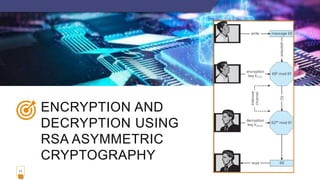
ASYMMETRIC ENCRYPTION EXAMPLE
• For example. make p = 7and q = 13
• We then calculate N = 7∗13 = 91 and (p−1)(q−1) = 72
• We next select ke relatively prime to 72 and< 72, yielding 5
• Finally , we calculate kd such that kekd mod 72 = 1, yielding 29
• We how have our keys
• Public key, ke, N = 5, 91
• Private key, kd , N = 29, 91
• Encrypting the message 69 with the public key results in the cyphertext 62
• Cyphertext can be decoded with the private key
• Public key can be distributed in cleartext to anyone who wants to communicate with holder of public
key
10
ENCRYPTION AND
DECRYPTION USING
RSA ASYMMETRIC
CRYPTOGRAPHY
11
CRYPTOGRAPHY
• Note symmetric cryptography based on transformations, asymmetric based on
mathematical functions
• Asymmetric much more compute intensive
• Typically not used for bulk data encryption
12
13

OS ppt Modified.pptx

  • 1.
  • 2.
    SECURIT Y The term operatingsystem (OS) security refers to practices and measures that can ensure the confidentiality, integrity, and availability (CIA) of operating systems.
  • 3.
    GROUP MEMBERS 3 Group E Muhammad AbdullahHashmi 20021519- 016 Muhammad Yaseen 20021519- 051 Eman Mir 20021519-099 Sheharyar Tariq Butt 20021519-108
  • 4.
    CRYPTOGRAPHY AS ASECURITY TOOL • Broadest security tool available • Source and destination of messages cannot be trusted without cryptography • Means to constrain potential senders (sources) and / or receivers (destinations) of messages • Based on secrets (keys) 4
  • 5.
  • 6.
    ENCRY PTION Encryption algorithm consistsof --> Set of K keys --> Set of M Messages --> Set of C ciphertexts (encrypted messages) --> A function E : K → (M→C). That is, for each k K, E(k) is a function for generating ciphertexts from messages. --> Both E and E(k) for any k should be efficiently computable functions. --> A function D : K → (C → M). That is, for each k K, D(k) is a function for generating messages from ciphertexts. --> Both D and D(k) for any k should be efficiently computable functions. 6 An encryption algorithm must provide this essential property: Given a ciphertext c  C, a computer can compute m such that E(k)(m) = c only if it possesses D(k). --> Thus, a computer holding D(k) can decrypt ciphertexts to the plaintexts used to produce them, but a computer not holding D(k) cannot decrypt ciphertexts. --> Since ciphertexts are generally exposed (for example, sent on the network), it is important that it be infeasible to derive D(k) from the ciphertexts
  • 7.
    SYMMETRIC ENCRYPTION • Samekey used to encrypt and decrypt • E(k) can be derived from D(k), and vice versa • DES is most commonly used symmetric block-encryption algorithm (created by US Govt) • Encrypts a block of data at a time • Triple-DES considered more secure • Advanced Encryption Standard (AES), twofish up and coming • RC4 is most common symmetric stream cipher, but known to have vulnerabilities • Encrypts/decrypts a strem of bytes (i.e wireless transmission) • Key is a input to psuedo-random-bit generator • Generates an infinite keystream 7
  • 8.
    ASYMMETRIC ENCRYPTION • Public-keyencryption based on each user having two keys: • public key – published key used to encrypt data • private key – key known only to individual user used to decrypt data • Must be an encryption scheme that can be made public without making it easy to figure out the decryption scheme • Most common is RSA block cipher • Efficient algorithm for testing whether or not a number is prime • No efficient algorithm is know for finding the prime factors of a number 8
  • 9.
    ASYMMETRIC ENCRYPTION • Formally,it is computationally infeasible to derive D(kd , N) from E(ke , N), and so E(ke , N) need not be kept secret and can be widely disseminated • E(ke , N) (or just ke) is the public key • D(kd , N) (or just kd) is the private key • N is the product of two large, randomly chosen prime numbers p and q (for example, p and q are 512 bits each) • Encryption algorithm is E(ke , N)(m) = mke mod N, where ke satisfies kekd mod (p−1)(q −1) = 1 • The decryption algorithm is then D(kd , N)(c) = ckd mod N 9
  • 10.
    ASYMMETRIC ENCRYPTION EXAMPLE •For example. make p = 7and q = 13 • We then calculate N = 7∗13 = 91 and (p−1)(q−1) = 72 • We next select ke relatively prime to 72 and< 72, yielding 5 • Finally , we calculate kd such that kekd mod 72 = 1, yielding 29 • We how have our keys • Public key, ke, N = 5, 91 • Private key, kd , N = 29, 91 • Encrypting the message 69 with the public key results in the cyphertext 62 • Cyphertext can be decoded with the private key • Public key can be distributed in cleartext to anyone who wants to communicate with holder of public key 10
  • 11.
    ENCRYPTION AND DECRYPTION USING RSAASYMMETRIC CRYPTOGRAPHY 11
  • 12.
    CRYPTOGRAPHY • Note symmetriccryptography based on transformations, asymmetric based on mathematical functions • Asymmetric much more compute intensive • Typically not used for bulk data encryption 12
  • 13.