GANDHI INSTITUTUE FOR EDUCATION & TECHNOLOGY 
OPERATING SYSTEM 
ASSIGNMENT – 1 
 
Short questions 
(a) Differentiate between a process and a program citing at least three differences. (BPUT 2012) 
(b) Differentiate among batch processing, multiprogramming and time‐sharing with suitable 
timing diagrams.( BPUT 2012) 
(c) Give real life example/application of round robin, FCFS, priority and SJF algorithms.( BPUT 
2012) 
(d) What are the advantages of the layered approach to system design.( BPUT 2011) 
(e) Define and differentiate between multitasking and multiprogramming.( BPUT 2011) 
(f) What is the nucleus or kernel of an operating system?( BPUT 2011) 
(g) What is a process? What is a PCB?( BPUT 2011) 
(h) What is throughput, turnaround time, waiting time and response time? (BPUT 2011) 
(i) What are the advantages of using threads compared to processes? (BPUT 2011) 
(j) What is pre‐fetching? How it helps in improving performance of multiprogramming? (BPUT 
2010) 
(k) What is the major drawback of multilevel scheduling? Suggest a solution for it. (BPUT 2010) 
(l)  Specify two advantages of multiprogramming.( BPUT 2009) 
(m) Four jobs A, B, C, D arrive at a single processor system at the same time. The CPU burst time 
represents are 4, 1, 8, 1 time units respectively. Find completion time of A in round robin 
scheduling with one unit of time slice.( BPUT 2009) 
(n) Define the difference between preemptive and non preemptive scheduling.( BPUT 2008) 
(o) What are the basic functions of an operating system? (BPUT 2008) 
Long Question 
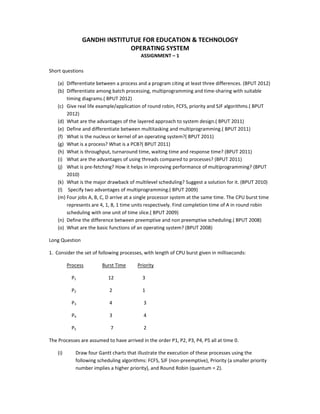
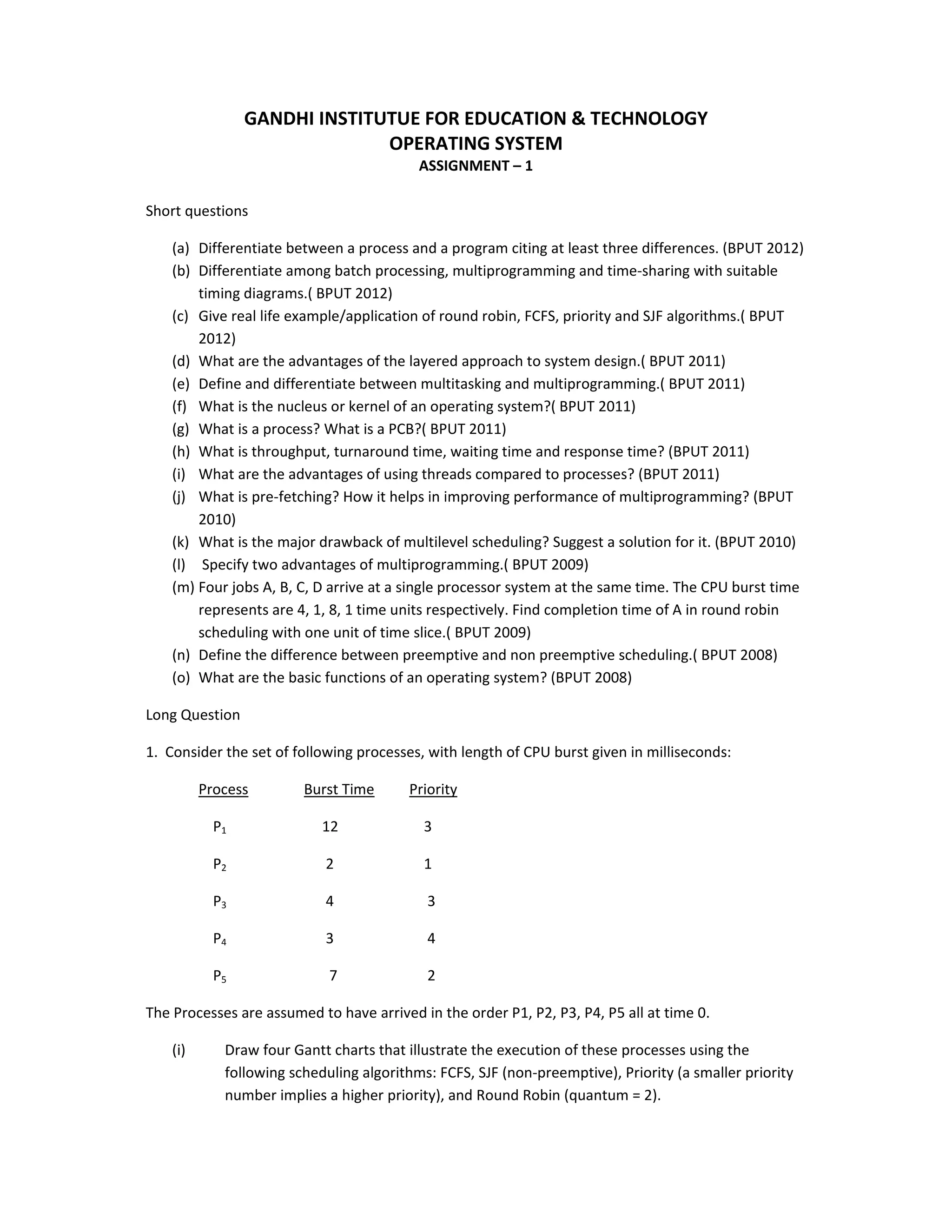
1.  Consider the set of following processes, with length of CPU burst given in milliseconds: 
  Process   Burst Time  Priority 
      P1         12        3 
      P2          2        1 
      P3          4         3 
      P4           3         4 
      P5           7         2 
The Processes are assumed to have arrived in the order P1, P2, P3, P4, P5 all at time 0. 
(i) Draw four Gantt charts that illustrate the execution of these processes using the 
following scheduling algorithms: FCFS, SJF (non‐preemptive), Priority (a smaller priority 
number implies a higher priority), and Round Robin (quantum = 2). 
(ii) What is the turnaround time of each process for each of the scheduling algorithms in 
part a? 
(iii) What is the waiting time of each process for each of these scheduling algorithms? 
(iv) Which of the algorithms results in minimum average waiting time (over all processes)? 
(BPUT 2012) 
2. Describe various functions of an operating system. (BPUT 2012) 
3. Describe various multithreading models. (BPUT 2012) 
4. What are the major activities of an operating system? What is the main advantage of layered 
approach to system design? (BPUT 2011) 
 
5. Consider a variant of RR scheduling algorithm where the entries in the ready queue are pointers 
to the PCB. What would be major advantages and disadvantages of this scheme? (BPUT 2011)  
6. Explain a step‐by‐step manner and in detail how a context switching between a running process, 
P1, and the first process in the ready queue, P2 happens. (BPUT 2011) 
7. Define a PCB. What is the role during process execution? Draw a neat block diagram representing 
different states of a process and its transition among various states. (BPUT 2010) 
8. Define context switching. Whit a suitable example explain context switching mechanism among 
several processes. (BPUT 2011, 2010) 
9. Discuss multilevel feedback scheduling. State its advantages. (BPUT 2009) 
10.  Write short notes on: 
       a) System call (BPUT 2012) 
  b) Process state transition diagram. (BPUT 2009)     
11. What is IPC? Explain mechanisms of IPC for cooperating among processes in an OS. (BPUT 2010)   


OS ASSIGNMENT-1

  • 1.
    GANDHI INSTITUTUE FOR EDUCATION & TECHNOLOGY  OPERATING SYSTEM  ASSIGNMENT – 1    Short questions  (a) Differentiate between a process and a program citing at least three differences. (BPUT 2012)  (b) Differentiate among batch processing, multiprogramming and time‐sharing with suitable  timing diagrams.( BPUT 2012)  (c)Give real life example/application of round robin, FCFS, priority and SJF algorithms.( BPUT  2012)  (d) What are the advantages of the layered approach to system design.( BPUT 2011)  (e) Define and differentiate between multitasking and multiprogramming.( BPUT 2011)  (f) What is the nucleus or kernel of an operating system?( BPUT 2011)  (g) What is a process? What is a PCB?( BPUT 2011)  (h) What is throughput, turnaround time, waiting time and response time? (BPUT 2011)  (i) What are the advantages of using threads compared to processes? (BPUT 2011)  (j) What is pre‐fetching? How it helps in improving performance of multiprogramming? (BPUT  2010)  (k) What is the major drawback of multilevel scheduling? Suggest a solution for it. (BPUT 2010)  (l)  Specify two advantages of multiprogramming.( BPUT 2009)  (m) Four jobs A, B, C, D arrive at a single processor system at the same time. The CPU burst time  represents are 4, 1, 8, 1 time units respectively. Find completion time of A in round robin  scheduling with one unit of time slice.( BPUT 2009)  (n) Define the difference between preemptive and non preemptive scheduling.( BPUT 2008)  (o) What are the basic functions of an operating system? (BPUT 2008)  Long Question  1.  Consider the set of following processes, with length of CPU burst given in milliseconds:    Process   Burst Time  Priority        P1         12        3        P2          2        1        P3          4         3        P4           3         4        P5           7         2  The Processes are assumed to have arrived in the order P1, P2, P3, P4, P5 all at time 0.  (i) Draw four Gantt charts that illustrate the execution of these processes using the  following scheduling algorithms: FCFS, SJF (non‐preemptive), Priority (a smaller priority  number implies a higher priority), and Round Robin (quantum = 2). 
  • 2.
    (ii) What is the turnaround time of each process for each of the scheduling algorithms in  part a?  (iii) What is the waiting time of each process for each of these scheduling algorithms?  (iv)Which of the algorithms results in minimum average waiting time (over all processes)?  (BPUT 2012)  2. Describe various functions of an operating system. (BPUT 2012)  3. Describe various multithreading models. (BPUT 2012)  4. What are the major activities of an operating system? What is the main advantage of layered  approach to system design? (BPUT 2011)    5. Consider a variant of RR scheduling algorithm where the entries in the ready queue are pointers  to the PCB. What would be major advantages and disadvantages of this scheme? (BPUT 2011)   6. Explain a step‐by‐step manner and in detail how a context switching between a running process,  P1, and the first process in the ready queue, P2 happens. (BPUT 2011)  7. Define a PCB. What is the role during process execution? Draw a neat block diagram representing  different states of a process and its transition among various states. (BPUT 2010)  8. Define context switching. Whit a suitable example explain context switching mechanism among  several processes. (BPUT 2011, 2010)  9. Discuss multilevel feedback scheduling. State its advantages. (BPUT 2009)  10.  Write short notes on:         a) System call (BPUT 2012)    b) Process state transition diagram. (BPUT 2009)      11. What is IPC? Explain mechanisms of IPC for cooperating among processes in an OS. (BPUT 2010)