Downloaded 216 times
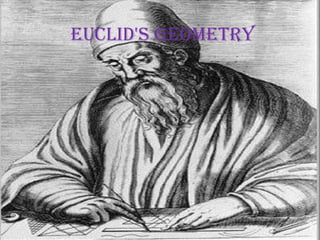

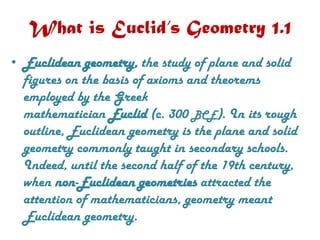


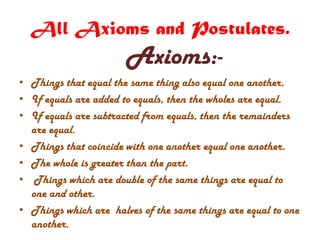





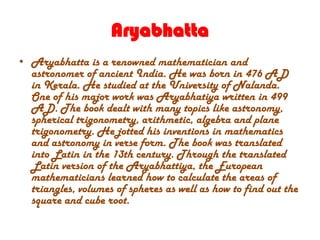


Euclid's Geometry outlines Euclid's influential work on geometry from around 300 BCE. It defines Euclidean geometry as the study of plane and solid figures using axioms and theorems. It also distinguishes between axioms, which are general mathematical assumptions, and postulates, which are specific geometric assumptions. Finally, it briefly discusses several influential mathematicians throughout history and their contributions, including Euclid, Ramanujan, Descartes, Aryabhatta, and Thales.


