Geology
Dr.R.K.Kaleeswari
Professor (SS&AC)
Department of Soil Science & Agrl. Chemistry
TNAU, Coimbatore, India
GEOLOGY
Greek Earth The study of
Geology = The study of Earth
Geology : Definition
 Geology is the study of Earth, includes,
physical and chemical properties, earth
creation, inner and outer processes affected
it, since its creation to present day.
Branches of Geology
 Crystallography
 Mineralogy.
 Petrology .
 Paleontology .
 Stratigraphy .
Crystallography
 Crystallography is the experimental
science of determining the arrangement of
atoms in the crystalline solids
Mineralogy.
 Mineralogy is a subject of geology
specializing in the scientific study of
chemistry, crystal structure, and physical
(including optical) properties of minerals.
Petrology
 Petrology (from the Greek πέτρα, petra, "rock" and
λόγος, logos, "study") is the branch of geology that
studies the origin, composition, distribution and
structure of rocks.
 lithology focuses on macroscopic hand-sample or
outcrop-scale description of rocks petrography is the
speciality that deals with microscopic details
Paleontology
 the study of fossils to determine organisms'
evolution and interactions with each other
and their environments
Stratigraphy
 a branch of geology which studies rock
layers (strata) and layering (stratification).
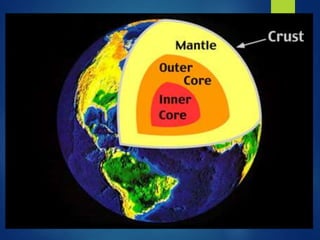
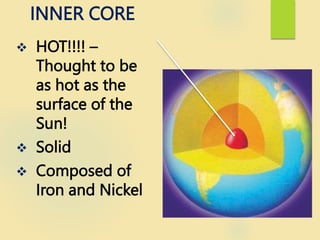
INNER CORE
 HOT!!!! –
Thought to be
as hot as the
surface of the
Sun!
 Solid
 Composed of
Iron and Nickel
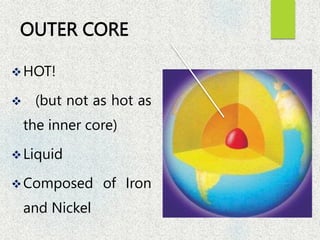
OUTER CORE
HOT!
 (but not as hot as
the inner core)
Liquid
Composed of Iron
and Nickel
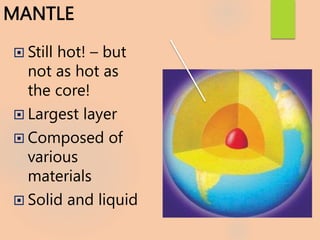
MANTLE
 Still hot! – but
not as hot as
the core!
 Largest layer
 Composed of
various
materials
 Solid and liquid
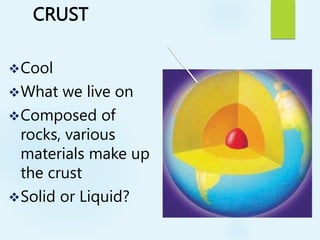
CRUST
Cool
What we live on
Composed of
rocks, various
materials make up
the crust
Solid or Liquid?
Origin of earth
 About 4.5 billion years ago, Earth formed out of
nebula of gases and dust that were to become the
solar system
 The earth is between 4.3 and 4.5 billion years old.
 Small objects called planetoids accreted or combined
together to build larger objects such as planets
Origin of earth
 Nebular Hypothesis
 Planetesimal Hypothesis
 Gaseous Tidal Hypothesis
 Binary Star Hypothesis
 Gas Dust Cloud Hypothesis
Nebular Hypothesis
• German philosopher, Kant and French
mathematician, Laplace
• Earth, planets and sun originated from
Nebula.
• Nebula was large cloud of gas and dust. It
rotates slowly.
Nebular Hypothesis
 Gradually it cooled and contracted and its speed
 increased.
 A gaseous ring was separated from nebula
 Later the ring cooled and took form of a planet
 On repetition of the process all other planets came
 into being
 The central region, nebula became sun.
Objections
 Sun should have the greatest angular
momentum because of its mass and situated in
the center, however, it has only two percent of
momentum of the solar system
 How the hot gaseous material condensed in to
rings
Planetesimal Hypothesis
 Chamberlin and Moulton proposed the theory in 1904
 The sun existed before the formation of planets
 A star came close to the sun.
 Because of the gravitation pull of the star, small gaseous
bodies were separated from the sun
 These bodies on cooing became small planet's
 During rotation the small planets collided and form planets
Objections
 The angular momentum could not be
produced by the passing star.
 The theory failed to explain how the
planetesimals had become one planet
Gaseous Tidal Theory
 Jeans and Jeffrey proposed the theory in 1925
 Large star came near the sun.
 Due to gravitational pull a gaseous tide was
raised on the surface of the sun.
Gaseous Tidal Theory
 As the star came nearer, the tide increased in size.
 Gaseous tide detached when star move away.
 The shape of the tide was like spindle.
 It broke into pieces-forming nine planets of the solar
system
Binary Star Hypothesis
 The idea was developed by Lyttleton in 1938.
Before the formation of planets, the sun had a
companion star.
 Another star passed close to these double
stars and dragged the companion star away.
Binary Star Hypothesis
 A gaseous filament was torn from the
companion star and it remained close to the
sun.
 The planets were originated from this gaseous
filament in the same way as described in the
gaseous tidal hypothesis.

Gas Dust Cloud Hypothesis
 This hypothesis is due to C. Von Weizsacker
and O. J. Schmidt (1943).
 In this hypothesis the planets are thought to
have evolved out of a cold cloud of gas and
dust which was present around the sun.
Gas Dust Cloud Hypothesis
 It was called a “proloplanetary cloud”. Its shape
was like a disc.
 Planets were formed in this cloud by gradual
aggregation of the dispersed matter.
 This hypothesis explains well some of the
observed phenomenon relating to the solar
system.
Thank you

Origin of Earth.ppt

  • 1.
    Geology Dr.R.K.Kaleeswari Professor (SS&AC) Department ofSoil Science & Agrl. Chemistry TNAU, Coimbatore, India
  • 2.
    GEOLOGY Greek Earth Thestudy of Geology = The study of Earth
  • 3.
    Geology : Definition Geology is the study of Earth, includes, physical and chemical properties, earth creation, inner and outer processes affected it, since its creation to present day.
  • 4.
    Branches of Geology Crystallography  Mineralogy.  Petrology .  Paleontology .  Stratigraphy .
  • 5.
    Crystallography  Crystallography isthe experimental science of determining the arrangement of atoms in the crystalline solids
  • 6.
    Mineralogy.  Mineralogy isa subject of geology specializing in the scientific study of chemistry, crystal structure, and physical (including optical) properties of minerals.
  • 7.
    Petrology  Petrology (fromthe Greek πέτρα, petra, "rock" and λόγος, logos, "study") is the branch of geology that studies the origin, composition, distribution and structure of rocks.  lithology focuses on macroscopic hand-sample or outcrop-scale description of rocks petrography is the speciality that deals with microscopic details
  • 8.
    Paleontology  the studyof fossils to determine organisms' evolution and interactions with each other and their environments
  • 9.
    Stratigraphy  a branchof geology which studies rock layers (strata) and layering (stratification).
  • 11.
    INNER CORE  HOT!!!!– Thought to be as hot as the surface of the Sun!  Solid  Composed of Iron and Nickel
  • 12.
    OUTER CORE HOT!  (butnot as hot as the inner core) Liquid Composed of Iron and Nickel
  • 13.
    MANTLE  Still hot!– but not as hot as the core!  Largest layer  Composed of various materials  Solid and liquid
  • 14.
    CRUST Cool What we liveon Composed of rocks, various materials make up the crust Solid or Liquid?
  • 15.
    Origin of earth About 4.5 billion years ago, Earth formed out of nebula of gases and dust that were to become the solar system  The earth is between 4.3 and 4.5 billion years old.  Small objects called planetoids accreted or combined together to build larger objects such as planets
  • 16.
    Origin of earth Nebular Hypothesis  Planetesimal Hypothesis  Gaseous Tidal Hypothesis  Binary Star Hypothesis  Gas Dust Cloud Hypothesis
  • 17.
    Nebular Hypothesis • Germanphilosopher, Kant and French mathematician, Laplace • Earth, planets and sun originated from Nebula. • Nebula was large cloud of gas and dust. It rotates slowly.
  • 18.
    Nebular Hypothesis  Graduallyit cooled and contracted and its speed  increased.  A gaseous ring was separated from nebula  Later the ring cooled and took form of a planet  On repetition of the process all other planets came  into being  The central region, nebula became sun.
  • 19.
    Objections  Sun shouldhave the greatest angular momentum because of its mass and situated in the center, however, it has only two percent of momentum of the solar system  How the hot gaseous material condensed in to rings
  • 20.
    Planetesimal Hypothesis  Chamberlinand Moulton proposed the theory in 1904  The sun existed before the formation of planets  A star came close to the sun.  Because of the gravitation pull of the star, small gaseous bodies were separated from the sun  These bodies on cooing became small planet's  During rotation the small planets collided and form planets
  • 21.
    Objections  The angularmomentum could not be produced by the passing star.  The theory failed to explain how the planetesimals had become one planet
  • 22.
    Gaseous Tidal Theory Jeans and Jeffrey proposed the theory in 1925  Large star came near the sun.  Due to gravitational pull a gaseous tide was raised on the surface of the sun.
  • 23.
    Gaseous Tidal Theory As the star came nearer, the tide increased in size.  Gaseous tide detached when star move away.  The shape of the tide was like spindle.  It broke into pieces-forming nine planets of the solar system
  • 24.
    Binary Star Hypothesis The idea was developed by Lyttleton in 1938. Before the formation of planets, the sun had a companion star.  Another star passed close to these double stars and dragged the companion star away.
  • 25.
    Binary Star Hypothesis A gaseous filament was torn from the companion star and it remained close to the sun.  The planets were originated from this gaseous filament in the same way as described in the gaseous tidal hypothesis.
  • 26.
    Gas Dust CloudHypothesis  This hypothesis is due to C. Von Weizsacker and O. J. Schmidt (1943).  In this hypothesis the planets are thought to have evolved out of a cold cloud of gas and dust which was present around the sun.
  • 27.
    Gas Dust CloudHypothesis  It was called a “proloplanetary cloud”. Its shape was like a disc.  Planets were formed in this cloud by gradual aggregation of the dispersed matter.  This hypothesis explains well some of the observed phenomenon relating to the solar system.
  • 28.