Organizational Conflict
Group – 2
Submitted by:-
• Alok Kumar Ranjan (06)
• Megha Khatri (26)
• Puneet Arora (34)
• Puneet Chawla (35)
• Swetangshu Acharya (54)
• Vishnu Nair (59)
Under the guidance of:-
Dr. Sweta Malla
Introduction and Agenda
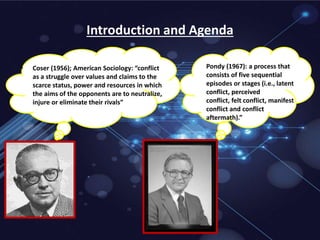
• Coser (1956); American Sociology: “conflict
as a struggle over values and claims to the
scarce status, power and resources in which
the aims of the opponents are to neutralize,
injure or eliminate their rivals”
Pondy (1967): a process that
consists of five sequential
episodes or stages (i.e., latent
conflict, perceived
conflict, felt conflict, manifest
conflict and conflict
aftermath).”
Introduction and Agenda contd..
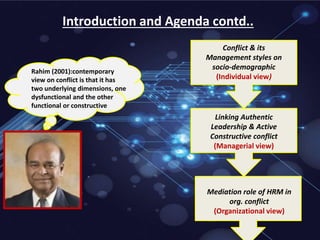
Rahim (2001):contemporary
view on conflict is that it has
two underlying dimensions, one
dysfunctional and the other
functional or constructive
Conflict & its
Management styles on
socio-demographic
(Individual view)
Linking Authentic
Leadership & Active
Constructive conflict
(Managerial view)
Mediation role of HRM in
org. conflict
(Organizational view)
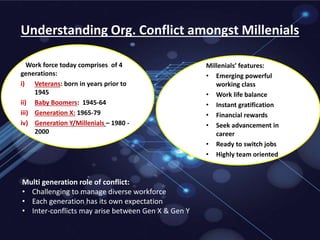
Millenials’ features:
• Emerging powerful
working class
• Work life balance
• Instant gratification
• Financial rewards
• Seek advancement in
career
• Ready to switch jobs
• Highly team oriented
Understanding Org. Conflict amongst Millenials
Work force today comprises of 4
generations:
i) Veterans: born in years prior to
1945
ii) Baby Boomers: 1945-64
iii) Generation X: 1965-79
iv) Generation Y/Millenials – 1980 -
2000
Multi generation role of conflict:
• Challenging to manage diverse workforce
• Each generation has its own expectation
• Inter-conflicts may arise between Gen X & Gen Y
Accommodating - person has a high concern for others and a low concern for self. Fall victim to
people as “doormats”.
Avoiding - a tendency to deny, rationalise or avoid the problem, to displace anger or aggression
Competing – Dominating, don’t care about others, concerned about self-interest
Collaborating - Large amount of time spent towards a positive solution for all, includes everyone’s
ideas
Compromising - When there’s a time crunch, adapts the “least painful for all”
Two dimensional model of conflict handling
styles
Research Study
• Qualitative study to explore most preferred conflict management style by Gen Y
• Conducted amongst students in a university at Jameshedpur
• Distributed among 300 students, received completed questionnaire from 224
• Limitations: Conditions may vary in Metro cities, small sample size, cross sectional
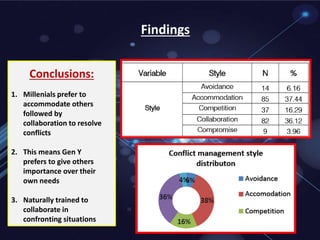
Findings
1. Millenials prefer to
accommodate others
followed by
collaboration to resolve
conflicts
2. This means Gen Y
prefers to give others
importance over their
own needs
3. Naturally trained to
collaborate in
confronting situations
Conclusions:
Active Leadership (AL) & Active Constructive
Conflict (ACC)
• In ever org, conflict & changes are bound to occur
• Constructive conflict can be a positive force
• An authentic leader influences the relations towards conflict
• 5 essential dimensions of AL:
i) Purpose ii) Values iii) Heart iv) Relationships iii) Self-discipline
• Positive organizational scholarship (POS) model: Integrations of +ve/-ve conditions, not
merely eliminating the –ve ones. These act as “catalysts”.
• Org. performance, difficulties, challenges are interpreted, managed and transformed to
reveal their underlying positive domain
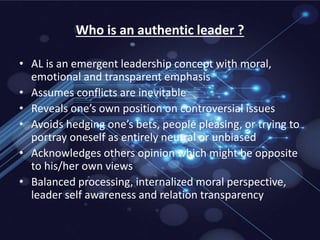
Who is an authentic leader ?
• AL is an emergent leadership concept with moral,
emotional and transparent emphasis
• Assumes conflicts are inevitable
• Reveals one’s own position on controversial issues
• Avoids hedging one’s bets, people pleasing, or trying to
portray oneself as entirely neutral or unbiased
• Acknowledges others opinion which might be opposite
to his/her own views
• Balanced processing, internalized moral perspective,
leader self awareness and relation transparency
How AL helps to reduce conflict ?
Establishes
transparent
relationship in org.
hierarchy
Leaders use
collaborating
style the most
Range of conflict
handling strategies
viz. moral, emotional
and intellectual
AL reduces
dependency of outside
dispute resolution
services
Success of the high
performing teams can be
attributed to the leader
Creates systematic
environment conducive to
the operating principles
and core values of the org.
Higher cultural
intelligence and
competence
Innovates from
conflicts and
celebrates changes
using the diversity of
human capital
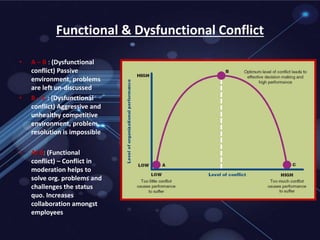
Functional & Dysfunctional Conflict
• A – B : (Dysfunctional
conflict) Passive
environment, problems
are left un-discussed
• B – C : (Dysfunctional
conflict) Aggressive and
unhealthy competitive
environment, problem
resolution is impossible
• At B: (Functional
conflict) – Conflict in
moderation helps to
solve org. problems and
challenges the status
quo. Increases
collaboration amongst
employees
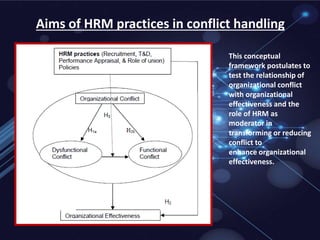
Aims of HRM practices in conflict handling
This conceptual
framework postulates to
test the relationship of
organizational conflict
with organizational
effectiveness and the
role of HRM as
moderator in
transforming or reducing
conflict to
enhance organizational
effectiveness.
Steps of implementation
• Recruitment & Selection: Internal recruitment, creative thinkers, fair
recruitment, selection
• Training and Development: Conflict training, updating training programs,
equal opportunities
• Performance appraisal & feedback: Research showed currently people
are content with yearly appraisal cycles. This is in negation to the
common construct of constant evaluation, clear criteria , performance
based rewards and feedback.
• Role of Union: management part, positive role, participation of union in
decision making

organizational conflict

  • 1.
    Organizational Conflict Group –2 Submitted by:- • Alok Kumar Ranjan (06) • Megha Khatri (26) • Puneet Arora (34) • Puneet Chawla (35) • Swetangshu Acharya (54) • Vishnu Nair (59) Under the guidance of:- Dr. Sweta Malla
  • 2.
    Introduction and Agenda •Coser (1956); American Sociology: “conflict as a struggle over values and claims to the scarce status, power and resources in which the aims of the opponents are to neutralize, injure or eliminate their rivals” Pondy (1967): a process that consists of five sequential episodes or stages (i.e., latent conflict, perceived conflict, felt conflict, manifest conflict and conflict aftermath).”
  • 3.
    Introduction and Agendacontd.. Rahim (2001):contemporary view on conflict is that it has two underlying dimensions, one dysfunctional and the other functional or constructive Conflict & its Management styles on socio-demographic (Individual view) Linking Authentic Leadership & Active Constructive conflict (Managerial view) Mediation role of HRM in org. conflict (Organizational view)
  • 4.
    Millenials’ features: • Emergingpowerful working class • Work life balance • Instant gratification • Financial rewards • Seek advancement in career • Ready to switch jobs • Highly team oriented Understanding Org. Conflict amongst Millenials Work force today comprises of 4 generations: i) Veterans: born in years prior to 1945 ii) Baby Boomers: 1945-64 iii) Generation X: 1965-79 iv) Generation Y/Millenials – 1980 - 2000 Multi generation role of conflict: • Challenging to manage diverse workforce • Each generation has its own expectation • Inter-conflicts may arise between Gen X & Gen Y
  • 5.
    Accommodating - personhas a high concern for others and a low concern for self. Fall victim to people as “doormats”. Avoiding - a tendency to deny, rationalise or avoid the problem, to displace anger or aggression Competing – Dominating, don’t care about others, concerned about self-interest Collaborating - Large amount of time spent towards a positive solution for all, includes everyone’s ideas Compromising - When there’s a time crunch, adapts the “least painful for all” Two dimensional model of conflict handling styles
  • 6.
    Research Study • Qualitativestudy to explore most preferred conflict management style by Gen Y • Conducted amongst students in a university at Jameshedpur • Distributed among 300 students, received completed questionnaire from 224 • Limitations: Conditions may vary in Metro cities, small sample size, cross sectional
  • 7.
    Findings 1. Millenials preferto accommodate others followed by collaboration to resolve conflicts 2. This means Gen Y prefers to give others importance over their own needs 3. Naturally trained to collaborate in confronting situations Conclusions:
  • 8.
    Active Leadership (AL)& Active Constructive Conflict (ACC) • In ever org, conflict & changes are bound to occur • Constructive conflict can be a positive force • An authentic leader influences the relations towards conflict • 5 essential dimensions of AL: i) Purpose ii) Values iii) Heart iv) Relationships iii) Self-discipline • Positive organizational scholarship (POS) model: Integrations of +ve/-ve conditions, not merely eliminating the –ve ones. These act as “catalysts”. • Org. performance, difficulties, challenges are interpreted, managed and transformed to reveal their underlying positive domain
  • 9.
    Who is anauthentic leader ? • AL is an emergent leadership concept with moral, emotional and transparent emphasis • Assumes conflicts are inevitable • Reveals one’s own position on controversial issues • Avoids hedging one’s bets, people pleasing, or trying to portray oneself as entirely neutral or unbiased • Acknowledges others opinion which might be opposite to his/her own views • Balanced processing, internalized moral perspective, leader self awareness and relation transparency
  • 10.
    How AL helpsto reduce conflict ? Establishes transparent relationship in org. hierarchy Leaders use collaborating style the most Range of conflict handling strategies viz. moral, emotional and intellectual AL reduces dependency of outside dispute resolution services Success of the high performing teams can be attributed to the leader Creates systematic environment conducive to the operating principles and core values of the org. Higher cultural intelligence and competence Innovates from conflicts and celebrates changes using the diversity of human capital
  • 11.
    Functional & DysfunctionalConflict • A – B : (Dysfunctional conflict) Passive environment, problems are left un-discussed • B – C : (Dysfunctional conflict) Aggressive and unhealthy competitive environment, problem resolution is impossible • At B: (Functional conflict) – Conflict in moderation helps to solve org. problems and challenges the status quo. Increases collaboration amongst employees
  • 12.
    Aims of HRMpractices in conflict handling This conceptual framework postulates to test the relationship of organizational conflict with organizational effectiveness and the role of HRM as moderator in transforming or reducing conflict to enhance organizational effectiveness.
  • 13.
    Steps of implementation •Recruitment & Selection: Internal recruitment, creative thinkers, fair recruitment, selection • Training and Development: Conflict training, updating training programs, equal opportunities • Performance appraisal & feedback: Research showed currently people are content with yearly appraisal cycles. This is in negation to the common construct of constant evaluation, clear criteria , performance based rewards and feedback. • Role of Union: management part, positive role, participation of union in decision making

Editor's Notes

  • #4 Research paper 1: Individual view: “Are Conflict Management Styles of Gen Y Related to their Socio-Demographic Characteristics?” (SLIDES 4-7) Research paper 2: Managerial view: “Making conflict work: Authentic leadership and reactive and reflective management styles”(SLIDES 8-10) Research paper 3: Organizational view: “Mediating Role of HRM in Organizational Conflict and Impact on Organizational Effectiveness: Empirical Evidence of Pakistan Public Universities” (SLIDES 11-13) Database: EBSCO
  • #5 Generation Y, who are in midst of their education and ready to enter the workforce. It focuses on their preferred conflict management style and also explores relationship between their sociodemographic characteristics and preferred conflict management style.
  • #6 Thomas and Kilmann (1974) outlined five conflict management strategies, which have been studied by several other researchers (Wilmot and Hocker, 2011).
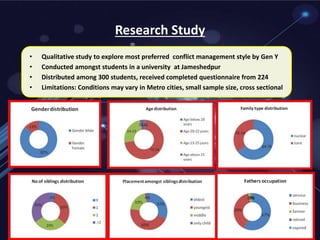
  • #7 Gender: 87% of respondents were males whereas 13%females. Age: 72.24% respondents were aged in between 20-22 years, 24.23% in between 23-25 years and 3.52% were aged above 25 years. Since most of the students were pursuing final year B-tech, maximum were aged in between 20-22 years. Course level: 32.16% students were pursuing their PG course (MCA), while 67.84% were pursuing their graduation in B-tech. Students from only three disciplines of study were studied. Academic discipline: 37.89% students were from Civil engineering discipline, 31.72% from computer science and engineering and remaining 31.72% from MCA. Family structure: 65% respondents belonged to nuclear family whereas 35% to joint family. Fathers occupation: 57% students father were in service class, 39% in business class, 2% were farmers, 1% retired and 0.44% students father were expired. Mothers occupation: 92% of students mother were house wife, while 8% belonged to working class. No. of siblings: 3% students were single child in their family, 33% had one sibling, 29% had two siblings and 35% students had more than 2 siblings. Placement amongst siblings: 32% respondents were eldest among their siblings, 45% were youngest, 19% were placed in middle and 3% were the single child in their family. Family income level: 89% respondents belonged to a family with average income, while 11% belonged to low income family. None of the student belonged to high income family background.
  • #8 The study found that the most preferred conflict management style of Gen Y is accommodation, followed by collaboration. This shows that while having high concern for self, they have concern for others as well in conflicts, which is a good sign for healthy competitions and peace at large. This was followed by collaboration. The study explored a strong and significant association between gender, age, course, discipline, academic year and fathers occupation with the preferred style of conflict management of Gen Y. While, a weak association was discovered between their family structure, family income level, no of siblings, placement amongst siblings and their mothers occupation with their conflict management style.
  • #9 A newer approach to leadership, called authentic leadership (AL), influences conflict management in organizations to foster high-performance environments.
  • #10 An indicator of AL is a willingness to engage with others on controversial issues and to reveal one’s own position on these issues instead of the often-embraced managerial approach of hedging one’s bets, people pleasing, or trying to portray oneself as an entirely neutral, unbiased figure. AL is predicated on the idea conflict always exists within organizations, and a positive approach to leadership entails not only sharing one’s stance on the controversial issues but also balanced processing. The balanced processing aspect of AL means is being able to actually listen to another’s perspective, even if it differs from one’s own views. Both of these leadership dimensions of AL, balanced processing and relational transparency, can influence one’s approach to constructively resolving the conflict.
  • #11 Managers can follow the three Rs—recognition, resolution, and restoration—to effectively manage conflict, paying attention to the recognition of latent conflict and restoration.
  • #13 This study the relationship between organizational conflict, HRM and organizational effectiveness and to use such HRM practices in reducing the conflict in the educational sector as well as in other business sector. Therefore, the research questions of this study are: (1) Can HRM practices help moderate the conflict from dysfunctional to functional conflict in higher education 2) Is there any relationship between organizational conflict and HRM with organizational effectiveness?
  • #14 The study provides practical implications to alleviate the problem of conflict in theorganizations, importance of conflict should be highlighted for the organizations. Organizational conflict is more difficult and complex phenomenon. If it remains at the functional level then it would work in the interest of the organization. For managers and administrators, HRM practices are extremely important in moderating the dysfunctional conflict into functional conflict and in enhancing the organizational effectiveness. Therefore, HRM practices can play a vital role in higher education as well as in the other business sector organizations in enhancing the organizational effectiveness. Specifically in public institutes Government should on HRM aspect by allocation of budget and by enforcing the HR policies and practices. Thus, in terms of organizational actions, administrators or managers are highly recommended to pay more attention to the role and impact of the HRM practices.