ORGANIZATIONAL BEHAVIOR
S T E P H E N P. R O B B I N S
E L E V E N T H E D I T I O N
W W W . P R E N H A L L . C O M / R O B B I N S
© 2005 Prentice Hall Inc.
All rights reserved.
PowerPoint Presentation
by Charlie Cook
What Is Organizational
Behavior
Chapter One
TWELFTH EDITION
© 2005 Prentice Hall Inc. All rights reserved. 1–2
What Managers Do
Managerial Activities
• Make decisions
• Allocate resources
• Direct activities of others
to attain goals
Managers (or administrators)
Individuals who achieve goals through other
people.
© 2005 Prentice Hall Inc. All rights reserved. 1–3
Where Managers Work
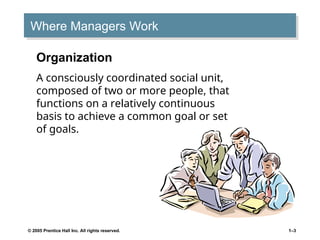
Organization
A consciously coordinated social unit,
composed of two or more people, that
functions on a relatively continuous
basis to achieve a common goal or set
of goals.
© 2005 Prentice Hall Inc. All rights reserved. 1–4
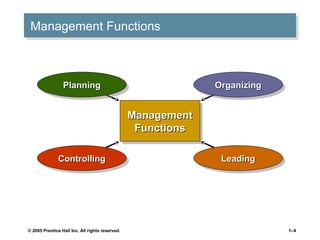
Management Functions
Management
Management
Functions
Functions
Planning
Planning Organizing
Organizing
Leading
Leading
Controlling
Controlling
© 2005 Prentice Hall Inc. All rights reserved. 1–5
Management Functions (cont’d)
Planning
A process that includes defining
goals, establishing strategy, and
developing plans to coordinate
activities.
© 2005 Prentice Hall Inc. All rights reserved. 1–6
Management Functions (cont’d)
Organizing
Determining what tasks are to be done,
who is to do them, how the tasks are to
be grouped, who reports to whom, and
where decisions are to be made.
© 2005 Prentice Hall Inc. All rights reserved. 1–7
Management Functions (cont’d)
Leading
A function that includes motivating
employees, directing others, selecting
the most effective communication
channels, and resolving conflicts.
© 2005 Prentice Hall Inc. All rights reserved. 1–8
Management Functions (cont’d)
Controlling
Monitoring activities to ensure they are being
accomplished as planned and correcting any
significant deviations.
© 2005 Prentice Hall Inc. All rights reserved. 1–9
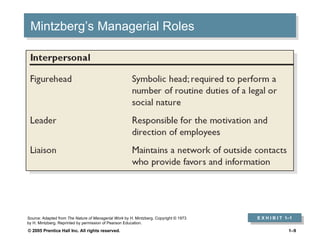
Mintzberg’s Managerial Roles
E X H I B I T 1–1
Source: Adapted from The Nature of Managerial Work by H. Mintzberg. Copyright © 1973
by H. Mintzberg. Reprinted by permission of Pearson Education.
© 2005 Prentice Hall Inc. All rights reserved. 1–10
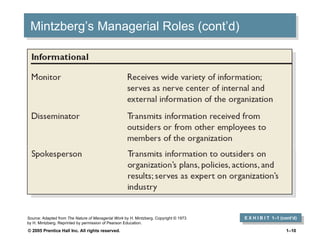
Mintzberg’s Managerial Roles (cont’d)
E X H I B I T 1–1 (cont’d)
Source: Adapted from The Nature of Managerial Work by H. Mintzberg. Copyright © 1973
by H. Mintzberg. Reprinted by permission of Pearson Education.
© 2005 Prentice Hall Inc. All rights reserved. 1–11
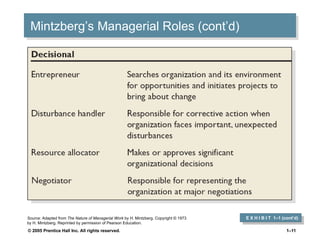
Mintzberg’s Managerial Roles (cont’d)
E X H I B I T 1–1 (cont’d)
Source: Adapted from The Nature of Managerial Work by H. Mintzberg. Copyright © 1973
by H. Mintzberg. Reprinted by permission of Pearson Education.
© 2005 Prentice Hall Inc. All rights reserved. 1–12
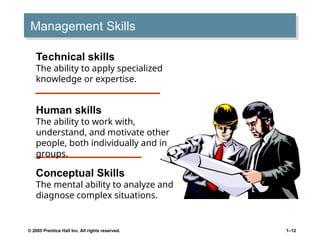
Management Skills
Technical skills
The ability to apply specialized
knowledge or expertise.
Human skills
The ability to work with,
understand, and motivate other
people, both individually and in
groups.
Conceptual Skills
The mental ability to analyze and
diagnose complex situations.
© 2005 Prentice Hall Inc. All rights reserved. 1–13
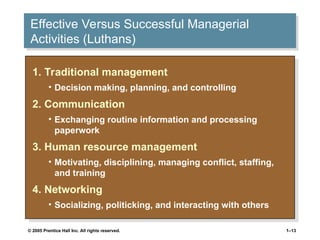
Effective Versus Successful Managerial
Activities (Luthans)
1. Traditional management
• Decision making, planning, and controlling
2. Communication
• Exchanging routine information and processing
paperwork
3. Human resource management
• Motivating, disciplining, managing conflict, staffing,
and training
4. Networking
• Socializing, politicking, and interacting with others
© 2005 Prentice Hall Inc. All rights reserved. 1–14
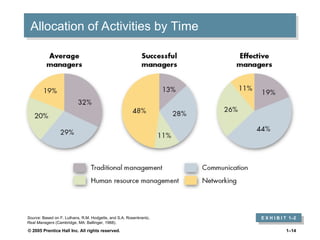
E X H I B I T 1–2
Allocation of Activities by Time
Source: Based on F. Luthans, R.M. Hodgetts, and S.A. Rosenkrantz,
Real Managers (Cambridge, MA: Ballinger, 1988).
© 2005 Prentice Hall Inc. All rights reserved. 1–15
Enter Organizational Behavior
Organizational behavior
(OB)
A field of study that
investigates the impact that
individuals, groups, and
structure have on behavior
within organizations, for the
purpose of applying such
knowledge toward improving
an organization’s
effectiveness.
© 2005 Prentice Hall Inc. All rights reserved. 1–16
Replacing Intuition with Systematic Study
Systematic study
Looking at relationships, attempting to attribute
causes and effects, and drawing conclusions
based on scientific evidence.
Provides a means to predict behaviors.
Intuition
A feeling not necessarily supported by research.
© 2005 Prentice Hall Inc. All rights reserved. 1–17
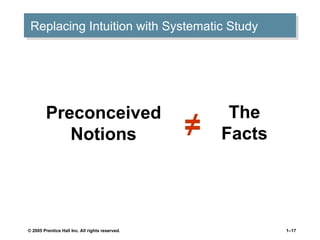
Replacing Intuition with Systematic Study
The
Facts
Preconceived
Notions ≠
© 2005 Prentice Hall Inc. All rights reserved. 1–18
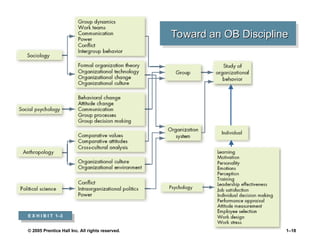
Toward an OB Discipline
E X H I B I T 1–3
© 2005 Prentice Hall Inc. All rights reserved. 1–19
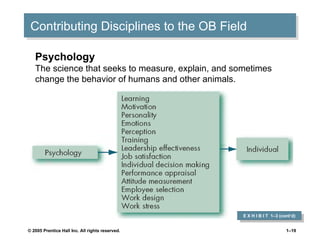
Contributing Disciplines to the OB Field
E X H I B I T 1–3 (cont’d)
Psychology
The science that seeks to measure, explain, and sometimes
change the behavior of humans and other animals.
© 2005 Prentice Hall Inc. All rights reserved. 1–20
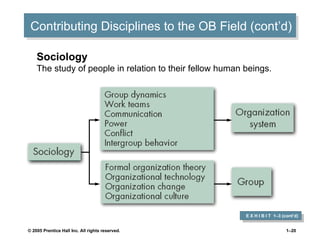
Contributing Disciplines to the OB Field (cont’d)
E X H I B I T 1–3 (cont’d)
Sociology
The study of people in relation to their fellow human beings.
© 2005 Prentice Hall Inc. All rights reserved. 1–21
Contributing Disciplines to the OB Field (cont’d)
E X H I B I T 1–3 (cont’d)
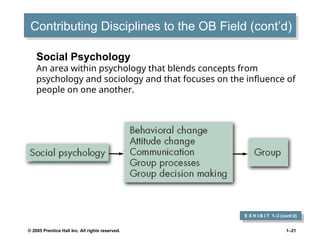
Social Psychology
An area within psychology that blends concepts from
psychology and sociology and that focuses on the influence of
people on one another.
© 2005 Prentice Hall Inc. All rights reserved. 1–22
Contributing Disciplines to the OB Field (cont’d)
E X H I B I T 1–3 (cont’d)
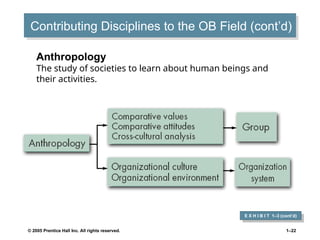
Anthropology
The study of societies to learn about human beings and
their activities.
© 2005 Prentice Hall Inc. All rights reserved. 1–23
Contributing Disciplines to the OB Field (cont’d)
E X H I B I T 1–3 (cont’d)
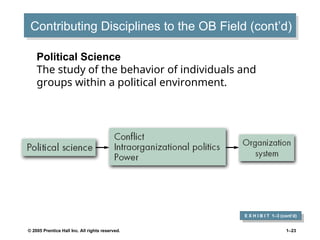
Political Science
The study of the behavior of individuals and
groups within a political environment.
© 2005 Prentice Hall Inc. All rights reserved. 1–24
There Are Few Absolutes in OB
Contingency
Contingency
Variables
Variables
x y
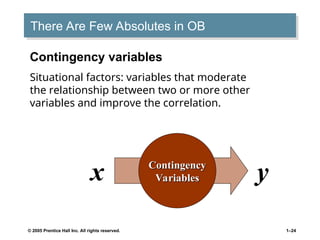
Contingency variables
Situational factors: variables that moderate
the relationship between two or more other
variables and improve the correlation.
© 2005 Prentice Hall Inc. All rights reserved. 1–25
Challenges and Opportunities for OB
 Responding to Globalization
– Increased foreign assignments
– Working with people from different cultures
– Coping with anti-capitalism backlash
– Overseeing movement of jobs to countries with
low-cost labor
 Managing Workforce Diversity
– Embracing diversity
– Changing U.S. demographics
– Implications for managers
• Recognizing and responding to differences
© 2005 Prentice Hall Inc. All rights reserved. 1–26
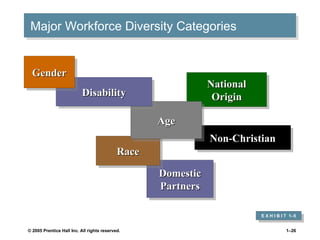
Domestic
Domestic
Partners
Partners
Major Workforce Diversity Categories
Race
Race
Non-Christian
Non-Christian
National
National
Origin
Origin
Age
Age
Disability
Disability
E X H I B I T 1–5
Gender
Gender
© 2005 Prentice Hall Inc. All rights reserved. 1–27
Challenges and Opportunities for OB (cont’d)
 Improving Quality and Productivity
– Quality management (QM)
– Process reengineering
 Responding to the Labor Shortage
– Changing work force demographics
– Fewer skilled laborers
– Early retirements and older workers
 Improving Customer Service
– Increased expectation of service quality
– Customer-responsive cultures
© 2005 Prentice Hall Inc. All rights reserved. 1–28
Improving Quality and Productivity
 Quality management (QM)
– The constant attainment of customer satisfaction
through the continuous improvement of all
organizational processes.
– Requires employees to rethink what they do and
become more involved in workplace decisions.
 Process reengineering
– Asks managers to reconsider how work would be
done and their organization structured if they were
starting over.
– Instead of making incremental changes in
processes, reengineering involves evaluating every
process in terms of its contribution.
© 2005 Prentice Hall Inc. All rights reserved. 1–29
Challenges and Opportunity for OB (cont’d)
 Improving People Skills
 Empowering People
 Stimulating Innovation and Change
 Coping with “Temporariness”
 Working in Networked Organizations
 Helping Employees Balance Work/Life Conflicts
 Improving Ethical Behavior
© 2005 Prentice Hall Inc. All rights reserved. 1–30
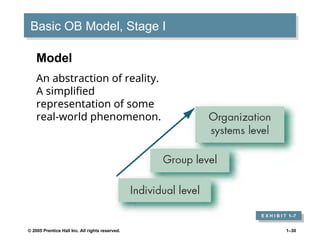
Basic OB Model, Stage I
E X H I B I T 1–7
Model
An abstraction of reality.
A simplified
representation of some
real-world phenomenon.
© 2005 Prentice Hall Inc. All rights reserved. 1–31
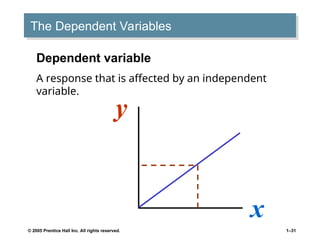
The Dependent Variables
x
y
Dependent variable
A response that is affected by an independent
variable.
© 2005 Prentice Hall Inc. All rights reserved. 1–32
The Dependent Variables (cont’d)
Productivity
A performance measure that
includes effectiveness and
efficiency.
Effectiveness
Achievement of goals.
Efficiency
The ratio of effective
output to the input
required to achieve it.
© 2005 Prentice Hall Inc. All rights reserved. 1–33
The Dependent Variables (cont’d)
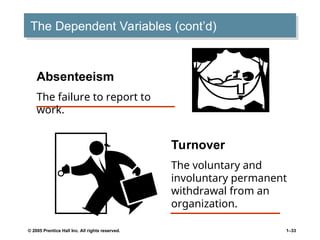
Absenteeism
The failure to report to
work.
Turnover
The voluntary and
involuntary permanent
withdrawal from an
organization.
© 2005 Prentice Hall Inc. All rights reserved. 1–34
The Dependent Variables (cont’d)
Organizational citizenship
behavior (OCB)
Discretionary behavior that is not
part of an employee’s formal job
requirements, but that
nevertheless promotes the
effective functioning of the
organization.
© 2005 Prentice Hall Inc. All rights reserved. 1–35
The Dependent Variables (cont’d)
Job satisfaction
A general attitude toward one’s job, the difference
between the amount of reward workers receive and
the amount they believe they should receive.
© 2005 Prentice Hall Inc. All rights reserved. 1–36
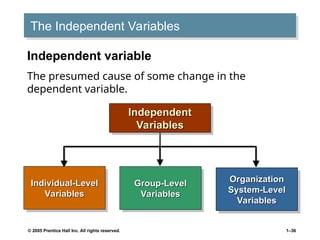
The Independent Variables
Independent
Independent
Variables
Variables
Individual-Level
Individual-Level
Variables
Variables
Organization
Organization
System-Level
System-Level
Variables
Variables
Group-Level
Group-Level
Variables
Variables
Independent variable
The presumed cause of some change in the
dependent variable.

Chapter 1: what is organizational behavior.ppt

  • 1.
    ORGANIZATIONAL BEHAVIOR ORGANIZATIONAL BEHAVIOR ST E P H E N P. R O B B I N S S T E P H E N P. R O B B I N S E L E V E N T H E D I T I O N E L E V E N T H E D I T I O N W W W . P R E N H A L L . C O M / R O B B I N S W W W . P R E N H A L L . C O M / R O B B I N S © 2005 Prentice Hall Inc. All rights reserved. PowerPoint Presentation by Charlie Cook What Is Organizational Behavior Chapter One TWELFTH EDITION
  • 2.
    © 2005 PrenticeHall Inc. All rights reserved. 1–2 What Managers Do Managerial Activities • Make decisions • Allocate resources • Direct activities of others to attain goals Managers (or administrators) Individuals who achieve goals through other people.
  • 3.
    © 2005 PrenticeHall Inc. All rights reserved. 1–3 Where Managers Work Organization A consciously coordinated social unit, composed of two or more people, that functions on a relatively continuous basis to achieve a common goal or set of goals.
  • 4.
    © 2005 PrenticeHall Inc. All rights reserved. 1–4 Management Functions Management Management Functions Functions Planning Planning Organizing Organizing Leading Leading Controlling Controlling
  • 5.
    © 2005 PrenticeHall Inc. All rights reserved. 1–5 Management Functions (cont’d) Planning A process that includes defining goals, establishing strategy, and developing plans to coordinate activities.
  • 6.
    © 2005 PrenticeHall Inc. All rights reserved. 1–6 Management Functions (cont’d) Organizing Determining what tasks are to be done, who is to do them, how the tasks are to be grouped, who reports to whom, and where decisions are to be made.
  • 7.
    © 2005 PrenticeHall Inc. All rights reserved. 1–7 Management Functions (cont’d) Leading A function that includes motivating employees, directing others, selecting the most effective communication channels, and resolving conflicts.
  • 8.
    © 2005 PrenticeHall Inc. All rights reserved. 1–8 Management Functions (cont’d) Controlling Monitoring activities to ensure they are being accomplished as planned and correcting any significant deviations.
  • 9.
    © 2005 PrenticeHall Inc. All rights reserved. 1–9 Mintzberg’s Managerial Roles E X H I B I T 1–1 Source: Adapted from The Nature of Managerial Work by H. Mintzberg. Copyright © 1973 by H. Mintzberg. Reprinted by permission of Pearson Education.
  • 10.
    © 2005 PrenticeHall Inc. All rights reserved. 1–10 Mintzberg’s Managerial Roles (cont’d) E X H I B I T 1–1 (cont’d) Source: Adapted from The Nature of Managerial Work by H. Mintzberg. Copyright © 1973 by H. Mintzberg. Reprinted by permission of Pearson Education.
  • 11.
    © 2005 PrenticeHall Inc. All rights reserved. 1–11 Mintzberg’s Managerial Roles (cont’d) E X H I B I T 1–1 (cont’d) Source: Adapted from The Nature of Managerial Work by H. Mintzberg. Copyright © 1973 by H. Mintzberg. Reprinted by permission of Pearson Education.
  • 12.
    © 2005 PrenticeHall Inc. All rights reserved. 1–12 Management Skills Technical skills The ability to apply specialized knowledge or expertise. Human skills The ability to work with, understand, and motivate other people, both individually and in groups. Conceptual Skills The mental ability to analyze and diagnose complex situations.
  • 13.
    © 2005 PrenticeHall Inc. All rights reserved. 1–13 Effective Versus Successful Managerial Activities (Luthans) 1. Traditional management • Decision making, planning, and controlling 2. Communication • Exchanging routine information and processing paperwork 3. Human resource management • Motivating, disciplining, managing conflict, staffing, and training 4. Networking • Socializing, politicking, and interacting with others
  • 14.
    © 2005 PrenticeHall Inc. All rights reserved. 1–14 E X H I B I T 1–2 Allocation of Activities by Time Source: Based on F. Luthans, R.M. Hodgetts, and S.A. Rosenkrantz, Real Managers (Cambridge, MA: Ballinger, 1988).
  • 15.
    © 2005 PrenticeHall Inc. All rights reserved. 1–15 Enter Organizational Behavior Organizational behavior (OB) A field of study that investigates the impact that individuals, groups, and structure have on behavior within organizations, for the purpose of applying such knowledge toward improving an organization’s effectiveness.
  • 16.
    © 2005 PrenticeHall Inc. All rights reserved. 1–16 Replacing Intuition with Systematic Study Systematic study Looking at relationships, attempting to attribute causes and effects, and drawing conclusions based on scientific evidence. Provides a means to predict behaviors. Intuition A feeling not necessarily supported by research.
  • 17.
    © 2005 PrenticeHall Inc. All rights reserved. 1–17 Replacing Intuition with Systematic Study The Facts Preconceived Notions ≠
  • 18.
    © 2005 PrenticeHall Inc. All rights reserved. 1–18 Toward an OB Discipline Toward an OB Discipline E X H I B I T 1–3
  • 19.
    © 2005 PrenticeHall Inc. All rights reserved. 1–19 Contributing Disciplines to the OB Field E X H I B I T 1–3 (cont’d) Psychology The science that seeks to measure, explain, and sometimes change the behavior of humans and other animals.
  • 20.
    © 2005 PrenticeHall Inc. All rights reserved. 1–20 Contributing Disciplines to the OB Field (cont’d) E X H I B I T 1–3 (cont’d) Sociology The study of people in relation to their fellow human beings.
  • 21.
    © 2005 PrenticeHall Inc. All rights reserved. 1–21 Contributing Disciplines to the OB Field (cont’d) E X H I B I T 1–3 (cont’d) Social Psychology An area within psychology that blends concepts from psychology and sociology and that focuses on the influence of people on one another.
  • 22.
    © 2005 PrenticeHall Inc. All rights reserved. 1–22 Contributing Disciplines to the OB Field (cont’d) E X H I B I T 1–3 (cont’d) Anthropology The study of societies to learn about human beings and their activities.
  • 23.
    © 2005 PrenticeHall Inc. All rights reserved. 1–23 Contributing Disciplines to the OB Field (cont’d) E X H I B I T 1–3 (cont’d) Political Science The study of the behavior of individuals and groups within a political environment.
  • 24.
    © 2005 PrenticeHall Inc. All rights reserved. 1–24 There Are Few Absolutes in OB Contingency Contingency Variables Variables x y Contingency variables Situational factors: variables that moderate the relationship between two or more other variables and improve the correlation.
  • 25.
    © 2005 PrenticeHall Inc. All rights reserved. 1–25 Challenges and Opportunities for OB  Responding to Globalization – Increased foreign assignments – Working with people from different cultures – Coping with anti-capitalism backlash – Overseeing movement of jobs to countries with low-cost labor  Managing Workforce Diversity – Embracing diversity – Changing U.S. demographics – Implications for managers • Recognizing and responding to differences
  • 26.
    © 2005 PrenticeHall Inc. All rights reserved. 1–26 Domestic Domestic Partners Partners Major Workforce Diversity Categories Race Race Non-Christian Non-Christian National National Origin Origin Age Age Disability Disability E X H I B I T 1–5 Gender Gender
  • 27.
    © 2005 PrenticeHall Inc. All rights reserved. 1–27 Challenges and Opportunities for OB (cont’d)  Improving Quality and Productivity – Quality management (QM) – Process reengineering  Responding to the Labor Shortage – Changing work force demographics – Fewer skilled laborers – Early retirements and older workers  Improving Customer Service – Increased expectation of service quality – Customer-responsive cultures
  • 28.
    © 2005 PrenticeHall Inc. All rights reserved. 1–28 Improving Quality and Productivity  Quality management (QM) – The constant attainment of customer satisfaction through the continuous improvement of all organizational processes. – Requires employees to rethink what they do and become more involved in workplace decisions.  Process reengineering – Asks managers to reconsider how work would be done and their organization structured if they were starting over. – Instead of making incremental changes in processes, reengineering involves evaluating every process in terms of its contribution.
  • 29.
    © 2005 PrenticeHall Inc. All rights reserved. 1–29 Challenges and Opportunity for OB (cont’d)  Improving People Skills  Empowering People  Stimulating Innovation and Change  Coping with “Temporariness”  Working in Networked Organizations  Helping Employees Balance Work/Life Conflicts  Improving Ethical Behavior
  • 30.
    © 2005 PrenticeHall Inc. All rights reserved. 1–30 Basic OB Model, Stage I E X H I B I T 1–7 Model An abstraction of reality. A simplified representation of some real-world phenomenon.
  • 31.
    © 2005 PrenticeHall Inc. All rights reserved. 1–31 The Dependent Variables x y Dependent variable A response that is affected by an independent variable.
  • 32.
    © 2005 PrenticeHall Inc. All rights reserved. 1–32 The Dependent Variables (cont’d) Productivity A performance measure that includes effectiveness and efficiency. Effectiveness Achievement of goals. Efficiency The ratio of effective output to the input required to achieve it.
  • 33.
    © 2005 PrenticeHall Inc. All rights reserved. 1–33 The Dependent Variables (cont’d) Absenteeism The failure to report to work. Turnover The voluntary and involuntary permanent withdrawal from an organization.
  • 34.
    © 2005 PrenticeHall Inc. All rights reserved. 1–34 The Dependent Variables (cont’d) Organizational citizenship behavior (OCB) Discretionary behavior that is not part of an employee’s formal job requirements, but that nevertheless promotes the effective functioning of the organization.
  • 35.
    © 2005 PrenticeHall Inc. All rights reserved. 1–35 The Dependent Variables (cont’d) Job satisfaction A general attitude toward one’s job, the difference between the amount of reward workers receive and the amount they believe they should receive.
  • 36.
    © 2005 PrenticeHall Inc. All rights reserved. 1–36 The Independent Variables Independent Independent Variables Variables Individual-Level Individual-Level Variables Variables Organization Organization System-Level System-Level Variables Variables Group-Level Group-Level Variables Variables Independent variable The presumed cause of some change in the dependent variable.