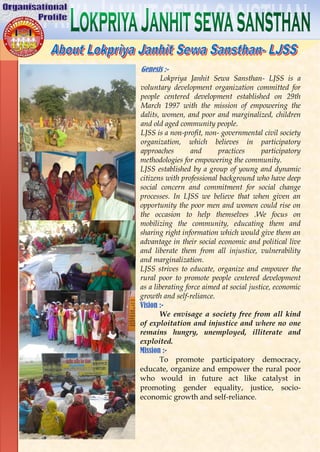
Genesis :-
Lokpriya Janhit Sewa Sansthan- LJSS is a
voluntary development organization committed for
people centered development established on 29th
March 1997 with the mission of empowering the
dalits, women, and poor and marginalized, children
and old aged community people.
LJSS is a non-profit, non- governmental civil society
organization, which believes in participatory
approaches and practices participatory
methodologies for empowering the community.
LJSS established by a group of young and dynamic
citizens with professional background who have deep
social concern and commitment for social change
processes. In LJSS we believe that when given an
opportunity the poor men and women could rise on
the occasion to help themselves .We focus on
mobilizing the community, educating them and
sharing right information which would give them an
advantage in their social economic and political live
and liberate them from all injustice, vulnerability
and marginalization.
LJSS strives to educate, organize and empower the
rural poor to promote people centered development
as a liberating force aimed at social justice, economic
growth and self-reliance.
Vision :-
We envisage a society free from all kind
of exploitation and injustice and where no one
remains hungry, unemployed, illiterate and
exploited.
Mission :-
To promote participatory democracy,
educate, organize and empower the rural poor
who would in future act like catalyst in
promoting gender equality, justice, socio-
economic growth and self-reliance.
Aims
 Promoting elementary education for adolescent girl
and children
 Children’s development through promoting health,
education leadership and nutrition.
 Community based primary health care for the
deprived communities.
 Women empowerment to achieve socio, economic and
political status.
 Promote livelihood and sustainable agricultural
practices.
 Entitlement realization by the marginalized and
socially excluded communities.
 Environment Education, protection and
conservation.
 Strengthening of Civil Society Organizations
(CSOs)
The
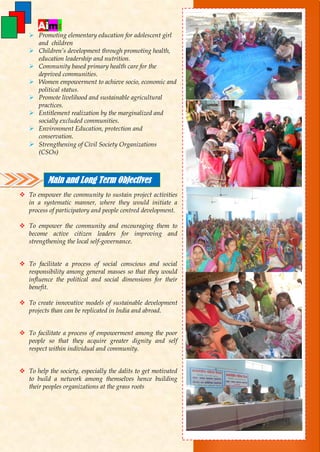
 To empower the community to sustain project activities
in a systematic manner, where they would initiate a
process of participatory and people centred development.
 To empower the community and encouraging them to
become active citizen leaders for improving and
strengthening the local self-governance.
 To facilitate a process of social conscious and social
responsibility among general masses so that they would
influence the political and social dimensions for their
benefit.
 To create innovative models of sustainable development
projects than can be replicated in India and abroad.
 To facilitate a process of empowerment among the poor
people so that they acquire greater dignity and self
respect within individual and community.
 To help the society, especially the dalits to get motivated
to build a network among themselves hence building
their peoples organizations at the grass roots
Main and Long Term Objectives
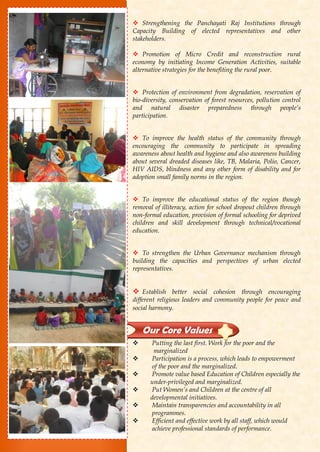
 Strengthening the Panchayati Raj Institutions through
Capacity Building of elected representatives and other
stakeholders.
 Promotion of Micro Credit and reconstruction rural
economy by initiating Income Generation Activities, suitable
alternative strategies for the benefiting the rural poor.
 Protection of environment from degradation, reservation of
bio-diversity, conservation of forest resources, pollution control
and natural disaster preparedness through people’s
participation.
 To improve the health status of the community through
encouraging the community to participate in spreading
awareness about health and hygiene and also awareness building
about several dreaded diseases like, TB, Malaria, Polio, Cancer,
HIV AIDS, blindness and any other form of disability and for
adoption small family norms in the region.
 To improve the educational status of the region though
removal of illiteracy, action for school dropout children through
non-formal education, provision of formal schooling for deprived
children and skill development through technical/vocational
education.
 To strengthen the Urban Governance mechanism through
building the capacities and perspectives of urban elected
representatives.
 Establish better social cohesion through encouraging
different religious leaders and community people for peace and
social harmony.
 Putting the last first. Work for the poor and the
marginalized
 Participation is a process, which leads to empowerment
of the poor and the marginalized.
 Promote value based Education of Children especially the
under-privileged and marginalized.
 Put Women’s and Children at the centre of all
developmental initiatives.
 Maintain transparencies and accountability in all
programmes.
 Efficient and effective work by all staff, which would
achieve professional standards of performance.
Our Core Values
 Developing a very clear understanding of all projects,
roles and responsibilities is an important
prerequisite.
 Teamwork and commitment in any job assigned.
 Completing the job assigned well within the speculated
time period.
 Regularly upgrading the skills and knowledge and
always strive for excellence.
 Fight of the right of the poor.
 Promote People centered development initiatives and
ensure people’s participation especially women and
child.
 DDeeppaarrttmmeenntt ooff HHeeaalltthh,, PPrraattaappggaarrhh
 MMAAMMTTAA HHeeaalltthh IInnssttiittuuttee ffoorr MMootthheerr aanndd
CChhiilldd
 TTAATTAA TTrruussttss MMuummbbaaii
 DDiissttrriicctt RRuurraall DDeevveellooppmmeenntt AAggeennccyy
 IInntteeggrraatteedd CChhiilldd ddeevveellooppmmeenntt ––PPrraattaappggaarrhh
 FFuunnccttiioonnaall vvooccaattiioonnaall TTrraaiinniinngg aanndd rreesseeaarrcchh
ssoocciieettyy
 PPeeooppllee AAccttiioonn ffoorr NNaattiioonnaall IInntteeggrraattiioonn ––
PPAANNII FFaaiizzaabbaadd
 SSAATTHHII UU..PP..
 UU..PP.. MMaahhiillaa KKaallyyaann llttdd.. NNiiggaamm--LLuucckknnooww
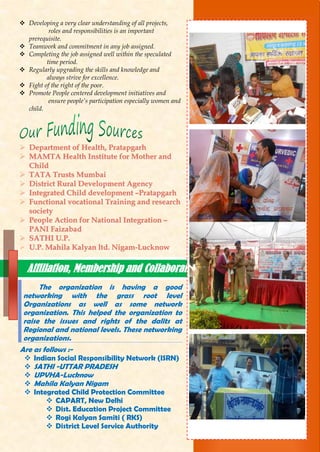
The organization is having a good
networking with the grass root level
Organizations as well as some network
organization. This helped the organization to
raise the issues and rights of the dalits at
Regional and national levels. These networking
organizations.
Are as follows :-
 Indian Social Responsibility Network (ISRN)
 SATHI -UTTAR PRADESH
 UPVHA-Lucknow
 Mahila Kalyan Nigam
 Integrated Child Protection Committee
 CAPART, New Delhi
 Dist. Education Project Committee
 Rogi Kalyan Samiti ( RKS)
 District Level Service Authority
Affiliation, Membership and Collaboration
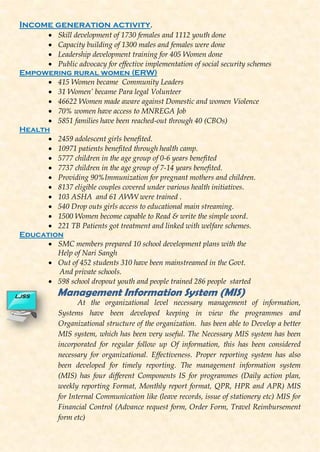
Community Health Programme (C.H.P.)
 Axshya Project
 Empowering rural women (ERW)
 Community Health Programme(CHP)
Coverage area
 70 Gram Panchayats in Lalganj Block, District- Pratapgarh Uttar Padesh
 20 Gram Panchayats in Sangipur Block District-Pratapgarh, Uttar Pradesh
Achievements
Social security and other intervention
 Promoted Total Sanitation- 8975 People benefited.
 523 Shiksha Samities members’s capacity enhanced
 8763 Family benefited through Community Health Programme.
 3221 labors have been registered Under Labor welfare schemes and now 2700
got benefited of the govt. scheme.
 22 Bal Manch has been formed
 61 groups of Adolescent Girl formed
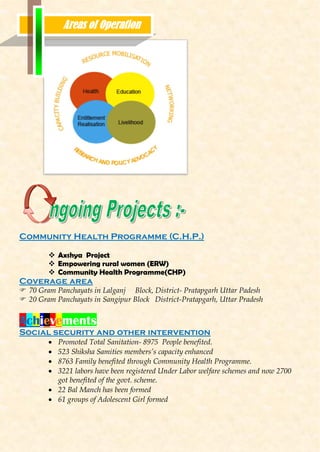
Areas of Operation
Income generation activity.
 Skill development of 1730 females and 1112 youth done
 Capacity building of 1300 males and females were done
 Leadership development training for 405 Women done
 Public advocacy for effective implementation of social security schemes
Empowering rural women (ERW)
 415 Women became Community Leaders
 31 Women’ became Para legal Volunteer
 46622 Women made aware against Domestic and women Violence
 70% women have access to MNREGA Job
 5851 families have been reached-out through 40 (CBOs)
Health
 2459 adolescent girls benefited.
 10971 patients benefited through health camp.
 5777 children in the age group of 0-6 years benefited
 7737 children in the age group of 7-14 years benefited.
 Providing 90%Immunization for pregnant mothers and children.
 8137 eligible couples covered under various health initiatives.
 103 ASHA and 61 AWW were trained .
 540 Drop outs girls access to educational main streaming.
 1500 Women become capable to Read & write the simple word.
 221 TB Patients got treatment and linked with welfare schemes.
Education
 SMC members prepared 10 school development plans with the
Help of Nari Sangh
 Out of 452 students 310 have been mainstreamed in the Govt.
And private schools.
 598 school dropout youth and people trained 286 people started
Management Information System (MIS)
At the organizational level necessary management of information,
Systems have been developed keeping in view the programmes and
Organizational structure of the organization. has been able to Develop a better
MIS system, which has been very useful. The Necessary MIS system has been
incorporated for regular follow up Of information, this has been considered
necessary for organizational. Effectiveness. Proper reporting system has also
been developed for timely reporting. The management information system
(MIS) has four different Components IS for programmes (Daily action plan,
weekly reporting Format, Monthly report format, QPR, HPR and APR) MIS
for Internal Communication like (leave records, issue of stationery etc) MIS for
Financial Control (Advance request form, Order Form, Travel Reimbursement
form etc)
LJSS
For more Details Contact us :
Lokpriya Janhit Sewa
Sansthan- LJSS
Ghuisar Nath Road , Lalganj,Pratapgarh ( UP) 230132
Email: lokpriyapbh@gmail.com
Mob. 09721207006, 9451275040
Name and address-
Lokpriya Janhit Sewa Sansthan- LJSS
Ghuisar Nath Road , Lalganj Pratapgarh ( UP) 230132
Registration No. Date and Place
1086, Date-29-03-1997, Allahabad
Renewed
#117/2012-13 dated .29.03.2012
FCRA No. 136630018, Date- 10.08.2016
PAN No. AAATL3491L
Registration under the Income Tax Regn #.58-59/16/AA/F/2004-05
Name of Contact Person- Mr. Niranjan Prakash (Secretary)
Cell. +91-9721207006
+91-9451275040
Registration with NITI AYOG UP/2009/0003991
 We look forward for your active support
and guidance to reach a milestone.
General Information

ORGANIZATION PROFILE LJSS

  • 1.
    Genesis :- Lokpriya JanhitSewa Sansthan- LJSS is a voluntary development organization committed for people centered development established on 29th March 1997 with the mission of empowering the dalits, women, and poor and marginalized, children and old aged community people. LJSS is a non-profit, non- governmental civil society organization, which believes in participatory approaches and practices participatory methodologies for empowering the community. LJSS established by a group of young and dynamic citizens with professional background who have deep social concern and commitment for social change processes. In LJSS we believe that when given an opportunity the poor men and women could rise on the occasion to help themselves .We focus on mobilizing the community, educating them and sharing right information which would give them an advantage in their social economic and political live and liberate them from all injustice, vulnerability and marginalization. LJSS strives to educate, organize and empower the rural poor to promote people centered development as a liberating force aimed at social justice, economic growth and self-reliance. Vision :- We envisage a society free from all kind of exploitation and injustice and where no one remains hungry, unemployed, illiterate and exploited. Mission :- To promote participatory democracy, educate, organize and empower the rural poor who would in future act like catalyst in promoting gender equality, justice, socio- economic growth and self-reliance.
  • 2.
    Aims  Promoting elementaryeducation for adolescent girl and children  Children’s development through promoting health, education leadership and nutrition.  Community based primary health care for the deprived communities.  Women empowerment to achieve socio, economic and political status.  Promote livelihood and sustainable agricultural practices.  Entitlement realization by the marginalized and socially excluded communities.  Environment Education, protection and conservation.  Strengthening of Civil Society Organizations (CSOs) The  To empower the community to sustain project activities in a systematic manner, where they would initiate a process of participatory and people centred development.  To empower the community and encouraging them to become active citizen leaders for improving and strengthening the local self-governance.  To facilitate a process of social conscious and social responsibility among general masses so that they would influence the political and social dimensions for their benefit.  To create innovative models of sustainable development projects than can be replicated in India and abroad.  To facilitate a process of empowerment among the poor people so that they acquire greater dignity and self respect within individual and community.  To help the society, especially the dalits to get motivated to build a network among themselves hence building their peoples organizations at the grass roots Main and Long Term Objectives
  • 3.
     Strengthening thePanchayati Raj Institutions through Capacity Building of elected representatives and other stakeholders.  Promotion of Micro Credit and reconstruction rural economy by initiating Income Generation Activities, suitable alternative strategies for the benefiting the rural poor.  Protection of environment from degradation, reservation of bio-diversity, conservation of forest resources, pollution control and natural disaster preparedness through people’s participation.  To improve the health status of the community through encouraging the community to participate in spreading awareness about health and hygiene and also awareness building about several dreaded diseases like, TB, Malaria, Polio, Cancer, HIV AIDS, blindness and any other form of disability and for adoption small family norms in the region.  To improve the educational status of the region though removal of illiteracy, action for school dropout children through non-formal education, provision of formal schooling for deprived children and skill development through technical/vocational education.  To strengthen the Urban Governance mechanism through building the capacities and perspectives of urban elected representatives.  Establish better social cohesion through encouraging different religious leaders and community people for peace and social harmony.  Putting the last first. Work for the poor and the marginalized  Participation is a process, which leads to empowerment of the poor and the marginalized.  Promote value based Education of Children especially the under-privileged and marginalized.  Put Women’s and Children at the centre of all developmental initiatives.  Maintain transparencies and accountability in all programmes.  Efficient and effective work by all staff, which would achieve professional standards of performance. Our Core Values
  • 4.
     Developing avery clear understanding of all projects, roles and responsibilities is an important prerequisite.  Teamwork and commitment in any job assigned.  Completing the job assigned well within the speculated time period.  Regularly upgrading the skills and knowledge and always strive for excellence.  Fight of the right of the poor.  Promote People centered development initiatives and ensure people’s participation especially women and child.  DDeeppaarrttmmeenntt ooff HHeeaalltthh,, PPrraattaappggaarrhh  MMAAMMTTAA HHeeaalltthh IInnssttiittuuttee ffoorr MMootthheerr aanndd CChhiilldd  TTAATTAA TTrruussttss MMuummbbaaii  DDiissttrriicctt RRuurraall DDeevveellooppmmeenntt AAggeennccyy  IInntteeggrraatteedd CChhiilldd ddeevveellooppmmeenntt ––PPrraattaappggaarrhh  FFuunnccttiioonnaall vvooccaattiioonnaall TTrraaiinniinngg aanndd rreesseeaarrcchh ssoocciieettyy  PPeeooppllee AAccttiioonn ffoorr NNaattiioonnaall IInntteeggrraattiioonn –– PPAANNII FFaaiizzaabbaadd  SSAATTHHII UU..PP..  UU..PP.. MMaahhiillaa KKaallyyaann llttdd.. NNiiggaamm--LLuucckknnooww The organization is having a good networking with the grass root level Organizations as well as some network organization. This helped the organization to raise the issues and rights of the dalits at Regional and national levels. These networking organizations. Are as follows :-  Indian Social Responsibility Network (ISRN)  SATHI -UTTAR PRADESH  UPVHA-Lucknow  Mahila Kalyan Nigam  Integrated Child Protection Committee  CAPART, New Delhi  Dist. Education Project Committee  Rogi Kalyan Samiti ( RKS)  District Level Service Authority Affiliation, Membership and Collaboration
  • 5.
    Community Health Programme(C.H.P.)  Axshya Project  Empowering rural women (ERW)  Community Health Programme(CHP) Coverage area  70 Gram Panchayats in Lalganj Block, District- Pratapgarh Uttar Padesh  20 Gram Panchayats in Sangipur Block District-Pratapgarh, Uttar Pradesh Achievements Social security and other intervention  Promoted Total Sanitation- 8975 People benefited.  523 Shiksha Samities members’s capacity enhanced  8763 Family benefited through Community Health Programme.  3221 labors have been registered Under Labor welfare schemes and now 2700 got benefited of the govt. scheme.  22 Bal Manch has been formed  61 groups of Adolescent Girl formed Areas of Operation
  • 6.
    Income generation activity. Skill development of 1730 females and 1112 youth done  Capacity building of 1300 males and females were done  Leadership development training for 405 Women done  Public advocacy for effective implementation of social security schemes Empowering rural women (ERW)  415 Women became Community Leaders  31 Women’ became Para legal Volunteer  46622 Women made aware against Domestic and women Violence  70% women have access to MNREGA Job  5851 families have been reached-out through 40 (CBOs) Health  2459 adolescent girls benefited.  10971 patients benefited through health camp.  5777 children in the age group of 0-6 years benefited  7737 children in the age group of 7-14 years benefited.  Providing 90%Immunization for pregnant mothers and children.  8137 eligible couples covered under various health initiatives.  103 ASHA and 61 AWW were trained .  540 Drop outs girls access to educational main streaming.  1500 Women become capable to Read & write the simple word.  221 TB Patients got treatment and linked with welfare schemes. Education  SMC members prepared 10 school development plans with the Help of Nari Sangh  Out of 452 students 310 have been mainstreamed in the Govt. And private schools.  598 school dropout youth and people trained 286 people started Management Information System (MIS) At the organizational level necessary management of information, Systems have been developed keeping in view the programmes and Organizational structure of the organization. has been able to Develop a better MIS system, which has been very useful. The Necessary MIS system has been incorporated for regular follow up Of information, this has been considered necessary for organizational. Effectiveness. Proper reporting system has also been developed for timely reporting. The management information system (MIS) has four different Components IS for programmes (Daily action plan, weekly reporting Format, Monthly report format, QPR, HPR and APR) MIS for Internal Communication like (leave records, issue of stationery etc) MIS for Financial Control (Advance request form, Order Form, Travel Reimbursement form etc) LJSS
  • 7.
    For more DetailsContact us : Lokpriya Janhit Sewa Sansthan- LJSS Ghuisar Nath Road , Lalganj,Pratapgarh ( UP) 230132 Email: lokpriyapbh@gmail.com Mob. 09721207006, 9451275040 Name and address- Lokpriya Janhit Sewa Sansthan- LJSS Ghuisar Nath Road , Lalganj Pratapgarh ( UP) 230132 Registration No. Date and Place 1086, Date-29-03-1997, Allahabad Renewed #117/2012-13 dated .29.03.2012 FCRA No. 136630018, Date- 10.08.2016 PAN No. AAATL3491L Registration under the Income Tax Regn #.58-59/16/AA/F/2004-05 Name of Contact Person- Mr. Niranjan Prakash (Secretary) Cell. +91-9721207006 +91-9451275040 Registration with NITI AYOG UP/2009/0003991  We look forward for your active support and guidance to reach a milestone. General Information