Organization Planning,
Design and Development
Prof. K N Tayade
IT Department
Government College of Engineering,
Amravati
Organization Planning
Organization planning defines or reshapes the organization
structure of a firm as a basis for
1. Clarifying objectives, roles and relationships.
2. Determining the management resources required now and
in the future.
3. Providing information on job requirements so that the
right people can be appointed, adequate training can be
given, and payments to staff are commensurate with their
relative levels of responsibility and value to the company.
The organization structure of a firm is the framework for
carrying out the task of management.
Organization Planning Techniques
1. Organization Analysis:
Process of defining the objectives and activities of a firm in the
light of an examination of its external environment and internal
circumstances.
2. Organization Design:
The information provided by the organization analysis is used to
define the structure of the organization, the function of each major activity
and the role and responsibilities of each management position in the
structure.
Organization Planning Techniques
1. Organization Analysis:
Process of defining the objectives and activities of a firm in the
light of an examination of its external environment and internal
circumstances.
2. Organization Design:
The information provided by the organization analysis is used to
define the structure of the organization, the function of each major activity
and the role and responsibilities of each management position in the
structure.
Principal Components of an Organization
Management Systems: Structure and Processes
1. Planning System
2. Management Control System
3. Communication and Information System
4. Evaluation and Reward System
Organization Design
The organization design is a dynamic process, yet most of the models and
concepts are static.
Five Basic parts of an Organization
1. Operating core
2. Strategic Apex
3. Middle Line
4. Technostructure
5. Support Staff
Basic Parts of an Organization
1. Operating Core
This part consists of those who perform the basic work relating to
production or services. They secure inputs for production, transform
inputs into outputs, Distribute the outputs or provide direct services.
2. Strategic Apex
The strategic apex comprises people having overall responsibility
of the organization, namely the chief executive and other top-level
managers. They have the responsibility to set goals, prepare plans and
develop strategies to implement plans and accomplish goals.
3. Middle Line:
It is the linking pin between the strategic apex and the operating
core. The chain runs from senior managers down to the first-line
supervisors. The chain of authority could be scalar or matrix.
Basic Parts of an Organization
4. Technostructure
Technostructure is made up of analyst whose job is
to control, stabilize and standardize patterns of activity in
the organization. In fully developed organization, the
technostructure is at work at all levels of the hierarchy.
5. Support Staff
Support staff are engaged in large organizations to
encompass more and more boundary activities, such as
running an industrial canteen or hospital, in order to reduce
uncertainty, and control their own affairs.
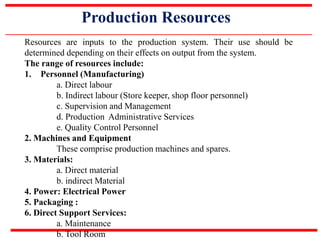
Production Resources
Resources are inputs to the production system. Their use should be
determined depending on their effects on output from the system.
The range of resources include:
1. Personnel (Manufacturing)
a. Direct labour
b. Indirect labour (Store keeper, shop floor personnel)
c. Supervision and Management
d. Production Administrative Services
e. Quality Control Personnel
2. Machines and Equipment
These comprise production machines and spares.
3. Materials:
a. Direct material
b. indirect Material
4. Power: Electrical Power
5. Packaging :
6. Direct Support Services:
a. Maintenance
b. Tool Room
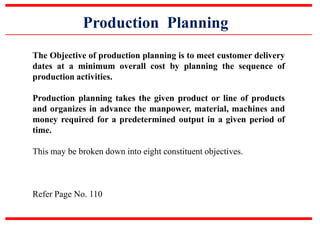
Production Planning
The Objective of production planning is to meet customer delivery
dates at a minimum overall cost by planning the sequence of
production activities.
Production planning takes the given product or line of products
and organizes in advance the manpower, material, machines and
money required for a predetermined output in a given period of
time.
This may be broken down into eight constituent objectives.
Refer Page No. 110
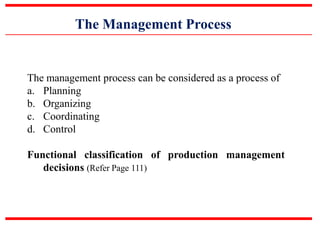
The Management Process
The management process can be considered as a process of
a. Planning
b. Organizing
c. Coordinating
d. Control
Functional classification of production management
decisions (Refer Page 111)
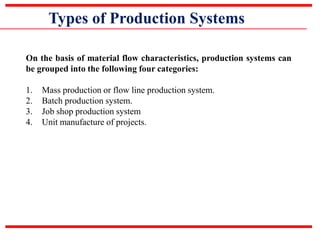
Types of Production Systems
On the basis of material flow characteristics, production systems can
be grouped into the following four categories:
1. Mass production or flow line production system.
2. Batch production system.
3. Job shop production system
4. Unit manufacture of projects.
Production Control
Production control covers all the functions and activities which process
orders and, at the same time, has a fundamental effect on production
resource utilization and efficiency.
Production control is concerned with both marketing and production,
linking the two together, so that while there is effective production
planning, marketing people respond to production situations.
Objectives of Production Control
The objectives of production control system will help to determine:
1. The types of system required
2. The data needed
3. How the system is operated
4. The degree of interrelationship needed within the production
control system.
Production Scheduling and Sequencing
Both capacity planning and production requirements planning make use
of simple scheduling rules when production capacities are related to
order input.
Priorities are established which determine the use of production
equipment and the sequence in which orders will be met.
According to Paul Mali’s definition “ A schedule is a time-negotiated
agreement on how allocated resources will be committed to
achieving an objective.”
OR
A schedule is a blueprint or a detailed guideline.
It is important that the scheduling and sequencing rules agreed at
capacity and production requirements planning levels are made
explicit and expanded to ensure that scheduling remains as effective
as current constraints would allow.
Refer Fig 4.8 on page no. 125.
Scheduling Methods
Three major scheduling methods are commonly used:
1. Priority Scheduling
2. Serial Scheduling
3. Parallel Scheduling

Organization planning, design and development

  • 1.
    Organization Planning, Design andDevelopment Prof. K N Tayade IT Department Government College of Engineering, Amravati
  • 2.
    Organization Planning Organization planningdefines or reshapes the organization structure of a firm as a basis for 1. Clarifying objectives, roles and relationships. 2. Determining the management resources required now and in the future. 3. Providing information on job requirements so that the right people can be appointed, adequate training can be given, and payments to staff are commensurate with their relative levels of responsibility and value to the company. The organization structure of a firm is the framework for carrying out the task of management.
  • 3.
    Organization Planning Techniques 1.Organization Analysis: Process of defining the objectives and activities of a firm in the light of an examination of its external environment and internal circumstances. 2. Organization Design: The information provided by the organization analysis is used to define the structure of the organization, the function of each major activity and the role and responsibilities of each management position in the structure.
  • 4.
    Organization Planning Techniques 1.Organization Analysis: Process of defining the objectives and activities of a firm in the light of an examination of its external environment and internal circumstances. 2. Organization Design: The information provided by the organization analysis is used to define the structure of the organization, the function of each major activity and the role and responsibilities of each management position in the structure.
  • 5.
    Principal Components ofan Organization Management Systems: Structure and Processes 1. Planning System 2. Management Control System 3. Communication and Information System 4. Evaluation and Reward System
  • 6.
    Organization Design The organizationdesign is a dynamic process, yet most of the models and concepts are static. Five Basic parts of an Organization 1. Operating core 2. Strategic Apex 3. Middle Line 4. Technostructure 5. Support Staff
  • 7.
    Basic Parts ofan Organization 1. Operating Core This part consists of those who perform the basic work relating to production or services. They secure inputs for production, transform inputs into outputs, Distribute the outputs or provide direct services. 2. Strategic Apex The strategic apex comprises people having overall responsibility of the organization, namely the chief executive and other top-level managers. They have the responsibility to set goals, prepare plans and develop strategies to implement plans and accomplish goals. 3. Middle Line: It is the linking pin between the strategic apex and the operating core. The chain runs from senior managers down to the first-line supervisors. The chain of authority could be scalar or matrix.
  • 8.
    Basic Parts ofan Organization 4. Technostructure Technostructure is made up of analyst whose job is to control, stabilize and standardize patterns of activity in the organization. In fully developed organization, the technostructure is at work at all levels of the hierarchy. 5. Support Staff Support staff are engaged in large organizations to encompass more and more boundary activities, such as running an industrial canteen or hospital, in order to reduce uncertainty, and control their own affairs.
  • 9.
    Production Resources Resources areinputs to the production system. Their use should be determined depending on their effects on output from the system. The range of resources include: 1. Personnel (Manufacturing) a. Direct labour b. Indirect labour (Store keeper, shop floor personnel) c. Supervision and Management d. Production Administrative Services e. Quality Control Personnel 2. Machines and Equipment These comprise production machines and spares. 3. Materials: a. Direct material b. indirect Material 4. Power: Electrical Power 5. Packaging : 6. Direct Support Services: a. Maintenance b. Tool Room
  • 10.
    Production Planning The Objectiveof production planning is to meet customer delivery dates at a minimum overall cost by planning the sequence of production activities. Production planning takes the given product or line of products and organizes in advance the manpower, material, machines and money required for a predetermined output in a given period of time. This may be broken down into eight constituent objectives. Refer Page No. 110
  • 11.
    The Management Process Themanagement process can be considered as a process of a. Planning b. Organizing c. Coordinating d. Control Functional classification of production management decisions (Refer Page 111)
  • 12.
    Types of ProductionSystems On the basis of material flow characteristics, production systems can be grouped into the following four categories: 1. Mass production or flow line production system. 2. Batch production system. 3. Job shop production system 4. Unit manufacture of projects.
  • 13.
    Production Control Production controlcovers all the functions and activities which process orders and, at the same time, has a fundamental effect on production resource utilization and efficiency. Production control is concerned with both marketing and production, linking the two together, so that while there is effective production planning, marketing people respond to production situations.
  • 14.
    Objectives of ProductionControl The objectives of production control system will help to determine: 1. The types of system required 2. The data needed 3. How the system is operated 4. The degree of interrelationship needed within the production control system.
  • 15.
    Production Scheduling andSequencing Both capacity planning and production requirements planning make use of simple scheduling rules when production capacities are related to order input. Priorities are established which determine the use of production equipment and the sequence in which orders will be met. According to Paul Mali’s definition “ A schedule is a time-negotiated agreement on how allocated resources will be committed to achieving an objective.” OR A schedule is a blueprint or a detailed guideline. It is important that the scheduling and sequencing rules agreed at capacity and production requirements planning levels are made explicit and expanded to ensure that scheduling remains as effective as current constraints would allow. Refer Fig 4.8 on page no. 125.
  • 16.
    Scheduling Methods Three majorscheduling methods are commonly used: 1. Priority Scheduling 2. Serial Scheduling 3. Parallel Scheduling