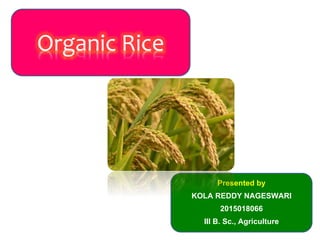
Organic Rice
Presented by
KOLA REDDY NAGESWARI
2015018066
III B. Sc., Agriculture
Introduction
• Rice (Oryza sativa) is staple food for more than
half of the world population.
• India is the world's second largest producer of
Rice, Wheat and other cereals.
• This cereal contributes a considerable amount of
calories to the consumer.
• Conventional rice production we uses over 40
different agro chemicals to control weeds,
diseases and insects - pesticides which puts
consumer health at risk.
• Organic rice production systems have a lot of
advantages over conventional rice cultivation
practices.
Cond...
• India is a major exporter of organic rice in the
International market.
• During 2008-09, around 5630 MT of organic
basmati rice was exported from India through
APEDA.
• Since, the demand is increasing nature for organic
rice year by year.
Extent of organic rice in India
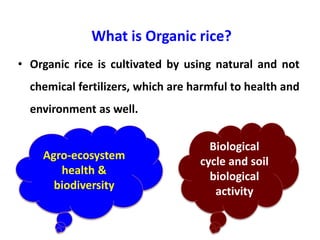
• Organic rice is cultivated by using natural and not
chemical fertilizers, which are harmful to health and
environment as well.
Agro-ecosystem
health &
biodiversity
Biological
cycle and soil
biological
activity
What is Organic rice?
Needs of organic cultivation
Sound
ecosystem
Free from
chemical
Fat
free
Fiber
value
Low sugar
content
Soil
fertility
Organic rice Conventional rice
Calorie 218 250
Carbohydrate 46 grams 53 grams
Dietary fibre 4 grams 1 gram
Glycemic index 59 89
Nutritional properties Organic Rice and conventional Rice (USDA)
• Organic rice are rich in minerals and vitamins
• Lesser G.I food does not cause in rapid sugar spike but
feel full for longer period of time
• Rice is the major crop that receives maximum
quantity of fertilizers (40%) and pesticides
(17-18%) and
• These practices pose major challenges in organic
rice farming for nutrient and pest management.
• Yield reduces in the conversion (initial) period.
Challenges for Organic Rice Cultivation
Package of practices for
Organic Rice
Step for organic rice production
Zero budget natural farming
Waking up of farmer’s
friend (soil fertility)
Jeeva amruth
Nursery Management
i) Nutrient Management
• During seed bed preparation, organic manures
such as FYM, Compost, vermin - compost can be
used @ 5t/ha of nursery area.
• Gana jeeva amuruth :200kg/acre
ii) Seed treatment
a) Plant protection
• Beejamrut: 3 liter/ac of Seeds
• Prevents seed borne disease
b) Bio fertilizer
• Azospirillum and phosphorus solubilizing bacteria
10 gram each/kg of Seeds.
Uses: Fix atmospheric nitrogen 30-35 kg N/ha/season,
solubilizes phosphorus and silicon and induce
drought tolerant.
Special nursery management Practices
i) Dhrava jeeva amrut (7 DAS)
1 ac : 200 litres
ii) Sour butter milk (9 DAS)
1 ac 100 liter water + 3 liter sourbutter milk
Benefit:
• Strengthen the seed and
• Increase the milking stage and reduces the
pest incidence (Main filed)
• During land preparation 10 t of FYM/ha + 5 tons paddy
straw and 10 tones of in-situ grown dhaincha/sunhemp
green manure/ha needs to be incorporated.
• In the last puddle, vermi-compost @ 2 t/ha may be applied
(optional).
• Through these organics, approximately 150 kg N, 40 -50 kg
P2O5, 100 - 120 kg K2O and micronutrients can be supplied.
Organic manure application
SPECIAL TECHNIQUES FOLLOWED
IN MAINFIELD:
Apply Gana jeevamruth: 200 kg / ac
• Dry rice straw:10 kg
I. N: growing legumes plants as cover
crop
II. P: Fish bone meal
III. K: rice straw and manures
IV. Apply Navadhanayaa mixed powder at
first showering time: indirect source
for N, P, K and about 16 essential
nutrients.
• Bio-fertilizers such as Azospirillum or PSB/PSM @
2 - 3 kg /ha mixed with 25 kg FYM or VC and applied
to the soil just before planting.
• Blue green algae @ 10 kg/ha, 10 days after planting.
• Apply azolla @ 1 t/ha, 7-10 days after transplanting
and incorporated after 3 weeks.
Bio - fertilizers
After transplanting once per 15 days spray with
a) Fish meal amino acid (Fish meal is a good
source phosphorus 12%) and
b) Dharava jeeva amrut - 200 liter/ac Spray 4
times in crop period.
c) Panchakavya: apply 10th, 15th, 30th & 50th day
d) Spray 6 lit of sourbutter milk/ac in 200 liter of
water: At milking stage:
Special Care after Transplanting
Weed suppression
• Weed control and soil fertility are the principal
challenges associated with organic rice production.
• Primary weed - control practices include crop
rotations, land leveling, seedbed preparation.
• Water management.
• Rotary hoeing.
Pest and Disease management
Pest and disease management
• Agniyasthiram - removes 75% of insect and pest.
20 lit
Tobacco
leaves
3kg
0.5kg
3kg
Custard
apple leaves
0.5kg
Cont…
• Agni yasthiram - 200ml /10 l of water in addition to
this neemayasthiram is used
• Fall armyworm and chinch bug - flush of water.
• Stinkbugs and water weevils - Timely planting,
variety selection and cultural practices.
Research Evidence
Effect of organic and inorganic nutrition of rice
on grain yield (2009-11)
Dr Y. V. Singh
Conclusion
• Investment
• Nutritional value
• Soil fertility
• Health issues
• Yield
Organic Rice

Organic Rice

  • 1.
    Organic Rice Presented by KOLAREDDY NAGESWARI 2015018066 III B. Sc., Agriculture
  • 2.
    Introduction • Rice (Oryzasativa) is staple food for more than half of the world population. • India is the world's second largest producer of Rice, Wheat and other cereals. • This cereal contributes a considerable amount of calories to the consumer.
  • 3.
    • Conventional riceproduction we uses over 40 different agro chemicals to control weeds, diseases and insects - pesticides which puts consumer health at risk. • Organic rice production systems have a lot of advantages over conventional rice cultivation practices. Cond...
  • 4.
    • India isa major exporter of organic rice in the International market. • During 2008-09, around 5630 MT of organic basmati rice was exported from India through APEDA. • Since, the demand is increasing nature for organic rice year by year. Extent of organic rice in India
  • 5.
    • Organic riceis cultivated by using natural and not chemical fertilizers, which are harmful to health and environment as well. Agro-ecosystem health & biodiversity Biological cycle and soil biological activity What is Organic rice?
  • 6.
    Needs of organiccultivation Sound ecosystem Free from chemical Fat free Fiber value Low sugar content Soil fertility
  • 7.
    Organic rice Conventionalrice Calorie 218 250 Carbohydrate 46 grams 53 grams Dietary fibre 4 grams 1 gram Glycemic index 59 89 Nutritional properties Organic Rice and conventional Rice (USDA) • Organic rice are rich in minerals and vitamins • Lesser G.I food does not cause in rapid sugar spike but feel full for longer period of time
  • 8.
    • Rice isthe major crop that receives maximum quantity of fertilizers (40%) and pesticides (17-18%) and • These practices pose major challenges in organic rice farming for nutrient and pest management. • Yield reduces in the conversion (initial) period. Challenges for Organic Rice Cultivation
  • 9.
    Package of practicesfor Organic Rice
  • 10.
    Step for organicrice production Zero budget natural farming Waking up of farmer’s friend (soil fertility) Jeeva amruth
  • 11.
  • 12.
    i) Nutrient Management •During seed bed preparation, organic manures such as FYM, Compost, vermin - compost can be used @ 5t/ha of nursery area. • Gana jeeva amuruth :200kg/acre ii) Seed treatment a) Plant protection • Beejamrut: 3 liter/ac of Seeds • Prevents seed borne disease
  • 13.
    b) Bio fertilizer •Azospirillum and phosphorus solubilizing bacteria 10 gram each/kg of Seeds. Uses: Fix atmospheric nitrogen 30-35 kg N/ha/season, solubilizes phosphorus and silicon and induce drought tolerant.
  • 14.
    Special nursery managementPractices i) Dhrava jeeva amrut (7 DAS) 1 ac : 200 litres ii) Sour butter milk (9 DAS) 1 ac 100 liter water + 3 liter sourbutter milk Benefit: • Strengthen the seed and • Increase the milking stage and reduces the pest incidence (Main filed)
  • 15.
    • During landpreparation 10 t of FYM/ha + 5 tons paddy straw and 10 tones of in-situ grown dhaincha/sunhemp green manure/ha needs to be incorporated. • In the last puddle, vermi-compost @ 2 t/ha may be applied (optional). • Through these organics, approximately 150 kg N, 40 -50 kg P2O5, 100 - 120 kg K2O and micronutrients can be supplied. Organic manure application
  • 16.
    SPECIAL TECHNIQUES FOLLOWED INMAINFIELD: Apply Gana jeevamruth: 200 kg / ac • Dry rice straw:10 kg I. N: growing legumes plants as cover crop II. P: Fish bone meal III. K: rice straw and manures IV. Apply Navadhanayaa mixed powder at first showering time: indirect source for N, P, K and about 16 essential nutrients.
  • 17.
    • Bio-fertilizers suchas Azospirillum or PSB/PSM @ 2 - 3 kg /ha mixed with 25 kg FYM or VC and applied to the soil just before planting. • Blue green algae @ 10 kg/ha, 10 days after planting. • Apply azolla @ 1 t/ha, 7-10 days after transplanting and incorporated after 3 weeks. Bio - fertilizers
  • 18.
    After transplanting onceper 15 days spray with a) Fish meal amino acid (Fish meal is a good source phosphorus 12%) and b) Dharava jeeva amrut - 200 liter/ac Spray 4 times in crop period. c) Panchakavya: apply 10th, 15th, 30th & 50th day d) Spray 6 lit of sourbutter milk/ac in 200 liter of water: At milking stage: Special Care after Transplanting
  • 19.
    Weed suppression • Weedcontrol and soil fertility are the principal challenges associated with organic rice production. • Primary weed - control practices include crop rotations, land leveling, seedbed preparation. • Water management. • Rotary hoeing.
  • 20.
    Pest and Diseasemanagement
  • 21.
    Pest and diseasemanagement • Agniyasthiram - removes 75% of insect and pest. 20 lit Tobacco leaves 3kg 0.5kg 3kg Custard apple leaves 0.5kg
  • 22.
    Cont… • Agni yasthiram- 200ml /10 l of water in addition to this neemayasthiram is used • Fall armyworm and chinch bug - flush of water. • Stinkbugs and water weevils - Timely planting, variety selection and cultural practices.
  • 23.
  • 24.
    Effect of organicand inorganic nutrition of rice on grain yield (2009-11) Dr Y. V. Singh
  • 25.
    Conclusion • Investment • Nutritionalvalue • Soil fertility • Health issues • Yield