Institution name
Presented by
ORGANIC FARMING:
Definition, Principle, History, Conclusion
To
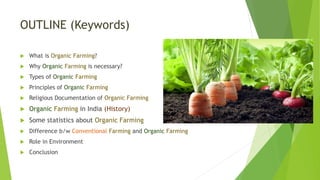
OUTLINE (Keywords)
 What is Organic Farming?
 Why Organic Farming is necessary?
 Types of Organic Farming
 Principles of Organic Farming
 Religious Documentation of Organic Farming
 Organic Farming in India (History)
 Some statistics about Organic Farming
 Difference b/w Conventional Farming and Organic Farming
 Role in Environment
 Conclusion
What is Organic Farming?
 Organic farming is a system which avoids or largely excludes the use
of synthetic inputs (such as fertilizers, pesticides, hormones, feed
additives etc.) and to the maximum extent feasible rely upon crop
rotations, crop residues, animal manures, off-farm organic waste.
 “It is a holistic production management system that promotes and
enhance health of agro-ecosystem, including biodivervsity, biological
cycles and soil biological activity.”
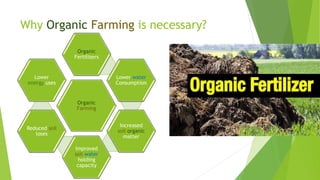
Organic
Farming
Organic
Fertilizers
Lower water
Consumption
Increased
soil organic
matter
Improved
soil water
holding
capacity
Reduced soil
loses
Lower
energy uses
Why Organic Farming is necessary?
TYPES OF ORGANIC FARMING
 PURE ORGANIC FARMING : Use of organic manures and biopesticides
with complete avoidance of inorganic chemicals and pesticides.
 INTEGRATED FARMING : Involves Integrated Nutrient Management
(INM) and Integrated Pest Management (IPM).
 INTEGRATED FARMING SYSTEMS : Local resources are effectively
recycled by involving other components such as poultry, fish pond,
mushroom, goat rearing etc. apart from crop components. It is a low
input organic farming.
Cont.….
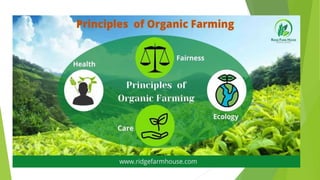
 Health : sustain and enhance the health of soil, plant, animal, human and
planet as one and indivisible.
 Ecology : based on living ecological systems and cycles, work with them,
emulate them, and help sustain them.
 Fairness : build on relationships that ensure fairness with regard to the
common environment and life opportunities.
 Care : managed in a precautionary and responsible manner to protect the
health and well-being of current and future generations and the environment.
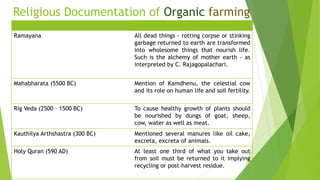
Religious Documentation of Organic farming
Ramayana All dead things - rotting corpse or stinking
garbage returned to earth are transformed
into wholesome things that nourish life.
Such is the alchemy of mother earth - as
interpreted by C. Rajagopalachari.
Mahabharata (5500 BC) Mention of Kamdhenu, the celestial cow
and its role on human life and soil fertility.
Rig Veda (2500 – 1500 BC) To cause healthy growth of plants should
be nourished by dungs of goat, sheep,
cow, water as well as meat.
Kauthilya Arthshastra (300 BC) Mentioned several manures like oil cake,
excreta, excreta of animals.
Holy Quran (590 AD) At least one third of what you take out
from soil must be returned to it implying
recycling or post-harvest residue.
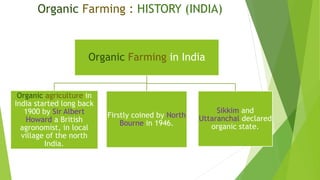
Organic Farming in India
Organic agriculture in
India started long back
1900 by Sir Albert
Howard a British
agronomist, in local
village of the north
India.
Firstly coined by North
Bourne in 1946.
Sikkim and
Uttaranchal declared
organic state.
Organic Farming : HISTORY (INDIA)
Land area of major countries under
Organic Farming (FIBL & IFOAM 2013)
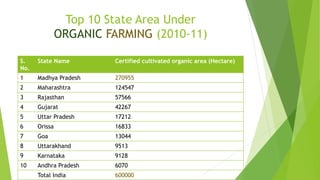
Top 10 State Area Under
ORGANIC FARMING (2010-11)
S.
No.
State Name Certified cultivated organic area (Hectare)
1 Madhya Pradesh 270955
2 Maharashtra 124547
3 Rajasthan 57566
4 Gujarat 42267
5 Uttar Pradesh 17212
6 Orissa 16833
7 Goa 13044
8 Uttarakhand 9513
9 Karnataka 9128
10 Andhra Pradesh 6070
Total India 600000
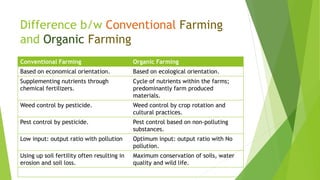
Difference b/w Conventional Farming
and Organic Farming
Conventional Farming Organic Farming
Based on economical orientation. Based on ecological orientation.
Supplementing nutrients through
chemical fertilizers.
Cycle of nutrients within the farms;
predominantly farm produced
materials.
Weed control by pesticide. Weed control by crop rotation and
cultural practices.
Pest control by pesticide. Pest control based on non-polluting
substances.
Low input: output ratio with pollution Optimum input: output ratio with No
pollution.
Using up soil fertility often resulting in
erosion and soil loss.
Maximum conservation of soils, water
quality and wild life.
 Sustainable and eco-friendly
 Improves quality and nutritive value of the farm produces
 Encourages sustainable livelihood of the producers as well as safeguards
consumers health
 Promotes healthy use of the natural resources and minimizes all forms of the
pollution
 Enhances and sustains biological diversity
Role in Environment
CONCLUSION
 Organic Farming is :
 Sustainable
 Economic
 Eco-Friendly
 No risk of residual toxicity
 Improves soil fertility
 Yields Quality production
 Compost prepared from farm wastes
 FYM (Farm Yard Manure), Neem-cake (by-product obtained in the process of cold
pressing of neem tree fruits and kernels), Biogas slurry (by-product of anaerobic
digestion from Biogas plant), vermicompost (a mixture of decomposing vegetable or
food waste, bedding materials, and vermicast) etc.
 maintains organic matter in soil.
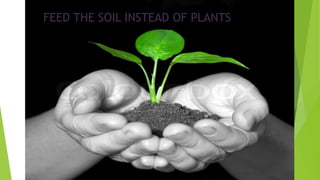
FEED THE SOIL INSTEAD OF PLANTS
Source of information- Google

Organic Farming

  • 1.
    Institution name Presented by ORGANICFARMING: Definition, Principle, History, Conclusion To
  • 2.
    OUTLINE (Keywords)  Whatis Organic Farming?  Why Organic Farming is necessary?  Types of Organic Farming  Principles of Organic Farming  Religious Documentation of Organic Farming  Organic Farming in India (History)  Some statistics about Organic Farming  Difference b/w Conventional Farming and Organic Farming  Role in Environment  Conclusion
  • 3.
    What is OrganicFarming?  Organic farming is a system which avoids or largely excludes the use of synthetic inputs (such as fertilizers, pesticides, hormones, feed additives etc.) and to the maximum extent feasible rely upon crop rotations, crop residues, animal manures, off-farm organic waste.  “It is a holistic production management system that promotes and enhance health of agro-ecosystem, including biodivervsity, biological cycles and soil biological activity.”
  • 4.
    Organic Farming Organic Fertilizers Lower water Consumption Increased soil organic matter Improved soilwater holding capacity Reduced soil loses Lower energy uses Why Organic Farming is necessary?
  • 5.
    TYPES OF ORGANICFARMING  PURE ORGANIC FARMING : Use of organic manures and biopesticides with complete avoidance of inorganic chemicals and pesticides.  INTEGRATED FARMING : Involves Integrated Nutrient Management (INM) and Integrated Pest Management (IPM).  INTEGRATED FARMING SYSTEMS : Local resources are effectively recycled by involving other components such as poultry, fish pond, mushroom, goat rearing etc. apart from crop components. It is a low input organic farming.
  • 7.
    Cont.….  Health :sustain and enhance the health of soil, plant, animal, human and planet as one and indivisible.  Ecology : based on living ecological systems and cycles, work with them, emulate them, and help sustain them.  Fairness : build on relationships that ensure fairness with regard to the common environment and life opportunities.  Care : managed in a precautionary and responsible manner to protect the health and well-being of current and future generations and the environment.
  • 8.
    Religious Documentation ofOrganic farming Ramayana All dead things - rotting corpse or stinking garbage returned to earth are transformed into wholesome things that nourish life. Such is the alchemy of mother earth - as interpreted by C. Rajagopalachari. Mahabharata (5500 BC) Mention of Kamdhenu, the celestial cow and its role on human life and soil fertility. Rig Veda (2500 – 1500 BC) To cause healthy growth of plants should be nourished by dungs of goat, sheep, cow, water as well as meat. Kauthilya Arthshastra (300 BC) Mentioned several manures like oil cake, excreta, excreta of animals. Holy Quran (590 AD) At least one third of what you take out from soil must be returned to it implying recycling or post-harvest residue.
  • 9.
    Organic Farming inIndia Organic agriculture in India started long back 1900 by Sir Albert Howard a British agronomist, in local village of the north India. Firstly coined by North Bourne in 1946. Sikkim and Uttaranchal declared organic state. Organic Farming : HISTORY (INDIA)
  • 10.
    Land area ofmajor countries under Organic Farming (FIBL & IFOAM 2013)
  • 11.
    Top 10 StateArea Under ORGANIC FARMING (2010-11) S. No. State Name Certified cultivated organic area (Hectare) 1 Madhya Pradesh 270955 2 Maharashtra 124547 3 Rajasthan 57566 4 Gujarat 42267 5 Uttar Pradesh 17212 6 Orissa 16833 7 Goa 13044 8 Uttarakhand 9513 9 Karnataka 9128 10 Andhra Pradesh 6070 Total India 600000
  • 12.
    Difference b/w ConventionalFarming and Organic Farming Conventional Farming Organic Farming Based on economical orientation. Based on ecological orientation. Supplementing nutrients through chemical fertilizers. Cycle of nutrients within the farms; predominantly farm produced materials. Weed control by pesticide. Weed control by crop rotation and cultural practices. Pest control by pesticide. Pest control based on non-polluting substances. Low input: output ratio with pollution Optimum input: output ratio with No pollution. Using up soil fertility often resulting in erosion and soil loss. Maximum conservation of soils, water quality and wild life.
  • 13.
     Sustainable andeco-friendly  Improves quality and nutritive value of the farm produces  Encourages sustainable livelihood of the producers as well as safeguards consumers health  Promotes healthy use of the natural resources and minimizes all forms of the pollution  Enhances and sustains biological diversity Role in Environment
  • 14.
    CONCLUSION  Organic Farmingis :  Sustainable  Economic  Eco-Friendly  No risk of residual toxicity  Improves soil fertility  Yields Quality production  Compost prepared from farm wastes  FYM (Farm Yard Manure), Neem-cake (by-product obtained in the process of cold pressing of neem tree fruits and kernels), Biogas slurry (by-product of anaerobic digestion from Biogas plant), vermicompost (a mixture of decomposing vegetable or food waste, bedding materials, and vermicast) etc.  maintains organic matter in soil.
  • 15.
    FEED THE SOILINSTEAD OF PLANTS
  • 16.