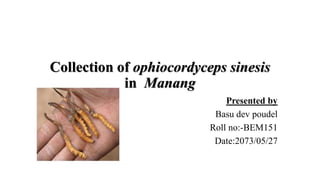
Collection of ophiocordyceps sinesis
in Manang
Presented by
Basu dev poudel
Roll no:-BEM151
Date:2073/05/27
Introduction
• Ophiocordyceps sinesis literally means summer plant and winter insect
in Tibetan, known as Yarsagumba, Yarchagunbu, Kira, Jeevanbuti,
Chyau,Chyau kira and Jara in Nepali.
• Rare and unique herb that grows in the meadows above 3,500 meters
(11,483 feet) in the Himalayan region.
• Endemic species to the Himalayas and Tibet .
• Treatment of different diseases like diarrhea, headache, cough,
rheumatism, liver disease, and also as an aphrodisiac and tonic.
Objective
• To study of the Collection of Ophiocordyceps sinensis in
Nyeshang valley Manang
Method
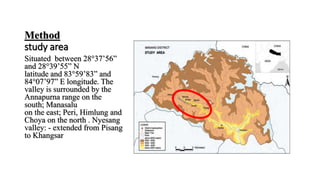
study area
Situated between 28°37’56”
and 28°39’55” N
latitude and 83°59’83” and
84°07’97” E longitude. The
valley is surrounded by the
Annapurna range on the
south; Manasalu
on the east; Peri, Himlung and
Choya on the north . Nyesang
valley: - extended from Pisang
to Khangsar
Method
Data collection
• Informal interviews
Interviews were conducted by walking to people's houses and asking
for their permission.
Tried to find people of different age groups (young people, and old
people), of different genders, and of different occupations. The key
persons are Yarsagumba collectors/user, manage people
Result and discussion
• 3,500 m to 5,000 m altitudes was the habitat of yarsagumba.
• Pisang and Narako was the most suitable area for Yarsagumba
collection.
• People from Gorkha and Dhading district were main collector of
yarsagumba.
• Manage people are does not take part in collection due to religious
view .
• Collector collect only 5-10 pieces of yarsagumba perhead per day i.e.
monthly 150-200 pieces.Since 2007 they used to collect more than
3000 pieces in a season.
• Healthy grassland environment is favorable for the caterpillar
development.
Result and Discussion
• In 1 kg, large size yarsa approx.2000-2500 pieces and small size yarsa
approx. 3000-3500 pieces.
• Nowadays Yarsagumba harvest has decreased significantly.
• The price of large sized yellow colored and robust individual was
higher about NRs 700-1000.
• The price of smaller, grey colored and hollow Yarsagumba about NRs
300-500.
• The entry fee varies across the sites and also based on the origin of
collectors. Entry fee was NRs 7500 for locals and NRs15000 for
outsiders .
conclusion
• Collection of Yarsagumba per unit per head declined due to the
increasing number of people involved in collection.
• Over-harvesting, pre-mature harvesting and habitat destruction cause
of yarsagumba population decline.
• The unsustainable collection, inadequate knowledge on life cycle,
and trade pattern is increasing the risk and vulnerability of Yarsa.
• To maintain a healthy pasture environment, over trampling effects
and over grazing should be minimized and checked.
• The price difference between local and international market should
maintain.
References
• Chhetri P. (2014) Livelihood Strategies of People in the Himalayan Region of
Nepal: A Study in the Villages of Eastern Manang, Independent Study
Project (ISP) Collection. Paper 1831.
• Devkota S. (2006) Yarsagumba [Cordyceps sinensis (Berk.) Sacc.]; Traditional
Utilization in Dolpa District, Western Nepal .Our Nature 4:48-52.
• Devkota S. (2009) the frequency and relationship of flowering plants on
the distribution pattern of Ophiocordyceps sinensis. Banko Janakari, 19 (1)
• Thapa BB, Panthi S , Rai RK, Shrestha UB ,Aryal A, Shrestha S,Shrestha B
(2014) An Assessment of Yarsagumba (Ophiocordyceps sinensis) Collection
in Dhorpatan Hunting Reserve, Nepal. Journal of Mountain Science: 11(2):
555-562.
Thank you
Any
questions

Ophiocordyceps sinesis

  • 1.
    Collection of ophiocordycepssinesis in Manang Presented by Basu dev poudel Roll no:-BEM151 Date:2073/05/27
  • 2.
    Introduction • Ophiocordyceps sinesisliterally means summer plant and winter insect in Tibetan, known as Yarsagumba, Yarchagunbu, Kira, Jeevanbuti, Chyau,Chyau kira and Jara in Nepali. • Rare and unique herb that grows in the meadows above 3,500 meters (11,483 feet) in the Himalayan region. • Endemic species to the Himalayas and Tibet . • Treatment of different diseases like diarrhea, headache, cough, rheumatism, liver disease, and also as an aphrodisiac and tonic.
  • 3.
    Objective • To studyof the Collection of Ophiocordyceps sinensis in Nyeshang valley Manang
  • 4.
    Method study area Situated between28°37’56” and 28°39’55” N latitude and 83°59’83” and 84°07’97” E longitude. The valley is surrounded by the Annapurna range on the south; Manasalu on the east; Peri, Himlung and Choya on the north . Nyesang valley: - extended from Pisang to Khangsar
  • 5.
    Method Data collection • Informalinterviews Interviews were conducted by walking to people's houses and asking for their permission. Tried to find people of different age groups (young people, and old people), of different genders, and of different occupations. The key persons are Yarsagumba collectors/user, manage people
  • 6.
    Result and discussion •3,500 m to 5,000 m altitudes was the habitat of yarsagumba. • Pisang and Narako was the most suitable area for Yarsagumba collection. • People from Gorkha and Dhading district were main collector of yarsagumba. • Manage people are does not take part in collection due to religious view . • Collector collect only 5-10 pieces of yarsagumba perhead per day i.e. monthly 150-200 pieces.Since 2007 they used to collect more than 3000 pieces in a season. • Healthy grassland environment is favorable for the caterpillar development.
  • 7.
    Result and Discussion •In 1 kg, large size yarsa approx.2000-2500 pieces and small size yarsa approx. 3000-3500 pieces. • Nowadays Yarsagumba harvest has decreased significantly. • The price of large sized yellow colored and robust individual was higher about NRs 700-1000. • The price of smaller, grey colored and hollow Yarsagumba about NRs 300-500. • The entry fee varies across the sites and also based on the origin of collectors. Entry fee was NRs 7500 for locals and NRs15000 for outsiders .
  • 8.
    conclusion • Collection ofYarsagumba per unit per head declined due to the increasing number of people involved in collection. • Over-harvesting, pre-mature harvesting and habitat destruction cause of yarsagumba population decline. • The unsustainable collection, inadequate knowledge on life cycle, and trade pattern is increasing the risk and vulnerability of Yarsa. • To maintain a healthy pasture environment, over trampling effects and over grazing should be minimized and checked. • The price difference between local and international market should maintain.
  • 9.
    References • Chhetri P.(2014) Livelihood Strategies of People in the Himalayan Region of Nepal: A Study in the Villages of Eastern Manang, Independent Study Project (ISP) Collection. Paper 1831. • Devkota S. (2006) Yarsagumba [Cordyceps sinensis (Berk.) Sacc.]; Traditional Utilization in Dolpa District, Western Nepal .Our Nature 4:48-52. • Devkota S. (2009) the frequency and relationship of flowering plants on the distribution pattern of Ophiocordyceps sinensis. Banko Janakari, 19 (1) • Thapa BB, Panthi S , Rai RK, Shrestha UB ,Aryal A, Shrestha S,Shrestha B (2014) An Assessment of Yarsagumba (Ophiocordyceps sinensis) Collection in Dhorpatan Hunting Reserve, Nepal. Journal of Mountain Science: 11(2): 555-562.
  • 10.