With your teachers: Natasha and
Delaney
ORGANIC CHEMISTRY
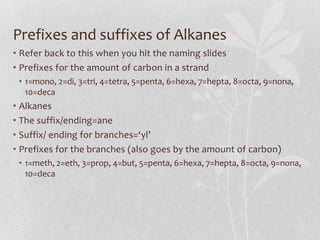
Prefixes and suffixes of Alkanes
• Refer back to this when you hit the naming slides
• Prefixes for the amount of carbon in a strand
• 1=mono, 2=di, 3=tri, 4=tetra, 5=penta, 6=hexa, 7=hepta, 8=octa, 9=nona,
10=deca
• Alkanes
• The suffix/ending=ane
• Suffix/ ending for branches=‘yl’
• Prefixes for the branches (also goes by the amount of carbon)
• 1=meth, 2=eth, 3=prop, 4=but, 5=penta, 6=hexa, 7=hepta, 8=octa, 9=nona,
10=deca
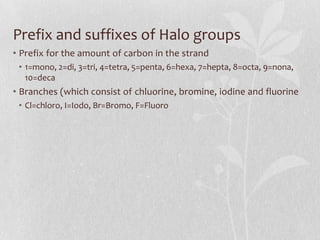
Prefix and suffixes of Halo groups
• Prefix for the amount of carbon in the strand
• 1=mono, 2=di, 3=tri, 4=tetra, 5=penta, 6=hexa, 7=hepta, 8=octa, 9=nona,
10=deca
• Branches (which consist of chluorine, bromine, iodine and fluorine
• Cl=chloro, I=Iodo, Br=Bromo, F=Fluoro
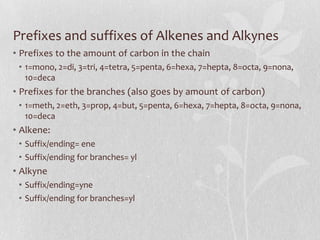
Prefixes and suffixes of Alkenes and Alkynes
• Prefixes to the amount of carbon in the chain
• 1=mono, 2=di, 3=tri, 4=tetra, 5=penta, 6=hexa, 7=hepta, 8=octa, 9=nona,
10=deca
• Prefixes for the branches (also goes by amount of carbon)
• 1=meth, 2=eth, 3=prop, 4=but, 5=penta, 6=hexa, 7=hepta, 8=octa, 9=nona,
10=deca
• Alkene:
• Suffix/ending= ene
• Suffix/ending for branches= yl
• Alkyne
• Suffix/ending=yne
• Suffix/ending for branches=yl
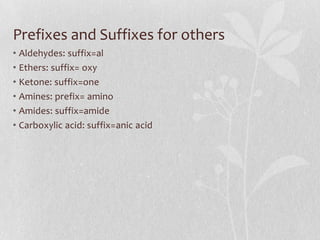
Prefixes and Suffixes for others
• Aldehydes: suffix=al
• Ethers: suffix= oxy
• Ketone: suffix=one
• Amines: prefix= amino
• Amides: suffix=amide
• Carboxylic acid: suffix=anic acid
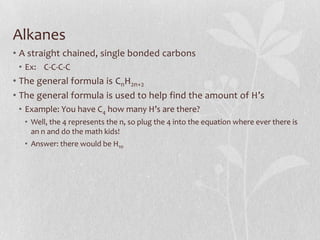
Alkanes
• A straight chained, single bonded carbons
• Ex: C-C-C-C
• The general formula is CnH2n+2
• The general formula is used to help find the amount of H’s
• Example: You have C4 how many H’s are there?
• Well, the 4 represents the n, so plug the 4 into the equation where ever there is
an n and do the math kids!
• Answer: there would be H10
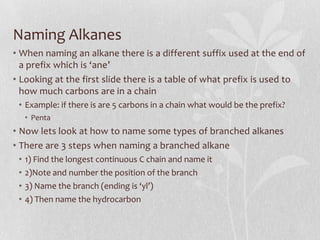
Naming Alkanes
• When naming an alkane there is a different suffix used at the end of
a prefix which is ‘ane’
• Looking at the first slide there is a table of what prefix is used to
how much carbons are in a chain
• Example: if there is are 5 carbons in a chain what would be the prefix?
• Penta
• Now lets look at how to name some types of branched alkanes
• There are 3 steps when naming a branched alkane
• 1) Find the longest continuous C chain and name it
• 2)Note and number the position of the branch
• 3) Name the branch (ending is ‘yl’)
• 4) Then name the hydrocarbon
Branched Alkanes #1
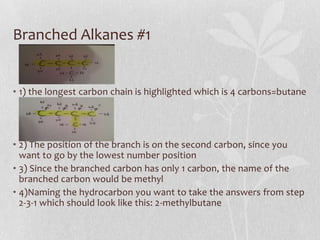
• 1) the longest carbon chain is highlighted which is 4 carbons=butane
• 2) The position of the branch is on the second carbon, since you
want to go by the lowest number position
• 3) Since the branched carbon has only 1 carbon, the name of the
branched carbon would be methyl
• 4)Naming the hydrocarbon you want to take the answers from step
2-3-1 which should look like this: 2-methylbutane
Branched Alkanes #2
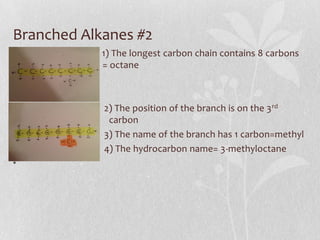
• 1) The longest carbon chain contains 8 carbons
w = octane
•
• 2) The position of the branch is on the 3rd
carbon carbon
• 3) The name of the branch has 1 carbon=methyl
• 4) The hydrocarbon name= 3-methyloctane
•
Branched Alkanes #3
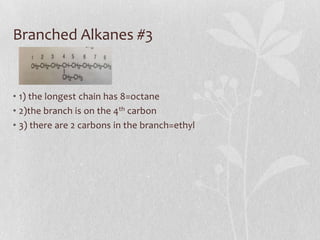
• 1) the longest chain has 8=octane
• 2)the branch is on the 4th carbon
• 3) there are 2 carbons in the branch=ethyl
Branched Alkanes #4
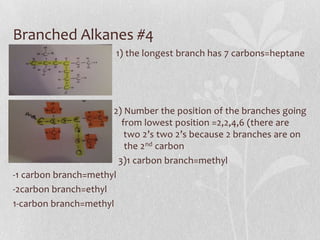
1) the longest branch has 7 carbons=heptane
2) Number the position of the branches going
f from lowest position =2,2,4,6 (there are
t two 2’s two 2’s because 2 branches are on
t the 2nd carbon
3)1 carbon branch=methyl
-1 carbon branch=methyl
-2carbon branch=ethyl
1-carbon branch=methyl
Con’t branched alkanes #4
• Since there are 2 different types of branches (ethyl and methyl) you
want to start in alphabetically
• So first you would have the 4-ethyl: since the 4 is the position and ethyl is
the prefix for the 2 carbons in the branch
• Next you want to list all the positions of the same # carbon branch (which
is the methyl).So: 2-2-6-trimethyl
• The tri prefix represents that there are 3 methyl's (1+1+1=3 which is tri)
• Finally you want to put the heptane at the end
• The final answer is 4-ethyl-2-2-6-trimethylheptane
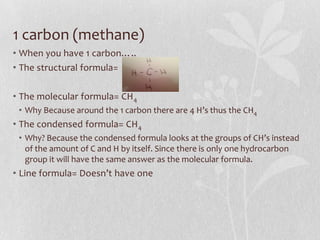
1 carbon (methane)
• When you have 1 carbon…..
• The structural formula=
• The molecular formula= CH4
• Why Because around the 1 carbon there are 4 H’s thus the CH4
• The condensed formula= CH4
• Why? Because the condensed formula looks at the groups of CH’s instead
of the amount of C and H by itself. Since there is only one hydrocarbon
group it will have the same answer as the molecular formula.
• Line formula= Doesn’t have one
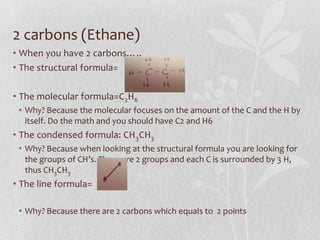
2 carbons (Ethane)
• When you have 2 carbons…..
• The structural formula=
• The molecular formula=C2H6
• Why? Because the molecular focuses on the amount of the C and the H by
itself. Do the math and you should have C2 and H6
• The condensed formula: CH3CH3
• Why? Because when looking at the structural formula you are looking for
the groups of CH’s. There are 2 groups and each C is surrounded by 3 H,
thus CH3CH3
• The line formula=
• Why? Because there are 2 carbons which equals to 2 points
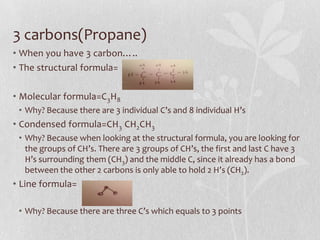
3 carbons(Propane)
• When you have 3 carbon…..
• The structural formula=
• Molecular formula=C3H8
• Why? Because there are 3 individual C’s and 8 individual H’s
• Condensed formula=CH3 CH2CH3
• Why? Because when looking at the structural formula, you are looking for
the groups of CH’s. There are 3 groups of CH’s, the first and last C have 3
H’s surrounding them (CH3) and the middle C, since it already has a bond
between the other 2 carbons is only able to hold 2 H’s (CH2).
• Line formula=
• Why? Because there are three C’s which equals to 3 points
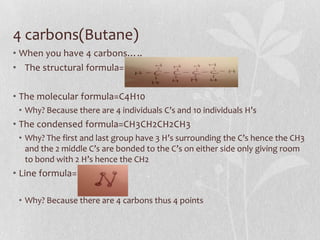
4 carbons(Butane)
• When you have 4 carbons…..
• The structural formula=
• The molecular formula=C4H10
• Why? Because there are 4 individuals C’s and 10 individuals H’s
• The condensed formula=CH3CH2CH2CH3
• Why? The first and last group have 3 H’s surrounding the C’s hence the CH3
and the 2 middle C’s are bonded to the C’s on either side only giving room
to bond with 2 H’s hence the CH2
• Line formula=
• Why? Because there are 4 carbons thus 4 points
Questions
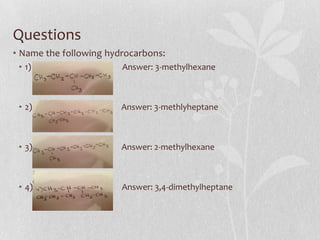
• Name the following hydrocarbons:
• 1) Answer: 3-methylhexane
• 2) Answer: 3-methlyheptane
• 3) Answer: 2-methylhexane
• 4) Answer: 3,4-dimethylheptane
Questions
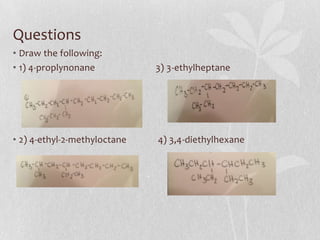
• Draw the following:
• 1) 4-proplynonane 3) 3-ethylheptane
• 2) 4-ethyl-2-methyloctane 4) 3,4-diethylhexane
Alkanes in everyday life
• 1) commercial fuels (propane)
• 2) Components of gasoline (pentane)
• 3) Natural gas (methane)
• 4) In plant hormones
• 5) Paraffin wax
Isomers
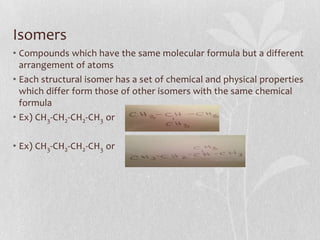
• Compounds which have the same molecular formula but a different
arrangement of atoms
• Each structural isomer has a set of chemical and physical properties
which differ form those of other isomers with the same chemical
formula
• Ex) CH3-CH2-CH2-CH3 or
Isomer questions
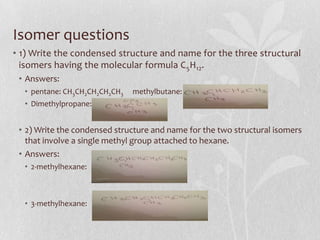
• 1) Write the condensed structure and name for the three structural
isomers having the molecular formula C5H12.
• Answers:
• pentane: CH3CH2CH2CH2CH3 methylbutane:
• Dimethylpropane:
• 2) Write the condensed structure and name for the two structural isomers
that involve a single methyl group attached to hexane.
• Answers:
• 2-methylhexane:
• 3-methylhexane:
Cyclo Alkane
• They are hydrocarbon chains that are connected in a ‘head to tail’
format
• The general formula=CnH2n
• So if you have C5, how many H’s would you have
• Plug in the 5 for the n, and times it by 2
• Answer=H10
Naming
• Ex)
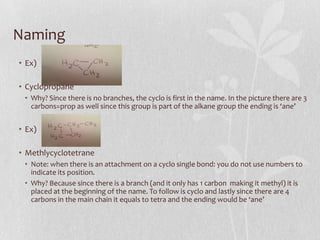
• Cyclopropane
• Why? Since there is no branches, the cyclo is first in the name. In the picture there are 3
carbons=prop as well since this group is part of the alkane group the ending is ‘ane’
• Ex)
• Methlycyclotetrane
• Note: when there is an attachment on a cyclo single bond: you do not use numbers to
indicate its position.
• Why? Because since there is a branch (and it only has 1 carbon making it methyl) it is
placed at the beginning of the name. To follow is cyclo and lastly since there are 4
carbons in the main chain it equals to tetra and the ending would be ‘ane’
Cyclopropane
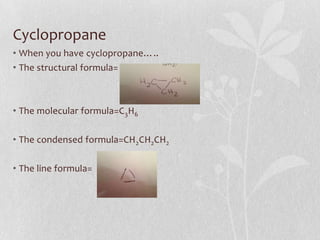
• When you have cyclopropane…..
• The structural formula=
• The molecular formula=C3H6
• The condensed formula=CH2CH2CH2
• The line formula=
Cyclobutane
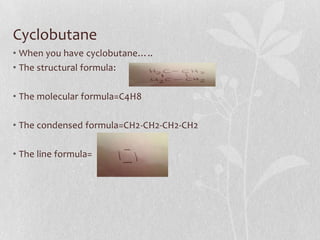
• When you have cyclobutane…..
• The structural formula:
• The molecular formula=C4H8
• The condensed formula=CH2-CH2-CH2-CH2
• The line formula=
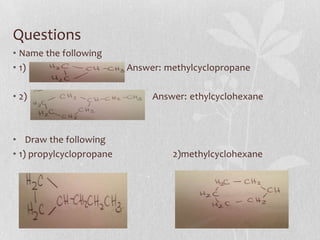
Questions
• Name the following
• 1) Answer: methylcyclopropane
• 2) Answer: ethylcyclohexane
• Draw the following
• 1) propylcyclopropane 2)methylcyclohexane
Everyday use
• 1) pharmaceutical drugs
• 2) important components of food
Alkyl halides(halo groups)
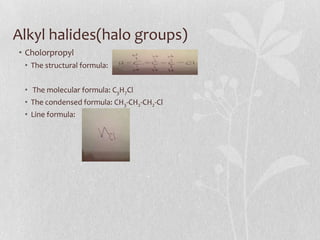
• Cholorpropyl
• The structural formula:
• The molecular formula: C3H7Cl
• The condensed formula: CH3-CH2-CH2-Cl
• Line formula:
Halo groups
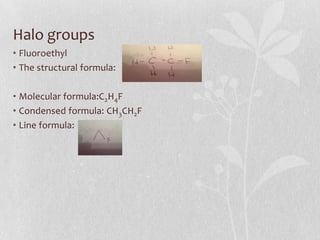
• Fluoroethyl
• The structural formula:
• Molecular formula:C2H4F
• Condensed formula: CH3CH2F
• Line formula:
Drawing Halo
• Chloroethane= CH3-CH2-Cl
• Why there are 2 carbons=ethane and there is only 1 chloro
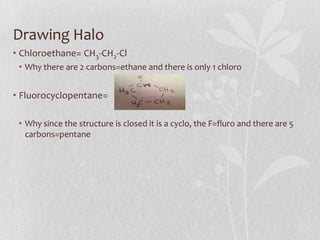
• Fluorocyclopentane=
• Why since the structure is closed it is a cyclo, the F=fluro and there are 5
carbons=pentane
Naming Halo groups
• CH3-Cl=Chloromethane
• Why? Because one carbon=methane and one Halo alkyl (Cl)=Choloro
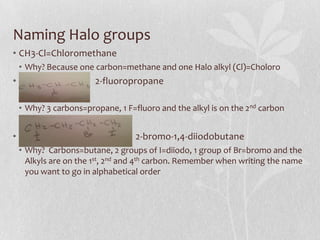
• 2-fluoropropane
• Why? 3 carbons=propane, 1 F=fluoro and the alkyl is on the 2nd carbon
• 2-bromo-1,4-diiodobutane
• Why? Carbons=butane, 2 groups of I=diiodo, 1 group of Br=bromo and the
Alkyls are on the 1st, 2nd and 4th carbon. Remember when writing the name
you want to go in alphabetical order
Questions
• Draw the following
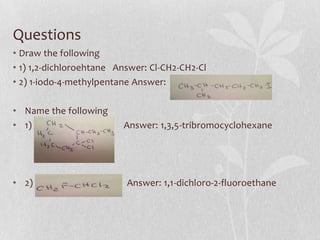
• 1) 1,2-dichloroehtane Answer: Cl-CH2-CH2-Cl
• 2) 1-iodo-4-methylpentane Answer:
• Name the following
• 1) Answer: 1,3,5-tribromocyclohexane
• 2) Answer: 1,1-dichloro-2-fluoroethane
Everyday uses
• Chloroform: an anesthetic
• Chlorofluorocarbons: used in refrigerators
Alkenes
• An alkene is an organic compound containing a carbon-carbon
double bond
• Their general formula=CnH2n
• Alkenes are known as unsaturated hydrocarbons because the have
less hydrogen atoms equivalent to alkanes. On contrast, alkanes are
saturated because they hold the max number of hydrogen's
Naming
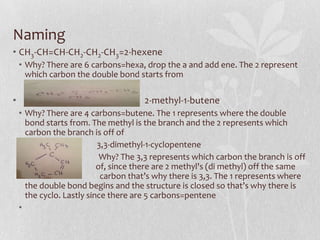
• CH3-CH=CH-CH2-CH2-CH3=2-hexene
• Why? There are 6 carbons=hexa, drop the a and add ene. The 2 represent
which carbon the double bond starts from
• 2-methyl-1-butene
• Why? There are 4 carbons=butene. The 1 represents where the double
bond starts from. The methyl is the branch and the 2 represents which
carbon the branch is off of
• 3,3-dimethyl-1-cyclopentene
• Why? The 3,3 represents which carbon the branch is off
o of, since there are 2 methyl's (di methyl) off the same
f carbon that’s why there is 3,3. The 1 represents where
the double bond begins and the structure is closed so that’s why there is
the cyclo. Lastly since there are 5 carbons=pentene
•
Drawing
• 2-butene= CH3-CH=CH-CH3
• Why? There are 4 carbons= butene, and the 2 represents where the double
bond begins
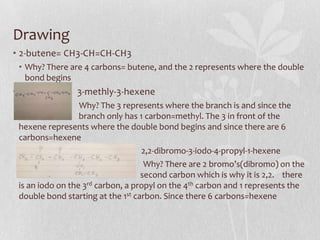
• 3-methly-3-hexene
Why? The 3 represents where the branch is and since the
bran branch only has 1 carbon=methyl. The 3 in front of the
hexene represents where the double bond begins and since there are 6
carbons=hexene
2,2-dibromo-3-iodo-4-propyl-1-hexene
Why? There are 2 bromo’s(dibromo) on the
2nd carbon d second carbon which is why it is 2,2. there
is an iodo on the 3rd carbon, a propyl on the 4th carbon and 1 represents the
double bond starting at the 1st carbon. Since there 6 carbons=hexene
Questions
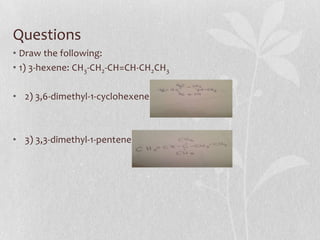
• Draw the following:
• 1) 3-hexene: CH3-CH2-CH=CH-CH2CH3
• 2) 3,6-dimethyl-1-cyclohexene:
• 3) 3,3-dimethyl-1-pentene
Questions
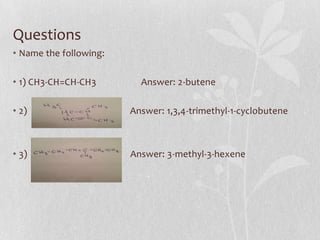
• Name the following:
• 1) CH3-CH=CH-CH3 Answer: 2-butene
• 2) Answer: 1,3,4-trimethyl-1-cyclobutene
• 3) Answer: 3-methyl-3-hexene
Everyday uses
• Used to artificially ripen fruit
• Extremely important in the manufacturing of plastics
Alkynes
• Are organic compounds that contain a triple bond
• Their general formula=CnH2n-2
• Alkynes are known as unsaturated hydrocarbons because the have
less hydrogen atoms equivalent to alkanes. On contrast, alkanes are
saturated because they hold the max number of hydrogen's
Naming
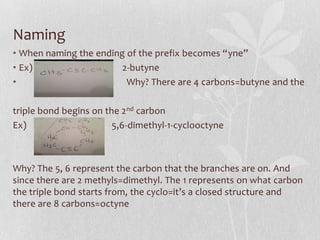
• When naming the ending of the prefix becomes “yne”
• Ex) 2-butyne
• Why? There are 4 carbons=butyne and the
triple bond begins on the 2nd carbon
Ex) 5,6-dimethyl-1-cyclooctyne
Why? The 5, 6 represent the carbon that the branches are on. And
since there are 2 methyls=dimethyl. The 1 represents on what carbon
the triple bond starts from, the cyclo=it’s a closed structure and
there are 8 carbons=octyne
Naming
•
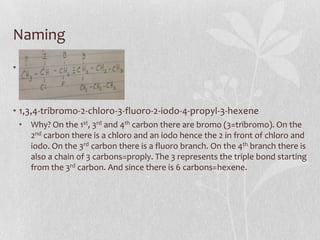
• 1,3,4-tribromo-2-chloro-3-fluoro-2-iodo-4-propyl-3-hexene
• Why? On the 1st, 3rd and 4th carbon there are bromo (3=tribromo). On the
2nd carbon there is a chloro and an iodo hence the 2 in front of chloro and
iodo. On the 3rd carbon there is a fluoro branch. On the 4th branch there is
also a chain of 3 carbons=proply. The 3 represents the triple bond starting
from the 3rd carbon. And since there is 6 carbons=hexene.
Drawing
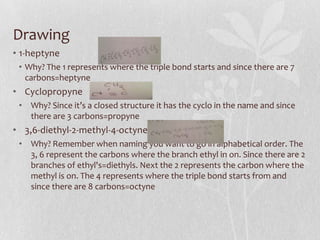
• 1-heptyne
• Why? The 1 represents where the triple bond starts and since there are 7
carbons=heptyne
• Cyclopropyne
• Why? Since it’s a closed structure it has the cyclo in the name and since
there are 3 carbons=propyne
• 3,6-diethyl-2-methyl-4-octyne
• Why? Remember when naming you want to go in alphabetical order. The
3, 6 represent the carbons where the branch ethyl in on. Since there are 2
branches of ethyl's=diethyls. Next the 2 represents the carbon where the
methyl is on. The 4 represents where the triple bond starts from and
since there are 8 carbons=octyne
Questions
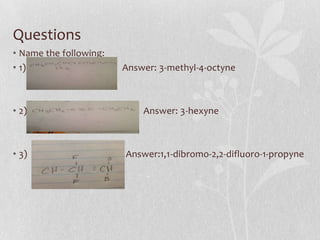
• Name the following:
• 1) Answer: 3-methyl-4-octyne
• 2) Answer: 3-hexyne
• 3) Answer:1,1-dibromo-2,2-difluoro-1-propyne
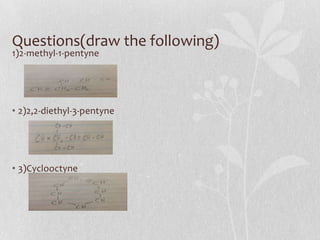
Questions(draw the following)
1)2-methyl-1-pentyne
• 2)2,2-diethyl-3-pentyne
• 3)Cyclooctyne
Everyday uses
• Used for metal cutting and wielding
• Can be used as an illuminant
alcohols
• Organic compounds that contain –OH
• When naming:
• Make sure the branch number of the alcohol is before the parent chain
(the longest carbon chain) name
• Number the branch carbons from the lowest carbon position
• The ending of the branch name drops the ‘e’ and an ‘ol’ is added
Functional groups
• A specific group of atoms which exists in molecules and gives a
molecule an ability to react in a specific manner or giver it special
properties
• Why is alcohol is there own functional group? Because they consist
of OH’s where as hydrocarbons consist of H’s and C’s.
Naming alcohols
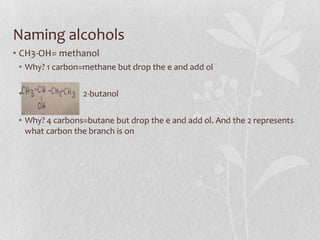
• CH3-OH= methanol
• Why? 1 carbon=methane but drop the e and add ol
• 2-butanol
• Why? 4 carbons=butane but drop the e and add ol. And the 2 represents
what carbon the branch is on
Drawing alcohols
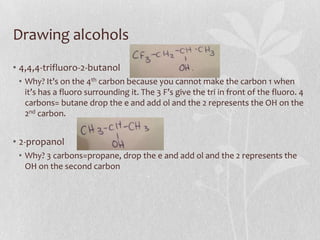
• 4,4,4-trifluoro-2-butanol
• Why? It’s on the 4th carbon because you cannot make the carbon 1 when
it’s has a fluoro surrounding it. The 3 F’s give the tri in front of the fluoro. 4
carbons= butane drop the e and add ol and the 2 represents the OH on the
2nd carbon.
• 2-propanol
• Why? 3 carbons=propane, drop the e and add ol and the 2 represents the
OH on the second carbon
Questions
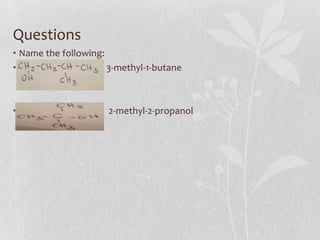
• Name the following:
• 3-methyl-1-butane
• 2-methyl-2-propanol
Questions
• Draw the following:
Everyday uses of alcohols
• Ethanol: it is the least toxic of the alcohols and is used in perfumes
to stop the plant and animal extracts from going off
• Cleaners: gets rid of bacteria and oil, can also be used as mouth
wash
• Antiseptic: is safer on skin because it works at lower levels of
concentration
• Sedative: preparing patients for surgery
Other functional groups
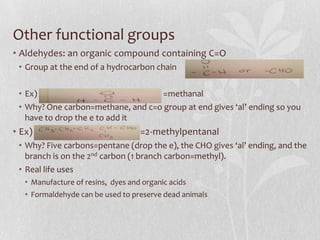
• Aldehydes: an organic compound containing C=O
• Group at the end of a hydrocarbon chain
• Ex) =methanal
• Why? One carbon=methane, and c=o group at end gives ‘al’ ending so you
have to drop the e to add it
• Ex) =2-methylpentanal
• Why? Five carbons=pentane (drop the e), the CHO gives ‘al’ ending, and the
branch is on the 2nd carbon (1 branch carbon=methyl).
• Real life uses
• Manufacture of resins, dyes and organic acids
• Formaldehyde can be used to preserve dead animals
Other functional groups
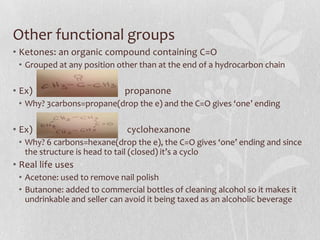
• Ketones: an organic compound containing C=O
• Grouped at any position other than at the end of a hydrocarbon chain
• Ex) propanone
• Why? 3carbons=propane(drop the e) and the C=O gives ‘one’ ending
• Ex) cyclohexanone
• Why? 6 carbons=hexane(drop the e), the C=O gives ‘one’ ending and since
the structure is head to tail (closed) it’s a cyclo
• Real life uses
• Acetone: used to remove nail polish
• Butanone: added to commercial bottles of cleaning alcohol so it makes it
undrinkable and seller can avoid it being taxed as an alcoholic beverage
Other Functional Groups
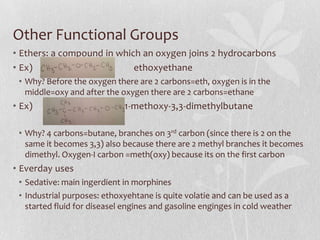
• Ethers: a compound in which an oxygen joins 2 hydrocarbons
• Ex) ethoxyethane
• Why? Before the oxygen there are 2 carbons=eth, oxygen is in the
middle=oxy and after the oxygen there are 2 carbons=ethane
• Ex) 1-methoxy-3,3-dimethylbutane
• Why? 4 carbons=butane, branches on 3rd carbon (since there is 2 on the
same it becomes 3,3) also because there are 2 methyl branches it becomes
dimethyl. Oxygen-I carbon =meth(oxy) because its on the first carbon
• Everday uses
• Sedative: main ingerdient in morphines
• Industrial purposes: ethoxyehtane is quite volatie and can be used as a
started fluid for diseasel engines and gasoline enginges in cold weather
Other Functional Groups
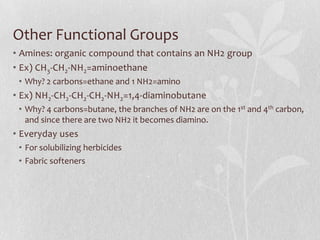
• Amines: organic compound that contains an NH2 group
• Ex) CH3-CH2-NH2=aminoethane
• Why? 2 carbons=ethane and 1 NH2=amino
• Ex) NH2-CH2-CH2-CH2-NH2=1,4-diaminobutane
• Why? 4 carbons=butane, the branches of NH2 are on the 1st and 4th carbon,
and since there are two NH2 it becomes diamino.
• Everyday uses
• For solubilizing herbicides
• Fabric softeners
Other Functional Groups
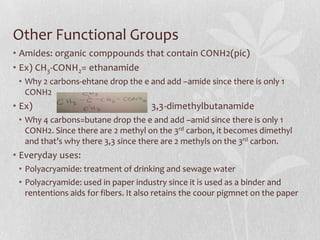
• Amides: organic comppounds that contain CONH2(pic)
• Ex) CH3-CONH2= ethanamide
• Why 2 carbons-ehtane drop the e and add –amide since there is only 1
CONH2
• Ex) 3,3-dimethylbutanamide
• Why 4 carbons=butane drop the e and add –amid since there is only 1
CONH2. Since there are 2 methyl on the 3rd carbon, it becomes dimethyl
and that’s why there 3,3 since there are 2 methyls on the 3rd carbon.
• Everyday uses:
• Polyacryamide: treatment of drinking and sewage water
• Polyacryamide: used in paper industry since it is used as a binder and
rententions aids for fibers. It also retains the coour pigmnet on the paper
Other Functional groups
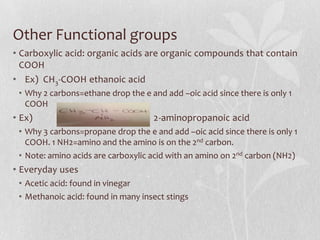
• Carboxylic acid: organic acids are organic compounds that contain
COOH
• Ex) CH3-COOH ethanoic acid
• Why 2 carbons=ethane drop the e and add –oic acid since there is only 1
COOH
• Ex) 2-aminopropanoic acid
• Why 3 carbons=propane drop the e and add –oic acid since there is only 1
COOH. 1 NH2=amino and the amino is on the 2nd carbon.
• Note: amino acids are carboxylic acid with an amino on 2nd carbon (NH2)
• Everyday uses
• Acetic acid: found in vinegar
• Methanoic acid: found in many insect stings
• WE HOPE YOU KIDS ACTUALLY LEARNT SOMETHING!!!! 
• THANK YOU

Organic chemistry

  • 1.
    With your teachers:Natasha and Delaney ORGANIC CHEMISTRY
  • 2.
    Prefixes and suffixesof Alkanes • Refer back to this when you hit the naming slides • Prefixes for the amount of carbon in a strand • 1=mono, 2=di, 3=tri, 4=tetra, 5=penta, 6=hexa, 7=hepta, 8=octa, 9=nona, 10=deca • Alkanes • The suffix/ending=ane • Suffix/ ending for branches=‘yl’ • Prefixes for the branches (also goes by the amount of carbon) • 1=meth, 2=eth, 3=prop, 4=but, 5=penta, 6=hexa, 7=hepta, 8=octa, 9=nona, 10=deca
  • 3.
    Prefix and suffixesof Halo groups • Prefix for the amount of carbon in the strand • 1=mono, 2=di, 3=tri, 4=tetra, 5=penta, 6=hexa, 7=hepta, 8=octa, 9=nona, 10=deca • Branches (which consist of chluorine, bromine, iodine and fluorine • Cl=chloro, I=Iodo, Br=Bromo, F=Fluoro
  • 4.
    Prefixes and suffixesof Alkenes and Alkynes • Prefixes to the amount of carbon in the chain • 1=mono, 2=di, 3=tri, 4=tetra, 5=penta, 6=hexa, 7=hepta, 8=octa, 9=nona, 10=deca • Prefixes for the branches (also goes by amount of carbon) • 1=meth, 2=eth, 3=prop, 4=but, 5=penta, 6=hexa, 7=hepta, 8=octa, 9=nona, 10=deca • Alkene: • Suffix/ending= ene • Suffix/ending for branches= yl • Alkyne • Suffix/ending=yne • Suffix/ending for branches=yl
  • 5.
    Prefixes and Suffixesfor others • Aldehydes: suffix=al • Ethers: suffix= oxy • Ketone: suffix=one • Amines: prefix= amino • Amides: suffix=amide • Carboxylic acid: suffix=anic acid
  • 6.
    Alkanes • A straightchained, single bonded carbons • Ex: C-C-C-C • The general formula is CnH2n+2 • The general formula is used to help find the amount of H’s • Example: You have C4 how many H’s are there? • Well, the 4 represents the n, so plug the 4 into the equation where ever there is an n and do the math kids! • Answer: there would be H10
  • 7.
    Naming Alkanes • Whennaming an alkane there is a different suffix used at the end of a prefix which is ‘ane’ • Looking at the first slide there is a table of what prefix is used to how much carbons are in a chain • Example: if there is are 5 carbons in a chain what would be the prefix? • Penta • Now lets look at how to name some types of branched alkanes • There are 3 steps when naming a branched alkane • 1) Find the longest continuous C chain and name it • 2)Note and number the position of the branch • 3) Name the branch (ending is ‘yl’) • 4) Then name the hydrocarbon
  • 8.
    Branched Alkanes #1 •1) the longest carbon chain is highlighted which is 4 carbons=butane • 2) The position of the branch is on the second carbon, since you want to go by the lowest number position • 3) Since the branched carbon has only 1 carbon, the name of the branched carbon would be methyl • 4)Naming the hydrocarbon you want to take the answers from step 2-3-1 which should look like this: 2-methylbutane
  • 9.
    Branched Alkanes #2 •1) The longest carbon chain contains 8 carbons w = octane • • 2) The position of the branch is on the 3rd carbon carbon • 3) The name of the branch has 1 carbon=methyl • 4) The hydrocarbon name= 3-methyloctane •
  • 10.
    Branched Alkanes #3 •1) the longest chain has 8=octane • 2)the branch is on the 4th carbon • 3) there are 2 carbons in the branch=ethyl
  • 11.
    Branched Alkanes #4 1)the longest branch has 7 carbons=heptane 2) Number the position of the branches going f from lowest position =2,2,4,6 (there are t two 2’s two 2’s because 2 branches are on t the 2nd carbon 3)1 carbon branch=methyl -1 carbon branch=methyl -2carbon branch=ethyl 1-carbon branch=methyl
  • 12.
    Con’t branched alkanes#4 • Since there are 2 different types of branches (ethyl and methyl) you want to start in alphabetically • So first you would have the 4-ethyl: since the 4 is the position and ethyl is the prefix for the 2 carbons in the branch • Next you want to list all the positions of the same # carbon branch (which is the methyl).So: 2-2-6-trimethyl • The tri prefix represents that there are 3 methyl's (1+1+1=3 which is tri) • Finally you want to put the heptane at the end • The final answer is 4-ethyl-2-2-6-trimethylheptane
  • 13.
    1 carbon (methane) •When you have 1 carbon….. • The structural formula= • The molecular formula= CH4 • Why Because around the 1 carbon there are 4 H’s thus the CH4 • The condensed formula= CH4 • Why? Because the condensed formula looks at the groups of CH’s instead of the amount of C and H by itself. Since there is only one hydrocarbon group it will have the same answer as the molecular formula. • Line formula= Doesn’t have one
  • 14.
    2 carbons (Ethane) •When you have 2 carbons….. • The structural formula= • The molecular formula=C2H6 • Why? Because the molecular focuses on the amount of the C and the H by itself. Do the math and you should have C2 and H6 • The condensed formula: CH3CH3 • Why? Because when looking at the structural formula you are looking for the groups of CH’s. There are 2 groups and each C is surrounded by 3 H, thus CH3CH3 • The line formula= • Why? Because there are 2 carbons which equals to 2 points
  • 15.
    3 carbons(Propane) • Whenyou have 3 carbon….. • The structural formula= • Molecular formula=C3H8 • Why? Because there are 3 individual C’s and 8 individual H’s • Condensed formula=CH3 CH2CH3 • Why? Because when looking at the structural formula, you are looking for the groups of CH’s. There are 3 groups of CH’s, the first and last C have 3 H’s surrounding them (CH3) and the middle C, since it already has a bond between the other 2 carbons is only able to hold 2 H’s (CH2). • Line formula= • Why? Because there are three C’s which equals to 3 points
  • 16.
    4 carbons(Butane) • Whenyou have 4 carbons….. • The structural formula= • The molecular formula=C4H10 • Why? Because there are 4 individuals C’s and 10 individuals H’s • The condensed formula=CH3CH2CH2CH3 • Why? The first and last group have 3 H’s surrounding the C’s hence the CH3 and the 2 middle C’s are bonded to the C’s on either side only giving room to bond with 2 H’s hence the CH2 • Line formula= • Why? Because there are 4 carbons thus 4 points
  • 17.
    Questions • Name thefollowing hydrocarbons: • 1) Answer: 3-methylhexane • 2) Answer: 3-methlyheptane • 3) Answer: 2-methylhexane • 4) Answer: 3,4-dimethylheptane
  • 18.
    Questions • Draw thefollowing: • 1) 4-proplynonane 3) 3-ethylheptane • 2) 4-ethyl-2-methyloctane 4) 3,4-diethylhexane
  • 19.
    Alkanes in everydaylife • 1) commercial fuels (propane) • 2) Components of gasoline (pentane) • 3) Natural gas (methane) • 4) In plant hormones • 5) Paraffin wax
  • 20.
    Isomers • Compounds whichhave the same molecular formula but a different arrangement of atoms • Each structural isomer has a set of chemical and physical properties which differ form those of other isomers with the same chemical formula • Ex) CH3-CH2-CH2-CH3 or • Ex) CH3-CH2-CH2-CH3 or
  • 21.
    Isomer questions • 1)Write the condensed structure and name for the three structural isomers having the molecular formula C5H12. • Answers: • pentane: CH3CH2CH2CH2CH3 methylbutane: • Dimethylpropane: • 2) Write the condensed structure and name for the two structural isomers that involve a single methyl group attached to hexane. • Answers: • 2-methylhexane: • 3-methylhexane:
  • 22.
    Cyclo Alkane • Theyare hydrocarbon chains that are connected in a ‘head to tail’ format • The general formula=CnH2n • So if you have C5, how many H’s would you have • Plug in the 5 for the n, and times it by 2 • Answer=H10
  • 23.
    Naming • Ex) • Cyclopropane •Why? Since there is no branches, the cyclo is first in the name. In the picture there are 3 carbons=prop as well since this group is part of the alkane group the ending is ‘ane’ • Ex) • Methlycyclotetrane • Note: when there is an attachment on a cyclo single bond: you do not use numbers to indicate its position. • Why? Because since there is a branch (and it only has 1 carbon making it methyl) it is placed at the beginning of the name. To follow is cyclo and lastly since there are 4 carbons in the main chain it equals to tetra and the ending would be ‘ane’
  • 24.
    Cyclopropane • When youhave cyclopropane….. • The structural formula= • The molecular formula=C3H6 • The condensed formula=CH2CH2CH2 • The line formula=
  • 25.
    Cyclobutane • When youhave cyclobutane….. • The structural formula: • The molecular formula=C4H8 • The condensed formula=CH2-CH2-CH2-CH2 • The line formula=
  • 26.
    Questions • Name thefollowing • 1) Answer: methylcyclopropane • 2) Answer: ethylcyclohexane • Draw the following • 1) propylcyclopropane 2)methylcyclohexane
  • 27.
    Everyday use • 1)pharmaceutical drugs • 2) important components of food
  • 28.
    Alkyl halides(halo groups) •Cholorpropyl • The structural formula: • The molecular formula: C3H7Cl • The condensed formula: CH3-CH2-CH2-Cl • Line formula:
  • 29.
    Halo groups • Fluoroethyl •The structural formula: • Molecular formula:C2H4F • Condensed formula: CH3CH2F • Line formula:
  • 30.
    Drawing Halo • Chloroethane=CH3-CH2-Cl • Why there are 2 carbons=ethane and there is only 1 chloro • Fluorocyclopentane= • Why since the structure is closed it is a cyclo, the F=fluro and there are 5 carbons=pentane
  • 31.
    Naming Halo groups •CH3-Cl=Chloromethane • Why? Because one carbon=methane and one Halo alkyl (Cl)=Choloro • 2-fluoropropane • Why? 3 carbons=propane, 1 F=fluoro and the alkyl is on the 2nd carbon • 2-bromo-1,4-diiodobutane • Why? Carbons=butane, 2 groups of I=diiodo, 1 group of Br=bromo and the Alkyls are on the 1st, 2nd and 4th carbon. Remember when writing the name you want to go in alphabetical order
  • 32.
    Questions • Draw thefollowing • 1) 1,2-dichloroehtane Answer: Cl-CH2-CH2-Cl • 2) 1-iodo-4-methylpentane Answer: • Name the following • 1) Answer: 1,3,5-tribromocyclohexane • 2) Answer: 1,1-dichloro-2-fluoroethane
  • 33.
    Everyday uses • Chloroform:an anesthetic • Chlorofluorocarbons: used in refrigerators
  • 34.
    Alkenes • An alkeneis an organic compound containing a carbon-carbon double bond • Their general formula=CnH2n • Alkenes are known as unsaturated hydrocarbons because the have less hydrogen atoms equivalent to alkanes. On contrast, alkanes are saturated because they hold the max number of hydrogen's
  • 35.
    Naming • CH3-CH=CH-CH2-CH2-CH3=2-hexene • Why?There are 6 carbons=hexa, drop the a and add ene. The 2 represent which carbon the double bond starts from • 2-methyl-1-butene • Why? There are 4 carbons=butene. The 1 represents where the double bond starts from. The methyl is the branch and the 2 represents which carbon the branch is off of • 3,3-dimethyl-1-cyclopentene • Why? The 3,3 represents which carbon the branch is off o of, since there are 2 methyl's (di methyl) off the same f carbon that’s why there is 3,3. The 1 represents where the double bond begins and the structure is closed so that’s why there is the cyclo. Lastly since there are 5 carbons=pentene •
  • 36.
    Drawing • 2-butene= CH3-CH=CH-CH3 •Why? There are 4 carbons= butene, and the 2 represents where the double bond begins • 3-methly-3-hexene Why? The 3 represents where the branch is and since the bran branch only has 1 carbon=methyl. The 3 in front of the hexene represents where the double bond begins and since there are 6 carbons=hexene 2,2-dibromo-3-iodo-4-propyl-1-hexene Why? There are 2 bromo’s(dibromo) on the 2nd carbon d second carbon which is why it is 2,2. there is an iodo on the 3rd carbon, a propyl on the 4th carbon and 1 represents the double bond starting at the 1st carbon. Since there 6 carbons=hexene
  • 37.
    Questions • Draw thefollowing: • 1) 3-hexene: CH3-CH2-CH=CH-CH2CH3 • 2) 3,6-dimethyl-1-cyclohexene: • 3) 3,3-dimethyl-1-pentene
  • 38.
    Questions • Name thefollowing: • 1) CH3-CH=CH-CH3 Answer: 2-butene • 2) Answer: 1,3,4-trimethyl-1-cyclobutene • 3) Answer: 3-methyl-3-hexene
  • 39.
    Everyday uses • Usedto artificially ripen fruit • Extremely important in the manufacturing of plastics
  • 40.
    Alkynes • Are organiccompounds that contain a triple bond • Their general formula=CnH2n-2 • Alkynes are known as unsaturated hydrocarbons because the have less hydrogen atoms equivalent to alkanes. On contrast, alkanes are saturated because they hold the max number of hydrogen's
  • 41.
    Naming • When namingthe ending of the prefix becomes “yne” • Ex) 2-butyne • Why? There are 4 carbons=butyne and the triple bond begins on the 2nd carbon Ex) 5,6-dimethyl-1-cyclooctyne Why? The 5, 6 represent the carbon that the branches are on. And since there are 2 methyls=dimethyl. The 1 represents on what carbon the triple bond starts from, the cyclo=it’s a closed structure and there are 8 carbons=octyne
  • 42.
    Naming • • 1,3,4-tribromo-2-chloro-3-fluoro-2-iodo-4-propyl-3-hexene • Why?On the 1st, 3rd and 4th carbon there are bromo (3=tribromo). On the 2nd carbon there is a chloro and an iodo hence the 2 in front of chloro and iodo. On the 3rd carbon there is a fluoro branch. On the 4th branch there is also a chain of 3 carbons=proply. The 3 represents the triple bond starting from the 3rd carbon. And since there is 6 carbons=hexene.
  • 43.
    Drawing • 1-heptyne • Why?The 1 represents where the triple bond starts and since there are 7 carbons=heptyne • Cyclopropyne • Why? Since it’s a closed structure it has the cyclo in the name and since there are 3 carbons=propyne • 3,6-diethyl-2-methyl-4-octyne • Why? Remember when naming you want to go in alphabetical order. The 3, 6 represent the carbons where the branch ethyl in on. Since there are 2 branches of ethyl's=diethyls. Next the 2 represents the carbon where the methyl is on. The 4 represents where the triple bond starts from and since there are 8 carbons=octyne
  • 44.
    Questions • Name thefollowing: • 1) Answer: 3-methyl-4-octyne • 2) Answer: 3-hexyne • 3) Answer:1,1-dibromo-2,2-difluoro-1-propyne
  • 45.
    Questions(draw the following) 1)2-methyl-1-pentyne •2)2,2-diethyl-3-pentyne • 3)Cyclooctyne
  • 46.
    Everyday uses • Usedfor metal cutting and wielding • Can be used as an illuminant
  • 47.
    alcohols • Organic compoundsthat contain –OH • When naming: • Make sure the branch number of the alcohol is before the parent chain (the longest carbon chain) name • Number the branch carbons from the lowest carbon position • The ending of the branch name drops the ‘e’ and an ‘ol’ is added
  • 48.
    Functional groups • Aspecific group of atoms which exists in molecules and gives a molecule an ability to react in a specific manner or giver it special properties • Why is alcohol is there own functional group? Because they consist of OH’s where as hydrocarbons consist of H’s and C’s.
  • 49.
    Naming alcohols • CH3-OH=methanol • Why? 1 carbon=methane but drop the e and add ol • 2-butanol • Why? 4 carbons=butane but drop the e and add ol. And the 2 represents what carbon the branch is on
  • 50.
    Drawing alcohols • 4,4,4-trifluoro-2-butanol •Why? It’s on the 4th carbon because you cannot make the carbon 1 when it’s has a fluoro surrounding it. The 3 F’s give the tri in front of the fluoro. 4 carbons= butane drop the e and add ol and the 2 represents the OH on the 2nd carbon. • 2-propanol • Why? 3 carbons=propane, drop the e and add ol and the 2 represents the OH on the second carbon
  • 51.
    Questions • Name thefollowing: • 3-methyl-1-butane • 2-methyl-2-propanol
  • 52.
  • 53.
    Everyday uses ofalcohols • Ethanol: it is the least toxic of the alcohols and is used in perfumes to stop the plant and animal extracts from going off • Cleaners: gets rid of bacteria and oil, can also be used as mouth wash • Antiseptic: is safer on skin because it works at lower levels of concentration • Sedative: preparing patients for surgery
  • 54.
    Other functional groups •Aldehydes: an organic compound containing C=O • Group at the end of a hydrocarbon chain • Ex) =methanal • Why? One carbon=methane, and c=o group at end gives ‘al’ ending so you have to drop the e to add it • Ex) =2-methylpentanal • Why? Five carbons=pentane (drop the e), the CHO gives ‘al’ ending, and the branch is on the 2nd carbon (1 branch carbon=methyl). • Real life uses • Manufacture of resins, dyes and organic acids • Formaldehyde can be used to preserve dead animals
  • 55.
    Other functional groups •Ketones: an organic compound containing C=O • Grouped at any position other than at the end of a hydrocarbon chain • Ex) propanone • Why? 3carbons=propane(drop the e) and the C=O gives ‘one’ ending • Ex) cyclohexanone • Why? 6 carbons=hexane(drop the e), the C=O gives ‘one’ ending and since the structure is head to tail (closed) it’s a cyclo • Real life uses • Acetone: used to remove nail polish • Butanone: added to commercial bottles of cleaning alcohol so it makes it undrinkable and seller can avoid it being taxed as an alcoholic beverage
  • 56.
    Other Functional Groups •Ethers: a compound in which an oxygen joins 2 hydrocarbons • Ex) ethoxyethane • Why? Before the oxygen there are 2 carbons=eth, oxygen is in the middle=oxy and after the oxygen there are 2 carbons=ethane • Ex) 1-methoxy-3,3-dimethylbutane • Why? 4 carbons=butane, branches on 3rd carbon (since there is 2 on the same it becomes 3,3) also because there are 2 methyl branches it becomes dimethyl. Oxygen-I carbon =meth(oxy) because its on the first carbon • Everday uses • Sedative: main ingerdient in morphines • Industrial purposes: ethoxyehtane is quite volatie and can be used as a started fluid for diseasel engines and gasoline enginges in cold weather
  • 57.
    Other Functional Groups •Amines: organic compound that contains an NH2 group • Ex) CH3-CH2-NH2=aminoethane • Why? 2 carbons=ethane and 1 NH2=amino • Ex) NH2-CH2-CH2-CH2-NH2=1,4-diaminobutane • Why? 4 carbons=butane, the branches of NH2 are on the 1st and 4th carbon, and since there are two NH2 it becomes diamino. • Everyday uses • For solubilizing herbicides • Fabric softeners
  • 58.
    Other Functional Groups •Amides: organic comppounds that contain CONH2(pic) • Ex) CH3-CONH2= ethanamide • Why 2 carbons-ehtane drop the e and add –amide since there is only 1 CONH2 • Ex) 3,3-dimethylbutanamide • Why 4 carbons=butane drop the e and add –amid since there is only 1 CONH2. Since there are 2 methyl on the 3rd carbon, it becomes dimethyl and that’s why there 3,3 since there are 2 methyls on the 3rd carbon. • Everyday uses: • Polyacryamide: treatment of drinking and sewage water • Polyacryamide: used in paper industry since it is used as a binder and rententions aids for fibers. It also retains the coour pigmnet on the paper
  • 59.
    Other Functional groups •Carboxylic acid: organic acids are organic compounds that contain COOH • Ex) CH3-COOH ethanoic acid • Why 2 carbons=ethane drop the e and add –oic acid since there is only 1 COOH • Ex) 2-aminopropanoic acid • Why 3 carbons=propane drop the e and add –oic acid since there is only 1 COOH. 1 NH2=amino and the amino is on the 2nd carbon. • Note: amino acids are carboxylic acid with an amino on 2nd carbon (NH2) • Everyday uses • Acetic acid: found in vinegar • Methanoic acid: found in many insect stings
  • 60.
    • WE HOPEYOU KIDS ACTUALLY LEARNT SOMETHING!!!!  • THANK YOU