An Introduction
to Crossref
Rachael Lammey
Head of Special Programs
Vanessa Fairhurst
Community Engagement Manager
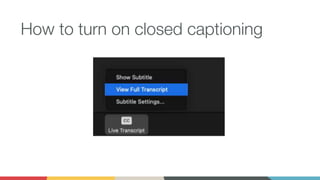
How to turn on closed captioning
Agenda
1. About us
2. Getting started as a member at Crossref
3. Persistent Identifiers (DOIs) & the importance of metadata
4. How we work and collaborate with other organizations for the
benefit of the scholarly community
5. Where to find further help and support
6. Q&A
About Us
Crossref makes research outputs easy to find, cite,
link, assess, and reuse.
We’re a not-for-profit membership organization that
exists to make scholarly communications better.
Mission
crossref.org/
strategy
https://openscholarlyinfrastructure.org/
Governance, Sustainability and Insurance
Supporting Open Research
https://www.crossref.org/blog/crossrefs-board-votes-to-adopt-the-principles-of-open-scholarly-infrastructure/
Crossref overview
• Over 19,000 member and affiliated organizations
• Metadata store of over 126 million scholarly content items
• Publishers join Crossref to increase visibility of their content and aid
discovery, find out who is using it, and to participate in other
collaborative services.
• A DOI is just the start - We offer a wide array of services to ensure that
scholarly research metadata is registered, linked, and distributed.
• We preserve the metadata we receive and make it available via our open
APIs and Search.
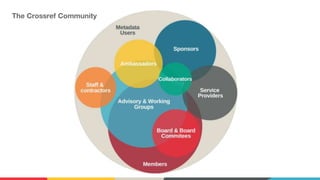
The Crossref Community
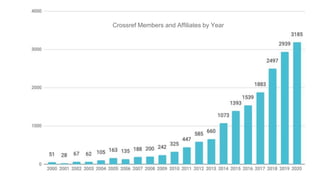
Crossref Members and Affiliates by Year
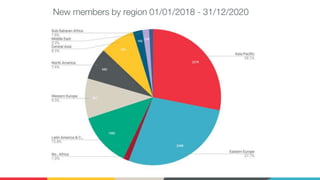
New members by region 01/01/2018 - 31/12/2020
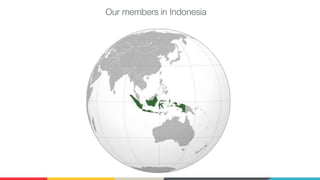
Our members in Indonesia
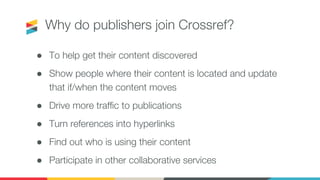
Why do publishers join Crossref?
● To help get their content discovered
● Show people where their content is located and update
that if/when the content moves
● Drive more traffic to publications
● Turn references into hyperlinks
● Find out who is using their content
● Participate in other collaborative services
Getting started
as a member
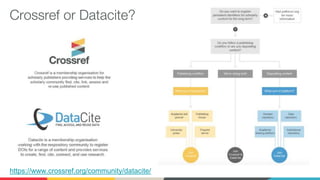
Crossref or Datacite?
https://www.crossref.org/community/datacite/
Sponsors in Indonesia:
● Relawan Jurnal Indonesia
● Aliansi Pengelola Jurnal Ekonomi dan Bisnis Indonesia
● Forum Pengelola Jurnal Manajemen
● Association for Scientific Computing Electrical and Engineering (ASCEE)
● Conferences.id
● UniveID
● Neliti
Working with a Sponsor
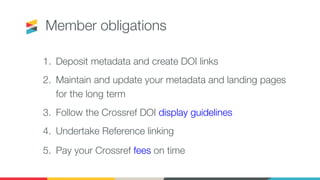
Member obligations
1. Deposit metadata and create DOI links
2. Maintain and update your metadata and landing pages
for the long term
3. Follow the Crossref DOI display guidelines
4. Undertake Reference linking
5. Pay your Crossref fees on time
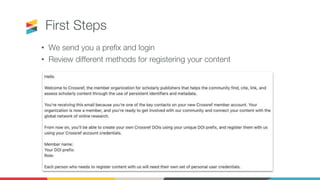
First Steps
• We send you a prefix and login
• Review different methods for registering your content
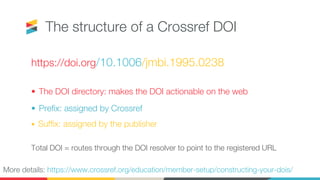
The structure of a Crossref DOI
https://doi.org/10.1006/jmbi.1995.0238
• The DOI directory: makes the DOI actionable on the web
• Prefix: assigned by Crossref
• Suffix: assigned by the publisher
Total DOI = routes through the DOI resolver to point to the registered URL
More details: https://www.crossref.org/education/member-setup/constructing-your-dois/
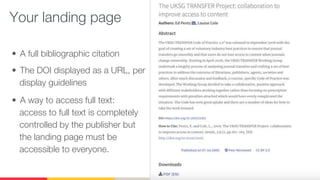
Your landing page
• A full bibliographic citation
• The DOI displayed as a URL, per
display guidelines
• A way to access full text:
access to full text is completely
controlled by the publisher but
the landing page must be
accessible to everyone.
What can I register a DOI for?
Journals
Books
Book chapters
Conference proceedings
Datasets
Dissertations
Reports
Standards
Posted content (preprints)
Peer reviews
Grants
… and more
Persistent identifiers &
the importance of
metadata
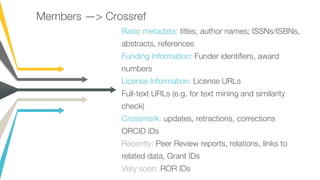
Members —> Crossref
Basic metadata: titles; author names; ISSNs/ISBNs,
abstracts, references
Funding Information: Funder identifiers, award
numbers
License Information: License URLs
Full-text URLs (e.g. for text mining and similarity
check)
Crossmark: updates, retractions, corrections
ORCID iDs
Recently: Peer Review reports, relations, links to
related data, Grant IDs
Very soon: ROR IDs
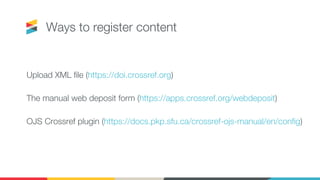
Ways to register content
Upload XML file (https://doi.crossref.org)
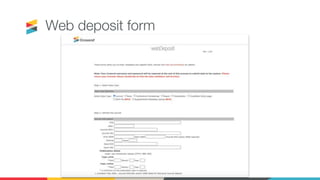
The manual web deposit form (https://apps.crossref.org/webdeposit)
OJS Crossref plugin (https://docs.pkp.sfu.ca/crossref-ojs-manual/en/config)
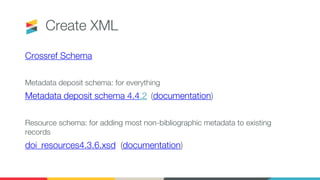
Create XML
Crossref Schema
Metadata deposit schema: for everything
Metadata deposit schema 4.4.2 (documentation)
Resource schema: for adding most non-bibliographic metadata to existing
records
doi_resources4.3.6.xsd (documentation)
Web deposit form
OJS/Crossref integrations
• automatic DOI deposit to Crossref on article publication (3.1.2);
• inclusion of other article metadata in the Crossref deposit, including author ORCID iDs;
article abstracts; and more (OJS 2.4.5);
• inclusion of funding data (OJS 3.1.2-1);
• inclusion of references (OJS 3.1.2-1);
• improved use of Crossref API (OJS 3.1.2-1);
• support for Similarity Check service;
• support for reference linking and submission (OJS 3.1.2-x)
• support for Crossref Funder Registry (OJS 3.1.2-x)
• support publications/versioning for DOIs (OJS 3.2)
https://docs.pkp.sfu.ca/crossref-ojs-manual/en/
Metadata should be…
• accurate
• complete
• up to date
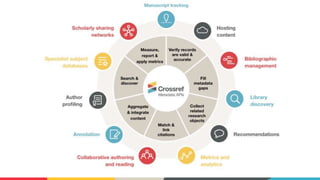
Metadata enables:
• Discoverability
• Research and editorial integrity
• Reproducibility
• Reporting and assessment
https://www.crossref.org/education/metadata/metadata-for-different-purposes/
Our services
● Reference Linking
● Cited-by
● The Funder Registry
● Event Data
● Crossmark
● Similarity Check
https://www.crossref.org/services/
Community
Initiatives
PKP
● Signed MOU in 2020 to formalize relationship
● Statement of work to relicense deposit plugin, improvements to
plugins & adding additional services
● OJS Version 3.4 release Q3/Q4
DOAJ partnership
● Signed MOU to formalize
relationship
● Analysis on gaps and overlaps
● Collaboration to support small
and emerging publishers
● Lower barriers to participation
globally
“Together we stand
a greater chance of
encouraging an
open, fair and fully
inclusive future for
scholarly publishing”
- Lars Bjørnshauge, DOAJ
Founder and Managing Director
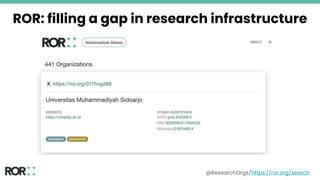
ROR: filling a gap in research infrastructure
@ResearchOrgs/https://ror.org/search
ROR: filling a gap in research infrastructure
● Non-commercial, fully open (CC0) registry
● Public API, data dump
● Specifically focused on research affiliations
● Includes 98K+ organizations
● Community-led project
● Supported in Crossref and DataCite
● In OJS plugin gallery: https://github.com/pkp/plugin-gallery/pull/28
@ResearchOrgs/https://ror.org
http://www.metadata2020.org/
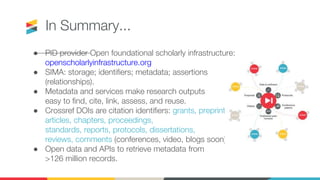
In Summary...
● PID provider Open foundational scholarly infrastructure:
openscholarlyinfrastructure.org
● SIMA: storage; identifiers; metadata; assertions
(relationships).
● Metadata and services make research outputs
easy to find, cite, link, assess, and reuse.
● Crossref DOIs are citation identifiers: grants, preprints,
articles, chapters, proceedings,
standards, reports, protocols, dissertations,
reviews, comments (conferences, video, blogs soon).
● Open data and APIs to retrieve metadata from
>126 million records.
Where are we going?
● An integrated, efficient, sustainable, comprehensive, open,
scholarly infrastructure where…..
● All research activities and outputs, researchers, and organizations
have persistent identifiers and rich, standardized, open metadata
expressing a network of relationships available through human
and machine interfaces thereby enabling.....
● An open and broadly-governed research ecosystem making
research outputs easy to find, cite, link, assess, and reuse, which
will support Open Research, enabling researchers to focus on
research and advance human knowledge
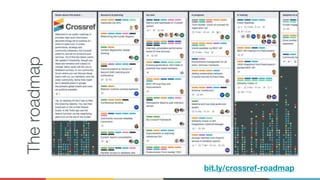
The
roadmap
bit.ly/crossref-roadmap
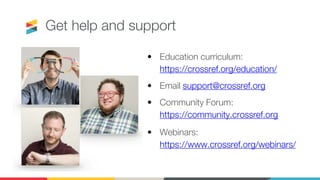
Get help and support
• Education curriculum:
https://crossref.org/education/
• Email support@crossref.org
• Community Forum:
https://community.crossref.org
• Webinars:
https://www.crossref.org/webinars/
Thank you!
Questions?

Crossref LIVE Indonesia: An Introduction to Crossref, CRLIVE-ID 13 July 2021

  • 1.
  • 2.
    Rachael Lammey Head ofSpecial Programs Vanessa Fairhurst Community Engagement Manager
  • 3.
    How to turnon closed captioning
  • 4.
    Agenda 1. About us 2.Getting started as a member at Crossref 3. Persistent Identifiers (DOIs) & the importance of metadata 4. How we work and collaborate with other organizations for the benefit of the scholarly community 5. Where to find further help and support 6. Q&A
  • 5.
  • 6.
    Crossref makes researchoutputs easy to find, cite, link, assess, and reuse. We’re a not-for-profit membership organization that exists to make scholarly communications better. Mission
  • 7.
  • 8.
    https://openscholarlyinfrastructure.org/ Governance, Sustainability andInsurance Supporting Open Research https://www.crossref.org/blog/crossrefs-board-votes-to-adopt-the-principles-of-open-scholarly-infrastructure/
  • 9.
    Crossref overview • Over19,000 member and affiliated organizations • Metadata store of over 126 million scholarly content items • Publishers join Crossref to increase visibility of their content and aid discovery, find out who is using it, and to participate in other collaborative services. • A DOI is just the start - We offer a wide array of services to ensure that scholarly research metadata is registered, linked, and distributed. • We preserve the metadata we receive and make it available via our open APIs and Search.
  • 10.
  • 11.
    Crossref Members andAffiliates by Year
  • 12.
    New members byregion 01/01/2018 - 31/12/2020
  • 13.
    Our members inIndonesia
  • 14.
    Why do publishersjoin Crossref? ● To help get their content discovered ● Show people where their content is located and update that if/when the content moves ● Drive more traffic to publications ● Turn references into hyperlinks ● Find out who is using their content ● Participate in other collaborative services
  • 15.
  • 16.
  • 18.
    Sponsors in Indonesia: ●Relawan Jurnal Indonesia ● Aliansi Pengelola Jurnal Ekonomi dan Bisnis Indonesia ● Forum Pengelola Jurnal Manajemen ● Association for Scientific Computing Electrical and Engineering (ASCEE) ● Conferences.id ● UniveID ● Neliti Working with a Sponsor
  • 19.
    Member obligations 1. Depositmetadata and create DOI links 2. Maintain and update your metadata and landing pages for the long term 3. Follow the Crossref DOI display guidelines 4. Undertake Reference linking 5. Pay your Crossref fees on time
  • 20.
    First Steps • Wesend you a prefix and login • Review different methods for registering your content
  • 21.
    The structure ofa Crossref DOI https://doi.org/10.1006/jmbi.1995.0238 • The DOI directory: makes the DOI actionable on the web • Prefix: assigned by Crossref • Suffix: assigned by the publisher Total DOI = routes through the DOI resolver to point to the registered URL More details: https://www.crossref.org/education/member-setup/constructing-your-dois/
  • 22.
    Your landing page •A full bibliographic citation • The DOI displayed as a URL, per display guidelines • A way to access full text: access to full text is completely controlled by the publisher but the landing page must be accessible to everyone.
  • 23.
    What can Iregister a DOI for? Journals Books Book chapters Conference proceedings Datasets Dissertations Reports Standards Posted content (preprints) Peer reviews Grants … and more
  • 24.
    Persistent identifiers & theimportance of metadata
  • 25.
    Members —> Crossref Basicmetadata: titles; author names; ISSNs/ISBNs, abstracts, references Funding Information: Funder identifiers, award numbers License Information: License URLs Full-text URLs (e.g. for text mining and similarity check) Crossmark: updates, retractions, corrections ORCID iDs Recently: Peer Review reports, relations, links to related data, Grant IDs Very soon: ROR IDs
  • 26.
    Ways to registercontent Upload XML file (https://doi.crossref.org) The manual web deposit form (https://apps.crossref.org/webdeposit) OJS Crossref plugin (https://docs.pkp.sfu.ca/crossref-ojs-manual/en/config)
  • 27.
    Create XML Crossref Schema Metadatadeposit schema: for everything Metadata deposit schema 4.4.2 (documentation) Resource schema: for adding most non-bibliographic metadata to existing records doi_resources4.3.6.xsd (documentation)
  • 28.
  • 29.
    OJS/Crossref integrations • automaticDOI deposit to Crossref on article publication (3.1.2); • inclusion of other article metadata in the Crossref deposit, including author ORCID iDs; article abstracts; and more (OJS 2.4.5); • inclusion of funding data (OJS 3.1.2-1); • inclusion of references (OJS 3.1.2-1); • improved use of Crossref API (OJS 3.1.2-1); • support for Similarity Check service; • support for reference linking and submission (OJS 3.1.2-x) • support for Crossref Funder Registry (OJS 3.1.2-x) • support publications/versioning for DOIs (OJS 3.2) https://docs.pkp.sfu.ca/crossref-ojs-manual/en/
  • 30.
    Metadata should be… •accurate • complete • up to date
  • 32.
    Metadata enables: • Discoverability •Research and editorial integrity • Reproducibility • Reporting and assessment https://www.crossref.org/education/metadata/metadata-for-different-purposes/
  • 33.
    Our services ● ReferenceLinking ● Cited-by ● The Funder Registry ● Event Data ● Crossmark ● Similarity Check https://www.crossref.org/services/
  • 34.
  • 35.
    PKP ● Signed MOUin 2020 to formalize relationship ● Statement of work to relicense deposit plugin, improvements to plugins & adding additional services ● OJS Version 3.4 release Q3/Q4
  • 36.
    DOAJ partnership ● SignedMOU to formalize relationship ● Analysis on gaps and overlaps ● Collaboration to support small and emerging publishers ● Lower barriers to participation globally “Together we stand a greater chance of encouraging an open, fair and fully inclusive future for scholarly publishing” - Lars Bjørnshauge, DOAJ Founder and Managing Director
  • 37.
    ROR: filling agap in research infrastructure @ResearchOrgs/https://ror.org/search
  • 38.
    ROR: filling agap in research infrastructure ● Non-commercial, fully open (CC0) registry ● Public API, data dump ● Specifically focused on research affiliations ● Includes 98K+ organizations ● Community-led project ● Supported in Crossref and DataCite ● In OJS plugin gallery: https://github.com/pkp/plugin-gallery/pull/28 @ResearchOrgs/https://ror.org
  • 39.
  • 40.
    In Summary... ● PIDprovider Open foundational scholarly infrastructure: openscholarlyinfrastructure.org ● SIMA: storage; identifiers; metadata; assertions (relationships). ● Metadata and services make research outputs easy to find, cite, link, assess, and reuse. ● Crossref DOIs are citation identifiers: grants, preprints, articles, chapters, proceedings, standards, reports, protocols, dissertations, reviews, comments (conferences, video, blogs soon). ● Open data and APIs to retrieve metadata from >126 million records.
  • 41.
    Where are wegoing? ● An integrated, efficient, sustainable, comprehensive, open, scholarly infrastructure where….. ● All research activities and outputs, researchers, and organizations have persistent identifiers and rich, standardized, open metadata expressing a network of relationships available through human and machine interfaces thereby enabling..... ● An open and broadly-governed research ecosystem making research outputs easy to find, cite, link, assess, and reuse, which will support Open Research, enabling researchers to focus on research and advance human knowledge
  • 42.
  • 43.
    Get help andsupport • Education curriculum: https://crossref.org/education/ • Email support@crossref.org • Community Forum: https://community.crossref.org • Webinars: https://www.crossref.org/webinars/
  • 45.