Oblivious RAM (ORAM)
A. Satapathy1 C. Soni2
1,2Information and Communication Laboratory
Industrial Technology Research Institute
Taiwan
Under the guidance of Dr. Tzi-cker Chiueh
2017, July 24th
A. Satapathy, C. Soni Oblivious RAM (ORAM) 2017, July 24th
1 / 136
Outline
1 Introduction
Overview
Hide Access Pattern
Goals and Actions
Oblivious RAM
Cuckoo Hashing
2 Types of ORAM
Optimal ORAM
Trivial ORAM
Goldreich’s ”Square Root” ORAM
Ostrovsky’s ”Hierarchical” ORAM
Binary ORAM
Path ORAM
Circuit ORAM
3 Summary
4 References
A. Satapathy, C. Soni Oblivious RAM (ORAM) 2017, July 24th
2 / 136
Outline
1 Introduction
Overview
Hide Access Pattern
Goals and Actions
Oblivious RAM
Cuckoo Hashing
2 Types of ORAM
Optimal ORAM
Trivial ORAM
Goldreich’s ”Square Root” ORAM
Ostrovsky’s ”Hierarchical” ORAM
Binary ORAM
Path ORAM
Circuit ORAM
3 Summary
4 References
A. Satapathy, C. Soni Oblivious RAM (ORAM) 2017, July 24th
3 / 136
Overview
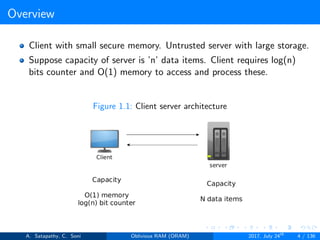
Client with small secure memory. Untrusted server with large storage.
Suppose capacity of server is ’n’ data items. Client requires log(n)
bits counter and O(1) memory to access and process these.
Figure 1.1: Client server architecture
A. Satapathy, C. Soni Oblivious RAM (ORAM) 2017, July 24th
4 / 136
Overview
Therefore,
Confidentiality: Client encrypts data to hide its contents.
Integrity: Message Authentication Code (MAC) is computed to
prevent server from changing it.
Privacy: Hide access pattern to prevent leakage of sensitive
information about data.
A. Satapathy, C. Soni Oblivious RAM (ORAM) 2017, July 24th
5 / 136
Outline
1 Introduction
Overview
Hide Access Pattern
Goals and Actions
Oblivious RAM
Cuckoo Hashing
2 Types of ORAM
Optimal ORAM
Trivial ORAM
Goldreich’s ”Square Root” ORAM
Ostrovsky’s ”Hierarchical” ORAM
Binary ORAM
Path ORAM
Circuit ORAM
3 Summary
4 References
A. Satapathy, C. Soni Oblivious RAM (ORAM) 2017, July 24th
6 / 136
Hide Access Pattern
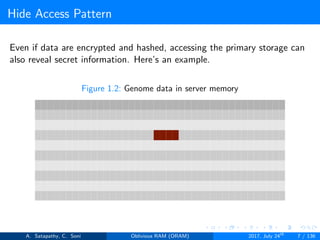
Even if data are encrypted and hashed, accessing the primary storage can
also reveal secret information. Here’s an example.
Figure 1.2: Genome data in server memory
A. Satapathy, C. Soni Oblivious RAM (ORAM) 2017, July 24th
7 / 136
Hide Access Pattern
1: function GENOME(int a, array M)
2: return M[a] Read an element of M
3: end function
Algorithm 1: Read a specific location from GNOME
1: function GENOME(int a, array M)
2: M[a] = #num Re-Write an element of M
3: return M[a]
4: end function
Algorithm 2: Update GNOME sequence
A. Satapathy, C. Soni Oblivious RAM (ORAM) 2017, July 24th
8 / 136
Hide Access Pattern
Allele/ single-nucleotide polymorphisms (SNP) which leads to cancer.
Allele/ SNP is located at specific location on the genome. Brown
blocks are allele/ SNP in figure 1.2.
Client wants to know he/ she has cancer or not, it leads to access
specific memory locations on server.
Admin/ observer can infer that client was concerned about cancer.
Even if data are encrypted, accessing the storage can also reveal
sensitive information.
A. Satapathy, C. Soni Oblivious RAM (ORAM) 2017, July 24th
9 / 136
Outline
1 Introduction
Overview
Hide Access Pattern
Goals and Actions
Oblivious RAM
Cuckoo Hashing
2 Types of ORAM
Optimal ORAM
Trivial ORAM
Goldreich’s ”Square Root” ORAM
Ostrovsky’s ”Hierarchical” ORAM
Binary ORAM
Path ORAM
Circuit ORAM
3 Summary
4 References
A. Satapathy, C. Soni Oblivious RAM (ORAM) 2017, July 24th
10 / 136
Goals and Actions
Goals:
Server has no idea of client’s access data items.
The location of data item must be independent of its index.
Any two sequence of operations y, y‘ of equal length, access patterns
of y and y‘ are computationally indistinguishable. i.e. A(y) = A(y‘).
Suppose y = (read2, write20, write7, read100) and y‘ = (write10,
read3, read40, read30). Both are operationally indistinguishable.
readi = read from location ’i’. writej = write to location ’j’
A. Satapathy, C. Soni Oblivious RAM (ORAM) 2017, July 24th
11 / 136
Goals and Actions
Actions:
Stores ’N’ data items of equal size, of the form (indexi|| datai) on
server.
Data must be encrypted with secure probabilistic encryption scheme.
Each access to the remote storage must include a read and a write.
i.e. readi or writei will be replaced by read(s) + write(s).
Two consecutive access to indexi, must not be the same location.
A. Satapathy, C. Soni Oblivious RAM (ORAM) 2017, July 24th
12 / 136
Goals and Actions
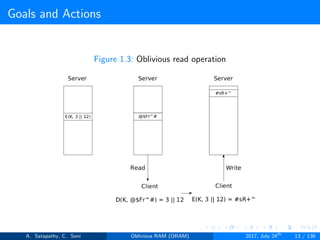
Figure 1.3: Oblivious read operation
A. Satapathy, C. Soni Oblivious RAM (ORAM) 2017, July 24th
13 / 136
Goals and Actions
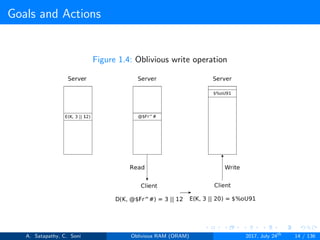
Figure 1.4: Oblivious write operation
A. Satapathy, C. Soni Oblivious RAM (ORAM) 2017, July 24th
14 / 136
Outline
1 Introduction
Overview
Hide Access Pattern
Goals and Actions
Oblivious RAM
Cuckoo Hashing
2 Types of ORAM
Optimal ORAM
Trivial ORAM
Goldreich’s ”Square Root” ORAM
Ostrovsky’s ”Hierarchical” ORAM
Binary ORAM
Path ORAM
Circuit ORAM
3 Summary
4 References
A. Satapathy, C. Soni Oblivious RAM (ORAM) 2017, July 24th
15 / 136
Oblivious RAM
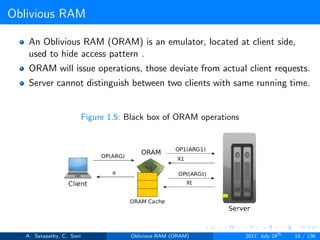
An Oblivious RAM (ORAM) is an emulator, located at client side,
used to hide access pattern .
ORAM will issue operations, those deviate from actual client requests.
Server cannot distinguish between two clients with same running time.
Figure 1.5: Black box of ORAM operations
A. Satapathy, C. Soni Oblivious RAM (ORAM) 2017, July 24th
16 / 136
Outline
1 Introduction
Overview
Hide Access Pattern
Goals and Actions
Oblivious RAM
Cuckoo Hashing
2 Types of ORAM
Optimal ORAM
Trivial ORAM
Goldreich’s ”Square Root” ORAM
Ostrovsky’s ”Hierarchical” ORAM
Binary ORAM
Path ORAM
Circuit ORAM
3 Summary
4 References
A. Satapathy, C. Soni Oblivious RAM (ORAM) 2017, July 24th
17 / 136
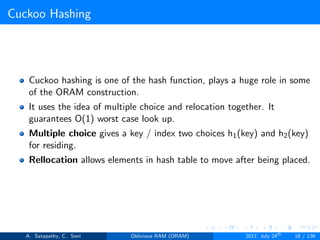
Cuckoo Hashing
Cuckoo hashing is one of the hash function, plays a huge role in some
of the ORAM construction.
It uses the idea of multiple choice and relocation together. It
guarantees O(1) worst case look up.
Multiple choice gives a key / index two choices h1(key) and h2(key)
for residing.
Rellocation allows elements in hash table to move after being placed.
A. Satapathy, C. Soni Oblivious RAM (ORAM) 2017, July 24th
18 / 136
Cuckoo Hashing
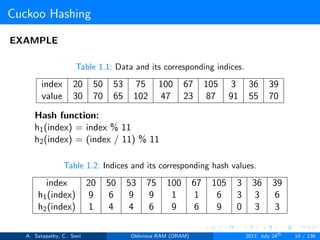
EXAMPLE
Table 1.1: Data and its corresponding indices.
index 20 50 53 75 100 67 105 3 36 39
value 30 70 65 102 47 23 87 91 55 70
Hash function:
h1(index) = index % 11
h2(index) = (index / 11) % 11
Table 1.2: Indices and its corresponding hash values.
index 20 50 53 75 100 67 105 3 36 39
h1(index) 9 6 9 9 1 1 6 3 3 6
h2(index) 1 4 4 6 9 6 9 0 3 3
A. Satapathy, C. Soni Oblivious RAM (ORAM) 2017, July 24th
19 / 136
Cuckoo Hashing
→ 20, h1(20) = 9
Table 1.3: Cuckoo hash table after insertion 20.
Table[1] 20
Table[2]
→ 50, h1(50) = 6
Table 1.4: Cuckoo hash table after insertion 50.
Table[1] 50 20
Table[2]
A. Satapathy, C. Soni Oblivious RAM (ORAM) 2017, July 24th
20 / 136
Cuckoo Hashing
→ 53, h1(53) = 9, but 20 at 9. So, h2(20) = 1.
Table 1.5: Cuckoo hash table after insertion 53.
Table[1] 50 53
Table[2] 20
→ 75, h1(75) = 9, h2(53) = 4
Table 1.6: Cuckoo hash table after insertion 75.
Table[1] 50 75
Table[2] 20 53
A. Satapathy, C. Soni Oblivious RAM (ORAM) 2017, July 24th
21 / 136
Cuckoo Hashing
→ 100, h1(100) = 1.
Table 1.7: Cuckoo hash table after insertion 100.
Table[1] 100 50 75
Table[2] 20 53
→ 67, h1(67) = 1, h2(100) = 9.
Table 1.8: Cuckoo hash table after insertion 67.
Table[1] 67 50 75
Table[2] 20 53 100
A. Satapathy, C. Soni Oblivious RAM (ORAM) 2017, July 24th
22 / 136
Cuckoo Hashing
→ 105, h1(105) = 6, h2(50) = 4, h1(53) = 9, h2(75) = 6.
Table 1.9: Cuckoo hash table after insertion 105.
Table[1] 67 105 53
Table[2] 20 50 75 100
→ 3, h1(3) = 3.
Table 1.10: Cuckoo hash table after insertion 3.
Table[1] 67 3 105 53
Table[2] 20 50 75 100
A. Satapathy, C. Soni Oblivious RAM (ORAM) 2017, July 24th
23 / 136
Cuckoo Hashing
→ 36, h1(36) = 3, h2(3) = 0.
Table 1.11: Cuckoo hash table after insertion 36.
Table[1] 67 36 105 53
Table[2] 3 20 50 75 100
→ 39, h1(36) = 6, h2(105) = 9, h1(100) = 1, h2(67) = 6, h1(75) = 9,
h2(53) = 4, h1(50) = 6, h2(39) = 3.
Table 1.12: Cuckoo hash table after insertion 39.
Table[1] 100 36 50 75
Table[2] 3 20 39 53 67 105
A. Satapathy, C. Soni Oblivious RAM (ORAM) 2017, July 24th
24 / 136
Cuckoo Hashing
Table 1.13: Final hash table
Table[1] 100 36 50 75
Table[2] 3 20 39 53 67 105
Time complexity; Insertion - O(1). Deletion - O(1).
If collision occurs using two exist hash functions, new hash functions
are selected. Continue the cycle, until all data are placed
A. Satapathy, C. Soni Oblivious RAM (ORAM) 2017, July 24th
25 / 136
Outline
1 Introduction
Overview
Hide Access Pattern
Goals and Actions
Oblivious RAM
Cuckoo Hashing
2 Types of ORAM
Optimal ORAM
Trivial ORAM
Goldreich’s ”Square Root” ORAM
Ostrovsky’s ”Hierarchical” ORAM
Binary ORAM
Path ORAM
Circuit ORAM
3 Summary
4 References
A. Satapathy, C. Soni Oblivious RAM (ORAM) 2017, July 24th
26 / 136
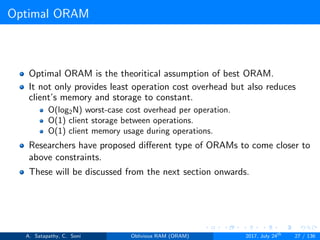
Optimal ORAM
Optimal ORAM is the theoritical assumption of best ORAM.
It not only provides least operation cost overhead but also reduces
client’s memory and storage to constant.
O(log2N) worst-case cost overhead per operation.
O(1) client storage between operations.
O(1) client memory usage during operations.
Researchers have proposed different type of ORAMs to come closer to
above constraints.
These will be discussed from the next section onwards.
A. Satapathy, C. Soni Oblivious RAM (ORAM) 2017, July 24th
27 / 136
Outline
1 Introduction
Overview
Hide Access Pattern
Goals and Actions
Oblivious RAM
Cuckoo Hashing
2 Types of ORAM
Optimal ORAM
Trivial ORAM
Goldreich’s ”Square Root” ORAM
Ostrovsky’s ”Hierarchical” ORAM
Binary ORAM
Path ORAM
Circuit ORAM
3 Summary
4 References
A. Satapathy, C. Soni Oblivious RAM (ORAM) 2017, July 24th
28 / 136
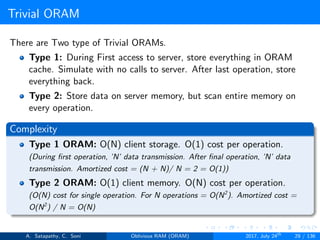
Trivial ORAM
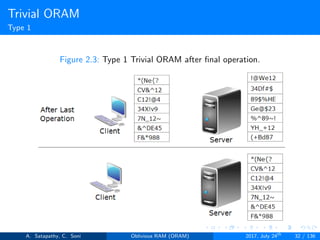
There are Two type of Trivial ORAMs.
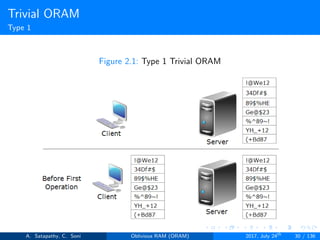
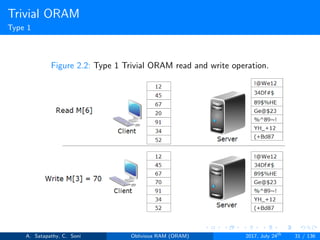
Type 1: During First access to server, store everything in ORAM
cache. Simulate with no calls to server. After last operation, store
everything back.
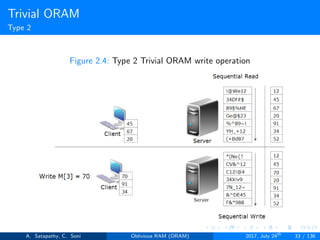
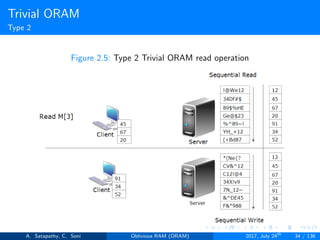
Type 2: Store data on server memory, but scan entire memory on
every operation.
Complexity
Type 1 ORAM: O(N) client storage. O(1) cost per operation.
(During first operation, ’N’ data transmission. After final operation, ’N’ data
transmission. Amortized cost = (N + N)/ N = 2 = O(1))
Type 2 ORAM: O(1) client memory. O(N) cost per operation.
(O(N) cost for single operation. For N operations = O(N2
). Amortized cost =
O(N2
) / N = O(N)
A. Satapathy, C. Soni Oblivious RAM (ORAM) 2017, July 24th
29 / 136
Trivial ORAM
Type 1
Figure 2.1: Type 1 Trivial ORAM
A. Satapathy, C. Soni Oblivious RAM (ORAM) 2017, July 24th
30 / 136
Trivial ORAM
Type 1
Figure 2.2: Type 1 Trivial ORAM read and write operation.
A. Satapathy, C. Soni Oblivious RAM (ORAM) 2017, July 24th
31 / 136
Trivial ORAM
Type 1
Figure 2.3: Type 1 Trivial ORAM after final operation.
A. Satapathy, C. Soni Oblivious RAM (ORAM) 2017, July 24th
32 / 136
Trivial ORAM
Type 2
Figure 2.4: Type 2 Trivial ORAM write operation
A. Satapathy, C. Soni Oblivious RAM (ORAM) 2017, July 24th
33 / 136
Trivial ORAM
Type 2
Figure 2.5: Type 2 Trivial ORAM read operation
A. Satapathy, C. Soni Oblivious RAM (ORAM) 2017, July 24th
34 / 136
Outline
1 Introduction
Overview
Hide Access Pattern
Goals and Actions
Oblivious RAM
Cuckoo Hashing
2 Types of ORAM
Optimal ORAM
Trivial ORAM
Goldreich’s ”Square Root” ORAM
Ostrovsky’s ”Hierarchical” ORAM
Binary ORAM
Path ORAM
Circuit ORAM
3 Summary
4 References
A. Satapathy, C. Soni Oblivious RAM (ORAM) 2017, July 24th
35 / 136
Goldreich’s ”Square Root” ORAM
Goldreich’s square root ORAM requires
Server storage N + 2C words
Client storage O(1) [Constant data words]
’N’ actual data words, ’C’ dummy words and ’C’ sheltered words
Figure 2.6: server storage structure in square root ORAM
A. Satapathy, C. Soni Oblivious RAM (ORAM) 2017, July 24th
36 / 136
Goldreich’s ”Square Root” ORAM
Generally, in Goldreich’s square root ORAM, C = N0.5
Server storage N + 2N0.5 words
Client storage O(1) [Constant data words]
’N’ actual data words, ’N0.5’ dummy words and ’N0.5’ sheltered words
Figure 2.7: server storage structure in square root ORAM
A. Satapathy, C. Soni Oblivious RAM (ORAM) 2017, July 24th
37 / 136
Goldreich’s ”Square Root” ORAM
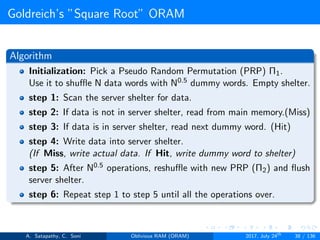
Algorithm
Initialization: Pick a Pseudo Random Permutation (PRP) Π1.
Use it to shuffle N data words with N0.5 dummy words. Empty shelter.
step 1: Scan the server shelter for data.
step 2: If data is not in server shelter, read from main memory.(Miss)
step 3: If data is in server shelter, read next dummy word. (Hit)
step 4: Write data into server shelter.
(If Miss, write actual data. If Hit, write dummy word to shelter)
step 5: After N0.5 operations, reshuffle with new PRP (Π2) and flush
server shelter.
step 6: Repeat step 1 to step 5 until all the operations over.
A. Satapathy, C. Soni Oblivious RAM (ORAM) 2017, July 24th
38 / 136
Goldreich’s ”Square Root” ORAM
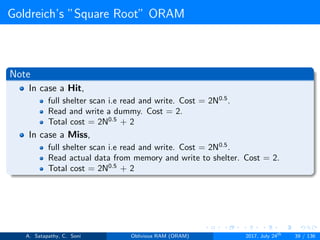
Note
In case a Hit,
full shelter scan i.e read and write. Cost = 2N0.5
.
Read and write a dummy. Cost = 2.
Total cost = 2N0.5
+ 2
In case a Miss,
full shelter scan i.e read and write. Cost = 2N0.5
.
Read actual data from memory and write to shelter. Cost = 2.
Total cost = 2N0.5
+ 2
A. Satapathy, C. Soni Oblivious RAM (ORAM) 2017, July 24th
39 / 136
Goldreich’s ”Square Root” ORAM
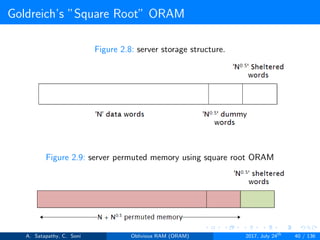
Figure 2.8: server storage structure.
Figure 2.9: server permuted memory using square root ORAM
A. Satapathy, C. Soni Oblivious RAM (ORAM) 2017, July 24th
40 / 136
Goldreich’s ”Square Root” ORAM
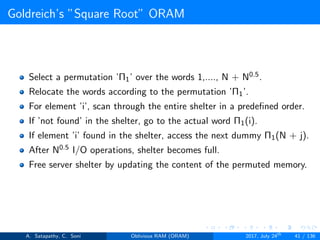
Select a permutation ’Π1’ over the words 1,...., N + N0.5.
Relocate the words according to the permutation ’Π1’.
For element ’i’, scan through the entire shelter in a predefined order.
If ’not found’ in the shelter, go to the actual word Π1(i).
If element ’i’ found in the shelter, access the next dummy Π1(N + j).
After N0.5 I/O operations, shelter becomes full.
Free server shelter by updating the content of the permuted memory.
A. Satapathy, C. Soni Oblivious RAM (ORAM) 2017, July 24th
41 / 136
Goldreich’s ”Square Root” ORAM
Updation
Select new permutation ’Π2’ to sort N + 2N0.5 elements based on
Π2(i).
Sorting makes old and new values of elements come together.
Remove old values, make elements to be restricted in 1,..., N + N0.5.
Updation made shelter empty and usable for next N0.5 operations.
A. Satapathy, C. Soni Oblivious RAM (ORAM) 2017, July 24th
42 / 136
Goldreich’s ”Square Root” ORAM
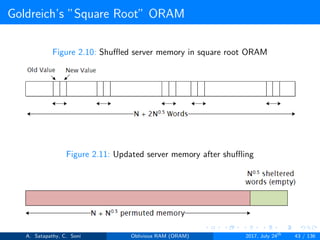
Figure 2.10: Shuffled server memory in square root ORAM
Figure 2.11: Updated server memory after shuffling
A. Satapathy, C. Soni Oblivious RAM (ORAM) 2017, July 24th
43 / 136
Goldreich’s ”Square Root” ORAM
Shuffling
For each comparision, read both positions and rewrite them, either
swapping the data or not (depending Π(i) > Π(j))
For obliviousness, sorting doesn’t depend on sequence of inputs.
Some of the oblivious sorting algorithms are given below.
Bubble Sort. T(N) = O(N2
)
Sorting Networks
Batcher Network. T(N) = O(Nlog2
2
N)
AKS Network. T(N) = O(Nlog2N)
Quick sort is not an oblivious sorting algorithm, as selection of pivot
in each iteration depends on sequence of inputs.
A. Satapathy, C. Soni Oblivious RAM (ORAM) 2017, July 24th
44 / 136
Goldreich’s ”Square Root” ORAM
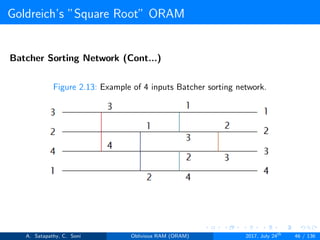
Batcher Sorting Network
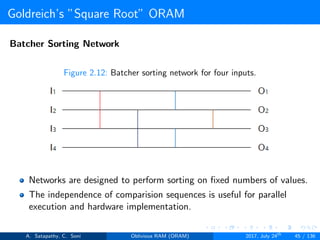
Figure 2.12: Batcher sorting network for four inputs.
Networks are designed to perform sorting on fixed numbers of values.
The independence of comparision sequences is useful for parallel
execution and hardware implementation.
A. Satapathy, C. Soni Oblivious RAM (ORAM) 2017, July 24th
45 / 136
Goldreich’s ”Square Root” ORAM
Batcher Sorting Network (Cont...)
Figure 2.13: Example of 4 inputs Batcher sorting network.
A. Satapathy, C. Soni Oblivious RAM (ORAM) 2017, July 24th
46 / 136
Goldreich’s ”Square Root” ORAM
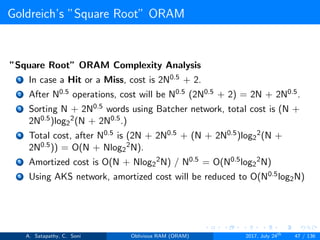
”Square Root” ORAM Complexity Analysis
1 In case a Hit or a Miss, cost is 2N0.5 + 2.
2 After N0.5 operations, cost will be N0.5 (2N0.5 + 2) = 2N + 2N0.5.
3 Sorting N + 2N0.5 words using Batcher network, total cost is (N +
2N0.5)log2
2(N + 2N0.5.)
4 Total cost, after N0.5 is (2N + 2N0.5 + (N + 2N0.5)log2
2(N +
2N0.5)) = O(N + Nlog2
2N).
5 Amortized cost is O(N + Nlog2
2N) / N0.5 = O(N0.5log2
2N)
6 Using AKS network, amortized cost will be reduced to O(N0.5log2N)
A. Satapathy, C. Soni Oblivious RAM (ORAM) 2017, July 24th
47 / 136
Goldreich’s ”Square Root” ORAM
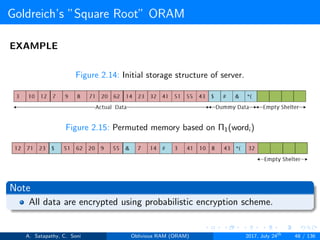
EXAMPLE
Figure 2.14: Initial storage structure of server.
Figure 2.15: Permuted memory based on Π1(wordi)
Note
All data are encrypted using probabilistic encryption scheme.
A. Satapathy, C. Soni Oblivious RAM (ORAM) 2017, July 24th
48 / 136
Goldreich’s ”Square Root” ORAM
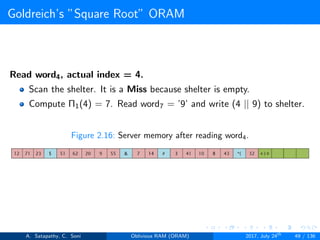
Read word4, actual index = 4.
Scan the shelter. It is a Miss because shelter is empty.
Compute Π1(4) = 7. Read word7 = ’9’ and write (4 || 9) to shelter.
Figure 2.16: Server memory after reading word4.
A. Satapathy, C. Soni Oblivious RAM (ORAM) 2017, July 24th
49 / 136
Goldreich’s ”Square Root” ORAM
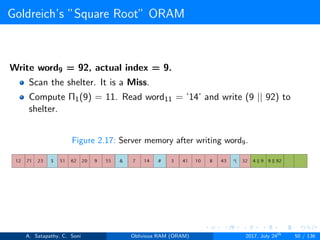
Write word9 = 92, actual index = 9.
Scan the shelter. It is a Miss.
Compute Π1(9) = 11. Read word11 = ’14’ and write (9 || 92) to
shelter.
Figure 2.17: Server memory after writing word9.
A. Satapathy, C. Soni Oblivious RAM (ORAM) 2017, July 24th
50 / 136
Goldreich’s ”Square Root” ORAM
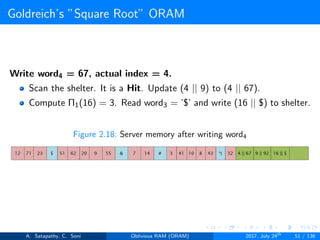
Write word4 = 67, actual index = 4.
Scan the shelter. It is a Hit. Update (4 || 9) to (4 || 67).
Compute Π1(16) = 3. Read word3 = ’$’ and write (16 || $) to shelter.
Figure 2.18: Server memory after writing word4
A. Satapathy, C. Soni Oblivious RAM (ORAM) 2017, July 24th
51 / 136
Goldreich’s ”Square Root” ORAM
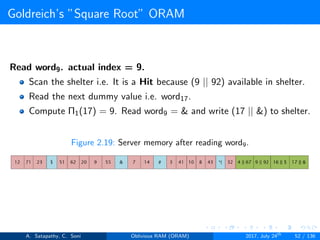
Read word9. actual index = 9.
Scan the shelter i.e. It is a Hit because (9 || 92) available in shelter.
Read the next dummy value i.e. word17.
Compute Π1(17) = 9. Read word9 = & and write (17 || &) to shelter.
Figure 2.19: Server memory after reading word9.
A. Satapathy, C. Soni Oblivious RAM (ORAM) 2017, July 24th
52 / 136
Goldreich’s ”Square Root” ORAM
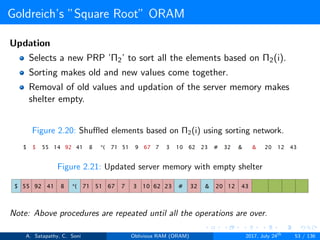
Updation
Selects a new PRP ’Π2’ to sort all the elements based on Π2(i).
Sorting makes old and new values come together.
Removal of old values and updation of the server memory makes
shelter empty.
Figure 2.20: Shuffled elements based on Π2(i) using sorting network.
Figure 2.21: Updated server memory with empty shelter
Note: Above procedures are repeated until all the operations are over.
A. Satapathy, C. Soni Oblivious RAM (ORAM) 2017, July 24th
53 / 136
Outline
1 Introduction
Overview
Hide Access Pattern
Goals and Actions
Oblivious RAM
Cuckoo Hashing
2 Types of ORAM
Optimal ORAM
Trivial ORAM
Goldreich’s ”Square Root” ORAM
Ostrovsky’s ”Hierarchical” ORAM
Binary ORAM
Path ORAM
Circuit ORAM
3 Summary
4 References
A. Satapathy, C. Soni Oblivious RAM (ORAM) 2017, July 24th
54 / 136
Ostrovsky’s ”Hierarchical” ORAM
Amortized cost will be reduced further by replacing square root
ORAM with hierarchical ORAM.
It stores data, including dummies in random hash tables, rather than
storing them in a linear array.
Data items are stored in encrypted form of (indexi || datai)
As the level increases, the number of hash tables at each level also
increases.
Shuffle buffers with a frequency inversely proportional to their levels
i.e. if the level increases then the shuffling frequency decreases.
It follows a more complicated layout to hide memory access patterns.
A. Satapathy, C. Soni Oblivious RAM (ORAM) 2017, July 24th
55 / 136
Ostrovsky’s ”Hierarchical” ORAM
Client Storage
Hash function for each level.
O(1) client memory. [Constant data words].
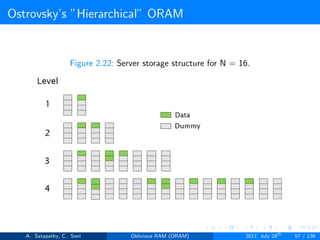
Server Storage
log2N levels for ’N’ data items.
Level ’i’ contains 2i hash tables or buckets.
Each hash table contains log2N blocks.
Each block contains encrypted data or dummy item.
Level ’i’ contains at most 2i data items.
Item ’x’ is located in one of the levels, in buckets Hi(x). (i is the level,
x is index of the item)
A. Satapathy, C. Soni Oblivious RAM (ORAM) 2017, July 24th
56 / 136
Ostrovsky’s ”Hierarchical” ORAM
Figure 2.22: Server storage structure for N = 16.
A. Satapathy, C. Soni Oblivious RAM (ORAM) 2017, July 24th
57 / 136
Ostrovsky’s ”Hierarchical” ORAM
Read / write a data item using ORAM means read the data item and
write it back.
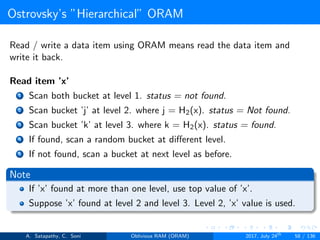
Read item ’x’
1 Scan both bucket at level 1. status = not found.
2 Scan bucket ’j’ at level 2. where j = H2(x). status = Not found.
3 Scan bucket ’k’ at level 3. where k = H2(x). status = found.
4 If found, scan a random bucket at different level.
5 If not found, scan a bucket at next level as before.
Note
If ’x’ found at more than one level, use top value of ’x’.
Suppose ’x’ found at level 2 and level 3. Level 2, ’x’ value is used.
A. Satapathy, C. Soni Oblivious RAM (ORAM) 2017, July 24th
58 / 136
Ostrovsky’s ”Hierarchical” ORAM
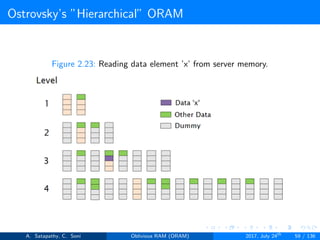
Figure 2.23: Reading data element ’x’ from server memory.
A. Satapathy, C. Soni Oblivious RAM (ORAM) 2017, July 24th
59 / 136
Ostrovsky’s ”Hierarchical” ORAM
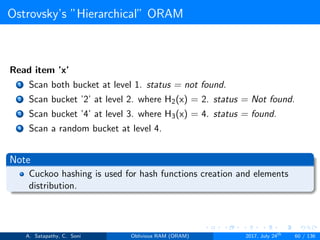
Read item ’x’
1 Scan both bucket at level 1. status = not found.
2 Scan bucket ’2’ at level 2. where H2(x) = 2. status = Not found.
3 Scan bucket ’4’ at level 3. where H3(x) = 4. status = found.
4 Scan a random bucket at level 4.
Note
Cuckoo hashing is used for hash functions creation and elements
distribution.
A. Satapathy, C. Soni Oblivious RAM (ORAM) 2017, July 24th
60 / 136
Ostrovsky’s ”Hierarchical” ORAM
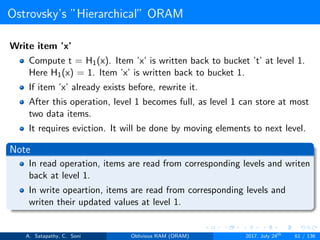
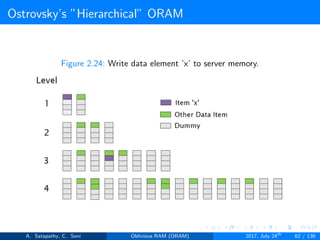
Write item ’x’
Compute t = H1(x). Item ’x’ is written back to bucket ’t’ at level 1.
Here H1(x) = 1. Item ’x’ is written back to bucket 1.
If item ’x’ already exists before, rewrite it.
After this operation, level 1 becomes full, as level 1 can store at most
two data items.
It requires eviction. It will be done by moving elements to next level.
Note
In read operation, items are read from corresponding levels and writen
back at level 1.
In write opeartion, items are read from corresponding levels and
writen their updated values at level 1.
A. Satapathy, C. Soni Oblivious RAM (ORAM) 2017, July 24th
61 / 136
Ostrovsky’s ”Hierarchical” ORAM
Figure 2.24: Write data element ’x’ to server memory.
A. Satapathy, C. Soni Oblivious RAM (ORAM) 2017, July 24th
62 / 136
Ostrovsky’s ”Hierarchical” ORAM
Algorithm (Eviction)
known: Level i stores at most 2i items.
step 1: Every 2i operations, Empty level ’i’ and move its contents to
level ’i+1’.
step 2: If an item with same index ’v’ appears in both levels, after
sorting, newest version (from level i) is kept and older version is
erased.
step 3: After reshuffling, level i + 1 must be reordered using new
hash function.
Note
Sorting networks like Batcher or AKS network is used for sorting.
A. Satapathy, C. Soni Oblivious RAM (ORAM) 2017, July 24th
63 / 136
Ostrovsky’s ”Hierarchical” ORAM
Algorithm (Reshuffling)
step 1: Sort the contents of both levels ’i’ and ’i+1’ on their indices.
A total of (2i + 2i+1)log2N items including dummies.
step 2: After sorting, two copies of same data item are now adjacent.
scan data and replace older copies with dummies.
step 3: Select new hash function Hi+1 and calculate Hi+1(x) for non
dummy item ’x’.
step 4: Arrange data items in buckets based on Hi+1. Maximum
log2N data items can be assigned to each bucket.
step 5: Scan and adjust number of dummies at level i+1.
A. Satapathy, C. Soni Oblivious RAM (ORAM) 2017, July 24th
64 / 136
Ostrovsky’s ”Hierarchical” ORAM
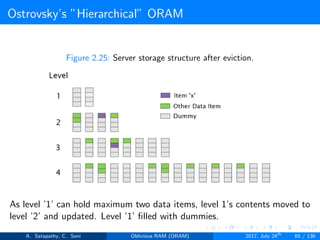
Figure 2.25: Server storage structure after eviction.
As level ’1’ can hold maximum two data items, level 1’s contents moved to
level ’2’ and updated. Level ’1’ filled with dummies.
A. Satapathy, C. Soni Oblivious RAM (ORAM) 2017, July 24th
65 / 136
Ostrovsky’s ”Hierarchical” ORAM
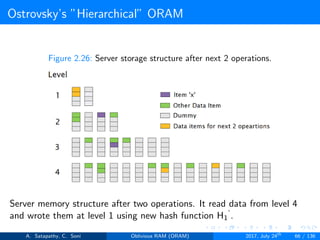
Figure 2.26: Server storage structure after next 2 operations.
Server memory structure after two operations. It read data from level 4
and wrote them at level 1 using new hash function H1
’.
A. Satapathy, C. Soni Oblivious RAM (ORAM) 2017, July 24th
66 / 136
Ostrovsky’s ”Hierarchical” ORAM
Eviction (After last 2 operations)
1 Last two operations made level ’1’ full (maximum 21 data item). So,
contents of level ’1’ will move to level ’2’.
2 As level 2 full before (maximum 22 data item). Level ’2’ contents will
move to level ’3’ first.
3 Level ’2’ contents moved to level ’3’ and updated. Here older value of
item ’x’ removed during updation.
4 Level ’1’ contents moved to level ’2’ and updated.
A. Satapathy, C. Soni Oblivious RAM (ORAM) 2017, July 24th
67 / 136
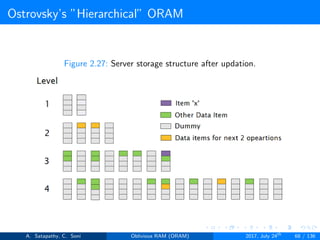
Ostrovsky’s ”Hierarchical” ORAM
Figure 2.27: Server storage structure after updation.
A. Satapathy, C. Soni Oblivious RAM (ORAM) 2017, July 24th
68 / 136
Ostrovsky’s ”Hierarchical” ORAM
”Hierarchical” ORAM Complexity Analysis
Worst Case Access Cost Complexity
Scan all buckets at level 1. Cost = 2log2N
Scan one bucket at level 2. Cost = log2N
Scan one bucket at level 3. Cost = log2N
Similarly one bucket at level log2N. Cost = log2N
So, access cost per data = 2log2N + (log2N - 1)log2N = O(log2
2N)
Write Cost Complexity
O(1). As, item has to be written at level 1.
A. Satapathy, C. Soni Oblivious RAM (ORAM) 2017, July 24th
69 / 136
Ostrovsky’s ”Hierarchical” ORAM
”Hierarchical” ORAM Complexity Analysis (Cont...)
Worst Case Eviction Cost
After reshuffle, level ’i’ is empty. Level ’i+1’ has at most 2i+1 data
items.
A shuffle of level ’i’ (2i data items) using batcher network takes
O(2ilog2
2(2ilog2N)). Here 2ilog2N represents total items including
dummies.
O(2ilog2
2(2ilog2N)) can be simplified to O(2ilog2
2N).
After ’N’ operations, the cost overhead of shuffling is O((N/2)21log2N
+ (N/4)22log2
2N + (N/8)23log2
2N + .... ) = O(Nlog2
3N)
’N’ operations made level 1 shuffled ’N/2’ times, level 2 shuffled
’N/4’ times and so on.
Amortized cost = O(Nlog2
3N) / N = O(log2
3N).
A. Satapathy, C. Soni Oblivious RAM (ORAM) 2017, July 24th
70 / 136
Ostrovsky’s ”Hierarchical” ORAM
”Hierarchical” ORAM Complexity Analysis (Cont..)
Access cost per operation = O(log2
2N).
Write cost per operation = O(1).
Eviction cost per operation = O(log2
3N)
Total cost = O(log2
2N) + O(1) + O(log2
3N) ≈ O(log2
3N)
A. Satapathy, C. Soni Oblivious RAM (ORAM) 2017, July 24th
71 / 136
Outline
1 Introduction
Overview
Hide Access Pattern
Goals and Actions
Oblivious RAM
Cuckoo Hashing
2 Types of ORAM
Optimal ORAM
Trivial ORAM
Goldreich’s ”Square Root” ORAM
Ostrovsky’s ”Hierarchical” ORAM
Binary ORAM
Path ORAM
Circuit ORAM
3 Summary
4 References
A. Satapathy, C. Soni Oblivious RAM (ORAM) 2017, July 24th
72 / 136
Binary ORAM
Amortized cost will be reduced further by replacing hierarchical
ORAM with binary ORAM.
It stores data in one of the buckets in its assigned path, rather than
storing them in random hash tables.
Data items are stored in encrypted form of (indexi || datai)
As the level increases, the number of buckets at each level also
increases by a factor of two.
The probability that a node/bucket at a particular level receives a
data item from its upper level is inversely proportional to its level i.e.
if the level increases then probability decreases.
It follows simplified layout than hierarchical ORAM to hide memory
access pattern.
A. Satapathy, C. Soni Oblivious RAM (ORAM) 2017, July 24th
73 / 136
Binary ORAM
Client Storage
A position map, stores mapped path of each data item.
Position map has N indices and each index is log2N bits long.
A position map of Nlog2N bits.
Server Storage
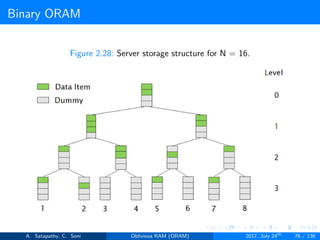
A full binary tree with log2N levels.
Level ’i’ contains 2i nodes or buckets.
Each node contains log2N blocks.
Each node contains encrypted data and/or dummy items.
Item ’x’ is located in one of the nodes in its path ’j’ i.e. from root to
leaf ’j’.
A. Satapathy, C. Soni Oblivious RAM (ORAM) 2017, July 24th
74 / 136
Binary ORAM
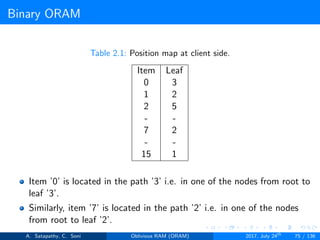
Table 2.1: Position map at client side.
Item Leaf
0 3
1 2
2 5
- -
7 2
- -
15 1
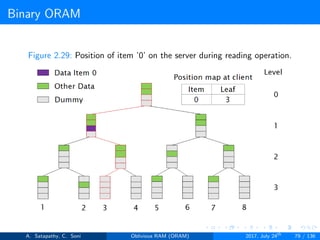
Item ’0’ is located in the path ’3’ i.e. in one of the nodes from root to
leaf ’3’.
Similarly, item ’7’ is located in the path ’2’ i.e. in one of the nodes
from root to leaf ’2’.
A. Satapathy, C. Soni Oblivious RAM (ORAM) 2017, July 24th
75 / 136
Binary ORAM
Figure 2.28: Server storage structure for N = 16.
A. Satapathy, C. Soni Oblivious RAM (ORAM) 2017, July 24th
76 / 136
Binary ORAM
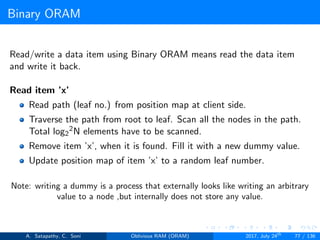
Read/write a data item using Binary ORAM means read the data item
and write it back.
Read item ’x’
Read path (leaf no.) from position map at client side.
Traverse the path from root to leaf. Scan all the nodes in the path.
Total log2
2N elements have to be scanned.
Remove item ’x’, when it is found. Fill it with a new dummy value.
Update position map of item ’x’ to a random leaf number.
Note: writing a dummy is a process that externally looks like writing an arbitrary
value to a node ,but internally does not store any value.
A. Satapathy, C. Soni Oblivious RAM (ORAM) 2017, July 24th
77 / 136
Binary ORAM
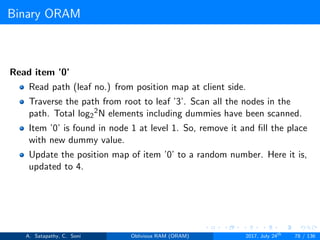
Read item ’0’
Read path (leaf no.) from position map at client side.
Traverse the path from root to leaf ’3’. Scan all the nodes in the
path. Total log2
2N elements including dummies have been scanned.
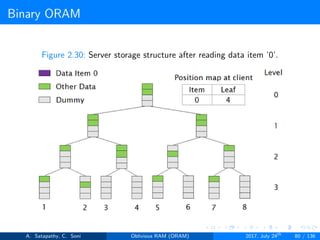
Item ’0’ is found in node 1 at level 1. So, remove it and fill the place
with new dummy value.
Update the position map of item ’0’ to a random number. Here it is,
updated to 4.
A. Satapathy, C. Soni Oblivious RAM (ORAM) 2017, July 24th
78 / 136
Binary ORAM
Figure 2.29: Position of item ’0’ on the server during reading operation.
A. Satapathy, C. Soni Oblivious RAM (ORAM) 2017, July 24th
79 / 136
Binary ORAM
Figure 2.30: Server storage structure after reading data item ’0’.
A. Satapathy, C. Soni Oblivious RAM (ORAM) 2017, July 24th
80 / 136
Binary ORAM
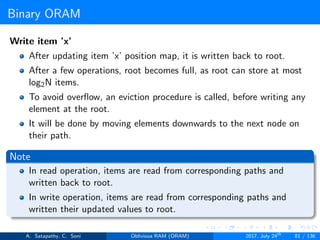
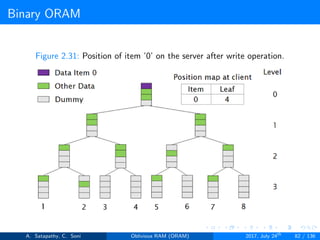
Write item ’x’
After updating item ’x’ position map, it is written back to root.
After a few operations, root becomes full, as root can store at most
log2N items.
To avoid overflow, an eviction procedure is called, before writing any
element at the root.
It will be done by moving elements downwards to the next node on
their path.
Note
In read operation, items are read from corresponding paths and
written back to root.
In write operation, items are read from corresponding paths and
written their updated values to root.
A. Satapathy, C. Soni Oblivious RAM (ORAM) 2017, July 24th
81 / 136
Binary ORAM
Figure 2.31: Position of item ’0’ on the server after write operation.
A. Satapathy, C. Soni Oblivious RAM (ORAM) 2017, July 24th
82 / 136
Binary ORAM
Algorithm (Eviction)
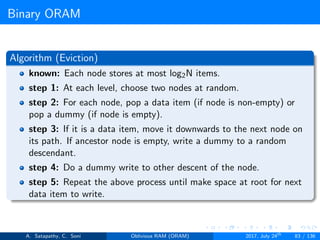
known: Each node stores at most log2N items.
step 1: At each level, choose two nodes at random.
step 2: For each node, pop a data item (if node is non-empty) or
pop a dummy (if node is empty).
step 3: If it is a data item, move it downwards to the next node on
its path. If ancestor node is empty, write a dummy to a random
descendant.
step 4: Do a dummy write to other descent of the node.
step 5: Repeat the above process until make space at root for next
data item to write.
A. Satapathy, C. Soni Oblivious RAM (ORAM) 2017, July 24th
83 / 136
Binary ORAM
Note
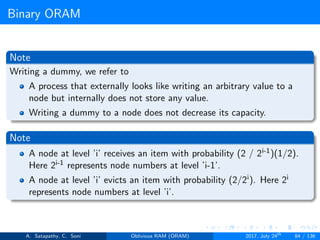
Writing a dummy, we refer to
A process that externally looks like writing an arbitrary value to a
node but internally does not store any value.
Writing a dummy to a node does not decrease its capacity.
Note
A node at level ’i’ receives an item with probability (2 / 2i-1)(1/2).
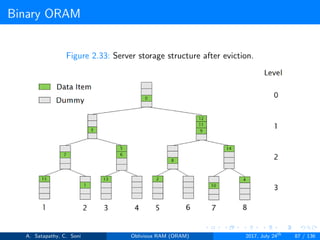
Here 2i-1 represents node numbers at level ’i-1’.
A node at level ’i’ evicts an item with probability (2/2i). Here 2i
represents node numbers at level ’i’.
A. Satapathy, C. Soni Oblivious RAM (ORAM) 2017, July 24th
84 / 136
Binary ORAM
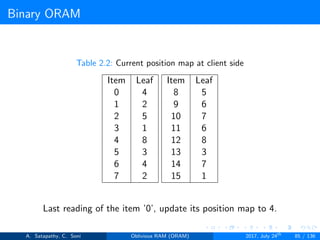
Table 2.2: Current position map at client side
Item Leaf
0 4
1 2
2 5
3 1
4 8
5 3
6 4
7 2
Item Leaf
8 5
9 6
10 7
11 6
12 8
13 3
14 7
15 1
Last reading of the item ’0’, update its position map to 4.
A. Satapathy, C. Soni Oblivious RAM (ORAM) 2017, July 24th
85 / 136
Binary ORAM
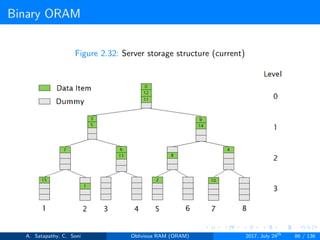
Figure 2.32: Server storage structure (current)
A. Satapathy, C. Soni Oblivious RAM (ORAM) 2017, July 24th
86 / 136
Binary ORAM
Figure 2.33: Server storage structure after eviction.
A. Satapathy, C. Soni Oblivious RAM (ORAM) 2017, July 24th
87 / 136
Binary ORAM
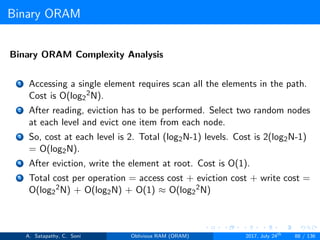
Binary ORAM Complexity Analysis
1 Accessing a single element requires scan all the elements in the path.
Cost is O(log2
2N).
2 After reading, eviction has to be performed. Select two random nodes
at each level and evict one item from each node.
3 So, cost at each level is 2. Total (log2N-1) levels. Cost is 2(log2N-1)
= O(log2N).
4 After eviction, write the element at root. Cost is O(1).
5 Total cost per operation = access cost + eviction cost + write cost =
O(log2
2N) + O(log2N) + O(1) ≈ O(log2
2N)
A. Satapathy, C. Soni Oblivious RAM (ORAM) 2017, July 24th
88 / 136
Binary ORAM
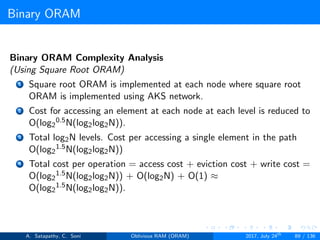
Binary ORAM Complexity Analysis
(Using Square Root ORAM)
1 Square root ORAM is implemented at each node where square root
ORAM is implemented using AKS network.
2 Cost for accessing an element at each node at each level is reduced to
O(log2
0.5N(log2log2N)).
3 Total log2N levels. Cost per accessing a single element in the path
O(log2
1.5N(log2log2N))
4 Total cost per operation = access cost + eviction cost + write cost =
O(log2
1.5N(log2log2N)) + O(log2N) + O(1) ≈
O(log2
1.5N(log2log2N)).
A. Satapathy, C. Soni Oblivious RAM (ORAM) 2017, July 24th
89 / 136
Outline
1 Introduction
Overview
Hide Access Pattern
Goals and Actions
Oblivious RAM
Cuckoo Hashing
2 Types of ORAM
Optimal ORAM
Trivial ORAM
Goldreich’s ”Square Root” ORAM
Ostrovsky’s ”Hierarchical” ORAM
Binary ORAM
Path ORAM
Circuit ORAM
3 Summary
4 References
A. Satapathy, C. Soni Oblivious RAM (ORAM) 2017, July 24th
90 / 136
Path ORAM
Amortized cost will be reduced further by upgrading binary ORAM to
Path ORAM.
Data items are stored in encrypted form of (indexi || datai).
As the level increases, the number of buckets/nodes at each level also
increases by a factor of two.
While reading a particular element, all the elements in the path are
deleted from the server and stored in client stash.
While writing, position map of the element is updated and all the
read elements are rearranged in the read path.
Path ORAM tries to push the elements as close to the leaf in each
write operation.
It follows simplified layout than binary ORAM to hide memory access
pattern.
A. Satapathy, C. Soni Oblivious RAM (ORAM) 2017, July 24th
91 / 136
Path ORAM
Client Storage
A position map, stores mapped path of each data item.
Position map has N indices, but each index is log2N bits long.
A position map of Nlog2N bits.
A stash (temporary storage) where size of stash is bounded by
Pr[stash = R] ≥ 1 - 2-Ω(R). R = O(log2N).ω(1).
Server Storage
A full binary treee with log2N levels.
Each node contains O(1) blocks.
As level increases, number of nodes increases by a factor of two.
Block in each node either contains encrypted data item or it’s empty.
item ’x’ is located in one of the nodes in its path ’j’ i.e. from root to
leaf ’j’.
A. Satapathy, C. Soni Oblivious RAM (ORAM) 2017, July 24th
92 / 136
Path ORAM
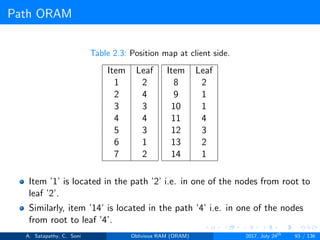
Table 2.3: Position map at client side.
Item Leaf
1 2
2 4
3 3
4 4
5 3
6 1
7 2
Item Leaf
8 2
9 1
10 1
11 4
12 3
13 2
14 1
Item ’1’ is located in the path ’2’ i.e. in one of the nodes from root to
leaf ’2’.
Similarly, item ’14’ is located in the path ’4’ i.e. in one of the nodes
from root to leaf ’4’.
A. Satapathy, C. Soni Oblivious RAM (ORAM) 2017, July 24th
93 / 136
Path ORAM
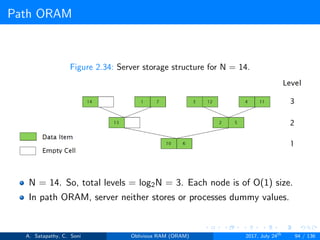
Figure 2.34: Server storage structure for N = 14.
N = 14. So, total levels = log2N = 3. Each node is of O(1) size.
In path ORAM, server neither stores or processes dummy values.
A. Satapathy, C. Soni Oblivious RAM (ORAM) 2017, July 24th
94 / 136
Path ORAM
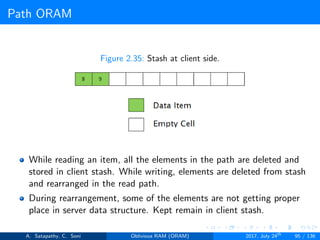
Figure 2.35: Stash at client side.
While reading an item, all the elements in the path are deleted and
stored in client stash. While writing, elements are deleted from stash
and rearranged in the read path.
During rearrangement, some of the elements are not getting proper
place in server data structure. Kept remain in client stash.
A. Satapathy, C. Soni Oblivious RAM (ORAM) 2017, July 24th
95 / 136
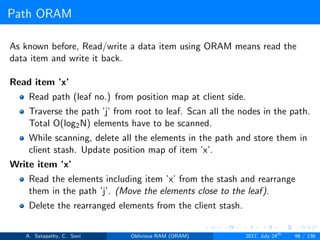
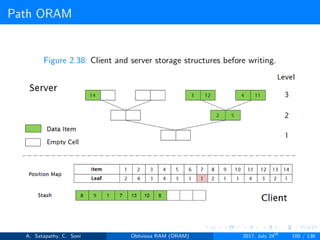
Path ORAM
As known before, Read/write a data item using ORAM means read the
data item and write it back.
Read item ’x’
Read path (leaf no.) from position map at client side.
Traverse the path ’j’ from root to leaf. Scan all the nodes in the path.
Total O(log2N) elements have to be scanned.
While scanning, delete all the elements in the path and store them in
client stash. Update position map of item ’x’.
Write item ’x’
Read the elements including item ’x’ from the stash and rearrange
them in the path ’j’. (Move the elements close to the leaf).
Delete the rearranged elements from the client stash.
A. Satapathy, C. Soni Oblivious RAM (ORAM) 2017, July 24th
96 / 136
Path ORAM
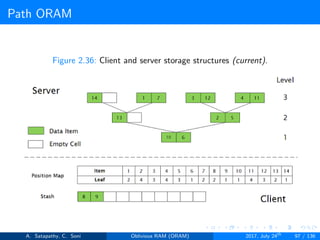
Figure 2.36: Client and server storage structures (current).
A. Satapathy, C. Soni Oblivious RAM (ORAM) 2017, July 24th
97 / 136
Path ORAM
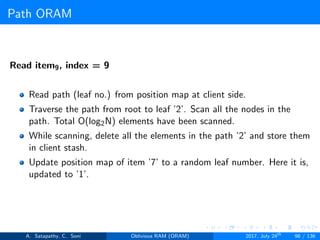
Read item9, index = 9
Read path (leaf no.) from position map at client side.
Traverse the path from root to leaf ’2’. Scan all the nodes in the
path. Total O(log2N) elements have been scanned.
While scanning, delete all the elements in the path ’2’ and store them
in client stash.
Update position map of item ’7’ to a random leaf number. Here it is,
updated to ’1’.
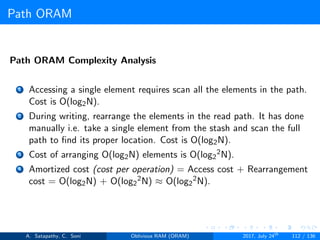
A. Satapathy, C. Soni Oblivious RAM (ORAM) 2017, July 24th
98 / 136
Path ORAM
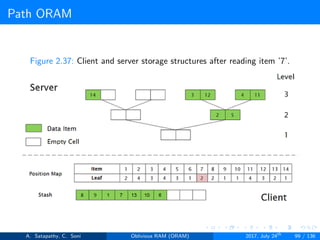
Figure 2.37: Client and server storage structures after reading item ’7’.
A. Satapathy, C. Soni Oblivious RAM (ORAM) 2017, July 24th
99 / 136
Path ORAM
Figure 2.38: Client and server storage structures before writing.
A. Satapathy, C. Soni Oblivious RAM (ORAM) 2017, July 24th
100 / 136
Path ORAM
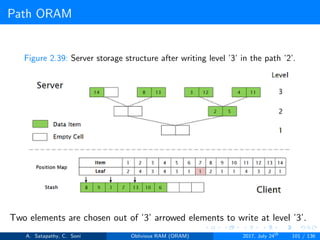
Figure 2.39: Server storage structure after writing level ’3’ in the path ’2’.
Two elements are chosen out of ’3’ arrowed elements to write at level ’3’.
A. Satapathy, C. Soni Oblivious RAM (ORAM) 2017, July 24th
101 / 136
Path ORAM
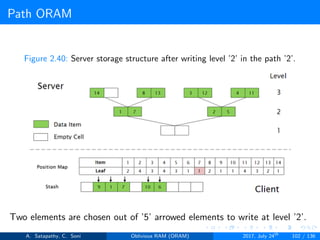
Figure 2.40: Server storage structure after writing level ’2’ in the path ’2’.
Two elements are chosen out of ’5’ arrowed elements to write at level ’2’.
A. Satapathy, C. Soni Oblivious RAM (ORAM) 2017, July 24th
102 / 136
Path ORAM
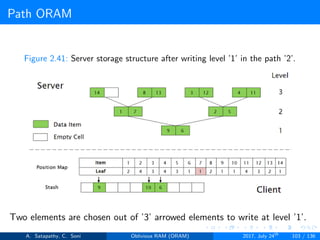
Figure 2.41: Server storage structure after writing level ’1’ in the path ’2’.
Two elements are chosen out of ’3’ arrowed elements to write at level ’1’.
A. Satapathy, C. Soni Oblivious RAM (ORAM) 2017, July 24th
103 / 136
Path ORAM
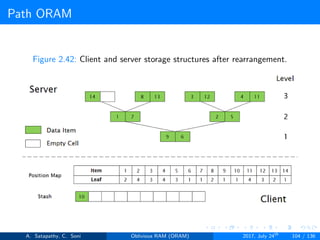
Figure 2.42: Client and server storage structures after rearrangement.
A. Satapathy, C. Soni Oblivious RAM (ORAM) 2017, July 24th
104 / 136
Path ORAM
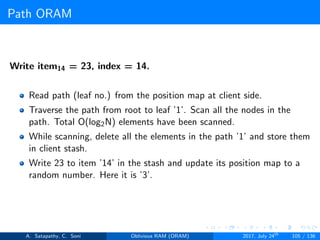
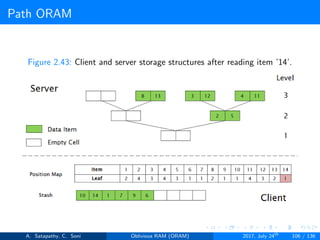
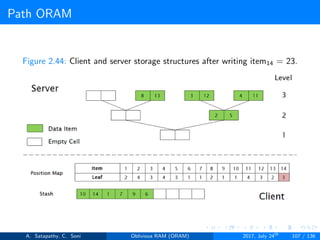
Write item14 = 23, index = 14.
Read path (leaf no.) from the position map at client side.
Traverse the path from root to leaf ’1’. Scan all the nodes in the
path. Total O(log2N) elements have been scanned.
While scanning, delete all the elements in the path ’1’ and store them
in client stash.
Write 23 to item ’14’ in the stash and update its position map to a
random number. Here it is ’3’.
A. Satapathy, C. Soni Oblivious RAM (ORAM) 2017, July 24th
105 / 136
Path ORAM
Figure 2.43: Client and server storage structures after reading item ’14’.
A. Satapathy, C. Soni Oblivious RAM (ORAM) 2017, July 24th
106 / 136
Path ORAM
Figure 2.44: Client and server storage structures after writing item14 = 23.
A. Satapathy, C. Soni Oblivious RAM (ORAM) 2017, July 24th
107 / 136
Path ORAM
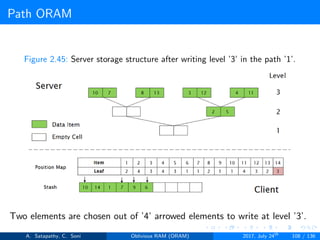
Figure 2.45: Server storage structure after writing level ’3’ in the path ’1’.
Two elements are chosen out of ’4’ arrowed elements to write at level ’3’.
A. Satapathy, C. Soni Oblivious RAM (ORAM) 2017, July 24th
108 / 136
Path ORAM
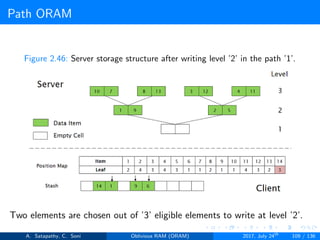
Figure 2.46: Server storage structure after writing level ’2’ in the path ’1’.
Two elements are chosen out of ’3’ eligible elements to write at level ’2’.
A. Satapathy, C. Soni Oblivious RAM (ORAM) 2017, July 24th
109 / 136
Path ORAM
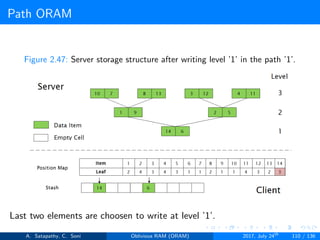
Figure 2.47: Server storage structure after writing level ’1’ in the path ’1’.
Last two elements are choosen to write at level ’1’.
A. Satapathy, C. Soni Oblivious RAM (ORAM) 2017, July 24th
110 / 136
Path ORAM
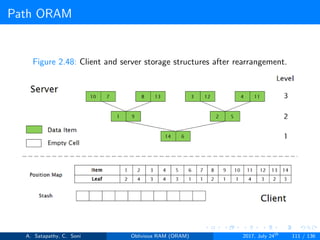
Figure 2.48: Client and server storage structures after rearrangement.
A. Satapathy, C. Soni Oblivious RAM (ORAM) 2017, July 24th
111 / 136
Path ORAM
Path ORAM Complexity Analysis
1 Accessing a single element requires scan all the elements in the path.
Cost is O(log2N).
2 During writing, rearrange the elements in the read path. It has done
manually i.e. take a single element from the stash and scan the full
path to find its proper location. Cost is O(log2N).
3 Cost of arranging O(log2N) elements is O(log2
2N).
4 Amortized cost (cost per operation) = Access cost + Rearrangement
cost = O(log2N) + O(log2
2N) ≈ O(log2
2N).
A. Satapathy, C. Soni Oblivious RAM (ORAM) 2017, July 24th
112 / 136
Outline
1 Introduction
Overview
Hide Access Pattern
Goals and Actions
Oblivious RAM
Cuckoo Hashing
2 Types of ORAM
Optimal ORAM
Trivial ORAM
Goldreich’s ”Square Root” ORAM
Ostrovsky’s ”Hierarchical” ORAM
Binary ORAM
Path ORAM
Circuit ORAM
3 Summary
4 References
A. Satapathy, C. Soni Oblivious RAM (ORAM) 2017, July 24th
113 / 136
Circuit ORAM
Circuit ORAM is the optimized ORAM available till today.
Amortized cost will be reduced further by upgrading binary ORAM to
Circuit ORAM.
Most suitable for MPC as it takes least number of AND and OR
gates for circuit implementation.
Data items are stored in encrypted form of (indexi || datai).
As the level increases, the number of buckets / nodes at each level
also increases by a factor of two.
While reading a particular element, scan all the buckets in its path.
When found, delete it from the bucket and store it in the stash.
While writing, rearrange the read element and elements in its newly
assigned path. It minimizes rearrangement cost to O(log2N).
A. Satapathy, C. Soni Oblivious RAM (ORAM) 2017, July 24th
114 / 136
Circuit ORAM
Client Storage
A position map, stores mapped path of each data item.
Position map has N indices, but each index is log2N bits long.
A position map of Nlog2N bits.
Server Storage
A full binary tree with log2N levels.
Each node contains O(1) blocks.
As level increases, number of nodes increases by a factor of two.
Block in each node either contains encrypted data item or it’s empty.
Item ’x’ is located in one of the nodes in its path ’j’ i.e. from root to
leaf ’j’.
A stash (temporary storage) where size of stash is bounded by
Pr[stash = R] ≥ 1 - 2-Ω(R). R = O(log2N).ω(1).
A. Satapathy, C. Soni Oblivious RAM (ORAM) 2017, July 24th
115 / 136
Circuit ORAM
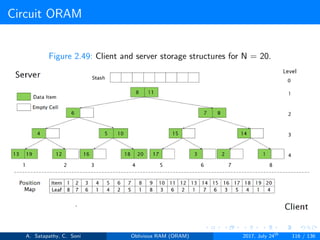
Figure 2.49: Client and server storage structures for N = 20.
A. Satapathy, C. Soni Oblivious RAM (ORAM) 2017, July 24th
116 / 136
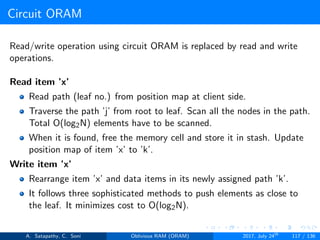
Circuit ORAM
Read/write operation using circuit ORAM is replaced by read and write
operations.
Read item ’x’
Read path (leaf no.) from position map at client side.
Traverse the path ’j’ from root to leaf. Scan all the nodes in the path.
Total O(log2N) elements have to be scanned.
When it is found, free the memory cell and store it in stash. Update
position map of item ’x’ to ’k’.
Write item ’x’
Rearrange item ’x’ and data items in its newly assigned path ’k’.
It follows three sophisticated methods to push elements as close to
the leaf. It minimizes cost to O(log2N).
A. Satapathy, C. Soni Oblivious RAM (ORAM) 2017, July 24th
117 / 136
Circuit ORAM
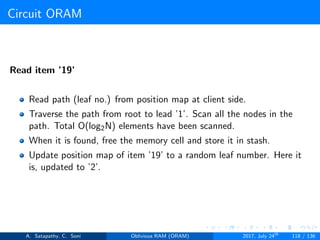
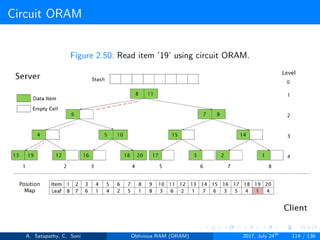
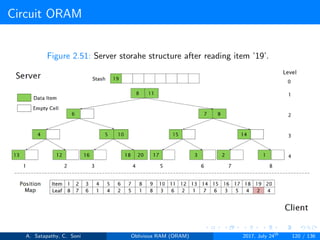
Read item ’19’
Read path (leaf no.) from position map at client side.
Traverse the path from root to lead ’1’. Scan all the nodes in the
path. Total O(log2N) elements have been scanned.
When it is found, free the memory cell and store it in stash.
Update position map of item ’19’ to a random leaf number. Here it
is, updated to ’2’.
A. Satapathy, C. Soni Oblivious RAM (ORAM) 2017, July 24th
118 / 136
Circuit ORAM
Figure 2.50: Read item ’19’ using circuit ORAM.
A. Satapathy, C. Soni Oblivious RAM (ORAM) 2017, July 24th
119 / 136
Circuit ORAM
Figure 2.51: Server storahe structure after reading item ’19’.
A. Satapathy, C. Soni Oblivious RAM (ORAM) 2017, July 24th
120 / 136
Circuit ORAM
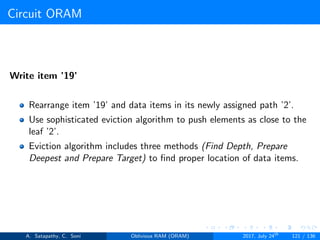
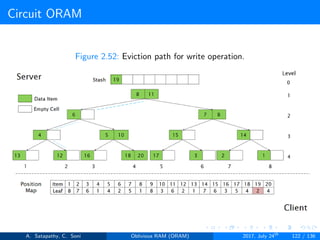
Write item ’19’
Rearrange item ’19’ and data items in its newly assigned path ’2’.
Use sophisticated eviction algorithm to push elements as close to the
leaf ’2’.
Eviction algorithm includes three methods (Find Depth, Prepare
Deepest and Prepare Target) to find proper location of data items.
A. Satapathy, C. Soni Oblivious RAM (ORAM) 2017, July 24th
121 / 136
Circuit ORAM
Figure 2.52: Eviction path for write operation.
A. Satapathy, C. Soni Oblivious RAM (ORAM) 2017, July 24th
122 / 136
Circuit ORAM
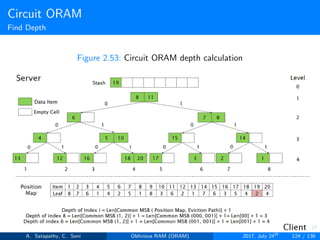
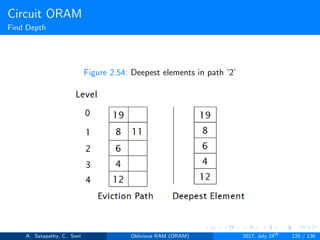
As eviction is performed after each read operation, find deepest element to
be evicted, at each level in the path. Eviction in a path includes
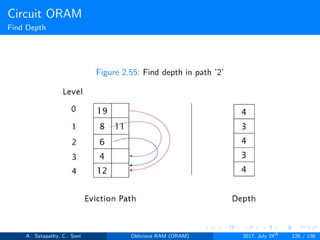
Find Depth (s → t): It is the top-down proceduce. A block in
node[s] can legally reside in node[t]; but no block in node[s] can
legally reside in node[t+1...L]. Here s < t.
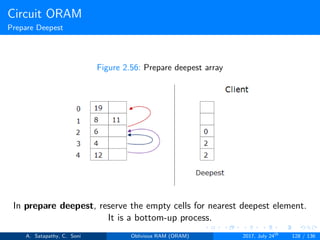
Prepare Deepest (s → t): It is the bottom-up procedure. The
deepest block in node[0...s-1] that can legally reside in node[s]
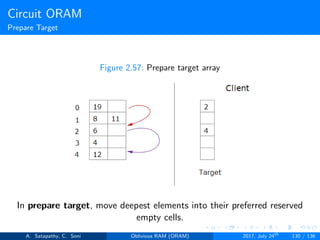
currently resides in node[t]. Here t < s.
Prepare Target (s → t): It follows top-down approach. During the
real block scan, pick up the deepest block in node[s] and drop it in
node[t]. Here s < t.
A. Satapathy, C. Soni Oblivious RAM (ORAM) 2017, July 24th
123 / 136
Circuit ORAM
Find Depth
Figure 2.53: Circuit ORAM depth calculation
A. Satapathy, C. Soni Oblivious RAM (ORAM) 2017, July 24th
124 / 136
Circuit ORAM
Find Depth
Figure 2.54: Deepest elements in path ’2’
A. Satapathy, C. Soni Oblivious RAM (ORAM) 2017, July 24th
125 / 136
Circuit ORAM
Find Depth
Figure 2.55: Find depth in path ’2’
A. Satapathy, C. Soni Oblivious RAM (ORAM) 2017, July 24th
126 / 136
Circuit ORAM
Prepare Deepest
1: function PREPARE DEEPEST(int Depth[ ])
2: Initialize Deepest := (⊥,⊥, ..., ⊥), src := ⊥, goal := -1.
3: If stash not empty then src := 0, goal := Depth[0]
4: end if
5: for i = 1 to L do:
6: if goal ≥ i then Deepest[i] : = src
7: end if
8: l := Deepest[i]
9: if l > goal then goal := l, Src := i
10: end if
11: end for
12: end function
Algorithm 3: Prepare deepest array.
A. Satapathy, C. Soni Oblivious RAM (ORAM) 2017, July 24th
127 / 136
Circuit ORAM
Prepare Deepest
Figure 2.56: Prepare deepest array
In prepare deepest, reserve the empty cells for nearest deepest element.
It is a bottom-up process.
A. Satapathy, C. Soni Oblivious RAM (ORAM) 2017, July 24th
128 / 136
Circuit ORAM
Prepare Target
1: function PREPARE TARGET(int Deepest[ ])
2: Initialize dest := ⊥, src := ⊥, Target := (⊥,⊥,...,⊥)
3: for i = L down to 0 do:
4: if i == src then Target[i] := dest, dest := ⊥, src := ⊥.
5: end if
6: if ((dest = ⊥ and node[i] has empty slot) or (Target[i] =
⊥)) and (Deepest[i] = ⊥) then
7: src := Deepest[i], dest := i
8: end if
9: end for
10: end function
Algorithm 4: Prepare target array.
A. Satapathy, C. Soni Oblivious RAM (ORAM) 2017, July 24th
129 / 136
Circuit ORAM
Prepare Target
Figure 2.57: Prepare target array
In prepare target, move deepest elements into their preferred reserved
empty cells.
A. Satapathy, C. Soni Oblivious RAM (ORAM) 2017, July 24th
130 / 136
Circuit ORAM
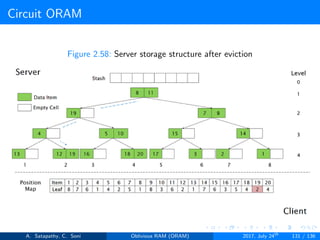
Figure 2.58: Server storage structure after eviction
A. Satapathy, C. Soni Oblivious RAM (ORAM) 2017, July 24th
131 / 136
Circuit ORAM
Circuit ORAM Complexity Analysis
Accessing a single element requires scan all the elements in the path.
Cost is O(log2N)
During writing, rearrange the elements in the newly assigned path. It
has done by performing three operations (two meta data scan and
one data scan)
Rearrangement cost = Find Depth + Prepare Deepest + Prepare
Target = O(log2N) + O(log2N) + O(log2N) ≈ O(log2N).
Cost per operation = Access cost + Rearrangement cost = O(log2N)
+ O(log2N) ≈ O(log2N).
A. Satapathy, C. Soni Oblivious RAM (ORAM) 2017, July 24th
132 / 136
Summary
We discussed
1 How memory access patterns leak sensitive information.
2 Goals and actions are required to hide memory access pattern.
3 Oblivious RAM (ORAM) and different types of ORAM.
4 Cuckoo hashing, one of the hashing algorithm is used in Ostrovsky’s
”Hierarchical” ORAM.
5 Complexity analysis of each ORAM and showed, how cost is reduced
drastically.
A. Satapathy, C. Soni Oblivious RAM (ORAM) 2017, July 24th
133 / 136
References
C. W. Fletcher, ”Oblivious RAM: From Theory to Practice”, Ph. D,
Massachusetts Institute of Technology, 2016.
D. Nath, ”ORAM: A Brief Overview”, University of California, Santa
Barbara, 2015.
B. Pinkas, ”Oblivious RAM”, Bar - Ilan University, Israel, 2015.
E. Shi, Oblivious RAM. Simons Institute: YouTube, 2015.
B. Pinkas, ORAM - Prof. Benny Pinkas. Bar-Ilan University, Israel:
YouTube, 2015.
M. Georgiou, ”Oblivious RAM: Classical results and recent
developments”, University of New York, 2016.
A. Satapathy, C. Soni Oblivious RAM (ORAM) 2017, July 24th
134 / 136
References
X. Yu et al., ”PrORAM: Dynamic Prefetcher for Oblivious RAM”,
ACM SIGARCH Computer Architecture News, vol. 43, no. 3, pp.
616-628, 2015.
E. Stefanov et al., ”Path ORAM: an extremely simple oblivious RAM
protocol”, in Proceedings of the 2013 ACM SIGSAC conference on
Computer and communications security, Berlin, Germany, 2013, pp.
299-310.
X. Wang, T. Chan and E. Shi, ”Circuit ORAM: On Tightness of the
Goldreich-Ostrovsky Lower Bound”, International Association for
Cryptologic Research, 2016.
A. Satapathy, C. Soni Oblivious RAM (ORAM) 2017, July 24th
135 / 136
The End
A. Satapathy, C. Soni Oblivious RAM (ORAM) 2017, July 24th
136 / 136

ORAM

  • 1.
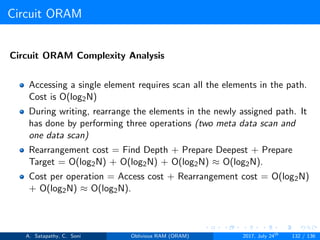
    Oblivious RAM (ORAM) A.Satapathy1 C. Soni2 1,2Information and Communication Laboratory Industrial Technology Research Institute Taiwan Under the guidance of Dr. Tzi-cker Chiueh 2017, July 24th A. Satapathy, C. Soni Oblivious RAM (ORAM) 2017, July 24th 1 / 136
  • 2.
    Outline 1 Introduction Overview Hide AccessPattern Goals and Actions Oblivious RAM Cuckoo Hashing 2 Types of ORAM Optimal ORAM Trivial ORAM Goldreich’s ”Square Root” ORAM Ostrovsky’s ”Hierarchical” ORAM Binary ORAM Path ORAM Circuit ORAM 3 Summary 4 References A. Satapathy, C. Soni Oblivious RAM (ORAM) 2017, July 24th 2 / 136
  • 3.
    Outline 1 Introduction Overview Hide AccessPattern Goals and Actions Oblivious RAM Cuckoo Hashing 2 Types of ORAM Optimal ORAM Trivial ORAM Goldreich’s ”Square Root” ORAM Ostrovsky’s ”Hierarchical” ORAM Binary ORAM Path ORAM Circuit ORAM 3 Summary 4 References A. Satapathy, C. Soni Oblivious RAM (ORAM) 2017, July 24th 3 / 136
  • 4.
    Overview Client with smallsecure memory. Untrusted server with large storage. Suppose capacity of server is ’n’ data items. Client requires log(n) bits counter and O(1) memory to access and process these. Figure 1.1: Client server architecture A. Satapathy, C. Soni Oblivious RAM (ORAM) 2017, July 24th 4 / 136
  • 5.
    Overview Therefore, Confidentiality: Client encryptsdata to hide its contents. Integrity: Message Authentication Code (MAC) is computed to prevent server from changing it. Privacy: Hide access pattern to prevent leakage of sensitive information about data. A. Satapathy, C. Soni Oblivious RAM (ORAM) 2017, July 24th 5 / 136
  • 6.
    Outline 1 Introduction Overview Hide AccessPattern Goals and Actions Oblivious RAM Cuckoo Hashing 2 Types of ORAM Optimal ORAM Trivial ORAM Goldreich’s ”Square Root” ORAM Ostrovsky’s ”Hierarchical” ORAM Binary ORAM Path ORAM Circuit ORAM 3 Summary 4 References A. Satapathy, C. Soni Oblivious RAM (ORAM) 2017, July 24th 6 / 136
  • 7.
    Hide Access Pattern Evenif data are encrypted and hashed, accessing the primary storage can also reveal secret information. Here’s an example. Figure 1.2: Genome data in server memory A. Satapathy, C. Soni Oblivious RAM (ORAM) 2017, July 24th 7 / 136
  • 8.
    Hide Access Pattern 1:function GENOME(int a, array M) 2: return M[a] Read an element of M 3: end function Algorithm 1: Read a specific location from GNOME 1: function GENOME(int a, array M) 2: M[a] = #num Re-Write an element of M 3: return M[a] 4: end function Algorithm 2: Update GNOME sequence A. Satapathy, C. Soni Oblivious RAM (ORAM) 2017, July 24th 8 / 136
  • 9.
    Hide Access Pattern Allele/single-nucleotide polymorphisms (SNP) which leads to cancer. Allele/ SNP is located at specific location on the genome. Brown blocks are allele/ SNP in figure 1.2. Client wants to know he/ she has cancer or not, it leads to access specific memory locations on server. Admin/ observer can infer that client was concerned about cancer. Even if data are encrypted, accessing the storage can also reveal sensitive information. A. Satapathy, C. Soni Oblivious RAM (ORAM) 2017, July 24th 9 / 136
  • 10.
    Outline 1 Introduction Overview Hide AccessPattern Goals and Actions Oblivious RAM Cuckoo Hashing 2 Types of ORAM Optimal ORAM Trivial ORAM Goldreich’s ”Square Root” ORAM Ostrovsky’s ”Hierarchical” ORAM Binary ORAM Path ORAM Circuit ORAM 3 Summary 4 References A. Satapathy, C. Soni Oblivious RAM (ORAM) 2017, July 24th 10 / 136
  • 11.
    Goals and Actions Goals: Serverhas no idea of client’s access data items. The location of data item must be independent of its index. Any two sequence of operations y, y‘ of equal length, access patterns of y and y‘ are computationally indistinguishable. i.e. A(y) = A(y‘). Suppose y = (read2, write20, write7, read100) and y‘ = (write10, read3, read40, read30). Both are operationally indistinguishable. readi = read from location ’i’. writej = write to location ’j’ A. Satapathy, C. Soni Oblivious RAM (ORAM) 2017, July 24th 11 / 136
  • 12.
    Goals and Actions Actions: Stores’N’ data items of equal size, of the form (indexi|| datai) on server. Data must be encrypted with secure probabilistic encryption scheme. Each access to the remote storage must include a read and a write. i.e. readi or writei will be replaced by read(s) + write(s). Two consecutive access to indexi, must not be the same location. A. Satapathy, C. Soni Oblivious RAM (ORAM) 2017, July 24th 12 / 136
  • 13.
    Goals and Actions Figure1.3: Oblivious read operation A. Satapathy, C. Soni Oblivious RAM (ORAM) 2017, July 24th 13 / 136
  • 14.
    Goals and Actions Figure1.4: Oblivious write operation A. Satapathy, C. Soni Oblivious RAM (ORAM) 2017, July 24th 14 / 136
  • 15.
    Outline 1 Introduction Overview Hide AccessPattern Goals and Actions Oblivious RAM Cuckoo Hashing 2 Types of ORAM Optimal ORAM Trivial ORAM Goldreich’s ”Square Root” ORAM Ostrovsky’s ”Hierarchical” ORAM Binary ORAM Path ORAM Circuit ORAM 3 Summary 4 References A. Satapathy, C. Soni Oblivious RAM (ORAM) 2017, July 24th 15 / 136
  • 16.
    Oblivious RAM An ObliviousRAM (ORAM) is an emulator, located at client side, used to hide access pattern . ORAM will issue operations, those deviate from actual client requests. Server cannot distinguish between two clients with same running time. Figure 1.5: Black box of ORAM operations A. Satapathy, C. Soni Oblivious RAM (ORAM) 2017, July 24th 16 / 136
  • 17.
    Outline 1 Introduction Overview Hide AccessPattern Goals and Actions Oblivious RAM Cuckoo Hashing 2 Types of ORAM Optimal ORAM Trivial ORAM Goldreich’s ”Square Root” ORAM Ostrovsky’s ”Hierarchical” ORAM Binary ORAM Path ORAM Circuit ORAM 3 Summary 4 References A. Satapathy, C. Soni Oblivious RAM (ORAM) 2017, July 24th 17 / 136
  • 18.
    Cuckoo Hashing Cuckoo hashingis one of the hash function, plays a huge role in some of the ORAM construction. It uses the idea of multiple choice and relocation together. It guarantees O(1) worst case look up. Multiple choice gives a key / index two choices h1(key) and h2(key) for residing. Rellocation allows elements in hash table to move after being placed. A. Satapathy, C. Soni Oblivious RAM (ORAM) 2017, July 24th 18 / 136
  • 19.
    Cuckoo Hashing EXAMPLE Table 1.1:Data and its corresponding indices. index 20 50 53 75 100 67 105 3 36 39 value 30 70 65 102 47 23 87 91 55 70 Hash function: h1(index) = index % 11 h2(index) = (index / 11) % 11 Table 1.2: Indices and its corresponding hash values. index 20 50 53 75 100 67 105 3 36 39 h1(index) 9 6 9 9 1 1 6 3 3 6 h2(index) 1 4 4 6 9 6 9 0 3 3 A. Satapathy, C. Soni Oblivious RAM (ORAM) 2017, July 24th 19 / 136
  • 20.
    Cuckoo Hashing → 20,h1(20) = 9 Table 1.3: Cuckoo hash table after insertion 20. Table[1] 20 Table[2] → 50, h1(50) = 6 Table 1.4: Cuckoo hash table after insertion 50. Table[1] 50 20 Table[2] A. Satapathy, C. Soni Oblivious RAM (ORAM) 2017, July 24th 20 / 136
  • 21.
    Cuckoo Hashing → 53,h1(53) = 9, but 20 at 9. So, h2(20) = 1. Table 1.5: Cuckoo hash table after insertion 53. Table[1] 50 53 Table[2] 20 → 75, h1(75) = 9, h2(53) = 4 Table 1.6: Cuckoo hash table after insertion 75. Table[1] 50 75 Table[2] 20 53 A. Satapathy, C. Soni Oblivious RAM (ORAM) 2017, July 24th 21 / 136
  • 22.
    Cuckoo Hashing → 100,h1(100) = 1. Table 1.7: Cuckoo hash table after insertion 100. Table[1] 100 50 75 Table[2] 20 53 → 67, h1(67) = 1, h2(100) = 9. Table 1.8: Cuckoo hash table after insertion 67. Table[1] 67 50 75 Table[2] 20 53 100 A. Satapathy, C. Soni Oblivious RAM (ORAM) 2017, July 24th 22 / 136
  • 23.
    Cuckoo Hashing → 105,h1(105) = 6, h2(50) = 4, h1(53) = 9, h2(75) = 6. Table 1.9: Cuckoo hash table after insertion 105. Table[1] 67 105 53 Table[2] 20 50 75 100 → 3, h1(3) = 3. Table 1.10: Cuckoo hash table after insertion 3. Table[1] 67 3 105 53 Table[2] 20 50 75 100 A. Satapathy, C. Soni Oblivious RAM (ORAM) 2017, July 24th 23 / 136
  • 24.
    Cuckoo Hashing → 36,h1(36) = 3, h2(3) = 0. Table 1.11: Cuckoo hash table after insertion 36. Table[1] 67 36 105 53 Table[2] 3 20 50 75 100 → 39, h1(36) = 6, h2(105) = 9, h1(100) = 1, h2(67) = 6, h1(75) = 9, h2(53) = 4, h1(50) = 6, h2(39) = 3. Table 1.12: Cuckoo hash table after insertion 39. Table[1] 100 36 50 75 Table[2] 3 20 39 53 67 105 A. Satapathy, C. Soni Oblivious RAM (ORAM) 2017, July 24th 24 / 136
  • 25.
    Cuckoo Hashing Table 1.13:Final hash table Table[1] 100 36 50 75 Table[2] 3 20 39 53 67 105 Time complexity; Insertion - O(1). Deletion - O(1). If collision occurs using two exist hash functions, new hash functions are selected. Continue the cycle, until all data are placed A. Satapathy, C. Soni Oblivious RAM (ORAM) 2017, July 24th 25 / 136
  • 26.
    Outline 1 Introduction Overview Hide AccessPattern Goals and Actions Oblivious RAM Cuckoo Hashing 2 Types of ORAM Optimal ORAM Trivial ORAM Goldreich’s ”Square Root” ORAM Ostrovsky’s ”Hierarchical” ORAM Binary ORAM Path ORAM Circuit ORAM 3 Summary 4 References A. Satapathy, C. Soni Oblivious RAM (ORAM) 2017, July 24th 26 / 136
  • 27.
    Optimal ORAM Optimal ORAMis the theoritical assumption of best ORAM. It not only provides least operation cost overhead but also reduces client’s memory and storage to constant. O(log2N) worst-case cost overhead per operation. O(1) client storage between operations. O(1) client memory usage during operations. Researchers have proposed different type of ORAMs to come closer to above constraints. These will be discussed from the next section onwards. A. Satapathy, C. Soni Oblivious RAM (ORAM) 2017, July 24th 27 / 136
  • 28.
    Outline 1 Introduction Overview Hide AccessPattern Goals and Actions Oblivious RAM Cuckoo Hashing 2 Types of ORAM Optimal ORAM Trivial ORAM Goldreich’s ”Square Root” ORAM Ostrovsky’s ”Hierarchical” ORAM Binary ORAM Path ORAM Circuit ORAM 3 Summary 4 References A. Satapathy, C. Soni Oblivious RAM (ORAM) 2017, July 24th 28 / 136
  • 29.
    Trivial ORAM There areTwo type of Trivial ORAMs. Type 1: During First access to server, store everything in ORAM cache. Simulate with no calls to server. After last operation, store everything back. Type 2: Store data on server memory, but scan entire memory on every operation. Complexity Type 1 ORAM: O(N) client storage. O(1) cost per operation. (During first operation, ’N’ data transmission. After final operation, ’N’ data transmission. Amortized cost = (N + N)/ N = 2 = O(1)) Type 2 ORAM: O(1) client memory. O(N) cost per operation. (O(N) cost for single operation. For N operations = O(N2 ). Amortized cost = O(N2 ) / N = O(N) A. Satapathy, C. Soni Oblivious RAM (ORAM) 2017, July 24th 29 / 136
  • 30.
    Trivial ORAM Type 1 Figure2.1: Type 1 Trivial ORAM A. Satapathy, C. Soni Oblivious RAM (ORAM) 2017, July 24th 30 / 136
  • 31.
    Trivial ORAM Type 1 Figure2.2: Type 1 Trivial ORAM read and write operation. A. Satapathy, C. Soni Oblivious RAM (ORAM) 2017, July 24th 31 / 136
  • 32.
    Trivial ORAM Type 1 Figure2.3: Type 1 Trivial ORAM after final operation. A. Satapathy, C. Soni Oblivious RAM (ORAM) 2017, July 24th 32 / 136
  • 33.
    Trivial ORAM Type 2 Figure2.4: Type 2 Trivial ORAM write operation A. Satapathy, C. Soni Oblivious RAM (ORAM) 2017, July 24th 33 / 136
  • 34.
    Trivial ORAM Type 2 Figure2.5: Type 2 Trivial ORAM read operation A. Satapathy, C. Soni Oblivious RAM (ORAM) 2017, July 24th 34 / 136
  • 35.
    Outline 1 Introduction Overview Hide AccessPattern Goals and Actions Oblivious RAM Cuckoo Hashing 2 Types of ORAM Optimal ORAM Trivial ORAM Goldreich’s ”Square Root” ORAM Ostrovsky’s ”Hierarchical” ORAM Binary ORAM Path ORAM Circuit ORAM 3 Summary 4 References A. Satapathy, C. Soni Oblivious RAM (ORAM) 2017, July 24th 35 / 136
  • 36.
    Goldreich’s ”Square Root”ORAM Goldreich’s square root ORAM requires Server storage N + 2C words Client storage O(1) [Constant data words] ’N’ actual data words, ’C’ dummy words and ’C’ sheltered words Figure 2.6: server storage structure in square root ORAM A. Satapathy, C. Soni Oblivious RAM (ORAM) 2017, July 24th 36 / 136
  • 37.
    Goldreich’s ”Square Root”ORAM Generally, in Goldreich’s square root ORAM, C = N0.5 Server storage N + 2N0.5 words Client storage O(1) [Constant data words] ’N’ actual data words, ’N0.5’ dummy words and ’N0.5’ sheltered words Figure 2.7: server storage structure in square root ORAM A. Satapathy, C. Soni Oblivious RAM (ORAM) 2017, July 24th 37 / 136
  • 38.
    Goldreich’s ”Square Root”ORAM Algorithm Initialization: Pick a Pseudo Random Permutation (PRP) Π1. Use it to shuffle N data words with N0.5 dummy words. Empty shelter. step 1: Scan the server shelter for data. step 2: If data is not in server shelter, read from main memory.(Miss) step 3: If data is in server shelter, read next dummy word. (Hit) step 4: Write data into server shelter. (If Miss, write actual data. If Hit, write dummy word to shelter) step 5: After N0.5 operations, reshuffle with new PRP (Π2) and flush server shelter. step 6: Repeat step 1 to step 5 until all the operations over. A. Satapathy, C. Soni Oblivious RAM (ORAM) 2017, July 24th 38 / 136
  • 39.
    Goldreich’s ”Square Root”ORAM Note In case a Hit, full shelter scan i.e read and write. Cost = 2N0.5 . Read and write a dummy. Cost = 2. Total cost = 2N0.5 + 2 In case a Miss, full shelter scan i.e read and write. Cost = 2N0.5 . Read actual data from memory and write to shelter. Cost = 2. Total cost = 2N0.5 + 2 A. Satapathy, C. Soni Oblivious RAM (ORAM) 2017, July 24th 39 / 136
  • 40.
    Goldreich’s ”Square Root”ORAM Figure 2.8: server storage structure. Figure 2.9: server permuted memory using square root ORAM A. Satapathy, C. Soni Oblivious RAM (ORAM) 2017, July 24th 40 / 136
  • 41.
    Goldreich’s ”Square Root”ORAM Select a permutation ’Π1’ over the words 1,...., N + N0.5. Relocate the words according to the permutation ’Π1’. For element ’i’, scan through the entire shelter in a predefined order. If ’not found’ in the shelter, go to the actual word Π1(i). If element ’i’ found in the shelter, access the next dummy Π1(N + j). After N0.5 I/O operations, shelter becomes full. Free server shelter by updating the content of the permuted memory. A. Satapathy, C. Soni Oblivious RAM (ORAM) 2017, July 24th 41 / 136
  • 42.
    Goldreich’s ”Square Root”ORAM Updation Select new permutation ’Π2’ to sort N + 2N0.5 elements based on Π2(i). Sorting makes old and new values of elements come together. Remove old values, make elements to be restricted in 1,..., N + N0.5. Updation made shelter empty and usable for next N0.5 operations. A. Satapathy, C. Soni Oblivious RAM (ORAM) 2017, July 24th 42 / 136
  • 43.
    Goldreich’s ”Square Root”ORAM Figure 2.10: Shuffled server memory in square root ORAM Figure 2.11: Updated server memory after shuffling A. Satapathy, C. Soni Oblivious RAM (ORAM) 2017, July 24th 43 / 136
  • 44.
    Goldreich’s ”Square Root”ORAM Shuffling For each comparision, read both positions and rewrite them, either swapping the data or not (depending Π(i) > Π(j)) For obliviousness, sorting doesn’t depend on sequence of inputs. Some of the oblivious sorting algorithms are given below. Bubble Sort. T(N) = O(N2 ) Sorting Networks Batcher Network. T(N) = O(Nlog2 2 N) AKS Network. T(N) = O(Nlog2N) Quick sort is not an oblivious sorting algorithm, as selection of pivot in each iteration depends on sequence of inputs. A. Satapathy, C. Soni Oblivious RAM (ORAM) 2017, July 24th 44 / 136
  • 45.
    Goldreich’s ”Square Root”ORAM Batcher Sorting Network Figure 2.12: Batcher sorting network for four inputs. Networks are designed to perform sorting on fixed numbers of values. The independence of comparision sequences is useful for parallel execution and hardware implementation. A. Satapathy, C. Soni Oblivious RAM (ORAM) 2017, July 24th 45 / 136
  • 46.
    Goldreich’s ”Square Root”ORAM Batcher Sorting Network (Cont...) Figure 2.13: Example of 4 inputs Batcher sorting network. A. Satapathy, C. Soni Oblivious RAM (ORAM) 2017, July 24th 46 / 136
  • 47.
    Goldreich’s ”Square Root”ORAM ”Square Root” ORAM Complexity Analysis 1 In case a Hit or a Miss, cost is 2N0.5 + 2. 2 After N0.5 operations, cost will be N0.5 (2N0.5 + 2) = 2N + 2N0.5. 3 Sorting N + 2N0.5 words using Batcher network, total cost is (N + 2N0.5)log2 2(N + 2N0.5.) 4 Total cost, after N0.5 is (2N + 2N0.5 + (N + 2N0.5)log2 2(N + 2N0.5)) = O(N + Nlog2 2N). 5 Amortized cost is O(N + Nlog2 2N) / N0.5 = O(N0.5log2 2N) 6 Using AKS network, amortized cost will be reduced to O(N0.5log2N) A. Satapathy, C. Soni Oblivious RAM (ORAM) 2017, July 24th 47 / 136
  • 48.
    Goldreich’s ”Square Root”ORAM EXAMPLE Figure 2.14: Initial storage structure of server. Figure 2.15: Permuted memory based on Π1(wordi) Note All data are encrypted using probabilistic encryption scheme. A. Satapathy, C. Soni Oblivious RAM (ORAM) 2017, July 24th 48 / 136
  • 49.
    Goldreich’s ”Square Root”ORAM Read word4, actual index = 4. Scan the shelter. It is a Miss because shelter is empty. Compute Π1(4) = 7. Read word7 = ’9’ and write (4 || 9) to shelter. Figure 2.16: Server memory after reading word4. A. Satapathy, C. Soni Oblivious RAM (ORAM) 2017, July 24th 49 / 136
  • 50.
    Goldreich’s ”Square Root”ORAM Write word9 = 92, actual index = 9. Scan the shelter. It is a Miss. Compute Π1(9) = 11. Read word11 = ’14’ and write (9 || 92) to shelter. Figure 2.17: Server memory after writing word9. A. Satapathy, C. Soni Oblivious RAM (ORAM) 2017, July 24th 50 / 136
  • 51.
    Goldreich’s ”Square Root”ORAM Write word4 = 67, actual index = 4. Scan the shelter. It is a Hit. Update (4 || 9) to (4 || 67). Compute Π1(16) = 3. Read word3 = ’$’ and write (16 || $) to shelter. Figure 2.18: Server memory after writing word4 A. Satapathy, C. Soni Oblivious RAM (ORAM) 2017, July 24th 51 / 136
  • 52.
    Goldreich’s ”Square Root”ORAM Read word9. actual index = 9. Scan the shelter i.e. It is a Hit because (9 || 92) available in shelter. Read the next dummy value i.e. word17. Compute Π1(17) = 9. Read word9 = & and write (17 || &) to shelter. Figure 2.19: Server memory after reading word9. A. Satapathy, C. Soni Oblivious RAM (ORAM) 2017, July 24th 52 / 136
  • 53.
    Goldreich’s ”Square Root”ORAM Updation Selects a new PRP ’Π2’ to sort all the elements based on Π2(i). Sorting makes old and new values come together. Removal of old values and updation of the server memory makes shelter empty. Figure 2.20: Shuffled elements based on Π2(i) using sorting network. Figure 2.21: Updated server memory with empty shelter Note: Above procedures are repeated until all the operations are over. A. Satapathy, C. Soni Oblivious RAM (ORAM) 2017, July 24th 53 / 136
  • 54.
    Outline 1 Introduction Overview Hide AccessPattern Goals and Actions Oblivious RAM Cuckoo Hashing 2 Types of ORAM Optimal ORAM Trivial ORAM Goldreich’s ”Square Root” ORAM Ostrovsky’s ”Hierarchical” ORAM Binary ORAM Path ORAM Circuit ORAM 3 Summary 4 References A. Satapathy, C. Soni Oblivious RAM (ORAM) 2017, July 24th 54 / 136
  • 55.
    Ostrovsky’s ”Hierarchical” ORAM Amortizedcost will be reduced further by replacing square root ORAM with hierarchical ORAM. It stores data, including dummies in random hash tables, rather than storing them in a linear array. Data items are stored in encrypted form of (indexi || datai) As the level increases, the number of hash tables at each level also increases. Shuffle buffers with a frequency inversely proportional to their levels i.e. if the level increases then the shuffling frequency decreases. It follows a more complicated layout to hide memory access patterns. A. Satapathy, C. Soni Oblivious RAM (ORAM) 2017, July 24th 55 / 136
  • 56.
    Ostrovsky’s ”Hierarchical” ORAM ClientStorage Hash function for each level. O(1) client memory. [Constant data words]. Server Storage log2N levels for ’N’ data items. Level ’i’ contains 2i hash tables or buckets. Each hash table contains log2N blocks. Each block contains encrypted data or dummy item. Level ’i’ contains at most 2i data items. Item ’x’ is located in one of the levels, in buckets Hi(x). (i is the level, x is index of the item) A. Satapathy, C. Soni Oblivious RAM (ORAM) 2017, July 24th 56 / 136
  • 57.
    Ostrovsky’s ”Hierarchical” ORAM Figure2.22: Server storage structure for N = 16. A. Satapathy, C. Soni Oblivious RAM (ORAM) 2017, July 24th 57 / 136
  • 58.
    Ostrovsky’s ”Hierarchical” ORAM Read/ write a data item using ORAM means read the data item and write it back. Read item ’x’ 1 Scan both bucket at level 1. status = not found. 2 Scan bucket ’j’ at level 2. where j = H2(x). status = Not found. 3 Scan bucket ’k’ at level 3. where k = H2(x). status = found. 4 If found, scan a random bucket at different level. 5 If not found, scan a bucket at next level as before. Note If ’x’ found at more than one level, use top value of ’x’. Suppose ’x’ found at level 2 and level 3. Level 2, ’x’ value is used. A. Satapathy, C. Soni Oblivious RAM (ORAM) 2017, July 24th 58 / 136
  • 59.
    Ostrovsky’s ”Hierarchical” ORAM Figure2.23: Reading data element ’x’ from server memory. A. Satapathy, C. Soni Oblivious RAM (ORAM) 2017, July 24th 59 / 136
  • 60.
    Ostrovsky’s ”Hierarchical” ORAM Readitem ’x’ 1 Scan both bucket at level 1. status = not found. 2 Scan bucket ’2’ at level 2. where H2(x) = 2. status = Not found. 3 Scan bucket ’4’ at level 3. where H3(x) = 4. status = found. 4 Scan a random bucket at level 4. Note Cuckoo hashing is used for hash functions creation and elements distribution. A. Satapathy, C. Soni Oblivious RAM (ORAM) 2017, July 24th 60 / 136
  • 61.
    Ostrovsky’s ”Hierarchical” ORAM Writeitem ’x’ Compute t = H1(x). Item ’x’ is written back to bucket ’t’ at level 1. Here H1(x) = 1. Item ’x’ is written back to bucket 1. If item ’x’ already exists before, rewrite it. After this operation, level 1 becomes full, as level 1 can store at most two data items. It requires eviction. It will be done by moving elements to next level. Note In read operation, items are read from corresponding levels and writen back at level 1. In write opeartion, items are read from corresponding levels and writen their updated values at level 1. A. Satapathy, C. Soni Oblivious RAM (ORAM) 2017, July 24th 61 / 136
  • 62.
    Ostrovsky’s ”Hierarchical” ORAM Figure2.24: Write data element ’x’ to server memory. A. Satapathy, C. Soni Oblivious RAM (ORAM) 2017, July 24th 62 / 136
  • 63.
    Ostrovsky’s ”Hierarchical” ORAM Algorithm(Eviction) known: Level i stores at most 2i items. step 1: Every 2i operations, Empty level ’i’ and move its contents to level ’i+1’. step 2: If an item with same index ’v’ appears in both levels, after sorting, newest version (from level i) is kept and older version is erased. step 3: After reshuffling, level i + 1 must be reordered using new hash function. Note Sorting networks like Batcher or AKS network is used for sorting. A. Satapathy, C. Soni Oblivious RAM (ORAM) 2017, July 24th 63 / 136
  • 64.
    Ostrovsky’s ”Hierarchical” ORAM Algorithm(Reshuffling) step 1: Sort the contents of both levels ’i’ and ’i+1’ on their indices. A total of (2i + 2i+1)log2N items including dummies. step 2: After sorting, two copies of same data item are now adjacent. scan data and replace older copies with dummies. step 3: Select new hash function Hi+1 and calculate Hi+1(x) for non dummy item ’x’. step 4: Arrange data items in buckets based on Hi+1. Maximum log2N data items can be assigned to each bucket. step 5: Scan and adjust number of dummies at level i+1. A. Satapathy, C. Soni Oblivious RAM (ORAM) 2017, July 24th 64 / 136
  • 65.
    Ostrovsky’s ”Hierarchical” ORAM Figure2.25: Server storage structure after eviction. As level ’1’ can hold maximum two data items, level 1’s contents moved to level ’2’ and updated. Level ’1’ filled with dummies. A. Satapathy, C. Soni Oblivious RAM (ORAM) 2017, July 24th 65 / 136
  • 66.
    Ostrovsky’s ”Hierarchical” ORAM Figure2.26: Server storage structure after next 2 operations. Server memory structure after two operations. It read data from level 4 and wrote them at level 1 using new hash function H1 ’. A. Satapathy, C. Soni Oblivious RAM (ORAM) 2017, July 24th 66 / 136
  • 67.
    Ostrovsky’s ”Hierarchical” ORAM Eviction(After last 2 operations) 1 Last two operations made level ’1’ full (maximum 21 data item). So, contents of level ’1’ will move to level ’2’. 2 As level 2 full before (maximum 22 data item). Level ’2’ contents will move to level ’3’ first. 3 Level ’2’ contents moved to level ’3’ and updated. Here older value of item ’x’ removed during updation. 4 Level ’1’ contents moved to level ’2’ and updated. A. Satapathy, C. Soni Oblivious RAM (ORAM) 2017, July 24th 67 / 136
  • 68.
    Ostrovsky’s ”Hierarchical” ORAM Figure2.27: Server storage structure after updation. A. Satapathy, C. Soni Oblivious RAM (ORAM) 2017, July 24th 68 / 136
  • 69.
    Ostrovsky’s ”Hierarchical” ORAM ”Hierarchical”ORAM Complexity Analysis Worst Case Access Cost Complexity Scan all buckets at level 1. Cost = 2log2N Scan one bucket at level 2. Cost = log2N Scan one bucket at level 3. Cost = log2N Similarly one bucket at level log2N. Cost = log2N So, access cost per data = 2log2N + (log2N - 1)log2N = O(log2 2N) Write Cost Complexity O(1). As, item has to be written at level 1. A. Satapathy, C. Soni Oblivious RAM (ORAM) 2017, July 24th 69 / 136
  • 70.
    Ostrovsky’s ”Hierarchical” ORAM ”Hierarchical”ORAM Complexity Analysis (Cont...) Worst Case Eviction Cost After reshuffle, level ’i’ is empty. Level ’i+1’ has at most 2i+1 data items. A shuffle of level ’i’ (2i data items) using batcher network takes O(2ilog2 2(2ilog2N)). Here 2ilog2N represents total items including dummies. O(2ilog2 2(2ilog2N)) can be simplified to O(2ilog2 2N). After ’N’ operations, the cost overhead of shuffling is O((N/2)21log2N + (N/4)22log2 2N + (N/8)23log2 2N + .... ) = O(Nlog2 3N) ’N’ operations made level 1 shuffled ’N/2’ times, level 2 shuffled ’N/4’ times and so on. Amortized cost = O(Nlog2 3N) / N = O(log2 3N). A. Satapathy, C. Soni Oblivious RAM (ORAM) 2017, July 24th 70 / 136
  • 71.
    Ostrovsky’s ”Hierarchical” ORAM ”Hierarchical”ORAM Complexity Analysis (Cont..) Access cost per operation = O(log2 2N). Write cost per operation = O(1). Eviction cost per operation = O(log2 3N) Total cost = O(log2 2N) + O(1) + O(log2 3N) ≈ O(log2 3N) A. Satapathy, C. Soni Oblivious RAM (ORAM) 2017, July 24th 71 / 136
  • 72.
    Outline 1 Introduction Overview Hide AccessPattern Goals and Actions Oblivious RAM Cuckoo Hashing 2 Types of ORAM Optimal ORAM Trivial ORAM Goldreich’s ”Square Root” ORAM Ostrovsky’s ”Hierarchical” ORAM Binary ORAM Path ORAM Circuit ORAM 3 Summary 4 References A. Satapathy, C. Soni Oblivious RAM (ORAM) 2017, July 24th 72 / 136
  • 73.
    Binary ORAM Amortized costwill be reduced further by replacing hierarchical ORAM with binary ORAM. It stores data in one of the buckets in its assigned path, rather than storing them in random hash tables. Data items are stored in encrypted form of (indexi || datai) As the level increases, the number of buckets at each level also increases by a factor of two. The probability that a node/bucket at a particular level receives a data item from its upper level is inversely proportional to its level i.e. if the level increases then probability decreases. It follows simplified layout than hierarchical ORAM to hide memory access pattern. A. Satapathy, C. Soni Oblivious RAM (ORAM) 2017, July 24th 73 / 136
  • 74.
    Binary ORAM Client Storage Aposition map, stores mapped path of each data item. Position map has N indices and each index is log2N bits long. A position map of Nlog2N bits. Server Storage A full binary tree with log2N levels. Level ’i’ contains 2i nodes or buckets. Each node contains log2N blocks. Each node contains encrypted data and/or dummy items. Item ’x’ is located in one of the nodes in its path ’j’ i.e. from root to leaf ’j’. A. Satapathy, C. Soni Oblivious RAM (ORAM) 2017, July 24th 74 / 136
  • 75.
    Binary ORAM Table 2.1:Position map at client side. Item Leaf 0 3 1 2 2 5 - - 7 2 - - 15 1 Item ’0’ is located in the path ’3’ i.e. in one of the nodes from root to leaf ’3’. Similarly, item ’7’ is located in the path ’2’ i.e. in one of the nodes from root to leaf ’2’. A. Satapathy, C. Soni Oblivious RAM (ORAM) 2017, July 24th 75 / 136
  • 76.
    Binary ORAM Figure 2.28:Server storage structure for N = 16. A. Satapathy, C. Soni Oblivious RAM (ORAM) 2017, July 24th 76 / 136
  • 77.
    Binary ORAM Read/write adata item using Binary ORAM means read the data item and write it back. Read item ’x’ Read path (leaf no.) from position map at client side. Traverse the path from root to leaf. Scan all the nodes in the path. Total log2 2N elements have to be scanned. Remove item ’x’, when it is found. Fill it with a new dummy value. Update position map of item ’x’ to a random leaf number. Note: writing a dummy is a process that externally looks like writing an arbitrary value to a node ,but internally does not store any value. A. Satapathy, C. Soni Oblivious RAM (ORAM) 2017, July 24th 77 / 136
  • 78.
    Binary ORAM Read item’0’ Read path (leaf no.) from position map at client side. Traverse the path from root to leaf ’3’. Scan all the nodes in the path. Total log2 2N elements including dummies have been scanned. Item ’0’ is found in node 1 at level 1. So, remove it and fill the place with new dummy value. Update the position map of item ’0’ to a random number. Here it is, updated to 4. A. Satapathy, C. Soni Oblivious RAM (ORAM) 2017, July 24th 78 / 136
  • 79.
    Binary ORAM Figure 2.29:Position of item ’0’ on the server during reading operation. A. Satapathy, C. Soni Oblivious RAM (ORAM) 2017, July 24th 79 / 136
  • 80.
    Binary ORAM Figure 2.30:Server storage structure after reading data item ’0’. A. Satapathy, C. Soni Oblivious RAM (ORAM) 2017, July 24th 80 / 136
  • 81.
    Binary ORAM Write item’x’ After updating item ’x’ position map, it is written back to root. After a few operations, root becomes full, as root can store at most log2N items. To avoid overflow, an eviction procedure is called, before writing any element at the root. It will be done by moving elements downwards to the next node on their path. Note In read operation, items are read from corresponding paths and written back to root. In write operation, items are read from corresponding paths and written their updated values to root. A. Satapathy, C. Soni Oblivious RAM (ORAM) 2017, July 24th 81 / 136
  • 82.
    Binary ORAM Figure 2.31:Position of item ’0’ on the server after write operation. A. Satapathy, C. Soni Oblivious RAM (ORAM) 2017, July 24th 82 / 136
  • 83.
    Binary ORAM Algorithm (Eviction) known:Each node stores at most log2N items. step 1: At each level, choose two nodes at random. step 2: For each node, pop a data item (if node is non-empty) or pop a dummy (if node is empty). step 3: If it is a data item, move it downwards to the next node on its path. If ancestor node is empty, write a dummy to a random descendant. step 4: Do a dummy write to other descent of the node. step 5: Repeat the above process until make space at root for next data item to write. A. Satapathy, C. Soni Oblivious RAM (ORAM) 2017, July 24th 83 / 136
  • 84.
    Binary ORAM Note Writing adummy, we refer to A process that externally looks like writing an arbitrary value to a node but internally does not store any value. Writing a dummy to a node does not decrease its capacity. Note A node at level ’i’ receives an item with probability (2 / 2i-1)(1/2). Here 2i-1 represents node numbers at level ’i-1’. A node at level ’i’ evicts an item with probability (2/2i). Here 2i represents node numbers at level ’i’. A. Satapathy, C. Soni Oblivious RAM (ORAM) 2017, July 24th 84 / 136
  • 85.
    Binary ORAM Table 2.2:Current position map at client side Item Leaf 0 4 1 2 2 5 3 1 4 8 5 3 6 4 7 2 Item Leaf 8 5 9 6 10 7 11 6 12 8 13 3 14 7 15 1 Last reading of the item ’0’, update its position map to 4. A. Satapathy, C. Soni Oblivious RAM (ORAM) 2017, July 24th 85 / 136
  • 86.
    Binary ORAM Figure 2.32:Server storage structure (current) A. Satapathy, C. Soni Oblivious RAM (ORAM) 2017, July 24th 86 / 136
  • 87.
    Binary ORAM Figure 2.33:Server storage structure after eviction. A. Satapathy, C. Soni Oblivious RAM (ORAM) 2017, July 24th 87 / 136
  • 88.
    Binary ORAM Binary ORAMComplexity Analysis 1 Accessing a single element requires scan all the elements in the path. Cost is O(log2 2N). 2 After reading, eviction has to be performed. Select two random nodes at each level and evict one item from each node. 3 So, cost at each level is 2. Total (log2N-1) levels. Cost is 2(log2N-1) = O(log2N). 4 After eviction, write the element at root. Cost is O(1). 5 Total cost per operation = access cost + eviction cost + write cost = O(log2 2N) + O(log2N) + O(1) ≈ O(log2 2N) A. Satapathy, C. Soni Oblivious RAM (ORAM) 2017, July 24th 88 / 136
  • 89.
    Binary ORAM Binary ORAMComplexity Analysis (Using Square Root ORAM) 1 Square root ORAM is implemented at each node where square root ORAM is implemented using AKS network. 2 Cost for accessing an element at each node at each level is reduced to O(log2 0.5N(log2log2N)). 3 Total log2N levels. Cost per accessing a single element in the path O(log2 1.5N(log2log2N)) 4 Total cost per operation = access cost + eviction cost + write cost = O(log2 1.5N(log2log2N)) + O(log2N) + O(1) ≈ O(log2 1.5N(log2log2N)). A. Satapathy, C. Soni Oblivious RAM (ORAM) 2017, July 24th 89 / 136
  • 90.
    Outline 1 Introduction Overview Hide AccessPattern Goals and Actions Oblivious RAM Cuckoo Hashing 2 Types of ORAM Optimal ORAM Trivial ORAM Goldreich’s ”Square Root” ORAM Ostrovsky’s ”Hierarchical” ORAM Binary ORAM Path ORAM Circuit ORAM 3 Summary 4 References A. Satapathy, C. Soni Oblivious RAM (ORAM) 2017, July 24th 90 / 136
  • 91.
    Path ORAM Amortized costwill be reduced further by upgrading binary ORAM to Path ORAM. Data items are stored in encrypted form of (indexi || datai). As the level increases, the number of buckets/nodes at each level also increases by a factor of two. While reading a particular element, all the elements in the path are deleted from the server and stored in client stash. While writing, position map of the element is updated and all the read elements are rearranged in the read path. Path ORAM tries to push the elements as close to the leaf in each write operation. It follows simplified layout than binary ORAM to hide memory access pattern. A. Satapathy, C. Soni Oblivious RAM (ORAM) 2017, July 24th 91 / 136
  • 92.
    Path ORAM Client Storage Aposition map, stores mapped path of each data item. Position map has N indices, but each index is log2N bits long. A position map of Nlog2N bits. A stash (temporary storage) where size of stash is bounded by Pr[stash = R] ≥ 1 - 2-Ω(R). R = O(log2N).ω(1). Server Storage A full binary treee with log2N levels. Each node contains O(1) blocks. As level increases, number of nodes increases by a factor of two. Block in each node either contains encrypted data item or it’s empty. item ’x’ is located in one of the nodes in its path ’j’ i.e. from root to leaf ’j’. A. Satapathy, C. Soni Oblivious RAM (ORAM) 2017, July 24th 92 / 136
  • 93.
    Path ORAM Table 2.3:Position map at client side. Item Leaf 1 2 2 4 3 3 4 4 5 3 6 1 7 2 Item Leaf 8 2 9 1 10 1 11 4 12 3 13 2 14 1 Item ’1’ is located in the path ’2’ i.e. in one of the nodes from root to leaf ’2’. Similarly, item ’14’ is located in the path ’4’ i.e. in one of the nodes from root to leaf ’4’. A. Satapathy, C. Soni Oblivious RAM (ORAM) 2017, July 24th 93 / 136
  • 94.
    Path ORAM Figure 2.34:Server storage structure for N = 14. N = 14. So, total levels = log2N = 3. Each node is of O(1) size. In path ORAM, server neither stores or processes dummy values. A. Satapathy, C. Soni Oblivious RAM (ORAM) 2017, July 24th 94 / 136
  • 95.
    Path ORAM Figure 2.35:Stash at client side. While reading an item, all the elements in the path are deleted and stored in client stash. While writing, elements are deleted from stash and rearranged in the read path. During rearrangement, some of the elements are not getting proper place in server data structure. Kept remain in client stash. A. Satapathy, C. Soni Oblivious RAM (ORAM) 2017, July 24th 95 / 136
  • 96.
    Path ORAM As knownbefore, Read/write a data item using ORAM means read the data item and write it back. Read item ’x’ Read path (leaf no.) from position map at client side. Traverse the path ’j’ from root to leaf. Scan all the nodes in the path. Total O(log2N) elements have to be scanned. While scanning, delete all the elements in the path and store them in client stash. Update position map of item ’x’. Write item ’x’ Read the elements including item ’x’ from the stash and rearrange them in the path ’j’. (Move the elements close to the leaf). Delete the rearranged elements from the client stash. A. Satapathy, C. Soni Oblivious RAM (ORAM) 2017, July 24th 96 / 136
  • 97.
    Path ORAM Figure 2.36:Client and server storage structures (current). A. Satapathy, C. Soni Oblivious RAM (ORAM) 2017, July 24th 97 / 136
  • 98.
    Path ORAM Read item9,index = 9 Read path (leaf no.) from position map at client side. Traverse the path from root to leaf ’2’. Scan all the nodes in the path. Total O(log2N) elements have been scanned. While scanning, delete all the elements in the path ’2’ and store them in client stash. Update position map of item ’7’ to a random leaf number. Here it is, updated to ’1’. A. Satapathy, C. Soni Oblivious RAM (ORAM) 2017, July 24th 98 / 136
  • 99.
    Path ORAM Figure 2.37:Client and server storage structures after reading item ’7’. A. Satapathy, C. Soni Oblivious RAM (ORAM) 2017, July 24th 99 / 136
  • 100.
    Path ORAM Figure 2.38:Client and server storage structures before writing. A. Satapathy, C. Soni Oblivious RAM (ORAM) 2017, July 24th 100 / 136
  • 101.
    Path ORAM Figure 2.39:Server storage structure after writing level ’3’ in the path ’2’. Two elements are chosen out of ’3’ arrowed elements to write at level ’3’. A. Satapathy, C. Soni Oblivious RAM (ORAM) 2017, July 24th 101 / 136
  • 102.
    Path ORAM Figure 2.40:Server storage structure after writing level ’2’ in the path ’2’. Two elements are chosen out of ’5’ arrowed elements to write at level ’2’. A. Satapathy, C. Soni Oblivious RAM (ORAM) 2017, July 24th 102 / 136
  • 103.
    Path ORAM Figure 2.41:Server storage structure after writing level ’1’ in the path ’2’. Two elements are chosen out of ’3’ arrowed elements to write at level ’1’. A. Satapathy, C. Soni Oblivious RAM (ORAM) 2017, July 24th 103 / 136
  • 104.
    Path ORAM Figure 2.42:Client and server storage structures after rearrangement. A. Satapathy, C. Soni Oblivious RAM (ORAM) 2017, July 24th 104 / 136
  • 105.
    Path ORAM Write item14= 23, index = 14. Read path (leaf no.) from the position map at client side. Traverse the path from root to leaf ’1’. Scan all the nodes in the path. Total O(log2N) elements have been scanned. While scanning, delete all the elements in the path ’1’ and store them in client stash. Write 23 to item ’14’ in the stash and update its position map to a random number. Here it is ’3’. A. Satapathy, C. Soni Oblivious RAM (ORAM) 2017, July 24th 105 / 136
  • 106.
    Path ORAM Figure 2.43:Client and server storage structures after reading item ’14’. A. Satapathy, C. Soni Oblivious RAM (ORAM) 2017, July 24th 106 / 136
  • 107.
    Path ORAM Figure 2.44:Client and server storage structures after writing item14 = 23. A. Satapathy, C. Soni Oblivious RAM (ORAM) 2017, July 24th 107 / 136
  • 108.
    Path ORAM Figure 2.45:Server storage structure after writing level ’3’ in the path ’1’. Two elements are chosen out of ’4’ arrowed elements to write at level ’3’. A. Satapathy, C. Soni Oblivious RAM (ORAM) 2017, July 24th 108 / 136
  • 109.
    Path ORAM Figure 2.46:Server storage structure after writing level ’2’ in the path ’1’. Two elements are chosen out of ’3’ eligible elements to write at level ’2’. A. Satapathy, C. Soni Oblivious RAM (ORAM) 2017, July 24th 109 / 136
  • 110.
    Path ORAM Figure 2.47:Server storage structure after writing level ’1’ in the path ’1’. Last two elements are choosen to write at level ’1’. A. Satapathy, C. Soni Oblivious RAM (ORAM) 2017, July 24th 110 / 136
  • 111.
    Path ORAM Figure 2.48:Client and server storage structures after rearrangement. A. Satapathy, C. Soni Oblivious RAM (ORAM) 2017, July 24th 111 / 136
  • 112.
    Path ORAM Path ORAMComplexity Analysis 1 Accessing a single element requires scan all the elements in the path. Cost is O(log2N). 2 During writing, rearrange the elements in the read path. It has done manually i.e. take a single element from the stash and scan the full path to find its proper location. Cost is O(log2N). 3 Cost of arranging O(log2N) elements is O(log2 2N). 4 Amortized cost (cost per operation) = Access cost + Rearrangement cost = O(log2N) + O(log2 2N) ≈ O(log2 2N). A. Satapathy, C. Soni Oblivious RAM (ORAM) 2017, July 24th 112 / 136
  • 113.
    Outline 1 Introduction Overview Hide AccessPattern Goals and Actions Oblivious RAM Cuckoo Hashing 2 Types of ORAM Optimal ORAM Trivial ORAM Goldreich’s ”Square Root” ORAM Ostrovsky’s ”Hierarchical” ORAM Binary ORAM Path ORAM Circuit ORAM 3 Summary 4 References A. Satapathy, C. Soni Oblivious RAM (ORAM) 2017, July 24th 113 / 136
  • 114.
    Circuit ORAM Circuit ORAMis the optimized ORAM available till today. Amortized cost will be reduced further by upgrading binary ORAM to Circuit ORAM. Most suitable for MPC as it takes least number of AND and OR gates for circuit implementation. Data items are stored in encrypted form of (indexi || datai). As the level increases, the number of buckets / nodes at each level also increases by a factor of two. While reading a particular element, scan all the buckets in its path. When found, delete it from the bucket and store it in the stash. While writing, rearrange the read element and elements in its newly assigned path. It minimizes rearrangement cost to O(log2N). A. Satapathy, C. Soni Oblivious RAM (ORAM) 2017, July 24th 114 / 136
  • 115.
    Circuit ORAM Client Storage Aposition map, stores mapped path of each data item. Position map has N indices, but each index is log2N bits long. A position map of Nlog2N bits. Server Storage A full binary tree with log2N levels. Each node contains O(1) blocks. As level increases, number of nodes increases by a factor of two. Block in each node either contains encrypted data item or it’s empty. Item ’x’ is located in one of the nodes in its path ’j’ i.e. from root to leaf ’j’. A stash (temporary storage) where size of stash is bounded by Pr[stash = R] ≥ 1 - 2-Ω(R). R = O(log2N).ω(1). A. Satapathy, C. Soni Oblivious RAM (ORAM) 2017, July 24th 115 / 136
  • 116.
    Circuit ORAM Figure 2.49:Client and server storage structures for N = 20. A. Satapathy, C. Soni Oblivious RAM (ORAM) 2017, July 24th 116 / 136
  • 117.
    Circuit ORAM Read/write operationusing circuit ORAM is replaced by read and write operations. Read item ’x’ Read path (leaf no.) from position map at client side. Traverse the path ’j’ from root to leaf. Scan all the nodes in the path. Total O(log2N) elements have to be scanned. When it is found, free the memory cell and store it in stash. Update position map of item ’x’ to ’k’. Write item ’x’ Rearrange item ’x’ and data items in its newly assigned path ’k’. It follows three sophisticated methods to push elements as close to the leaf. It minimizes cost to O(log2N). A. Satapathy, C. Soni Oblivious RAM (ORAM) 2017, July 24th 117 / 136
  • 118.
    Circuit ORAM Read item’19’ Read path (leaf no.) from position map at client side. Traverse the path from root to lead ’1’. Scan all the nodes in the path. Total O(log2N) elements have been scanned. When it is found, free the memory cell and store it in stash. Update position map of item ’19’ to a random leaf number. Here it is, updated to ’2’. A. Satapathy, C. Soni Oblivious RAM (ORAM) 2017, July 24th 118 / 136
  • 119.
    Circuit ORAM Figure 2.50:Read item ’19’ using circuit ORAM. A. Satapathy, C. Soni Oblivious RAM (ORAM) 2017, July 24th 119 / 136
  • 120.
    Circuit ORAM Figure 2.51:Server storahe structure after reading item ’19’. A. Satapathy, C. Soni Oblivious RAM (ORAM) 2017, July 24th 120 / 136
  • 121.
    Circuit ORAM Write item’19’ Rearrange item ’19’ and data items in its newly assigned path ’2’. Use sophisticated eviction algorithm to push elements as close to the leaf ’2’. Eviction algorithm includes three methods (Find Depth, Prepare Deepest and Prepare Target) to find proper location of data items. A. Satapathy, C. Soni Oblivious RAM (ORAM) 2017, July 24th 121 / 136
  • 122.
    Circuit ORAM Figure 2.52:Eviction path for write operation. A. Satapathy, C. Soni Oblivious RAM (ORAM) 2017, July 24th 122 / 136
  • 123.
    Circuit ORAM As evictionis performed after each read operation, find deepest element to be evicted, at each level in the path. Eviction in a path includes Find Depth (s → t): It is the top-down proceduce. A block in node[s] can legally reside in node[t]; but no block in node[s] can legally reside in node[t+1...L]. Here s < t. Prepare Deepest (s → t): It is the bottom-up procedure. The deepest block in node[0...s-1] that can legally reside in node[s] currently resides in node[t]. Here t < s. Prepare Target (s → t): It follows top-down approach. During the real block scan, pick up the deepest block in node[s] and drop it in node[t]. Here s < t. A. Satapathy, C. Soni Oblivious RAM (ORAM) 2017, July 24th 123 / 136
  • 124.
    Circuit ORAM Find Depth Figure2.53: Circuit ORAM depth calculation A. Satapathy, C. Soni Oblivious RAM (ORAM) 2017, July 24th 124 / 136
  • 125.
    Circuit ORAM Find Depth Figure2.54: Deepest elements in path ’2’ A. Satapathy, C. Soni Oblivious RAM (ORAM) 2017, July 24th 125 / 136
  • 126.
    Circuit ORAM Find Depth Figure2.55: Find depth in path ’2’ A. Satapathy, C. Soni Oblivious RAM (ORAM) 2017, July 24th 126 / 136
  • 127.
    Circuit ORAM Prepare Deepest 1:function PREPARE DEEPEST(int Depth[ ]) 2: Initialize Deepest := (⊥,⊥, ..., ⊥), src := ⊥, goal := -1. 3: If stash not empty then src := 0, goal := Depth[0] 4: end if 5: for i = 1 to L do: 6: if goal ≥ i then Deepest[i] : = src 7: end if 8: l := Deepest[i] 9: if l > goal then goal := l, Src := i 10: end if 11: end for 12: end function Algorithm 3: Prepare deepest array. A. Satapathy, C. Soni Oblivious RAM (ORAM) 2017, July 24th 127 / 136
  • 128.
    Circuit ORAM Prepare Deepest Figure2.56: Prepare deepest array In prepare deepest, reserve the empty cells for nearest deepest element. It is a bottom-up process. A. Satapathy, C. Soni Oblivious RAM (ORAM) 2017, July 24th 128 / 136
  • 129.
    Circuit ORAM Prepare Target 1:function PREPARE TARGET(int Deepest[ ]) 2: Initialize dest := ⊥, src := ⊥, Target := (⊥,⊥,...,⊥) 3: for i = L down to 0 do: 4: if i == src then Target[i] := dest, dest := ⊥, src := ⊥. 5: end if 6: if ((dest = ⊥ and node[i] has empty slot) or (Target[i] = ⊥)) and (Deepest[i] = ⊥) then 7: src := Deepest[i], dest := i 8: end if 9: end for 10: end function Algorithm 4: Prepare target array. A. Satapathy, C. Soni Oblivious RAM (ORAM) 2017, July 24th 129 / 136
  • 130.
    Circuit ORAM Prepare Target Figure2.57: Prepare target array In prepare target, move deepest elements into their preferred reserved empty cells. A. Satapathy, C. Soni Oblivious RAM (ORAM) 2017, July 24th 130 / 136
  • 131.
    Circuit ORAM Figure 2.58:Server storage structure after eviction A. Satapathy, C. Soni Oblivious RAM (ORAM) 2017, July 24th 131 / 136
  • 132.
    Circuit ORAM Circuit ORAMComplexity Analysis Accessing a single element requires scan all the elements in the path. Cost is O(log2N) During writing, rearrange the elements in the newly assigned path. It has done by performing three operations (two meta data scan and one data scan) Rearrangement cost = Find Depth + Prepare Deepest + Prepare Target = O(log2N) + O(log2N) + O(log2N) ≈ O(log2N). Cost per operation = Access cost + Rearrangement cost = O(log2N) + O(log2N) ≈ O(log2N). A. Satapathy, C. Soni Oblivious RAM (ORAM) 2017, July 24th 132 / 136
  • 133.
    Summary We discussed 1 Howmemory access patterns leak sensitive information. 2 Goals and actions are required to hide memory access pattern. 3 Oblivious RAM (ORAM) and different types of ORAM. 4 Cuckoo hashing, one of the hashing algorithm is used in Ostrovsky’s ”Hierarchical” ORAM. 5 Complexity analysis of each ORAM and showed, how cost is reduced drastically. A. Satapathy, C. Soni Oblivious RAM (ORAM) 2017, July 24th 133 / 136
  • 134.
    References C. W. Fletcher,”Oblivious RAM: From Theory to Practice”, Ph. D, Massachusetts Institute of Technology, 2016. D. Nath, ”ORAM: A Brief Overview”, University of California, Santa Barbara, 2015. B. Pinkas, ”Oblivious RAM”, Bar - Ilan University, Israel, 2015. E. Shi, Oblivious RAM. Simons Institute: YouTube, 2015. B. Pinkas, ORAM - Prof. Benny Pinkas. Bar-Ilan University, Israel: YouTube, 2015. M. Georgiou, ”Oblivious RAM: Classical results and recent developments”, University of New York, 2016. A. Satapathy, C. Soni Oblivious RAM (ORAM) 2017, July 24th 134 / 136
  • 135.
    References X. Yu etal., ”PrORAM: Dynamic Prefetcher for Oblivious RAM”, ACM SIGARCH Computer Architecture News, vol. 43, no. 3, pp. 616-628, 2015. E. Stefanov et al., ”Path ORAM: an extremely simple oblivious RAM protocol”, in Proceedings of the 2013 ACM SIGSAC conference on Computer and communications security, Berlin, Germany, 2013, pp. 299-310. X. Wang, T. Chan and E. Shi, ”Circuit ORAM: On Tightness of the Goldreich-Ostrovsky Lower Bound”, International Association for Cryptologic Research, 2016. A. Satapathy, C. Soni Oblivious RAM (ORAM) 2017, July 24th 135 / 136
  • 136.
    The End A. Satapathy,C. Soni Oblivious RAM (ORAM) 2017, July 24th 136 / 136