ObliVM
A. Satapathy1 C. Soni2
1,2Information and Communication Laboratory
Industrial Technology Research Institute
Taiwan
Under the guidance of Dr. Tzi-cker Chiueh
2017, July 28th
A. Satapathy, C. Soni ObliVM 2017, July 28th
1 / 82
Outline
1 Acknowledgement
2 Introduction
Overview
Programmer’s View
Features
3 Programming Language
Standard Types
Generic Types
Native Types
Program Execution Trace
Loop Coalescing
4 Applications
MapReduce
Circuit ORAM
Karatsuba Multiplication
Stack
Dijkstra Algorithm
5 ObliVM Compiler
Environment Preparation
Compilation Process
Execution Process
Input Preparation
6 Results
Input Preparation
Compilation
Execution
7 Summary
8 References
A. Satapathy, C. Soni ObliVM 2017, July 28th
2 / 82
Acknowledgement
”ObliVM has developed by Chang Liu, Xiao Shaun Wang,
Kartik Nayak, Yan Huang and Elaine Shi
from University of Maryland and Indiana University.”
A. Satapathy, C. Soni ObliVM 2017, July 28th
3 / 82
Outline
1 Acknowledgement
2 Introduction
Overview
Programmer’s View
Features
3 Programming Language
Standard Types
Generic Types
Native Types
Program Execution Trace
Loop Coalescing
4 Applications
MapReduce
Circuit ORAM
Karatsuba Multiplication
Stack
Dijkstra Algorithm
5 ObliVM Compiler
Environment Preparation
Compilation Process
Execution Process
Input Preparation
6 Results
Input Preparation
Compilation
Execution
7 Summary
8 References
A. Satapathy, C. Soni ObliVM 2017, July 28th
4 / 82
Overview
A programming framework for secure multi party computation which
supports user friendly programming abstraction.
Presently, it uses Improved 2-party Garbled circuit protocol at
backend.
ObliVM compiler compiles program to circuit representations whose
inputs are oblivious memory accesses.
It offers a reusable framework to implement and distribute new
cryptographic algorithms.
It can be used to develop various applications in the field of data
mining, streaming algorithms, graph algorithms, data structures etc.
A. Satapathy, C. Soni ObliVM 2017, July 28th
5 / 82
Outline
1 Acknowledgement
2 Introduction
Overview
Programmer’s View
Features
3 Programming Language
Standard Types
Generic Types
Native Types
Program Execution Trace
Loop Coalescing
4 Applications
MapReduce
Circuit ORAM
Karatsuba Multiplication
Stack
Dijkstra Algorithm
5 ObliVM Compiler
Environment Preparation
Compilation Process
Execution Process
Input Preparation
6 Results
Input Preparation
Compilation
Execution
7 Summary
8 References
A. Satapathy, C. Soni ObliVM 2017, July 28th
6 / 82
Programmer’s View
As an Expert Programmer
Easily extend the system with rich, optimized libraries or customized
cryptographic protocols.
Develop and export those libraries as a standard/native/generic types
and functions, in the source language.
As a Non-specialist Programmer
Write programs using above standard/native/generic data types and
functions.
ObliVM compiler compiles the program to an efficient secure
computation protocol.
A. Satapathy, C. Soni ObliVM 2017, July 28th
7 / 82
Outline
1 Acknowledgement
2 Introduction
Overview
Programmer’s View
Features
3 Programming Language
Standard Types
Generic Types
Native Types
Program Execution Trace
Loop Coalescing
4 Applications
MapReduce
Circuit ORAM
Karatsuba Multiplication
Stack
Dijkstra Algorithm
5 ObliVM Compiler
Environment Preparation
Compilation Process
Execution Process
Input Preparation
6 Results
Input Preparation
Compilation
Execution
7 Summary
8 References
A. Satapathy, C. Soni ObliVM 2017, July 28th
8 / 82
Features
ObliVM language builds on top of the SCVM language which offers
scalability to big data.
Apart from standard features it supports generic and native type
primitives.
It has addressed the key requirement, program execution traces will
not leak information.
These execution traces include memory instruction trace, function
stack trace and declassification trace.
A. Satapathy, C. Soni ObliVM 2017, July 28th
9 / 82
Outline
1 Acknowledgement
2 Introduction
Overview
Programmer’s View
Features
3 Programming Language
Standard Types
Generic Types
Native Types
Program Execution Trace
Loop Coalescing
4 Applications
MapReduce
Circuit ORAM
Karatsuba Multiplication
Stack
Dijkstra Algorithm
5 ObliVM Compiler
Environment Preparation
Compilation Process
Execution Process
Input Preparation
6 Results
Input Preparation
Compilation
Execution
7 Summary
8 References
A. Satapathy, C. Soni ObliVM 2017, July 28th
10 / 82
Standard Types
Variables or arrays are either of a secure or public type.
secure variables or arrays are secretly shared between two parties.
i.e. neither party sees the value.
public variables or arrays are seen by both parties.
secure int10[public 1000] keys: Array contents are secret shared
but indices to array are public. No ORAM is used. 10 in int10
indicated 10 bits key value.
secure int10[secure 1000] keys: Array contents are secret shared
and indices to array are secure. Trivial ORAM is used. 10 in int10
indicated 10 bits key value.
public int10[public 1000] keys : Arrays contents are seen by
both parties.
A. Satapathy, C. Soni ObliVM 2017, July 28th
11 / 82
Standard Types
Figure 3.1: Data distribution of secure int10[public 4] P1 and
secure int10[public 4] P2 and their access
A. Satapathy, C. Soni ObliVM 2017, July 28th
12 / 82
Standard Types
Figure 3.2: Data distribution of secure int10[secure 4] P1 and
secure int10[secure 4] P2 and their access
A. Satapathy, C. Soni ObliVM 2017, July 28th
13 / 82
Outline
1 Acknowledgement
2 Introduction
Overview
Programmer’s View
Features
3 Programming Language
Standard Types
Generic Types
Native Types
Program Execution Trace
Loop Coalescing
4 Applications
MapReduce
Circuit ORAM
Karatsuba Multiplication
Stack
Dijkstra Algorithm
5 ObliVM Compiler
Environment Preparation
Compilation Process
Execution Process
Input Preparation
6 Results
Input Preparation
Compilation
Execution
7 Summary
8 References
A. Satapathy, C. Soni ObliVM 2017, July 28th
14 / 82
Generic Types
Generic Variable
ObliVM uses ’struct’ keyword to define composite data type.
It supports generic data type like C++ template.
Suppose a binary tree with public key value but secret node data can
be defined using struct. node size is 1000.
struct KeyValueTable<T>{
secure int10[public 1000] keys;
T[public 1000] values;
};
Generic type T similar to template in C++. Data type T to be
secret-shared.
A. Satapathy, C. Soni ObliVM 2017, July 28th
15 / 82
Generic Types
Generic Constant
ObliVM supports generic constants to improve flexibility and
reusability of programming language. An example is given below.
struct TreeNode@m<T>{
public int@m key;
T value;
public int@m left, right;
};
struct Tree@m<T>{
TreeNode<T>[public (1<<m) - 1] nodes;
public int@m root;
};
@m is the generic constant. Here @m indicates m bits integer.
A. Satapathy, C. Soni ObliVM 2017, July 28th
16 / 82
Generic Types
Generic Function
ObliVM supports generic functions to bring modularity in program.
A generic function, to search the value associated with a given key in
previously defined binary tree is given below.
T Tree@m<T>.search(public int@m key){
public int@m now = this.root, tk;
T ret;
while (now != -1){
tk = this.nodes[now].key;
if (tk == key) {ret = this.nodes[now].value;}
if(tk <= key) {now = this.nodes[now].right;}
else {now = this.nodes[now].left}; }
return ret; }
A. Satapathy, C. Soni ObliVM 2017, July 28th
17 / 82
Outline
1 Acknowledgement
2 Introduction
Overview
Programmer’s View
Features
3 Programming Language
Standard Types
Generic Types
Native Types
Program Execution Trace
Loop Coalescing
4 Applications
MapReduce
Circuit ORAM
Karatsuba Multiplication
Stack
Dijkstra Algorithm
5 ObliVM Compiler
Environment Preparation
Compilation Process
Execution Process
Input Preparation
6 Results
Input Preparation
Compilation
Execution
7 Summary
8 References
A. Satapathy, C. Soni ObliVM 2017, July 28th
18 / 82
Native Types
Native Data Types
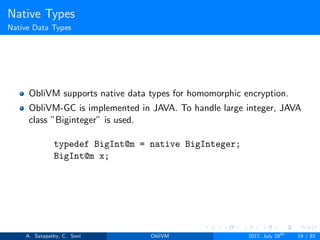
ObliVM supports native data types for homomorphic encryption.
ObliVM-GC is implemented in JAVA. To handle large integer, JAVA
class ”Biginteger” is used.
typedef BigInt@m = native BigInteger;
BigInt@m x;
A. Satapathy, C. Soni ObliVM 2017, July 28th
19 / 82
Native Types
Native Functions
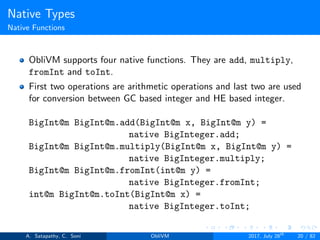
ObliVM supports four native functions. They are add, multiply,
fromInt and toInt.
First two operations are arithmetic operations and last two are used
for conversion between GC based integer and HE based integer.
BigInt@m BigInt@m.add(BigInt@m x, BigInt@m y) =
native BigInteger.add;
BigInt@m BigInt@m.multiply(BigInt@m x, BigInt@m y) =
native BigInteger.multiply;
BigInt@m BigInt@m.fromInt(int@m y) =
native BigInteger.fromInt;
int@m BigInt@m.toInt(BigInt@m x) =
native BigInteger.toInt;
A. Satapathy, C. Soni ObliVM 2017, July 28th
20 / 82
Outline
1 Acknowledgement
2 Introduction
Overview
Programmer’s View
Features
3 Programming Language
Standard Types
Generic Types
Native Types
Program Execution Trace
Loop Coalescing
4 Applications
MapReduce
Circuit ORAM
Karatsuba Multiplication
Stack
Dijkstra Algorithm
5 ObliVM Compiler
Environment Preparation
Compilation Process
Execution Process
Input Preparation
6 Results
Input Preparation
Compilation
Execution
7 Summary
8 References
A. Satapathy, C. Soni ObliVM 2017, July 28th
21 / 82
Program Execution Trace
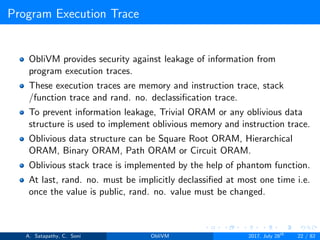
ObliVM provides security against leakage of information from
program execution traces.
These execution traces are memory and instruction trace, stack
/function trace and rand. no. declassification trace.
To prevent information leakage, Trivial ORAM or any oblivious data
structure is used to implement oblivious memory and instruction trace.
Oblivious data structure can be Square Root ORAM, Hierarchical
ORAM, Binary ORAM, Path ORAM or Circuit ORAM.
Oblivious stack trace is implemented by the help of phantom function.
At last, rand. no. must be implicitly declassified at most one time i.e.
once the value is public, rand. no. value must be changed.
A. Satapathy, C. Soni ObliVM 2017, July 28th
22 / 82
Program Execution Trace
Rand. No. Trace
rnd@m RND(public int32 m)
Function RND returns random m bits. Here m is a 32 bits integer.
In ObliVM, Rand. no. always secretly shared between the parties.
Rand. no. is declassified by assigning it to a public variable.
Declassification is called implicity declassification, if rand. value is
public without any precomputation.
So, rand. no. must be implicity declassified at most once. Once the
value is public, rand. no. value must be changed.
A. Satapathy, C. Soni ObliVM 2017, July 28th
23 / 82
Program Execution Trace
Implicit Declassifications (Example 1)
Let us consider an example for rand. no. implicit declassification.
rnd32 r = RND(32), x;
if (s) x = r;
else x = RND(32);
........
public int32 p = x;
public int32 q = r;
if s = 1 then public variables ’p’ and ’q’ contain ’r’ value. Here ’r’
value is disclosed twice.
To prevent this, rand. variable value must be updated after first
revelation.
A. Satapathy, C. Soni ObliVM 2017, July 28th
24 / 82
Program Execution Trace
Implicit Declassifications (Example 2)
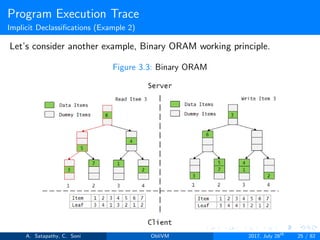
Let’s consider another example, Binary ORAM working principle.
Figure 3.3: Binary ORAM
A. Satapathy, C. Soni ObliVM 2017, July 28th
25 / 82
Program Execution Trace
Implicit Declassifications (Example 2 Cont.)
In binary ORAM, element will be de-allocated once it found and
written back to root.
Scanning happened in the element’s assigned path which is a random
value.
Path number (i.e. random value) of current element is revealed to
server before scanning.
So, in binary ORAM, path number is changed after scanning to
prevent information leakage.
A. Satapathy, C. Soni ObliVM 2017, July 28th
26 / 82
Program Execution Trace
Stack/Function Trace
Let’s consider a native function implementation.
secure int32 prefixSum (public int32 n){
secure int32 ret = a[n];
a[n] = 0;
if (n != 0) ret + prefixSum (n - 1);
return ret;
}
If n != 0 is true, prefixSum will be executed which made function
trace unoblivious. To avoid this, phantom keyword is used.
A. Satapathy, C. Soni ObliVM 2017, July 28th
27 / 82
Program Execution Trace
Oblivious Stack/Function Trace
Function call within a secret conditional statement will be made
oblivious with the help of phantom keyword.
phatom function is executed in dual modes. One is ’real’ and other
one is ’phantom’.
In ’real’ mode, all the statements inside the function are executed and
real changes are taken place.
In ’phantom’ mode, it simulates memory and instruction trace
without any changes. Let’s consider an example in next slide.
A. Satapathy, C. Soni ObliVM 2017, July 28th
28 / 82
Program Execution Trace
Phantom Function
phantom secure int32 prefixSum (public int32 n){
secure int32 ret = a[n];
a[n] = 0;
if (n != 0) ret + prefixSum (n - 1);
return ret;
}
Here prefixSum is a phantom function. function prefixSum will be
called, even if ’n != 0’ is false.
If condition is true, ’0’ will be assigned to ’a’. If condition is false,
value of ’a’ will not change i.e the previous value is retained.
Both cases, same amount of memory traces are generated.
A. Satapathy, C. Soni ObliVM 2017, July 28th
29 / 82
Program Execution Trace
Phantom Function (Cont...)
prefixSum(idx, indicator)
The compiler will generate code which contains the above signature
If indicator is false, function will run in real mode. If true, function
will run in phantom mode.
It’s difficult for an adversary to differentiate between real execution
and phantom execution.
A. Satapathy, C. Soni ObliVM 2017, July 28th
30 / 82
Outline
1 Acknowledgement
2 Introduction
Overview
Programmer’s View
Features
3 Programming Language
Standard Types
Generic Types
Native Types
Program Execution Trace
Loop Coalescing
4 Applications
MapReduce
Circuit ORAM
Karatsuba Multiplication
Stack
Dijkstra Algorithm
5 ObliVM Compiler
Environment Preparation
Compilation Process
Execution Process
Input Preparation
6 Results
Input Preparation
Compilation
Execution
7 Summary
8 References
A. Satapathy, C. Soni ObliVM 2017, July 28th
31 / 82
Loop Coalescing
The process of converting nested loops to a single loop is called loop
coalescing. It is used for code optimization.
It gains performance on certain architecture. It reduces higher
dimensional loop to a single dimension.
for (i = 0; i < N; i++) {
for (j = 0; j < M;
j++) {
a[i][j]=b[i][j];
}
}
for (ij = 0; i < MN; ij++)
{
i = ij / M;
j = ij % M;
a[i][j]=b[i][j];
}
A. Satapathy, C. Soni ObliVM 2017, July 28th
32 / 82
Outline
1 Acknowledgement
2 Introduction
Overview
Programmer’s View
Features
3 Programming Language
Standard Types
Generic Types
Native Types
Program Execution Trace
Loop Coalescing
4 Applications
MapReduce
Circuit ORAM
Karatsuba Multiplication
Stack
Dijkstra Algorithm
5 ObliVM Compiler
Environment Preparation
Compilation Process
Execution Process
Input Preparation
6 Results
Input Preparation
Compilation
Execution
7 Summary
8 References
A. Satapathy, C. Soni ObliVM 2017, July 28th
33 / 82
MapReduce
MapReduce algorithm has two functions. MAP and REDUCE.
MAP under MAPPER class, takes input and tokenizes it.
REDUCE under REDUCER class, finds matching pairs and reduce
them.
Algorithm (Map)
Given: int K[ ] = {ki}i ∈ [n]. ki ∈ domain ’D’
1: function MAP(int K[ ])
2: Initialize C ← Φ
3: for i = 1 to n do:
4: C ← C (ki, 1)
5: end for
6: return C
7: end function
A. Satapathy, C. Soni ObliVM 2017, July 28th
34 / 82
MapReduce
Algorithm (Reduce)
Given: (k1, v1), (k2, v2), (k3, v3), ....,(kj, vj).
1: Initialize int Z[ ] ← 0, t ← 0.
2: for i = 1 to j do:
3: if ki = k do:
4: Z[t] ← vi.
5: t ← t + 1
6: function REDUCE(int k, int Z[ ])
7: Initialize Sum ← 0, n ← |Z[ ]|
8: for i = 1 to n do:
9: Sum ← Sum + Z[i]
10: return Sum
11: end function
A. Satapathy, C. Soni ObliVM 2017, July 28th
35 / 82
MapReduce
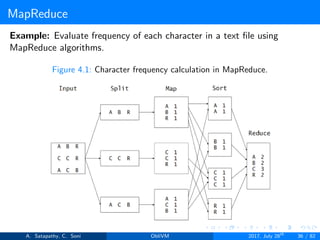
Example: Evaluate frequency of each character in a text file using
MapReduce algorithms.
Figure 4.1: Character frequency calculation in MapReduce.
A. Satapathy, C. Soni ObliVM 2017, July 28th
36 / 82
MapReduce
Oblivious MapReduce
A sequential implementation of MapReduce algorithm which runs on a
processor thread.
By default MAP function is oblivious. It is done by sequential scan
over the data.
In REDUCE operation, oblivious sort algorithm is used to group the
pairs having same key values.
For last (ki, vi) pair of each group, replace vi with sum. Replace other
vi in groups with ⊥.
Apply oblivious sort to relocate ⊥ to the end.
A. Satapathy, C. Soni ObliVM 2017, July 28th
37 / 82
MapReduce
Oblivious MapReduce
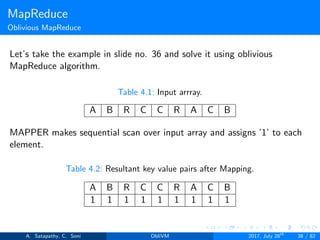
Let’s take the example in slide no. 36 and solve it using oblivious
MapReduce algorithm.
Table 4.1: Input arrray.
A B R C C R A C B
MAPPER makes sequential scan over input array and assigns ’1’ to each
element.
Table 4.2: Resultant key value pairs after Mapping.
A B R C C R A C B
1 1 1 1 1 1 1 1 1
A. Satapathy, C. Soni ObliVM 2017, July 28th
38 / 82
MapReduce
Oblivious MapReduce
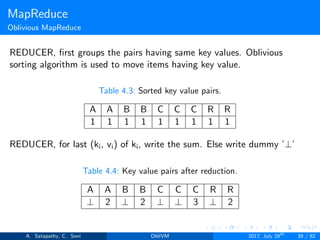
REDUCER, first groups the pairs having same key values. Oblivious
sorting algorithm is used to move items having key value.
Table 4.3: Sorted key value pairs.
A A B B C C C R R
1 1 1 1 1 1 1 1 1
REDUCER, for last (ki, vi) of ki, write the sum. Else write dummy ’⊥’
Table 4.4: Key value pairs after reduction.
A A B B C C C R R
⊥ 2 ⊥ 2 ⊥ ⊥ 3 ⊥ 2
A. Satapathy, C. Soni ObliVM 2017, July 28th
39 / 82
MapReduce
Oblivious MapReduce
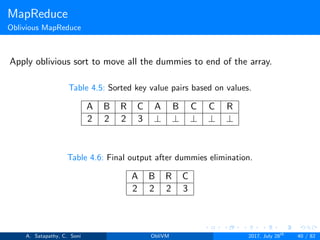
Apply oblivious sort to move all the dummies to end of the array.
Table 4.5: Sorted key value pairs based on values.
A B R C A B C C R
2 2 2 3 ⊥ ⊥ ⊥ ⊥ ⊥
Table 4.6: Final output after dummies elimination.
A B R C
2 2 2 3
A. Satapathy, C. Soni ObliVM 2017, July 28th
40 / 82
MapReduce
Oblivious MapReduce
Pair<K,V>[public n] MapReduce@m@n<I,K,V>(I[public m]
data, Pair<K,V> map(I), V reduce(K,V,V), V initialVal,
int2 cmp(K, K)) {
public int32 i;
Pair<K,V>[public m] d2;
for (i = 0; i<m; i++)
d2[i] = map(data[i])
sort@m<K,V>(d2, 1, cmp);
K key = d2[0].k;
V val = initialVal;
Pair<int1, Pair<K,V>>[public m] res;
for (i = 0; i<m; i++) {
res[i].v.k = key;
res[i].v.v = val;
if (cmp(key, d2[i+1].k)) == 0 {
A. Satapathy, C. Soni ObliVM 2017, July 28th
41 / 82
MapReduce
Oblivious MapReduce
res[i].k.val = 1; }
else {
res[i].k.val = 0;
key = d2[i+1].k;
val = initialVal; }
val = reduce(key, val, d2[i+1].v); }
res[m-1].k.val = 0;
res[m-1]v.k = key;
res[m-1].v.v = val;
sort@m<int1, Pair<K,V>>(res, 1, zeroOneCmp);
Pair<K,V>[public n] top;
for (i = 0; i < n; i = i+1)
top[i] = res[i].v;
return top; }
A. Satapathy, C. Soni ObliVM 2017, July 28th
42 / 82
MapReduce
Oblivious MapReduce
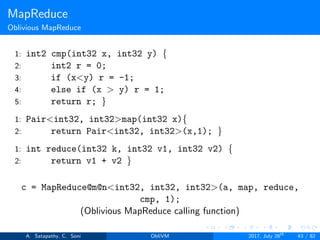
1: int2 cmp(int32 x, int32 y) {
2: int2 r = 0;
3: if (x<y) r = -1;
4: else if (x > y) r = 1;
5: return r; }
1: Pair<int32, int32>map(int32 x){
2: return Pair<int32, int32>(x,1); }
1: int reduce(int32 k, int32 v1, int32 v2) {
2: return v1 + v2 }
c = MapReduce@m@n<int32, int32, int32>(a, map, reduce,
cmp, 1);
(Oblivious MapReduce calling function)
A. Satapathy, C. Soni ObliVM 2017, July 28th
43 / 82
Outline
1 Acknowledgement
2 Introduction
Overview
Programmer’s View
Features
3 Programming Language
Standard Types
Generic Types
Native Types
Program Execution Trace
Loop Coalescing
4 Applications
MapReduce
Circuit ORAM
Karatsuba Multiplication
Stack
Dijkstra Algorithm
5 ObliVM Compiler
Environment Preparation
Compilation Process
Execution Process
Input Preparation
6 Results
Input Preparation
Compilation
Execution
7 Summary
8 References
A. Satapathy, C. Soni ObliVM 2017, July 28th
44 / 82
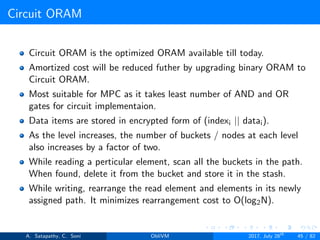
Circuit ORAM
Circuit ORAM is the optimized ORAM available till today.
Amortized cost will be reduced futher by upgrading binary ORAM to
Circuit ORAM.
Most suitable for MPC as it takes least number of AND and OR
gates for circuit implementaion.
Data items are stored in encrypted form of (indexi || datai).
As the level increases, the number of buckets / nodes at each level
also increases by a factor of two.
While reading a perticular element, scan all the buckets in the path.
When found, delete it from the bucket and store it in the stash.
While writing, rearrange the read element and elements in its newly
assigned path. It minimizes rearrangement cost to O(log2N).
A. Satapathy, C. Soni ObliVM 2017, July 28th
45 / 82
Circuit ORAM
#define BUCSIZE 3
#define STASHSIZE 33
struct Block@n<T> {
int@n id, pos;
T data; };
struct CircuitOram@n<T> {
dummy Block@n<T>[public 1<<n+1][public BUCSIZE]
buckets;
dummy Block@n<T>[public STASHSIZE] stash; };
phantom T CircuitOram@n<T>.readAndRemove (int@n id,
rnd@n pos) {
public int32 pubPos = pos;
public int32 i = (1 << n) + pubPos;
T res;
for (public int32 k = n; k>=0; k=k-1) {
for (public int32 j=0;j<BUCSIZE;j=j+1) {
A. Satapathy, C. Soni ObliVM 2017, July 28th
46 / 82
Circuit ORAM
if (buckets[i][j] != null &&
buckets[i][j].id == id){
res = buckets[i][j].data;
buckets[i][j] = null; } }
i = (i-1) / 2; }
for (public int32 i=0;i<STASHSIZE;i=i+1) {
if (stash[i]!=null && stash[i].id==id) {
res = stash[i].data;
stash[i] = null; } }
return res;}
A. Satapathy, C. Soni ObliVM 2017, July 28th
47 / 82
Outline
1 Acknowledgement
2 Introduction
Overview
Programmer’s View
Features
3 Programming Language
Standard Types
Generic Types
Native Types
Program Execution Trace
Loop Coalescing
4 Applications
MapReduce
Circuit ORAM
Karatsuba Multiplication
Stack
Dijkstra Algorithm
5 ObliVM Compiler
Environment Preparation
Compilation Process
Execution Process
Input Preparation
6 Results
Input Preparation
Compilation
Execution
7 Summary
8 References
A. Satapathy, C. Soni ObliVM 2017, July 28th
48 / 82
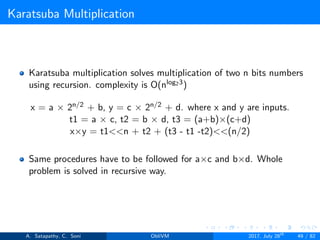
Karatsuba Multiplication
Karatsuba multiplication solves multiplication of two n bits numbers
using recursion. complexity is O(nlog23)
x = a × 2n/2 + b, y = c × 2n/2 + d. where x and y are inputs.
t1 = a × c, t2 = b × d, t3 = (a+b)×(c+d)
x×y = t1<<n + t2 + (t3 - t1 -t2)<<(n/2)
Same procedures have to be followed for a×c and b×d. Whole
problem is solved in recursive way.
A. Satapathy, C. Soni ObliVM 2017, July 28th
49 / 82
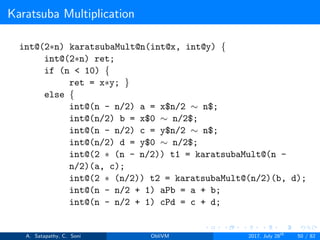
Karatsuba Multiplication
int@(2∗n) karatsubaMult@n(int@x, int@y) {
int@(2∗n) ret;
if (n < 10) {
ret = x∗y; }
else {
int@(n - n/2) a = x$n/2 ∼ n$;
int@(n/2) b = x$0 ∼ n/2$;
int@(n - n/2) c = y$n/2 ∼ n$;
int@(n/2) d = y$0 ∼ n/2$;
int@(2 ∗ (n - n/2)) t1 = karatsubaMult@(n -
n/2)(a, c);
int@(2 ∗ (n/2)) t2 = karatsubaMult@(n/2)(b, d);
int@(n - n/2 + 1) aPb = a + b;
int@(n - n/2 + 1) cPd = c + d;
A. Satapathy, C. Soni ObliVM 2017, July 28th
50 / 82
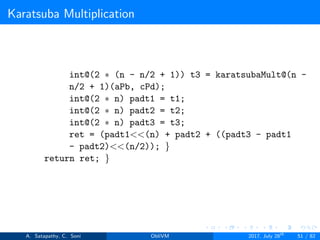
Karatsuba Multiplication
int@(2 ∗ (n - n/2 + 1)) t3 = karatsubaMult@(n -
n/2 + 1)(aPb, cPd);
int@(2 ∗ n) padt1 = t1;
int@(2 ∗ n) padt2 = t2;
int@(2 ∗ n) padt3 = t3;
ret = (padt1<<(n) + padt2 + ((padt3 - padt1
- padt2)<<(n/2)); }
return ret; }
A. Satapathy, C. Soni ObliVM 2017, July 28th
51 / 82
Outline
1 Acknowledgement
2 Introduction
Overview
Programmer’s View
Features
3 Programming Language
Standard Types
Generic Types
Native Types
Program Execution Trace
Loop Coalescing
4 Applications
MapReduce
Circuit ORAM
Karatsuba Multiplication
Stack
Dijkstra Algorithm
5 ObliVM Compiler
Environment Preparation
Compilation Process
Execution Process
Input Preparation
6 Results
Input Preparation
Compilation
Execution
7 Summary
8 References
A. Satapathy, C. Soni ObliVM 2017, July 28th
52 / 82
Stack
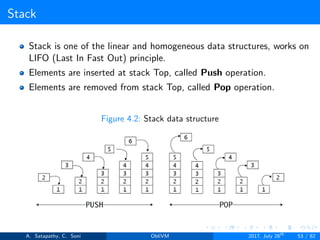
Stack is one of the linear and homogeneous data structures, works on
LIFO (Last In Fast Out) principle.
Elements are inserted at stack Top, called Push operation.
Elements are removed from stack Top, called Pop operation.
Figure 4.2: Stack data structure
A. Satapathy, C. Soni ObliVM 2017, July 28th
53 / 82
Stack
Circuit ORAM Operations
rnd@m RND(public int32 m) = native lib.rand;
struct Pointer@m {
int32 index;
rand@m pos; };
struct SecStore@m<T> {
CircuitORAM@m<T> oram;
int32 cnt; };
phantom void SecStore@m<T>.add(int32 index, int@m pos, T
data) {
oram.add(index, pos, data); }
A. Satapathy, C. Soni ObliVM 2017, July 28th
54 / 82
Stack
Circuit ORAM Operations
phantom T SecStore@m<T>.readAndRemove(int32 index, rnd@m
pos) {
return oram.readAndRemove(index, pos); }
phantom Pointer@m SecStore@m<T>.allocate() {
cnt = cnt + 1;
return Pointer@m(cnt, RND(m)); }
readAndRemove(...) is used to read an element using circuit
ORAM. allocate(...) is used to assigned new path to read
element.
add(...) is used to write the element in new path.
Above functions are called inside stack to implement push and pop
operations. Normally, used by non-specialist programmer.
A. Satapathy, C. Soni ObliVM 2017, July 28th
55 / 82
Stack
Oblivious Stack
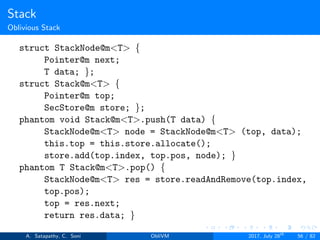
struct StackNode@m<T> {
Pointer@m next;
T data; };
struct Stack@m<T> {
Pointer@m top;
SecStore@m store; };
phantom void Stack@m<T>.push(T data) {
StackNode@m<T> node = StackNode@m<T> (top, data);
this.top = this.store.allocate();
store.add(top.index, top.pos, node); }
phantom T Stack@m<T>.pop() {
StackNode@m<T> res = store.readAndRemove(top.index,
top.pos);
top = res.next;
return res.data; }
A. Satapathy, C. Soni ObliVM 2017, July 28th
56 / 82
Outline
1 Acknowledgement
2 Introduction
Overview
Programmer’s View
Features
3 Programming Language
Standard Types
Generic Types
Native Types
Program Execution Trace
Loop Coalescing
4 Applications
MapReduce
Circuit ORAM
Karatsuba Multiplication
Stack
Dijkstra Algorithm
5 ObliVM Compiler
Environment Preparation
Compilation Process
Execution Process
Input Preparation
6 Results
Input Preparation
Compilation
Execution
7 Summary
8 References
A. Satapathy, C. Soni ObliVM 2017, July 28th
57 / 82
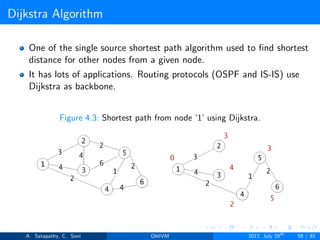
Dijkstra Algorithm
One of the single source shortest path algorithm used to find shortest
distance for other nodes from a given node.
It has lots of applications. Routing protocols (OSPF and IS-IS) use
Dijkstra as backbone.
Figure 4.3: Shortest path from node ’1’ using Dijkstra.
A. Satapathy, C. Soni ObliVM 2017, July 28th
58 / 82
Dijkstra Algorithm
Given Input Secrets: Source node ’s’, Adjacency list ’e’ and sum of out
degrees s[u].
1: Initialize dis = [∞, ∞, ∞, .....,∞] and dis[s] = 0
2: PQ.push(0, s)
3: while (!PQ.empty())
4: (dist, u) = PQ.deleteMin()
5: if (dist == dis[u])
6: dis[u] = -dis[u]
7: for (i = s[u]; i < s[u+1]; i++)
8: (u, v, w) = e[i]
9: newDist = dist + w
10: if (newDist < dis[v])
11: dis[v] = newDist
12: PQ.insert(newDist, v)
A. Satapathy, C. Soni ObliVM 2017, July 28th
59 / 82
Dijkstra Algorithm
Oblivious Dijkstra with Loop Coalescing
Input Secrets: Source ’s’, Adjacency list ’e’ and Sum of Out-degrees s[u].
1: Initialize dis = [∞, .....,∞] and dis[s] = 0, innerLoop = False
2: PQ.push(0, s)
3: for (i = 0 → 2V + E - 1)
4: (dist, u) = PQ.deleteMin()
5: if (dist == dis[u])
6: dis[u] = -dis[u], i = s[u], innerLoop = True
7: else
8: if i < s[u+1]
9: (u, v, w) = e[i], newDist = dist + w
10: if newDist < dis[v]
11: dis[v] = newDist, PQ.insert(newDist, v)
12: i = i + 1
13: else
14: innerLoop = False
A. Satapathy, C. Soni ObliVM 2017, July 28th
60 / 82
Outline
1 Acknowledgement
2 Introduction
Overview
Programmer’s View
Features
3 Programming Language
Standard Types
Generic Types
Native Types
Program Execution Trace
Loop Coalescing
4 Applications
MapReduce
Circuit ORAM
Karatsuba Multiplication
Stack
Dijkstra Algorithm
5 ObliVM Compiler
Environment Preparation
Compilation Process
Execution Process
Input Preparation
6 Results
Input Preparation
Compilation
Execution
7 Summary
8 References
A. Satapathy, C. Soni ObliVM 2017, July 28th
61 / 82
Environment Preparation
Prerequisite for Ubuntu
Install python 2.7: sudo apt-get install python
Install Oracle Java 8 JavaCC 5.0
sudo apt-add-repository ppa:webupd8team/java
sudo apt-get update
sudo apt-get install oracle-java8-installer
java -version
Download ’ObliVM’ from this URL
https://github.com/oblivm/ObliVMLang
Prepare ObliVM environment: ./compile.sh
A. Satapathy, C. Soni ObliVM 2017, July 28th
62 / 82
Outline
1 Acknowledgement
2 Introduction
Overview
Programmer’s View
Features
3 Programming Language
Standard Types
Generic Types
Native Types
Program Execution Trace
Loop Coalescing
4 Applications
MapReduce
Circuit ORAM
Karatsuba Multiplication
Stack
Dijkstra Algorithm
5 ObliVM Compiler
Environment Preparation
Compilation Process
Execution Process
Input Preparation
6 Results
Input Preparation
Compilation
Execution
7 Summary
8 References
A. Satapathy, C. Soni ObliVM 2017, July 28th
63 / 82
Compilation Process
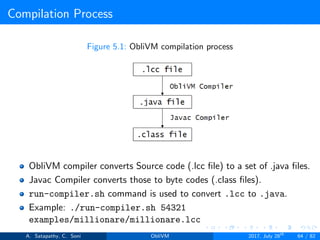
Figure 5.1: ObliVM compilation process
ObliVM compiler converts Source code (.lcc file) to a set of .java files.
Javac Compiler converts those to byte codes (.class files).
run-compiler.sh command is used to convert .lcc to .java.
Example: ./run-compiler.sh 54321
examples/millionare/millionare.lcc
A. Satapathy, C. Soni ObliVM 2017, July 28th
64 / 82
Compilation Process
run-compiler.sh file contains the following commands
1 mkdir -p flexsc-bin;
2 mkdir -p to-run;
3 java -cp bin:lib/* com.oblivm.compiler.cmd.Cmd -o
./flexsc-bin/ -p 12;
4 find flexsc-bin -name "*.java">source.txt;
5 javac -cp to-run:lib/* -d to-run @source.txt;
A. Satapathy, C. Soni ObliVM 2017, July 28th
65 / 82
Compilation Process
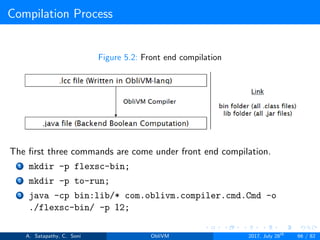
Figure 5.2: Front end compilation
The first three commands are come under front end compilation.
1 mkdir -p flexsc-bin;
2 mkdir -p to-run;
3 java -cp bin:lib/* com.oblivm.compiler.cmd.Cmd -o
./flexsc-bin/ -p 12;
A. Satapathy, C. Soni ObliVM 2017, July 28th
66 / 82
Compilation Process
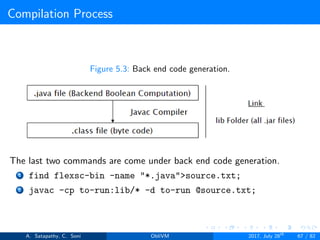
Figure 5.3: Back end code generation.
The last two commands are come under back end code generation.
1 find flexsc-bin -name "*.java">source.txt;
2 javac -cp to-run:lib/* -d to-run @source.txt;
A. Satapathy, C. Soni ObliVM 2017, July 28th
67 / 82
Outline
1 Acknowledgement
2 Introduction
Overview
Programmer’s View
Features
3 Programming Language
Standard Types
Generic Types
Native Types
Program Execution Trace
Loop Coalescing
4 Applications
MapReduce
Circuit ORAM
Karatsuba Multiplication
Stack
Dijkstra Algorithm
5 ObliVM Compiler
Environment Preparation
Compilation Process
Execution Process
Input Preparation
6 Results
Input Preparation
Compilation
Execution
7 Summary
8 References
A. Satapathy, C. Soni ObliVM 2017, July 28th
68 / 82
Execution Process
Final byte codes (.class files) with two files are given as input to JVM
interpreter to generate final output.
countConfig.conf and Cmd.class files are linked to generate final
output.
runtogether.sh command is used to execute the byte code. It
contains the following commands.
java -cp to-run:lib/* com.oblivm.backend.lang.inter.Cmd
-t eva -i $2 -config countConfig.conf -c
com.oblivm.backend.generated.millionare.NoClass & java
-cp to-run:lib/* com.oblivm.backend.lang.inter.Cmd -t
gen -i $1 -config countConfig.conf -c
com.oblivm.backend.generated.millionare.NoClass
A. Satapathy, C. Soni ObliVM 2017, July 28th
69 / 82
Outline
1 Acknowledgement
2 Introduction
Overview
Programmer’s View
Features
3 Programming Language
Standard Types
Generic Types
Native Types
Program Execution Trace
Loop Coalescing
4 Applications
MapReduce
Circuit ORAM
Karatsuba Multiplication
Stack
Dijkstra Algorithm
5 ObliVM Compiler
Environment Preparation
Compilation Process
Execution Process
Input Preparation
6 Results
Input Preparation
Compilation
Execution
7 Summary
8 References
A. Satapathy, C. Soni ObliVM 2017, July 28th
70 / 82
Input Preparation
Input files to ObliVM contains binary strings.
datainitializer.py from tools folder is used to generate final
input files from raw input files.
A. Satapathy, C. Soni ObliVM 2017, July 28th
71 / 82
Outline
1 Acknowledgement
2 Introduction
Overview
Programmer’s View
Features
3 Programming Language
Standard Types
Generic Types
Native Types
Program Execution Trace
Loop Coalescing
4 Applications
MapReduce
Circuit ORAM
Karatsuba Multiplication
Stack
Dijkstra Algorithm
5 ObliVM Compiler
Environment Preparation
Compilation Process
Execution Process
Input Preparation
6 Results
Input Preparation
Compilation
Execution
7 Summary
8 References
A. Satapathy, C. Soni ObliVM 2017, July 28th
72 / 82
Input Preparation
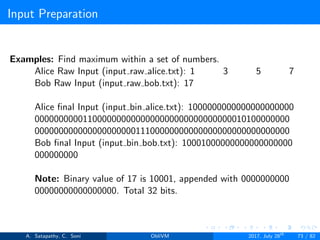
Examples: Find maximum within a set of numbers.
Alice Raw Input (input raw alice.txt): 1 3 5 7
Bob Raw Input (input raw bob.txt): 17
Alice final Input (input bin alice.txt): 1000000000000000000000
00000000001100000000000000000000000000000010100000000
00000000000000000000011100000000000000000000000000000
Bob final Input (input bin bob.txt): 10001000000000000000000
000000000
Note: Binary value of 17 is 10001, appended with 0000000000
00000000000000000. Total 32 bits.
A. Satapathy, C. Soni ObliVM 2017, July 28th
73 / 82
Outline
1 Acknowledgement
2 Introduction
Overview
Programmer’s View
Features
3 Programming Language
Standard Types
Generic Types
Native Types
Program Execution Trace
Loop Coalescing
4 Applications
MapReduce
Circuit ORAM
Karatsuba Multiplication
Stack
Dijkstra Algorithm
5 ObliVM Compiler
Environment Preparation
Compilation Process
Execution Process
Input Preparation
6 Results
Input Preparation
Compilation
Execution
7 Summary
8 References
A. Satapathy, C. Soni ObliVM 2017, July 28th
74 / 82
Compilation
Find the maximum within set of numbers without using Trivial ORAM.
File location: examples/findmax3.lcc
1: package com.oblivm.backend.generated.findmax;
2: int main@n(int[public n] x, int y) {
3: int max = y;
4: for(public int i = 0; i<n; i = i + 1) {
5: if (x[i] > max) max = x[i];
6: }
7: return max;
8: }
Compilation: ./run-compiler.sh 54321 examples/findmax/
findmax3.lcc
A. Satapathy, C. Soni ObliVM 2017, July 28th
75 / 82
Compilation
Find the maximum within set of numbers using Trivial ORAM.
File location: examples/findmax2.lcc
1: package com.oblivm.backend.generated.findmax;
2: int main@n(int[n] x, int y) {
3: int max = y;
4: bfor (n) (int i = 0; i<n; i = i + 1) {
5: if (x[i] > max) max = x[i];
6: }
7: return max;
8: }
Compilation: ./run-compiler.sh 54321 examples/findmax/
findmax2.lcc
A. Satapathy, C. Soni ObliVM 2017, July 28th
76 / 82
Outline
1 Acknowledgement
2 Introduction
Overview
Programmer’s View
Features
3 Programming Language
Standard Types
Generic Types
Native Types
Program Execution Trace
Loop Coalescing
4 Applications
MapReduce
Circuit ORAM
Karatsuba Multiplication
Stack
Dijkstra Algorithm
5 ObliVM Compiler
Environment Preparation
Compilation Process
Execution Process
Input Preparation
6 Results
Input Preparation
Compilation
Execution
7 Summary
8 References
A. Satapathy, C. Soni ObliVM 2017, July 28th
77 / 82
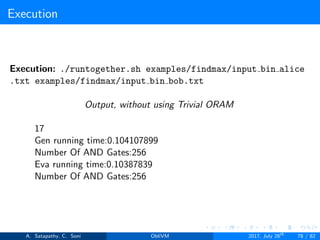
Execution
Execution: ./runtogether.sh examples/findmax/input bin alice
.txt examples/findmax/input bin bob.txt
Output, without using Trivial ORAM
17
Gen running time:0.104107899
Number Of AND Gates:256
Eva running time:0.10387839
Number Of AND Gates:256
A. Satapathy, C. Soni ObliVM 2017, July 28th
78 / 82
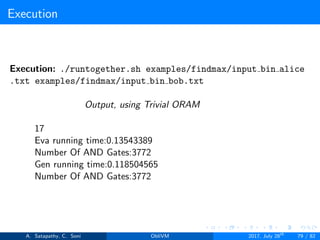
Execution
Execution: ./runtogether.sh examples/findmax/input bin alice
.txt examples/findmax/input bin bob.txt
Output, using Trivial ORAM
17
Eva running time:0.13543389
Number Of AND Gates:3772
Gen running time:0.118504565
Number Of AND Gates:3772
A. Satapathy, C. Soni ObliVM 2017, July 28th
79 / 82
Summary
We discussed
1 ObliVM framework and its data types and functions.
2 Implicit declassifications, function trace, phantom function and loop
coalescing technique.
3 Oblivious implementation of different algorithms such as MapReduce,
circuit ORAM, Karatsuba multiplication etc.
4 Environment installation, data preparation, compilation and execution.
5 pre-implemented findmax programs with results.
A. Satapathy, C. Soni ObliVM 2017, July 28th
80 / 82
References
C. Liu et al., ”ObliVM: A Programming Framework for Secure
Computation”, in IEEE Symposium on Security and Privacy (S&P),
2015.
”oblivm/ObliVMLang”, GitHub, 2017. [Online]. Available:
https://github.com/oblivm/ObliVMLang. [Accessed: 05- Jun- 2017].
A. Satapathy, C. Soni ObliVM 2017, July 28th
81 / 82
The End
A. Satapathy, C. Soni ObliVM 2017, July 28th
82 / 82

ObliVM

  • 1.
    ObliVM A. Satapathy1 C.Soni2 1,2Information and Communication Laboratory Industrial Technology Research Institute Taiwan Under the guidance of Dr. Tzi-cker Chiueh 2017, July 28th A. Satapathy, C. Soni ObliVM 2017, July 28th 1 / 82
  • 2.
    Outline 1 Acknowledgement 2 Introduction Overview Programmer’sView Features 3 Programming Language Standard Types Generic Types Native Types Program Execution Trace Loop Coalescing 4 Applications MapReduce Circuit ORAM Karatsuba Multiplication Stack Dijkstra Algorithm 5 ObliVM Compiler Environment Preparation Compilation Process Execution Process Input Preparation 6 Results Input Preparation Compilation Execution 7 Summary 8 References A. Satapathy, C. Soni ObliVM 2017, July 28th 2 / 82
  • 3.
    Acknowledgement ”ObliVM has developedby Chang Liu, Xiao Shaun Wang, Kartik Nayak, Yan Huang and Elaine Shi from University of Maryland and Indiana University.” A. Satapathy, C. Soni ObliVM 2017, July 28th 3 / 82
  • 4.
    Outline 1 Acknowledgement 2 Introduction Overview Programmer’sView Features 3 Programming Language Standard Types Generic Types Native Types Program Execution Trace Loop Coalescing 4 Applications MapReduce Circuit ORAM Karatsuba Multiplication Stack Dijkstra Algorithm 5 ObliVM Compiler Environment Preparation Compilation Process Execution Process Input Preparation 6 Results Input Preparation Compilation Execution 7 Summary 8 References A. Satapathy, C. Soni ObliVM 2017, July 28th 4 / 82
  • 5.
    Overview A programming frameworkfor secure multi party computation which supports user friendly programming abstraction. Presently, it uses Improved 2-party Garbled circuit protocol at backend. ObliVM compiler compiles program to circuit representations whose inputs are oblivious memory accesses. It offers a reusable framework to implement and distribute new cryptographic algorithms. It can be used to develop various applications in the field of data mining, streaming algorithms, graph algorithms, data structures etc. A. Satapathy, C. Soni ObliVM 2017, July 28th 5 / 82
  • 6.
    Outline 1 Acknowledgement 2 Introduction Overview Programmer’sView Features 3 Programming Language Standard Types Generic Types Native Types Program Execution Trace Loop Coalescing 4 Applications MapReduce Circuit ORAM Karatsuba Multiplication Stack Dijkstra Algorithm 5 ObliVM Compiler Environment Preparation Compilation Process Execution Process Input Preparation 6 Results Input Preparation Compilation Execution 7 Summary 8 References A. Satapathy, C. Soni ObliVM 2017, July 28th 6 / 82
  • 7.
    Programmer’s View As anExpert Programmer Easily extend the system with rich, optimized libraries or customized cryptographic protocols. Develop and export those libraries as a standard/native/generic types and functions, in the source language. As a Non-specialist Programmer Write programs using above standard/native/generic data types and functions. ObliVM compiler compiles the program to an efficient secure computation protocol. A. Satapathy, C. Soni ObliVM 2017, July 28th 7 / 82
  • 8.
    Outline 1 Acknowledgement 2 Introduction Overview Programmer’sView Features 3 Programming Language Standard Types Generic Types Native Types Program Execution Trace Loop Coalescing 4 Applications MapReduce Circuit ORAM Karatsuba Multiplication Stack Dijkstra Algorithm 5 ObliVM Compiler Environment Preparation Compilation Process Execution Process Input Preparation 6 Results Input Preparation Compilation Execution 7 Summary 8 References A. Satapathy, C. Soni ObliVM 2017, July 28th 8 / 82
  • 9.
    Features ObliVM language buildson top of the SCVM language which offers scalability to big data. Apart from standard features it supports generic and native type primitives. It has addressed the key requirement, program execution traces will not leak information. These execution traces include memory instruction trace, function stack trace and declassification trace. A. Satapathy, C. Soni ObliVM 2017, July 28th 9 / 82
  • 10.
    Outline 1 Acknowledgement 2 Introduction Overview Programmer’sView Features 3 Programming Language Standard Types Generic Types Native Types Program Execution Trace Loop Coalescing 4 Applications MapReduce Circuit ORAM Karatsuba Multiplication Stack Dijkstra Algorithm 5 ObliVM Compiler Environment Preparation Compilation Process Execution Process Input Preparation 6 Results Input Preparation Compilation Execution 7 Summary 8 References A. Satapathy, C. Soni ObliVM 2017, July 28th 10 / 82
  • 11.
    Standard Types Variables orarrays are either of a secure or public type. secure variables or arrays are secretly shared between two parties. i.e. neither party sees the value. public variables or arrays are seen by both parties. secure int10[public 1000] keys: Array contents are secret shared but indices to array are public. No ORAM is used. 10 in int10 indicated 10 bits key value. secure int10[secure 1000] keys: Array contents are secret shared and indices to array are secure. Trivial ORAM is used. 10 in int10 indicated 10 bits key value. public int10[public 1000] keys : Arrays contents are seen by both parties. A. Satapathy, C. Soni ObliVM 2017, July 28th 11 / 82
  • 12.
    Standard Types Figure 3.1:Data distribution of secure int10[public 4] P1 and secure int10[public 4] P2 and their access A. Satapathy, C. Soni ObliVM 2017, July 28th 12 / 82
  • 13.
    Standard Types Figure 3.2:Data distribution of secure int10[secure 4] P1 and secure int10[secure 4] P2 and their access A. Satapathy, C. Soni ObliVM 2017, July 28th 13 / 82
  • 14.
    Outline 1 Acknowledgement 2 Introduction Overview Programmer’sView Features 3 Programming Language Standard Types Generic Types Native Types Program Execution Trace Loop Coalescing 4 Applications MapReduce Circuit ORAM Karatsuba Multiplication Stack Dijkstra Algorithm 5 ObliVM Compiler Environment Preparation Compilation Process Execution Process Input Preparation 6 Results Input Preparation Compilation Execution 7 Summary 8 References A. Satapathy, C. Soni ObliVM 2017, July 28th 14 / 82
  • 15.
    Generic Types Generic Variable ObliVMuses ’struct’ keyword to define composite data type. It supports generic data type like C++ template. Suppose a binary tree with public key value but secret node data can be defined using struct. node size is 1000. struct KeyValueTable<T>{ secure int10[public 1000] keys; T[public 1000] values; }; Generic type T similar to template in C++. Data type T to be secret-shared. A. Satapathy, C. Soni ObliVM 2017, July 28th 15 / 82
  • 16.
    Generic Types Generic Constant ObliVMsupports generic constants to improve flexibility and reusability of programming language. An example is given below. struct TreeNode@m<T>{ public int@m key; T value; public int@m left, right; }; struct Tree@m<T>{ TreeNode<T>[public (1<<m) - 1] nodes; public int@m root; }; @m is the generic constant. Here @m indicates m bits integer. A. Satapathy, C. Soni ObliVM 2017, July 28th 16 / 82
  • 17.
    Generic Types Generic Function ObliVMsupports generic functions to bring modularity in program. A generic function, to search the value associated with a given key in previously defined binary tree is given below. T Tree@m<T>.search(public int@m key){ public int@m now = this.root, tk; T ret; while (now != -1){ tk = this.nodes[now].key; if (tk == key) {ret = this.nodes[now].value;} if(tk <= key) {now = this.nodes[now].right;} else {now = this.nodes[now].left}; } return ret; } A. Satapathy, C. Soni ObliVM 2017, July 28th 17 / 82
  • 18.
    Outline 1 Acknowledgement 2 Introduction Overview Programmer’sView Features 3 Programming Language Standard Types Generic Types Native Types Program Execution Trace Loop Coalescing 4 Applications MapReduce Circuit ORAM Karatsuba Multiplication Stack Dijkstra Algorithm 5 ObliVM Compiler Environment Preparation Compilation Process Execution Process Input Preparation 6 Results Input Preparation Compilation Execution 7 Summary 8 References A. Satapathy, C. Soni ObliVM 2017, July 28th 18 / 82
  • 19.
    Native Types Native DataTypes ObliVM supports native data types for homomorphic encryption. ObliVM-GC is implemented in JAVA. To handle large integer, JAVA class ”Biginteger” is used. typedef BigInt@m = native BigInteger; BigInt@m x; A. Satapathy, C. Soni ObliVM 2017, July 28th 19 / 82
  • 20.
    Native Types Native Functions ObliVMsupports four native functions. They are add, multiply, fromInt and toInt. First two operations are arithmetic operations and last two are used for conversion between GC based integer and HE based integer. BigInt@m BigInt@m.add(BigInt@m x, BigInt@m y) = native BigInteger.add; BigInt@m BigInt@m.multiply(BigInt@m x, BigInt@m y) = native BigInteger.multiply; BigInt@m BigInt@m.fromInt(int@m y) = native BigInteger.fromInt; int@m BigInt@m.toInt(BigInt@m x) = native BigInteger.toInt; A. Satapathy, C. Soni ObliVM 2017, July 28th 20 / 82
  • 21.
    Outline 1 Acknowledgement 2 Introduction Overview Programmer’sView Features 3 Programming Language Standard Types Generic Types Native Types Program Execution Trace Loop Coalescing 4 Applications MapReduce Circuit ORAM Karatsuba Multiplication Stack Dijkstra Algorithm 5 ObliVM Compiler Environment Preparation Compilation Process Execution Process Input Preparation 6 Results Input Preparation Compilation Execution 7 Summary 8 References A. Satapathy, C. Soni ObliVM 2017, July 28th 21 / 82
  • 22.
    Program Execution Trace ObliVMprovides security against leakage of information from program execution traces. These execution traces are memory and instruction trace, stack /function trace and rand. no. declassification trace. To prevent information leakage, Trivial ORAM or any oblivious data structure is used to implement oblivious memory and instruction trace. Oblivious data structure can be Square Root ORAM, Hierarchical ORAM, Binary ORAM, Path ORAM or Circuit ORAM. Oblivious stack trace is implemented by the help of phantom function. At last, rand. no. must be implicitly declassified at most one time i.e. once the value is public, rand. no. value must be changed. A. Satapathy, C. Soni ObliVM 2017, July 28th 22 / 82
  • 23.
    Program Execution Trace Rand.No. Trace rnd@m RND(public int32 m) Function RND returns random m bits. Here m is a 32 bits integer. In ObliVM, Rand. no. always secretly shared between the parties. Rand. no. is declassified by assigning it to a public variable. Declassification is called implicity declassification, if rand. value is public without any precomputation. So, rand. no. must be implicity declassified at most once. Once the value is public, rand. no. value must be changed. A. Satapathy, C. Soni ObliVM 2017, July 28th 23 / 82
  • 24.
    Program Execution Trace ImplicitDeclassifications (Example 1) Let us consider an example for rand. no. implicit declassification. rnd32 r = RND(32), x; if (s) x = r; else x = RND(32); ........ public int32 p = x; public int32 q = r; if s = 1 then public variables ’p’ and ’q’ contain ’r’ value. Here ’r’ value is disclosed twice. To prevent this, rand. variable value must be updated after first revelation. A. Satapathy, C. Soni ObliVM 2017, July 28th 24 / 82
  • 25.
    Program Execution Trace ImplicitDeclassifications (Example 2) Let’s consider another example, Binary ORAM working principle. Figure 3.3: Binary ORAM A. Satapathy, C. Soni ObliVM 2017, July 28th 25 / 82
  • 26.
    Program Execution Trace ImplicitDeclassifications (Example 2 Cont.) In binary ORAM, element will be de-allocated once it found and written back to root. Scanning happened in the element’s assigned path which is a random value. Path number (i.e. random value) of current element is revealed to server before scanning. So, in binary ORAM, path number is changed after scanning to prevent information leakage. A. Satapathy, C. Soni ObliVM 2017, July 28th 26 / 82
  • 27.
    Program Execution Trace Stack/FunctionTrace Let’s consider a native function implementation. secure int32 prefixSum (public int32 n){ secure int32 ret = a[n]; a[n] = 0; if (n != 0) ret + prefixSum (n - 1); return ret; } If n != 0 is true, prefixSum will be executed which made function trace unoblivious. To avoid this, phantom keyword is used. A. Satapathy, C. Soni ObliVM 2017, July 28th 27 / 82
  • 28.
    Program Execution Trace ObliviousStack/Function Trace Function call within a secret conditional statement will be made oblivious with the help of phantom keyword. phatom function is executed in dual modes. One is ’real’ and other one is ’phantom’. In ’real’ mode, all the statements inside the function are executed and real changes are taken place. In ’phantom’ mode, it simulates memory and instruction trace without any changes. Let’s consider an example in next slide. A. Satapathy, C. Soni ObliVM 2017, July 28th 28 / 82
  • 29.
    Program Execution Trace PhantomFunction phantom secure int32 prefixSum (public int32 n){ secure int32 ret = a[n]; a[n] = 0; if (n != 0) ret + prefixSum (n - 1); return ret; } Here prefixSum is a phantom function. function prefixSum will be called, even if ’n != 0’ is false. If condition is true, ’0’ will be assigned to ’a’. If condition is false, value of ’a’ will not change i.e the previous value is retained. Both cases, same amount of memory traces are generated. A. Satapathy, C. Soni ObliVM 2017, July 28th 29 / 82
  • 30.
    Program Execution Trace PhantomFunction (Cont...) prefixSum(idx, indicator) The compiler will generate code which contains the above signature If indicator is false, function will run in real mode. If true, function will run in phantom mode. It’s difficult for an adversary to differentiate between real execution and phantom execution. A. Satapathy, C. Soni ObliVM 2017, July 28th 30 / 82
  • 31.
    Outline 1 Acknowledgement 2 Introduction Overview Programmer’sView Features 3 Programming Language Standard Types Generic Types Native Types Program Execution Trace Loop Coalescing 4 Applications MapReduce Circuit ORAM Karatsuba Multiplication Stack Dijkstra Algorithm 5 ObliVM Compiler Environment Preparation Compilation Process Execution Process Input Preparation 6 Results Input Preparation Compilation Execution 7 Summary 8 References A. Satapathy, C. Soni ObliVM 2017, July 28th 31 / 82
  • 32.
    Loop Coalescing The processof converting nested loops to a single loop is called loop coalescing. It is used for code optimization. It gains performance on certain architecture. It reduces higher dimensional loop to a single dimension. for (i = 0; i < N; i++) { for (j = 0; j < M; j++) { a[i][j]=b[i][j]; } } for (ij = 0; i < MN; ij++) { i = ij / M; j = ij % M; a[i][j]=b[i][j]; } A. Satapathy, C. Soni ObliVM 2017, July 28th 32 / 82
  • 33.
    Outline 1 Acknowledgement 2 Introduction Overview Programmer’sView Features 3 Programming Language Standard Types Generic Types Native Types Program Execution Trace Loop Coalescing 4 Applications MapReduce Circuit ORAM Karatsuba Multiplication Stack Dijkstra Algorithm 5 ObliVM Compiler Environment Preparation Compilation Process Execution Process Input Preparation 6 Results Input Preparation Compilation Execution 7 Summary 8 References A. Satapathy, C. Soni ObliVM 2017, July 28th 33 / 82
  • 34.
    MapReduce MapReduce algorithm hastwo functions. MAP and REDUCE. MAP under MAPPER class, takes input and tokenizes it. REDUCE under REDUCER class, finds matching pairs and reduce them. Algorithm (Map) Given: int K[ ] = {ki}i ∈ [n]. ki ∈ domain ’D’ 1: function MAP(int K[ ]) 2: Initialize C ← Φ 3: for i = 1 to n do: 4: C ← C (ki, 1) 5: end for 6: return C 7: end function A. Satapathy, C. Soni ObliVM 2017, July 28th 34 / 82
  • 35.
    MapReduce Algorithm (Reduce) Given: (k1,v1), (k2, v2), (k3, v3), ....,(kj, vj). 1: Initialize int Z[ ] ← 0, t ← 0. 2: for i = 1 to j do: 3: if ki = k do: 4: Z[t] ← vi. 5: t ← t + 1 6: function REDUCE(int k, int Z[ ]) 7: Initialize Sum ← 0, n ← |Z[ ]| 8: for i = 1 to n do: 9: Sum ← Sum + Z[i] 10: return Sum 11: end function A. Satapathy, C. Soni ObliVM 2017, July 28th 35 / 82
  • 36.
    MapReduce Example: Evaluate frequencyof each character in a text file using MapReduce algorithms. Figure 4.1: Character frequency calculation in MapReduce. A. Satapathy, C. Soni ObliVM 2017, July 28th 36 / 82
  • 37.
    MapReduce Oblivious MapReduce A sequentialimplementation of MapReduce algorithm which runs on a processor thread. By default MAP function is oblivious. It is done by sequential scan over the data. In REDUCE operation, oblivious sort algorithm is used to group the pairs having same key values. For last (ki, vi) pair of each group, replace vi with sum. Replace other vi in groups with ⊥. Apply oblivious sort to relocate ⊥ to the end. A. Satapathy, C. Soni ObliVM 2017, July 28th 37 / 82
  • 38.
    MapReduce Oblivious MapReduce Let’s takethe example in slide no. 36 and solve it using oblivious MapReduce algorithm. Table 4.1: Input arrray. A B R C C R A C B MAPPER makes sequential scan over input array and assigns ’1’ to each element. Table 4.2: Resultant key value pairs after Mapping. A B R C C R A C B 1 1 1 1 1 1 1 1 1 A. Satapathy, C. Soni ObliVM 2017, July 28th 38 / 82
  • 39.
    MapReduce Oblivious MapReduce REDUCER, firstgroups the pairs having same key values. Oblivious sorting algorithm is used to move items having key value. Table 4.3: Sorted key value pairs. A A B B C C C R R 1 1 1 1 1 1 1 1 1 REDUCER, for last (ki, vi) of ki, write the sum. Else write dummy ’⊥’ Table 4.4: Key value pairs after reduction. A A B B C C C R R ⊥ 2 ⊥ 2 ⊥ ⊥ 3 ⊥ 2 A. Satapathy, C. Soni ObliVM 2017, July 28th 39 / 82
  • 40.
    MapReduce Oblivious MapReduce Apply oblivioussort to move all the dummies to end of the array. Table 4.5: Sorted key value pairs based on values. A B R C A B C C R 2 2 2 3 ⊥ ⊥ ⊥ ⊥ ⊥ Table 4.6: Final output after dummies elimination. A B R C 2 2 2 3 A. Satapathy, C. Soni ObliVM 2017, July 28th 40 / 82
  • 41.
    MapReduce Oblivious MapReduce Pair<K,V>[public n]MapReduce@m@n<I,K,V>(I[public m] data, Pair<K,V> map(I), V reduce(K,V,V), V initialVal, int2 cmp(K, K)) { public int32 i; Pair<K,V>[public m] d2; for (i = 0; i<m; i++) d2[i] = map(data[i]) sort@m<K,V>(d2, 1, cmp); K key = d2[0].k; V val = initialVal; Pair<int1, Pair<K,V>>[public m] res; for (i = 0; i<m; i++) { res[i].v.k = key; res[i].v.v = val; if (cmp(key, d2[i+1].k)) == 0 { A. Satapathy, C. Soni ObliVM 2017, July 28th 41 / 82
  • 42.
    MapReduce Oblivious MapReduce res[i].k.val =1; } else { res[i].k.val = 0; key = d2[i+1].k; val = initialVal; } val = reduce(key, val, d2[i+1].v); } res[m-1].k.val = 0; res[m-1]v.k = key; res[m-1].v.v = val; sort@m<int1, Pair<K,V>>(res, 1, zeroOneCmp); Pair<K,V>[public n] top; for (i = 0; i < n; i = i+1) top[i] = res[i].v; return top; } A. Satapathy, C. Soni ObliVM 2017, July 28th 42 / 82
  • 43.
    MapReduce Oblivious MapReduce 1: int2cmp(int32 x, int32 y) { 2: int2 r = 0; 3: if (x<y) r = -1; 4: else if (x > y) r = 1; 5: return r; } 1: Pair<int32, int32>map(int32 x){ 2: return Pair<int32, int32>(x,1); } 1: int reduce(int32 k, int32 v1, int32 v2) { 2: return v1 + v2 } c = MapReduce@m@n<int32, int32, int32>(a, map, reduce, cmp, 1); (Oblivious MapReduce calling function) A. Satapathy, C. Soni ObliVM 2017, July 28th 43 / 82
  • 44.
    Outline 1 Acknowledgement 2 Introduction Overview Programmer’sView Features 3 Programming Language Standard Types Generic Types Native Types Program Execution Trace Loop Coalescing 4 Applications MapReduce Circuit ORAM Karatsuba Multiplication Stack Dijkstra Algorithm 5 ObliVM Compiler Environment Preparation Compilation Process Execution Process Input Preparation 6 Results Input Preparation Compilation Execution 7 Summary 8 References A. Satapathy, C. Soni ObliVM 2017, July 28th 44 / 82
  • 45.
    Circuit ORAM Circuit ORAMis the optimized ORAM available till today. Amortized cost will be reduced futher by upgrading binary ORAM to Circuit ORAM. Most suitable for MPC as it takes least number of AND and OR gates for circuit implementaion. Data items are stored in encrypted form of (indexi || datai). As the level increases, the number of buckets / nodes at each level also increases by a factor of two. While reading a perticular element, scan all the buckets in the path. When found, delete it from the bucket and store it in the stash. While writing, rearrange the read element and elements in its newly assigned path. It minimizes rearrangement cost to O(log2N). A. Satapathy, C. Soni ObliVM 2017, July 28th 45 / 82
  • 46.
    Circuit ORAM #define BUCSIZE3 #define STASHSIZE 33 struct Block@n<T> { int@n id, pos; T data; }; struct CircuitOram@n<T> { dummy Block@n<T>[public 1<<n+1][public BUCSIZE] buckets; dummy Block@n<T>[public STASHSIZE] stash; }; phantom T CircuitOram@n<T>.readAndRemove (int@n id, rnd@n pos) { public int32 pubPos = pos; public int32 i = (1 << n) + pubPos; T res; for (public int32 k = n; k>=0; k=k-1) { for (public int32 j=0;j<BUCSIZE;j=j+1) { A. Satapathy, C. Soni ObliVM 2017, July 28th 46 / 82
  • 47.
    Circuit ORAM if (buckets[i][j]!= null && buckets[i][j].id == id){ res = buckets[i][j].data; buckets[i][j] = null; } } i = (i-1) / 2; } for (public int32 i=0;i<STASHSIZE;i=i+1) { if (stash[i]!=null && stash[i].id==id) { res = stash[i].data; stash[i] = null; } } return res;} A. Satapathy, C. Soni ObliVM 2017, July 28th 47 / 82
  • 48.
    Outline 1 Acknowledgement 2 Introduction Overview Programmer’sView Features 3 Programming Language Standard Types Generic Types Native Types Program Execution Trace Loop Coalescing 4 Applications MapReduce Circuit ORAM Karatsuba Multiplication Stack Dijkstra Algorithm 5 ObliVM Compiler Environment Preparation Compilation Process Execution Process Input Preparation 6 Results Input Preparation Compilation Execution 7 Summary 8 References A. Satapathy, C. Soni ObliVM 2017, July 28th 48 / 82
  • 49.
    Karatsuba Multiplication Karatsuba multiplicationsolves multiplication of two n bits numbers using recursion. complexity is O(nlog23) x = a × 2n/2 + b, y = c × 2n/2 + d. where x and y are inputs. t1 = a × c, t2 = b × d, t3 = (a+b)×(c+d) x×y = t1<<n + t2 + (t3 - t1 -t2)<<(n/2) Same procedures have to be followed for a×c and b×d. Whole problem is solved in recursive way. A. Satapathy, C. Soni ObliVM 2017, July 28th 49 / 82
  • 50.
    Karatsuba Multiplication int@(2∗n) karatsubaMult@n(int@x,int@y) { int@(2∗n) ret; if (n < 10) { ret = x∗y; } else { int@(n - n/2) a = x$n/2 ∼ n$; int@(n/2) b = x$0 ∼ n/2$; int@(n - n/2) c = y$n/2 ∼ n$; int@(n/2) d = y$0 ∼ n/2$; int@(2 ∗ (n - n/2)) t1 = karatsubaMult@(n - n/2)(a, c); int@(2 ∗ (n/2)) t2 = karatsubaMult@(n/2)(b, d); int@(n - n/2 + 1) aPb = a + b; int@(n - n/2 + 1) cPd = c + d; A. Satapathy, C. Soni ObliVM 2017, July 28th 50 / 82
  • 51.
    Karatsuba Multiplication int@(2 ∗(n - n/2 + 1)) t3 = karatsubaMult@(n - n/2 + 1)(aPb, cPd); int@(2 ∗ n) padt1 = t1; int@(2 ∗ n) padt2 = t2; int@(2 ∗ n) padt3 = t3; ret = (padt1<<(n) + padt2 + ((padt3 - padt1 - padt2)<<(n/2)); } return ret; } A. Satapathy, C. Soni ObliVM 2017, July 28th 51 / 82
  • 52.
    Outline 1 Acknowledgement 2 Introduction Overview Programmer’sView Features 3 Programming Language Standard Types Generic Types Native Types Program Execution Trace Loop Coalescing 4 Applications MapReduce Circuit ORAM Karatsuba Multiplication Stack Dijkstra Algorithm 5 ObliVM Compiler Environment Preparation Compilation Process Execution Process Input Preparation 6 Results Input Preparation Compilation Execution 7 Summary 8 References A. Satapathy, C. Soni ObliVM 2017, July 28th 52 / 82
  • 53.
    Stack Stack is oneof the linear and homogeneous data structures, works on LIFO (Last In Fast Out) principle. Elements are inserted at stack Top, called Push operation. Elements are removed from stack Top, called Pop operation. Figure 4.2: Stack data structure A. Satapathy, C. Soni ObliVM 2017, July 28th 53 / 82
  • 54.
    Stack Circuit ORAM Operations rnd@mRND(public int32 m) = native lib.rand; struct Pointer@m { int32 index; rand@m pos; }; struct SecStore@m<T> { CircuitORAM@m<T> oram; int32 cnt; }; phantom void SecStore@m<T>.add(int32 index, int@m pos, T data) { oram.add(index, pos, data); } A. Satapathy, C. Soni ObliVM 2017, July 28th 54 / 82
  • 55.
    Stack Circuit ORAM Operations phantomT SecStore@m<T>.readAndRemove(int32 index, rnd@m pos) { return oram.readAndRemove(index, pos); } phantom Pointer@m SecStore@m<T>.allocate() { cnt = cnt + 1; return Pointer@m(cnt, RND(m)); } readAndRemove(...) is used to read an element using circuit ORAM. allocate(...) is used to assigned new path to read element. add(...) is used to write the element in new path. Above functions are called inside stack to implement push and pop operations. Normally, used by non-specialist programmer. A. Satapathy, C. Soni ObliVM 2017, July 28th 55 / 82
  • 56.
    Stack Oblivious Stack struct StackNode@m<T>{ Pointer@m next; T data; }; struct Stack@m<T> { Pointer@m top; SecStore@m store; }; phantom void Stack@m<T>.push(T data) { StackNode@m<T> node = StackNode@m<T> (top, data); this.top = this.store.allocate(); store.add(top.index, top.pos, node); } phantom T Stack@m<T>.pop() { StackNode@m<T> res = store.readAndRemove(top.index, top.pos); top = res.next; return res.data; } A. Satapathy, C. Soni ObliVM 2017, July 28th 56 / 82
  • 57.
    Outline 1 Acknowledgement 2 Introduction Overview Programmer’sView Features 3 Programming Language Standard Types Generic Types Native Types Program Execution Trace Loop Coalescing 4 Applications MapReduce Circuit ORAM Karatsuba Multiplication Stack Dijkstra Algorithm 5 ObliVM Compiler Environment Preparation Compilation Process Execution Process Input Preparation 6 Results Input Preparation Compilation Execution 7 Summary 8 References A. Satapathy, C. Soni ObliVM 2017, July 28th 57 / 82
  • 58.
    Dijkstra Algorithm One ofthe single source shortest path algorithm used to find shortest distance for other nodes from a given node. It has lots of applications. Routing protocols (OSPF and IS-IS) use Dijkstra as backbone. Figure 4.3: Shortest path from node ’1’ using Dijkstra. A. Satapathy, C. Soni ObliVM 2017, July 28th 58 / 82
  • 59.
    Dijkstra Algorithm Given InputSecrets: Source node ’s’, Adjacency list ’e’ and sum of out degrees s[u]. 1: Initialize dis = [∞, ∞, ∞, .....,∞] and dis[s] = 0 2: PQ.push(0, s) 3: while (!PQ.empty()) 4: (dist, u) = PQ.deleteMin() 5: if (dist == dis[u]) 6: dis[u] = -dis[u] 7: for (i = s[u]; i < s[u+1]; i++) 8: (u, v, w) = e[i] 9: newDist = dist + w 10: if (newDist < dis[v]) 11: dis[v] = newDist 12: PQ.insert(newDist, v) A. Satapathy, C. Soni ObliVM 2017, July 28th 59 / 82
  • 60.
    Dijkstra Algorithm Oblivious Dijkstrawith Loop Coalescing Input Secrets: Source ’s’, Adjacency list ’e’ and Sum of Out-degrees s[u]. 1: Initialize dis = [∞, .....,∞] and dis[s] = 0, innerLoop = False 2: PQ.push(0, s) 3: for (i = 0 → 2V + E - 1) 4: (dist, u) = PQ.deleteMin() 5: if (dist == dis[u]) 6: dis[u] = -dis[u], i = s[u], innerLoop = True 7: else 8: if i < s[u+1] 9: (u, v, w) = e[i], newDist = dist + w 10: if newDist < dis[v] 11: dis[v] = newDist, PQ.insert(newDist, v) 12: i = i + 1 13: else 14: innerLoop = False A. Satapathy, C. Soni ObliVM 2017, July 28th 60 / 82
  • 61.
    Outline 1 Acknowledgement 2 Introduction Overview Programmer’sView Features 3 Programming Language Standard Types Generic Types Native Types Program Execution Trace Loop Coalescing 4 Applications MapReduce Circuit ORAM Karatsuba Multiplication Stack Dijkstra Algorithm 5 ObliVM Compiler Environment Preparation Compilation Process Execution Process Input Preparation 6 Results Input Preparation Compilation Execution 7 Summary 8 References A. Satapathy, C. Soni ObliVM 2017, July 28th 61 / 82
  • 62.
    Environment Preparation Prerequisite forUbuntu Install python 2.7: sudo apt-get install python Install Oracle Java 8 JavaCC 5.0 sudo apt-add-repository ppa:webupd8team/java sudo apt-get update sudo apt-get install oracle-java8-installer java -version Download ’ObliVM’ from this URL https://github.com/oblivm/ObliVMLang Prepare ObliVM environment: ./compile.sh A. Satapathy, C. Soni ObliVM 2017, July 28th 62 / 82
  • 63.
    Outline 1 Acknowledgement 2 Introduction Overview Programmer’sView Features 3 Programming Language Standard Types Generic Types Native Types Program Execution Trace Loop Coalescing 4 Applications MapReduce Circuit ORAM Karatsuba Multiplication Stack Dijkstra Algorithm 5 ObliVM Compiler Environment Preparation Compilation Process Execution Process Input Preparation 6 Results Input Preparation Compilation Execution 7 Summary 8 References A. Satapathy, C. Soni ObliVM 2017, July 28th 63 / 82
  • 64.
    Compilation Process Figure 5.1:ObliVM compilation process ObliVM compiler converts Source code (.lcc file) to a set of .java files. Javac Compiler converts those to byte codes (.class files). run-compiler.sh command is used to convert .lcc to .java. Example: ./run-compiler.sh 54321 examples/millionare/millionare.lcc A. Satapathy, C. Soni ObliVM 2017, July 28th 64 / 82
  • 65.
    Compilation Process run-compiler.sh filecontains the following commands 1 mkdir -p flexsc-bin; 2 mkdir -p to-run; 3 java -cp bin:lib/* com.oblivm.compiler.cmd.Cmd -o ./flexsc-bin/ -p 12; 4 find flexsc-bin -name "*.java">source.txt; 5 javac -cp to-run:lib/* -d to-run @source.txt; A. Satapathy, C. Soni ObliVM 2017, July 28th 65 / 82
  • 66.
    Compilation Process Figure 5.2:Front end compilation The first three commands are come under front end compilation. 1 mkdir -p flexsc-bin; 2 mkdir -p to-run; 3 java -cp bin:lib/* com.oblivm.compiler.cmd.Cmd -o ./flexsc-bin/ -p 12; A. Satapathy, C. Soni ObliVM 2017, July 28th 66 / 82
  • 67.
    Compilation Process Figure 5.3:Back end code generation. The last two commands are come under back end code generation. 1 find flexsc-bin -name "*.java">source.txt; 2 javac -cp to-run:lib/* -d to-run @source.txt; A. Satapathy, C. Soni ObliVM 2017, July 28th 67 / 82
  • 68.
    Outline 1 Acknowledgement 2 Introduction Overview Programmer’sView Features 3 Programming Language Standard Types Generic Types Native Types Program Execution Trace Loop Coalescing 4 Applications MapReduce Circuit ORAM Karatsuba Multiplication Stack Dijkstra Algorithm 5 ObliVM Compiler Environment Preparation Compilation Process Execution Process Input Preparation 6 Results Input Preparation Compilation Execution 7 Summary 8 References A. Satapathy, C. Soni ObliVM 2017, July 28th 68 / 82
  • 69.
    Execution Process Final bytecodes (.class files) with two files are given as input to JVM interpreter to generate final output. countConfig.conf and Cmd.class files are linked to generate final output. runtogether.sh command is used to execute the byte code. It contains the following commands. java -cp to-run:lib/* com.oblivm.backend.lang.inter.Cmd -t eva -i $2 -config countConfig.conf -c com.oblivm.backend.generated.millionare.NoClass & java -cp to-run:lib/* com.oblivm.backend.lang.inter.Cmd -t gen -i $1 -config countConfig.conf -c com.oblivm.backend.generated.millionare.NoClass A. Satapathy, C. Soni ObliVM 2017, July 28th 69 / 82
  • 70.
    Outline 1 Acknowledgement 2 Introduction Overview Programmer’sView Features 3 Programming Language Standard Types Generic Types Native Types Program Execution Trace Loop Coalescing 4 Applications MapReduce Circuit ORAM Karatsuba Multiplication Stack Dijkstra Algorithm 5 ObliVM Compiler Environment Preparation Compilation Process Execution Process Input Preparation 6 Results Input Preparation Compilation Execution 7 Summary 8 References A. Satapathy, C. Soni ObliVM 2017, July 28th 70 / 82
  • 71.
    Input Preparation Input filesto ObliVM contains binary strings. datainitializer.py from tools folder is used to generate final input files from raw input files. A. Satapathy, C. Soni ObliVM 2017, July 28th 71 / 82
  • 72.
    Outline 1 Acknowledgement 2 Introduction Overview Programmer’sView Features 3 Programming Language Standard Types Generic Types Native Types Program Execution Trace Loop Coalescing 4 Applications MapReduce Circuit ORAM Karatsuba Multiplication Stack Dijkstra Algorithm 5 ObliVM Compiler Environment Preparation Compilation Process Execution Process Input Preparation 6 Results Input Preparation Compilation Execution 7 Summary 8 References A. Satapathy, C. Soni ObliVM 2017, July 28th 72 / 82
  • 73.
    Input Preparation Examples: Findmaximum within a set of numbers. Alice Raw Input (input raw alice.txt): 1 3 5 7 Bob Raw Input (input raw bob.txt): 17 Alice final Input (input bin alice.txt): 1000000000000000000000 00000000001100000000000000000000000000000010100000000 00000000000000000000011100000000000000000000000000000 Bob final Input (input bin bob.txt): 10001000000000000000000 000000000 Note: Binary value of 17 is 10001, appended with 0000000000 00000000000000000. Total 32 bits. A. Satapathy, C. Soni ObliVM 2017, July 28th 73 / 82
  • 74.
    Outline 1 Acknowledgement 2 Introduction Overview Programmer’sView Features 3 Programming Language Standard Types Generic Types Native Types Program Execution Trace Loop Coalescing 4 Applications MapReduce Circuit ORAM Karatsuba Multiplication Stack Dijkstra Algorithm 5 ObliVM Compiler Environment Preparation Compilation Process Execution Process Input Preparation 6 Results Input Preparation Compilation Execution 7 Summary 8 References A. Satapathy, C. Soni ObliVM 2017, July 28th 74 / 82
  • 75.
    Compilation Find the maximumwithin set of numbers without using Trivial ORAM. File location: examples/findmax3.lcc 1: package com.oblivm.backend.generated.findmax; 2: int main@n(int[public n] x, int y) { 3: int max = y; 4: for(public int i = 0; i<n; i = i + 1) { 5: if (x[i] > max) max = x[i]; 6: } 7: return max; 8: } Compilation: ./run-compiler.sh 54321 examples/findmax/ findmax3.lcc A. Satapathy, C. Soni ObliVM 2017, July 28th 75 / 82
  • 76.
    Compilation Find the maximumwithin set of numbers using Trivial ORAM. File location: examples/findmax2.lcc 1: package com.oblivm.backend.generated.findmax; 2: int main@n(int[n] x, int y) { 3: int max = y; 4: bfor (n) (int i = 0; i<n; i = i + 1) { 5: if (x[i] > max) max = x[i]; 6: } 7: return max; 8: } Compilation: ./run-compiler.sh 54321 examples/findmax/ findmax2.lcc A. Satapathy, C. Soni ObliVM 2017, July 28th 76 / 82
  • 77.
    Outline 1 Acknowledgement 2 Introduction Overview Programmer’sView Features 3 Programming Language Standard Types Generic Types Native Types Program Execution Trace Loop Coalescing 4 Applications MapReduce Circuit ORAM Karatsuba Multiplication Stack Dijkstra Algorithm 5 ObliVM Compiler Environment Preparation Compilation Process Execution Process Input Preparation 6 Results Input Preparation Compilation Execution 7 Summary 8 References A. Satapathy, C. Soni ObliVM 2017, July 28th 77 / 82
  • 78.
    Execution Execution: ./runtogether.sh examples/findmax/inputbin alice .txt examples/findmax/input bin bob.txt Output, without using Trivial ORAM 17 Gen running time:0.104107899 Number Of AND Gates:256 Eva running time:0.10387839 Number Of AND Gates:256 A. Satapathy, C. Soni ObliVM 2017, July 28th 78 / 82
  • 79.
    Execution Execution: ./runtogether.sh examples/findmax/inputbin alice .txt examples/findmax/input bin bob.txt Output, using Trivial ORAM 17 Eva running time:0.13543389 Number Of AND Gates:3772 Gen running time:0.118504565 Number Of AND Gates:3772 A. Satapathy, C. Soni ObliVM 2017, July 28th 79 / 82
  • 80.
    Summary We discussed 1 ObliVMframework and its data types and functions. 2 Implicit declassifications, function trace, phantom function and loop coalescing technique. 3 Oblivious implementation of different algorithms such as MapReduce, circuit ORAM, Karatsuba multiplication etc. 4 Environment installation, data preparation, compilation and execution. 5 pre-implemented findmax programs with results. A. Satapathy, C. Soni ObliVM 2017, July 28th 80 / 82
  • 81.
    References C. Liu etal., ”ObliVM: A Programming Framework for Secure Computation”, in IEEE Symposium on Security and Privacy (S&P), 2015. ”oblivm/ObliVMLang”, GitHub, 2017. [Online]. Available: https://github.com/oblivm/ObliVMLang. [Accessed: 05- Jun- 2017]. A. Satapathy, C. Soni ObliVM 2017, July 28th 81 / 82
  • 82.
    The End A. Satapathy,C. Soni ObliVM 2017, July 28th 82 / 82