Introduction
• A “microbe” or “microscopic
organism” is a living thing that is
too small to be seen with naked
eye. We need to use a microscope
to see them.
• Human beings like other animals,
harbor a wide array of
microorganisms both on and in
their bodies.
4
• The human body is continuously inhabited by many different
micro-organisms mostly bacteria, some fungi and other micro-
organisms, which under normal circumstances in a healthy
individual, are harmless, and may even be beneficial. These
micro-organisms are termed, the normal micro flora.
• Oral micro flora : - Micro-organisms inhabiting the oral
cavity.
• All the micro-organisms which establish a more or less
permanent residence at oral surfaces in man, in one or more of
oral habitats, are referred to as normal micro flora of human
mouth.
5
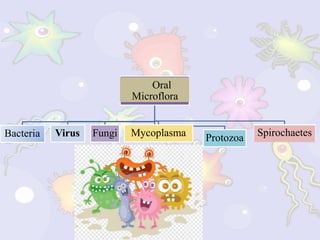
Oral
Microflora
Bacteria Virus Fungi ProtozoaMycoplasma Spirochaetes
Bacteria
Cocci
Gram
positive
Gram
negative
Bacilli
Gram
positive
Gram
nagative
Colonization of infant’s oral cavity
Vertical transmission
• From mother to infant.
• The genotypes of streptococcus mutans in
infants appear to be identical to that present in
mother.
• Maternal factors associated with infant
colonization
– Salivary levels of mutans streptococci
– Mother’s oral hygiene
– Periodontal status
– Snack frequency
– Socioeconomic status
furrows of tongue can also harbour mutans
streptococci in predentate infants.
Horizontal transmission
• Between members of a group.
• Siblings of similar age.
• Children in a day care centre
Effect of mode of delivery on oral
microflora
In the oral cavity, mutans streptococci were detected
more frequently and at a younger age in children
delivered by C-section than in those delivered vaginally
These authors hypothesized that C-section,
compared with vaginal birth, lowered the exposure
to commensal, protective bacteria from the mother
during birth, reducing the natural barrier to
colonization by oral pathogens
Mode of birth delivery affects oral
microflora in infants
PERINATAL ORAL HEALTH
Generally, colonization of Strep. Mutans in the oral
cavity of children is the result of transmission of these
organisms from the child’s primary caregiver.
A direct relationship exists between MS (mutans
strep)levels in adult caregivers and that of caries
prevalence in their children.
Oral flora of pre-dentate mouth
Since the oral cavity of the neonate lacks teeth and only
mucosal surfaces are available during the first months of
life, organisms with ligands for the tooth are absent.
Epithelial binding sites for group A streptococci and
their lipoteichoic acid in the oral cavity of term
newborn infants are absent or minimal at birth, but
reach adult levels between 48 and 72 hours after birth.
The oral colonization patterns differ among
individuals already in infancy; variable bacterial
load in saliva and other close contacts and the
frequency of this bacterial exposure may partly
account for individual differences.
Acquisition and development of oral flora
At birth
Infancy and early childhood
Adolescence
Adulthood
At birth
• Fetus in womb – sterile
• Passive contamination:
- Mother, people in contact
- Mother’s uterus, vagina-
candida, lactobacilli
• Infant’s oral cavity –
epithelial surfaces
• S. salivarius S. oralis, S.
mitis
Infancy and early childhood
• S. mutans, S. sanguis
• Non-desquamating surface to
colonize
• ‘Window of infectivity’
- 19-31 months (26 months)
- Greatest risk
• The infant comes into contact with an ever-increasing range of
microorganisms and some become established as part of commensal flora.
• The eruption of deciduous teeth provides a new attachment surface and
turns Streptococcus sanguis and mutans as regular inhabitants of oral
cavity.
• Anaerobes are few in number due to absence of deep gingival crevice.
• Actinomyces , Lactobacilli are found regularly
Adolescence
• More complex
- Presence of deep fissures
- Larger interproximal surfaces
- Deep gingival crevices allowing
anaerobic organisms.
• Bacteriods
• Fusobacterium
• Spirochetes
• The greatest number of organisms in mouth occur when
permanent teeth erupt.
• These teeth have deep fissures, larger inter proximal spaces
and deeper gingival crevice, allowing a great increase in
anaerobes.
Rationale for the timing of the first oral
evaluation
To determine the risk status of the infant based on
information obtained from the parents and to
perform a screening examination of infants’ mouths
Assess transmission of Streptococcus
Mutans
DietaryAssessment
Teach proper care for the child’s teeth.
Prepare to provide preventive,
interceptive or restorative
services.
Dental caries is preventable, by early risk
assessment to identify parent-infant groups who
are at increased risk for Early childhood caries.
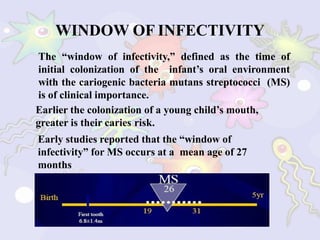
WINDOW OF INFECTIVITY
The “window of infectivity,” defined as the time of
initial colonization of the infant’s oral environment
with the cariogenic bacteria mutans streptococci (MS)
is of clinical importance.
Earlier the colonization of a young child’s mouth,
greater is their caries risk.
Early studies reported that the “window of
infectivity” for MS occurs at a mean age of 27
months
• The timing of immunization should precede the
“window of infectivity”.
• i.e. the period during which children usually become
infected with Mutans Streptococci which extends from 19
to 31 months of age.( median age of 26 months).
Oral microflora

Oral microflora

  • 3.
    Introduction • A “microbe”or “microscopic organism” is a living thing that is too small to be seen with naked eye. We need to use a microscope to see them. • Human beings like other animals, harbor a wide array of microorganisms both on and in their bodies. 4
  • 4.
    • The humanbody is continuously inhabited by many different micro-organisms mostly bacteria, some fungi and other micro- organisms, which under normal circumstances in a healthy individual, are harmless, and may even be beneficial. These micro-organisms are termed, the normal micro flora. • Oral micro flora : - Micro-organisms inhabiting the oral cavity. • All the micro-organisms which establish a more or less permanent residence at oral surfaces in man, in one or more of oral habitats, are referred to as normal micro flora of human mouth. 5
  • 5.
    Oral Microflora Bacteria Virus FungiProtozoaMycoplasma Spirochaetes
  • 6.
  • 7.
    Colonization of infant’soral cavity Vertical transmission • From mother to infant. • The genotypes of streptococcus mutans in infants appear to be identical to that present in mother. • Maternal factors associated with infant colonization – Salivary levels of mutans streptococci – Mother’s oral hygiene – Periodontal status – Snack frequency – Socioeconomic status furrows of tongue can also harbour mutans streptococci in predentate infants.
  • 8.
    Horizontal transmission • Betweenmembers of a group. • Siblings of similar age. • Children in a day care centre
  • 9.
    Effect of modeof delivery on oral microflora In the oral cavity, mutans streptococci were detected more frequently and at a younger age in children delivered by C-section than in those delivered vaginally These authors hypothesized that C-section, compared with vaginal birth, lowered the exposure to commensal, protective bacteria from the mother during birth, reducing the natural barrier to colonization by oral pathogens Mode of birth delivery affects oral microflora in infants
  • 10.
    PERINATAL ORAL HEALTH Generally,colonization of Strep. Mutans in the oral cavity of children is the result of transmission of these organisms from the child’s primary caregiver. A direct relationship exists between MS (mutans strep)levels in adult caregivers and that of caries prevalence in their children.
  • 11.
    Oral flora ofpre-dentate mouth Since the oral cavity of the neonate lacks teeth and only mucosal surfaces are available during the first months of life, organisms with ligands for the tooth are absent. Epithelial binding sites for group A streptococci and their lipoteichoic acid in the oral cavity of term newborn infants are absent or minimal at birth, but reach adult levels between 48 and 72 hours after birth. The oral colonization patterns differ among individuals already in infancy; variable bacterial load in saliva and other close contacts and the frequency of this bacterial exposure may partly account for individual differences.
  • 12.
    Acquisition and developmentof oral flora At birth Infancy and early childhood Adolescence Adulthood
  • 13.
    At birth • Fetusin womb – sterile • Passive contamination: - Mother, people in contact - Mother’s uterus, vagina- candida, lactobacilli • Infant’s oral cavity – epithelial surfaces • S. salivarius S. oralis, S. mitis
  • 14.
    Infancy and earlychildhood • S. mutans, S. sanguis • Non-desquamating surface to colonize • ‘Window of infectivity’ - 19-31 months (26 months) - Greatest risk • The infant comes into contact with an ever-increasing range of microorganisms and some become established as part of commensal flora. • The eruption of deciduous teeth provides a new attachment surface and turns Streptococcus sanguis and mutans as regular inhabitants of oral cavity. • Anaerobes are few in number due to absence of deep gingival crevice. • Actinomyces , Lactobacilli are found regularly
  • 15.
    Adolescence • More complex -Presence of deep fissures - Larger interproximal surfaces - Deep gingival crevices allowing anaerobic organisms. • Bacteriods • Fusobacterium • Spirochetes • The greatest number of organisms in mouth occur when permanent teeth erupt. • These teeth have deep fissures, larger inter proximal spaces and deeper gingival crevice, allowing a great increase in anaerobes.
  • 16.
    Rationale for thetiming of the first oral evaluation To determine the risk status of the infant based on information obtained from the parents and to perform a screening examination of infants’ mouths Assess transmission of Streptococcus Mutans DietaryAssessment Teach proper care for the child’s teeth. Prepare to provide preventive, interceptive or restorative services. Dental caries is preventable, by early risk assessment to identify parent-infant groups who are at increased risk for Early childhood caries.
  • 17.
    WINDOW OF INFECTIVITY The“window of infectivity,” defined as the time of initial colonization of the infant’s oral environment with the cariogenic bacteria mutans streptococci (MS) is of clinical importance. Earlier the colonization of a young child’s mouth, greater is their caries risk. Early studies reported that the “window of infectivity” for MS occurs at a mean age of 27 months
  • 19.
    • The timingof immunization should precede the “window of infectivity”. • i.e. the period during which children usually become infected with Mutans Streptococci which extends from 19 to 31 months of age.( median age of 26 months).