BY Dr MILIND
RAJAN
DEPT- PEDIATRIC
DENTISTRY
DEFINITION:
Inflammation is defined as the local response of living tissues to
injury due to any agent.
ETIOLOGY:
The causes of inflammation are many and varied:
 Exogenous causes:
 Physical agents
 Mechanic agents: fractures, foreign corps, sand, etc.
 Thermal agents: burns, freezing
 Chemical agents: toxic gases, acids, bases
 Biological agents: bacteria, viruses, parasites
 Endogenous causes:
 Circulation disorders: thrombosis, infarction, hemorrhage
 Enzymes activation – e.g. acute pancreatitis
 Metabolic products – uric acid, urea
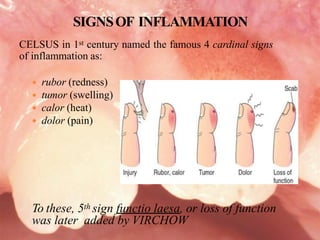
CELSUS in 1st century named the famous 4 cardinal signs
of inflammation as:
 rubor (redness)
 tumor (swelling)
 calor (heat)
 dolor (pain)
To these, 5th sign functio laesa, or loss of function
was later added by VIRCHOW
SIGNSOF INFLAMMATION
TYPES OF INFLAMMATION
ACUTE
Rapid onset
Short duration
Fluid accumulation, plasma protein exudation
Neutrophils
CHRONIC
Onset- insidious
Longer duration
Lymphocytes, macrophages, plasma cells as inflammatory
cells
• The clinical and radiographic images of gingiva
and periodontium in children and adolescent differ
from those seen in adults, owing to the significant
changes taking place during growth and
development.
• The periodontium during childhood and puberty is
in constant state of change owing to the exfoliation
and eruption of teeth.
7
• This makes a general description of the normal
periodontium difficult because it varies with age
of the patient. (Baer and Benjamin, 1974)
8
Features Children Adults
Gingival Colour More Reddish Coral Pink
Contour Free Gingival Margin-
rounded
Gingival Margin-
Knife Edge
Consistency Flabby Due To Less
CT Density And Lack
Of Organized
Collagen Fiber
Bundles
Firm And Resilient
Surface Texture Stippling Absent In
Infancy.
Mostly Seen By Age
Of 6yrs
Stippling Present
9
Features Children Adults
Interdental Area Saddle Shaped Gingiva Papillary Gingiva
Gingival Sulcus Newly Erupted Teeth
Sulcus Depth Is
Greater Than
Deciduous Predecessor
1-2mm
Attached Gingiva Width Increases With
Age And Concomitant
Decrease In Sulcus
Depth
Greater In Adults
1
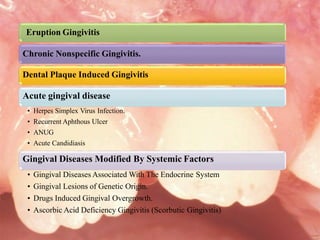
Eruption Gingivitis
Chronic Nonspecific Gingivitis.
Dental Plaque Induced Gingivitis
Acute gingival disease
• Herpes Simplex Virus Infection.
• Recurrent Aphthous Ulcer
• ANUG
• Acute Candidiasis
Gingival Diseases Modified By Systemic Factors
• Gingival Diseases Associated With The Endocrine System
• Gingival Lesions of Genetic Origin.
• Drugs Induced Gingival Overgrowth.
• Ascorbic Acid Deficiency Gingivitis (Scorbutic Gingivitis)
GINGIVAL DISEASES
ERUPTION
GINGIVITIS
A transitory type of
gingivitis
young
is often
in
when the
teeth are
observed
children
primary
erupting.
Often localized and
associated with difficult
eruption, subsides after
the teeth emerge into
the oral cavity.
1
1
The greatest increase in the incidence of gingivitis in
children is often seen in the 6- to 7- year age group
when the permanent teeth begin to erupt.
This inflammation is most commonly associated with
the eruption of the first and second permanent molars,
and the condition can be painful and can develop into a
pericoronitis or a pericoronal abscess.
1
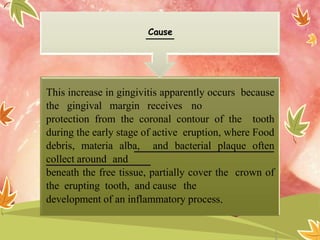
This increase in gingivitis apparently occurs because
the gingival margin receives no
protection from the coronal contour of the tooth
during the early stage of active eruption, where Food
debris, materia alba, and bacterial plaque often
collect around and
beneath the free tissue, partially cover the crown of
the erupting tooth, and cause the
development of an inflammatory process.
Cause
1
DENTAL PLAQUE INDUCED
GINGIVITIS
The degree of dental cleanliness
and the condition of the gingival
tissues in children are related.
Adequate mouth hygiene and
cleanliness of the teeth are related to
frequency of brushing and the
thoroughness with which bacterial
plaque is removed from the teeth
1
Gingivitis is generally less severe in children than in
adults with similar plaque levels.
MATSSON performed a 21-day experimental gingivitis
study comparing 6 children, aged 4 to 5 years, with 6
dental students, aged 23 to 29 years. They found that the
children developed gingivitis less readily than the adults.
1
Gingivitis associated with poor oral hygiene is
usually classified as:
 Early (slight).
 Moderate.
 Advanced.
 The importance of a good standard of oral cleanliness
in reducing gingivitis and, ideally, preventing the
progression of the disease in later life.
1
2
HERPES SIMPLEX VIRUS INFECTION
2
Herpes virus causes one of the most widespread viral
infections.
The primary infection usually occurs in a child younger
than 6 years of age who has had no contact with the type 1
herpes simplex virus (HSV-1) and who therefore has no
neutralizing antibodies.
 It is believed that 99% of all primary infections
are of the subclinical type.
The infection may also occur in susceptible adults who
have not had a primary infection
The primary infection may be manifested by acute
symptoms (acute herpetic gingivostomatitis). which
runs a course of 10 to 14 days.
The active symptoms of the acute disease can occur
in children with clean mouths and healthy oral tissues.
May be characterized by only one or two mild sores on
the oral mucous membranes, which may be of little
concern to the child or may go unnoticed by the
parents.
2
.
2
The symptoms of the disease develop
suddenly and include :
Fiery red gingival tissues.
Malaise.
Irritability.
Headache.
And pain associated with the intake of
food and liquids of acid content.
2
Recurrent Herpes Labialis(RHL)
2
After the initial primary attack during early childhood, the
herpes simplex virus becomes inactive and resides in
sensory nerve ganglia.
The virus often reappears later as the familiar cold sore or
fever blister, usually on the outside of the lips .
Approximately 5% of recurrences are intraoral.
2
TREATMENT
Systemic antiviral medications daily dosages are the same as those
for the primary infection, but the course of treatment is usually 5
days instead of 10.
Food and drug administration (FDA) in children 12 years and older is
valacyclovir 2 g, initially and 2 g 12 hours later.
Topical antiviral agent, penciclovir cream may be applied to perioral lesions
but should not be applied to intraoral lesions every 2 hours while awake for 4
days, and it is approved for use in children 12 years of age and older.
Topical 5% acyclovir cream may be prescribed for use five times daily for 4
days in children 12 years of age and older are frequently exposed to HSV-1
2
ACUTE NECROTIZING ULCERATIVE
GINGIVITIS (VINCENT INFECTION)
Rare among preschool
children .
occurs occasionally in
children 6 to 12 years
old, and is common in
young adults.
2
ANUG can be easily diagnosed because of the
involvement of the interproximal papillae and the
presence of a pseudomembranous necrotic covering
of the marginal tissue
The clinical manifestations of the disease include:
Inflamed, painful, bleeding gingival tissue,
Poor appetite,
Temperature as high as 40°C (104°F),
General malaise,
 And a fetid odor
2
Treatment :
The disease responds dramatically within 24 to 48 hours
to :
1) subgingival curettage,
2) débridement,
3) use of mild oxidizing solutions.
4) If the gingival tissues are acutely and extensively
inflamed when the patient is first seen, antibiotic
therapy is indicated.
5) Improved oral hygiene,
6) the use of mild oxidizing mouth rinses after each
meal, and twice daily rinsing with chlorhexidine will aid
in overcoming the infection. 3
ACUTE CANDIDIASIS (THRUSH,
CANDIDOSIS,MONILIASIS)
3
The lesions of the oral disease appear as raised,
furry, white patches, which can be removed easily to
produce a bleeding underlying surface
Neonatal candidiasis, contracted during passage
through the vagina and erupting clinically during the
first 2 weeks of life, is a common occurrence. This
infection is also common in immunosuppressed
Patients.
sometimes develop thrush after local antibiotic
therapy .
3
Treatment :
Antifungal antibiotics control thrush.
For infants and very young children, a suspension of
1 mL (100,000 U) of nystatin (Mycostatin) may be
dropped into the mouth for local action four times a
day. The drug is nonirritating and nontoxic.
Clotrimazole suspension (10 mg/mL), 1 to 2 mL
applied to affected areas four times daily, is an
effective antifungal medication.
Systemic fluconazole suspension (10 mg/mL) is safe
to use in infants at a total dosage of 6 mg/kg or less
per day.
3
CHRONIC NONSPECIFIC GINGIVITIS
3
A type of gingivitis commonly seen during the pre-
teenage and teenage years .
May be localized to the anterior region, or it may
be more generalized.
Although the condition is rarely painful, it may
persist for long periods without much improvement
3
CHARACTERIZED BY :
3
The fiery red gingival lesion is not accompanied by
enlarged interdental labial papillae or closely
associated with local irritants.
The gingivitis showed little improvement after a
prophylactic treatment.
The age of the patients involved and the prevalence
of the disease in girls suggested a hormonal
imbalance as a possible factor.
Histologic examination of tissue sections and the use
of special stains ruled out a bacterial infection.
Treatment :
An improved dietary intake of vitamins and
the use of multiple-vitamin supplements will
improve the gingival condition in many
children.
Improved oral hygiene.
3
ASCORBIC ACID DEFICIENCY
GINGIVITIS
(SCORBUTIC GINGIVITIS)
Scorbutic gingivitis is associated
with vitamin C deficiency and
differs from the type of
poor oralgingivitis related to
hygiene.
The involvement is usually limited
to the marginal tissues and
papillae.
The child with scorbutic
gingivitis may complain of severe
pain, and spontaneous hemorrhage
is evident.
3
Severe clinical scorbutic gingivitis is rare in children.
It may occur in children allergic to fruit juices.
Inflammation and enlargement of the marginal gingival
tissue and papillae in the absence of local predisposing
factors are possible evidence of scorbutic gingivitis.
Treatment :
Daily administration of 250 to 500 mg of ascorbic acid.
Older children and adults may require 1 g of vitamin C
for 2 weeks to speed recovery.
64
CONCLUSION
4
Gingivitis is a reversible disease. Therapy is aimed
primarily at reduction of etiologic factors to reduce or
eliminate inflammation, thereby allowing gingival tissues
to heal.
Complete dental care, improved oral hygiene, and
supplementation with vitamin C and other water-soluble
vitamins will greatly improve the gingival condition.
As with all disorders affecting periodontal tissues,
maintaining excellent oral hygiene is the primary key to
successful therapy.

Inflammation milind

  • 2.
    BY Dr MILIND RAJAN DEPT-PEDIATRIC DENTISTRY
  • 4.
    DEFINITION: Inflammation is definedas the local response of living tissues to injury due to any agent. ETIOLOGY: The causes of inflammation are many and varied:  Exogenous causes:  Physical agents  Mechanic agents: fractures, foreign corps, sand, etc.  Thermal agents: burns, freezing  Chemical agents: toxic gases, acids, bases  Biological agents: bacteria, viruses, parasites  Endogenous causes:  Circulation disorders: thrombosis, infarction, hemorrhage  Enzymes activation – e.g. acute pancreatitis  Metabolic products – uric acid, urea
  • 5.
    CELSUS in 1stcentury named the famous 4 cardinal signs of inflammation as:  rubor (redness)  tumor (swelling)  calor (heat)  dolor (pain) To these, 5th sign functio laesa, or loss of function was later added by VIRCHOW SIGNSOF INFLAMMATION
  • 6.
    TYPES OF INFLAMMATION ACUTE Rapidonset Short duration Fluid accumulation, plasma protein exudation Neutrophils CHRONIC Onset- insidious Longer duration Lymphocytes, macrophages, plasma cells as inflammatory cells
  • 7.
    • The clinicaland radiographic images of gingiva and periodontium in children and adolescent differ from those seen in adults, owing to the significant changes taking place during growth and development. • The periodontium during childhood and puberty is in constant state of change owing to the exfoliation and eruption of teeth. 7
  • 8.
    • This makesa general description of the normal periodontium difficult because it varies with age of the patient. (Baer and Benjamin, 1974) 8
  • 9.
    Features Children Adults GingivalColour More Reddish Coral Pink Contour Free Gingival Margin- rounded Gingival Margin- Knife Edge Consistency Flabby Due To Less CT Density And Lack Of Organized Collagen Fiber Bundles Firm And Resilient Surface Texture Stippling Absent In Infancy. Mostly Seen By Age Of 6yrs Stippling Present 9
  • 10.
    Features Children Adults InterdentalArea Saddle Shaped Gingiva Papillary Gingiva Gingival Sulcus Newly Erupted Teeth Sulcus Depth Is Greater Than Deciduous Predecessor 1-2mm Attached Gingiva Width Increases With Age And Concomitant Decrease In Sulcus Depth Greater In Adults 1
  • 11.
    Eruption Gingivitis Chronic NonspecificGingivitis. Dental Plaque Induced Gingivitis Acute gingival disease • Herpes Simplex Virus Infection. • Recurrent Aphthous Ulcer • ANUG • Acute Candidiasis Gingival Diseases Modified By Systemic Factors • Gingival Diseases Associated With The Endocrine System • Gingival Lesions of Genetic Origin. • Drugs Induced Gingival Overgrowth. • Ascorbic Acid Deficiency Gingivitis (Scorbutic Gingivitis)
  • 12.
  • 13.
    ERUPTION GINGIVITIS A transitory typeof gingivitis young is often in when the teeth are observed children primary erupting. Often localized and associated with difficult eruption, subsides after the teeth emerge into the oral cavity. 1
  • 14.
  • 15.
    The greatest increasein the incidence of gingivitis in children is often seen in the 6- to 7- year age group when the permanent teeth begin to erupt. This inflammation is most commonly associated with the eruption of the first and second permanent molars, and the condition can be painful and can develop into a pericoronitis or a pericoronal abscess. 1
  • 16.
    This increase ingingivitis apparently occurs because the gingival margin receives no protection from the coronal contour of the tooth during the early stage of active eruption, where Food debris, materia alba, and bacterial plaque often collect around and beneath the free tissue, partially cover the crown of the erupting tooth, and cause the development of an inflammatory process. Cause 1
  • 17.
    DENTAL PLAQUE INDUCED GINGIVITIS Thedegree of dental cleanliness and the condition of the gingival tissues in children are related. Adequate mouth hygiene and cleanliness of the teeth are related to frequency of brushing and the thoroughness with which bacterial plaque is removed from the teeth 1
  • 18.
    Gingivitis is generallyless severe in children than in adults with similar plaque levels. MATSSON performed a 21-day experimental gingivitis study comparing 6 children, aged 4 to 5 years, with 6 dental students, aged 23 to 29 years. They found that the children developed gingivitis less readily than the adults. 1
  • 19.
    Gingivitis associated withpoor oral hygiene is usually classified as:  Early (slight).  Moderate.  Advanced.  The importance of a good standard of oral cleanliness in reducing gingivitis and, ideally, preventing the progression of the disease in later life. 1
  • 20.
  • 21.
    HERPES SIMPLEX VIRUSINFECTION 2 Herpes virus causes one of the most widespread viral infections. The primary infection usually occurs in a child younger than 6 years of age who has had no contact with the type 1 herpes simplex virus (HSV-1) and who therefore has no neutralizing antibodies.  It is believed that 99% of all primary infections are of the subclinical type. The infection may also occur in susceptible adults who have not had a primary infection
  • 22.
    The primary infectionmay be manifested by acute symptoms (acute herpetic gingivostomatitis). which runs a course of 10 to 14 days. The active symptoms of the acute disease can occur in children with clean mouths and healthy oral tissues. May be characterized by only one or two mild sores on the oral mucous membranes, which may be of little concern to the child or may go unnoticed by the parents. 2
  • 23.
  • 24.
    The symptoms ofthe disease develop suddenly and include : Fiery red gingival tissues. Malaise. Irritability. Headache. And pain associated with the intake of food and liquids of acid content. 2
  • 25.
    Recurrent Herpes Labialis(RHL) 2 Afterthe initial primary attack during early childhood, the herpes simplex virus becomes inactive and resides in sensory nerve ganglia. The virus often reappears later as the familiar cold sore or fever blister, usually on the outside of the lips . Approximately 5% of recurrences are intraoral.
  • 26.
  • 27.
    TREATMENT Systemic antiviral medicationsdaily dosages are the same as those for the primary infection, but the course of treatment is usually 5 days instead of 10. Food and drug administration (FDA) in children 12 years and older is valacyclovir 2 g, initially and 2 g 12 hours later. Topical antiviral agent, penciclovir cream may be applied to perioral lesions but should not be applied to intraoral lesions every 2 hours while awake for 4 days, and it is approved for use in children 12 years of age and older. Topical 5% acyclovir cream may be prescribed for use five times daily for 4 days in children 12 years of age and older are frequently exposed to HSV-1 2
  • 28.
    ACUTE NECROTIZING ULCERATIVE GINGIVITIS(VINCENT INFECTION) Rare among preschool children . occurs occasionally in children 6 to 12 years old, and is common in young adults. 2
  • 29.
    ANUG can beeasily diagnosed because of the involvement of the interproximal papillae and the presence of a pseudomembranous necrotic covering of the marginal tissue The clinical manifestations of the disease include: Inflamed, painful, bleeding gingival tissue, Poor appetite, Temperature as high as 40°C (104°F), General malaise,  And a fetid odor 2
  • 30.
    Treatment : The diseaseresponds dramatically within 24 to 48 hours to : 1) subgingival curettage, 2) débridement, 3) use of mild oxidizing solutions. 4) If the gingival tissues are acutely and extensively inflamed when the patient is first seen, antibiotic therapy is indicated. 5) Improved oral hygiene, 6) the use of mild oxidizing mouth rinses after each meal, and twice daily rinsing with chlorhexidine will aid in overcoming the infection. 3
  • 31.
    ACUTE CANDIDIASIS (THRUSH, CANDIDOSIS,MONILIASIS) 3 Thelesions of the oral disease appear as raised, furry, white patches, which can be removed easily to produce a bleeding underlying surface Neonatal candidiasis, contracted during passage through the vagina and erupting clinically during the first 2 weeks of life, is a common occurrence. This infection is also common in immunosuppressed Patients. sometimes develop thrush after local antibiotic therapy .
  • 32.
  • 33.
    Treatment : Antifungal antibioticscontrol thrush. For infants and very young children, a suspension of 1 mL (100,000 U) of nystatin (Mycostatin) may be dropped into the mouth for local action four times a day. The drug is nonirritating and nontoxic. Clotrimazole suspension (10 mg/mL), 1 to 2 mL applied to affected areas four times daily, is an effective antifungal medication. Systemic fluconazole suspension (10 mg/mL) is safe to use in infants at a total dosage of 6 mg/kg or less per day. 3
  • 34.
    CHRONIC NONSPECIFIC GINGIVITIS 3 Atype of gingivitis commonly seen during the pre- teenage and teenage years . May be localized to the anterior region, or it may be more generalized. Although the condition is rarely painful, it may persist for long periods without much improvement
  • 35.
  • 36.
    CHARACTERIZED BY : 3 Thefiery red gingival lesion is not accompanied by enlarged interdental labial papillae or closely associated with local irritants. The gingivitis showed little improvement after a prophylactic treatment. The age of the patients involved and the prevalence of the disease in girls suggested a hormonal imbalance as a possible factor. Histologic examination of tissue sections and the use of special stains ruled out a bacterial infection.
  • 37.
    Treatment : An improveddietary intake of vitamins and the use of multiple-vitamin supplements will improve the gingival condition in many children. Improved oral hygiene. 3
  • 38.
    ASCORBIC ACID DEFICIENCY GINGIVITIS (SCORBUTICGINGIVITIS) Scorbutic gingivitis is associated with vitamin C deficiency and differs from the type of poor oralgingivitis related to hygiene. The involvement is usually limited to the marginal tissues and papillae. The child with scorbutic gingivitis may complain of severe pain, and spontaneous hemorrhage is evident. 3
  • 39.
    Severe clinical scorbuticgingivitis is rare in children. It may occur in children allergic to fruit juices. Inflammation and enlargement of the marginal gingival tissue and papillae in the absence of local predisposing factors are possible evidence of scorbutic gingivitis. Treatment : Daily administration of 250 to 500 mg of ascorbic acid. Older children and adults may require 1 g of vitamin C for 2 weeks to speed recovery. 64
  • 40.
    CONCLUSION 4 Gingivitis is areversible disease. Therapy is aimed primarily at reduction of etiologic factors to reduce or eliminate inflammation, thereby allowing gingival tissues to heal. Complete dental care, improved oral hygiene, and supplementation with vitamin C and other water-soluble vitamins will greatly improve the gingival condition. As with all disorders affecting periodontal tissues, maintaining excellent oral hygiene is the primary key to successful therapy.