Its exceptions
SUBMITTED BY:
Anamika Bishnoi
4thYear B.A.LL.B.
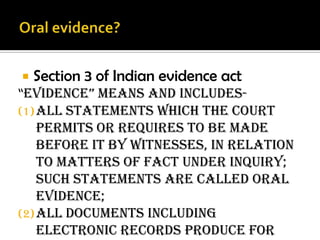
ï‚Ą Section 3 of Indian evidence act
“evidence” means and includes-
(1)All statements which the court
permits or requires to be made
before it by witnesses, in relation
to Matters of fact under inquiry;
such statements are called oral
evidence;
(2)All documents including
electronic records produce for
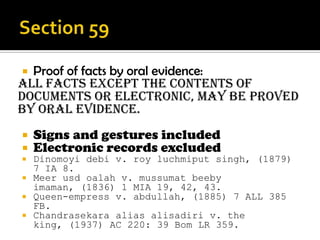
ï‚Ą Proof of facts by oral evidence:
All facts except the contents of
documents or electronic, may be proved
by oral evidence.
ï‚Ą Signs and gestures included
ï‚Ą Electronic records excluded
ï‚Ą Dinomoyi debi v. roy luchmiput singh, (1879)
7 IA 8.
ï‚Ą Meer usd oalah v. mussumat beeby
imaman, (1836) 1 MIA 19, 42, 43.
ï‚Ą Queen-empress v. abdullah, (1885) 7 ALL 385
FB.
ï‚Ą Chandrasekara alias alisadiri v. the
king, (1937) AC 220: 39 Bom LR 359.
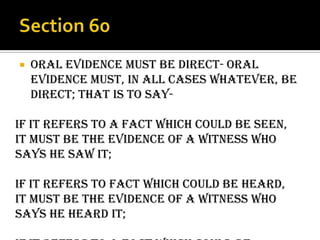
ï‚Ą Oral evidence must be direct- oral
evidence must, in all cases whatever, be
direct; that is to say-
If it refers to a fact which could be seen,
it must be the evidence of a witness who
says he saw it;
If it refers to fact which could be heard,
it must be the evidence of a witness who
says he heard it;
If it refers to an opinion or to the grounds on
which that opinion is held, it must be the
evidence of the person who holds that opinion
on those grounds:
Provided that the opinions of experts
expressed in any treatises commonly offered
for sale, and the grounds on which such
opinions are held, may be proved by the
production of such treatises if the author is
dead or cannot be found, or has become
incapable giving evidence, or cannot be
called as a witness without an amount of
Hearsay evidence
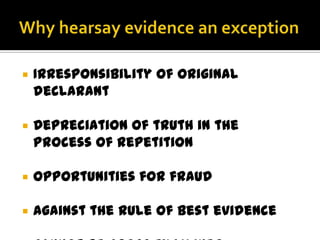
ï‚Ą Irresponsibility of original
declarant
ï‚Ą Depreciation of truth in the
process of repetition
ï‚Ą Opportunities for fraud
ï‚Ą Against the rule of best evidence
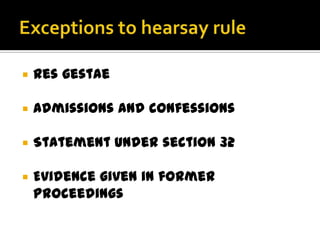
ï‚Ą Res gestae
ï‚Ą Admissions and confessions
ï‚Ą Statement under section 32
ï‚Ą Evidence given in former
proceedings
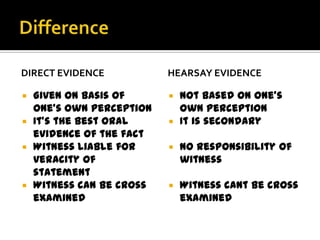
DIRECT EVIDENCE
ï‚Ą Given on basis of
one’s own perception
ï‚Ą It’s the best oral
evidence of the fact
ï‚Ą Witness liable for
veracity of
statement
ï‚Ą Witness can be cross
examined
HEARSAY EVIDENCE
ï‚Ą Not based on one’s
own perception
ï‚Ą It is secondary
ï‚Ą No responsibility of
witness
ï‚Ą Witness cant be cross
examined
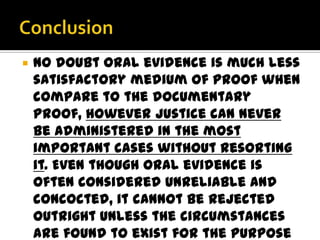
ï‚Ą no doubt oral evidence is much less
satisfactory medium of proof when
compare to the documentary
proof, however justice can never
be administered in the most
important cases without resorting
it. Even though oral evidence is
often considered unreliable and
concocted, it cannot be rejected
outright unless the circumstances
are found to exist for the purpose
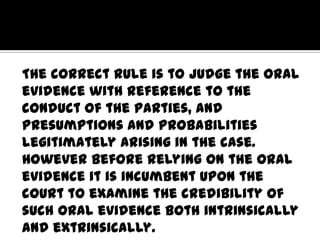
The correct rule is to judge the oral
evidence with reference to the
conduct of the parties, and
presumptions and probabilities
legitimately arising in the case.
However before relying on the oral
evidence it is incumbent upon the
court to examine the credibility of
such oral evidence both intrinsically
and extrinsically.
THANK YOU

Oral evidence must be direct

  • 1.
    Its exceptions SUBMITTED BY: AnamikaBishnoi 4thYear B.A.LL.B.
  • 2.
    ï‚Ą Section 3of Indian evidence act “evidence” means and includes- (1)All statements which the court permits or requires to be made before it by witnesses, in relation to Matters of fact under inquiry; such statements are called oral evidence; (2)All documents including electronic records produce for
  • 3.
    ï‚Ą Proof offacts by oral evidence: All facts except the contents of documents or electronic, may be proved by oral evidence. ï‚Ą Signs and gestures included ï‚Ą Electronic records excluded ï‚Ą Dinomoyi debi v. roy luchmiput singh, (1879) 7 IA 8. ï‚Ą Meer usd oalah v. mussumat beeby imaman, (1836) 1 MIA 19, 42, 43. ï‚Ą Queen-empress v. abdullah, (1885) 7 ALL 385 FB. ï‚Ą Chandrasekara alias alisadiri v. the king, (1937) AC 220: 39 Bom LR 359.
  • 4.
    ï‚Ą Oral evidencemust be direct- oral evidence must, in all cases whatever, be direct; that is to say- If it refers to a fact which could be seen, it must be the evidence of a witness who says he saw it; If it refers to fact which could be heard, it must be the evidence of a witness who says he heard it;
  • 5.
    If it refersto an opinion or to the grounds on which that opinion is held, it must be the evidence of the person who holds that opinion on those grounds: Provided that the opinions of experts expressed in any treatises commonly offered for sale, and the grounds on which such opinions are held, may be proved by the production of such treatises if the author is dead or cannot be found, or has become incapable giving evidence, or cannot be called as a witness without an amount of
  • 6.
  • 7.
    ï‚Ą Irresponsibility oforiginal declarant ï‚Ą Depreciation of truth in the process of repetition ï‚Ą Opportunities for fraud ï‚Ą Against the rule of best evidence
  • 8.
    ï‚Ą Res gestae ï‚ĄAdmissions and confessions ï‚Ą Statement under section 32 ï‚Ą Evidence given in former proceedings
  • 9.
    DIRECT EVIDENCE ï‚Ą Givenon basis of one’s own perception ï‚Ą It’s the best oral evidence of the fact ï‚Ą Witness liable for veracity of statement ï‚Ą Witness can be cross examined HEARSAY EVIDENCE ï‚Ą Not based on one’s own perception ï‚Ą It is secondary ï‚Ą No responsibility of witness ï‚Ą Witness cant be cross examined
  • 10.
    ï‚Ą no doubtoral evidence is much less satisfactory medium of proof when compare to the documentary proof, however justice can never be administered in the most important cases without resorting it. Even though oral evidence is often considered unreliable and concocted, it cannot be rejected outright unless the circumstances are found to exist for the purpose
  • 11.
    The correct ruleis to judge the oral evidence with reference to the conduct of the parties, and presumptions and probabilities legitimately arising in the case. However before relying on the oral evidence it is incumbent upon the court to examine the credibility of such oral evidence both intrinsically and extrinsically.
  • 12.