This document discusses key aspects of dealing with evidence in court cases under Malaysian law. It covers determining the nature of evidence as oral or documentary, assessing a client's evidence, and exceptions to the hearsay rule that allow statements from unavailable witnesses to be used. The main legislation governing evidence in Malaysia is the Evidence Act 1950, and common law principles can provide guidance where the Act is silent.
Dealing with Evidence
By
LEE SWEE SENG
Advocate & Solicitor
Certified Mediator
Notary Public
Patent Agent
Trademark Agent
www.leesweeseng.com
sweeseng@tmnet.net.my
2.
Determine the nature of evidence
Assessing the client’s evidence
Effectively structuring evidence in
chief to fit your case theory
Handling documentary evidence
Presenting the evidence in court
Improper admission and rejection
of evidence
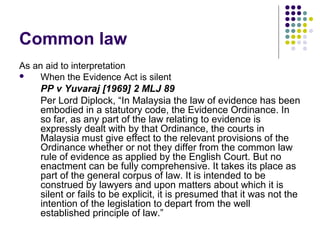
Common law
As anaid to interpretation
When the Evidence Act is silent
PP v Yuvaraj [1969] 2 MLJ 89
Per Lord Diplock, “In Malaysia the law of evidence has been
embodied in a statutory code, the Evidence Ordinance. In
so far, as any part of the law relating to evidence is
expressly dealt with by that Ordinance, the courts in
Malaysia must give effect to the relevant provisions of the
Ordinance whether or not they differ from the common law
rule of evidence as applied by the English Court. But no
enactment can be fully comprehensive. It takes its place as
part of the general corpus of law. It is intended to be
construed by lawyers and upon matters about which it is
silent or fails to be explicit, it is presumed that it was not the
intention of the legislation to depart from the well
established principle of law.”
S.3 of theEvidence Act 1950
provides the definition of “evidence” as:
(a) all statements which the court permits or
requires to be made before it by witnesses in
relation to matters of fact under inquiry: such
statements are called oral evidence ;
(b) all documents produced for the inspection of the
court: such documents are called documentary
evidence ;
7.
Oral Evidence
S.59 of the EA 1950, provides that,
All facts, except the contents of
documents, may be proved by oral
evidence .
“oral evidence” means all statement
which the Court permits or requires to be
made before it by witnesses in relation to
matters of facts under inquiry.
(S. Augustine Paul. Evidence Practice and Procedure 1994 pg. 389)
8.
Oral Evidence
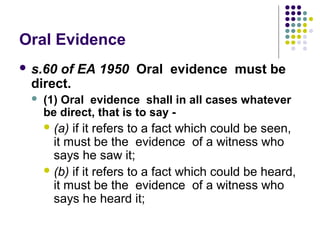
s.60ofEA 1950 Oral evidence must be
direct.
(1) Oral evidence shall in all cases whatever
be direct, that is to say -
(a) if it refers to a fact which could be seen,
it must be the evidence of a witness who
says he saw it;
(b) if it refers to a fact which could be heard,
it must be the evidence of a witness who
says he heard it;
9.
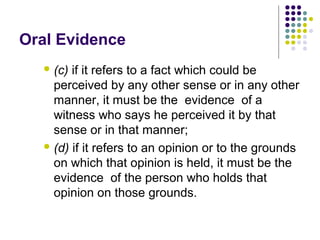
Oral Evidence
(c) if it refers to a fact which could be
perceived by any other sense or in any other
manner, it must be the evidence of a
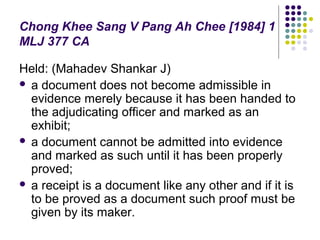
witness who says he perceived it by that
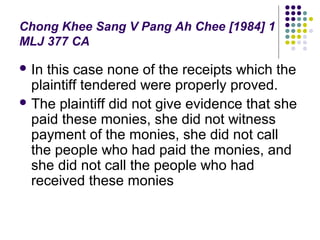
sense or in that manner;
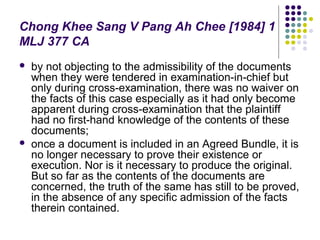
(d) if it refers to an opinion or to the grounds
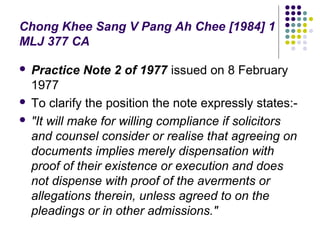
on which that opinion is held, it must be the
evidence of the person who holds that
opinion on those grounds.
10.
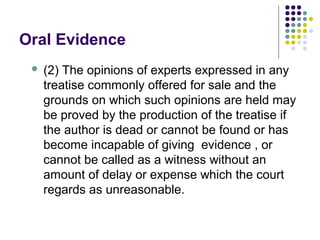
Oral Evidence
(2) The opinions of experts expressed in any
treatise commonly offered for sale and the
grounds on which such opinions are held may
be proved by the production of the treatise if
the author is dead or cannot be found or has
become incapable of giving evidence , or
cannot be called as a witness without an
amount of delay or expense which the court
regards as unreasonable.
11.
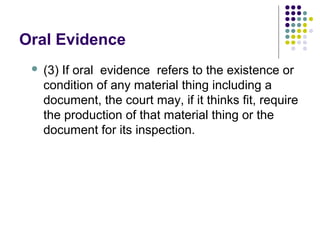
Oral Evidence
(3) If oral evidence refers to the existence or
condition of any material thing including a
document, the court may, if it thinks fit, require
the production of that material thing or the
document for its inspection.
12.
Evidential value oforal evidence
The weight and value of oral evidence
depends on its credibility as found by the
Court in each case. The court must give
reasons for its findings on credibility.
Balasingham v PP [1959] MLJ 193 (HC)
13.
Documentary evidence
s.3 of EA1950 Interpretation
“document” means any matter expressed,
described or howsoever represented, upon any
substance, material, thing or article, including any
matter embodied in a disc, tape, film, sound track or
other device whatsoever, by means of-
(a) letters, figures, marks, symbols, signals, signs, or
other forms of expression, description, or
representation whatsoever;
(b) any visual recording (whether of still or moving
images);
14.
Documentary evidence
(c) any sound recording, or any electronic magnetic,
mechanical or other recording whatsoever and howsoever
made, or any sounds, electronic impulses, or other data
whatsoever;
(d) a recording, or transmission, over a distance of any
matter by any, or any combination, of the means
mentioned in paragraph (a), (b), or (c),
or by more than one of the means mentioned in
paragraphs (a), (b), (c) and (d), intended to be used
or which may be used for the purpose of expressing,
describing, or howsoever representing, that matter;
15.
Documentary evidence
s. 61 of the EA 1950 provides that
The content of documents may be proved
either by primary or secondary evidence.
16.
Document produced by
computer
s. 90A. 90B and 90C of EA 1950 relates
to documents produced by computers.
This section is an exception to the hearsay
rule and provides that a document
produced by a computer or a statement
contained in such document shall be
admissible as evidence of any fact stated
therein whether or not the person
tendering the same is the maker of such
document or statement.
17.
Document produced by
computer
A document shall be deemed to have
been produced by a computer whether it
was produced by it directly or by means of
any appropriate equipment and whether or
not there was any direct or indirect human
intervention.
It applies to civil and criminal proceedings.
Facts in issue
‘…any fact from which either by itself or in
connection with other facts the existence, non-
existence, nature or extent of any right, liability or
disability asserted or denied in any suit or
proceedings necessarily follows.’ s. 3 EA 1950
Proving facts in issue by direct evidence
Ideally a fact in issue should be proved by direct
evidence (that is evidence of a person who himself
perceived the fact), if this is available.
E.g. eye-witness testimony
20.
Relevant Facts
More often than not, direct evidence of
the facts in issue is not available in the
facts in issue.
These are facts from which the facts in
issue may be inferred.
(Evidence, Advocacy And The Litigation Process, 1992, Jeffrey Pinsler)
21.
The general categories of relevant facts
are covered by section 6 to 11 EA 1950
which are worded widely so that ‘..the
general ground on which facts are
relevant might be stated in as many and
as popular forms as possible so that if a
fact is relevant, its relevancy may be
easily ascertained.’
22.
Evidence given bywitness without
personal knowledge/not available
Hearsay Rule
The assertions of persons made out of
court whether orally or in documentary
form or in the form of conduct tendered
to prove the facts which they refer to (ie.
facts in issue and relevant facts) are
inadmissible unless they fall within the
scope of the established exceptions.
(Evidence, Advocacy And The Litigation Process, 1992, Jeffrey Pinsler)
23.
The rational for such principle is that the
witness cannot verify the truth of facts of
which he has no personal knowledge.
As the person does not have personal
knowledge of the facts is not in court,
the accuracy of his perception and his
veracity cannot be assessed and tested
in cross-examination.
(Evidence, Advocacy And The Litigation Process, 1992, Jeffrey Pinsler)
24.
Exceptions to thehearsay rule
Statement of persons who cannot be called as
witness under s.32 s.33 of the EA 1950
S.32 of the EA provides for various categories
of circumstances in which oral and written
statements may be admitted as long as the
maker is unavailable for one of the prescribed
reasons.
25.
Under the circumstanceswhere:-
1. he is dead;
2. he cannot be found;
3. he has become incapable of giving evidence;
or
4. his attendance cannot be procured without
an amount of delay and expense which under
the circumstances of the case appears to the
court unreasonable.
26.
Weight tobe given to statement under
section 32 and 33 of EA 1950.
s.158 of EA 1950 provides that
Whenever any statement relevant under s.32 or
33 is proved, all matters may be proved either in
order to contradict or to corroborate it, or in order
to impeach or confirm the credit of the person by
whom it was made, which might have been
proved if that person had been called as a
witness and had denied upon cross-examination
the truth of the matter suggested.
27.
s. 73A(1)(a) of EA 1950 provides that
…in any civil proceedings where direct oral evidence
of a fact would be admissible, any statement made by
a person in a document and tending to establish that
fact shall, on production of the original document, be
admissible as evidence of that fact if the following
conditions are satisfied:
28.
a) If the maker of the statement either
i. Had personal knowledge of the matters dealt
with by the statement; or
ii. Where the document in question is or forms part
of a record purporting to be a continuous
record, made the statement in the performance
of a duty to record information supplied to him
by a person who had, or might reasonably be
supposed to have had, personal knowledge of
those matters; and
29.
b) If the maker of the statement is called as a
witness in the proceedings.
Provides that the condition that the maker of the
statement shall be called as a witness need not be
satisfied if he is dead, or unfit by reason of his
bodily or mental condition to attend as a witness, or
if he is beyond the seas and it is not reasonably
practicable to secure his attendance, or if all
reasonable effort to find him have been made
without success
30.
Weight
s.73A(6)of EA 1950
Court may consider whether the statement
was made contemporaneously with the
occurrence or existence of the facts stated
and to the question whether or not the
maker of the statement had any incentive
to conceal or misrepresent facts.
31.
JohoreState EconomicDevelopment
Corp v Queen Bee Sdn Bhd [1995] 4 MLJ
371 HC
A document which had been admitted
was discounted as it was not made
contemporaneously with the occurrence
of the facts stated therein.
32.
Arab-Malaysian Merchant BankBhd v Chong On
Foh Medical Hall & Liquor Dealers [1997] 4 MLJ
532 HC
The plaintiff, a licensed merchant bank, sued the
defendant, a firm, based on a factoring
agreement dated 12 March 1985.
At the hearing one Simon a/l Jones Ganesh, an
officer of the plaintiff (`the officer`), gave
evidence and wanted to tender the agreement.
On behalf of the plaintiff, the agreement was
signed by one Dr Junid and one Dr Cheah Teoh
Keong, a managing director. The document was
kept by the bank.
33.
Arab-Malaysian Merchant BankBhd v Chong On
Foh Medical Hall & Liquor Dealers [1997] 4 MLJ
532 HC
Itwas the officer's duty to provide
information regarding accounts of clients
who failed to repay the plaintiff. Dr Junid,
who had knowledge of the document, had
left the plaintiff.
Dr Cheah, on the other hand, could not
come to the Magistrate`s Court, Bukit
Mertajam from Kuala Lumpur as he was a
busy man.
34.
Arab-Malaysian Merchant BankBhd v Chong On
Foh Medical Hall & Liquor Dealers [1997] 4 MLJ
532 HC
The defendant objected to the tendering of
the agreement. The learned magistrate
ruled that the agreement was not
admissible and adjourned the case for the
plaintiff to appeal.
The plaintiff appealed and the issue
concerned the admissibility of the
document and the interpretation of s 73A
of the Evidence Act 1950.
35.
Arab-Malaysian Merchant BankBhd v Chong On
Foh Medical Hall & Liquor Dealers [1997] 4 MLJ
532 HC
Held: (Abdul Hamid J)
Under s 73A of the Act, a statement was
admissible under three circumstances, namely:
(i) where the maker of the statement was called to
give evidence;
(ii) where the maker was not available but the
proviso to sub (1) of s 73A was satisfied; and
(iii) where the maker was available but was not
called as a witness under the circumstances
provided by sub (2) of s 73A.
36.
Arab-Malaysian Merchant BankBhd v Chong On
Foh Medical Hall & Liquor Dealers [1997] 4 MLJ
532 HC
Under sub (2) of s 73A of the Act, a statement was
admissible if the court was satisfied that undue
delay or expense would be caused in order to call
the maker to give evidence.
The circumstances of this case justified the
agreement to be admitted under sub-s (2) of s 73A
of the Act. Dr Cheah himself had come to Bukit
Mertajam from Kuala Lumpur five or six times for the
same case. The claim was only for a sum of
RM5,425.82 while the costs incurred by the plaintiff
were more than what it was claiming.
Appeal allowed.
37.
Allegation of Fraud
Where a client alleges fraud it is
prudent to make them swear a
statutory declaration stating the
particulars of fraud.
38.
United Malayan BankingCorp Bhd v Palm and
Vegetable Oils (M) Sdn Bhd & Ors [1994] 3
MLJ 73
In1979, the appellant filed a writ and
a statement of claim against the
respondents, claiming for moneys
owed under banking facilities. In
1981, the appellant filed an
application for an O.14 judgment, but
the court refused to grant leave to
enter summary judgment.
39.
United Malayan BankingCorp Bhd v Palm and
Vegetable Oils (M) Sdn Bhd & Ors [1994] 3
MLJ 73
In 1986, the appellant's solicitors took out
a summons for directions and the senior
assistant registrar ordered the parties,
inter alia, to serve on each other a list of
documents and file an affidavit verifying
such list within 60 days. The appellant's
solicitors accordingly filed such an
affidavit, which was served on the
respondents on the same date.
40.
United Malayan BankingCorp Bhd v Palm and
Vegetable Oils (M) Sdn Bhd & Ors [1994] 3
MLJ 73
As there was no response at all from
the respondents, the appellant's
solicitors filed the request for setting
down the action for trial in 1988.
In 1989, the respondents filed a
summons-in-chambers to apply for a
dismissal of the appellant's claim for
want of prosecution.
41.
United Malayan BankingCorp Bhd v Palm and
Vegetable Oils (M) Sdn Bhd & Ors [1994] 3
MLJ 73
The appellants, however, contended that
there had been reasonable and credible
excuse for the delay as there were several
negotiations between the parties which
continued even after the action had been
set down for trial. The judge upheld the
decision of the senior assistant registrar.
The appellants have appealed.
42.
United Malayan BankingCorp Bhd v Palm and
Vegetable Oils (M) Sdn Bhd & Ors [1994] 3
MLJ 73
The senior assistant registrar granted the
application and accordingly struck out the suit.
On appeal by the appellants, the respondents
contended that nine years had passed since
the filing of the writ and during that period,
important key witnesses had died and the
control of the appellant bank had changed
hands a few times and this would substantially
prejudice them if the action were to go to trial.
43.
United Malayan BankingCorp Bhd v Palm and
Vegetable Oils (M) Sdn Bhd & Ors [1994] 3
MLJ 73
Held: (Mohamed Dzaiddin SCJ)
(1).An action may be dismissed for want of prosecution
when a party has been guilty of intentional and
contumelious default and where there has been
inordinate and inexcusable delay in the prosecution of
the action.
On the question of inordinate and inexcusable delay, the
power should be exercised only where the court is
satisfied that there has been inordinate and inexcusable
delay on the part of the plaintiff and that such delay
would give rise to a substantial risk that it was not
possible to have a fair trial or is likely to cause serious
prejudice to the defendants.
44.
United Malayan BankingCorp Bhd v Palm and
Vegetable Oils (M) Sdn Bhd & Ors [1994] 3
MLJ 73
Here, the trial judge had misapplied the above
principles as, since the affidavit was filed by the
appellants, there had been no further evidence
to show which key witnesses of the respondents
had since died.
45.
United Malayan BankingCorp Bhd v Palm and
Vegetable Oils (M) Sdn Bhd & Ors [1994] 3
MLJ 73
The judge also overlooked the fact that the
respondents themselves had yet to file
their list of documents within the stipulated
period under the order of the senior
assistant registrar in the summons for
directions.
This was certainly a factor to be taken into
account as to whether the respondents
had contributed to the delay.
46.
United Malayan BankingCorp Bhd v Palm and
Vegetable Oils (M) Sdn Bhd & Ors [1994] 3
MLJ 73
Looking at the pleadings, the entire case of the
appellant would depend on documents which
are still in existence. Having regard to the above
observations and bearing in mind that the
prejudice alleged must be shown to be `serious`,
on the facts and circumstances of this case, no
serious prejudice to the respondents had been
made out.
The delay in the present case was due to the
earnest desire of both parties to reach an
amicable settlement which did not succeed .
Adducing evidence by
examinationin chief of witness
Our main method of adducing evidence in
chief is by way of a sworn witness
statement.
S.137(1) of EA 1950 provides that
Examination of witness by the party who calls
him shall be called examination in chief.
49.
Adducing evidence by
examinationin chief of witness
S.138 of EA 1950 provides that
(1)Witness shall be first examined in chief then if
the adverse party so desire cross-examine
them if the party calling them so desires re-
examine.
(2) The examination and cross-examination
must relate to relevant fact but the cross-
examination need not be confined to the fact
to which the witness testified on his
examination in chief.
50.
Commencing the examination in chief:
introducing and personalising the witness
For better appreciation of the testimony of the
witness and may enhance the credibility of the
witness.
Help witness to settle down in the intimidating
atmosphere of the court room and enable him to
adopt to the course of question which is to be
asked.
(Evidence, Advocacy And The Litigation Process, 1992, Jeffrey Pinsler)
51.
There is risk in spending too much time on
introduction but more leeway is allowed when
advocate examine his own client because the
character of the party may have bearing on the
evidence.
(Evidence, Advocacy And The Litigation Process, 1992, Jeffrey Pinsler)
52.
Elicitingthe backgroundfacts and the
facts which constitute the series of
incidents leading up to the main facts of
the case
This is where the chronological question begins.
The objective is to draw from the witness the clear
and logical progression of the event as they
occurred.
(Evidence, Advocacy And The Litigation Process, 1992, Jeffrey Pinsler)
53.
Eliciting the main facts
This is an essential part of the examination in
chief as it will determine the liability or non-
liability.
It is therefore necessary for the advocate to ask
question in a manner that will elicit responses
which recreate as clearly and accurately as
possible the details of the incident.
(Evidence, Advocacy And The Litigation Process, 1992, Jeffrey Pinsler)
54.
Manner of questioning
Leading question
S.142 of EA 1950 provides that
(1)Leading question may not, if objected to by the
adverse party, be asked in examination in chief or
in re-examination, except with the permission of
the court
(2) The court shall permit leading question as to
matters which are introductory or undisputed, or
which have in its opinion been already sufficiently
proved.
Primary Evidence
s.61 of EA1950
Primary evidence means the document itself
produced for the inspection of the court.
57.
Soo Boon SiongV. Saw Fatt Seong & Ors
[2008] 1 CLJ 365
Held: (Mokhtar Sidin CJA)
‘It is a firmly established rule (to which there are
exceptions) requiring that when documentary
evidence is tendered, primary evidence of the
document, that is to say the production of the
documents itself is essential.’
58.
Secondary Evidence
s.63 of the EA 1950 provides for the
categories of secondary evidence.
Refers to evidence of the contents of the
original document which comes by report,
or in some other second hand or
derivative way.
59.
Secondary Evidence
s.65 of EA 1950 deals with the conditions
to be satisfied before the admission the
secondary evidence.
E.g. a copy of the original document, or
oral evidence from a person who has seen
the original and can recall its contents
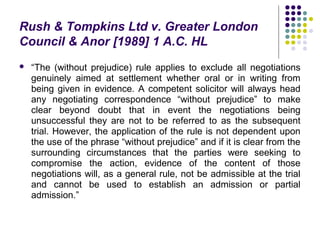
Rush & TompkinsLtd v. Greater London
Council & Anor [1989] 1 A.C. HL
“The (without prejudice) rule applies to exclude all negotiations
genuinely aimed at settlement whether oral or in writing from
being given in evidence. A competent solicitor will always head
any negotiating correspondence “without prejudice” to make
clear beyond doubt that in event the negotiations being
unsuccessful they are not to be referred to as the subsequent
trial. However, the application of the rule is not dependent upon
the use of the phrase “without prejudice” and if it is clear from the
surrounding circumstances that the parties were seeking to
compromise the action, evidence of the content of those
negotiations will, as a general rule, not be admissible at the trial
and cannot be used to establish an admission or partial
admission.”
63.
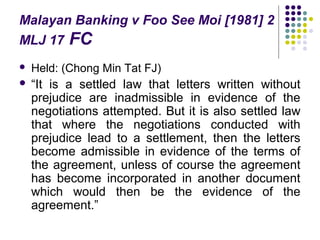
Malayan Banking vFoo See Moi [1981] 2
MLJ 17 FC
Held: (Chong Min Tat FJ)
“It is a settled law that letters written without
prejudice are inadmissible in evidence of the
negotiations attempted. But it is also settled law
that where the negotiations conducted with
prejudice lead to a settlement, then the letters
become admissible in evidence of the terms of
the agreement, unless of course the agreement
has become incorporated in another document
which would then be the evidence of the
agreement.”
Overseas Investment PteLtd v Anthony
William O`Brien & Anor
[1988] 3 MLJ 332
Facts:
In this case summary judgment had been obtained by
the plaintiff against the defendant for the sum of
S$120,689.02.
The plaintiff levied execution by way of a writ of seizure
and sale and some household goods were seized at the
premises alleged to be the residence of the defendant.
The wife of the defendant claimed that the goods had
been bought jointly and severally by her and her
husband but said she was unable to produce receipts
immediately.
66.
Overseas Investment PteLtd v Anthony
William O`Brien & Anor
[1988] 3 MLJ 332
The sheriff took out an interpleader summons.
At the hearing the claimant produced some receipts
and the matter was adjourned to enable her to
produce more receipts. The plaintiff agreed to release
11 items only.
At the adjourned hearing the claimant gave oral
evidence. The registrar on the material before him
dismissed her claim.
The goods were subsequently sold.
She appealed to the High Court.
67.
Overseas Investment PteLtd v Anthony
William O`Brien & Anor
[1988] 3 MLJ 332
Held: (M. Shankar J)
Where a case is to be decided on a context of affidavits,
the rule is that material allegations which are not
contradicted are deemed to be admitted.
The plaintiff in this case had produced no evidence of
the defendant's title in the goods.
Where one party gives sworn uncontradicted testimony
to prove a fact, that evidence must be accepted because
there is nothing in the other end of the scales. The
plaintiff had produced no evidence whatsoever.
68.
Overseas Investment PteLtd v Anthony
William O`Brien & Anor
[1988] 3 MLJ 332
The doctrine of harta sepencarian applied to all
property acquired in the course of a marriage out of
the joint resources or the joint efforts of the spouses.
In the absence of clear evidence that the property was
the sole property of one spouse, both have an equal
share.
Where a wife is in possession of chattles in the
matrimonial home and she gives sworn testimony that
they were hers, an execution creditor cannot be held
to have displaced her claim merely by producing
evidence that the husband was living in the same
home and is in receipt of good income.
69.
Overseas Investment PteLtd v Anthony
William O`Brien & Anor
[1988] 3 MLJ 332
This is not just a case of wrongful irregular execution. It
was an execution levied by the plaintiff on goods which
have been proved to be the property not of the
defendant`s but a third party against whom the plaintiff
has no judgment. Such wrongful seizure is an actionable
trespass and the remedy is in damages.
The decision of the registrar must be set aside and the
plaintiff be ordered to pay all damages suffered by the
claimant as a result of the seizure and sale.
Chong Khee SangV Pang Ah Chee [1984] 1
MLJ 377 CA
On 24 April 1978 one Cheah Soi Moi ("the deceased")
was killed when the motorcycle he was riding was
knocked into by a motor car. On 17 July 1979 his mother
commenced an action, suing the car driver as
administratrix of the deceased`s estate and in her own
capacity as dependant, for damages under ss 7 and 8 of
the Civil Law Act, 1956. In default of defence, an order
was made precluding the defendant from defending the
action. The case was set down for hearing for damages
to be assessed.
Solicitors for both parties corresponded and were agreed
on the contents of an Agreed Bundle but in the event,
the P's solicitors failed to prepare and file the Agreed
Bundle.
72.
Chong Khee SangV Pang Ah Chee [1984] 1
MLJ 377 CA
P’s counsel adverted to the oral and written
consent of Defence Counsel to include the
disputed receipts in the proposed Agreed
Bundle. Defence Counsel qualified that his
consent to include the receipts in the Agreed
Bundle was not an admission that he accepted
that payments as proved.
The learned President, having already admitted
the documents and marked them as and when
they were tendered by the P in her examination-
in-chief, ordered the case to proceed.
73.
Chong Khee SangV Pang Ah Chee [1984] 1
MLJ 377 CA
No evidence was given by the P that she had
disbursed the money for motorcycle repairs and
funeral expenses nor did she call on the issuers of the
receipts to prove the payments. The receipts were left
to prove themselves.
In his judgment, the learned President stated that to
his own knowledge Chinese funerals were expensive
and gave it as his opinion that $2,000 for funeral
expenses was fair and reasonable. He did not address
his mind to the issue whether the expenses were
proved.
The D appealed on the ground that the P had not
proved her case.
74.
Chong Khee SangV Pang Ah Chee [1984] 1
MLJ 377 CA
Held: (Mahadev Shankar J)
a document does not become admissible in
evidence merely because it has been handed to
the adjudicating officer and marked as an
exhibit;
a document cannot be admitted into evidence
and marked as such until it has been properly
proved;
a receipt is a document like any other and if it is
to be proved as a document such proof must be
given by its maker.
75.
Chong Khee SangV Pang Ah Chee [1984] 1
MLJ 377 CA
In this case none of the receipts which the
plaintiff tendered were properly proved.
The plaintiff did not give evidence that she
paid these monies, she did not witness
payment of the monies, she did not call
the people who had paid the monies, and
she did not call the people who had
received these monies
76.
Chong Khee SangV Pang Ah Chee [1984] 1
MLJ 377 CA
by not objecting to the admissibility of the documents
when they were tendered in examination-in-chief but
only during cross-examination, there was no waiver on
the facts of this case especially as it had only become
apparent during cross-examination that the plaintiff
had no first-hand knowledge of the contents of these
documents;
once a document is included in an Agreed Bundle, it is
no longer necessary to prove their existence or
execution. Nor is it necessary to produce the original.
But so far as the contents of the documents are
concerned, the truth of the same has still to be proved,
in the absence of any specific admission of the facts
therein contained.
77.
Chong Khee SangV Pang Ah Chee [1984] 1
MLJ 377 CA
Practice Note 2 of 1977 issued on 8 February
1977
To clarify the position the note expressly states:-
"It will make for willing compliance if solicitors
and counsel consider or realise that agreeing on
documents implies merely dispensation with
proof of their existence or execution and does
not dispense with proof of the averments or
allegations therein, unless agreed to on the
pleadings or in other admissions."
78.
Chong Khee SangV Pang Ah Chee [1984] 1
MLJ 377 CA
A further Practice Note 4 of 1977 was also
issued which appears to have done away
with the necessity of filing a bundle of
documents not agreed.
All these practice notes designed to protect
counsel in the preparation of cases and to
save time and expense of all concerned,
have over the years undoubtedly been
honoured more in their breach rather in their
observance.
Conditions tobe satisfied before the document
can be admitted in evidence.
s.90(1) of EA 1950 provides that
In any criminal or civil proceeding a document
produced by a computer or a statement
contained in such document, shall be
admissible as evidence of any fact stated
therein if the document was produced by the
computer in the course of its ordinary use,
whether or not the person tendering the same
is the maker of such document or statement.
81.
For the purpose of this section it may be
proved that a document was produced by a
computer in the course of its ordinary use by
tendering to the court a certificate signed by a
person who either before or after the
production of the document by the computer is
responsible for the management of the
operation of that computer or for the conduct
of the activities which that computer was used.
82.
Gnanasegaran a/l Prarajasingamv PP
[1997] 3 MLJ 1,11 CA
The appellant appealed, arguing that the computer
print-out evidence was not admissible because
s.90A of the Evidence Act 1950 required that in
the case of computerized records, a certificate had
to be produced to authenticate the records.
(Per Mahadez Shankar JCA) section 90(1) is an
updating of the ‘best evidence rule’ with the realities
of the electronic age, and now it is no longer
necessary to call the actual teller or bank clerk who
keyed in the date provided he did in the court of
ordinary use of the computer.
83.
Gnanasegaran a/l Prarajasingamv PP
[1997] 3 MLJ 1,11 CA
(Per Shaik Daud JCA ) s. 90A of the EA 1950
makes computerized records made in the
course of its ordinary use admissible if the
following is proven, ie that: (i) the documents
were produced by a computer; and (ii) the
computer records are produced in the course of
its ordinary use.
84.
Gnanasegaran a/l Prarajasingamv PP
[1997] 3 MLJ 1,11 CA
Proof can either be by a certificate signed by
someone solely in charge of the computer which
produced the printout as required by s 90A(2),
or by an officer of the bank.
In this case, Zainal was able to testify with
regard to the documents because he was in
charge of the operations of current accounts.
dismissing the appeal
85.
Presenting the
evidence incourt
Deemed clause of service
S.91 s.92 of EA 1950
Entire agreement clause
Conclusive evidence
TA Securities Bhdv Ng Yen Ling
[2000] 3 MLJ 743 HC
The Ps claimed for contra losses suffered by
them in share trading carried out under the D’s
account with them. In applying to open the
account, the D agreed with the P in para 23 of
the covenant and undertakings annexed to the
application form that service of any legal
process were to be by way of prepaid
registered post sent to the D’s address and
that the legal process shall be deemed to have
been duly served and duly received by the D
upon the expiry of three days after the posting
was effected.
88.
TA Securities Bhdv Ng Yen Ling
[2000] 3 MLJ 743 HC
The P obtained a judgment in default of appearance
against the D. The defendant filed an application to
set aside the default judgment which was dismissed
by the senior assistant registrar. The D appealed.
The D claimed that she did not receive the writ and
contending that the deeming was rebuttable, argued
that although it was not possible for the D to prove
non-receipt of the writ, the conduct of the D had
been consistent with her not having received the writ
and therefore her claim of not receiving the writ
should be accepted as cogent and credible.
Appeal dismissed.
89.
TA Securities Bhdv Ng Yen Ling
[2000] 3 MLJ 743 HC
Held: (Abdul Aziz J)
The writ in this case was sent by prepaid
registered post to the proper address of the
defendant and the deeming of para 23 and of O
10 r 3(1)(b) of the Rules of the High Court
1980 came into operation.
The words `shall be deemed` in para 23 meant
`shall be regarded as`, meaning that the
deeming was not meant to be a presumption
and was therefore not something that was
rebuttable.
90.
TA Securities Bhdv Ng Yen Ling
[2000] 3 MLJ 743 HC
The court was bound by authorities to hold that
the defendant was precluded from showing that
she did not receive the writ.
The court had to take it as conclusive that the
writ was served on her. It was therefore not
necessary for the court to consider the conduct
of the defendant
Lee Chee Weiv Tan Hor Peow Victor and Others
and another Appeal [2007] 3 SLR 537; [2007]
SGCA 22
In February 2005, the P entered into an
agreement to sell his shares in Distribution
Management Solutions Pte Ltd (“DMS”) (the
“Agreement”), a subsidiary of Accord
Customer Care Solutions Ltd (“ACCS”), to
the fourth defendant for $4.5m. The
Agreement expressly provided for the
parties’ position if listing did not take place
and further contained an “entire agreement”
clause.
93.
Lee Chee Weiv Tan Hor Peow Victor and Others
and another Appeal [2007] 3 SLR 537; [2007]
SGCA 22
Shortly thereafter, the Commercial Affairs Department
began an investigation into the affairs of ACCS and
some of its senior officers, which included the first,
third and fourth Ds. As a result, the prospective listing
plans of DMS were abandoned, and the fourth D
refused to complete the agreement. The first, third and
fourth Ds were subsequently convicted and sentenced
to imprisonment for engaging in a conspiracy to cheat
and the falsification of documents.
The plaintiff commenced proceedings against all four
Ds for breach of the Agreement, alleging that the
fourth D entered into the Agreement on behalf of all
the Ds.
94.
Lee Chee Weiv Tan Hor Peow Victor and Others
and another Appeal [2007] 3 SLR 537; [2007]
SGCA 22
The Ds argued that the P was not entitled to
enforce the Agreement on the grounds that:
(a) the failure to list DMS on the Main Board of the
Singapore Exchange, a contingent condition of the
Agreement;
(b) the failure to provide a resolution of the board
of directors of DMS approving the registration of
the transfer of the shares as required by the
Agreement; and
c) that the failure to list DMS frustrated the
purpose of the Agreement.
95.
Lee Chee Weiv Tan Hor Peow Victor and Others
and another Appeal [2007] 3 SLR 537; [2007]
SGCA 22
The trial judge rejected the D’s arguments
and found that the first and third Ds were
the principal parties interested in the
purchase of the plaintiff’s shares and
accordingly held the first, third and fourth
Ds liable for breach of the Agreement.
96.
Lee Chee Weiv Tan Hor Peow Victor and Others
and another Appeal [2007] 3 SLR 537; [2007]
SGCA 22
Nonetheless, the trial judge ordered
nominal damages of $300 and disallowed
the P’s claims for specific performance or
damages in lieu of specific performance
due to the failure by the p to plead for
damages “to be assessed”.
97.
Lee Chee Weiv Tan Hor Peow Victor and Others
and another Appeal [2007] 3 SLR 537; [2007]
SGCA 22
A counterclaim by the fourth D for
repayment of the sum of $750,000 paid as
an initial deposit under the agreement was
also allowed on the basis that the P was
not entitled to retain the money paid
unless the Agreement specifically
provided that it was paid as a non-
refundable deposit or if the P actually
performed his part of the bargain.
98.
Lee Chee Weiv Tan Hor Peow Victor and Others
and another Appeal [2007] 3 SLR 537; [2007]
SGCA 22
The P was dissatisfied and appealed on the
grounds:
(a) that specific performance of the sale and
purchase agreement for shares in a public
company should have been ordered;
(b) if not, damages in lieu of specific performance
and the assessment should have been granted;
and
(c) that the counterclaim for payment of the sum of
$750,000 should have been allowed. The fourth
defendant cross-appealed in relation to the finding
of liability.
99.
Lee Chee Weiv Tan Hor Peow Victor and Others
and another Appeal [2007] 3 SLR 537; [2007]
SGCA 22
Held: (VK Rajah JA)
The effect of an entire agreement clause was
essentially a matter of contractual interpretation and
necessarily depended upon its precise wording and
context. Generally, such clauses were conducive to
certainty as they defined and confined the parties’
rights and obligations within the four corners of the
written document, thereby precluding any attempt to
qualify or supplement the document by reference to
pre-contractual representations.
100.
Lee Chee Weiv Tan Hor Peow Victor and Others
and another Appeal [2007] 3 SLR 537; [2007]
SGCA 22
However, in so far as contracts were not
interpreted in a vacuum, objective facts could
potentially assist in the interpretation of
ambiguous terms.
Entire agreement clauses would usually not
prevent a court from justifiably adopting a
contextual approach in contract
interpretation. Such clauses had little bearing
on textual or interpretative controversies as to
the meaning of particular words or terms in
contracts

 Most read
 Most read
 Most read