MD. Mizanul Hoque, PCIU
Law School
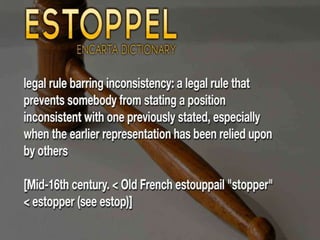
 The term estoppel is said to have been derived
from the French term 'estoup' which means 'shut
the mouth'.
 The doctrine of estoppel is a rule of evidence
contained in Section 115 of the Evidence Act.
When one person by his declaration , act or
omission intentionally caused or permitted
another to believe a thing to be true and act
upon such belief, neither he nor his
representative shall be allowed in any suit or
proceeding between himself and such person or
his representative to deny the truth of that thing
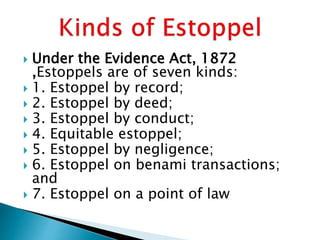
 Under the Evidence Act, 1872
,Estoppels are of seven kinds:
 1. Estoppel by record;
 2. Estoppel by deed;
 3. Estoppel by conduct;
 4. Equitable estoppel;
 5. Estoppel by negligence;
 6. Estoppel on benami transactions;
and
 7. Estoppel on a point of law
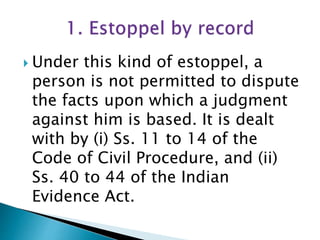
 Under this kind of estoppel, a
person is not permitted to dispute
the facts upon which a judgment
against him is based. It is dealt
with by (i) Ss. 11 to 14 of the
Code of Civil Procedure, and (ii)
Ss. 40 to 44 of the Indian
Evidence Act.
 Under this kind of estoppel,
where a party has entered into
a solemn engagement by deed
as to certain facts, neither he,
nor any one claiming through
or under him, is permitted to
deny such facts.
 Sometimes called estoppel in pais, may arise from
agreement, misrepresentation, or negligence.
Estoppel in pais is dealt with in Ss. 115 to 117.
(Estoppel in pais means “estoppel in the country” or
“estoppel before the public.”)
 If a man, either by words or by conduct, has
intimated that he consents to an act which has
been done, and that he will not offer any
opposition to it, although it could not have been
lawfully done without his consent, and he thereby
induces others to do that from which they
otherwise might have abstained from doing, he
cannot question the legality of the act to the
prejudice of those who have so given faith to his
words, or to the fair inference to be drawn from his
conduct. S. 115 deals with estoppel by
representation by act or conduct, and Ss. 116 and
117 deal with estoppel by agreement or contract
 The Evidence Act is not exhaustive of the rules of
estoppel. Thus, although S. 116 only deals with the
estoppel that arises against a tenant or licensee, a
similar estoppel has been held to arise against a
mortgagee, an executor, a legatee, a trustee, or an
assignee of property, precluding him from denying
the title of the mortgagor, the testator, the author of
the trust, or the assignor, as the case may be.
 Further, S. 116 is not exhaustive of all instances of
estoppel as between landlord and tenant. Thus, there
are cases of estoppel which, though not within the
terms of Ss. 115 to 117 of the Evidence Act, are
recognised instances of estoppel. Estoppels which are
not covered by the Evidence Act may be termed
equitable estoppels.
 This type of estoppel enables a party, as against
some other party, to claim a right of property
which in fact he does not possess. Such estoppel
is described as estoppel by negligence or by
conduct or representation or by a holding out of
ostensible authority. Such estoppel is based on
the existence of a duty which the person
estopped is owing to the person led into the
wrong belief or to the general public of whom the
person is one. (Mercantile Ваnk. Central Bank,
(A.I.R, 1938 Privy Council, 52)
 If the owner of property clothes a third
person with the apparent ownership and a
right of disposition thereof, not merely by
transferring it to him, but also by
acknowledging that the transferee has paid
him the consideration for it, he is estopped
from asserting his title as against a person to
whom such third party has disposed of the
property and who has taken it in good faith
and for value. (Li Tse Shi v Pong Tse Ching,
(A.I.R. 1935 P.C. 208)
 Estoppel refers to a belief in a fact, and not in
a proposition of law. A person cannot be
estopped for a misrepresentation on a point
of law. An admission on a point of law is not
an admission of a “thing” so as to make the
admission matter of estoppel. Where persons
merely represent their conclusions of law as
to the validity of an assumed or admitted
adoption, there is no representation of a fact
to constitute an estoppel.
 The principle of estoppel cannot be invoked to defeat
the plain provisions or a statute. There is no estoppel
against an Act of Legislature. Thus, if a minor
represents himself to be of the age of majority, and
thereafter enters into an agreement, the agreement is
void, and the minor is not estopped from pleading that
the agreement is void ab initio, as he was, in truth, a
minor at the date of making the contract.
 Estoppel only applies to a contract inter partes, and it is
not open to parties to a contract to estop themselves or
anybody else in the face of an Act. The rule of estoppel
is one of evidence. It cannot prevail against a plain and
mandatory provision of law.
 The Supreme Court has observed that
the doctrine of estoppel does not
operate where the mandatory
conditions laid down by law on
grounds of public policy are ignored.
Thus, estoppel would not apply
against a sanction obtained by fraud
or by collusion between the parties.
(S.В. Noronah v. Prem Kumari Khanna,
(1980) 1 S.C.C. 52)
 Res Judicata is defined
in Section 11 of
the Code of Civil
Procedure.
 Res Judicata is based
on the principle that
there must be an end
to a litigation. Thus it
prevents multiplicity of
suits.
 Estoppel is defined in
Section 115 of the
Evidence Act,1872.
 Estoppel seeks to
prevent multiplicity of
representation.
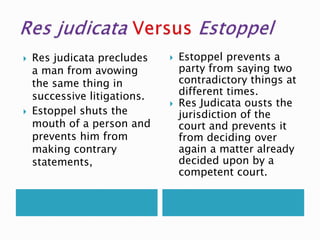
 Res judicata precludes
a man from avowing
the same thing in
successive litigations.
 Estoppel shuts the
mouth of a person and
prevents him from
making contrary
statements,
 Estoppel prevents a
party from saying two
contradictory things at
different times.
 Res Judicata ousts the
jurisdiction of the
court and prevents it
from deciding over
again a matter already
decided upon by a
competent court.
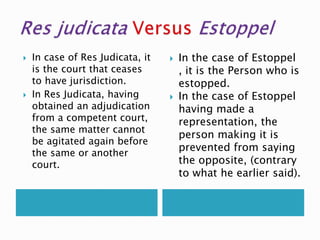
 In case of Res Judicata, it
is the court that ceases
to have jurisdiction.
 In Res Judicata, having
obtained an adjudication
from a competent court,
the same matter cannot
be agitated again before
the same or another
court.
 In the case of Estoppel
, it is the Person who is
estopped.
 In the case of Estoppel
having made a
representation, the
person making it is
prevented from saying
the opposite, (contrary
to what he earlier said).
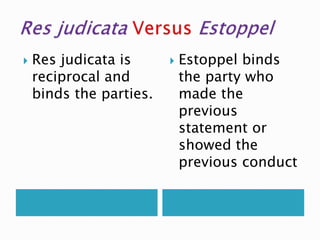
 Res judicata is
reciprocal and
binds the parties.
 Estoppel binds
the party who
made the
previous
statement or
showed the
previous conduct

Estoppel and Its Kind

  • 1.
    MD. Mizanul Hoque,PCIU Law School
  • 2.
     The termestoppel is said to have been derived from the French term 'estoup' which means 'shut the mouth'.  The doctrine of estoppel is a rule of evidence contained in Section 115 of the Evidence Act. When one person by his declaration , act or omission intentionally caused or permitted another to believe a thing to be true and act upon such belief, neither he nor his representative shall be allowed in any suit or proceeding between himself and such person or his representative to deny the truth of that thing
  • 4.
     Under theEvidence Act, 1872 ,Estoppels are of seven kinds:  1. Estoppel by record;  2. Estoppel by deed;  3. Estoppel by conduct;  4. Equitable estoppel;  5. Estoppel by negligence;  6. Estoppel on benami transactions; and  7. Estoppel on a point of law
  • 5.
     Under thiskind of estoppel, a person is not permitted to dispute the facts upon which a judgment against him is based. It is dealt with by (i) Ss. 11 to 14 of the Code of Civil Procedure, and (ii) Ss. 40 to 44 of the Indian Evidence Act.
  • 6.
     Under thiskind of estoppel, where a party has entered into a solemn engagement by deed as to certain facts, neither he, nor any one claiming through or under him, is permitted to deny such facts.
  • 7.
     Sometimes calledestoppel in pais, may arise from agreement, misrepresentation, or negligence. Estoppel in pais is dealt with in Ss. 115 to 117. (Estoppel in pais means “estoppel in the country” or “estoppel before the public.”)  If a man, either by words or by conduct, has intimated that he consents to an act which has been done, and that he will not offer any opposition to it, although it could not have been lawfully done without his consent, and he thereby induces others to do that from which they otherwise might have abstained from doing, he cannot question the legality of the act to the prejudice of those who have so given faith to his words, or to the fair inference to be drawn from his conduct. S. 115 deals with estoppel by representation by act or conduct, and Ss. 116 and 117 deal with estoppel by agreement or contract
  • 8.
     The EvidenceAct is not exhaustive of the rules of estoppel. Thus, although S. 116 only deals with the estoppel that arises against a tenant or licensee, a similar estoppel has been held to arise against a mortgagee, an executor, a legatee, a trustee, or an assignee of property, precluding him from denying the title of the mortgagor, the testator, the author of the trust, or the assignor, as the case may be.  Further, S. 116 is not exhaustive of all instances of estoppel as between landlord and tenant. Thus, there are cases of estoppel which, though not within the terms of Ss. 115 to 117 of the Evidence Act, are recognised instances of estoppel. Estoppels which are not covered by the Evidence Act may be termed equitable estoppels.
  • 9.
     This typeof estoppel enables a party, as against some other party, to claim a right of property which in fact he does not possess. Such estoppel is described as estoppel by negligence or by conduct or representation or by a holding out of ostensible authority. Such estoppel is based on the existence of a duty which the person estopped is owing to the person led into the wrong belief or to the general public of whom the person is one. (Mercantile Ваnk. Central Bank, (A.I.R, 1938 Privy Council, 52)
  • 10.
     If theowner of property clothes a third person with the apparent ownership and a right of disposition thereof, not merely by transferring it to him, but also by acknowledging that the transferee has paid him the consideration for it, he is estopped from asserting his title as against a person to whom such third party has disposed of the property and who has taken it in good faith and for value. (Li Tse Shi v Pong Tse Ching, (A.I.R. 1935 P.C. 208)
  • 11.
     Estoppel refersto a belief in a fact, and not in a proposition of law. A person cannot be estopped for a misrepresentation on a point of law. An admission on a point of law is not an admission of a “thing” so as to make the admission matter of estoppel. Where persons merely represent their conclusions of law as to the validity of an assumed or admitted adoption, there is no representation of a fact to constitute an estoppel.
  • 12.
     The principleof estoppel cannot be invoked to defeat the plain provisions or a statute. There is no estoppel against an Act of Legislature. Thus, if a minor represents himself to be of the age of majority, and thereafter enters into an agreement, the agreement is void, and the minor is not estopped from pleading that the agreement is void ab initio, as he was, in truth, a minor at the date of making the contract.  Estoppel only applies to a contract inter partes, and it is not open to parties to a contract to estop themselves or anybody else in the face of an Act. The rule of estoppel is one of evidence. It cannot prevail against a plain and mandatory provision of law.
  • 13.
     The SupremeCourt has observed that the doctrine of estoppel does not operate where the mandatory conditions laid down by law on grounds of public policy are ignored. Thus, estoppel would not apply against a sanction obtained by fraud or by collusion between the parties. (S.В. Noronah v. Prem Kumari Khanna, (1980) 1 S.C.C. 52)
  • 14.
     Res Judicatais defined in Section 11 of the Code of Civil Procedure.  Res Judicata is based on the principle that there must be an end to a litigation. Thus it prevents multiplicity of suits.  Estoppel is defined in Section 115 of the Evidence Act,1872.  Estoppel seeks to prevent multiplicity of representation.
  • 15.
     Res judicataprecludes a man from avowing the same thing in successive litigations.  Estoppel shuts the mouth of a person and prevents him from making contrary statements,  Estoppel prevents a party from saying two contradictory things at different times.  Res Judicata ousts the jurisdiction of the court and prevents it from deciding over again a matter already decided upon by a competent court.
  • 16.
     In caseof Res Judicata, it is the court that ceases to have jurisdiction.  In Res Judicata, having obtained an adjudication from a competent court, the same matter cannot be agitated again before the same or another court.  In the case of Estoppel , it is the Person who is estopped.  In the case of Estoppel having made a representation, the person making it is prevented from saying the opposite, (contrary to what he earlier said).
  • 17.
     Res judicatais reciprocal and binds the parties.  Estoppel binds the party who made the previous statement or showed the previous conduct