Oracle AIM Methodology
An Overview
Presented By:-
Feras Ahmad
Agenda
• What is Oracle AIM
• Oracle AIM – Structure
• Oracle AIM – Phases
• Oracle AIM – Processes
• Oracle AIM – Preview / Demo
• Recommendations
• Questions
Software Development Methodology
•Waterfall
•Prototyping
•Incremental
•Rapid Application
Development
•Rational Unified Process
•Agile Unified Process
Project Management Methods
•Project Management Institute –
PMBOK
•PRINCE 2
•Critical Chain Project Management
•Process based Project Mgmt
•Agile Project Management
Before moving ahead, Let’s capture the
Answers for some AIM Related Questions !!
Oracle Methodologies
• Oracle AIM 3.1 ( Application Implementation Methodology)
• Oracle EMM ( Easy Migration Methodology)
• Oracle Unified Method ( OUM)
• Our discussion is focus on “Oracle AIM”, version
3.1 ( also known as AIM Advantage)
What Oracle says about AIM
AIM brings a proven process to the table for implementing Oracle E-
Business Suite Business Solutions with
Highest degree of quality
Quick return on investment
Short time to benefit
A Complete, Effective Toolkit
Pre-seeded Content and
Sample Data
Deliverable Templates
Customizable Workplans
Project Management Support
On-line, Context Sensitive
Documentation
All delivered in an easy-to-use, web-based
interface
Detailed Task Description
What is Oracle AIM
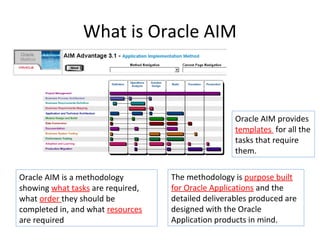
Oracle AIM provides
templates for all the
tasks that require
them.
Oracle AIM is a methodology
showing what tasks are required,
what order they should be
completed in, and what resources
are required
The methodology is purpose built
for Oracle Applications and the
detailed deliverables produced are
designed with the Oracle
Application products in mind.
Oracle AIM - Advantages
• Oracle's AIM is a proven approach for implementing packaged applications. It
comprises a set of well defined processes that can be managed in several ways
to guide you through an application implementation project.
• AIM provides the tools needed to effectively and efficiently plan, conduct, and
control project steps to successfully implement business solutions.
• AIM defines business needs at the beginning of the project and maintains their
visibility throughout the implementation.
• It defines internal, external, and time sensitive business events and maps each
event to the responding business and system processes.
• Client gains an accurate understanding of the business requirements that need
to be focused on during the course of the implementation.
Oracle AIM - Structure
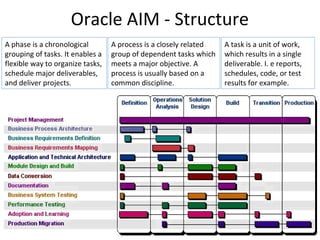
A task is a unit of work,
which results in a single
deliverable. I. e reports,
schedules, code, or test
results for example.
A process is a closely related
group of dependent tasks which
meets a major objective. A
process is usually based on a
common discipline.
A phase is a chronological
grouping of tasks. It enables a
flexible way to organize tasks,
schedule major deliverables,
and deliver projects.
Oracle AIM – Project Phases
• An AIM project is conducted in phases that provide quality and
control checkpoints to co-ordinate project activities that have a
common goal.
• During a project phase, your project team will be executing tasks
from several processes
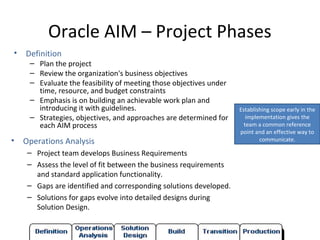
• Oracle AIM Project Phases as follows ( 6 Phases )
– Definitions
– Operation Analysis
– Solution Design
– Build
– Transition
– Production
Oracle AIM – Project Phases
• Definition
– Plan the project
– Review the organization's business objectives
– Evaluate the feasibility of meeting those objectives under
time, resource, and budget constraints
– Emphasis is on building an achievable work plan and
introducing it with guidelines.
– Strategies, objectives, and approaches are determined for
each AIM process
Establishing scope early in the
implementation gives the
team a common reference
point and an effective way to
communicate.• Operations Analysis
– Project team develops Business Requirements
– Assess the level of fit between the business requirements
and standard application functionality.
– Gaps are identified and corresponding solutions developed.
– Solutions for gaps evolve into detailed designs during
Solution Design.
Oracle AIM – Project Phases
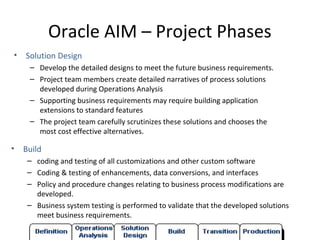
• Solution Design
– Develop the detailed designs to meet the future business requirements.
– Project team members create detailed narratives of process solutions
developed during Operations Analysis
– Supporting business requirements may require building application
extensions to standard features
– The project team carefully scrutinizes these solutions and chooses the
most cost effective alternatives.
• Build
– coding and testing of all customizations and other custom software
– Coding & testing of enhancements, data conversions, and interfaces
– Policy and procedure changes relating to business process modifications are
developed.
– Business system testing is performed to validate that the developed solutions
meet business requirements.
Oracle AIM – Project Phases
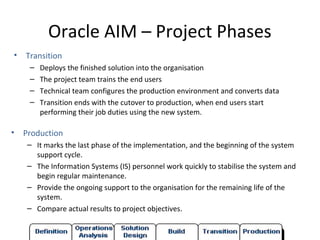
• Transition
– Deploys the finished solution into the organisation
– The project team trains the end users
– Technical team configures the production environment and converts data
– Transition ends with the cutover to production, when end users start
performing their job duties using the new system.
• Production
– It marks the last phase of the implementation, and the beginning of the system
support cycle.
– The Information Systems (IS) personnel work quickly to stabilise the system and
begin regular maintenance.
– Provide the ongoing support to the organisation for the remaining life of the
system.
– Compare actual results to project objectives.
Oracle AIM – Processes
• A process in AIM represents a related set of
objectives, resource skill requirements, inputs, and
deliverable outputs.
• A task can belong to only one process.
• Project team members are usually assigned to a
process according to their specialization and
background.
• 12 Processes as referred in AIM –
– Project Management
– Business Process architecture
– Business Requirement Definition
– Business requirement definition
– Application & technical architecture
– Module Design & Build
– Data Conversion
– Documentation
– Business System Testing
– Performance Testing
– Adoption & Learning
– Production migration.
Oracle AIM – Processes
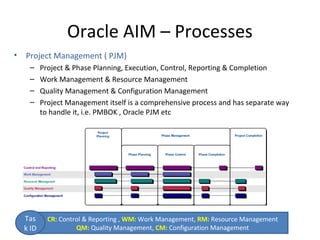
• Project Management ( PJM)
– Project & Phase Planning, Execution, Control, Reporting & Completion
– Work Management & Resource Management
– Quality Management & Configuration Management
– Project Management itself is a comprehensive process and has separate way
to handle it, i.e. PMBOK , Oracle PJM etc
CR: Control & Reporting , WM: Work Management, RM: Resource Management
QM: Quality Management, CM: Configuration Management
Tas
k ID
Oracle AIM – Processes
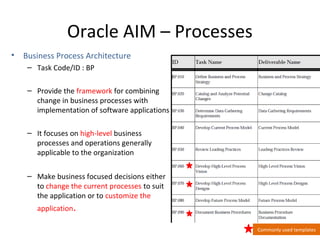
• Business Process Architecture
– Task Code/ID : BP
– Provide the framework for combining
change in business processes with
implementation of software applications
– It focuses on high-level business
processes and operations generally
applicable to the organization
– Make business focused decisions either
to change the current processes to suit
the application or to customize the
application.
Commonly used templates
Oracle AIM – Processes
• Business Requirements Definition
– Task Code/ ID: RD
– Defines the business needs that must be
met by the implementation project.
– Develop a complete set of business
requirements scenarios that can be used
to map business requirements to
application functionality.
– Analyze and identify the reporting
requirements for the business
– Carefully document audit and control
requirements to satisfy financial and
quality policies.
Commonly used templates
Oracle AIM – Processes
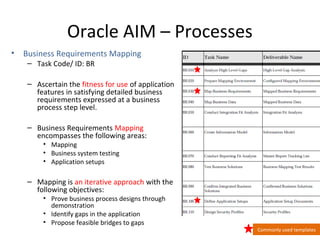
• Business Requirements Mapping
– Task Code/ ID: BR
– Ascertain the fitness for use of application
features in satisfying detailed business
requirements expressed at a business
process step level.
– Business Requirements Mapping
encompasses the following areas:
• Mapping
• Business system testing
• Application setups
– Mapping is an iterative approach with the
following objectives:
• Prove business process designs through
demonstration
• Identify gaps in the application
• Propose feasible bridges to gaps
Commonly used templates
Oracle AIM – Processes
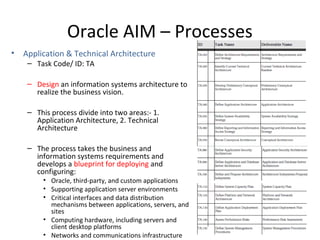
• Application & Technical Architecture
– Task Code/ ID: TA
– Design an information systems architecture to
realize the business vision.
– This process divide into two areas:- 1.
Application Architecture, 2. Technical
Architecture
– The process takes the business and
information systems requirements and
develops a blueprint for deploying and
configuring:
• Oracle, third-party, and custom applications
• Supporting application server environments
• Critical interfaces and data distribution
mechanisms between applications, servers, and
sites
• Computing hardware, including servers and
client desktop platforms
• Networks and communications infrastructure
Oracle AIM – Processes
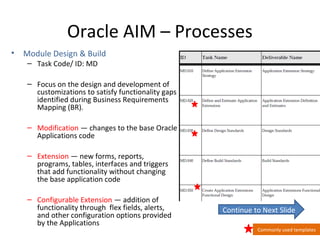
• Module Design & Build
– Task Code/ ID: MD
– Focus on the design and development of
customizations to satisfy functionality gaps
identified during Business Requirements
Mapping (BR).
– Modification — changes to the base Oracle
Applications code
– Extension — new forms, reports,
programs, tables, interfaces and triggers
that add functionality without changing
the base application code
– Configurable Extension — addition of
functionality through flex fields, alerts,
and other configuration options provided
by the Applications
Commonly used templates
Continue to Next Slide
Oracle AIM – Processes
• Module Design & Build
Oracle AIM – Processes
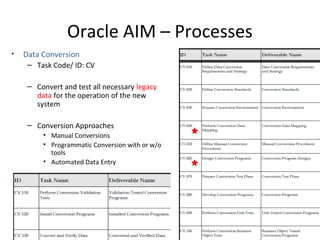
• Data Conversion
– Task Code/ ID: CV
– Convert and test all necessary legacy
data for the operation of the new
system
– Conversion Approaches
• Manual Conversions
• Programmatic Conversion with or w/o
tools
• Automated Data Entry
Oracle AIM – Processes
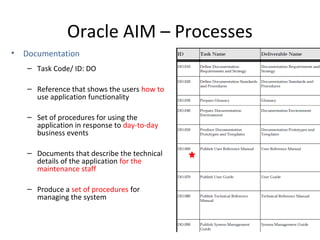
• Documentation
– Task Code/ ID: DO
– Reference that shows the users how to
use application functionality
– Set of procedures for using the
application in response to day-to-day
business events
– Documents that describe the technical
details of the application for the
maintenance staff
– Produce a set of procedures for
managing the system
Oracle AIM – Processes
• Business System Testing
– Task Code/ ID: TE
– Three main aspects of Business Testing – Planning, Early Introduction of Testing &
CRP
– Business System Testing does not address performance testing or the testing of
data conversion programs
Oracle AIM – Processes
• Performance Testing
– Task Code/ ID: PT
– Enables you to define, build, and execute a
performance test.
– To make decisions on whether the
performance is acceptable for the business
– Propose tactical or strategic changes to
address the performance quality shortfall.
– Automated V/s Manual
– Types of Performance Testing
• System Performance
• Module/ Code Performance
• Hardware and Networks
Oracle AIM – Processes
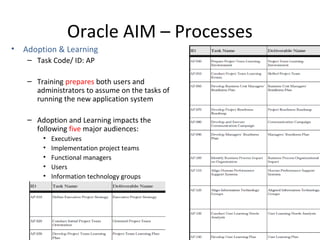
• Adoption & Learning
– Task Code/ ID: AP
– Training prepares both users and
administrators to assume on the tasks of
running the new application system
– Adoption and Learning impacts the
following five major audiences:
• Executives
• Implementation project teams
• Functional managers
• Users
• Information technology groups
Oracle AIM – Processes
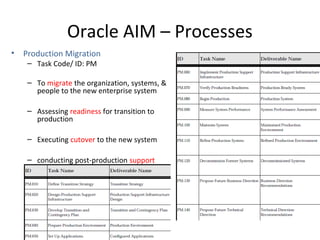
• Production Migration
– Task Code/ ID: PM
– To migrate the organization, systems, &
people to the new enterprise system
– Assessing readiness for transition to
production
– Executing cutover to the new system
– conducting post-production support
Oracle AIM - DEMO
• Oracle AIM Advantage 3.1 Demo
• Templates
• Q&A
• Discussion
My Experience & Thoughts
• CR010 – Project Management Plan /
Project Plan (WM020)
• Overview Training
• RD010 – Organization Structure
• RD020 – Business Requirement
Gathering
• RD050 / BR030 – MAP Business
Requirements
• TA040 –Application Architecture Strategy
• CRP Session I
• BP080 – Future Business Model
• BR010 – GAP Analysis
• CRP Session II
• MD050 – Functional Design
• MD070 –Technical Design
• System Integration Testing
• CV010 – Data conversion Strategy
• CV060 – Data Conversion Templates
• PM010 –Transition Strategy
• TE040 –Test Scripts
• BR110 – Security Profiles (Roles and
Responsibility Matrix)
• User Acceptance Testing (UAT)
• Cutover and Production Migration
Plan
• End User Training (End User Manual)
• BR100 –Application Set up
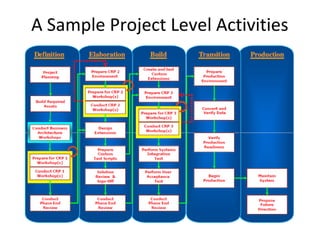
A Sample Project Level Activities
Some Recommendations
1. Follow the documentation principle like Preparer, reviewer with dates
and approvers with version controls details in all documents.
2. Try to avoid Word, Excel, PPT attachments to the templates.
3. Collect enough details from client to prepare the process flow.
4. Stick on to the Project schedule to submit the documents on time.
5. Ensure to fill the open and closed issues on all updates if any.
6. Follow the uniformity in using templates across all modules.
7. Avoid providing internal intranet URL etc for reference.
8. Follow the Oracle Custom standards while preparing Technical Docs.
9. Documents prepared by one person must be reviewed by another
before submitting to Client.
10.Get a sign off from client and as well as from PM on all docs.
Questions ?
Presented By:-
Feras Ahmad

Oracle AIM Methodology

  • 1.
    Oracle AIM Methodology AnOverview Presented By:- Feras Ahmad
  • 2.
    Agenda • What isOracle AIM • Oracle AIM – Structure • Oracle AIM – Phases • Oracle AIM – Processes • Oracle AIM – Preview / Demo • Recommendations • Questions
  • 3.
    Software Development Methodology •Waterfall •Prototyping •Incremental •RapidApplication Development •Rational Unified Process •Agile Unified Process
  • 4.
    Project Management Methods •ProjectManagement Institute – PMBOK •PRINCE 2 •Critical Chain Project Management •Process based Project Mgmt •Agile Project Management Before moving ahead, Let’s capture the Answers for some AIM Related Questions !!
  • 5.
    Oracle Methodologies • OracleAIM 3.1 ( Application Implementation Methodology) • Oracle EMM ( Easy Migration Methodology) • Oracle Unified Method ( OUM) • Our discussion is focus on “Oracle AIM”, version 3.1 ( also known as AIM Advantage)
  • 6.
    What Oracle saysabout AIM AIM brings a proven process to the table for implementing Oracle E- Business Suite Business Solutions with Highest degree of quality Quick return on investment Short time to benefit
  • 7.
    A Complete, EffectiveToolkit Pre-seeded Content and Sample Data Deliverable Templates Customizable Workplans Project Management Support On-line, Context Sensitive Documentation All delivered in an easy-to-use, web-based interface Detailed Task Description
  • 8.
    What is OracleAIM Oracle AIM provides templates for all the tasks that require them. Oracle AIM is a methodology showing what tasks are required, what order they should be completed in, and what resources are required The methodology is purpose built for Oracle Applications and the detailed deliverables produced are designed with the Oracle Application products in mind.
  • 9.
    Oracle AIM -Advantages • Oracle's AIM is a proven approach for implementing packaged applications. It comprises a set of well defined processes that can be managed in several ways to guide you through an application implementation project. • AIM provides the tools needed to effectively and efficiently plan, conduct, and control project steps to successfully implement business solutions. • AIM defines business needs at the beginning of the project and maintains their visibility throughout the implementation. • It defines internal, external, and time sensitive business events and maps each event to the responding business and system processes. • Client gains an accurate understanding of the business requirements that need to be focused on during the course of the implementation.
  • 10.
    Oracle AIM -Structure A task is a unit of work, which results in a single deliverable. I. e reports, schedules, code, or test results for example. A process is a closely related group of dependent tasks which meets a major objective. A process is usually based on a common discipline. A phase is a chronological grouping of tasks. It enables a flexible way to organize tasks, schedule major deliverables, and deliver projects.
  • 11.
    Oracle AIM –Project Phases • An AIM project is conducted in phases that provide quality and control checkpoints to co-ordinate project activities that have a common goal. • During a project phase, your project team will be executing tasks from several processes • Oracle AIM Project Phases as follows ( 6 Phases ) – Definitions – Operation Analysis – Solution Design – Build – Transition – Production
  • 12.
    Oracle AIM –Project Phases • Definition – Plan the project – Review the organization's business objectives – Evaluate the feasibility of meeting those objectives under time, resource, and budget constraints – Emphasis is on building an achievable work plan and introducing it with guidelines. – Strategies, objectives, and approaches are determined for each AIM process Establishing scope early in the implementation gives the team a common reference point and an effective way to communicate.• Operations Analysis – Project team develops Business Requirements – Assess the level of fit between the business requirements and standard application functionality. – Gaps are identified and corresponding solutions developed. – Solutions for gaps evolve into detailed designs during Solution Design.
  • 13.
    Oracle AIM –Project Phases • Solution Design – Develop the detailed designs to meet the future business requirements. – Project team members create detailed narratives of process solutions developed during Operations Analysis – Supporting business requirements may require building application extensions to standard features – The project team carefully scrutinizes these solutions and chooses the most cost effective alternatives. • Build – coding and testing of all customizations and other custom software – Coding & testing of enhancements, data conversions, and interfaces – Policy and procedure changes relating to business process modifications are developed. – Business system testing is performed to validate that the developed solutions meet business requirements.
  • 14.
    Oracle AIM –Project Phases • Transition – Deploys the finished solution into the organisation – The project team trains the end users – Technical team configures the production environment and converts data – Transition ends with the cutover to production, when end users start performing their job duties using the new system. • Production – It marks the last phase of the implementation, and the beginning of the system support cycle. – The Information Systems (IS) personnel work quickly to stabilise the system and begin regular maintenance. – Provide the ongoing support to the organisation for the remaining life of the system. – Compare actual results to project objectives.
  • 15.
    Oracle AIM –Processes • A process in AIM represents a related set of objectives, resource skill requirements, inputs, and deliverable outputs. • A task can belong to only one process. • Project team members are usually assigned to a process according to their specialization and background. • 12 Processes as referred in AIM – – Project Management – Business Process architecture – Business Requirement Definition – Business requirement definition – Application & technical architecture – Module Design & Build – Data Conversion – Documentation – Business System Testing – Performance Testing – Adoption & Learning – Production migration.
  • 16.
    Oracle AIM –Processes • Project Management ( PJM) – Project & Phase Planning, Execution, Control, Reporting & Completion – Work Management & Resource Management – Quality Management & Configuration Management – Project Management itself is a comprehensive process and has separate way to handle it, i.e. PMBOK , Oracle PJM etc CR: Control & Reporting , WM: Work Management, RM: Resource Management QM: Quality Management, CM: Configuration Management Tas k ID
  • 17.
    Oracle AIM –Processes • Business Process Architecture – Task Code/ID : BP – Provide the framework for combining change in business processes with implementation of software applications – It focuses on high-level business processes and operations generally applicable to the organization – Make business focused decisions either to change the current processes to suit the application or to customize the application. Commonly used templates
  • 18.
    Oracle AIM –Processes • Business Requirements Definition – Task Code/ ID: RD – Defines the business needs that must be met by the implementation project. – Develop a complete set of business requirements scenarios that can be used to map business requirements to application functionality. – Analyze and identify the reporting requirements for the business – Carefully document audit and control requirements to satisfy financial and quality policies. Commonly used templates
  • 19.
    Oracle AIM –Processes • Business Requirements Mapping – Task Code/ ID: BR – Ascertain the fitness for use of application features in satisfying detailed business requirements expressed at a business process step level. – Business Requirements Mapping encompasses the following areas: • Mapping • Business system testing • Application setups – Mapping is an iterative approach with the following objectives: • Prove business process designs through demonstration • Identify gaps in the application • Propose feasible bridges to gaps Commonly used templates
  • 20.
    Oracle AIM –Processes • Application & Technical Architecture – Task Code/ ID: TA – Design an information systems architecture to realize the business vision. – This process divide into two areas:- 1. Application Architecture, 2. Technical Architecture – The process takes the business and information systems requirements and develops a blueprint for deploying and configuring: • Oracle, third-party, and custom applications • Supporting application server environments • Critical interfaces and data distribution mechanisms between applications, servers, and sites • Computing hardware, including servers and client desktop platforms • Networks and communications infrastructure
  • 21.
    Oracle AIM –Processes • Module Design & Build – Task Code/ ID: MD – Focus on the design and development of customizations to satisfy functionality gaps identified during Business Requirements Mapping (BR). – Modification — changes to the base Oracle Applications code – Extension — new forms, reports, programs, tables, interfaces and triggers that add functionality without changing the base application code – Configurable Extension — addition of functionality through flex fields, alerts, and other configuration options provided by the Applications Commonly used templates Continue to Next Slide
  • 22.
    Oracle AIM –Processes • Module Design & Build
  • 23.
    Oracle AIM –Processes • Data Conversion – Task Code/ ID: CV – Convert and test all necessary legacy data for the operation of the new system – Conversion Approaches • Manual Conversions • Programmatic Conversion with or w/o tools • Automated Data Entry
  • 24.
    Oracle AIM –Processes • Documentation – Task Code/ ID: DO – Reference that shows the users how to use application functionality – Set of procedures for using the application in response to day-to-day business events – Documents that describe the technical details of the application for the maintenance staff – Produce a set of procedures for managing the system
  • 25.
    Oracle AIM –Processes • Business System Testing – Task Code/ ID: TE – Three main aspects of Business Testing – Planning, Early Introduction of Testing & CRP – Business System Testing does not address performance testing or the testing of data conversion programs
  • 26.
    Oracle AIM –Processes • Performance Testing – Task Code/ ID: PT – Enables you to define, build, and execute a performance test. – To make decisions on whether the performance is acceptable for the business – Propose tactical or strategic changes to address the performance quality shortfall. – Automated V/s Manual – Types of Performance Testing • System Performance • Module/ Code Performance • Hardware and Networks
  • 27.
    Oracle AIM –Processes • Adoption & Learning – Task Code/ ID: AP – Training prepares both users and administrators to assume on the tasks of running the new application system – Adoption and Learning impacts the following five major audiences: • Executives • Implementation project teams • Functional managers • Users • Information technology groups
  • 28.
    Oracle AIM –Processes • Production Migration – Task Code/ ID: PM – To migrate the organization, systems, & people to the new enterprise system – Assessing readiness for transition to production – Executing cutover to the new system – conducting post-production support
  • 29.
    Oracle AIM -DEMO • Oracle AIM Advantage 3.1 Demo • Templates • Q&A • Discussion
  • 30.
    My Experience &Thoughts • CR010 – Project Management Plan / Project Plan (WM020) • Overview Training • RD010 – Organization Structure • RD020 – Business Requirement Gathering • RD050 / BR030 – MAP Business Requirements • TA040 –Application Architecture Strategy • CRP Session I • BP080 – Future Business Model • BR010 – GAP Analysis • CRP Session II • MD050 – Functional Design • MD070 –Technical Design • System Integration Testing • CV010 – Data conversion Strategy • CV060 – Data Conversion Templates • PM010 –Transition Strategy • TE040 –Test Scripts • BR110 – Security Profiles (Roles and Responsibility Matrix) • User Acceptance Testing (UAT) • Cutover and Production Migration Plan • End User Training (End User Manual) • BR100 –Application Set up
  • 31.
    A Sample ProjectLevel Activities
  • 32.
    Some Recommendations 1. Followthe documentation principle like Preparer, reviewer with dates and approvers with version controls details in all documents. 2. Try to avoid Word, Excel, PPT attachments to the templates. 3. Collect enough details from client to prepare the process flow. 4. Stick on to the Project schedule to submit the documents on time. 5. Ensure to fill the open and closed issues on all updates if any. 6. Follow the uniformity in using templates across all modules. 7. Avoid providing internal intranet URL etc for reference. 8. Follow the Oracle Custom standards while preparing Technical Docs. 9. Documents prepared by one person must be reviewed by another before submitting to Client. 10.Get a sign off from client and as well as from PM on all docs.
  • 33.