Business & Consulting Toolkits
Free sample
Created by ex-McKinsey, Deloitte & BCG Management Consultants
Confidential
2
Improve the growth and efficiency of your organization by leveraging the know-how of ex-McKinsey, Deloitte & BCG
Management Consultants without breaking your budget
Imagine having a team of ex-McKinsey, Deloitte and BCG Management Consultants at your disposal at any time of the day to help you
solve your business problems. How much more confident would you be with your work? How much more time could you save? If you ever
tried solving business problems that you haven’t encountered before, you know how frustrating it can be just to move from a starting
point.
And even then, you still aren’t sure if what you’re doing is going to end up wasting your time and your money. Having someone who
experienced these kinds of situations by your side would be a huge help. That’s why businesses hire consultants for support in the first
place.
The only problem is that hiring a couple of tier 1 Consultants for a management consulting project would cost you at least $300,000! Not
every business or team can afford this.
I wanted to do something about that because I believe everyone deserves to receive high value business guidance, regardless of their
budget!
That’s why I’ve teamed up with other ex-McKinsey, Deloitte and BCG Consultants to create all the Toolkits, Frameworks & Templates
required to solve any business problem you may encounter! And it's all inside this website and the Gold Business & Consulting Package.
Now you can easily improve the growth and efficiency of your organization by leveraging the know-how and best practices of our ex-
McKinsey, Deloitte & BCG Management Consultants.
No matter if you're an executive, entrepreneur or consultant from a small or large organization, with Slidebooks Consulting we have the
opportunity to help you, at a cost that won't break your budget.
Whatever the kind of business challenge you face, you'll have a proven, structured way to solve it with our battle-tested Toolkits,
Frameworks and Templates.
Join today the 200,000+ Executives, Consultants & Entrepreneurs leveraging our Business & Consulting Toolkits to improve the
performance of their organization.
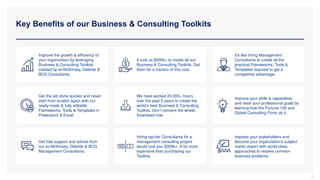
Key Benefits of our Business & Consulting Toolkits
3
Improve the growth & efficiency of
your organization by leveraging
Business & Consulting Toolkits
created by ex-McKinsey, Deloitte &
BCG Consultants.
It cost us $500k+ to create all our
Business & Consulting Toolkits. Get
them for a fraction of this cost.
It’s like hiring Management
Consultants to create all the
practical Frameworks, Tools &
Templates required to get a
competitive advantage.
Get the job done quicker and never
start from scratch again with our
ready-made & fully editable
Frameworks, Tools & Templates in
Powerpoint & Excel.
We have worked 20,000+ hours
over the past 5 years to create the
world’s best Business & Consulting
Toolkits. Don’t reinvent the wheel.
Download now.
Improve your skills & capabilities
and meet your professional goals by
learning how the Fortune 100 and
Global Consulting Firms do it.
Get free support and advice from
our ex-McKinsey, Deloitte & BCG
Management Consultants.
Hiring top-tier Consultants for a
management consulting project
would cost you $300k+. A lot more
expensive than purchasing our
Toolkits.
Impress your stakeholders and
become your organization’s subject
matter expert with world-class
approaches to resolve common
business problems.
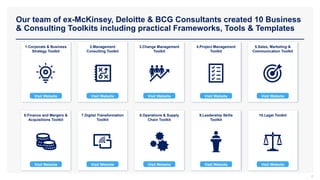
Our team of ex-McKinsey, Deloitte & BCG Consultants created 10 Business
& Consulting Toolkits including practical Frameworks, Tools & Templates
1.Corporate & Business
Strategy Toolkit
2.Management
Consulting Toolkit
3.Change Management
Toolkit
4.Project Management
Toolkit
5.Sales, Marketing &
Communication Toolkit
6.Finance and Mergers &
Acquisitions Toolkit
7.Digital Transformation
Toolkit
8.Operations & Supply
Chain Toolkit
9.Leadership Skills
Toolkit
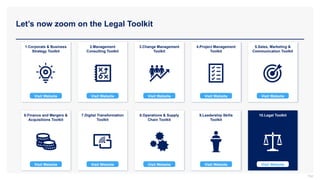
10.Legal Toolkit
Visit Website Visit Website Visit Website Visit Website Visit Website
Visit Website Visit Website Visit Website Visit Website
Visit Website
4
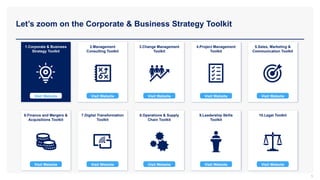
Let’s zoom on the Corporate & Business Strategy Toolkit
1.Corporate & Business
Strategy Toolkit
2.Management
Consulting Toolkit
3.Change Management
Toolkit
4.Project Management
Toolkit
5.Sales, Marketing &
Communication Toolkit
6.Finance and Mergers &
Acquisitions Toolkit
7.Digital Transformation
Toolkit
8.Operations & Supply
Chain Toolkit
9.Leadership Skills
Toolkit
10.Legal Toolkit
Visit Website Visit Website Visit Website Visit Website Visit Website
Visit Website Visit Website Visit Website Visit Website
Visit Website
5
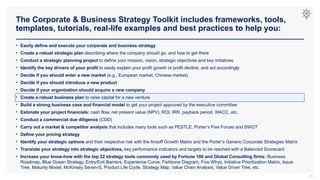
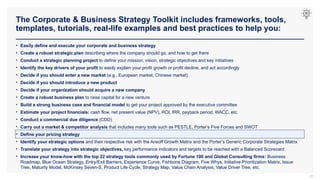
The Corporate & Business Strategy Toolkit includes frameworks, tools,
templates, tutorials, real-life examples and best practices to help you:
6
• Easily define and execute your corporate and business strategy
• Create a robust strategic plan describing where the company should go, and how to get there
• Conduct a strategic planning project to define your mission, vision, strategic objectives and key initiatives
• Identify the key drivers of your profit to easily explain your profit growth or profit decline, and act accordingly
• Decide if you should enter a new market (e.g., European market, Chinese market)
• Decide if you should introduce a new product
• Decide if your organization should acquire a new company
• Create a robust business plan to raise capital for a new venture
• Build a strong business case and financial model to get your project approved by the executive committee
• Estimate your project financials: revenue, cost savings, cash flow, net present value (NPV), ROI, IRR, payback period, WACC, etc.
• Conduct a commercial due diligence (CDD)
• Carry out a market & competitor analysis that includes many tools such as PESTLE, Porter’s Five Forces and SWOT
• Define your pricing strategy
• Identify your strategic options and their respective risk with the Ansoff Growth Matrix and the Porter’s Generic Corporate Strategies Matrix
• Translate your strategy into strategic objectives, key performance indicators and targets to be reached with a Balanced Scorecard
• Increase your know-how with the top 22 strategy tools commonly used by Fortune 100 and Global Consulting firms: Business
Roadmap, Blue Ocean Strategy, Entry/Exit Barriers, Experience Curve, Fishbone Diagram, Five Whys, Initiative Prioritization Matrix, Issue
Tree, Maturity Model, McKinsey Seven-S, Product Life Cycle, Strategy Map, Value Chain Analysis, Value Driver Tree, etc.
The Corporate & Business Strategy Toolkit includes frameworks, tools,
templates, tutorials, real-life examples and best practices to help you:
7
• Easily define and execute your corporate and business strategy
• Create a robust strategic plan describing where the company should go, and how to get there
• Conduct a strategic planning project to define your mission, vision, strategic objectives and key initiatives
• Identify the key drivers of your profit to easily explain your profit growth or profit decline, and act accordingly
• Decide if you should enter a new market (e.g., European market, Chinese market)
• Decide if you should introduce a new product
• Decide if your organization should acquire a new company
• Create a robust business plan to raise capital for a new venture
• Build a strong business case and financial model to get your project approved by the executive committee
• Estimate your project financials: revenue, cost savings, cash flow, net present value (NPV), ROI, IRR, payback period, WACC, etc.
• Conduct a commercial due diligence (CDD)
• Carry out a market & competitor analysis that includes many tools such as PESTLE, Porter’s Five Forces and SWOT
• Define your pricing strategy
• Identify your strategic options and their respective risk with the Ansoff Growth Matrix and the Porter’s Generic Corporate Strategies Matrix
• Translate your strategy into strategic objectives, key performance indicators and targets to be reached with a Balanced Scorecard
• Increase your know-how with the top 22 strategy tools commonly used by Fortune 100 and Global Consulting firms: Business
Roadmap, Blue Ocean Strategy, Entry/Exit Barriers, Experience Curve, Fishbone Diagram, Five Whys, Initiative Prioritization Matrix, Issue
Tree, Maturity Model, McKinsey Seven-S, Product Life Cycle, Strategy Map, Value Chain Analysis, Value Driver Tree, etc.
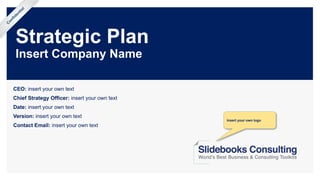
Strategic Plan
Insert Company Name
CEO: insert your own text
Chief Strategy Officer: insert your own text
Date: insert your own text
Version: insert your own text
Contact Email: insert your own text
Confidential
Insert your own logo
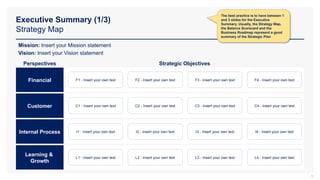
Executive Summary (1/3)
Strategy Map
Financial
Perspectives
Customer
Internal Process
Learning &
Growth
Strategic Objectives
I1 - Insert your own text I2 - Insert your own text I3 - Insert your own text I4 - Insert your own text
L1 - Insert your own text L2 - Insert your own text L3 - Insert your own text L4 - Insert your own text
C1 - Insert your own text C2 - Insert your own text C3 - Insert your own text C4 - Insert your own text
F1 - Insert your own text F2 - Insert your own text F3 - Insert your own text F4 - Insert your own text
Mission: Insert your Mission statement
Vision: Insert your Vision statement
The best practice is to have between 1
and 3 slides for the Executive
Summary. Usually, the Strategy Map,
the Balance Scorecard and the
Business Roadmap represent a good
summary of the Strategic Plan
9
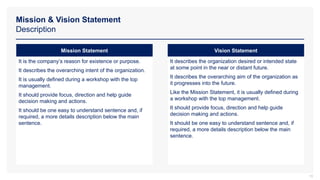
Mission Statement
It is the company’s reason for existence or purpose.
It describes the overarching intent of the organization.
It is usually defined during a workshop with the top
management.
It should provide focus, direction and help guide
decision making and actions.
It should be one easy to understand sentence and, if
required, a more details description below the main
sentence.
Vision Statement
It describes the organization desired or intended state
at some point in the near or distant future.
It describes the overarching aim of the organization as
it progresses into the future.
Like the Mission Statement, it is usually defined during
a workshop with the top management.
It should provide focus, direction and help guide
decision making and actions.
It should be one easy to understand sentence and, if
required, a more details description below the main
sentence.
Mission & Vision Statement
Description
10
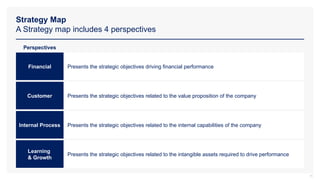
Strategy Map
A Strategy map includes 4 perspectives
11
Financial
Perspectives
Customer
Internal Process
Learning
& Growth
Presents the strategic objectives driving financial performance
Presents the strategic objectives related to the value proposition of the company
Presents the strategic objectives related to the internal capabilities of the company
Presents the strategic objectives related to the intangible assets required to drive performance
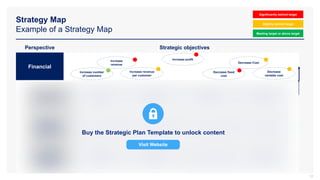
Strategy Map
Example of a Strategy Map
Financial
Perspective Strategic objectives
12
Increase
revenue
Increase profit
Increase number
of customers
Increase revenue
per customer
Decrease Cost
Decrease fixed
cost
Decrease
variable cost
Significantly behind target
Slightly behind target
Meeting target or above target
Buy the Strategic Plan Template to unlock content
Visit Website
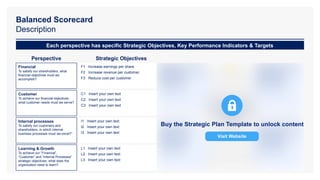
Balanced Scorecard
Description
C1 Insert your own text
C2 Insert your own text
C3 Insert your own text
I1 Insert your own text
I2 Insert your own text
I3 Insert your own text
L1 Insert your own text
L2 Insert your own text
L3 Insert your own text
F1 Increase earnings per share
F2 Increase revenue per customer
F3 Reduce cost per customer
Strategic Objectives
Financial
To satisfy our shareholders, what
financial objectives must we
accomplish?
Perspective
Customer
To achieve our financial objectives,
what customer needs must we serve?
Internal processes
To satisfy our customers and
shareholders, in which internal
business processes must we excel?”
Learning & Growth
To achieve our “Financial”,
“Customer” and “Internal Processes”
strategic objectives, what does the
organization need to learn?
Each perspective has specific Strategic Objectives, Key Performance Indicators & Targets
Buy the Strategic Plan Template to unlock content
Visit Website
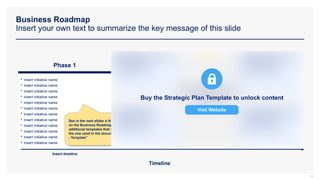
Business Roadmap
Insert your own text to summarize the key message of this slide
14
Insert timeline
Timeline
• Insert initiative name
Phase 1
See in the next slides a little bit more details
on the Business Roadmap and some
additional templates that you may prefer to
the one used in the document “Strategic Plan
- Template”
Buy the Strategic Plan Template to unlock content
Visit Website
The Corporate & Business Strategy Toolkit includes frameworks, tools,
templates, tutorials, real-life examples and best practices to help you:
15
• Easily define and execute your corporate and business strategy
• Create a robust strategic plan describing where the company should go, and how to get there
• Conduct a strategic planning project to define your mission, vision, strategic objectives and key initiatives
• Identify the key drivers of your profit to easily explain your profit growth or profit decline, and act accordingly
• Decide if you should enter a new market (e.g., European market, Chinese market)
• Decide if you should introduce a new product
• Decide if your organization should acquire a new company
• Create a robust business plan to raise capital for a new venture
• Build a strong business case and financial model to get your project approved by the executive committee
• Estimate your project financials: cash flow, net present value (NPV), ROI, IRR, payback period, WACC, etc.
• Conduct a commercial due diligence (CDD)
• Carry out a market & competitor analysis that includes many tools such as PESTLE, Porter’s Five Forces and SWOT
• Define your pricing strategy
• Identify your strategic options and their respective risk with the Ansoff Growth Matrix and the Porter’s Generic Corporate Strategies Matrix
• Translate your strategy into strategic objectives, key performance indicators and targets to be reached with a Balanced Scorecard
• Increase your know-how with the top 22 strategy tools commonly used by Fortune 100 and Global Consulting firms: Business
Roadmap, Blue Ocean Strategy, Entry/Exit Barriers, Experience Curve, Fishbone Diagram, Five Whys, Initiative Prioritization Matrix, Issue
Tree, Maturity Model, McKinsey Seven-S, Product Life Cycle, Strategy Map, Value Chain Analysis, Value Driver Tree, etc.
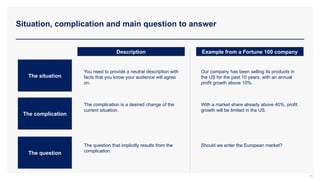
Situation, complication and main question to answer
The situation
The complication
The question
Description Example from a Fortune 100 company
You need to provide a neutral description with
facts that you know your audience will agree
on.
Our company has been selling its products in
the US for the past 10 years, with an annual
profit growth above 10%.
The complication is a desired change of the
current situation.
With a market share already above 40%, profit
growth will be limited in the US.
The question that implicitly results from the
complication.
Should we enter the European market?
16
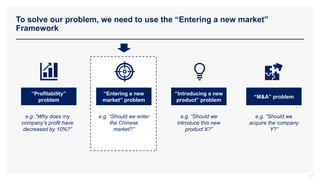
To solve our problem, we need to use the “Entering a new market”
Framework
“Profitability”
problem
“Entering a new
market” problem
“Introducing a new
product” problem
“M&A” problem
e.g. “Why does my
company’s profit have
decreased by 10%?”
e.g. “Should we enter
the Chinese
market?”
e.g. “Should we
introduce this new
product X?”
e.g. “Should we
acquire the company
Y?”
17
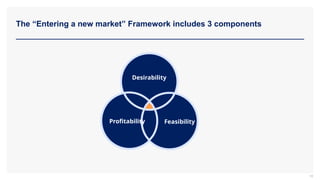
The “Entering a new market” Framework includes 3 components
Desirability
Profitability Feasibility
18
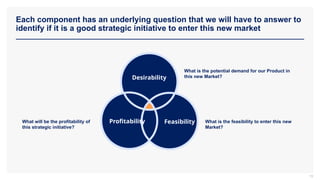
Each component has an underlying question that we will have to answer to
identify if it is a good strategic initiative to enter this new market
What is the potential demand for our Product in
this new Market?
What is the feasibility to enter this new
Market?
Desirability
Profitability Feasibility
What will be the profitability of
this strategic initiative?
19
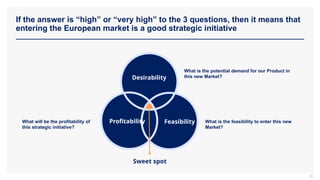
If the answer is “high” or “very high” to the 3 questions, then it means that
entering the European market is a good strategic initiative
Sweet spot
Desirability
Profitability Feasibility
What is the potential demand for our Product in
this new Market?
What is the feasibility to enter this new
Market?
What will be the profitability of
this strategic initiative?
20
Desirability
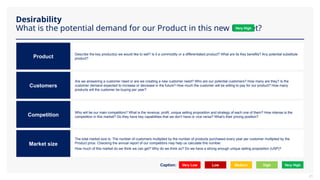
What is the potential demand for our Product in this new Market?
Product
Customers
Competition
Market size
Describe the key product(s) we would like to sell? Is it a commodity or a differentiated product? What are its Key benefits? Any potential substitute
product?
Are we answering a customer need or are we creating a new customer need? Who are our potential customers? How many are they? Is the
customer demand expected to increase or decrease in the future? How much the customer will be willing to pay for our product? How many
products will the customer be buying per year?
Who will be our main competitors? What is the revenue, profit, unique selling proposition and strategy of each one of them? How intense is the
competition in this market? Do they have key capabilities that we don’t have or vice versa? What’s their pricing position?
The total market size is: The number of customers multiplied by the number of products purchased every year per customer multiplied by the
Product price. Checking the annual report of our competitors may help us calculate this number.
How much of this market do we think we can get? Why do we think so? Do we have a strong enough unique selling proposition (USP)?
Very Low Low Medium High Very High
Caption:
Very High
21
The Corporate & Business Strategy Toolkit includes frameworks, tools,
templates, tutorials, real-life examples and best practices to help you:
22
• Easily define and execute your corporate and business strategy
• Create a robust strategic plan describing where the company should go, and how to get there
• Conduct a strategic planning project to define your mission, vision, strategic objectives and key initiatives
• Identify the key drivers of your profit to easily explain your profit growth or profit decline, and act accordingly
• Decide if you should enter a new market (e.g., European market, Chinese market)
• Decide if you should introduce a new product
• Decide if your organization should acquire a new company
• Create a robust business plan to raise capital for a new venture
• Build a strong business case and financial model to get your project approved by the executive committee
• Estimate your project financials: cash flow, net present value (NPV), ROI, IRR, payback period, WACC, etc.
• Conduct a commercial due diligence (CDD)
• Carry out a market & competitor analysis that includes many tools such as PESTLE, Porter’s Five Forces and SWOT
• Define your pricing strategy
• Identify your strategic options and their respective risk with the Ansoff Growth Matrix and the Porter’s Generic Corporate Strategies Matrix
• Translate your strategy into strategic objectives, key performance indicators and targets to be reached with a Balanced Scorecard
• Increase your know-how with the top 22 strategy tools commonly used by Fortune 100 and Global Consulting firms: Business
Roadmap, Blue Ocean Strategy, Entry/Exit Barriers, Experience Curve, Fishbone Diagram, Five Whys, Initiative Prioritization Matrix, Issue
Tree, Maturity Model, McKinsey Seven-S, Product Life Cycle, Strategy Map, Value Chain Analysis, Value Driver Tree, etc.
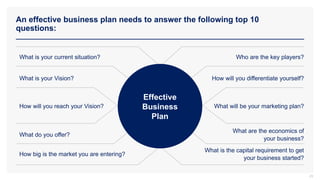
An effective business plan needs to answer the following top 10
questions:
23
What is your current situation?
What is your Vision?
How will you reach your Vision?
What do you offer?
How big is the market you are entering?
Who are the key players?
How will you differentiate yourself?
What will be your marketing plan?
What are the economics of
your business?
What is the capital requirement to get
your business started?
Effective
Business
Plan
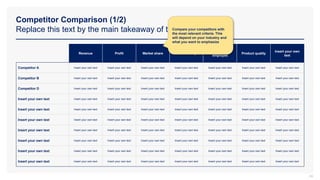
Competitor Comparison (1/2)
Replace this text by the main takeaway of this slide.
Revenue Profit Market share Main activity
Number of
employee
Product quality
Insert your own
text
Competitor A Insert your own text Insert your own text Insert your own text Insert your own text Insert your own text Insert your own text Insert your own text
Competitor B Insert your own text Insert your own text Insert your own text Insert your own text Insert your own text Insert your own text Insert your own text
Competitor D Insert your own text Insert your own text Insert your own text Insert your own text Insert your own text Insert your own text Insert your own text
Insert your own text Insert your own text Insert your own text Insert your own text Insert your own text Insert your own text Insert your own text Insert your own text
Compare your competitors with
the most relevant criteria. This
will depend on your industry and
what you want to emphasize
24
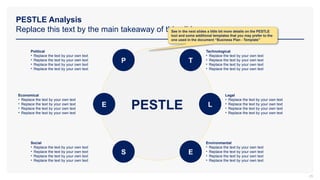
PESTLE Analysis
Replace this text by the main takeaway of this slide.
PESTLE
S
E L
Legal
• Replace the text by your own text
Environmental
• Replace the text by your own text
P
E
T
Technological
• Replace the text by your own text
Political
• Replace the text by your own text
Economical
• Replace the text by your own text
Social
• Replace the text by your own text
See in the next slides a little bit more details on the PESTLE
tool and some additional templates that you may prefer to the
one used in the document “Business Plan - Template”
25
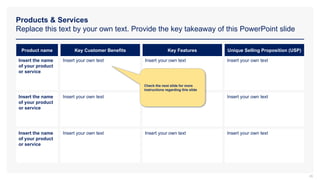
Products & Services
Replace this text by your own text. Provide the key takeaway of this PowerPoint slide
Product name Key Customer Benefits Key Features Unique Selling Proposition (USP)
Insert the name
of your product
or service
Insert your own text Insert your own text Insert your own text
Insert the name
of your product
or service
Insert your own text Insert your own text Insert your own text
Insert the name
of your product
or service
Insert your own text Insert your own text Insert your own text
Check the next slide for more
instructions regarding this slide
26
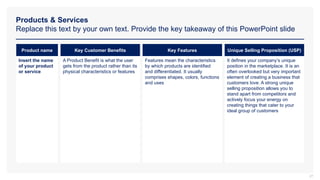
Products & Services
Replace this text by your own text. Provide the key takeaway of this PowerPoint slide
Product name Key Customer Benefits Key Features Unique Selling Proposition (USP)
Insert the name
of your product
or service
A Product Benefit is what the user
gets from the product rather than its
physical characteristics or features
Features mean the characteristics
by which products are identified
and differentiated. It usually
comprises shapes, colors, functions
and uses
It defines your company’s unique
position in the marketplace. It is an
often overlooked but very important
element of creating a business that
customers love. A strong unique
selling proposition allows you to
stand apart from competitors and
actively focus your energy on
creating things that cater to your
ideal group of customers
27
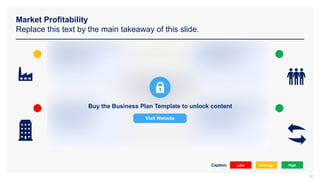
Market Profitability
Replace this text by the main takeaway of this slide.
Low Average High
Caption:
28
Buy the Business Plan Template to unlock content
Visit Website
The Corporate & Business Strategy Toolkit includes frameworks, tools,
templates, tutorials, real-life examples and best practices to help you:
29
• Easily define and execute your corporate and business strategy
• Create a robust strategic plan describing where the company should go, and how to get there
• Conduct a strategic planning project to define your mission, vision, strategic objectives and key initiatives
• Identify the key drivers of your profit to easily explain your profit growth or profit decline, and act accordingly
• Decide if you should enter a new market (e.g., European market, Chinese market)
• Decide if you should introduce a new product
• Decide if your organization should acquire a new company
• Create a robust business plan to raise capital for a new venture
• Build a strong business case and financial model to get your project approved by the executive committee
• Estimate your project financials: cash flow, net present value (NPV), ROI, IRR, payback period, WACC, etc.
• Conduct a commercial due diligence (CDD)
• Carry out a market & competitor analysis that includes many tools such as PESTLE, Porter’s Five Forces and SWOT
• Define your pricing strategy
• Identify your strategic options and their respective risk with the Ansoff Growth Matrix and the Porter’s Generic Corporate Strategies Matrix
• Translate your strategy into strategic objectives, key performance indicators and targets to be reached with a Balanced Scorecard
• Increase your know-how with the top 22 strategy tools commonly used by Fortune 100 and Global Consulting firms: Business
Roadmap, Blue Ocean Strategy, Entry/Exit Barriers, Experience Curve, Fishbone Diagram, Five Whys, Initiative Prioritization Matrix, Issue
Tree, Maturity Model, McKinsey Seven-S, Product Life Cycle, Strategy Map, Value Chain Analysis, Value Driver Tree, etc.
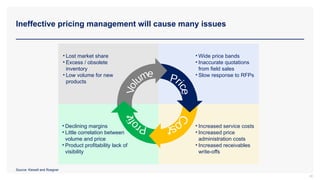
Ineffective pricing management will cause many issues
30
Source: Kiewell and Roegner
• Increased service costs
• Increased price
administration costs
• Increased receivables
write-offs
• Wide price bands
• Inaccurate quotations
from field sales
• Slow response to RFPs
• Declining margins
• Little correlation between
volume and price
• Product profitability lack of
visibility
• Lost market share
• Excess / obsolete
inventory
• Low volume for new
products
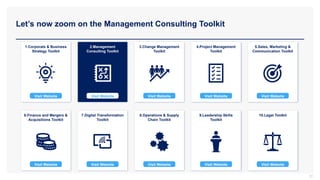
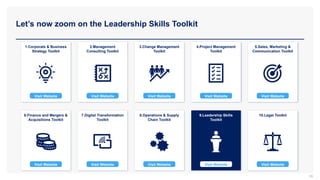
Let’s now zoom on the Management Consulting Toolkit
1.Corporate & Business
Strategy Toolkit
2.Management
Consulting Toolkit
3.Change Management
Toolkit
4.Project Management
Toolkit
5.Sales, Marketing &
Communication Toolkit
6.Finance and Mergers &
Acquisitions Toolkit
7.Digital Transformation
Toolkit
8.Operations & Supply
Chain Toolkit
9.Leadership Skills
Toolkit
10.Legal Toolkit
Visit Website Visit Website Visit Website Visit Website Visit Website
Visit Website Visit Website Visit Website Visit Website
Visit Website
31
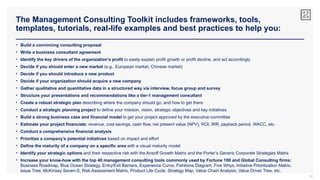
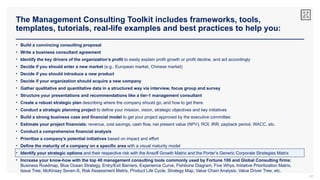
The Management Consulting Toolkit includes frameworks, tools,
templates, tutorials, real-life examples and best practices to help you:
32
• Build a convincing consulting proposal
• Write a business consultant agreement
• Identify the key drivers of the organization’s profit to easily explain profit growth or profit decline, and act accordingly
• Decide if you should enter a new market (e.g., European market, Chinese market)
• Decide if you should introduce a new product
• Decide if your organization should acquire a new company
• Gather qualitative and quantitative data in a structured way via interview, focus group and survey
• Structure your presentations and recommendations like a tier-1 management consultant
• Create a robust strategic plan describing where the company should go, and how to get there
• Conduct a strategic planning project to define your mission, vision, strategic objectives and key initiatives
• Build a strong business case and financial model to get your project approved by the executive committee
• Estimate your project financials: revenue, cost savings, cash flow, net present value (NPV), ROI, IRR, payback period, WACC, etc.
• Conduct a comprehensive financial analysis
• Prioritize a company’s potential initiatives based on impact and effort
• Define the maturity of a company on a specific area with a visual maturity model
• Identify your strategic options and their respective risk with the Ansoff Growth Matrix and the Porter’s Generic Corporate Strategies Matrix
• Increase your know-how with the top 40 management consulting tools commonly used by Fortune 100 and Global Consulting firms:
Business Roadmap, Blue Ocean Strategy, Entry/Exit Barriers, Experience Curve, Fishbone Diagram, Five Whys, Initiative Prioritization Matrix,
Issue Tree, McKinsey Seven-S, Risk Assessment Matrix, Product Life Cycle, Strategy Map, Value Chain Analysis, Value Driver Tree, etc.
The Management Consulting Toolkit includes frameworks, tools,
templates, tutorials, real-life examples and best practices to help you:
33
• Build a convincing consulting proposal
• Write a business consultant agreement
• Identify the key drivers of the organization’s profit to easily explain profit growth or profit decline, and act accordingly
• Decide if you should enter a new market (e.g., European market, Chinese market)
• Decide if you should introduce a new product
• Decide if your organization should acquire a new company
• Gather qualitative and quantitative data in a structured way via interview, focus group and survey
• Structure your presentations and recommendations like a tier-1 management consultant
• Create a robust strategic plan describing where the company should go, and how to get there
• Conduct a strategic planning project to define your mission, vision, strategic objectives and key initiatives
• Build a strong business case and financial model to get your project approved by the executive committee
• Estimate your project financials: revenue, cost savings, cash flow, net present value (NPV), ROI, IRR, payback period, WACC, etc.
• Conduct a comprehensive financial analysis
• Prioritize a company’s potential initiatives based on impact and effort
• Define the maturity of a company on a specific area with a visual maturity model
• Identify your strategic options and their respective risk with the Ansoff Growth Matrix and the Porter’s Generic Corporate Strategies Matrix
• Increase your know-how with the top 40 management consulting tools commonly used by Fortune 100 and Global Consulting firms:
Business Roadmap, Blue Ocean Strategy, Entry/Exit Barriers, Experience Curve, Fishbone Diagram, Five Whys, Initiative Prioritization Matrix,
Issue Tree, McKinsey Seven-S, Risk Assessment Matrix, Product Life Cycle, Strategy Map, Value Chain Analysis, Value Driver Tree, etc.
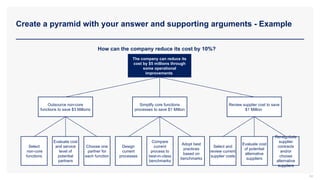
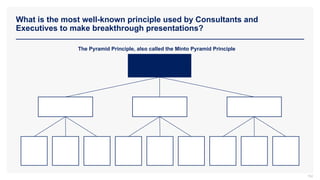
Create a pyramid with your answer and supporting arguments - Example
34
The company can reduce its
cost by $5 millions through
some operational
improvements
Select
non-core
functions
Evaluate cost
and service
level of
potential
partners
Choose one
partner for
each function
Design
current
processes
Compare
current
process to
best-in-class
benchmarks
Adopt best
practices
based on
benchmarks
Select and
review current
supplier costs
Evaluate cost
of potential
alternative
suppliers
Outsource non-core
functions to save $3 Millions
Simplify core functions
processes to save $1 Million
Review supplier cost to save
$1 Million
Renegotiate
supplier
contracts
and/or
choose
alternative
suppliers
How can the company reduce its cost by 10%?
The Management Consulting Toolkit includes frameworks, tools,
templates, tutorials, real-life examples and best practices to help you:
35
• Build a convincing consulting proposal
• Write a business consultant agreement
• Identify the key drivers of the organization’s profit to easily explain profit growth or profit decline, and act accordingly
• Decide if you should enter a new market (e.g., European market, Chinese market)
• Decide if you should introduce a new product
• Decide if your organization should acquire a new company
• Gather qualitative and quantitative data in a structured way via interview, focus group and survey
• Structure your presentations and recommendations like a tier-1 management consultant
• Create a robust strategic plan describing where the company should go, and how to get there
• Conduct a strategic planning project to define your mission, vision, strategic objectives and key initiatives
• Build a strong business case and financial model to get your project approved by the executive committee
• Estimate your project financials: revenue, cost savings, cash flow, net present value (NPV), ROI, IRR, payback period, WACC, etc.
• Conduct a comprehensive financial analysis
• Prioritize a company’s potential initiatives based on impact and effort
• Define the maturity of a company on a specific area with a visual maturity model
• Identify your strategic options and their respective risk with the Ansoff Growth Matrix and the Porter’s Generic Corporate Strategies Matrix
• Increase your know-how with the top 40 management consulting tools commonly used by Fortune 100 and Global Consulting firms:
Business Roadmap, Blue Ocean Strategy, Entry/Exit Barriers, Experience Curve, Fishbone Diagram, Five Whys, Initiative Prioritization Matrix,
Issue Tree, McKinsey Seven-S, Risk Assessment Matrix, Product Life Cycle, Strategy Map, Value Chain Analysis, Value Driver Tree, etc.
Business Case
Insert Project Name
Author: insert your own text
Project Sponsor: insert your own text
Project Manager: insert your own text
Change Manager: insert your own text
Date: insert your own text
Version No: insert your own text
Status: E.g. 1.0 for final / 0.1 for drafts
Confidential
Insert your own logo
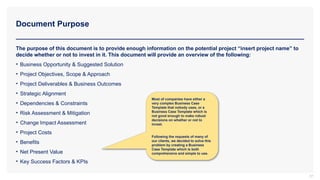
Document Purpose
37
The purpose of this document is to provide enough information on the potential project “insert project name” to
decide whether or not to invest in it. This document will provide an overview of the following:
• Business Opportunity & Suggested Solution
• Project Objectives, Scope & Approach
• Project Deliverables & Business Outcomes
• Strategic Alignment
• Dependencies & Constraints
• Risk Assessment & Mitigation
• Change Impact Assessment
• Project Costs
• Benefits
• Net Present Value
• Key Success Factors & KPIs
Most of companies have either a
very complex Business Case
Template that nobody uses, or a
Business Case Template which is
not good enough to make robust
decisions on whether or not to
invest.
Following the requests of many of
our clients, we decided to solve this
problem by creating a Business
Case Template which is both
comprehensive and simple to use.
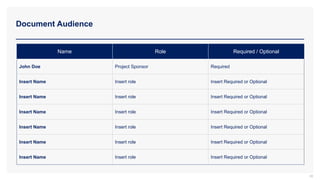
Document Audience
38
Name Role Required / Optional
John Doe Project Sponsor Required
Insert Name Insert role Insert Required or Optional
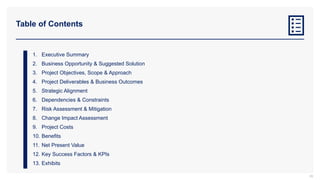
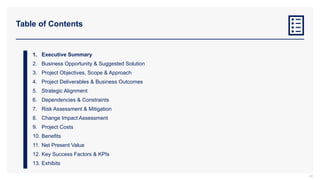
Table of Contents
1. Executive Summary
2. Business Opportunity & Suggested Solution
3. Project Objectives, Scope & Approach
4. Project Deliverables & Business Outcomes
5. Strategic Alignment
6. Dependencies & Constraints
7. Risk Assessment & Mitigation
8. Change Impact Assessment
9. Project Costs
10. Benefits
11. Net Present Value
12. Key Success Factors & KPIs
13. Exhibits
39
Table of Contents
1. Executive Summary
2. Business Opportunity & Suggested Solution
3. Project Objectives, Scope & Approach
4. Project Deliverables & Business Outcomes
5. Strategic Alignment
6. Dependencies & Constraints
7. Risk Assessment & Mitigation
8. Change Impact Assessment
9. Project Costs
10. Benefits
11. Net Present Value
12. Key Success Factors & KPIs
13. Exhibits
40
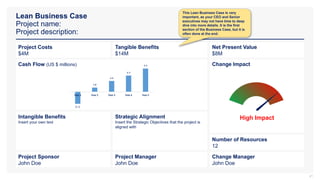
Change Impact
High Impact
Net Present Value
$8M
Number of Resources
12
Change Manager
John Doe
Cash Flow (US $ millions)
Project Sponsor
John Doe
Intangible Benefits
Insert your own text
Project Costs
$4M
Tangible Benefits
$14M
Project Manager
John Doe
Strategic Alignment
Insert the Strategic Objectives that the project is
aligned with
Lean Business Case
Project name:
Project description:
41
(5.1)
1.8
4.6
6.9
9.9
Year 1 Year 2 Year 3 Year 4 Year 5
This Lean Business Case is very
important, as your CEO and Senior
executives may not have time to deep
dive into more details. It is the first
section of the Business Case, but it is
often done at the end.
The Management Consulting Toolkit includes frameworks, tools,
templates, tutorials, real-life examples and best practices to help you:
42
• Build a convincing consulting proposal
• Write a business consultant agreement
• Identify the key drivers of the organization’s profit to easily explain profit growth or profit decline, and act accordingly
• Decide if you should enter a new market (e.g., European market, Chinese market)
• Decide if you should introduce a new product
• Decide if your organization should acquire a new company
• Gather qualitative and quantitative data in a structured way via interview, focus group and survey
• Structure your presentations and recommendations like a tier-1 management consultant
• Create a robust strategic plan describing where the company should go, and how to get there
• Conduct a strategic planning project to define your mission, vision, strategic objectives and key initiatives
• Build a strong business case and financial model to get your project approved by the executive committee
• Estimate your project financials: revenue, cost savings, cash flow, net present value (NPV), ROI, IRR, payback period, WACC, etc.
• Conduct a comprehensive financial analysis
• Prioritize a company’s potential initiatives based on impact and effort
• Define the maturity of a company on a specific area with a visual maturity model
• Identify your strategic options and their respective risk with the Ansoff Growth Matrix and the Porter’s Generic Corporate Strategies Matrix
• Increase your know-how with the top 40 management consulting tools commonly used by Fortune 100 and Global Consulting firms:
Business Roadmap, Blue Ocean Strategy, Entry/Exit Barriers, Experience Curve, Fishbone Diagram, Five Whys, Initiative Prioritization Matrix,
Issue Tree, McKinsey Seven-S, Risk Assessment Matrix, Product Life Cycle, Strategy Map, Value Chain Analysis, Value Driver Tree, etc.
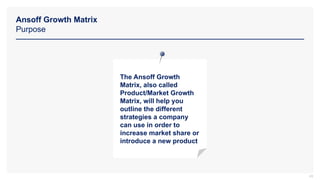
Ansoff Growth Matrix
Purpose
43
The Ansoff Growth
Matrix, also called
Product/Market Growth
Matrix, will help you
outline the different
strategies a company
can use in order to
increase market share or
introduce a new product
Ansoff Growth Matrix
Description
44
The Ansoff Matrix was developed by H. Igor Ansoff and first published in the Harvard Business Review in
1957, in an article titled "Strategies for Diversification." It has given generations of marketers and business
leaders a quick and simple way to think about the risks of growth.
Sometimes called the Product/Market Expansion Grid, the Matrix shows four strategies you can use to
grow. It also helps you analyze the risks associated with each one. The idea is that each time you move into
a new quadrant (horizontally or vertically), risk increases.
Ansoff Growth Matrix
Description
45
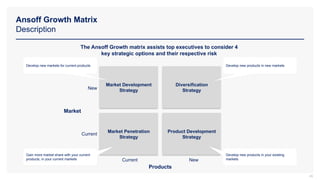
The Ansoff Growth matrix assists top executives to consider 4
key strategic options and their respective risk
Market Development
Strategy
Diversification
Strategy
Product Development
Strategy
Market Penetration
Strategy
Current New
New
Current
Market
Develop new markets for current products Develop new products in new markets
Gain more market share with your current
products, in your current markets
Develop new products in your existing
markets
Products
Ansoff Growth Matrix
Description
46
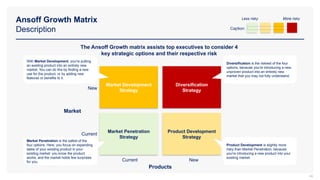
The Ansoff Growth matrix assists top executives to consider 4
key strategic options and their respective risk
Market Development
Strategy
Diversification
Strategy
Product Development
Strategy
Market Penetration
Strategy
Current New
New
Current
Market
With Market Development, you're putting
an existing product into an entirely new
market. You can do this by finding a new
use for the product, or by adding new
features or benefits to it.
Diversification is the riskiest of the four
options, because you're introducing a new,
unproven product into an entirely new
market that you may not fully understand.
Market Penetration is the safest of the
four options. Here, you focus on expanding
sales of your existing product in your
existing market: you know the product
works, and the market holds few surprises
for you.
Product Development is slightly more
risky than Market Penetration, because
you're introducing a new product into your
existing market.
Caption:
Less risky More risky
Products
Ansoff Growth Matrix
Template
47
Insert your own title
Market Development
Strategy
Diversification
Strategy
Product Development
Strategy
Market Penetration
Strategy
Current New
New
Current
Market
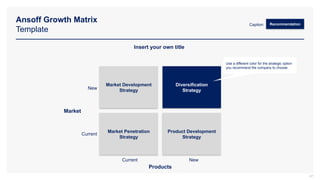
Use a different color for the strategic option
you recommend the company to choose
Products
Recommendation
Caption:
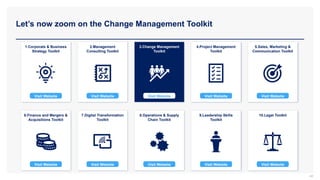
Let’s now zoom on the Change Management Toolkit
1.Corporate & Business
Strategy Toolkit
2.Management
Consulting Toolkit
3.Change Management
Toolkit
4.Project Management
Toolkit
5.Sales, Marketing &
Communication Toolkit
6.Finance and Mergers &
Acquisitions Toolkit
7.Digital Transformation
Toolkit
8.Operations & Supply
Chain Toolkit
9.Leadership Skills
Toolkit
10.Legal Toolkit
Visit Website Visit Website Visit Website Visit Website Visit Website
Visit Website Visit Website Visit Website Visit Website
Visit Website
48
The Change Management Toolkit includes frameworks, tools,
templates, tutorials, real-life examples and best practices to help you:
49
• Define and implement your change management strategy & plan
• Define and implement your communication strategy & plan
• Define and implement your sponsorship plan, coaching plan, and training plan
• Define and implement your resistance management plan
• Support individuals moving through change and improve organizational outcomes
• Identify how each employee will be impacted by the change happening within the organization with our Audience Identification Matrix
• Provide a succinct overview of a specific Change with our Change Lean Canvas
• Understand the stages of personal transition with the Change Personal Transition Curve
• Define what will be impacted by a change initiative (e.g. System, process, structure,…), and who will be impacted
• Assess the impact of multiple changes within your companies with our Change Impact Assessment
• Get a clear understanding of the 4 stages of team development
• Prioritize initiatives based on impact and value with our Initiative Prioritization Matrix
• Identify and mitigate your project risks and corporate risks with our Risk Register and Risk Assessment Matrix
• Identify and resolve your project issues and corporate issues with our Issue Register
• Understand the needs of your audience with the Maslow Hierarchy of Human Needs
• Ensure that all parts of your organization are aligned and work in harmony with the McKinsey 7-S Framework
• Increase your know-how with the top 32 change management tools commonly used by Fortune 100 and Global Consulting firms: ADKAR
Model, Business Roadmap, Change Lean Canvas, Change Commitment Curve, Change Impact Assessment Matrix, Channel Matrix, Heart & Mind
Human Drivers, Innovation Adoption Curve, Maturity Model, Mission & Vision Statement, Prosci 3-Phase Process, Team Charter, etc.
The Change Management Toolkit includes frameworks, tools,
templates, tutorials, real-life examples and best practices to help you:
50
• Define and implement your change management strategy & plan
• Define and implement your communication strategy & plan
• Define and implement your sponsorship plan, coaching plan, and training plan
• Define and implement your resistance management plan
• Support individuals moving through change and improve organizational outcomes
• Identify how each employee will be impacted by the change happening within the organization with our Audience Identification Matrix
• Provide a succinct overview of a specific Change with our Change Lean Canvas
• Understand the stages of personal transition with the Change Personal Transition Curve
• Define what will be impacted by a change initiative (e.g. System, process, structure,…), and who will be impacted
• Assess the impact of multiple changes within your companies with our Change Impact Assessment
• Get a clear understanding of the 4 stages of team development
• Prioritize initiatives based on impact and value with our Initiative Prioritization Matrix
• Identify and mitigate your project risks and corporate risks with our Risk Register and Risk Assessment Matrix
• Identify and resolve your project issues and corporate issues with our Issue Register
• Understand the needs of your audience with the Maslow Hierarchy of Human Needs
• Ensure that all parts of your organization are aligned and work in harmony with the McKinsey 7-S Framework
• Increase your know-how with the top 32 change management tools commonly used by Fortune 100 and Global Consulting firms: ADKAR
Model, Business Roadmap, Change Lean Canvas, Change Commitment Curve, Change Impact Assessment Matrix, Channel Matrix, Heart & Mind
Human Drivers, Innovation Adoption Curve, Maturity Model, Mission & Vision Statement, Prosci 3-Phase Process, Team Charter, etc.
Change Management
Strategy & Plan
Company: insert company name
CEO: insert your own text
Senior Change Manager: insert your own text
Date: insert your own text
Version: insert your own text
Contact Email: insert your own text
Confidential
Insert your own logo
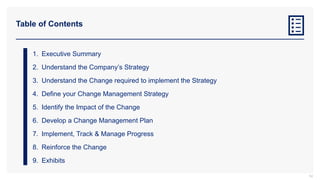
Table of Contents
1. Executive Summary
2. Understand the Company’s Strategy
3. Understand the Change required to implement the Strategy
4. Define your Change Management Strategy
5. Identify the Impact of the Change
6. Develop a Change Management Plan
7. Implement, Track & Manage Progress
8. Reinforce the Change
9. Exhibits
52
Table of Contents
1. Executive Summary
2. Understand the Company’s Strategy
3. Understand the Change required to implement the Strategy
4. Define your Change Management Strategy
5. Identify the Impact of the Change
6. Develop a Change Management Plan
7. Implement, Track & Manage Progress
8. Reinforce the Change
9. Exhibits
53
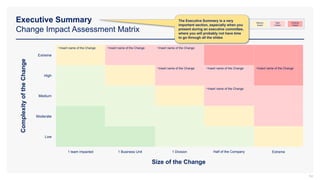
Executive Summary
Change Impact Assessment Matrix
54
Caption:
Low
Impact
Moderate
Impact
Medium
Impact
High
Impact
Extreme
Impact
Complexity
of
the
Change
Size of the Change
1 team impacted Extreme
1 Division
1 Business Unit
Medium
•Insert name of the Change
Moderate
Low
Extreme
•Insert name of the Change •Insert name of the Change
•Insert name of the Change
High
•Insert name of the Change
•Insert name of the Change •Insert name of the Change
Half of the Company
The Executive Summary is a very
important section, especially when you
present during an executive committee,
where you will probably not have time
to go through all the slides
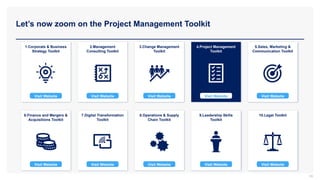
Let’s now zoom on the Project Management Toolkit
1.Corporate & Business
Strategy Toolkit
2.Management
Consulting Toolkit
3.Change Management
Toolkit
4.Project Management
Toolkit
5.Sales, Marketing &
Communication Toolkit
6.Finance and Mergers &
Acquisitions Toolkit
7.Digital Transformation
Toolkit
8.Operations & Supply
Chain Toolkit
9.Leadership Skills
Toolkit
10.Legal Toolkit
Visit Website Visit Website Visit Website Visit Website Visit Website
Visit Website Visit Website Visit Website Visit Website
Visit Website
55
The Project Management Toolkit includes frameworks, tools, templates,
tutorials, real-life examples and best practices to help you:
56
• Get a clear understanding of the project management overall approach commonly used by Fortune 100 and Global Consulting firms
• Build a strong business case and financial model to get your project approved by the executive committee
• Estimate your project financials: revenue, cost savings, cash flow, net present value (NPV), ROI, IRR, payback period, WACC, etc.
• Prioritize initiatives based on impact and value with our Initiative Prioritization Matrix
• Initiate your project with a world class project charter, RACI Matrix and Stakeholder Matrix
• Plan with our High-Level Project Plan and Detailed Project Plan
• Implement your project with our Risk Register, Issue Register, Project Dashboards and parking Lot
• Close your project with a Punch List and Post Project Evaluation Report
• Define and implement your change management strategy & plan
• Define and implement your communication strategy & plan
• Define and implement your sponsorship plan, coaching plan, training plan and resistance management plan
• Identify and mitigate your project risks with our Risk Register and Risk Assessment Matrix
• Identify and resolve your project issues with our Issue Register
• Increase your know-how with the top 36 project management tools commonly used by Fortune 100 and Global Consulting firms:
Business Roadmap, Change Lean Canvas, Change Commitment Curve, Change Impact Assessment Matrix, Channel Matrix, Heart & Mind
Human Drivers, Innovation Adoption Curve, Maturity Model, Mission & Vision Statement, Team Charter, etc.
The Project Management Toolkit includes frameworks, tools, templates,
tutorials, real-life examples and best practices to help you:
57
• Get a clear understanding of the project management overall approach commonly used by Fortune 100 and Global Consulting firms
• Build a strong business case and financial model to get your project approved by the executive committee
• Estimate your project financials: revenue, cost savings, cash flow, net present value (NPV), ROI, IRR, payback period, WACC, etc.
• Prioritize initiatives based on impact and value with our Initiative Prioritization Matrix
• Initiate your project with a world class project charter, RACI Matrix and Stakeholder Matrix
• Plan with our High-Level Project Plan and Detailed Project Plan
• Implement your project with our Risk Register, Issue Register, Project Dashboards and parking Lot
• Close your project with a Punch List and Post Project Evaluation Report
• Define and implement your change management strategy & plan
• Define and implement your communication strategy & plan
• Define and implement your sponsorship plan, coaching plan, training plan and resistance management plan
• Identify and mitigate your project risks with our Risk Register and Risk Assessment Matrix
• Identify and resolve your project issues with our Issue Register
• Increase your know-how with the top 36 project management tools commonly used by Fortune 100 and Global Consulting firms:
Business Roadmap, Change Lean Canvas, Change Commitment Curve, Change Impact Assessment Matrix, Channel Matrix, Heart & Mind
Human Drivers, Innovation Adoption Curve, Maturity Model, Mission & Vision Statement, Team Charter, etc.
Initiative Prioritization Matrix
Purpose
58
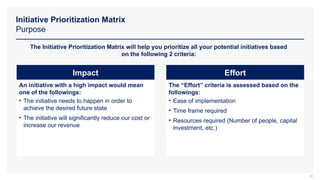
The Initiative Prioritization Matrix will help you prioritize all your potential initiatives based
on the following 2 criteria:
Impact Effort
An initiative with a high impact would mean
one of the followings:
• The initiative needs to happen in order to
achieve the desired future state
• The initiative will significantly reduce our cost or
increase our revenue
The “Effort” criteria is assessed based on the
followings:
• Ease of implementation
• Time frame required
• Resources required (Number of people, capital
investment, etc.)
Initiative Prioritization Matrix
Description
59
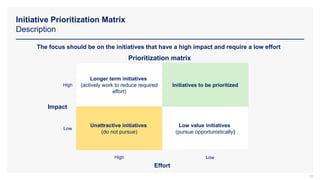
The focus should be on the initiatives that have a high impact and require a low effort
Impact
Effort
Prioritization matrix
Low
High
Low
High
Longer term initiatives
(actively work to reduce required
effort)
Initiatives to be prioritized
Unattractive initiatives
(do not pursue)
Low value initiatives
(pursue opportunistically)
Initiative Prioritization Matrix
Description
60
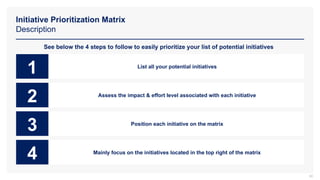
See below the 4 steps to follow to easily prioritize your list of potential initiatives
Assess the impact & effort level associated with each initiative
2
Position each initiative on the matrix
3
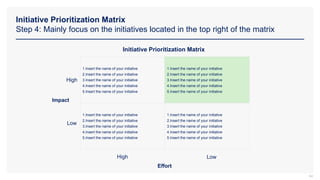
Mainly focus on the initiatives located in the top right of the matrix
4
List all your potential initiatives
1
Initiative Prioritization Matrix
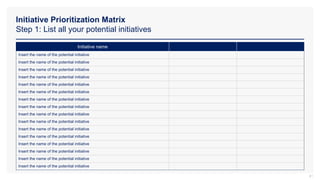
Step 1: List all your potential initiatives
61
Initiative name
Insert the name of the potential initiative
Initiative Prioritization Matrix
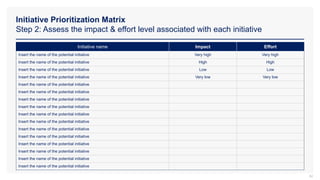
Step 2: Assess the impact & effort level associated with each initiative
62
Initiative name Impact Effort
Insert the name of the potential initiative Very high Very high
Insert the name of the potential initiative High High
Insert the name of the potential initiative Low Low
Insert the name of the potential initiative Very low Very low
Insert the name of the potential initiative
Initiative Prioritization Matrix
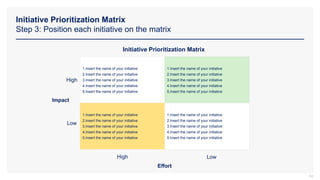
Step 3: Position each initiative on the matrix
63
Impact
Effort
Low
High
Low
High
1.Insert the name of your initiative
2.Insert the name of your initiative
3.Insert the name of your initiative
4.Insert the name of your initiative
5.Insert the name of your initiative
1.Insert the name of your initiative
2.Insert the name of your initiative
3.Insert the name of your initiative
4.Insert the name of your initiative
5.Insert the name of your initiative
1.Insert the name of your initiative
2.Insert the name of your initiative
3.Insert the name of your initiative
4.Insert the name of your initiative
5.Insert the name of your initiative
1.Insert the name of your initiative
2.Insert the name of your initiative
3.Insert the name of your initiative
4.Insert the name of your initiative
5.Insert the name of your initiative
Initiative Prioritization Matrix
Step 4: Mainly focus on the initiatives located in the top right of the matrix
64
Impact
Effort
Low
High
Low
High
Initiative Prioritization Matrix
1.Insert the name of your initiative
2.Insert the name of your initiative
3.Insert the name of your initiative
4.Insert the name of your initiative
5.Insert the name of your initiative
1.Insert the name of your initiative
2.Insert the name of your initiative
3.Insert the name of your initiative
4.Insert the name of your initiative
5.Insert the name of your initiative
1.Insert the name of your initiative
2.Insert the name of your initiative
3.Insert the name of your initiative
4.Insert the name of your initiative
5.Insert the name of your initiative
1.Insert the name of your initiative
2.Insert the name of your initiative
3.Insert the name of your initiative
4.Insert the name of your initiative
5.Insert the name of your initiative
The Project Management Toolkit includes frameworks, tools, templates,
tutorials, real-life examples and best practices to help you:
65
• Get a clear understanding of the project management overall approach commonly used by Fortune 100 and Global Consulting firms
• Build a strong business case and financial model to get your project approved by the executive committee
• Estimate your project financials: revenue, cost savings, cash flow, net present value (NPV), ROI, IRR, payback period, WACC, etc.
• Prioritize initiatives based on impact and value with our Initiative Prioritization Matrix
• Initiate your project with a world class project charter, RACI Matrix and Stakeholder Matrix
• Plan with our High-Level Project Plan and Detailed Project Plan
• Implement your project with our Risk Register, Issue Register, Project Dashboards and parking Lot
• Close your project with a Punch List and Post Project Evaluation Report
• Define and implement your change management strategy & plan
• Define and implement your communication strategy & plan
• Define and implement your sponsorship plan, coaching plan, training plan and resistance management plan
• Identify and mitigate your project risks with our Risk Register and Risk Assessment Matrix
• Identify and resolve your project issues with our Issue Register
• Increase your know-how with the top 36 project management tools commonly used by Fortune 100 and Global Consulting firms:
Business Roadmap, Change Lean Canvas, Change Commitment Curve, Change Impact Assessment Matrix, Channel Matrix, Heart & Mind
Human Drivers, Innovation Adoption Curve, Maturity Model, Mission & Vision Statement, Team Charter, etc.
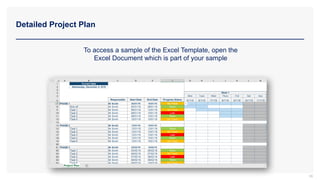
Detailed Project Plan
66
To access a sample of the Excel Template, open the
Excel Document which is part of your sample
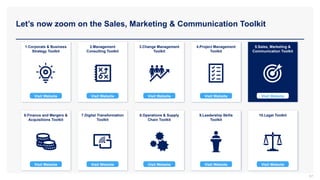
Let’s now zoom on the Sales, Marketing & Communication Toolkit
1.Corporate & Business
Strategy Toolkit
2.Management
Consulting Toolkit
3.Change Management
Toolkit
4.Project Management
Toolkit
5.Sales, Marketing &
Communication Toolkit
6.Finance and Mergers &
Acquisitions Toolkit
7.Digital Transformation
Toolkit
8.Operations & Supply
Chain Toolkit
9.Leadership Skills
Toolkit
10.Legal Toolkit
Visit Website Visit Website Visit Website Visit Website Visit Website
Visit Website Visit Website Visit Website Visit Website
Visit Website
67
The Sales, Marketing & Communication Toolkit includes frameworks, tools,
templates, tutorials, real-life examples and best practices to help you:
68
• Define and implement your sales strategy & plan
• Define and implement your marketing strategy & plan
• Define and implement your communication strategy & plan
• Define and implement your pricing strategy
The Sales, Marketing & Communication Toolkit includes frameworks, tools,
templates, tutorials, real-life examples and best practices to help you:
69
• Define and implement your sales strategy & plan
• Define and implement your marketing strategy & plan
• Define and implement your communication strategy & plan
• Define and implement your pricing strategy
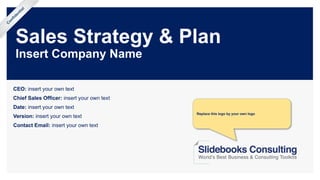
Sales Strategy & Plan
Insert Company Name
CEO: insert your own text
Chief Sales Officer: insert your own text
Date: insert your own text
Version: insert your own text
Contact Email: insert your own text
Confidential
Replace this logo by your own logo
Executive Summary
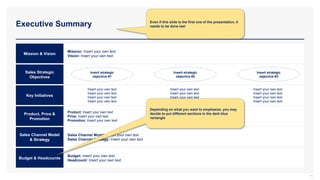
71
Mission & Vision
Mission: Insert your own text
Vision: Insert your own text
Sales Strategic
Objectives
Insert strategic
objective #1
Insert strategic
objective #2
Insert strategic
objective #3
Product, Price &
Promotion
Product: Insert your own text
Price: Insert your own text
Promotion: Insert your own text
Key Initiatives
Insert your own text
Sales Channel Model
& Strategy
Sales Channel Model: Insert your own text
Sales Channel Strategy: Insert your own text
Budget & Headcounts
Budget: Insert your own text
Headcount: Insert your own text
Depending on what you want to emphasize, you may
decide to put different sections in the dark blue
rectangle
Even if this slide is the first one of the presentation, it
needs to be done last
Table of Contents
72
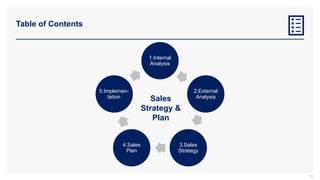
1.Internal
Analysis
2.External
Analysis
3.Sales
Strategy
4.Sales
Plan
5.Implemen-
tation Sales
Strategy &
Plan
Let’s now zoom on the Finance and Mergers & Acquisitions Toolkit
1.Corporate & Business
Strategy Toolkit
2.Management
Consulting Toolkit
3.Change Management
Toolkit
4.Project Management
Toolkit
5.Sales, Marketing &
Communication Toolkit
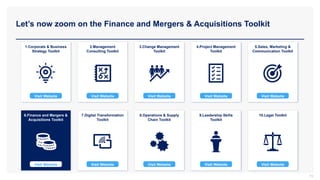
6.Finance and Mergers &
Acquisitions Toolkit
7.Digital Transformation
Toolkit
8.Operations & Supply
Chain Toolkit
9.Leadership Skills
Toolkit
10.Legal Toolkit
Visit Website Visit Website Visit Website Visit Website Visit Website
Visit Website Visit Website Visit Website Visit Website
Visit Website
73
The Finance and Mergers & Acquisitions Toolkit includes frameworks, tools,
templates, tutorials, real-life examples and best practices to help you:
74
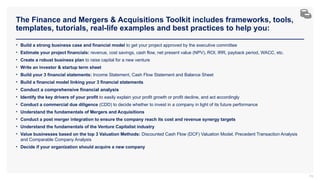
• Build a strong business case and financial model to get your project approved by the executive committee
• Estimate your project financials: revenue, cost savings, cash flow, net present value (NPV), ROI, IRR, payback period, WACC, etc.
• Create a robust business plan to raise capital for a new venture
• Write an investor & startup term sheet
• Build your 3 financial statements: Income Statement, Cash Flow Statement and Balance Sheet
• Build a financial model linking your 3 financial statements
• Conduct a comprehensive financial analysis
• Identify the key drivers of your profit to easily explain your profit growth or profit decline, and act accordingly
• Conduct a commercial due diligence (CDD) to decide whether to invest in a company in light of its future performance
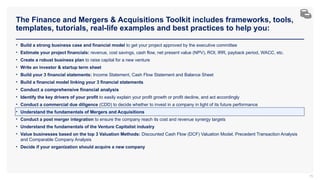
• Understand the fundamentals of Mergers and Acquisitions
• Conduct a post merger integration to ensure the company reach its cost and revenue synergy targets
• Understand the fundamentals of the Venture Capitalist industry
• Value businesses based on the top 3 Valuation Methods: Discounted Cash Flow (DCF) Valuation Model, Precedent Transaction Analysis
and Comparable Company Analysis
• Decide if your organization should acquire a new company
The Finance and Mergers & Acquisitions Toolkit includes frameworks, tools,
templates, tutorials, real-life examples and best practices to help you:
75
• Build a strong business case and financial model to get your project approved by the executive committee
• Estimate your project financials: revenue, cost savings, cash flow, net present value (NPV), ROI, IRR, payback period, WACC, etc.
• Create a robust business plan to raise capital for a new venture
• Write an investor & startup term sheet
• Build your 3 financial statements: Income Statement, Cash Flow Statement and Balance Sheet
• Build a financial model linking your 3 financial statements
• Conduct a comprehensive financial analysis
• Identify the key drivers of your profit to easily explain your profit growth or profit decline, and act accordingly
• Conduct a commercial due diligence (CDD) to decide whether to invest in a company in light of its future performance
• Understand the fundamentals of Mergers and Acquisitions
• Conduct a post merger integration to ensure the company reach its cost and revenue synergy targets
• Understand the fundamentals of the Venture Capitalist industry
• Value businesses based on the top 3 Valuation Methods: Discounted Cash Flow (DCF) Valuation Model, Precedent Transaction Analysis
and Comparable Company Analysis
• Decide if your organization should acquire a new company
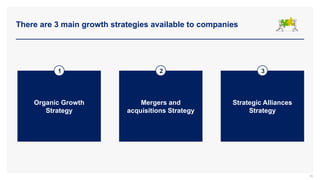
There are 3 main growth strategies available to companies
76
Organic Growth
Strategy
Mergers and
acquisitions Strategy
Strategic Alliances
Strategy
1 2 3
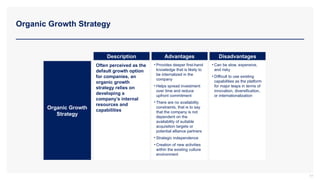
Organic Growth Strategy
Organic Growth
Strategy
Description Advantages Disadvantages
Often perceived as the
default growth option
for companies, an
organic growth
strategy relies on
developing a
company’s internal
resources and
capabilities
• Provides deeper first-hand
knowledge that is likely to
be internalized in the
company
• Helps spread investment
over time and reduce
upfront commitment
• There are no availability
constraints, that is to say
that the company is not
dependent on the
availability of suitable
acquisition targets or
potential alliance partners
• Strategic independence
• Creation of new activities
within the existing culture
environment
• Can be slow, expensive,
and risky
• Difficult to use existing
capabilities as the platform
for major leaps in terms of
innovation, diversification,
or internationalization
77
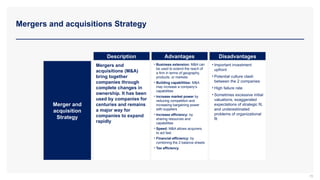
Mergers and acquisitions Strategy
Merger and
acquisition
Strategy
Description Advantages Disadvantages
Mergers and
acquisitions (M&A)
bring together
companies through
complete changes in
ownership. It has been
used by companies for
centuries and remains
a major way for
companies to expand
rapidly
• Business extension: M&A can
be used to extend the reach of
a firm in terms of geography,
products, or markets
• Building capabilities: M&A
may increase a company’s
capabilities
• Increase market power by
reducing competition and
increasing bargaining power
with suppliers
• Increase efficiency: by
sharing resources and
capabilities
• Speed: M&A allows acquirers
to act fast
• Financial efficiency: by
combining the 2 balance sheets
• Tax efficiency
• Important investment
upfront
• Potential culture clash
between the 2 companies
• High failure rate
• Sometimes excessive initial
valuations, exaggerated
expectations of strategic fit,
and underestimated
problems of organizational
fit
78
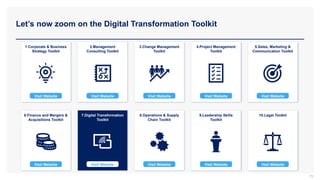
Let’s now zoom on the Digital Transformation Toolkit
1.Corporate & Business
Strategy Toolkit
2.Management
Consulting Toolkit
3.Change Management
Toolkit
4.Project Management
Toolkit
5.Sales, Marketing &
Communication Toolkit
6.Finance and Mergers &
Acquisitions Toolkit
7.Digital Transformation
Toolkit
8.Operations & Supply
Chain Toolkit
9.Leadership Skills
Toolkit
10.Legal Toolkit
Visit Website Visit Website Visit Website Visit Website Visit Website
Visit Website Visit Website Visit Website Visit Website
Visit Website
79
The Digital Transformation Toolkit includes frameworks, tools, templates,
tutorials, real-life examples and best practices to help you:
80
• Assess the digital maturity of your organization
• Define and implement your digital transformation strategy & plan
• Build a strong business case and financial model to get your digital transformation projects approved by the executive committee
• Estimate your project financials: revenue, cost savings, cash flow, net present value (NPV), ROI, IRR, payback period, WACC, etc.
• Define and implement your change management strategy & plan to ensure people adoption of the changes
• Get a clear understanding of the project management overall approach commonly used by Fortune 100 and Global Consulting
firms
• Prioritize digital transformation initiatives based on impact and value with our Initiative Prioritization Matrix
• Initiate your digital transformation project/program with a world class project charter, RACI Matrix and Stakeholder Matrix
• Plan with our High-Level Project Plan and Detailed Project Plan
• Implement your project with our Risk Register, Issue Register, Project Dashboards and parking Lot
• Close your project with a Punch List and Post Project Evaluation Report
• Define and implement your communication strategy & plan
• Identify and mitigate your project risks with our Risk Register and Risk Assessment Matrix
• Identify and resolve your project issues with our Issue Register
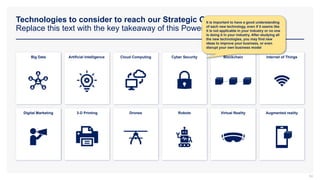
• Get an understanding of the top 12 main New Technologies that could make your company grow in a profitable way: Big Data,
Artificial Intelligence, Cloud Computing, Cyber security, Blockchain, Internet of Things, Digital Marketing, 3-D Printing, etc.
The Digital Transformation Toolkit includes frameworks, tools, templates,
tutorials, real-life examples and best practices to help you:
81
• Assess the digital maturity of your organization
• Define and implement your digital transformation strategy & plan
• Build a strong business case and financial model to get your digital transformation projects approved by the executive committee
• Estimate your project financials: revenue, cost savings, cash flow, net present value (NPV), ROI, IRR, payback period, WACC, etc.
• Define and implement your change management strategy & plan to ensure people adoption of the changes
• Get a clear understanding of the project management overall approach commonly used by Fortune 100 and Global Consulting
firms
• Prioritize digital transformation initiatives based on impact and value with our Initiative Prioritization Matrix
• Initiate your digital transformation project/program with a world class project charter, RACI Matrix and Stakeholder Matrix
• Plan with our High-Level Project Plan and Detailed Project Plan
• Implement your project with our Risk Register, Issue Register, Project Dashboards and parking Lot
• Close your project with a Punch List and Post Project Evaluation Report
• Define and implement your communication strategy & plan
• Identify and mitigate your project risks with our Risk Register and Risk Assessment Matrix
• Identify and resolve your project issues with our Issue Register
• Get an understanding of the top 12 main New Technologies that could make your company grow in a profitable way: Big Data,
Artificial Intelligence, Cloud Computing, Cyber security, Blockchain, Internet of Things, Digital Marketing, 3-D Printing, etc.
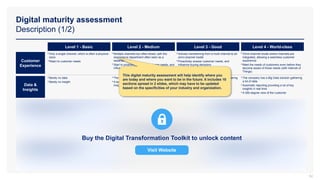
Digital maturity assessment
Description (1/2)
82
Level 1 - Basic Level 2 - Medium Level 3 - Good Level 4 - World-class
Customer
Experience
• Only a single channel, which is often a physical
store
• React to customer needs
• Multiple channels but often siloed, with the
ecommerce department often seen as a
separate entity
• Start to proactively answer customer needs, and
influence buying decisions
• Actively transitioning from a multi channel to an
omni-channel model
• Proactively answer customer needs, and
influence buying decisions
• Omni-channel model where channels are
integrated, allowing a seamless customer
experience
• Meet the needs of customers even before they
become aware of those needs (with Internet of
Things)
Data &
Insights
• Barely no data
• Barely no insight
• The company has some data
• A team of people manually analyze and provide
insight to the rest of the company
• The company has a Big Data solution gathering
a lot of data
• Automatic reporting with key insights
• Almost a 360-degree view of the customer
• The company has a Big Data solution gathering
a lot of data
• Automatic reporting providing a lot of key
insights in real time
• A 360-degree view of the customer
This digital maturity assessment will help identify where you
are today and where you want to be in the future. It includes 10
sections spread in 2 slides, which may have to be updated
based on the specificities of your industry and organization.
Buy the Digital Transformation Toolkit to unlock content
Visit Website
The Digital Transformation Toolkit includes frameworks, tools, templates,
tutorials, real-life examples and best practices to help you:
83
• Assess the digital maturity of your organization
• Define and implement your digital transformation strategy & plan
• Build a strong business case and financial model to get your digital transformation projects approved by the executive committee
• Estimate your project financials: revenue, cost savings, cash flow, net present value (NPV), ROI, IRR, payback period, WACC, etc.
• Define and implement your change management strategy & plan to ensure people adoption of the changes
• Get a clear understanding of the project management overall approach commonly used by Fortune 100 and Global Consulting
firms
• Prioritize digital transformation initiatives based on impact and value with our Initiative Prioritization Matrix
• Initiate your digital transformation project/program with a world class project charter, RACI Matrix and Stakeholder Matrix
• Plan with our High-Level Project Plan and Detailed Project Plan
• Implement your project with our Risk Register, Issue Register, Project Dashboards and parking Lot
• Close your project with a Punch List and Post Project Evaluation Report
• Define and implement your communication strategy & plan
• Identify and mitigate your project risks with our Risk Register and Risk Assessment Matrix
• Identify and resolve your project issues with our Issue Register
• Get an understanding of the top 12 main New Technologies that could make your company grow in a profitable way: Big Data,
Artificial Intelligence, Cloud Computing, Cyber security, Blockchain, Internet of Things, Digital Marketing, 3-D Printing, etc.
Digital Marketing 3-D Printing Drones Robots Virtual Reality
Big Data Artificial Intelligence Cloud Computing Cyber Security Blockchain Internet of Things
Augmented reality
Technologies to consider to reach our Strategic Objectives
Replace this text with the key takeaway of this Powerpoint slide.
84
It is important to have a good understanding
of each new technology, even if it seems like
it is not applicable in your industry or no one
is doing it in your industry. After studying all
the new technologies, you may find new
ideas to improve your business, or even
disrupt your own business model
Why are we considering the Big Data for our organization?
85
Big data is a term that describes the large volume of data, both structured and unstructured, that inundates a business on a day-to-day
basis. But it’s not the amount of data that’s important. It is what organizations do with the data that matters. Big data can be analyzed for
insights that lead to better tactical and strategical decisions.
While the term “big data” is relatively new, the act of gathering and storing large amounts of information for eventual analysis is ages old.
The concept gained momentum in the early 2000s when industry analyst Doug Laney articulated the now-mainstream definition of big
data as the three Vs:
• Volume: Organizations collect data from a variety of sources, including business transactions, social media and information from
sensor or machine-to-machine data. In the past, storing it would’ve been a problem, but today, new technologies have eased the
challenge.
• Velocity: Data streams in at an unprecedented speed and must be dealt with in a timely manner. RFID tags, sensors and smart
metering are driving the need to deal with torrents of data in near-real time.
• Variety: Data comes in all types of formats, from structured, numeric data in traditional databases to unstructured text documents,
email, video, audio, stock ticker data and financial transactions.
The amount of data in our world has been exploding, and analyzing large data sets will become a key basis of competition, underpinning
new waves of productivity growth, innovation, and consumer surplus, according to research by MGI and McKinsey's Business
Technology Office.
The next slides deep dive in each
technology
Examples of industry using Big Data
86
Government
Manufacturing
Banking
Health care
Retail
Education
With large amounts of information streaming in from
countless sources, banks are faced with finding new and
innovative ways to manage big data. Big Data and
Analytics help banks better understand customers and
minimize risk. Big data brings big insights, but it also
requires financial institutions to stay one step ahead of
the game with advanced analytics.
Educators armed with data-driven insight can make a
significant impact on school systems, students and
curriculums. By analyzing big data, they can identify at-
risk students, make sure students are making adequate
progress, and can implement a better system for
evaluation and support of teachers and principals.
When government agencies are able to harness and
apply analytics to their big data, they gain significant
ground when it comes to managing utilities, running
agencies, dealing with traffic congestion or preventing
crime. But while there are many advantages to big data,
governments must also address issues of transparency
and privacy.
Patient records. Treatment plans. Prescription
information. When it comes to health care, everything
needs to be done quickly, accurately, and, in some cases,
with enough transparency to satisfy stringent industry
regulations. When big data is managed effectively, health
care providers can uncover hidden insights that improve
patient care.
Armed with insight that big data can provide,
manufacturers can boost quality and output while
minimizing waste – processes that are key in today’s
highly competitive market. More and more manufacturers
are working in an analytics-based culture, which means
they can solve problems faster and make more agile
business decisions.
Customer relationship building is critical to the retail
industry – and the best way to manage that is to manage
big data. Retailers need to know the best way to market
to customers, the most effective way to handle
transactions, and the most strategic way to bring back
lapsed business. Big data remains at the heart of all
those things.
The next 15 slides are self
explanatory and do not include any
comments or instructions
Where does Big Data come from?
The sources for big data generally fall into one of three categories
87
Social media
data
Publicly
available data
Streaming data
This category includes data that reaches your IT systems from a web of connected
devices, often part of the IoT. You can analyze this data as it arrives and make decisions
on what data to keep, what not to keep and what requires further analysis.
The data on social interactions is an increasingly attractive set of information,
particularly for marketing, sales and support functions. It's often in unstructured or
semistructured forms, so it poses a unique challenge when it comes to consumption and
analysis.
Massive amounts of data are available through open data sources like the US
government’s data.gov, the CIA World Factbook or the European Union Open Data
Portal.
Let’s now zoom on the Operations & Supply Chain Toolkit
1.Corporate & Business
Strategy Toolkit
2.Management
Consulting Toolkit
3.Change Management
Toolkit
4.Project Management
Toolkit
5.Sales, Marketing &
Communication Toolkit
6.Finance and Mergers &
Acquisitions Toolkit
7.Digital Transformation
Toolkit
8.Operations & Supply
Chain Toolkit
9.Leadership Skills
Toolkit
10.Legal Toolkit
Visit Website Visit Website Visit Website Visit Website Visit Website
Visit Website Visit Website Visit Website Visit Website
Visit Website
88
The Operations & Supply Chain Toolkit includes frameworks, tools,
templates, tutorials, real-life examples and best practices to help you:
89
• Build a strong business case and financial model to get your project approved by the executive committee
• Estimate your project financials: revenue, cost savings, cash flow, net present value (NPV), ROI, IRR, payback period, WACC, etc.
• Identify and mitigate your project risks with our Risk Register and Risk Assessment Matrix
• Identify and resolve your project issues with our Issue Register
• Define and implement your digital transformation strategy & plan
• Conduct a post merger integration to ensure the company reach its cost and revenue synergy targets
• Get a clear understanding of the 5 Phases of Supply Chain Management
• Define & implement your supply chain strategy
• Analyze your value chain
• Assess the maturity of your Procurement Management
• Prioritize your initiatives based on impact and value with our Initiative Prioritization Matrix
• Get a clear understanding of the fundamentals of Business Process Management (BPM)
• Get a clear understanding of the fundamentals of Lean Six Sigma (LSS)
• Define and implement your pricing strategy
The Operations & Supply Chain Toolkit includes frameworks, tools,
templates, tutorials, real-life examples and best practices to help you:
90
• Build a strong business case and financial model to get your project approved by the executive committee
• Estimate your project financials: revenue, cost savings, cash flow, net present value (NPV), ROI, IRR, payback period, WACC, etc.
• Identify and mitigate your project risks with our Risk Register and Risk Assessment Matrix
• Identify and resolve your project issues with our Issue Register
• Define and implement your digital transformation strategy & plan
• Conduct a post merger integration to ensure the company reach its cost and revenue synergy targets
• Get a clear understanding of the 5 Phases of Supply Chain Management
• Define & implement your supply chain strategy
• Analyze your value chain
• Assess the maturity of your Procurement Management
• Prioritize your initiatives based on impact and value with our Initiative Prioritization Matrix
• Get a clear understanding of the fundamentals of Business Process Management (BPM)
• Get a clear understanding of the fundamentals of Lean Six Sigma (LSS)
• Define and implement your pricing strategy
Introduction
91
Supply Chain Management is the optimization of the flow of materials, information and
funds between and among all participating enterprises
Supplier Factory Warehouse Distributor Customer
Products
Information
Funds
The Supply Chain Management process includes 5 phases:
92
2.Demand &
Supply Chain
Planning
3.Sourcing &
Procurement
4.Manufacturing
5.Logistics &
Distribution
1.Supply Chain
Strategy
Zoom on Phase1: Supply Chain Strategy
93
2.Demand &
Supply Chain
Planning
3.Sourcing &
Procurement
4.Manufacturing
5.Logistics &
Distribution
1.Supply Chain
Strategy
Zoom on Phase1: Supply Chain Strategy
94
2.Demand &
Supply Chain
Planning
3.Sourcing &
Procurement
4.Manufacturing
5.Logistics &
Distribution
1.Supply Chain
Strategy
• Key steps & activities
• Best Practices, Tips & Templates
Defining a robust Supply Chain Strategy usually requires
a 3 to 6 months Project
95
The Project is often outsourced to a Consulting firm to avoid any conflict of interest
The top 5 steps that the Consultants will have to carry out are:
1 Understand Current State
2 Gather Best Practices & Benchmarks
3 Develop Future State
4 Conduct Gap Analysis between the desired Future State & the Current State
5 Build a Roadmap to cross the bridge between the desired Future State & the Current State
Let’s now zoom on the Leadership Skills Toolkit
1.Corporate & Business
Strategy Toolkit
2.Management
Consulting Toolkit
3.Change Management
Toolkit
4.Project Management
Toolkit
5.Sales, Marketing &
Communication Toolkit
6.Finance and Mergers &
Acquisitions Toolkit
7.Digital Transformation
Toolkit
8.Operations & Supply
Chain Toolkit
9.Leadership Skills
Toolkit
10.Legal Toolkit
Visit Website Visit Website Visit Website Visit Website Visit Website
Visit Website Visit Website Visit Website Visit Website
Visit Website
96
The Leadership Toolkit includes frameworks, tools, templates, tutorials, real-
life examples and best practices to help you:
97
• Structure your presentations and recommendations like a tier-1 management consultant
• Communicate effectively
• Develop your negotiating skills
• Develop your managerial skills
• Improve your time management
• Develop your leadership skills
• Define your personal mission statement, vision statement, values and objectives
The Leadership Toolkit includes frameworks, tools, templates, tutorials, real-
life examples and best practices to help you:
98
• Structure your presentations and recommendations like a tier-1 management consultant
• Communicate effectively
• Develop your negotiating skills
• Develop your managerial skills
• Improve your time management
• Develop your leadership skills
• Define your personal mission statement, vision statement, values and objectives
Table of contents
99
Behavioral
Skills
Presentation Skills
Effective Communication
Negotiations Skills
Leadership
Team management
Time Management
Table of contents
100
Behavioral
Skills
Presentation Skills
Effective Communication
Negotiations Skills
Leadership
Team management
Time Management
What is the most well-known principle used by Consultants and
Executives to make breakthrough presentations?
101
What is the most well-known principle used by Consultants and
Executives to make breakthrough presentations?
102
The Pyramid Principle, also called the Minto Pyramid Principle
Create a pyramid with your answer and supporting arguments - Template
103
Insert your answer
Insert your
supporting
argument
#1.1
Insert your
supporting
argument
#1.2
Insert your
supporting
argument
#1.3
Insert your
supporting
argument
#2.1
Insert your
supporting
argument
#2.2
Insert your
supporting
argument
#2.3
Insert your
supporting
argument
#3.1
Insert your
supporting
argument
#3.2
Insert your supporting
argument #1
Insert your supporting
argument #2
Insert your supporting
argument #3
Insert your
supporting
argument
#3,3
Insert your introduction’s question
Why or How?
Why or How?
Why or How? Why or How?
To communicate in a structured way with a busy
executive, you should start with the answer to
the executive’s question first, and then list your
supporting arguments
Group, summarize and order logically your
supporting arguments
Let’s now zoom on the Legal Toolkit
1.Corporate & Business
Strategy Toolkit
2.Management
Consulting Toolkit
3.Change Management
Toolkit
4.Project Management
Toolkit
5.Sales, Marketing &
Communication Toolkit
6.Finance and Mergers &
Acquisitions Toolkit
7.Digital Transformation
Toolkit
8.Operations & Supply
Chain Toolkit
9.Leadership Skills
Toolkit
10.Legal Toolkit
Visit Website Visit Website Visit Website Visit Website Visit Website
Visit Website Visit Website Visit Website Visit Website
Visit Website
104
The Legal Toolkit includes templates to help you:
105
• Write a business consultant agreement
• Write an investor & startup term sheet
• Write a non-disclosure agreement
• Write a non-compete agreement
The Legal Toolkit includes templates to help you:
106
• Write a business consultant agreement
• Write an investor & startup term sheet
• Write a non-disclosure agreement
• Write a non-compete agreement
All our Legal templates have been created in word. All you need to do is
replace the text highlighted in yellow by your own words
107
This free sample represents less than 1% of our Toolkits. You can access to all
our Toolkits for half the price with the Gold Business & Consulting Package
www.slidebooks.com
Gold Business & Consulting Package
Learn More
108
Need more help?
Hire one of our Management Consultants for $4,000 a day
Learn More
109
Thanks for your attention!
www.slidebooks.com
110

1. Business & Consulting Toolkits - Sample.pptx

  • 1.
    Business & ConsultingToolkits Free sample Created by ex-McKinsey, Deloitte & BCG Management Consultants Confidential
  • 2.
    2 Improve the growthand efficiency of your organization by leveraging the know-how of ex-McKinsey, Deloitte & BCG Management Consultants without breaking your budget Imagine having a team of ex-McKinsey, Deloitte and BCG Management Consultants at your disposal at any time of the day to help you solve your business problems. How much more confident would you be with your work? How much more time could you save? If you ever tried solving business problems that you haven’t encountered before, you know how frustrating it can be just to move from a starting point. And even then, you still aren’t sure if what you’re doing is going to end up wasting your time and your money. Having someone who experienced these kinds of situations by your side would be a huge help. That’s why businesses hire consultants for support in the first place. The only problem is that hiring a couple of tier 1 Consultants for a management consulting project would cost you at least $300,000! Not every business or team can afford this. I wanted to do something about that because I believe everyone deserves to receive high value business guidance, regardless of their budget! That’s why I’ve teamed up with other ex-McKinsey, Deloitte and BCG Consultants to create all the Toolkits, Frameworks & Templates required to solve any business problem you may encounter! And it's all inside this website and the Gold Business & Consulting Package. Now you can easily improve the growth and efficiency of your organization by leveraging the know-how and best practices of our ex- McKinsey, Deloitte & BCG Management Consultants. No matter if you're an executive, entrepreneur or consultant from a small or large organization, with Slidebooks Consulting we have the opportunity to help you, at a cost that won't break your budget. Whatever the kind of business challenge you face, you'll have a proven, structured way to solve it with our battle-tested Toolkits, Frameworks and Templates. Join today the 200,000+ Executives, Consultants & Entrepreneurs leveraging our Business & Consulting Toolkits to improve the performance of their organization.
  • 3.
    Key Benefits ofour Business & Consulting Toolkits 3 Improve the growth & efficiency of your organization by leveraging Business & Consulting Toolkits created by ex-McKinsey, Deloitte & BCG Consultants. It cost us $500k+ to create all our Business & Consulting Toolkits. Get them for a fraction of this cost. It’s like hiring Management Consultants to create all the practical Frameworks, Tools & Templates required to get a competitive advantage. Get the job done quicker and never start from scratch again with our ready-made & fully editable Frameworks, Tools & Templates in Powerpoint & Excel. We have worked 20,000+ hours over the past 5 years to create the world’s best Business & Consulting Toolkits. Don’t reinvent the wheel. Download now. Improve your skills & capabilities and meet your professional goals by learning how the Fortune 100 and Global Consulting Firms do it. Get free support and advice from our ex-McKinsey, Deloitte & BCG Management Consultants. Hiring top-tier Consultants for a management consulting project would cost you $300k+. A lot more expensive than purchasing our Toolkits. Impress your stakeholders and become your organization’s subject matter expert with world-class approaches to resolve common business problems.
  • 4.
    Our team ofex-McKinsey, Deloitte & BCG Consultants created 10 Business & Consulting Toolkits including practical Frameworks, Tools & Templates 1.Corporate & Business Strategy Toolkit 2.Management Consulting Toolkit 3.Change Management Toolkit 4.Project Management Toolkit 5.Sales, Marketing & Communication Toolkit 6.Finance and Mergers & Acquisitions Toolkit 7.Digital Transformation Toolkit 8.Operations & Supply Chain Toolkit 9.Leadership Skills Toolkit 10.Legal Toolkit Visit Website Visit Website Visit Website Visit Website Visit Website Visit Website Visit Website Visit Website Visit Website Visit Website 4
  • 5.
    Let’s zoom onthe Corporate & Business Strategy Toolkit 1.Corporate & Business Strategy Toolkit 2.Management Consulting Toolkit 3.Change Management Toolkit 4.Project Management Toolkit 5.Sales, Marketing & Communication Toolkit 6.Finance and Mergers & Acquisitions Toolkit 7.Digital Transformation Toolkit 8.Operations & Supply Chain Toolkit 9.Leadership Skills Toolkit 10.Legal Toolkit Visit Website Visit Website Visit Website Visit Website Visit Website Visit Website Visit Website Visit Website Visit Website Visit Website 5
  • 6.
    The Corporate &Business Strategy Toolkit includes frameworks, tools, templates, tutorials, real-life examples and best practices to help you: 6 • Easily define and execute your corporate and business strategy • Create a robust strategic plan describing where the company should go, and how to get there • Conduct a strategic planning project to define your mission, vision, strategic objectives and key initiatives • Identify the key drivers of your profit to easily explain your profit growth or profit decline, and act accordingly • Decide if you should enter a new market (e.g., European market, Chinese market) • Decide if you should introduce a new product • Decide if your organization should acquire a new company • Create a robust business plan to raise capital for a new venture • Build a strong business case and financial model to get your project approved by the executive committee • Estimate your project financials: revenue, cost savings, cash flow, net present value (NPV), ROI, IRR, payback period, WACC, etc. • Conduct a commercial due diligence (CDD) • Carry out a market & competitor analysis that includes many tools such as PESTLE, Porter’s Five Forces and SWOT • Define your pricing strategy • Identify your strategic options and their respective risk with the Ansoff Growth Matrix and the Porter’s Generic Corporate Strategies Matrix • Translate your strategy into strategic objectives, key performance indicators and targets to be reached with a Balanced Scorecard • Increase your know-how with the top 22 strategy tools commonly used by Fortune 100 and Global Consulting firms: Business Roadmap, Blue Ocean Strategy, Entry/Exit Barriers, Experience Curve, Fishbone Diagram, Five Whys, Initiative Prioritization Matrix, Issue Tree, Maturity Model, McKinsey Seven-S, Product Life Cycle, Strategy Map, Value Chain Analysis, Value Driver Tree, etc.
  • 7.
    The Corporate &Business Strategy Toolkit includes frameworks, tools, templates, tutorials, real-life examples and best practices to help you: 7 • Easily define and execute your corporate and business strategy • Create a robust strategic plan describing where the company should go, and how to get there • Conduct a strategic planning project to define your mission, vision, strategic objectives and key initiatives • Identify the key drivers of your profit to easily explain your profit growth or profit decline, and act accordingly • Decide if you should enter a new market (e.g., European market, Chinese market) • Decide if you should introduce a new product • Decide if your organization should acquire a new company • Create a robust business plan to raise capital for a new venture • Build a strong business case and financial model to get your project approved by the executive committee • Estimate your project financials: revenue, cost savings, cash flow, net present value (NPV), ROI, IRR, payback period, WACC, etc. • Conduct a commercial due diligence (CDD) • Carry out a market & competitor analysis that includes many tools such as PESTLE, Porter’s Five Forces and SWOT • Define your pricing strategy • Identify your strategic options and their respective risk with the Ansoff Growth Matrix and the Porter’s Generic Corporate Strategies Matrix • Translate your strategy into strategic objectives, key performance indicators and targets to be reached with a Balanced Scorecard • Increase your know-how with the top 22 strategy tools commonly used by Fortune 100 and Global Consulting firms: Business Roadmap, Blue Ocean Strategy, Entry/Exit Barriers, Experience Curve, Fishbone Diagram, Five Whys, Initiative Prioritization Matrix, Issue Tree, Maturity Model, McKinsey Seven-S, Product Life Cycle, Strategy Map, Value Chain Analysis, Value Driver Tree, etc.
  • 8.
    Strategic Plan Insert CompanyName CEO: insert your own text Chief Strategy Officer: insert your own text Date: insert your own text Version: insert your own text Contact Email: insert your own text Confidential Insert your own logo
  • 9.
    Executive Summary (1/3) StrategyMap Financial Perspectives Customer Internal Process Learning & Growth Strategic Objectives I1 - Insert your own text I2 - Insert your own text I3 - Insert your own text I4 - Insert your own text L1 - Insert your own text L2 - Insert your own text L3 - Insert your own text L4 - Insert your own text C1 - Insert your own text C2 - Insert your own text C3 - Insert your own text C4 - Insert your own text F1 - Insert your own text F2 - Insert your own text F3 - Insert your own text F4 - Insert your own text Mission: Insert your Mission statement Vision: Insert your Vision statement The best practice is to have between 1 and 3 slides for the Executive Summary. Usually, the Strategy Map, the Balance Scorecard and the Business Roadmap represent a good summary of the Strategic Plan 9
  • 10.
    Mission Statement It isthe company’s reason for existence or purpose. It describes the overarching intent of the organization. It is usually defined during a workshop with the top management. It should provide focus, direction and help guide decision making and actions. It should be one easy to understand sentence and, if required, a more details description below the main sentence. Vision Statement It describes the organization desired or intended state at some point in the near or distant future. It describes the overarching aim of the organization as it progresses into the future. Like the Mission Statement, it is usually defined during a workshop with the top management. It should provide focus, direction and help guide decision making and actions. It should be one easy to understand sentence and, if required, a more details description below the main sentence. Mission & Vision Statement Description 10
  • 11.
    Strategy Map A Strategymap includes 4 perspectives 11 Financial Perspectives Customer Internal Process Learning & Growth Presents the strategic objectives driving financial performance Presents the strategic objectives related to the value proposition of the company Presents the strategic objectives related to the internal capabilities of the company Presents the strategic objectives related to the intangible assets required to drive performance
  • 12.
    Strategy Map Example ofa Strategy Map Financial Perspective Strategic objectives 12 Increase revenue Increase profit Increase number of customers Increase revenue per customer Decrease Cost Decrease fixed cost Decrease variable cost Significantly behind target Slightly behind target Meeting target or above target Buy the Strategic Plan Template to unlock content Visit Website
  • 13.
    Balanced Scorecard Description C1 Insertyour own text C2 Insert your own text C3 Insert your own text I1 Insert your own text I2 Insert your own text I3 Insert your own text L1 Insert your own text L2 Insert your own text L3 Insert your own text F1 Increase earnings per share F2 Increase revenue per customer F3 Reduce cost per customer Strategic Objectives Financial To satisfy our shareholders, what financial objectives must we accomplish? Perspective Customer To achieve our financial objectives, what customer needs must we serve? Internal processes To satisfy our customers and shareholders, in which internal business processes must we excel?” Learning & Growth To achieve our “Financial”, “Customer” and “Internal Processes” strategic objectives, what does the organization need to learn? Each perspective has specific Strategic Objectives, Key Performance Indicators & Targets Buy the Strategic Plan Template to unlock content Visit Website
  • 14.
    Business Roadmap Insert yourown text to summarize the key message of this slide 14 Insert timeline Timeline • Insert initiative name • Insert initiative name • Insert initiative name • Insert initiative name • Insert initiative name • Insert initiative name • Insert initiative name • Insert initiative name • Insert initiative name • Insert initiative name • Insert initiative name • Insert initiative name Phase 1 See in the next slides a little bit more details on the Business Roadmap and some additional templates that you may prefer to the one used in the document “Strategic Plan - Template” Buy the Strategic Plan Template to unlock content Visit Website
  • 15.
    The Corporate &Business Strategy Toolkit includes frameworks, tools, templates, tutorials, real-life examples and best practices to help you: 15 • Easily define and execute your corporate and business strategy • Create a robust strategic plan describing where the company should go, and how to get there • Conduct a strategic planning project to define your mission, vision, strategic objectives and key initiatives • Identify the key drivers of your profit to easily explain your profit growth or profit decline, and act accordingly • Decide if you should enter a new market (e.g., European market, Chinese market) • Decide if you should introduce a new product • Decide if your organization should acquire a new company • Create a robust business plan to raise capital for a new venture • Build a strong business case and financial model to get your project approved by the executive committee • Estimate your project financials: cash flow, net present value (NPV), ROI, IRR, payback period, WACC, etc. • Conduct a commercial due diligence (CDD) • Carry out a market & competitor analysis that includes many tools such as PESTLE, Porter’s Five Forces and SWOT • Define your pricing strategy • Identify your strategic options and their respective risk with the Ansoff Growth Matrix and the Porter’s Generic Corporate Strategies Matrix • Translate your strategy into strategic objectives, key performance indicators and targets to be reached with a Balanced Scorecard • Increase your know-how with the top 22 strategy tools commonly used by Fortune 100 and Global Consulting firms: Business Roadmap, Blue Ocean Strategy, Entry/Exit Barriers, Experience Curve, Fishbone Diagram, Five Whys, Initiative Prioritization Matrix, Issue Tree, Maturity Model, McKinsey Seven-S, Product Life Cycle, Strategy Map, Value Chain Analysis, Value Driver Tree, etc.
  • 16.
    Situation, complication andmain question to answer The situation The complication The question Description Example from a Fortune 100 company You need to provide a neutral description with facts that you know your audience will agree on. Our company has been selling its products in the US for the past 10 years, with an annual profit growth above 10%. The complication is a desired change of the current situation. With a market share already above 40%, profit growth will be limited in the US. The question that implicitly results from the complication. Should we enter the European market? 16
  • 17.
    To solve ourproblem, we need to use the “Entering a new market” Framework “Profitability” problem “Entering a new market” problem “Introducing a new product” problem “M&A” problem e.g. “Why does my company’s profit have decreased by 10%?” e.g. “Should we enter the Chinese market?” e.g. “Should we introduce this new product X?” e.g. “Should we acquire the company Y?” 17
  • 18.
    The “Entering anew market” Framework includes 3 components Desirability Profitability Feasibility 18
  • 19.
    Each component hasan underlying question that we will have to answer to identify if it is a good strategic initiative to enter this new market What is the potential demand for our Product in this new Market? What is the feasibility to enter this new Market? Desirability Profitability Feasibility What will be the profitability of this strategic initiative? 19
  • 20.
    If the answeris “high” or “very high” to the 3 questions, then it means that entering the European market is a good strategic initiative Sweet spot Desirability Profitability Feasibility What is the potential demand for our Product in this new Market? What is the feasibility to enter this new Market? What will be the profitability of this strategic initiative? 20
  • 21.
    Desirability What is thepotential demand for our Product in this new Market? Product Customers Competition Market size Describe the key product(s) we would like to sell? Is it a commodity or a differentiated product? What are its Key benefits? Any potential substitute product? Are we answering a customer need or are we creating a new customer need? Who are our potential customers? How many are they? Is the customer demand expected to increase or decrease in the future? How much the customer will be willing to pay for our product? How many products will the customer be buying per year? Who will be our main competitors? What is the revenue, profit, unique selling proposition and strategy of each one of them? How intense is the competition in this market? Do they have key capabilities that we don’t have or vice versa? What’s their pricing position? The total market size is: The number of customers multiplied by the number of products purchased every year per customer multiplied by the Product price. Checking the annual report of our competitors may help us calculate this number. How much of this market do we think we can get? Why do we think so? Do we have a strong enough unique selling proposition (USP)? Very Low Low Medium High Very High Caption: Very High 21
  • 22.
    The Corporate &Business Strategy Toolkit includes frameworks, tools, templates, tutorials, real-life examples and best practices to help you: 22 • Easily define and execute your corporate and business strategy • Create a robust strategic plan describing where the company should go, and how to get there • Conduct a strategic planning project to define your mission, vision, strategic objectives and key initiatives • Identify the key drivers of your profit to easily explain your profit growth or profit decline, and act accordingly • Decide if you should enter a new market (e.g., European market, Chinese market) • Decide if you should introduce a new product • Decide if your organization should acquire a new company • Create a robust business plan to raise capital for a new venture • Build a strong business case and financial model to get your project approved by the executive committee • Estimate your project financials: cash flow, net present value (NPV), ROI, IRR, payback period, WACC, etc. • Conduct a commercial due diligence (CDD) • Carry out a market & competitor analysis that includes many tools such as PESTLE, Porter’s Five Forces and SWOT • Define your pricing strategy • Identify your strategic options and their respective risk with the Ansoff Growth Matrix and the Porter’s Generic Corporate Strategies Matrix • Translate your strategy into strategic objectives, key performance indicators and targets to be reached with a Balanced Scorecard • Increase your know-how with the top 22 strategy tools commonly used by Fortune 100 and Global Consulting firms: Business Roadmap, Blue Ocean Strategy, Entry/Exit Barriers, Experience Curve, Fishbone Diagram, Five Whys, Initiative Prioritization Matrix, Issue Tree, Maturity Model, McKinsey Seven-S, Product Life Cycle, Strategy Map, Value Chain Analysis, Value Driver Tree, etc.
  • 23.
    An effective businessplan needs to answer the following top 10 questions: 23 What is your current situation? What is your Vision? How will you reach your Vision? What do you offer? How big is the market you are entering? Who are the key players? How will you differentiate yourself? What will be your marketing plan? What are the economics of your business? What is the capital requirement to get your business started? Effective Business Plan
  • 24.
    Competitor Comparison (1/2) Replacethis text by the main takeaway of this slide. Revenue Profit Market share Main activity Number of employee Product quality Insert your own text Competitor A Insert your own text Insert your own text Insert your own text Insert your own text Insert your own text Insert your own text Insert your own text Competitor B Insert your own text Insert your own text Insert your own text Insert your own text Insert your own text Insert your own text Insert your own text Competitor D Insert your own text Insert your own text Insert your own text Insert your own text Insert your own text Insert your own text Insert your own text Insert your own text Insert your own text Insert your own text Insert your own text Insert your own text Insert your own text Insert your own text Insert your own text Insert your own text Insert your own text Insert your own text Insert your own text Insert your own text Insert your own text Insert your own text Insert your own text Insert your own text Insert your own text Insert your own text Insert your own text Insert your own text Insert your own text Insert your own text Insert your own text Insert your own text Insert your own text Insert your own text Insert your own text Insert your own text Insert your own text Insert your own text Insert your own text Insert your own text Insert your own text Insert your own text Insert your own text Insert your own text Insert your own text Insert your own text Insert your own text Insert your own text Insert your own text Insert your own text Insert your own text Insert your own text Insert your own text Insert your own text Insert your own text Insert your own text Insert your own text Insert your own text Insert your own text Insert your own text Insert your own text Insert your own text Insert your own text Compare your competitors with the most relevant criteria. This will depend on your industry and what you want to emphasize 24
  • 25.
    PESTLE Analysis Replace thistext by the main takeaway of this slide. PESTLE S E L Legal • Replace the text by your own text • Replace the text by your own text • Replace the text by your own text • Replace the text by your own text Environmental • Replace the text by your own text • Replace the text by your own text • Replace the text by your own text • Replace the text by your own text P E T Technological • Replace the text by your own text • Replace the text by your own text • Replace the text by your own text • Replace the text by your own text Political • Replace the text by your own text • Replace the text by your own text • Replace the text by your own text • Replace the text by your own text Economical • Replace the text by your own text • Replace the text by your own text • Replace the text by your own text • Replace the text by your own text Social • Replace the text by your own text • Replace the text by your own text • Replace the text by your own text • Replace the text by your own text See in the next slides a little bit more details on the PESTLE tool and some additional templates that you may prefer to the one used in the document “Business Plan - Template” 25
  • 26.
    Products & Services Replacethis text by your own text. Provide the key takeaway of this PowerPoint slide Product name Key Customer Benefits Key Features Unique Selling Proposition (USP) Insert the name of your product or service Insert your own text Insert your own text Insert your own text Insert the name of your product or service Insert your own text Insert your own text Insert your own text Insert the name of your product or service Insert your own text Insert your own text Insert your own text Check the next slide for more instructions regarding this slide 26
  • 27.
    Products & Services Replacethis text by your own text. Provide the key takeaway of this PowerPoint slide Product name Key Customer Benefits Key Features Unique Selling Proposition (USP) Insert the name of your product or service A Product Benefit is what the user gets from the product rather than its physical characteristics or features Features mean the characteristics by which products are identified and differentiated. It usually comprises shapes, colors, functions and uses It defines your company’s unique position in the marketplace. It is an often overlooked but very important element of creating a business that customers love. A strong unique selling proposition allows you to stand apart from competitors and actively focus your energy on creating things that cater to your ideal group of customers 27
  • 28.
    Market Profitability Replace thistext by the main takeaway of this slide. Low Average High Caption: 28 Buy the Business Plan Template to unlock content Visit Website
  • 29.
    The Corporate &Business Strategy Toolkit includes frameworks, tools, templates, tutorials, real-life examples and best practices to help you: 29 • Easily define and execute your corporate and business strategy • Create a robust strategic plan describing where the company should go, and how to get there • Conduct a strategic planning project to define your mission, vision, strategic objectives and key initiatives • Identify the key drivers of your profit to easily explain your profit growth or profit decline, and act accordingly • Decide if you should enter a new market (e.g., European market, Chinese market) • Decide if you should introduce a new product • Decide if your organization should acquire a new company • Create a robust business plan to raise capital for a new venture • Build a strong business case and financial model to get your project approved by the executive committee • Estimate your project financials: cash flow, net present value (NPV), ROI, IRR, payback period, WACC, etc. • Conduct a commercial due diligence (CDD) • Carry out a market & competitor analysis that includes many tools such as PESTLE, Porter’s Five Forces and SWOT • Define your pricing strategy • Identify your strategic options and their respective risk with the Ansoff Growth Matrix and the Porter’s Generic Corporate Strategies Matrix • Translate your strategy into strategic objectives, key performance indicators and targets to be reached with a Balanced Scorecard • Increase your know-how with the top 22 strategy tools commonly used by Fortune 100 and Global Consulting firms: Business Roadmap, Blue Ocean Strategy, Entry/Exit Barriers, Experience Curve, Fishbone Diagram, Five Whys, Initiative Prioritization Matrix, Issue Tree, Maturity Model, McKinsey Seven-S, Product Life Cycle, Strategy Map, Value Chain Analysis, Value Driver Tree, etc.
  • 30.
    Ineffective pricing managementwill cause many issues 30 Source: Kiewell and Roegner • Increased service costs • Increased price administration costs • Increased receivables write-offs • Wide price bands • Inaccurate quotations from field sales • Slow response to RFPs • Declining margins • Little correlation between volume and price • Product profitability lack of visibility • Lost market share • Excess / obsolete inventory • Low volume for new products
  • 31.
    Let’s now zoomon the Management Consulting Toolkit 1.Corporate & Business Strategy Toolkit 2.Management Consulting Toolkit 3.Change Management Toolkit 4.Project Management Toolkit 5.Sales, Marketing & Communication Toolkit 6.Finance and Mergers & Acquisitions Toolkit 7.Digital Transformation Toolkit 8.Operations & Supply Chain Toolkit 9.Leadership Skills Toolkit 10.Legal Toolkit Visit Website Visit Website Visit Website Visit Website Visit Website Visit Website Visit Website Visit Website Visit Website Visit Website 31
  • 32.
    The Management ConsultingToolkit includes frameworks, tools, templates, tutorials, real-life examples and best practices to help you: 32 • Build a convincing consulting proposal • Write a business consultant agreement • Identify the key drivers of the organization’s profit to easily explain profit growth or profit decline, and act accordingly • Decide if you should enter a new market (e.g., European market, Chinese market) • Decide if you should introduce a new product • Decide if your organization should acquire a new company • Gather qualitative and quantitative data in a structured way via interview, focus group and survey • Structure your presentations and recommendations like a tier-1 management consultant • Create a robust strategic plan describing where the company should go, and how to get there • Conduct a strategic planning project to define your mission, vision, strategic objectives and key initiatives • Build a strong business case and financial model to get your project approved by the executive committee • Estimate your project financials: revenue, cost savings, cash flow, net present value (NPV), ROI, IRR, payback period, WACC, etc. • Conduct a comprehensive financial analysis • Prioritize a company’s potential initiatives based on impact and effort • Define the maturity of a company on a specific area with a visual maturity model • Identify your strategic options and their respective risk with the Ansoff Growth Matrix and the Porter’s Generic Corporate Strategies Matrix • Increase your know-how with the top 40 management consulting tools commonly used by Fortune 100 and Global Consulting firms: Business Roadmap, Blue Ocean Strategy, Entry/Exit Barriers, Experience Curve, Fishbone Diagram, Five Whys, Initiative Prioritization Matrix, Issue Tree, McKinsey Seven-S, Risk Assessment Matrix, Product Life Cycle, Strategy Map, Value Chain Analysis, Value Driver Tree, etc.
  • 33.
    The Management ConsultingToolkit includes frameworks, tools, templates, tutorials, real-life examples and best practices to help you: 33 • Build a convincing consulting proposal • Write a business consultant agreement • Identify the key drivers of the organization’s profit to easily explain profit growth or profit decline, and act accordingly • Decide if you should enter a new market (e.g., European market, Chinese market) • Decide if you should introduce a new product • Decide if your organization should acquire a new company • Gather qualitative and quantitative data in a structured way via interview, focus group and survey • Structure your presentations and recommendations like a tier-1 management consultant • Create a robust strategic plan describing where the company should go, and how to get there • Conduct a strategic planning project to define your mission, vision, strategic objectives and key initiatives • Build a strong business case and financial model to get your project approved by the executive committee • Estimate your project financials: revenue, cost savings, cash flow, net present value (NPV), ROI, IRR, payback period, WACC, etc. • Conduct a comprehensive financial analysis • Prioritize a company’s potential initiatives based on impact and effort • Define the maturity of a company on a specific area with a visual maturity model • Identify your strategic options and their respective risk with the Ansoff Growth Matrix and the Porter’s Generic Corporate Strategies Matrix • Increase your know-how with the top 40 management consulting tools commonly used by Fortune 100 and Global Consulting firms: Business Roadmap, Blue Ocean Strategy, Entry/Exit Barriers, Experience Curve, Fishbone Diagram, Five Whys, Initiative Prioritization Matrix, Issue Tree, McKinsey Seven-S, Risk Assessment Matrix, Product Life Cycle, Strategy Map, Value Chain Analysis, Value Driver Tree, etc.
  • 34.
    Create a pyramidwith your answer and supporting arguments - Example 34 The company can reduce its cost by $5 millions through some operational improvements Select non-core functions Evaluate cost and service level of potential partners Choose one partner for each function Design current processes Compare current process to best-in-class benchmarks Adopt best practices based on benchmarks Select and review current supplier costs Evaluate cost of potential alternative suppliers Outsource non-core functions to save $3 Millions Simplify core functions processes to save $1 Million Review supplier cost to save $1 Million Renegotiate supplier contracts and/or choose alternative suppliers How can the company reduce its cost by 10%?
  • 35.
    The Management ConsultingToolkit includes frameworks, tools, templates, tutorials, real-life examples and best practices to help you: 35 • Build a convincing consulting proposal • Write a business consultant agreement • Identify the key drivers of the organization’s profit to easily explain profit growth or profit decline, and act accordingly • Decide if you should enter a new market (e.g., European market, Chinese market) • Decide if you should introduce a new product • Decide if your organization should acquire a new company • Gather qualitative and quantitative data in a structured way via interview, focus group and survey • Structure your presentations and recommendations like a tier-1 management consultant • Create a robust strategic plan describing where the company should go, and how to get there • Conduct a strategic planning project to define your mission, vision, strategic objectives and key initiatives • Build a strong business case and financial model to get your project approved by the executive committee • Estimate your project financials: revenue, cost savings, cash flow, net present value (NPV), ROI, IRR, payback period, WACC, etc. • Conduct a comprehensive financial analysis • Prioritize a company’s potential initiatives based on impact and effort • Define the maturity of a company on a specific area with a visual maturity model • Identify your strategic options and their respective risk with the Ansoff Growth Matrix and the Porter’s Generic Corporate Strategies Matrix • Increase your know-how with the top 40 management consulting tools commonly used by Fortune 100 and Global Consulting firms: Business Roadmap, Blue Ocean Strategy, Entry/Exit Barriers, Experience Curve, Fishbone Diagram, Five Whys, Initiative Prioritization Matrix, Issue Tree, McKinsey Seven-S, Risk Assessment Matrix, Product Life Cycle, Strategy Map, Value Chain Analysis, Value Driver Tree, etc.
  • 36.
    Business Case Insert ProjectName Author: insert your own text Project Sponsor: insert your own text Project Manager: insert your own text Change Manager: insert your own text Date: insert your own text Version No: insert your own text Status: E.g. 1.0 for final / 0.1 for drafts Confidential Insert your own logo
  • 37.
    Document Purpose 37 The purposeof this document is to provide enough information on the potential project “insert project name” to decide whether or not to invest in it. This document will provide an overview of the following: • Business Opportunity & Suggested Solution • Project Objectives, Scope & Approach • Project Deliverables & Business Outcomes • Strategic Alignment • Dependencies & Constraints • Risk Assessment & Mitigation • Change Impact Assessment • Project Costs • Benefits • Net Present Value • Key Success Factors & KPIs Most of companies have either a very complex Business Case Template that nobody uses, or a Business Case Template which is not good enough to make robust decisions on whether or not to invest. Following the requests of many of our clients, we decided to solve this problem by creating a Business Case Template which is both comprehensive and simple to use.
  • 38.
    Document Audience 38 Name RoleRequired / Optional John Doe Project Sponsor Required Insert Name Insert role Insert Required or Optional Insert Name Insert role Insert Required or Optional Insert Name Insert role Insert Required or Optional Insert Name Insert role Insert Required or Optional Insert Name Insert role Insert Required or Optional Insert Name Insert role Insert Required or Optional
  • 39.
    Table of Contents 1.Executive Summary 2. Business Opportunity & Suggested Solution 3. Project Objectives, Scope & Approach 4. Project Deliverables & Business Outcomes 5. Strategic Alignment 6. Dependencies & Constraints 7. Risk Assessment & Mitigation 8. Change Impact Assessment 9. Project Costs 10. Benefits 11. Net Present Value 12. Key Success Factors & KPIs 13. Exhibits 39
  • 40.
    Table of Contents 1.Executive Summary 2. Business Opportunity & Suggested Solution 3. Project Objectives, Scope & Approach 4. Project Deliverables & Business Outcomes 5. Strategic Alignment 6. Dependencies & Constraints 7. Risk Assessment & Mitigation 8. Change Impact Assessment 9. Project Costs 10. Benefits 11. Net Present Value 12. Key Success Factors & KPIs 13. Exhibits 40
  • 41.
    Change Impact High Impact NetPresent Value $8M Number of Resources 12 Change Manager John Doe Cash Flow (US $ millions) Project Sponsor John Doe Intangible Benefits Insert your own text Project Costs $4M Tangible Benefits $14M Project Manager John Doe Strategic Alignment Insert the Strategic Objectives that the project is aligned with Lean Business Case Project name: Project description: 41 (5.1) 1.8 4.6 6.9 9.9 Year 1 Year 2 Year 3 Year 4 Year 5 This Lean Business Case is very important, as your CEO and Senior executives may not have time to deep dive into more details. It is the first section of the Business Case, but it is often done at the end.
  • 42.
    The Management ConsultingToolkit includes frameworks, tools, templates, tutorials, real-life examples and best practices to help you: 42 • Build a convincing consulting proposal • Write a business consultant agreement • Identify the key drivers of the organization’s profit to easily explain profit growth or profit decline, and act accordingly • Decide if you should enter a new market (e.g., European market, Chinese market) • Decide if you should introduce a new product • Decide if your organization should acquire a new company • Gather qualitative and quantitative data in a structured way via interview, focus group and survey • Structure your presentations and recommendations like a tier-1 management consultant • Create a robust strategic plan describing where the company should go, and how to get there • Conduct a strategic planning project to define your mission, vision, strategic objectives and key initiatives • Build a strong business case and financial model to get your project approved by the executive committee • Estimate your project financials: revenue, cost savings, cash flow, net present value (NPV), ROI, IRR, payback period, WACC, etc. • Conduct a comprehensive financial analysis • Prioritize a company’s potential initiatives based on impact and effort • Define the maturity of a company on a specific area with a visual maturity model • Identify your strategic options and their respective risk with the Ansoff Growth Matrix and the Porter’s Generic Corporate Strategies Matrix • Increase your know-how with the top 40 management consulting tools commonly used by Fortune 100 and Global Consulting firms: Business Roadmap, Blue Ocean Strategy, Entry/Exit Barriers, Experience Curve, Fishbone Diagram, Five Whys, Initiative Prioritization Matrix, Issue Tree, McKinsey Seven-S, Risk Assessment Matrix, Product Life Cycle, Strategy Map, Value Chain Analysis, Value Driver Tree, etc.
  • 43.
    Ansoff Growth Matrix Purpose 43 TheAnsoff Growth Matrix, also called Product/Market Growth Matrix, will help you outline the different strategies a company can use in order to increase market share or introduce a new product
  • 44.
    Ansoff Growth Matrix Description 44 TheAnsoff Matrix was developed by H. Igor Ansoff and first published in the Harvard Business Review in 1957, in an article titled "Strategies for Diversification." It has given generations of marketers and business leaders a quick and simple way to think about the risks of growth. Sometimes called the Product/Market Expansion Grid, the Matrix shows four strategies you can use to grow. It also helps you analyze the risks associated with each one. The idea is that each time you move into a new quadrant (horizontally or vertically), risk increases.
  • 45.
    Ansoff Growth Matrix Description 45 TheAnsoff Growth matrix assists top executives to consider 4 key strategic options and their respective risk Market Development Strategy Diversification Strategy Product Development Strategy Market Penetration Strategy Current New New Current Market Develop new markets for current products Develop new products in new markets Gain more market share with your current products, in your current markets Develop new products in your existing markets Products
  • 46.
    Ansoff Growth Matrix Description 46 TheAnsoff Growth matrix assists top executives to consider 4 key strategic options and their respective risk Market Development Strategy Diversification Strategy Product Development Strategy Market Penetration Strategy Current New New Current Market With Market Development, you're putting an existing product into an entirely new market. You can do this by finding a new use for the product, or by adding new features or benefits to it. Diversification is the riskiest of the four options, because you're introducing a new, unproven product into an entirely new market that you may not fully understand. Market Penetration is the safest of the four options. Here, you focus on expanding sales of your existing product in your existing market: you know the product works, and the market holds few surprises for you. Product Development is slightly more risky than Market Penetration, because you're introducing a new product into your existing market. Caption: Less risky More risky Products
  • 47.
    Ansoff Growth Matrix Template 47 Insertyour own title Market Development Strategy Diversification Strategy Product Development Strategy Market Penetration Strategy Current New New Current Market Use a different color for the strategic option you recommend the company to choose Products Recommendation Caption:
  • 48.
    Let’s now zoomon the Change Management Toolkit 1.Corporate & Business Strategy Toolkit 2.Management Consulting Toolkit 3.Change Management Toolkit 4.Project Management Toolkit 5.Sales, Marketing & Communication Toolkit 6.Finance and Mergers & Acquisitions Toolkit 7.Digital Transformation Toolkit 8.Operations & Supply Chain Toolkit 9.Leadership Skills Toolkit 10.Legal Toolkit Visit Website Visit Website Visit Website Visit Website Visit Website Visit Website Visit Website Visit Website Visit Website Visit Website 48
  • 49.
    The Change ManagementToolkit includes frameworks, tools, templates, tutorials, real-life examples and best practices to help you: 49 • Define and implement your change management strategy & plan • Define and implement your communication strategy & plan • Define and implement your sponsorship plan, coaching plan, and training plan • Define and implement your resistance management plan • Support individuals moving through change and improve organizational outcomes • Identify how each employee will be impacted by the change happening within the organization with our Audience Identification Matrix • Provide a succinct overview of a specific Change with our Change Lean Canvas • Understand the stages of personal transition with the Change Personal Transition Curve • Define what will be impacted by a change initiative (e.g. System, process, structure,…), and who will be impacted • Assess the impact of multiple changes within your companies with our Change Impact Assessment • Get a clear understanding of the 4 stages of team development • Prioritize initiatives based on impact and value with our Initiative Prioritization Matrix • Identify and mitigate your project risks and corporate risks with our Risk Register and Risk Assessment Matrix • Identify and resolve your project issues and corporate issues with our Issue Register • Understand the needs of your audience with the Maslow Hierarchy of Human Needs • Ensure that all parts of your organization are aligned and work in harmony with the McKinsey 7-S Framework • Increase your know-how with the top 32 change management tools commonly used by Fortune 100 and Global Consulting firms: ADKAR Model, Business Roadmap, Change Lean Canvas, Change Commitment Curve, Change Impact Assessment Matrix, Channel Matrix, Heart & Mind Human Drivers, Innovation Adoption Curve, Maturity Model, Mission & Vision Statement, Prosci 3-Phase Process, Team Charter, etc.
  • 50.
    The Change ManagementToolkit includes frameworks, tools, templates, tutorials, real-life examples and best practices to help you: 50 • Define and implement your change management strategy & plan • Define and implement your communication strategy & plan • Define and implement your sponsorship plan, coaching plan, and training plan • Define and implement your resistance management plan • Support individuals moving through change and improve organizational outcomes • Identify how each employee will be impacted by the change happening within the organization with our Audience Identification Matrix • Provide a succinct overview of a specific Change with our Change Lean Canvas • Understand the stages of personal transition with the Change Personal Transition Curve • Define what will be impacted by a change initiative (e.g. System, process, structure,…), and who will be impacted • Assess the impact of multiple changes within your companies with our Change Impact Assessment • Get a clear understanding of the 4 stages of team development • Prioritize initiatives based on impact and value with our Initiative Prioritization Matrix • Identify and mitigate your project risks and corporate risks with our Risk Register and Risk Assessment Matrix • Identify and resolve your project issues and corporate issues with our Issue Register • Understand the needs of your audience with the Maslow Hierarchy of Human Needs • Ensure that all parts of your organization are aligned and work in harmony with the McKinsey 7-S Framework • Increase your know-how with the top 32 change management tools commonly used by Fortune 100 and Global Consulting firms: ADKAR Model, Business Roadmap, Change Lean Canvas, Change Commitment Curve, Change Impact Assessment Matrix, Channel Matrix, Heart & Mind Human Drivers, Innovation Adoption Curve, Maturity Model, Mission & Vision Statement, Prosci 3-Phase Process, Team Charter, etc.
  • 51.
    Change Management Strategy &Plan Company: insert company name CEO: insert your own text Senior Change Manager: insert your own text Date: insert your own text Version: insert your own text Contact Email: insert your own text Confidential Insert your own logo
  • 52.
    Table of Contents 1.Executive Summary 2. Understand the Company’s Strategy 3. Understand the Change required to implement the Strategy 4. Define your Change Management Strategy 5. Identify the Impact of the Change 6. Develop a Change Management Plan 7. Implement, Track & Manage Progress 8. Reinforce the Change 9. Exhibits 52
  • 53.
    Table of Contents 1.Executive Summary 2. Understand the Company’s Strategy 3. Understand the Change required to implement the Strategy 4. Define your Change Management Strategy 5. Identify the Impact of the Change 6. Develop a Change Management Plan 7. Implement, Track & Manage Progress 8. Reinforce the Change 9. Exhibits 53
  • 54.
    Executive Summary Change ImpactAssessment Matrix 54 Caption: Low Impact Moderate Impact Medium Impact High Impact Extreme Impact Complexity of the Change Size of the Change 1 team impacted Extreme 1 Division 1 Business Unit Medium •Insert name of the Change Moderate Low Extreme •Insert name of the Change •Insert name of the Change •Insert name of the Change High •Insert name of the Change •Insert name of the Change •Insert name of the Change Half of the Company The Executive Summary is a very important section, especially when you present during an executive committee, where you will probably not have time to go through all the slides
  • 55.
    Let’s now zoomon the Project Management Toolkit 1.Corporate & Business Strategy Toolkit 2.Management Consulting Toolkit 3.Change Management Toolkit 4.Project Management Toolkit 5.Sales, Marketing & Communication Toolkit 6.Finance and Mergers & Acquisitions Toolkit 7.Digital Transformation Toolkit 8.Operations & Supply Chain Toolkit 9.Leadership Skills Toolkit 10.Legal Toolkit Visit Website Visit Website Visit Website Visit Website Visit Website Visit Website Visit Website Visit Website Visit Website Visit Website 55
  • 56.
    The Project ManagementToolkit includes frameworks, tools, templates, tutorials, real-life examples and best practices to help you: 56 • Get a clear understanding of the project management overall approach commonly used by Fortune 100 and Global Consulting firms • Build a strong business case and financial model to get your project approved by the executive committee • Estimate your project financials: revenue, cost savings, cash flow, net present value (NPV), ROI, IRR, payback period, WACC, etc. • Prioritize initiatives based on impact and value with our Initiative Prioritization Matrix • Initiate your project with a world class project charter, RACI Matrix and Stakeholder Matrix • Plan with our High-Level Project Plan and Detailed Project Plan • Implement your project with our Risk Register, Issue Register, Project Dashboards and parking Lot • Close your project with a Punch List and Post Project Evaluation Report • Define and implement your change management strategy & plan • Define and implement your communication strategy & plan • Define and implement your sponsorship plan, coaching plan, training plan and resistance management plan • Identify and mitigate your project risks with our Risk Register and Risk Assessment Matrix • Identify and resolve your project issues with our Issue Register • Increase your know-how with the top 36 project management tools commonly used by Fortune 100 and Global Consulting firms: Business Roadmap, Change Lean Canvas, Change Commitment Curve, Change Impact Assessment Matrix, Channel Matrix, Heart & Mind Human Drivers, Innovation Adoption Curve, Maturity Model, Mission & Vision Statement, Team Charter, etc.
  • 57.
    The Project ManagementToolkit includes frameworks, tools, templates, tutorials, real-life examples and best practices to help you: 57 • Get a clear understanding of the project management overall approach commonly used by Fortune 100 and Global Consulting firms • Build a strong business case and financial model to get your project approved by the executive committee • Estimate your project financials: revenue, cost savings, cash flow, net present value (NPV), ROI, IRR, payback period, WACC, etc. • Prioritize initiatives based on impact and value with our Initiative Prioritization Matrix • Initiate your project with a world class project charter, RACI Matrix and Stakeholder Matrix • Plan with our High-Level Project Plan and Detailed Project Plan • Implement your project with our Risk Register, Issue Register, Project Dashboards and parking Lot • Close your project with a Punch List and Post Project Evaluation Report • Define and implement your change management strategy & plan • Define and implement your communication strategy & plan • Define and implement your sponsorship plan, coaching plan, training plan and resistance management plan • Identify and mitigate your project risks with our Risk Register and Risk Assessment Matrix • Identify and resolve your project issues with our Issue Register • Increase your know-how with the top 36 project management tools commonly used by Fortune 100 and Global Consulting firms: Business Roadmap, Change Lean Canvas, Change Commitment Curve, Change Impact Assessment Matrix, Channel Matrix, Heart & Mind Human Drivers, Innovation Adoption Curve, Maturity Model, Mission & Vision Statement, Team Charter, etc.
  • 58.
    Initiative Prioritization Matrix Purpose 58 TheInitiative Prioritization Matrix will help you prioritize all your potential initiatives based on the following 2 criteria: Impact Effort An initiative with a high impact would mean one of the followings: • The initiative needs to happen in order to achieve the desired future state • The initiative will significantly reduce our cost or increase our revenue The “Effort” criteria is assessed based on the followings: • Ease of implementation • Time frame required • Resources required (Number of people, capital investment, etc.)
  • 59.
    Initiative Prioritization Matrix Description 59 Thefocus should be on the initiatives that have a high impact and require a low effort Impact Effort Prioritization matrix Low High Low High Longer term initiatives (actively work to reduce required effort) Initiatives to be prioritized Unattractive initiatives (do not pursue) Low value initiatives (pursue opportunistically)
  • 60.
    Initiative Prioritization Matrix Description 60 Seebelow the 4 steps to follow to easily prioritize your list of potential initiatives Assess the impact & effort level associated with each initiative 2 Position each initiative on the matrix 3 Mainly focus on the initiatives located in the top right of the matrix 4 List all your potential initiatives 1
  • 61.
    Initiative Prioritization Matrix Step1: List all your potential initiatives 61 Initiative name Insert the name of the potential initiative Insert the name of the potential initiative Insert the name of the potential initiative Insert the name of the potential initiative Insert the name of the potential initiative Insert the name of the potential initiative Insert the name of the potential initiative Insert the name of the potential initiative Insert the name of the potential initiative Insert the name of the potential initiative Insert the name of the potential initiative Insert the name of the potential initiative Insert the name of the potential initiative Insert the name of the potential initiative Insert the name of the potential initiative Insert the name of the potential initiative
  • 62.
    Initiative Prioritization Matrix Step2: Assess the impact & effort level associated with each initiative 62 Initiative name Impact Effort Insert the name of the potential initiative Very high Very high Insert the name of the potential initiative High High Insert the name of the potential initiative Low Low Insert the name of the potential initiative Very low Very low Insert the name of the potential initiative Insert the name of the potential initiative Insert the name of the potential initiative Insert the name of the potential initiative Insert the name of the potential initiative Insert the name of the potential initiative Insert the name of the potential initiative Insert the name of the potential initiative Insert the name of the potential initiative Insert the name of the potential initiative Insert the name of the potential initiative Insert the name of the potential initiative
  • 63.
    Initiative Prioritization Matrix Step3: Position each initiative on the matrix 63 Impact Effort Low High Low High 1.Insert the name of your initiative 2.Insert the name of your initiative 3.Insert the name of your initiative 4.Insert the name of your initiative 5.Insert the name of your initiative 1.Insert the name of your initiative 2.Insert the name of your initiative 3.Insert the name of your initiative 4.Insert the name of your initiative 5.Insert the name of your initiative 1.Insert the name of your initiative 2.Insert the name of your initiative 3.Insert the name of your initiative 4.Insert the name of your initiative 5.Insert the name of your initiative 1.Insert the name of your initiative 2.Insert the name of your initiative 3.Insert the name of your initiative 4.Insert the name of your initiative 5.Insert the name of your initiative Initiative Prioritization Matrix
  • 64.
    Initiative Prioritization Matrix Step4: Mainly focus on the initiatives located in the top right of the matrix 64 Impact Effort Low High Low High Initiative Prioritization Matrix 1.Insert the name of your initiative 2.Insert the name of your initiative 3.Insert the name of your initiative 4.Insert the name of your initiative 5.Insert the name of your initiative 1.Insert the name of your initiative 2.Insert the name of your initiative 3.Insert the name of your initiative 4.Insert the name of your initiative 5.Insert the name of your initiative 1.Insert the name of your initiative 2.Insert the name of your initiative 3.Insert the name of your initiative 4.Insert the name of your initiative 5.Insert the name of your initiative 1.Insert the name of your initiative 2.Insert the name of your initiative 3.Insert the name of your initiative 4.Insert the name of your initiative 5.Insert the name of your initiative
  • 65.
    The Project ManagementToolkit includes frameworks, tools, templates, tutorials, real-life examples and best practices to help you: 65 • Get a clear understanding of the project management overall approach commonly used by Fortune 100 and Global Consulting firms • Build a strong business case and financial model to get your project approved by the executive committee • Estimate your project financials: revenue, cost savings, cash flow, net present value (NPV), ROI, IRR, payback period, WACC, etc. • Prioritize initiatives based on impact and value with our Initiative Prioritization Matrix • Initiate your project with a world class project charter, RACI Matrix and Stakeholder Matrix • Plan with our High-Level Project Plan and Detailed Project Plan • Implement your project with our Risk Register, Issue Register, Project Dashboards and parking Lot • Close your project with a Punch List and Post Project Evaluation Report • Define and implement your change management strategy & plan • Define and implement your communication strategy & plan • Define and implement your sponsorship plan, coaching plan, training plan and resistance management plan • Identify and mitigate your project risks with our Risk Register and Risk Assessment Matrix • Identify and resolve your project issues with our Issue Register • Increase your know-how with the top 36 project management tools commonly used by Fortune 100 and Global Consulting firms: Business Roadmap, Change Lean Canvas, Change Commitment Curve, Change Impact Assessment Matrix, Channel Matrix, Heart & Mind Human Drivers, Innovation Adoption Curve, Maturity Model, Mission & Vision Statement, Team Charter, etc.
  • 66.
    Detailed Project Plan 66 Toaccess a sample of the Excel Template, open the Excel Document which is part of your sample
  • 67.
    Let’s now zoomon the Sales, Marketing & Communication Toolkit 1.Corporate & Business Strategy Toolkit 2.Management Consulting Toolkit 3.Change Management Toolkit 4.Project Management Toolkit 5.Sales, Marketing & Communication Toolkit 6.Finance and Mergers & Acquisitions Toolkit 7.Digital Transformation Toolkit 8.Operations & Supply Chain Toolkit 9.Leadership Skills Toolkit 10.Legal Toolkit Visit Website Visit Website Visit Website Visit Website Visit Website Visit Website Visit Website Visit Website Visit Website Visit Website 67
  • 68.
    The Sales, Marketing& Communication Toolkit includes frameworks, tools, templates, tutorials, real-life examples and best practices to help you: 68 • Define and implement your sales strategy & plan • Define and implement your marketing strategy & plan • Define and implement your communication strategy & plan • Define and implement your pricing strategy
  • 69.
    The Sales, Marketing& Communication Toolkit includes frameworks, tools, templates, tutorials, real-life examples and best practices to help you: 69 • Define and implement your sales strategy & plan • Define and implement your marketing strategy & plan • Define and implement your communication strategy & plan • Define and implement your pricing strategy
  • 70.
    Sales Strategy &Plan Insert Company Name CEO: insert your own text Chief Sales Officer: insert your own text Date: insert your own text Version: insert your own text Contact Email: insert your own text Confidential Replace this logo by your own logo
  • 71.
    Executive Summary 71 Mission &Vision Mission: Insert your own text Vision: Insert your own text Sales Strategic Objectives Insert strategic objective #1 Insert strategic objective #2 Insert strategic objective #3 Product, Price & Promotion Product: Insert your own text Price: Insert your own text Promotion: Insert your own text Key Initiatives Insert your own text Insert your own text Insert your own text Insert your own text Insert your own text Insert your own text Insert your own text Insert your own text Insert your own text Insert your own text Insert your own text Insert your own text Sales Channel Model & Strategy Sales Channel Model: Insert your own text Sales Channel Strategy: Insert your own text Budget & Headcounts Budget: Insert your own text Headcount: Insert your own text Depending on what you want to emphasize, you may decide to put different sections in the dark blue rectangle Even if this slide is the first one of the presentation, it needs to be done last
  • 72.
  • 73.
    Let’s now zoomon the Finance and Mergers & Acquisitions Toolkit 1.Corporate & Business Strategy Toolkit 2.Management Consulting Toolkit 3.Change Management Toolkit 4.Project Management Toolkit 5.Sales, Marketing & Communication Toolkit 6.Finance and Mergers & Acquisitions Toolkit 7.Digital Transformation Toolkit 8.Operations & Supply Chain Toolkit 9.Leadership Skills Toolkit 10.Legal Toolkit Visit Website Visit Website Visit Website Visit Website Visit Website Visit Website Visit Website Visit Website Visit Website Visit Website 73
  • 74.
    The Finance andMergers & Acquisitions Toolkit includes frameworks, tools, templates, tutorials, real-life examples and best practices to help you: 74 • Build a strong business case and financial model to get your project approved by the executive committee • Estimate your project financials: revenue, cost savings, cash flow, net present value (NPV), ROI, IRR, payback period, WACC, etc. • Create a robust business plan to raise capital for a new venture • Write an investor & startup term sheet • Build your 3 financial statements: Income Statement, Cash Flow Statement and Balance Sheet • Build a financial model linking your 3 financial statements • Conduct a comprehensive financial analysis • Identify the key drivers of your profit to easily explain your profit growth or profit decline, and act accordingly • Conduct a commercial due diligence (CDD) to decide whether to invest in a company in light of its future performance • Understand the fundamentals of Mergers and Acquisitions • Conduct a post merger integration to ensure the company reach its cost and revenue synergy targets • Understand the fundamentals of the Venture Capitalist industry • Value businesses based on the top 3 Valuation Methods: Discounted Cash Flow (DCF) Valuation Model, Precedent Transaction Analysis and Comparable Company Analysis • Decide if your organization should acquire a new company
  • 75.
    The Finance andMergers & Acquisitions Toolkit includes frameworks, tools, templates, tutorials, real-life examples and best practices to help you: 75 • Build a strong business case and financial model to get your project approved by the executive committee • Estimate your project financials: revenue, cost savings, cash flow, net present value (NPV), ROI, IRR, payback period, WACC, etc. • Create a robust business plan to raise capital for a new venture • Write an investor & startup term sheet • Build your 3 financial statements: Income Statement, Cash Flow Statement and Balance Sheet • Build a financial model linking your 3 financial statements • Conduct a comprehensive financial analysis • Identify the key drivers of your profit to easily explain your profit growth or profit decline, and act accordingly • Conduct a commercial due diligence (CDD) to decide whether to invest in a company in light of its future performance • Understand the fundamentals of Mergers and Acquisitions • Conduct a post merger integration to ensure the company reach its cost and revenue synergy targets • Understand the fundamentals of the Venture Capitalist industry • Value businesses based on the top 3 Valuation Methods: Discounted Cash Flow (DCF) Valuation Model, Precedent Transaction Analysis and Comparable Company Analysis • Decide if your organization should acquire a new company
  • 76.
    There are 3main growth strategies available to companies 76 Organic Growth Strategy Mergers and acquisitions Strategy Strategic Alliances Strategy 1 2 3
  • 77.
    Organic Growth Strategy OrganicGrowth Strategy Description Advantages Disadvantages Often perceived as the default growth option for companies, an organic growth strategy relies on developing a company’s internal resources and capabilities • Provides deeper first-hand knowledge that is likely to be internalized in the company • Helps spread investment over time and reduce upfront commitment • There are no availability constraints, that is to say that the company is not dependent on the availability of suitable acquisition targets or potential alliance partners • Strategic independence • Creation of new activities within the existing culture environment • Can be slow, expensive, and risky • Difficult to use existing capabilities as the platform for major leaps in terms of innovation, diversification, or internationalization 77
  • 78.
    Mergers and acquisitionsStrategy Merger and acquisition Strategy Description Advantages Disadvantages Mergers and acquisitions (M&A) bring together companies through complete changes in ownership. It has been used by companies for centuries and remains a major way for companies to expand rapidly • Business extension: M&A can be used to extend the reach of a firm in terms of geography, products, or markets • Building capabilities: M&A may increase a company’s capabilities • Increase market power by reducing competition and increasing bargaining power with suppliers • Increase efficiency: by sharing resources and capabilities • Speed: M&A allows acquirers to act fast • Financial efficiency: by combining the 2 balance sheets • Tax efficiency • Important investment upfront • Potential culture clash between the 2 companies • High failure rate • Sometimes excessive initial valuations, exaggerated expectations of strategic fit, and underestimated problems of organizational fit 78
  • 79.
    Let’s now zoomon the Digital Transformation Toolkit 1.Corporate & Business Strategy Toolkit 2.Management Consulting Toolkit 3.Change Management Toolkit 4.Project Management Toolkit 5.Sales, Marketing & Communication Toolkit 6.Finance and Mergers & Acquisitions Toolkit 7.Digital Transformation Toolkit 8.Operations & Supply Chain Toolkit 9.Leadership Skills Toolkit 10.Legal Toolkit Visit Website Visit Website Visit Website Visit Website Visit Website Visit Website Visit Website Visit Website Visit Website Visit Website 79
  • 80.
    The Digital TransformationToolkit includes frameworks, tools, templates, tutorials, real-life examples and best practices to help you: 80 • Assess the digital maturity of your organization • Define and implement your digital transformation strategy & plan • Build a strong business case and financial model to get your digital transformation projects approved by the executive committee • Estimate your project financials: revenue, cost savings, cash flow, net present value (NPV), ROI, IRR, payback period, WACC, etc. • Define and implement your change management strategy & plan to ensure people adoption of the changes • Get a clear understanding of the project management overall approach commonly used by Fortune 100 and Global Consulting firms • Prioritize digital transformation initiatives based on impact and value with our Initiative Prioritization Matrix • Initiate your digital transformation project/program with a world class project charter, RACI Matrix and Stakeholder Matrix • Plan with our High-Level Project Plan and Detailed Project Plan • Implement your project with our Risk Register, Issue Register, Project Dashboards and parking Lot • Close your project with a Punch List and Post Project Evaluation Report • Define and implement your communication strategy & plan • Identify and mitigate your project risks with our Risk Register and Risk Assessment Matrix • Identify and resolve your project issues with our Issue Register • Get an understanding of the top 12 main New Technologies that could make your company grow in a profitable way: Big Data, Artificial Intelligence, Cloud Computing, Cyber security, Blockchain, Internet of Things, Digital Marketing, 3-D Printing, etc.
  • 81.
    The Digital TransformationToolkit includes frameworks, tools, templates, tutorials, real-life examples and best practices to help you: 81 • Assess the digital maturity of your organization • Define and implement your digital transformation strategy & plan • Build a strong business case and financial model to get your digital transformation projects approved by the executive committee • Estimate your project financials: revenue, cost savings, cash flow, net present value (NPV), ROI, IRR, payback period, WACC, etc. • Define and implement your change management strategy & plan to ensure people adoption of the changes • Get a clear understanding of the project management overall approach commonly used by Fortune 100 and Global Consulting firms • Prioritize digital transformation initiatives based on impact and value with our Initiative Prioritization Matrix • Initiate your digital transformation project/program with a world class project charter, RACI Matrix and Stakeholder Matrix • Plan with our High-Level Project Plan and Detailed Project Plan • Implement your project with our Risk Register, Issue Register, Project Dashboards and parking Lot • Close your project with a Punch List and Post Project Evaluation Report • Define and implement your communication strategy & plan • Identify and mitigate your project risks with our Risk Register and Risk Assessment Matrix • Identify and resolve your project issues with our Issue Register • Get an understanding of the top 12 main New Technologies that could make your company grow in a profitable way: Big Data, Artificial Intelligence, Cloud Computing, Cyber security, Blockchain, Internet of Things, Digital Marketing, 3-D Printing, etc.
  • 82.
    Digital maturity assessment Description(1/2) 82 Level 1 - Basic Level 2 - Medium Level 3 - Good Level 4 - World-class Customer Experience • Only a single channel, which is often a physical store • React to customer needs • Multiple channels but often siloed, with the ecommerce department often seen as a separate entity • Start to proactively answer customer needs, and influence buying decisions • Actively transitioning from a multi channel to an omni-channel model • Proactively answer customer needs, and influence buying decisions • Omni-channel model where channels are integrated, allowing a seamless customer experience • Meet the needs of customers even before they become aware of those needs (with Internet of Things) Data & Insights • Barely no data • Barely no insight • The company has some data • A team of people manually analyze and provide insight to the rest of the company • The company has a Big Data solution gathering a lot of data • Automatic reporting with key insights • Almost a 360-degree view of the customer • The company has a Big Data solution gathering a lot of data • Automatic reporting providing a lot of key insights in real time • A 360-degree view of the customer This digital maturity assessment will help identify where you are today and where you want to be in the future. It includes 10 sections spread in 2 slides, which may have to be updated based on the specificities of your industry and organization. Buy the Digital Transformation Toolkit to unlock content Visit Website
  • 83.
    The Digital TransformationToolkit includes frameworks, tools, templates, tutorials, real-life examples and best practices to help you: 83 • Assess the digital maturity of your organization • Define and implement your digital transformation strategy & plan • Build a strong business case and financial model to get your digital transformation projects approved by the executive committee • Estimate your project financials: revenue, cost savings, cash flow, net present value (NPV), ROI, IRR, payback period, WACC, etc. • Define and implement your change management strategy & plan to ensure people adoption of the changes • Get a clear understanding of the project management overall approach commonly used by Fortune 100 and Global Consulting firms • Prioritize digital transformation initiatives based on impact and value with our Initiative Prioritization Matrix • Initiate your digital transformation project/program with a world class project charter, RACI Matrix and Stakeholder Matrix • Plan with our High-Level Project Plan and Detailed Project Plan • Implement your project with our Risk Register, Issue Register, Project Dashboards and parking Lot • Close your project with a Punch List and Post Project Evaluation Report • Define and implement your communication strategy & plan • Identify and mitigate your project risks with our Risk Register and Risk Assessment Matrix • Identify and resolve your project issues with our Issue Register • Get an understanding of the top 12 main New Technologies that could make your company grow in a profitable way: Big Data, Artificial Intelligence, Cloud Computing, Cyber security, Blockchain, Internet of Things, Digital Marketing, 3-D Printing, etc.
  • 84.
    Digital Marketing 3-DPrinting Drones Robots Virtual Reality Big Data Artificial Intelligence Cloud Computing Cyber Security Blockchain Internet of Things Augmented reality Technologies to consider to reach our Strategic Objectives Replace this text with the key takeaway of this Powerpoint slide. 84 It is important to have a good understanding of each new technology, even if it seems like it is not applicable in your industry or no one is doing it in your industry. After studying all the new technologies, you may find new ideas to improve your business, or even disrupt your own business model
  • 85.
    Why are weconsidering the Big Data for our organization? 85 Big data is a term that describes the large volume of data, both structured and unstructured, that inundates a business on a day-to-day basis. But it’s not the amount of data that’s important. It is what organizations do with the data that matters. Big data can be analyzed for insights that lead to better tactical and strategical decisions. While the term “big data” is relatively new, the act of gathering and storing large amounts of information for eventual analysis is ages old. The concept gained momentum in the early 2000s when industry analyst Doug Laney articulated the now-mainstream definition of big data as the three Vs: • Volume: Organizations collect data from a variety of sources, including business transactions, social media and information from sensor or machine-to-machine data. In the past, storing it would’ve been a problem, but today, new technologies have eased the challenge. • Velocity: Data streams in at an unprecedented speed and must be dealt with in a timely manner. RFID tags, sensors and smart metering are driving the need to deal with torrents of data in near-real time. • Variety: Data comes in all types of formats, from structured, numeric data in traditional databases to unstructured text documents, email, video, audio, stock ticker data and financial transactions. The amount of data in our world has been exploding, and analyzing large data sets will become a key basis of competition, underpinning new waves of productivity growth, innovation, and consumer surplus, according to research by MGI and McKinsey's Business Technology Office. The next slides deep dive in each technology
  • 86.
    Examples of industryusing Big Data 86 Government Manufacturing Banking Health care Retail Education With large amounts of information streaming in from countless sources, banks are faced with finding new and innovative ways to manage big data. Big Data and Analytics help banks better understand customers and minimize risk. Big data brings big insights, but it also requires financial institutions to stay one step ahead of the game with advanced analytics. Educators armed with data-driven insight can make a significant impact on school systems, students and curriculums. By analyzing big data, they can identify at- risk students, make sure students are making adequate progress, and can implement a better system for evaluation and support of teachers and principals. When government agencies are able to harness and apply analytics to their big data, they gain significant ground when it comes to managing utilities, running agencies, dealing with traffic congestion or preventing crime. But while there are many advantages to big data, governments must also address issues of transparency and privacy. Patient records. Treatment plans. Prescription information. When it comes to health care, everything needs to be done quickly, accurately, and, in some cases, with enough transparency to satisfy stringent industry regulations. When big data is managed effectively, health care providers can uncover hidden insights that improve patient care. Armed with insight that big data can provide, manufacturers can boost quality and output while minimizing waste – processes that are key in today’s highly competitive market. More and more manufacturers are working in an analytics-based culture, which means they can solve problems faster and make more agile business decisions. Customer relationship building is critical to the retail industry – and the best way to manage that is to manage big data. Retailers need to know the best way to market to customers, the most effective way to handle transactions, and the most strategic way to bring back lapsed business. Big data remains at the heart of all those things. The next 15 slides are self explanatory and do not include any comments or instructions
  • 87.
    Where does BigData come from? The sources for big data generally fall into one of three categories 87 Social media data Publicly available data Streaming data This category includes data that reaches your IT systems from a web of connected devices, often part of the IoT. You can analyze this data as it arrives and make decisions on what data to keep, what not to keep and what requires further analysis. The data on social interactions is an increasingly attractive set of information, particularly for marketing, sales and support functions. It's often in unstructured or semistructured forms, so it poses a unique challenge when it comes to consumption and analysis. Massive amounts of data are available through open data sources like the US government’s data.gov, the CIA World Factbook or the European Union Open Data Portal.
  • 88.
    Let’s now zoomon the Operations & Supply Chain Toolkit 1.Corporate & Business Strategy Toolkit 2.Management Consulting Toolkit 3.Change Management Toolkit 4.Project Management Toolkit 5.Sales, Marketing & Communication Toolkit 6.Finance and Mergers & Acquisitions Toolkit 7.Digital Transformation Toolkit 8.Operations & Supply Chain Toolkit 9.Leadership Skills Toolkit 10.Legal Toolkit Visit Website Visit Website Visit Website Visit Website Visit Website Visit Website Visit Website Visit Website Visit Website Visit Website 88
  • 89.
    The Operations &Supply Chain Toolkit includes frameworks, tools, templates, tutorials, real-life examples and best practices to help you: 89 • Build a strong business case and financial model to get your project approved by the executive committee • Estimate your project financials: revenue, cost savings, cash flow, net present value (NPV), ROI, IRR, payback period, WACC, etc. • Identify and mitigate your project risks with our Risk Register and Risk Assessment Matrix • Identify and resolve your project issues with our Issue Register • Define and implement your digital transformation strategy & plan • Conduct a post merger integration to ensure the company reach its cost and revenue synergy targets • Get a clear understanding of the 5 Phases of Supply Chain Management • Define & implement your supply chain strategy • Analyze your value chain • Assess the maturity of your Procurement Management • Prioritize your initiatives based on impact and value with our Initiative Prioritization Matrix • Get a clear understanding of the fundamentals of Business Process Management (BPM) • Get a clear understanding of the fundamentals of Lean Six Sigma (LSS) • Define and implement your pricing strategy
  • 90.
    The Operations &Supply Chain Toolkit includes frameworks, tools, templates, tutorials, real-life examples and best practices to help you: 90 • Build a strong business case and financial model to get your project approved by the executive committee • Estimate your project financials: revenue, cost savings, cash flow, net present value (NPV), ROI, IRR, payback period, WACC, etc. • Identify and mitigate your project risks with our Risk Register and Risk Assessment Matrix • Identify and resolve your project issues with our Issue Register • Define and implement your digital transformation strategy & plan • Conduct a post merger integration to ensure the company reach its cost and revenue synergy targets • Get a clear understanding of the 5 Phases of Supply Chain Management • Define & implement your supply chain strategy • Analyze your value chain • Assess the maturity of your Procurement Management • Prioritize your initiatives based on impact and value with our Initiative Prioritization Matrix • Get a clear understanding of the fundamentals of Business Process Management (BPM) • Get a clear understanding of the fundamentals of Lean Six Sigma (LSS) • Define and implement your pricing strategy
  • 91.
    Introduction 91 Supply Chain Managementis the optimization of the flow of materials, information and funds between and among all participating enterprises Supplier Factory Warehouse Distributor Customer Products Information Funds
  • 92.
    The Supply ChainManagement process includes 5 phases: 92 2.Demand & Supply Chain Planning 3.Sourcing & Procurement 4.Manufacturing 5.Logistics & Distribution 1.Supply Chain Strategy
  • 93.
    Zoom on Phase1:Supply Chain Strategy 93 2.Demand & Supply Chain Planning 3.Sourcing & Procurement 4.Manufacturing 5.Logistics & Distribution 1.Supply Chain Strategy
  • 94.
    Zoom on Phase1:Supply Chain Strategy 94 2.Demand & Supply Chain Planning 3.Sourcing & Procurement 4.Manufacturing 5.Logistics & Distribution 1.Supply Chain Strategy • Key steps & activities • Best Practices, Tips & Templates
  • 95.
    Defining a robustSupply Chain Strategy usually requires a 3 to 6 months Project 95 The Project is often outsourced to a Consulting firm to avoid any conflict of interest The top 5 steps that the Consultants will have to carry out are: 1 Understand Current State 2 Gather Best Practices & Benchmarks 3 Develop Future State 4 Conduct Gap Analysis between the desired Future State & the Current State 5 Build a Roadmap to cross the bridge between the desired Future State & the Current State
  • 96.
    Let’s now zoomon the Leadership Skills Toolkit 1.Corporate & Business Strategy Toolkit 2.Management Consulting Toolkit 3.Change Management Toolkit 4.Project Management Toolkit 5.Sales, Marketing & Communication Toolkit 6.Finance and Mergers & Acquisitions Toolkit 7.Digital Transformation Toolkit 8.Operations & Supply Chain Toolkit 9.Leadership Skills Toolkit 10.Legal Toolkit Visit Website Visit Website Visit Website Visit Website Visit Website Visit Website Visit Website Visit Website Visit Website Visit Website 96
  • 97.
    The Leadership Toolkitincludes frameworks, tools, templates, tutorials, real- life examples and best practices to help you: 97 • Structure your presentations and recommendations like a tier-1 management consultant • Communicate effectively • Develop your negotiating skills • Develop your managerial skills • Improve your time management • Develop your leadership skills • Define your personal mission statement, vision statement, values and objectives
  • 98.
    The Leadership Toolkitincludes frameworks, tools, templates, tutorials, real- life examples and best practices to help you: 98 • Structure your presentations and recommendations like a tier-1 management consultant • Communicate effectively • Develop your negotiating skills • Develop your managerial skills • Improve your time management • Develop your leadership skills • Define your personal mission statement, vision statement, values and objectives
  • 99.
    Table of contents 99 Behavioral Skills PresentationSkills Effective Communication Negotiations Skills Leadership Team management Time Management
  • 100.
    Table of contents 100 Behavioral Skills PresentationSkills Effective Communication Negotiations Skills Leadership Team management Time Management
  • 101.
    What is themost well-known principle used by Consultants and Executives to make breakthrough presentations? 101
  • 102.
    What is themost well-known principle used by Consultants and Executives to make breakthrough presentations? 102 The Pyramid Principle, also called the Minto Pyramid Principle
  • 103.
    Create a pyramidwith your answer and supporting arguments - Template 103 Insert your answer Insert your supporting argument #1.1 Insert your supporting argument #1.2 Insert your supporting argument #1.3 Insert your supporting argument #2.1 Insert your supporting argument #2.2 Insert your supporting argument #2.3 Insert your supporting argument #3.1 Insert your supporting argument #3.2 Insert your supporting argument #1 Insert your supporting argument #2 Insert your supporting argument #3 Insert your supporting argument #3,3 Insert your introduction’s question Why or How? Why or How? Why or How? Why or How? To communicate in a structured way with a busy executive, you should start with the answer to the executive’s question first, and then list your supporting arguments Group, summarize and order logically your supporting arguments
  • 104.
    Let’s now zoomon the Legal Toolkit 1.Corporate & Business Strategy Toolkit 2.Management Consulting Toolkit 3.Change Management Toolkit 4.Project Management Toolkit 5.Sales, Marketing & Communication Toolkit 6.Finance and Mergers & Acquisitions Toolkit 7.Digital Transformation Toolkit 8.Operations & Supply Chain Toolkit 9.Leadership Skills Toolkit 10.Legal Toolkit Visit Website Visit Website Visit Website Visit Website Visit Website Visit Website Visit Website Visit Website Visit Website Visit Website 104
  • 105.
    The Legal Toolkitincludes templates to help you: 105 • Write a business consultant agreement • Write an investor & startup term sheet • Write a non-disclosure agreement • Write a non-compete agreement
  • 106.
    The Legal Toolkitincludes templates to help you: 106 • Write a business consultant agreement • Write an investor & startup term sheet • Write a non-disclosure agreement • Write a non-compete agreement
  • 107.
    All our Legaltemplates have been created in word. All you need to do is replace the text highlighted in yellow by your own words 107
  • 108.
    This free samplerepresents less than 1% of our Toolkits. You can access to all our Toolkits for half the price with the Gold Business & Consulting Package www.slidebooks.com Gold Business & Consulting Package Learn More 108
  • 109.
    Need more help? Hireone of our Management Consultants for $4,000 a day Learn More 109
  • 110.
    Thanks for yourattention! www.slidebooks.com 110