Optimizing Seismic Attributes
Interpretation by Shifting Hue Channel
in the HSV Color Space to Match
Human Color Spectral Sensitivity
Awal Mandong
2
• Introduction to Spectral Decomposition.
• Application of Spectral Decomposition: Feature delineation using RGB
blending.
• Discontinuity detection on Spectral Decomposition result and the use RGB
blending to aid interpretation.
• HSV Rotation or Hue Color Shift. How to aid interpretation by optimizing eye
sensitivity.
• Highlighting and Delineating Feature.
• Summary.
Outline
3
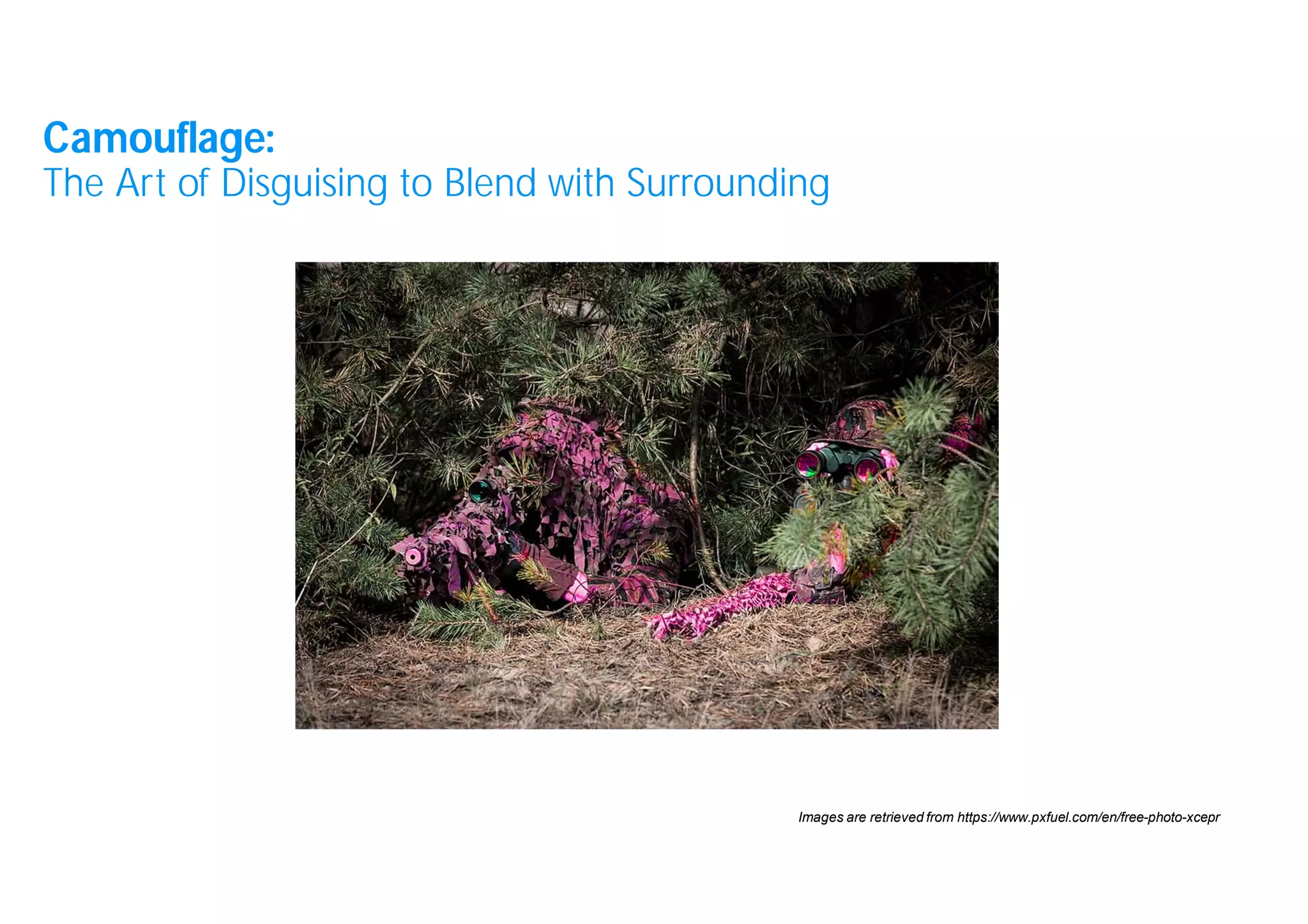
Images are retrieved from https://www.pxfuel.com/en/free-photo-xcepr
Camouflage:
The Art of Disguising to Blend with Surrounding
4
• Introduction to Spectral Decomposition.
• Application of Spectral Decomposition: Feature delineation using RGB
blending.
• Discontinuity detection on Spectral Decomposition result and the use RGB
blending to aid interpretation.
• HSV Rotation or Hue Color Shift. How to aid interpretation by optimizing eye
sensitivity.
• Highlighting and Delineating Feature.
• Summary.
Outline
5
• Spectral Decomposition is a process to decompose a signal into constituent sines and
cosines components.
• The frequency spectrum of a recorded seismic signal is affected by several factors such as
energy absorption, tuning etc.
• Since a particular geological features may be better recognized with a specific frequency
band, visualizing these features becomes easier with RGB blending of different frequency
volumes.
• RGB blending of Spectral Decomposition results has been very popular in seismic
interpretation especially in delineating geological features or lithology such as thin channel
sands, carbonate, etc.
• The use of discontinuity attribute aid the interpretation using Spectral decomposition results.
• Further more, high quality as well as robust interpretation can be achieved by matching the
color to the most sensitive range of human eye sensitivity.
Introduction to Spectral Decomposition
6
Seismic Section 0 10 20 80 90 100 Hz
Frequency
Time
(ms)
Time
(ms)
Time
(ms)
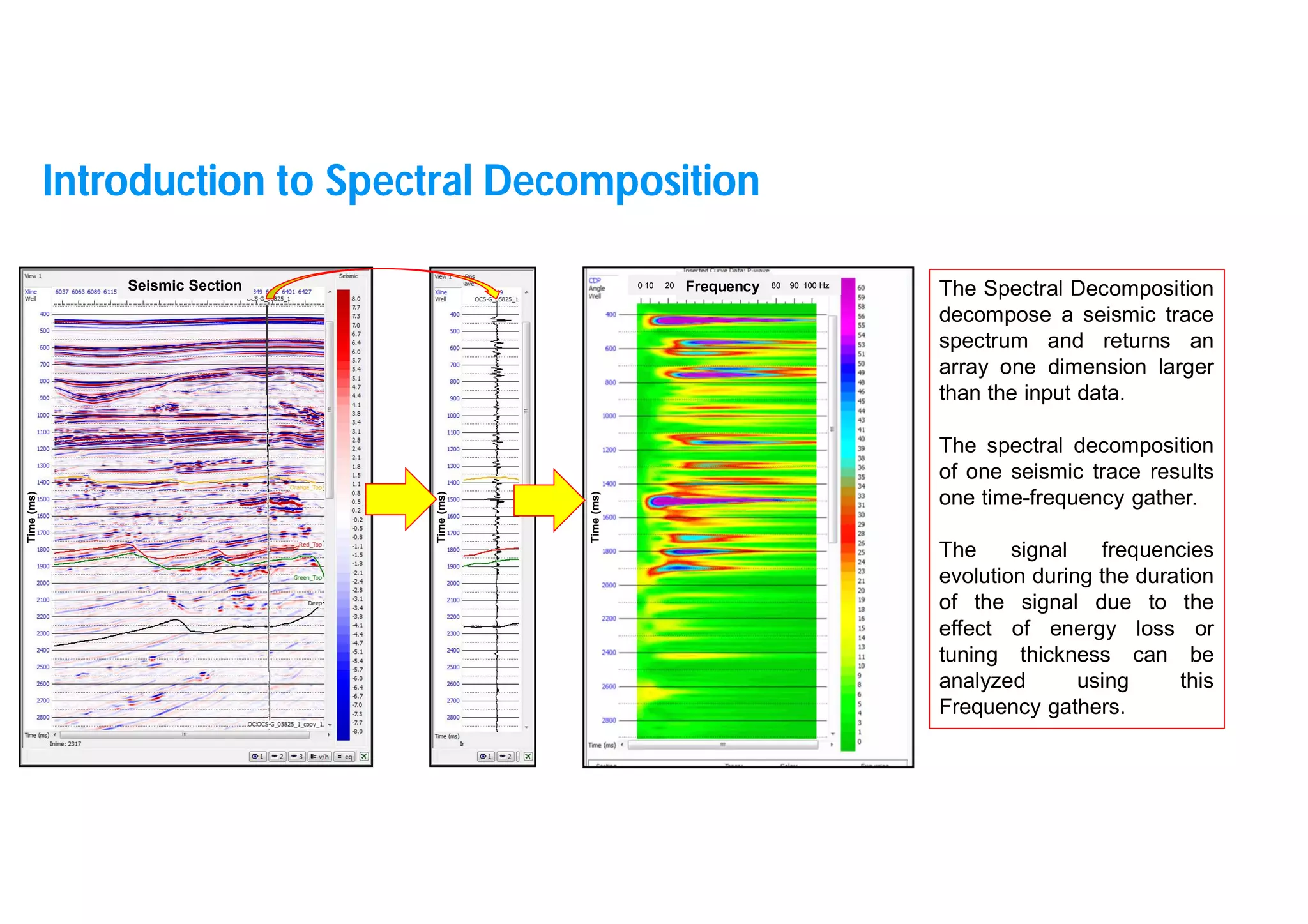
The Spectral Decomposition
decompose a seismic trace
spectrum and returns an
array one dimension larger
than the input data.
The spectral decomposition
of one seismic trace results
one time-frequency gather.
The signal frequencies
evolution during the duration
of the signal due to the
effect of energy loss or
tuning thickness can be
analyzed using this
Frequency gathers.
Introduction to Spectral Decomposition
7
Time
Introduction to Spectral Decomposition
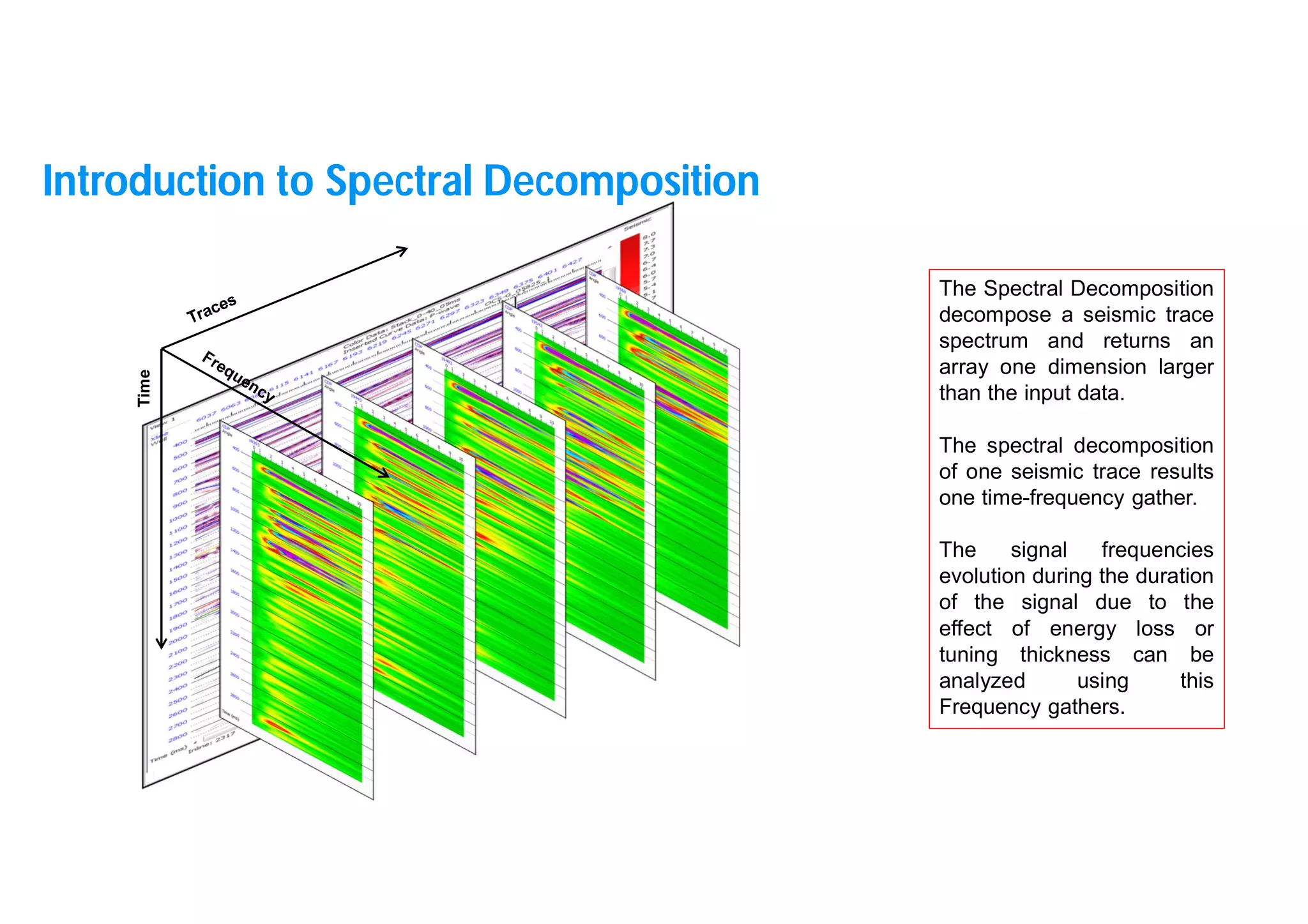
The Spectral Decomposition
decompose a seismic trace
spectrum and returns an
array one dimension larger
than the input data.
The spectral decomposition
of one seismic trace results
one time-frequency gather.
The signal frequencies
evolution during the duration
of the signal due to the
effect of energy loss or
tuning thickness can be
analyzed using this
Frequency gathers.
8
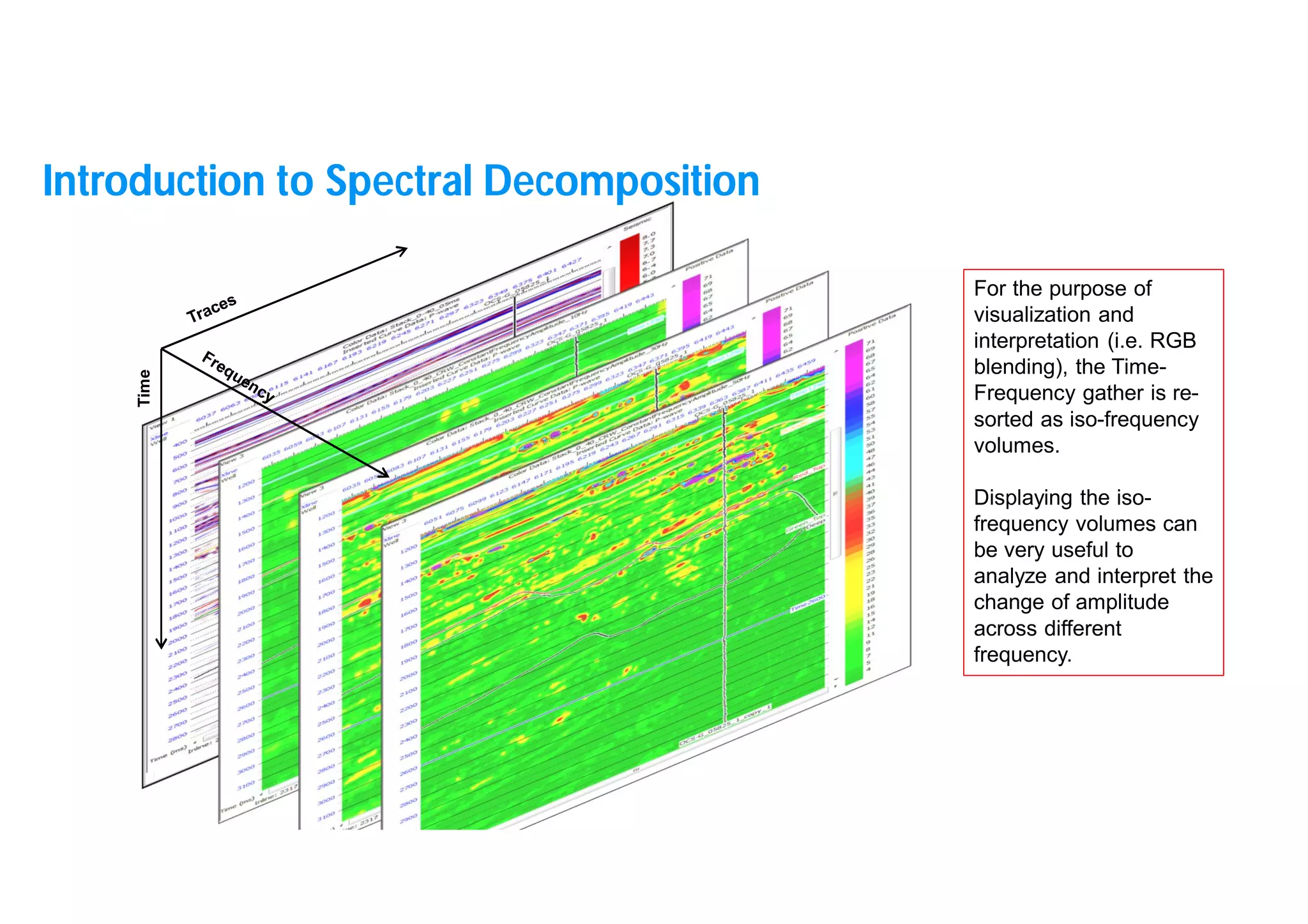
For the purpose of
visualization and
interpretation (i.e. RGB
blending), the Time-
Frequency gather is re-
sorted as iso-frequency
volumes.
Displaying the iso-
frequency volumes can
be very useful to
analyze and interpret the
change of amplitude
across different
frequency.
Time
Introduction to Spectral Decomposition
9
• Introduction to Spectral Decomposition.
• Application of Spectral Decomposition: Feature delineation using RGB
blending.
• Discontinuity detection on Spectral Decomposition result and the use RGB
blending to aid interpretation.
• HSV Rotation or Hue Color Shift. How to aid interpretation by optimizing eye
sensitivity.
• Highlighting and Delineating Feature.
• Summary.
Outline
10
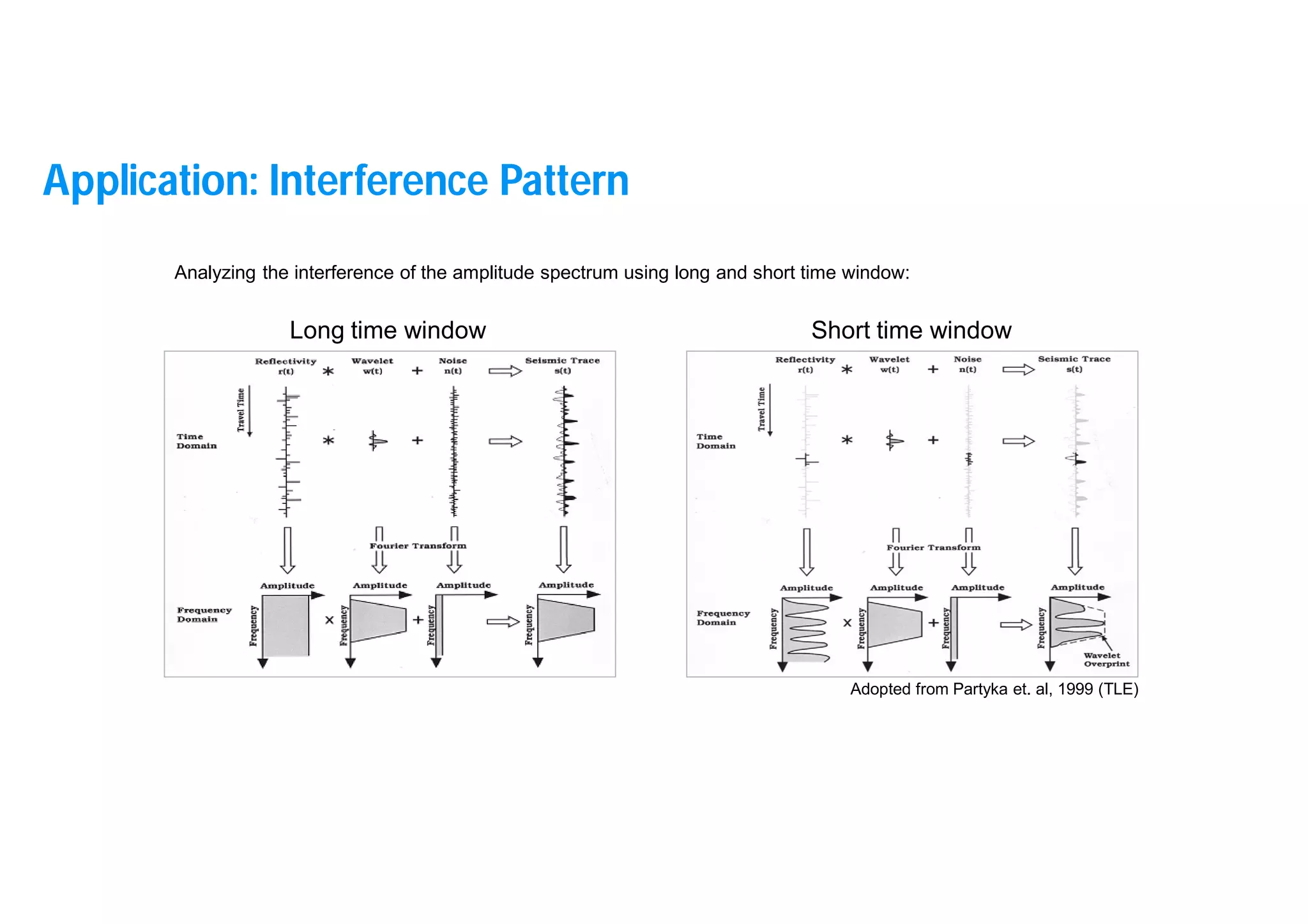
Analyzing the interference of the amplitude spectrum using long and short time window:
Long time window Short time window
Adopted from Partyka et. al, 1999 (TLE)
Application: Interference Pattern
11
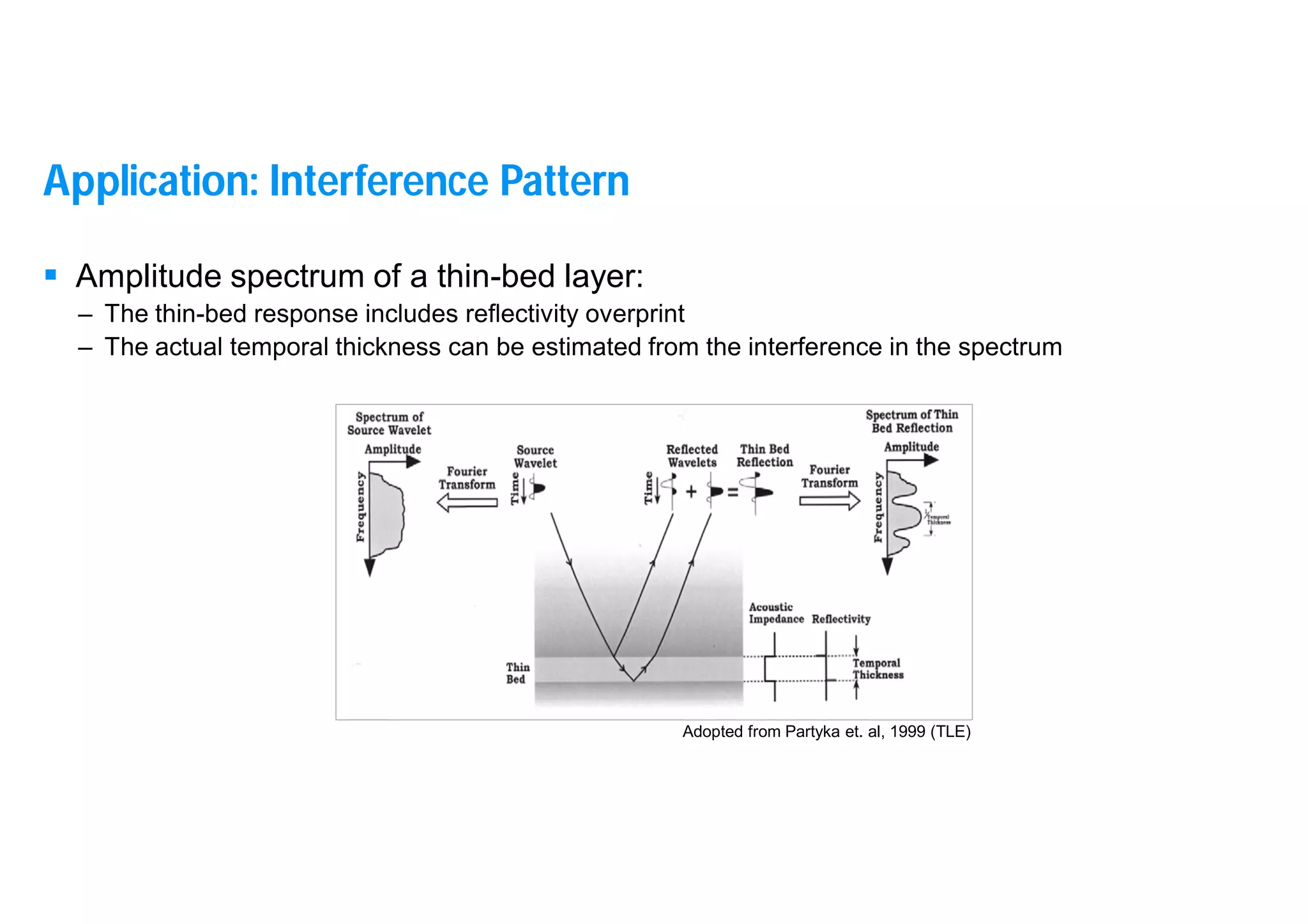
Application: Interference Pattern
 Amplitude spectrum of a thin-bed layer:
– The thin-bed response includes reflectivity overprint
– The actual temporal thickness can be estimated from the interference in the spectrum
Adopted from Partyka et. al, 1999 (TLE)
12
  1,2,...
N
with
notch
of
Frequency
1
-
N
thickness
Time 

Periodical sequence of notches from a simple
thin-bed layer (wedge model). Note the
interference on the amplitude spectrum of the
wedge.
V-shaped amplitude notches occur where
frequency is equal to 1/time-thickness of the
layer
Adopted from Partyka et. al, 1999 (TLE)
Thickness increase 0 – 40 [ms]
Frequency
[Hz]
Application: Interference Pattern
13
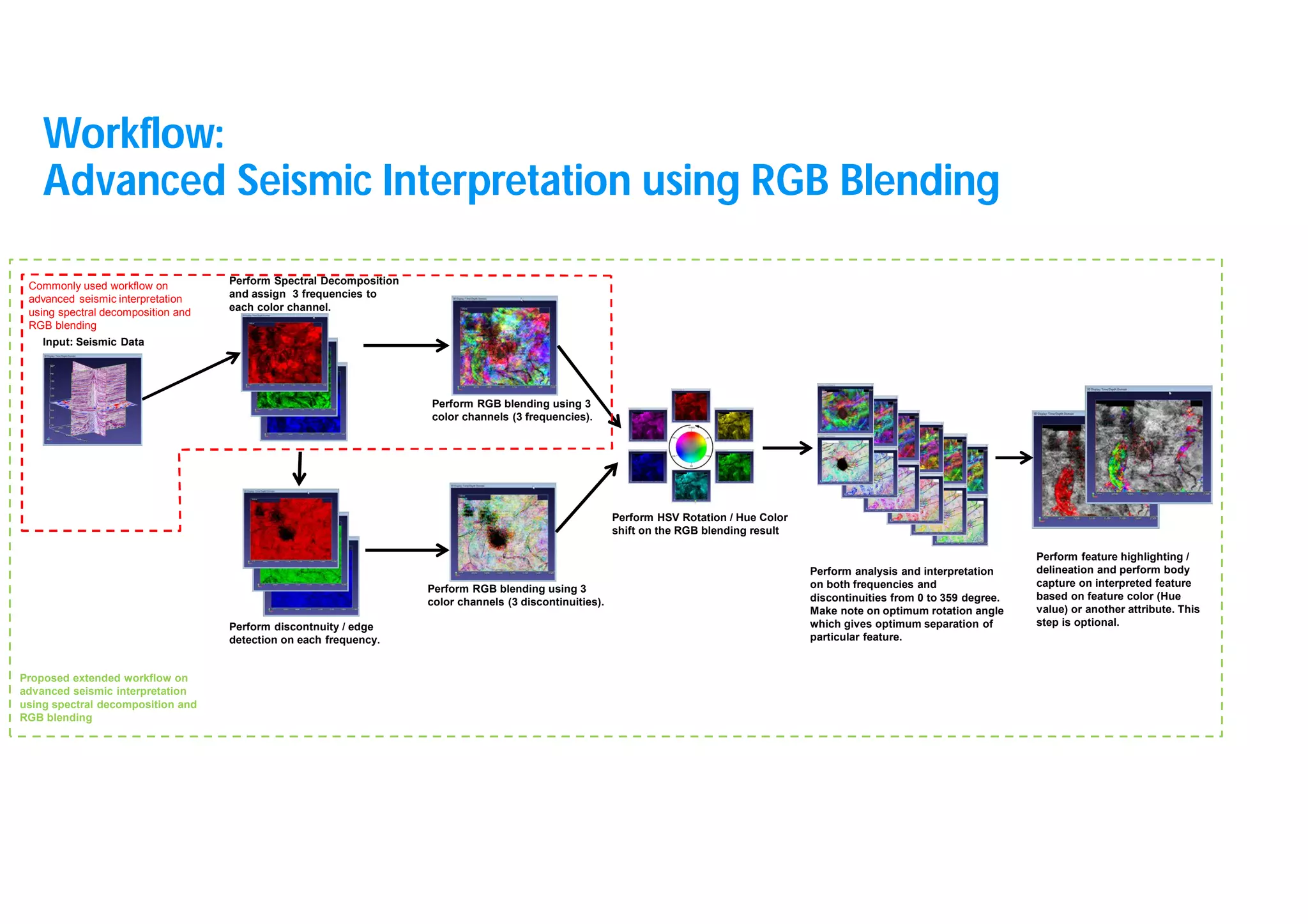
Commonly used workflow on
advanced seismic interpretation
using spectral decomposition and
RGB blending
Proposed extended workflow on
advanced seismic interpretation
using spectral decomposition and
RGB blending
Input: Seismic Data
Perform Spectral Decomposition
and assign 3 frequencies to
each color channel.
Perform RGB blending using 3
color channels (3 frequencies).
Perform RGB blending using 3
color channels (3 discontinuities).
Perform discontnuity / edge
detection on each frequency.
Perform HSV Rotation / Hue Color
shift on the RGB blending result
Perform analysis and interpretation
on both frequencies and
discontinuities from 0 to 359 degree.
Make note on optimum rotation angle
which gives optimum separation of
particular feature.
Perform feature highlighting /
delineation and perform body
capture on interpreted feature
based on feature color (Hue
value) or another attribute. This
step is optional.
Workflow:
Advanced Seismic Interpretation using RGB Blending
14
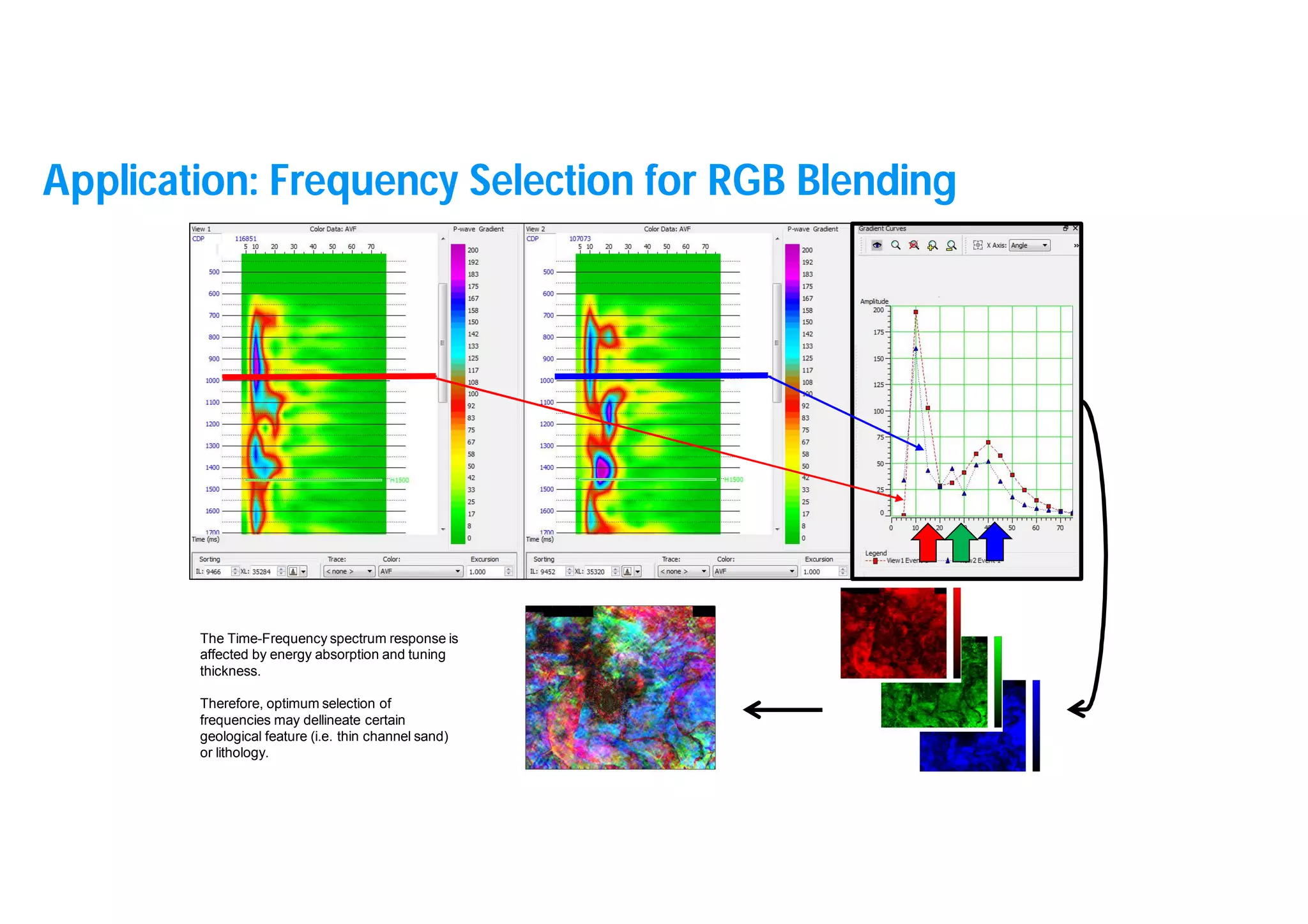
The Time-Frequency spectrum response is
affected by energy absorption and tuning
thickness.
Therefore, optimum selection of
frequencies may dellineate certain
geological feature (i.e. thin channel sand)
or lithology.
Application: Frequency Selection for RGB Blending
15
High
Low
Color
Scale
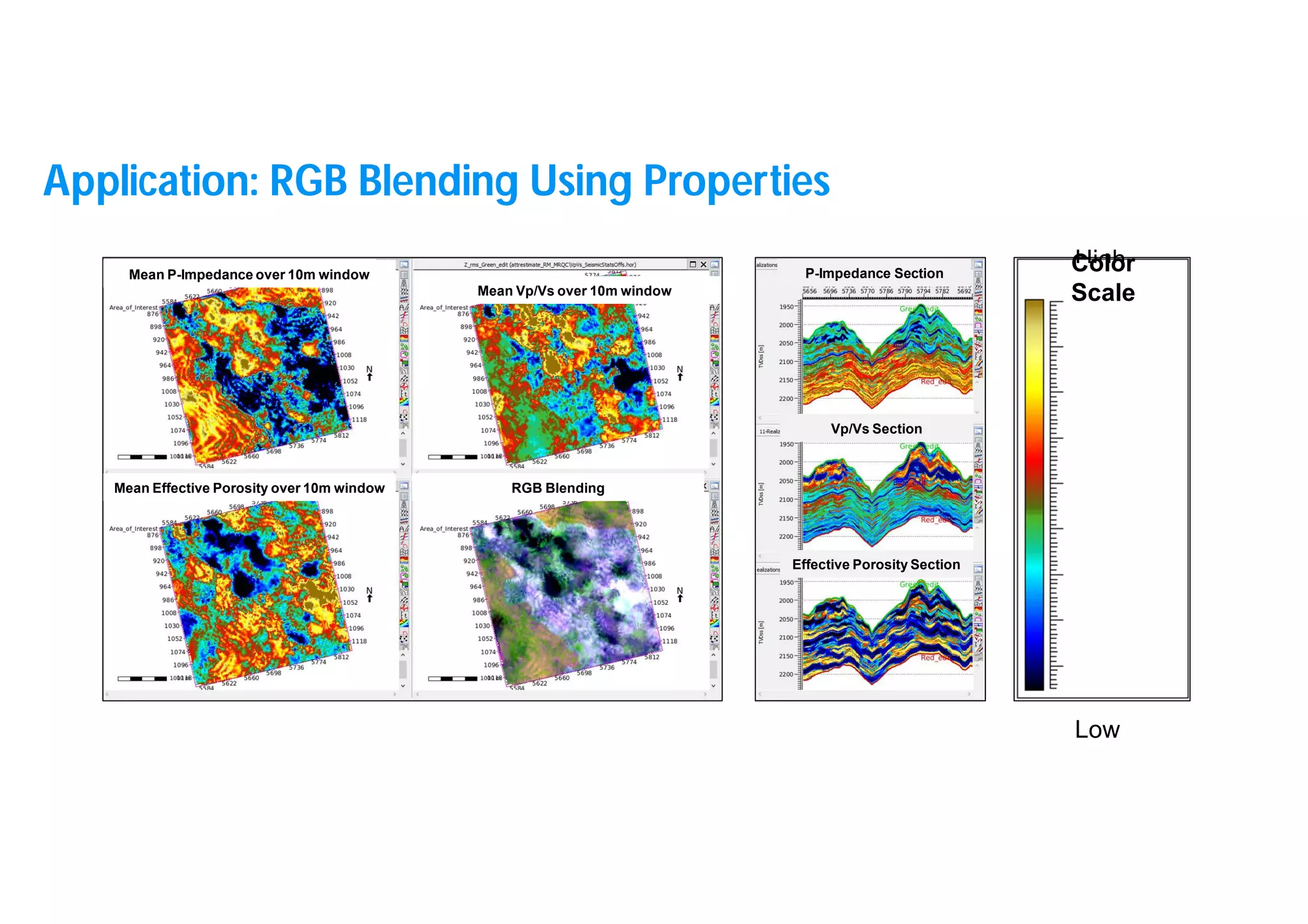
Mean P-Impedance over 10m window
Mean Effective Porosity over 10m window RGB Blending
P-Impedance Section
Mean Vp/Vs over 10m window
Vp/Vs Section
Effective Porosity Section
Application: RGB Blending Using Properties
16
• Introduction to Spectral Decomposition.
• Application of Spectral Decomposition: Feature delineation using RGB
blending.
• Discontinuity detection on Spectral Decomposition result and the use RGB
blending to aid interpretation.
• HSV Rotation or Hue Color Shift. How to aid interpretation by optimizing eye
sensitivity.
• Highlighting and Delineating Feature.
• Summary.
Outline
17
• Since human eye has limitation on separating certain color (i.e. features),
discontinuity / edge detection on each color channel volume may delineate the
particular feature or lithology better compared to the conventional RGB
blending.
• Horizon Edge Stacking was used to identify edges or features in the input
amplitude volume of each color channel.
• The Horizon Edge Stacking results then used as RGB blending input to get
better visual separation of the features of lithology.
• Changing the frequency combination could help the interpretation.
Discontinuity Detection Using Horizon Edge Stacking
18
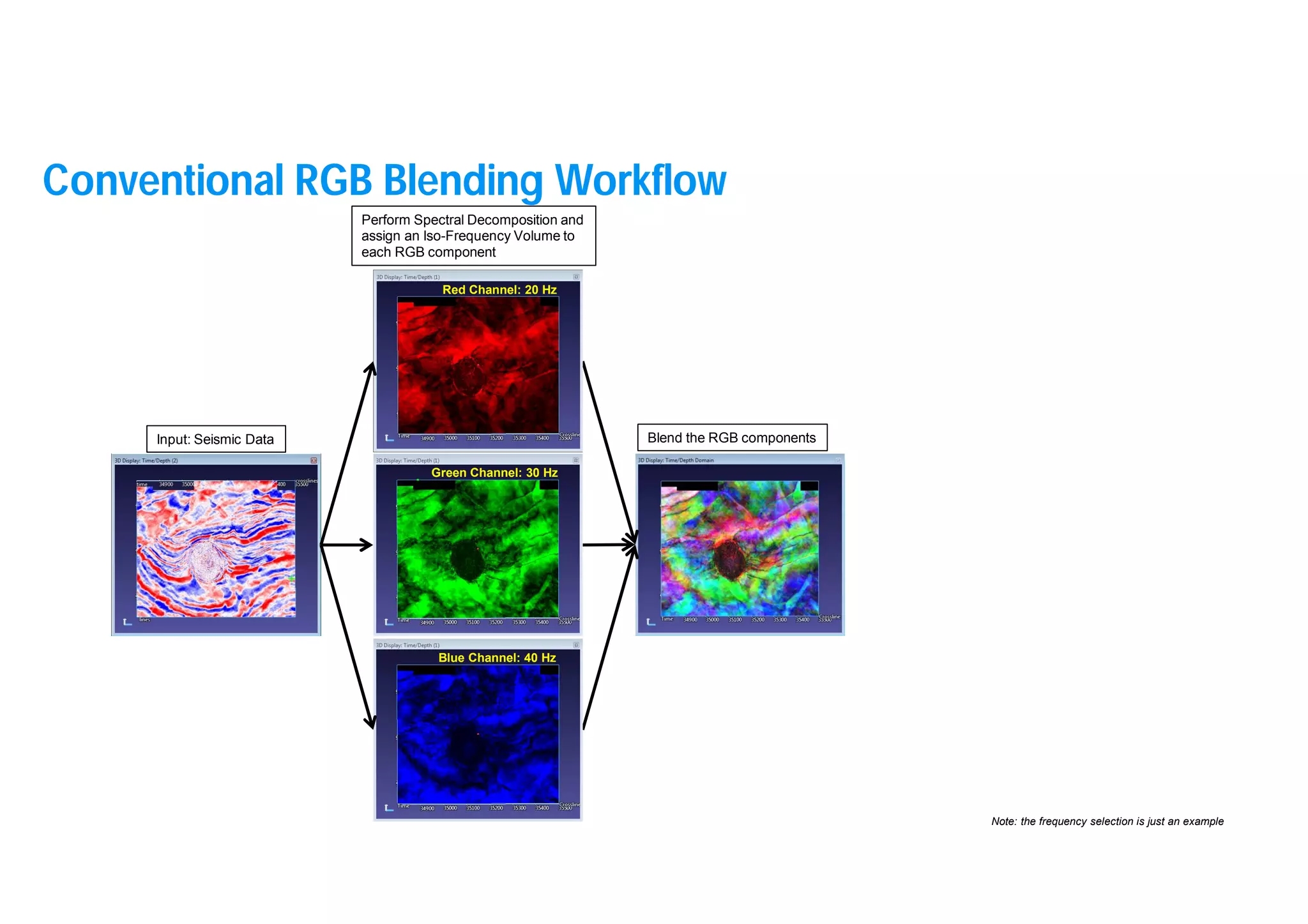
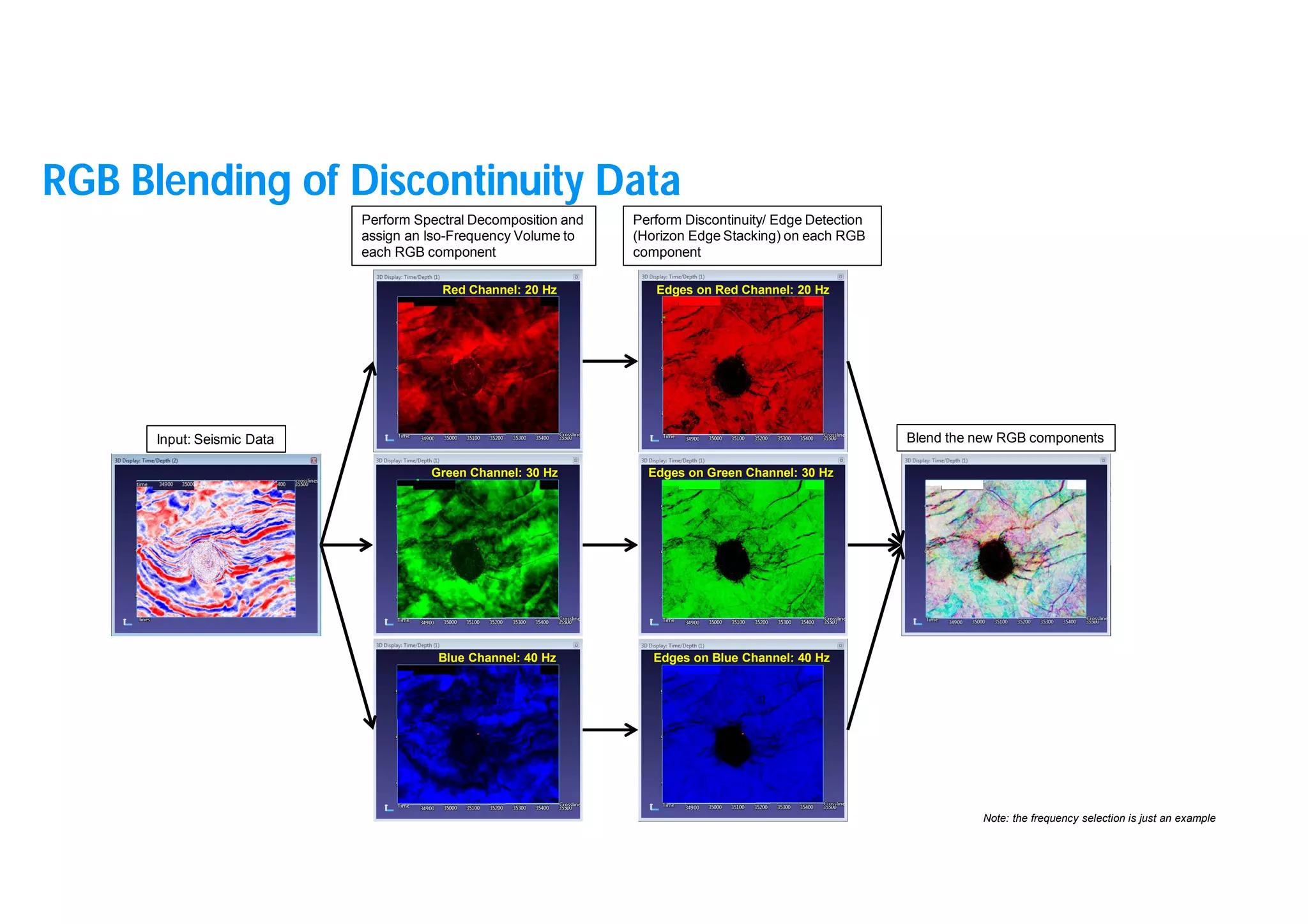
Blend the RGB components
Perform Spectral Decomposition and
assign an Iso-Frequency Volume to
each RGB component
Input: Seismic Data
Red Channel: 20 Hz
Green Channel: 30 Hz
Blue Channel: 40 Hz
Note: the frequency selection is just an example
Conventional RGB Blending Workflow
19
Perform Spectral Decomposition and
assign an Iso-Frequency Volume to
each RGB component
Blend the new RGB components
Input: Seismic Data
Red Channel: 20 Hz
Green Channel: 30 Hz
Blue Channel: 40 Hz
Note: the frequency selection is just an example
Perform Discontinuity/ Edge Detection
(Horizon Edge Stacking) on each RGB
component
Edges on Red Channel: 20 Hz
Edges on Green Channel: 30 Hz
Edges on Blue Channel: 40 Hz
RGB Blending of Discontinuity Data
20
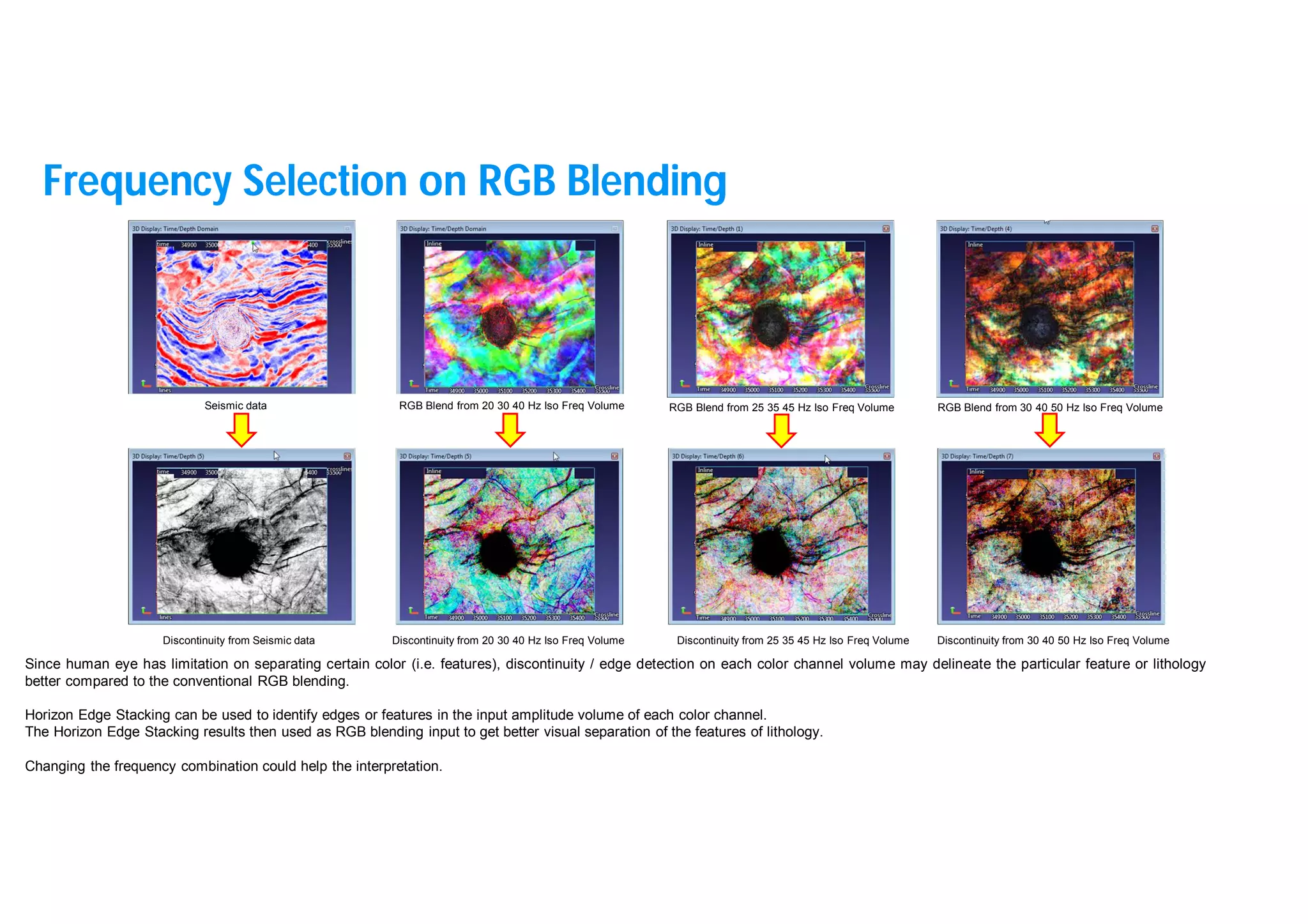
Seismic data RGB Blend from 20 30 40 Hz Iso Freq Volume
Discontinuity from Seismic data Discontinuity from 20 30 40 Hz Iso Freq Volume
Since human eye has limitation on separating certain color (i.e. features), discontinuity / edge detection on each color channel volume may delineate the particular feature or lithology
better compared to the conventional RGB blending.
Horizon Edge Stacking can be used to identify edges or features in the input amplitude volume of each color channel.
The Horizon Edge Stacking results then used as RGB blending input to get better visual separation of the features of lithology.
Changing the frequency combination could help the interpretation.
Discontinuity from 25 35 45 Hz Iso Freq Volume Discontinuity from 30 40 50 Hz Iso Freq Volume
RGB Blend from 25 35 45 Hz Iso Freq Volume RGB Blend from 30 40 50 Hz Iso Freq Volume
Frequency Selection on RGB Blending
21
• Introduction to Spectral Decomposition.
• Application of Spectral Decomposition: Feature delineation using RGB
blending.
• Discontinuity detection on Spectral Decomposition result and the use RGB
blending to aid interpretation.
• HSV Rotation or Hue Color Shift. How to aid interpretation by optimizing eye
sensitivity.
• Highlighting and Delineating Feature.
• Summary.
Outline
22
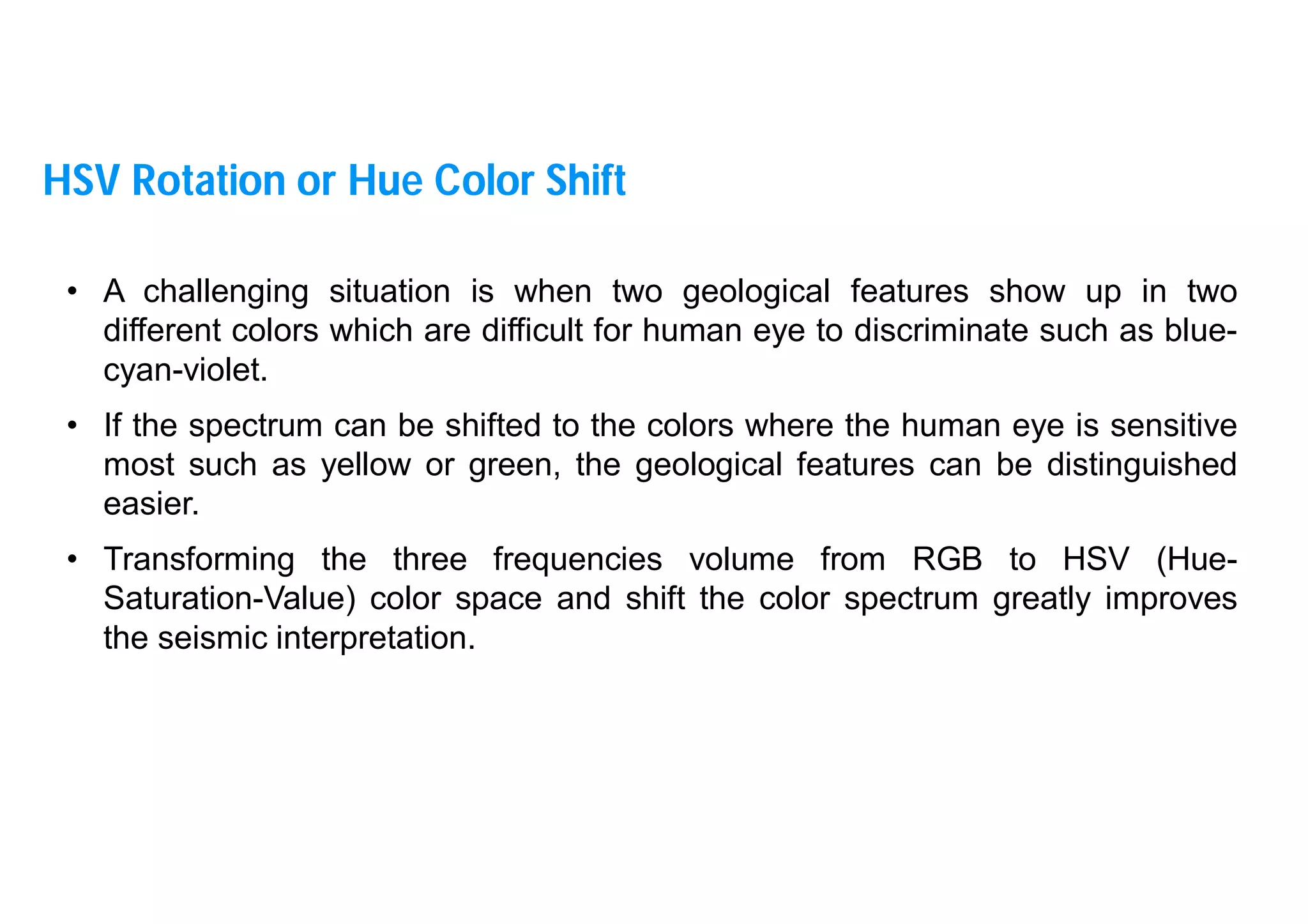
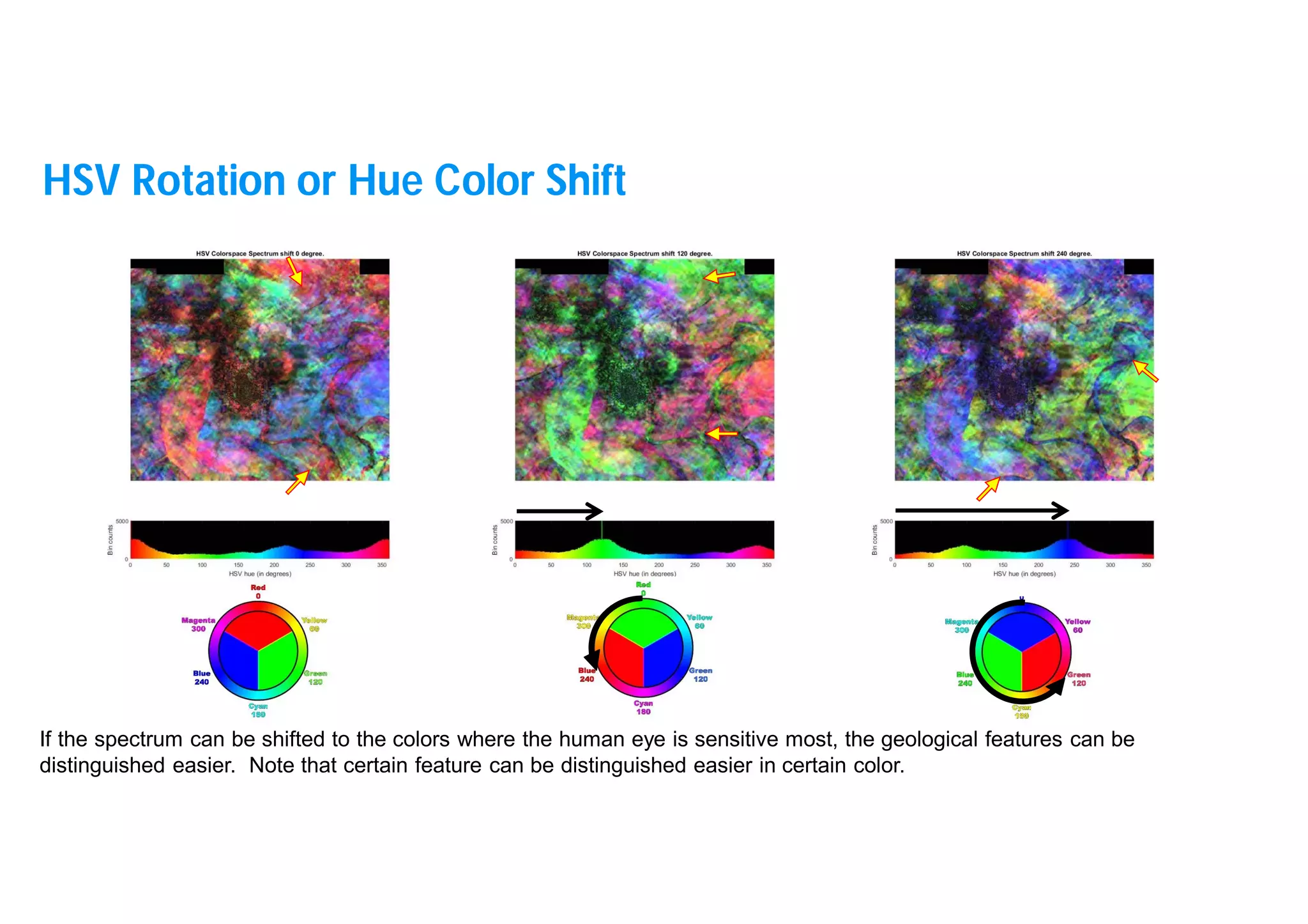
• A challenging situation is when two geological features show up in two
different colors which are difficult for human eye to discriminate such as blue-
cyan-violet.
• If the spectrum can be shifted to the colors where the human eye is sensitive
most such as yellow or green, the geological features can be distinguished
easier.
• Transforming the three frequencies volume from RGB to HSV (Hue-
Saturation-Value) color space and shift the color spectrum greatly improves
the seismic interpretation.
HSV Rotation or Hue Color Shift
23
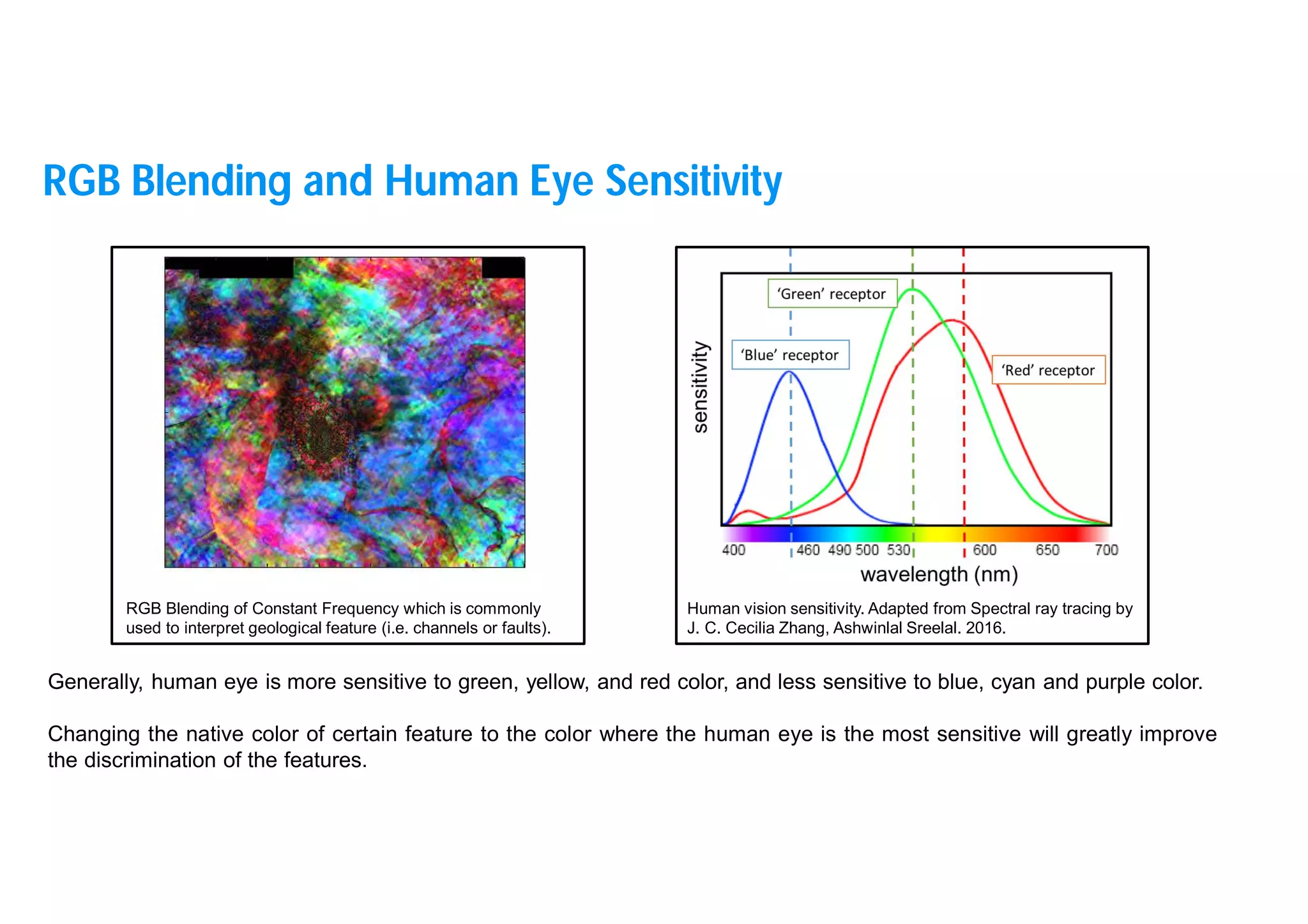
Human vision sensitivity. Adapted from Spectral ray tracing by
J. C. Cecilia Zhang, Ashwinlal Sreelal. 2016.
Generally, human eye is more sensitive to green, yellow, and red color, and less sensitive to blue, cyan and purple color.
Changing the native color of certain feature to the color where the human eye is the most sensitive will greatly improve
the discrimination of the features.
RGB Blending of Constant Frequency which is commonly
used to interpret geological feature (i.e. channels or faults).
RGB Blending and Human Eye Sensitivity
24
RGB color model
In the RGB color model, a color is determined by combination / blending the 3 basic colors.
In the HSV color model, a color is determined dominantly by hue value (i.e. in degree azimuth where 0 or 360 is red.)
Images are retrieved from https://en.wikipedia.org/wiki/HSL_and_HSV
RGB component
RGB
to
HSV
HSV component
HSV component
RGB and HSV Color Space
25
If the spectrum can be shifted to the colors where the human eye is sensitive most, the geological features can be
distinguished easier. Note that certain feature can be distinguished easier in certain color.
HSV Rotation or Hue Color Shift
26
Geo
27
Hor
izon
Edge
Stack
Seismic
Data
Slice
on
2100
ms
Hor
Edge
Stack
RGB
Blend
Spec
Decomp
RGB
blend
on
2100
ms
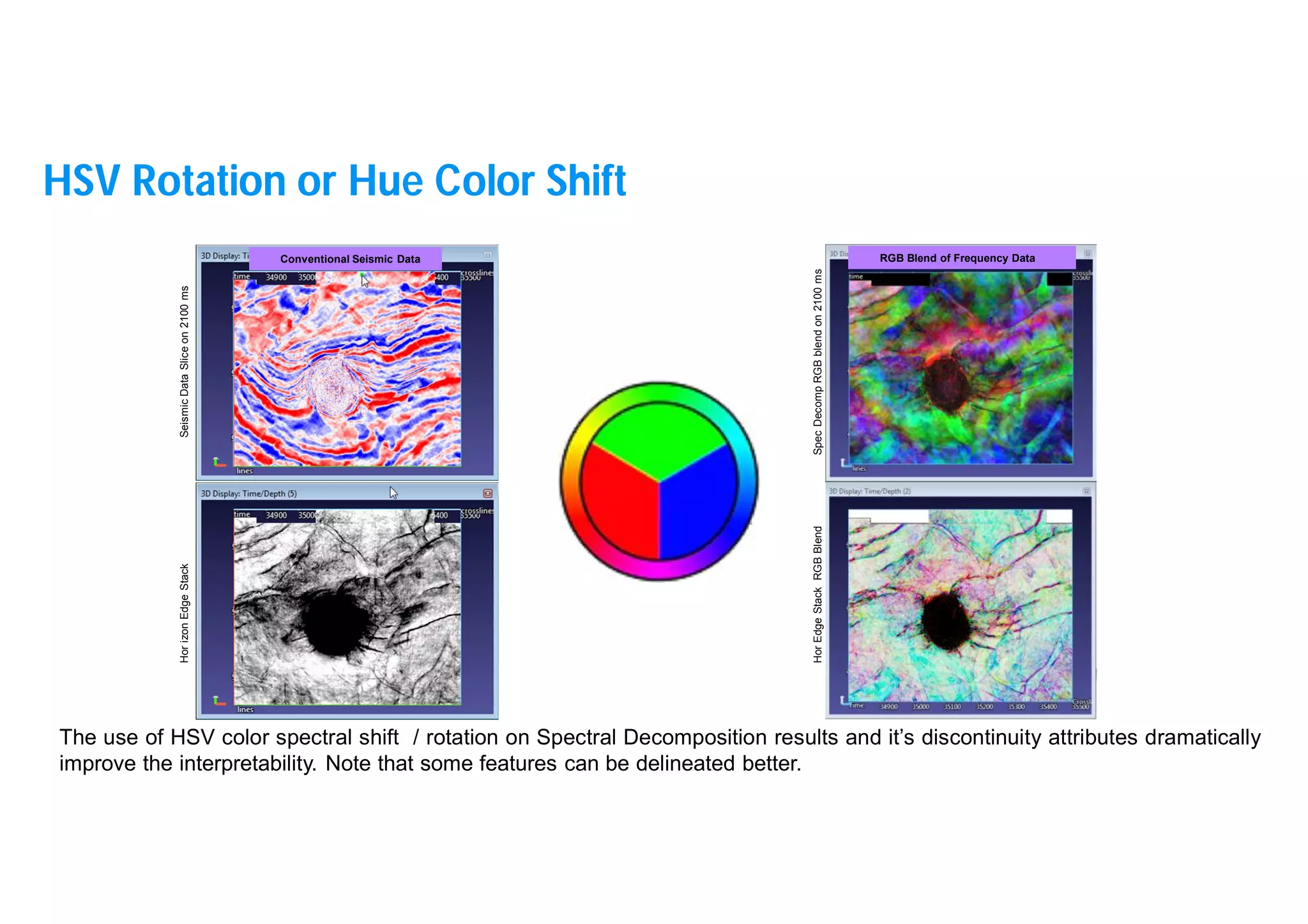
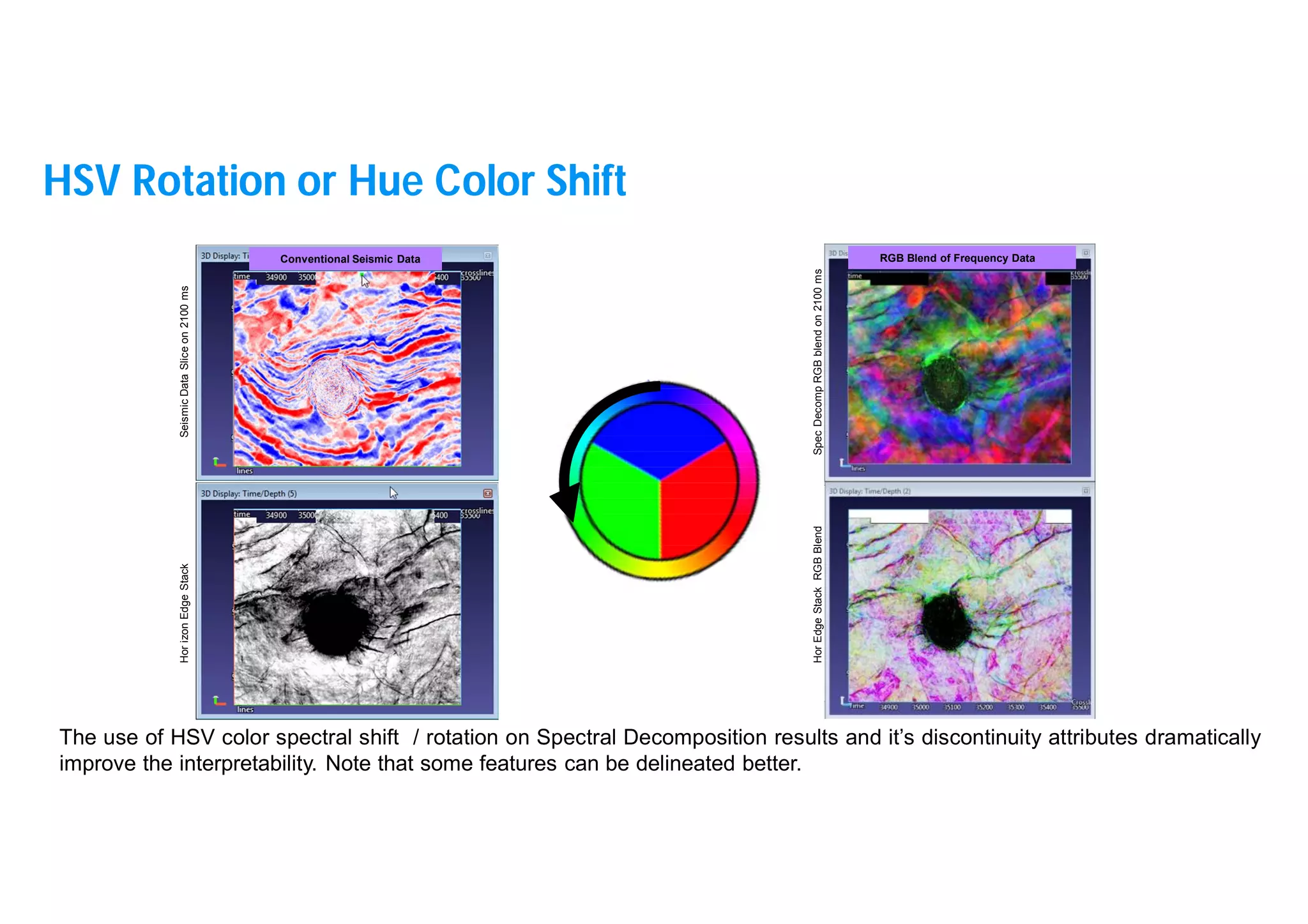
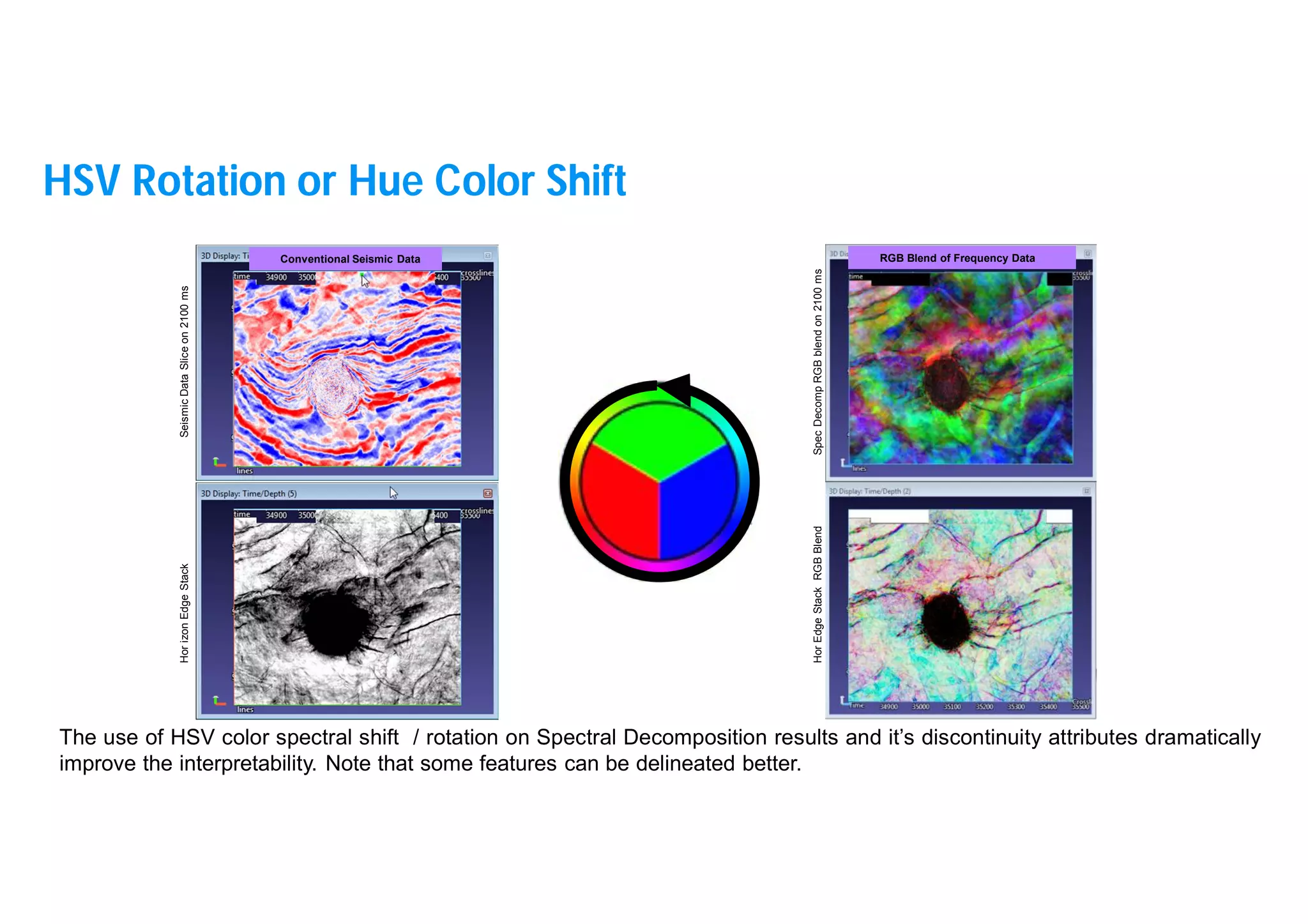
The use of HSV color spectral shift / rotation on Spectral Decomposition results and it’s discontinuity attributes dramatically
improve the interpretability. Note that some features can be delineated better.
Conventional Seismic Data RGB Blend of Frequency Data
HSV Rotation or Hue Color Shift
28
Hor
izon
Edge
Stack
Seismic
Data
Slice
on
2100
ms
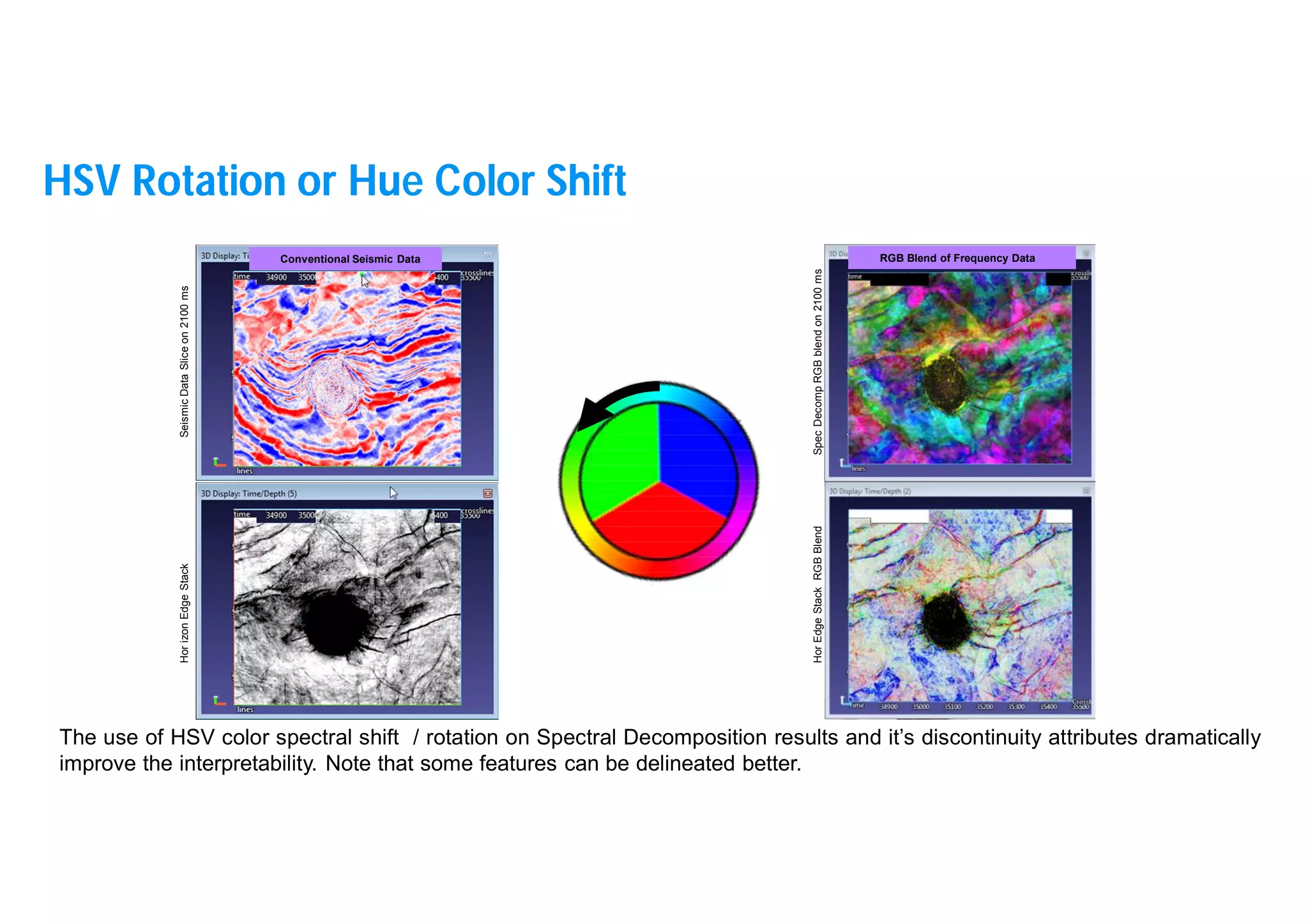
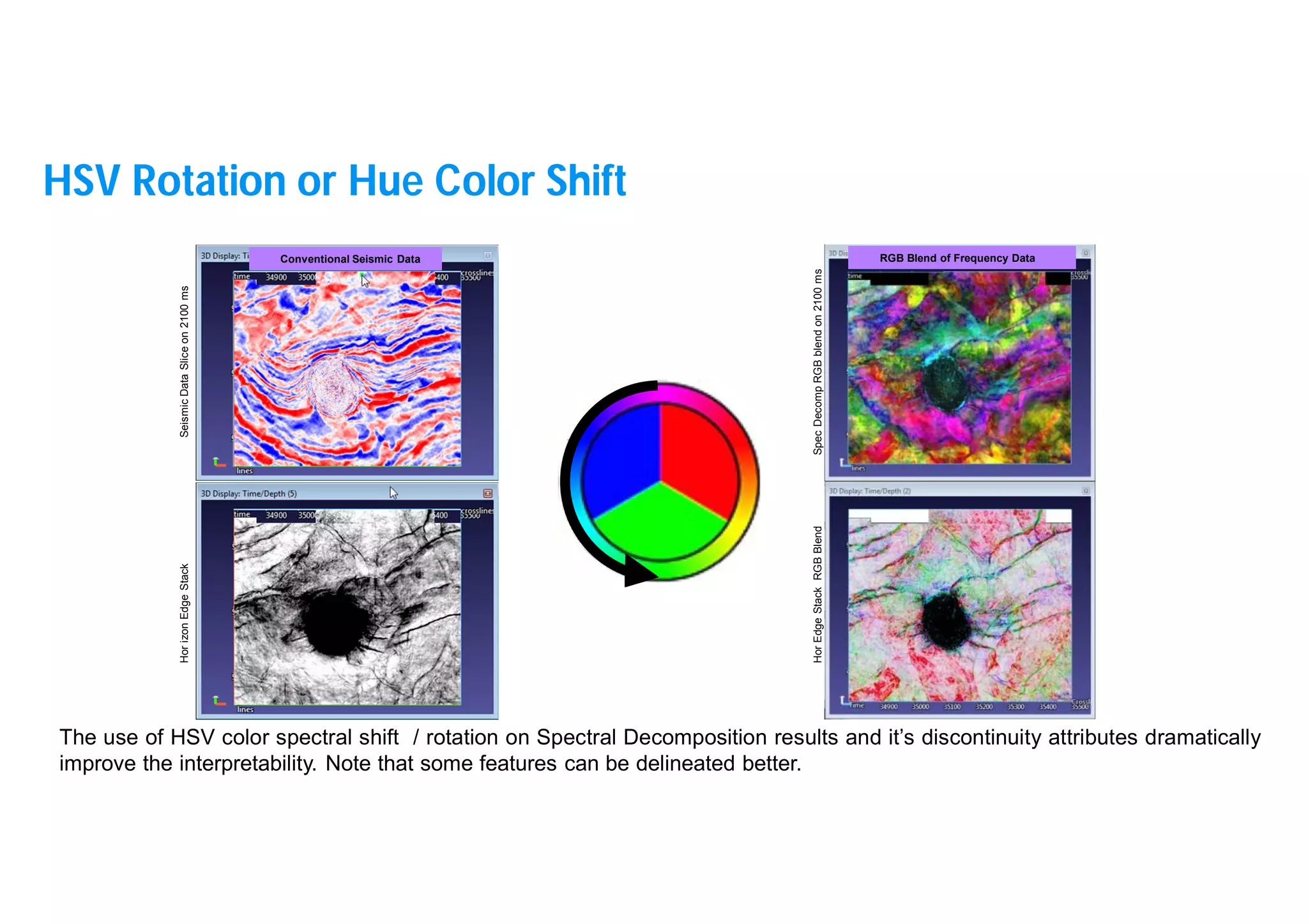
The use of HSV color spectral shift / rotation on Spectral Decomposition results and it’s discontinuity attributes dramatically
improve the interpretability. Note that some features can be delineated better.
Conventional Seismic Data RGB Blend of Frequency Data
Hor
Edge
Stack
RGB
Blend
Spec
Decomp
RGB
blend
on
2100
ms
HSV Rotation or Hue Color Shift
29
Hor
izon
Edge
Stack
Seismic
Data
Slice
on
2100
ms
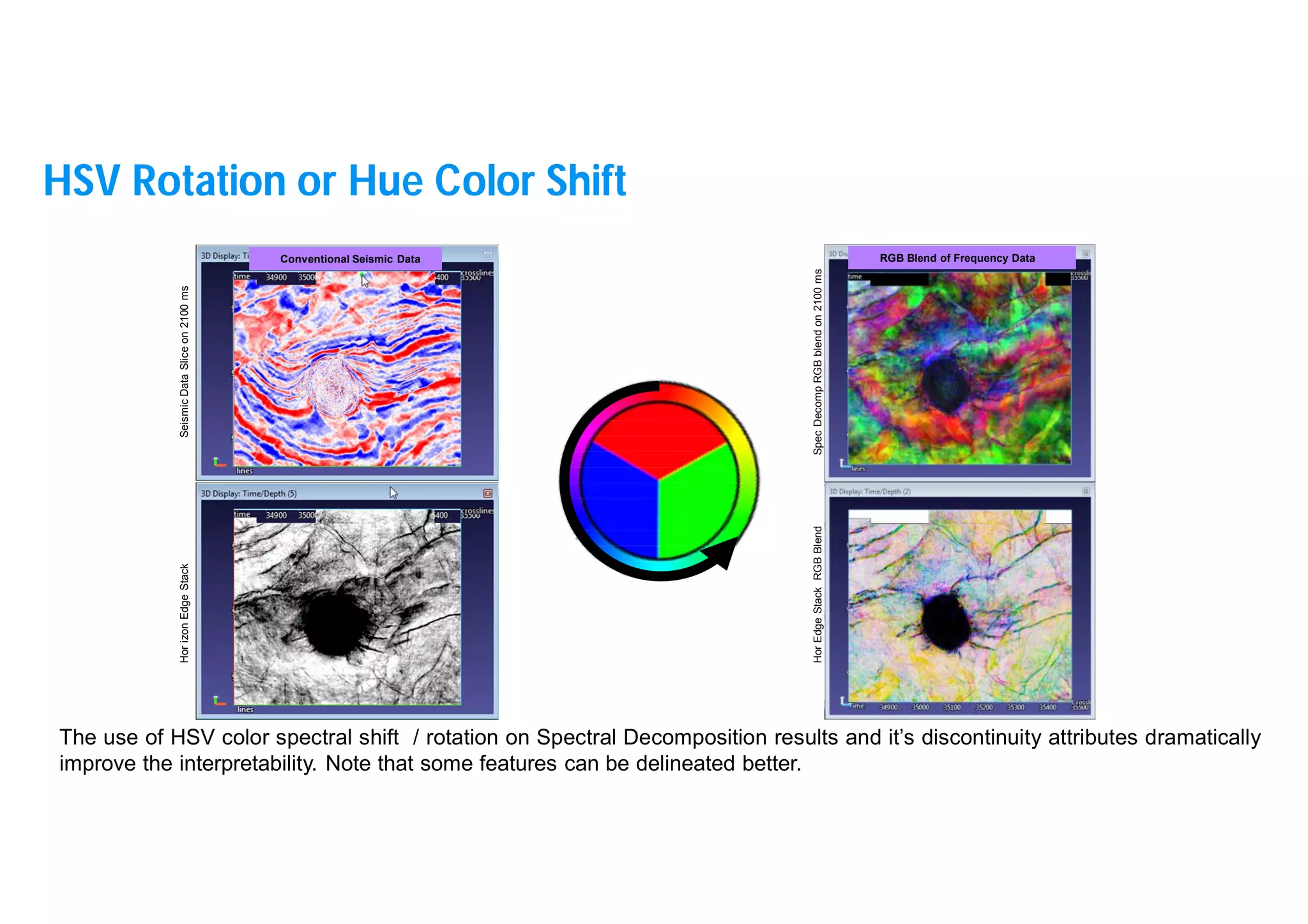
The use of HSV color spectral shift / rotation on Spectral Decomposition results and it’s discontinuity attributes dramatically
improve the interpretability. Note that some features can be delineated better.
Conventional Seismic Data RGB Blend of Frequency Data
Hor
Edge
Stack
RGB
Blend
Spec
Decomp
RGB
blend
on
2100
ms
HSV Rotation or Hue Color Shift
30
Hor
izon
Edge
Stack
Seismic
Data
Slice
on
2100
ms
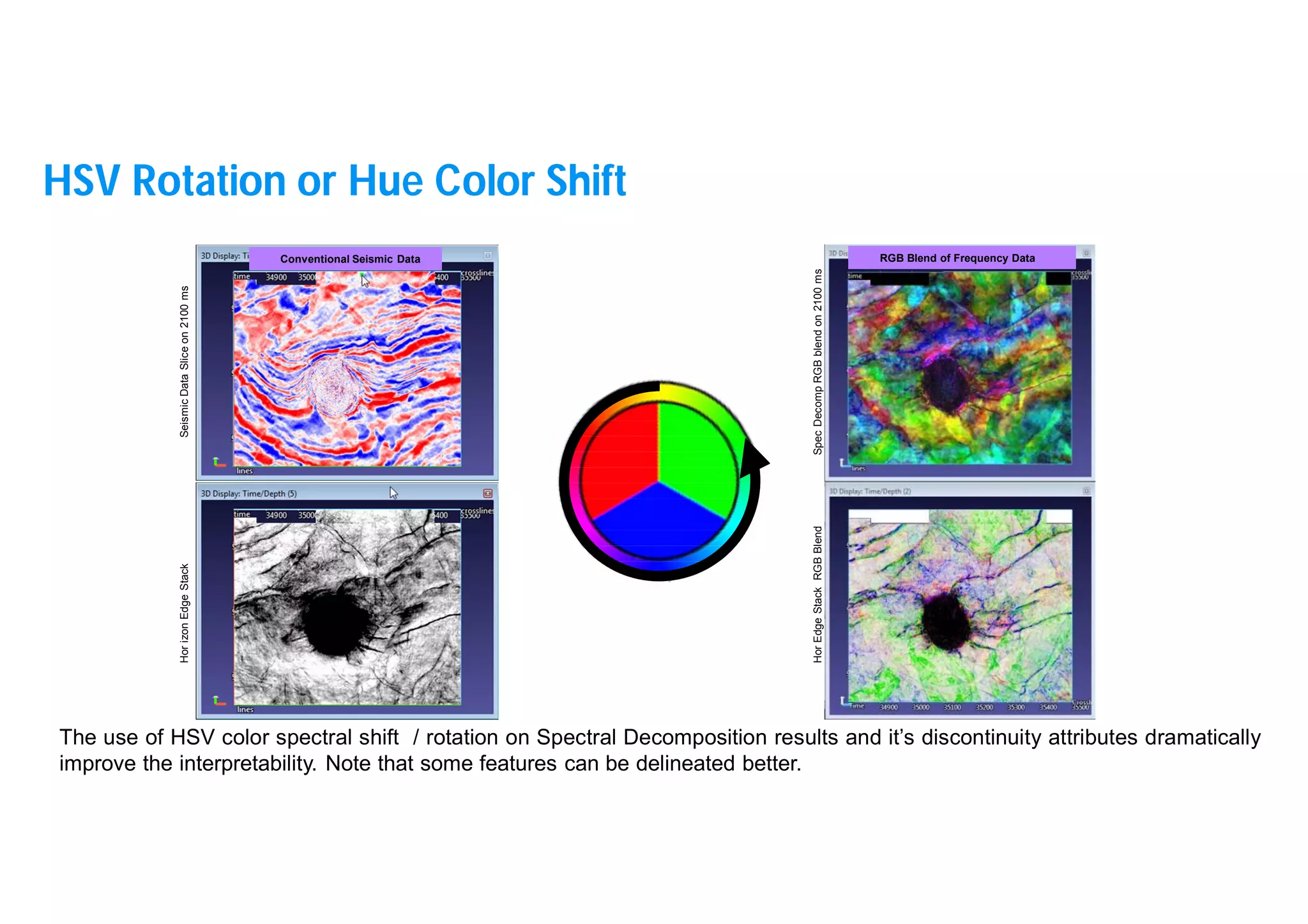
The use of HSV color spectral shift / rotation on Spectral Decomposition results and it’s discontinuity attributes dramatically
improve the interpretability. Note that some features can be delineated better.
Conventional Seismic Data RGB Blend of Frequency Data
Hor
Edge
Stack
RGB
Blend
Spec
Decomp
RGB
blend
on
2100
ms
HSV Rotation or Hue Color Shift
31
Hor
izon
Edge
Stack
Seismic
Data
Slice
on
2100
ms
The use of HSV color spectral shift / rotation on Spectral Decomposition results and it’s discontinuity attributes dramatically
improve the interpretability. Note that some features can be delineated better.
Conventional Seismic Data RGB Blend of Frequency Data
Hor
Edge
Stack
RGB
Blend
Spec
Decomp
RGB
blend
on
2100
ms
HSV Rotation or Hue Color Shift
32
Hor
izon
Edge
Stack
Seismic
Data
Slice
on
2100
ms
The use of HSV color spectral shift / rotation on Spectral Decomposition results and it’s discontinuity attributes dramatically
improve the interpretability. Note that some features can be delineated better.
Conventional Seismic Data RGB Blend of Frequency Data
Hor
Edge
Stack
RGB
Blend
Spec
Decomp
RGB
blend
on
2100
ms
HSV Rotation or Hue Color Shift
33
Hor
izon
Edge
Stack
Seismic
Data
Slice
on
2100
ms
The use of HSV color spectral shift / rotation on Spectral Decomposition results and it’s discontinuity attributes dramatically
improve the interpretability. Note that some features can be delineated better.
Conventional Seismic Data RGB Blend of Frequency Data
Hor
Edge
Stack
RGB
Blend
Spec
Decomp
RGB
blend
on
2100
ms
HSV Rotation or Hue Color Shift
34
Horizon
Edge
Stack
Seismic
Slice
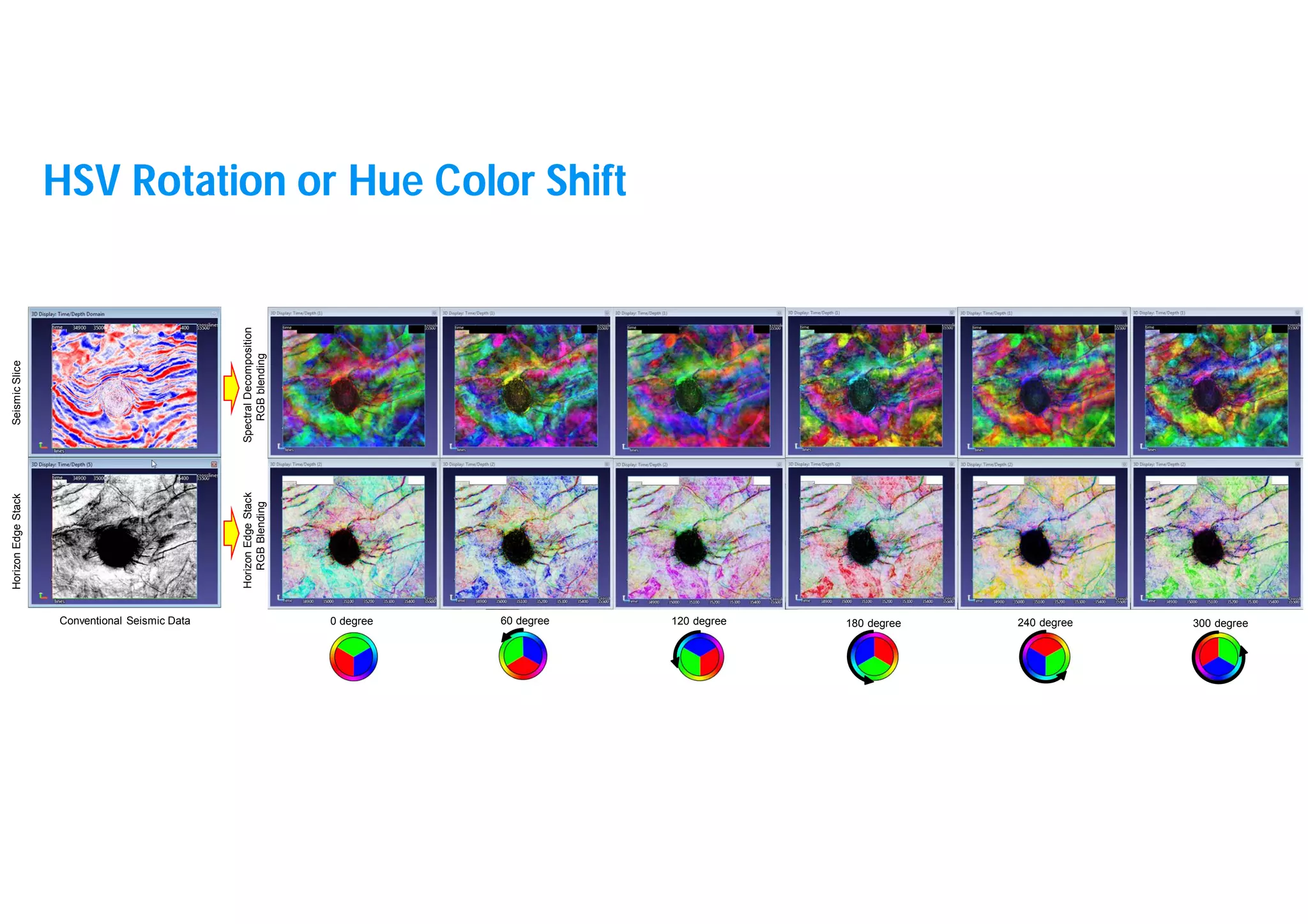
HSV Rotation or Hue Color Shift
Conventional Seismic Data 0 degree 60 degree 120 degree 180 degree 240 degree 300 degree
Horizon
Edge
Stack
Spectral
Decomposition
RGB
Blending
RGB
blending
35
• Introduction to Spectral Decomposition.
• Application of Spectral Decomposition: Feature delineation using RGB
blending.
• Discontinuity detection on Spectral Decomposition result and the use RGB
blending to aid interpretation.
• HSV Rotation or Hue Color Shift. How to aid interpretation by optimizing eye
sensitivity.
• Highlighting and Delineating Feature.
• Summary.
Outline
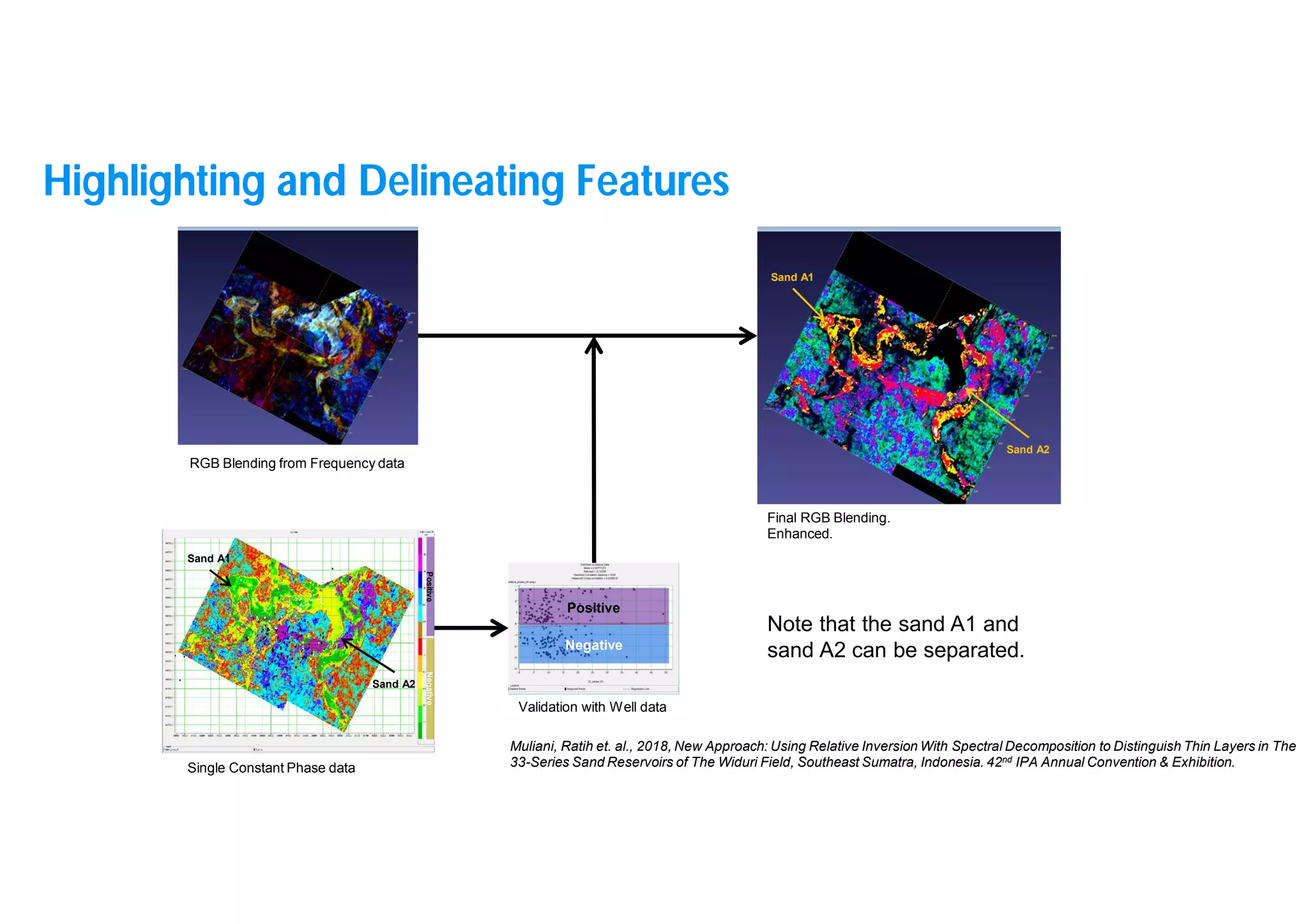
36
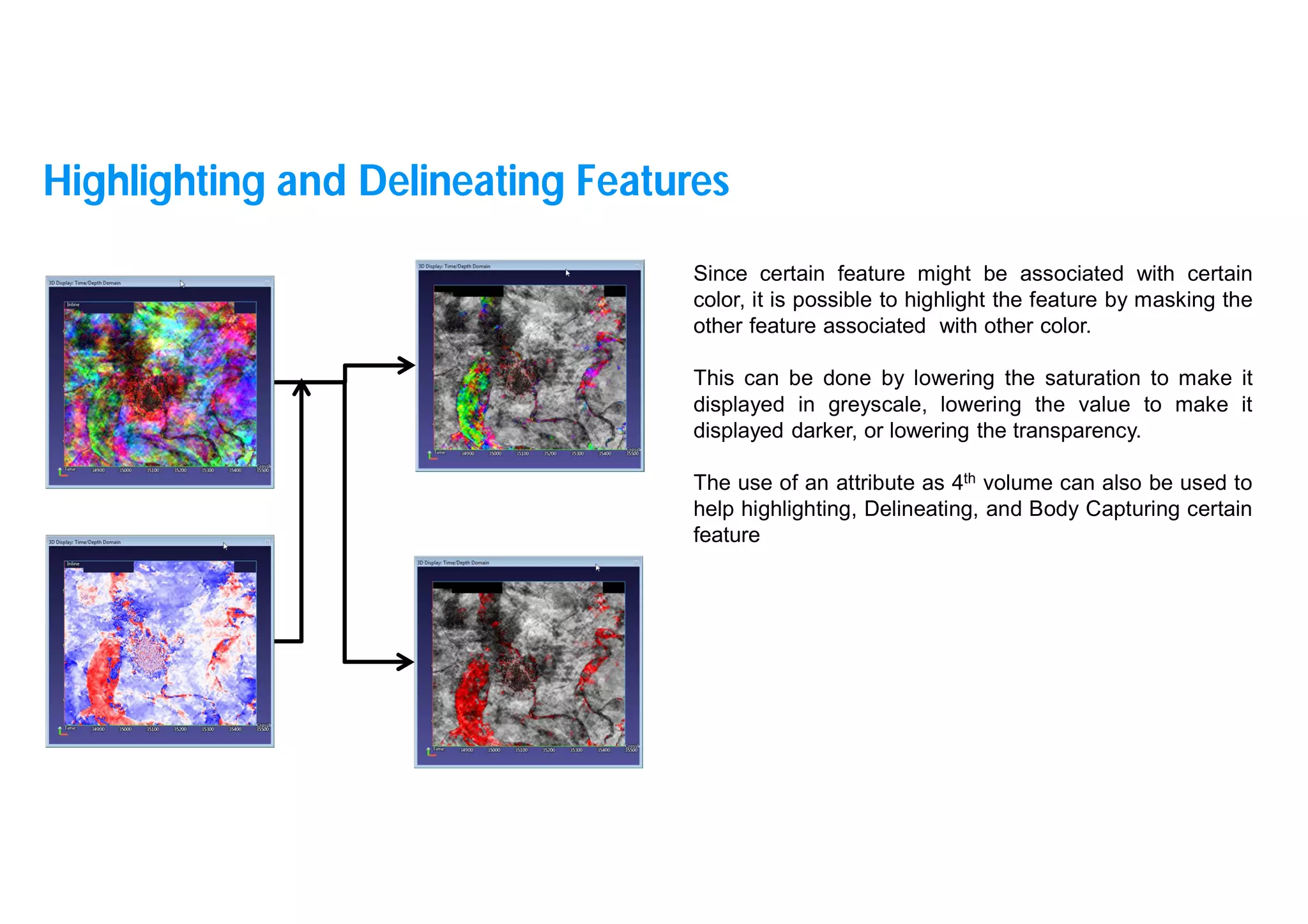
Since certain feature might be associated with certain
color, it is possible to highlight the feature by masking the
other feature associated with other color.
This can be done by lowering the saturation to make it
displayed in greyscale, lowering the value to make it
displayed darker, or lowering the transparency.
The use of an attribute as 4th volume can also be used to
help highlighting, Delineating, and Body Capturing certain
feature
Highlighting and Delineating Features
37
Negative
Positive
Negative
Positive
RGB Blending from Frequency data
Single Constant Phase data
Validation with Well data
Note that the sand A1 and
sand A2 can be separated.
Final RGB Blending.
Enhanced.
Sand A1
Sand A2
Sand A1
Sand A2
Muliani, Ratih et. al., 2018, New Approach: Using Relative Inversion With Spectral Decomposition to Distinguish Thin Layers in The
33-Series Sand Reservoirs of The Widuri Field, Southeast Sumatra, Indonesia. 42nd IPA Annual Convention & Exhibition.
Highlighting and Delineating Features
38
• Introduction to Spectral Decomposition.
• Application of Spectral Decomposition: Feature delineation using RGB
blending.
• Discontinuity detection on Spectral Decomposition result and the use RGB
blending to aid interpretation.
• HSV Rotation or Hue Color Shift. How to aid interpretation by optimizing eye
sensitivity.
• Highlighting and Delineating Feature.
• Summary.
Outline
39
• RGB blending of Spectral Decomposition results has been popular in
seismic interpretation especially in delineating geological features or
lithology such as thin channel sands and carbonate build ups.
• Since some geological features may show up in different frequencies,
visualizing these in RGB blending will facilitate easier delineation of those
features.
• Transforming the RGB to HSV color spectrum and shifting it to other colors
where the human eye is the most sensitive would make the delineation of
the geological features much easier and robust.
• Furthermore, since certain geological feature may be associated with
certain color, it is possible to highlight it by masking the other interfering
geological feature associated to other color by manipulating the Hue,
Saturation and Value.
Summary
Thank You
Awal.Mandong@geosoftware.com

Optimizing Seismic Attributes Interpretation using HSV Rotation_PPT.pdf

  • 1.
    Optimizing Seismic Attributes Interpretationby Shifting Hue Channel in the HSV Color Space to Match Human Color Spectral Sensitivity Awal Mandong
  • 2.
    2 • Introduction toSpectral Decomposition. • Application of Spectral Decomposition: Feature delineation using RGB blending. • Discontinuity detection on Spectral Decomposition result and the use RGB blending to aid interpretation. • HSV Rotation or Hue Color Shift. How to aid interpretation by optimizing eye sensitivity. • Highlighting and Delineating Feature. • Summary. Outline
  • 3.
    3 Images are retrievedfrom https://www.pxfuel.com/en/free-photo-xcepr Camouflage: The Art of Disguising to Blend with Surrounding
  • 4.
    4 • Introduction toSpectral Decomposition. • Application of Spectral Decomposition: Feature delineation using RGB blending. • Discontinuity detection on Spectral Decomposition result and the use RGB blending to aid interpretation. • HSV Rotation or Hue Color Shift. How to aid interpretation by optimizing eye sensitivity. • Highlighting and Delineating Feature. • Summary. Outline
  • 5.
    5 • Spectral Decompositionis a process to decompose a signal into constituent sines and cosines components. • The frequency spectrum of a recorded seismic signal is affected by several factors such as energy absorption, tuning etc. • Since a particular geological features may be better recognized with a specific frequency band, visualizing these features becomes easier with RGB blending of different frequency volumes. • RGB blending of Spectral Decomposition results has been very popular in seismic interpretation especially in delineating geological features or lithology such as thin channel sands, carbonate, etc. • The use of discontinuity attribute aid the interpretation using Spectral decomposition results. • Further more, high quality as well as robust interpretation can be achieved by matching the color to the most sensitive range of human eye sensitivity. Introduction to Spectral Decomposition
  • 6.
    6 Seismic Section 010 20 80 90 100 Hz Frequency Time (ms) Time (ms) Time (ms) The Spectral Decomposition decompose a seismic trace spectrum and returns an array one dimension larger than the input data. The spectral decomposition of one seismic trace results one time-frequency gather. The signal frequencies evolution during the duration of the signal due to the effect of energy loss or tuning thickness can be analyzed using this Frequency gathers. Introduction to Spectral Decomposition
  • 7.
    7 Time Introduction to SpectralDecomposition The Spectral Decomposition decompose a seismic trace spectrum and returns an array one dimension larger than the input data. The spectral decomposition of one seismic trace results one time-frequency gather. The signal frequencies evolution during the duration of the signal due to the effect of energy loss or tuning thickness can be analyzed using this Frequency gathers.
  • 8.
    8 For the purposeof visualization and interpretation (i.e. RGB blending), the Time- Frequency gather is re- sorted as iso-frequency volumes. Displaying the iso- frequency volumes can be very useful to analyze and interpret the change of amplitude across different frequency. Time Introduction to Spectral Decomposition
  • 9.
    9 • Introduction toSpectral Decomposition. • Application of Spectral Decomposition: Feature delineation using RGB blending. • Discontinuity detection on Spectral Decomposition result and the use RGB blending to aid interpretation. • HSV Rotation or Hue Color Shift. How to aid interpretation by optimizing eye sensitivity. • Highlighting and Delineating Feature. • Summary. Outline
  • 10.
    10 Analyzing the interferenceof the amplitude spectrum using long and short time window: Long time window Short time window Adopted from Partyka et. al, 1999 (TLE) Application: Interference Pattern
  • 11.
    11 Application: Interference Pattern Amplitude spectrum of a thin-bed layer: – The thin-bed response includes reflectivity overprint – The actual temporal thickness can be estimated from the interference in the spectrum Adopted from Partyka et. al, 1999 (TLE)
  • 12.
    12   1,2,... N with notch of Frequency 1 - N thickness Time  Periodical sequence of notches from a simple thin-bed layer (wedge model). Note the interference on the amplitude spectrum of the wedge. V-shaped amplitude notches occur where frequency is equal to 1/time-thickness of the layer Adopted from Partyka et. al, 1999 (TLE) Thickness increase 0 – 40 [ms] Frequency [Hz] Application: Interference Pattern
  • 13.
    13 Commonly used workflowon advanced seismic interpretation using spectral decomposition and RGB blending Proposed extended workflow on advanced seismic interpretation using spectral decomposition and RGB blending Input: Seismic Data Perform Spectral Decomposition and assign 3 frequencies to each color channel. Perform RGB blending using 3 color channels (3 frequencies). Perform RGB blending using 3 color channels (3 discontinuities). Perform discontnuity / edge detection on each frequency. Perform HSV Rotation / Hue Color shift on the RGB blending result Perform analysis and interpretation on both frequencies and discontinuities from 0 to 359 degree. Make note on optimum rotation angle which gives optimum separation of particular feature. Perform feature highlighting / delineation and perform body capture on interpreted feature based on feature color (Hue value) or another attribute. This step is optional. Workflow: Advanced Seismic Interpretation using RGB Blending
  • 14.
    14 The Time-Frequency spectrumresponse is affected by energy absorption and tuning thickness. Therefore, optimum selection of frequencies may dellineate certain geological feature (i.e. thin channel sand) or lithology. Application: Frequency Selection for RGB Blending
  • 15.
    15 High Low Color Scale Mean P-Impedance over10m window Mean Effective Porosity over 10m window RGB Blending P-Impedance Section Mean Vp/Vs over 10m window Vp/Vs Section Effective Porosity Section Application: RGB Blending Using Properties
  • 16.
    16 • Introduction toSpectral Decomposition. • Application of Spectral Decomposition: Feature delineation using RGB blending. • Discontinuity detection on Spectral Decomposition result and the use RGB blending to aid interpretation. • HSV Rotation or Hue Color Shift. How to aid interpretation by optimizing eye sensitivity. • Highlighting and Delineating Feature. • Summary. Outline
  • 17.
    17 • Since humaneye has limitation on separating certain color (i.e. features), discontinuity / edge detection on each color channel volume may delineate the particular feature or lithology better compared to the conventional RGB blending. • Horizon Edge Stacking was used to identify edges or features in the input amplitude volume of each color channel. • The Horizon Edge Stacking results then used as RGB blending input to get better visual separation of the features of lithology. • Changing the frequency combination could help the interpretation. Discontinuity Detection Using Horizon Edge Stacking
  • 18.
    18 Blend the RGBcomponents Perform Spectral Decomposition and assign an Iso-Frequency Volume to each RGB component Input: Seismic Data Red Channel: 20 Hz Green Channel: 30 Hz Blue Channel: 40 Hz Note: the frequency selection is just an example Conventional RGB Blending Workflow
  • 19.
    19 Perform Spectral Decompositionand assign an Iso-Frequency Volume to each RGB component Blend the new RGB components Input: Seismic Data Red Channel: 20 Hz Green Channel: 30 Hz Blue Channel: 40 Hz Note: the frequency selection is just an example Perform Discontinuity/ Edge Detection (Horizon Edge Stacking) on each RGB component Edges on Red Channel: 20 Hz Edges on Green Channel: 30 Hz Edges on Blue Channel: 40 Hz RGB Blending of Discontinuity Data
  • 20.
    20 Seismic data RGBBlend from 20 30 40 Hz Iso Freq Volume Discontinuity from Seismic data Discontinuity from 20 30 40 Hz Iso Freq Volume Since human eye has limitation on separating certain color (i.e. features), discontinuity / edge detection on each color channel volume may delineate the particular feature or lithology better compared to the conventional RGB blending. Horizon Edge Stacking can be used to identify edges or features in the input amplitude volume of each color channel. The Horizon Edge Stacking results then used as RGB blending input to get better visual separation of the features of lithology. Changing the frequency combination could help the interpretation. Discontinuity from 25 35 45 Hz Iso Freq Volume Discontinuity from 30 40 50 Hz Iso Freq Volume RGB Blend from 25 35 45 Hz Iso Freq Volume RGB Blend from 30 40 50 Hz Iso Freq Volume Frequency Selection on RGB Blending
  • 21.
    21 • Introduction toSpectral Decomposition. • Application of Spectral Decomposition: Feature delineation using RGB blending. • Discontinuity detection on Spectral Decomposition result and the use RGB blending to aid interpretation. • HSV Rotation or Hue Color Shift. How to aid interpretation by optimizing eye sensitivity. • Highlighting and Delineating Feature. • Summary. Outline
  • 22.
    22 • A challengingsituation is when two geological features show up in two different colors which are difficult for human eye to discriminate such as blue- cyan-violet. • If the spectrum can be shifted to the colors where the human eye is sensitive most such as yellow or green, the geological features can be distinguished easier. • Transforming the three frequencies volume from RGB to HSV (Hue- Saturation-Value) color space and shift the color spectrum greatly improves the seismic interpretation. HSV Rotation or Hue Color Shift
  • 23.
    23 Human vision sensitivity.Adapted from Spectral ray tracing by J. C. Cecilia Zhang, Ashwinlal Sreelal. 2016. Generally, human eye is more sensitive to green, yellow, and red color, and less sensitive to blue, cyan and purple color. Changing the native color of certain feature to the color where the human eye is the most sensitive will greatly improve the discrimination of the features. RGB Blending of Constant Frequency which is commonly used to interpret geological feature (i.e. channels or faults). RGB Blending and Human Eye Sensitivity
  • 24.
    24 RGB color model Inthe RGB color model, a color is determined by combination / blending the 3 basic colors. In the HSV color model, a color is determined dominantly by hue value (i.e. in degree azimuth where 0 or 360 is red.) Images are retrieved from https://en.wikipedia.org/wiki/HSL_and_HSV RGB component RGB to HSV HSV component HSV component RGB and HSV Color Space
  • 25.
    25 If the spectrumcan be shifted to the colors where the human eye is sensitive most, the geological features can be distinguished easier. Note that certain feature can be distinguished easier in certain color. HSV Rotation or Hue Color Shift
  • 26.
  • 27.
    27 Hor izon Edge Stack Seismic Data Slice on 2100 ms Hor Edge Stack RGB Blend Spec Decomp RGB blend on 2100 ms The use ofHSV color spectral shift / rotation on Spectral Decomposition results and it’s discontinuity attributes dramatically improve the interpretability. Note that some features can be delineated better. Conventional Seismic Data RGB Blend of Frequency Data HSV Rotation or Hue Color Shift
  • 28.
    28 Hor izon Edge Stack Seismic Data Slice on 2100 ms The use ofHSV color spectral shift / rotation on Spectral Decomposition results and it’s discontinuity attributes dramatically improve the interpretability. Note that some features can be delineated better. Conventional Seismic Data RGB Blend of Frequency Data Hor Edge Stack RGB Blend Spec Decomp RGB blend on 2100 ms HSV Rotation or Hue Color Shift
  • 29.
    29 Hor izon Edge Stack Seismic Data Slice on 2100 ms The use ofHSV color spectral shift / rotation on Spectral Decomposition results and it’s discontinuity attributes dramatically improve the interpretability. Note that some features can be delineated better. Conventional Seismic Data RGB Blend of Frequency Data Hor Edge Stack RGB Blend Spec Decomp RGB blend on 2100 ms HSV Rotation or Hue Color Shift
  • 30.
    30 Hor izon Edge Stack Seismic Data Slice on 2100 ms The use ofHSV color spectral shift / rotation on Spectral Decomposition results and it’s discontinuity attributes dramatically improve the interpretability. Note that some features can be delineated better. Conventional Seismic Data RGB Blend of Frequency Data Hor Edge Stack RGB Blend Spec Decomp RGB blend on 2100 ms HSV Rotation or Hue Color Shift
  • 31.
    31 Hor izon Edge Stack Seismic Data Slice on 2100 ms The use ofHSV color spectral shift / rotation on Spectral Decomposition results and it’s discontinuity attributes dramatically improve the interpretability. Note that some features can be delineated better. Conventional Seismic Data RGB Blend of Frequency Data Hor Edge Stack RGB Blend Spec Decomp RGB blend on 2100 ms HSV Rotation or Hue Color Shift
  • 32.
    32 Hor izon Edge Stack Seismic Data Slice on 2100 ms The use ofHSV color spectral shift / rotation on Spectral Decomposition results and it’s discontinuity attributes dramatically improve the interpretability. Note that some features can be delineated better. Conventional Seismic Data RGB Blend of Frequency Data Hor Edge Stack RGB Blend Spec Decomp RGB blend on 2100 ms HSV Rotation or Hue Color Shift
  • 33.
    33 Hor izon Edge Stack Seismic Data Slice on 2100 ms The use ofHSV color spectral shift / rotation on Spectral Decomposition results and it’s discontinuity attributes dramatically improve the interpretability. Note that some features can be delineated better. Conventional Seismic Data RGB Blend of Frequency Data Hor Edge Stack RGB Blend Spec Decomp RGB blend on 2100 ms HSV Rotation or Hue Color Shift
  • 34.
    34 Horizon Edge Stack Seismic Slice HSV Rotation orHue Color Shift Conventional Seismic Data 0 degree 60 degree 120 degree 180 degree 240 degree 300 degree Horizon Edge Stack Spectral Decomposition RGB Blending RGB blending
  • 35.
    35 • Introduction toSpectral Decomposition. • Application of Spectral Decomposition: Feature delineation using RGB blending. • Discontinuity detection on Spectral Decomposition result and the use RGB blending to aid interpretation. • HSV Rotation or Hue Color Shift. How to aid interpretation by optimizing eye sensitivity. • Highlighting and Delineating Feature. • Summary. Outline
  • 36.
    36 Since certain featuremight be associated with certain color, it is possible to highlight the feature by masking the other feature associated with other color. This can be done by lowering the saturation to make it displayed in greyscale, lowering the value to make it displayed darker, or lowering the transparency. The use of an attribute as 4th volume can also be used to help highlighting, Delineating, and Body Capturing certain feature Highlighting and Delineating Features
  • 37.
    37 Negative Positive Negative Positive RGB Blending fromFrequency data Single Constant Phase data Validation with Well data Note that the sand A1 and sand A2 can be separated. Final RGB Blending. Enhanced. Sand A1 Sand A2 Sand A1 Sand A2 Muliani, Ratih et. al., 2018, New Approach: Using Relative Inversion With Spectral Decomposition to Distinguish Thin Layers in The 33-Series Sand Reservoirs of The Widuri Field, Southeast Sumatra, Indonesia. 42nd IPA Annual Convention & Exhibition. Highlighting and Delineating Features
  • 38.
    38 • Introduction toSpectral Decomposition. • Application of Spectral Decomposition: Feature delineation using RGB blending. • Discontinuity detection on Spectral Decomposition result and the use RGB blending to aid interpretation. • HSV Rotation or Hue Color Shift. How to aid interpretation by optimizing eye sensitivity. • Highlighting and Delineating Feature. • Summary. Outline
  • 39.
    39 • RGB blendingof Spectral Decomposition results has been popular in seismic interpretation especially in delineating geological features or lithology such as thin channel sands and carbonate build ups. • Since some geological features may show up in different frequencies, visualizing these in RGB blending will facilitate easier delineation of those features. • Transforming the RGB to HSV color spectrum and shifting it to other colors where the human eye is the most sensitive would make the delineation of the geological features much easier and robust. • Furthermore, since certain geological feature may be associated with certain color, it is possible to highlight it by masking the other interfering geological feature associated to other color by manipulating the Hue, Saturation and Value. Summary
  • 40.