Network Optimisation Project
a. Overview
b. Issues
c. Delivery methodology
d. Workstreams
c
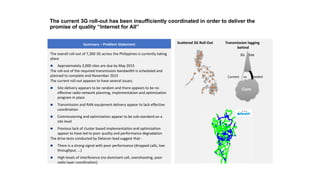
The current 3G roll-out has been insufficiently coordinated in order to deliver the
promise of quality “Internet for All”
The overall roll-out of 7,300 3G across the Philippines is currently taking
place
 Approximately 3,000 sites are due by May 2015
The roll-out of the required transmission bandwidth is scheduled and
planned to complete end November 2015
The current roll-out appears to have several issues;
 Site delivery appears to be random and there appears to be no
effective radio network planning, implementation and optimization
program in place
 Transmission and RAN equipment delivery appear to lack effective
coordination
 Commissioning and optimization appear to be sub-standard on a
site level
 Previous lack of cluster based implementation and optimization
appear to have led to poor quality and performance degradation
The drive tests conducted by Detecon lead suggest that :
 There is a strong signal with poor performance (dropped calls, low
throughput, …)
 High levels of interference (no dominant cell, overshooting, poor
radio layer coordination)
Summary – Problem Statement Scattered 3G Roll-Out
Core
Current vs. needed
Transmission lagging
behind
3G Site
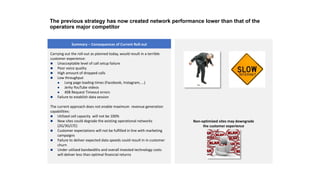
Carrying out the roll-out as planned today, would result in a terrible
customer experience:
 Unacceptable level of call setup failure
 Poor voice quality
 High amount of dropped calls
 Low throughput
 Long page loading times (Facebook, Instagram, …)
 Jerky YouTube videos
 408 Request Timeout errors
 Failure to establish data session
The current approach does not enable maximum revenue generation
capabilities:
 Utilized cell capacity will not be 100%
 New sites could degrade the existing operational networks
(2G/3G/LTE)
 Customer expectations will not be fulfilled in line with marketing
campaigns
 Failure to deliver expected data speeds could result in in customer
churn
 Under utilized bandwidths and overall invested technology costs
will deliver less than optimal financial returns
Summary – Consequences of Current Roll-out
Non-optimized sites may downgrade
the customer experience
The previous strategy has now created network performance lower than that of the
operators major competitor
a. Overview
b. Issues
c. Delivery methodology
d. Workstreams
c
2G
2G
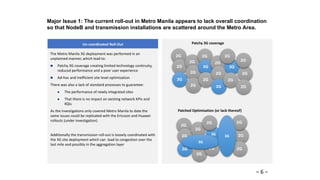
Major Issue 1: The current roll-out in Metro Manila appears to lack overall coordination
so that NodeB and transmission installations are scattered around the Metro Area.
Un-coordinated Roll-Out
2G
2G
3G
2G
2G
2G
2G
3G
2G
2G
2G
3G
3G
2G
2G
Patchy 3G coverage
2G
2G
3G
2G
3G
2G
3G
2G
2G
2G
2G
2G
2G
3G
Patched Optimization (or lack thereof)
The Metro Manila 3G deployment was performed in an
unplanned manner, which lead to:
 Patchy 3G coverage creating limited technology continuity,
reduced performance and a poor user experience
 Ad-hoc and inefficient site level optimization
There was also a lack of standard processes to guarantee:
 The performance of newly integrated sites
 That there is no impact on existing network KPIs and
KQIs
As the investigations only covered Metro Manila to date the
same issues could be replicated with the Ericsson and Huawei
rollouts (under investigation)
Additionally the transmission roll-out is loosely coordinated with
the 3G site deployment which can lead to congestion over the
last mile and possibly in the aggregation layer
– 6 –
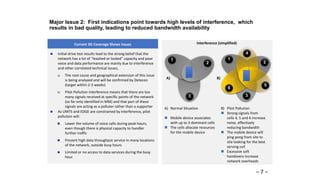
Major Issue 2: First indications point towards high levels of interference, which
results in bad quality, leading to reduced bandwidth availability
 Initial drive test results lead to the strong belief that the
network has a lot of “leashed or locked” capacity and poor
voice and data performance are mainly due to interference
and other correlated technical issues,
a) The root cause and geographical extension of this issue
is being analyzed and will be confirmed by Detecon
(target within 2-3 weeks)
b) Pilot Pollution interference means that there are too
many signals received at specific points of the network
(so far only identified in MM) and that part of these
signals are acting as a polluter rather than a supporter
 As UMTS and EDGE are constrained by interference, pilot
pollution will:
 Lower the volume of voice calls during peak hours,
even though there is physical capacity to handler
further traffic
 Prevent high data throughput service in many locations
of the network, outside busy hours
 Limited or no access to data services during the busy
hour
Current 3G Coverage Shows Issues
1
2
3
1
2
3
4
6
5
Interference (simplified)
A) Normal Situation
 Mobile device associates
with up to 3 dominant cells
 The cells allocate resources
for the mobile device
B) Pilot Pollution
 Strong signals from
cells 4, 5 and 6 increase
noise, effectively
reducing bandwidth
 The mobile device will
ping pong from site to
site looking for the best
serving cell
 Excessive soft
handovers increase
network overheads
A) B)
– 7 –
a. Overview
b. Issues
c. Delivery methodology
d. Workstreams
c
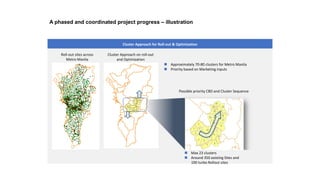
A phased and coordinated project progress – illustration
 Max 23 clusters
 Around 350 existing Sites and
100 turbo Rollout sites
Possible priority CBD and Cluster Sequence
 Approximately 70-80 clusters for Metro Manila
 Priority based on Marketing inputs
Cluster Approach for Roll-out & Optimization
Roll-out sites across
Metro Manila
Cluster Approach on roll-out
and Optimization
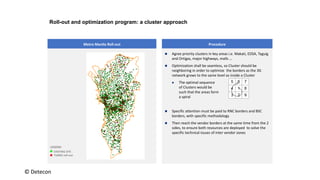
Procedure
Roll-out and optimization program: a cluster approach
Metro Manila Roll-out
LEGEND
EXISTING SITE
TURBO roll-out
 Agree priority clusters in key areas i.e. Makati, EDSA, Taguig
and Ortigas, major highways, malls …
 Optimization shall be seamless, so Cluster should be
neighboring in order to optimize the borders as the 3G
network grows to the same level as inside a Cluster
 The optimal sequence
of Clusters would be
such that the areas form
a spiral
 Specific attention must be paid to RNC borders and BSC
borders, with specific methodology
 Then reach the vendor borders at the same time from the 2
sides, to ensure both resources are deployed to solve the
specific technical issues of inter vendor zones
5 6 7
4 1 8
3 2 9
© Detecon
Close coordination between 3G roll-out, optimization and transmission guarantees the
best possible customer experience
RNC
Cluster Area
3G in scope of Cluster
3G out of scope of Cluster
but under investigation
Transmission scope beyond cluster
Roll-out coordination per cluster
 Co-ordinated NodeB
and transmission
rollout
 3G is expected to be
faster than Tx
 Optimization of radio
can start with Tx still
on-going
 Final Optimization
needs full band-
width to complete
3G Sites
Transmission
Optimization
0 40 80 [%3G]
0 25 50 80 [%Tx]
Cluster
Transmission roll-out will closely follow the 3G site Cluster roll-
out
 FOC rings span areas greater than the individual Cluster
 Bandwidth from the sites is only part of the end-to-end
bandwidth requirement to be taken into account
Transmission planning has to plan/decide:
 Technology to use: FOC, µWave, copper
 End-to-end needs: which rings are affected, where will
additional bandwidth be needed
 Best use of available resources
Additionally, certain on-going activities affect Transmission:
 VDSL (with >20Mbps/copper pair) as a technology
 µW links can be used for rapid deployment. This could lead
a delay in reaching a full FOC network.
 Current vendors planned for a phase-out (can) get an
extension (ECI, Aviat) due to rapid delivery and/or
deployment
Transmission
© Detecon
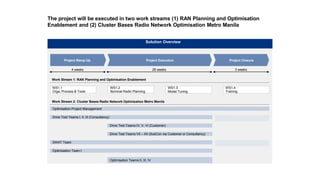
The project will be executed in two work streams (1) RAN Planning and Optimisation
Enablement and (2) Cluster Bases Radio Network Optimisation Metro Manila
Solution Overview
Project Ramp Up Project Execution Project Closure
26 weeks 3 weeks4 weeks
Work Stream 1: RAN Planning and Optimisation Enablement
Work Stream 2: Cluster Bases Radio Network Optimisation Metro Manila
Optimisation Project Management
Drive Test Teams I, II, III (Consultancy)
SWAT Team
Optimisation Team I
Drive Test Teams IV, V, VI (Customer)
Drive Test Teams VII – XII (SubCon via Customer or Consultancy)
Optimisation Teams II, III, IV
WS1.2
Nominal Radio Planning
WS1.1
Orga, Process & Tools
WS1.4
Training
WS1.3
Model Tuning
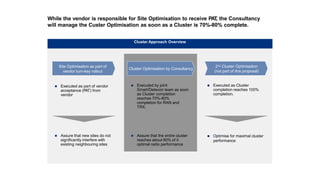
While the vendor is responsible for Site Optimisation to receive PAT, the Consultancy
will manage the Custer Optimisation as soon as a Cluster is 70%-80% complete.
Cluster Approach Overview
Site Optimisation as part of
vendor turn-key rollout
Cluster Optimisation by Consultancy
2nd Cluster Optimisation
(not part of this proposal)
 Executed as part of vendor
acceptance (PAT) from
vendor
 Executed by joint
Smart/Detecon team as soon
as Cluster completion
reaches 70%-80%
completion for RAN and
TRX.
 Executed as Cluster
completion reaches 100%
completion.
 Assure that new sites do not
significantly interfere with
existing neighbouring sites
 Assure that the entire cluster
reaches about 80% of it
optimal radio performance
 Optimise for maximal cluster
performance
Week 1 Week 2 Week 3
Data Filler /
Rigger
Astellia
Consultant
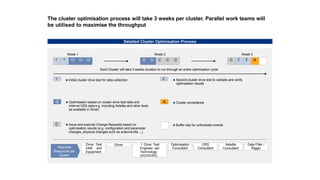
The cluster optimisation process will take 3 weeks per cluster. Parallel work teams will
be utilised to maximise the throughput
1
O
C
2
A
 Initial cluster drive test for data collection
 Optimisation based on cluster drive test data and
internal OSS data e.g. including Astellia and other tools
as available in Smart
 Issue and execute Change Requests based on
optimisation results (e.g. configuration and parameter
changes, physical changes such as antenna tilts ,,,)
 Second cluster drive test to validate and verify
optimisation results
 Cluster acceptance
 Buffer day for unforeseen events
Each Cluster will take 3 weeks duration to run through an entire optimisation cycle
Detailed Cluster Optimisation Process
Required
Resources per
Cluster
Drive Test
VAN and
Equipment
Driver 1 Drive Test
Engineer per
Technology
(2G/3G/4G)
Optimisation
Consultant
OSS
Consultant
C 2 2 A1 1 O O O O O C C C
Drive Test
Team III
Drive Test
Team IV
Drive Test
Team V
Drive Test
Team VI
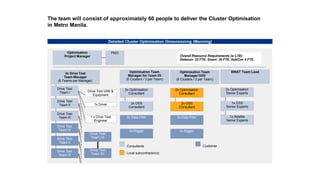
The team will consist of approximately 60 people to deliver the Cluster Optimisation
in Metro Manila.
Detailed Cluster Optimisation Dimensioning (Manning)
2x Drive Test
Team Manager
(6 Teams per Manager)
Drive Test
Team I
Drive Test
Team II
Drive Test VAN &
Equipment
1x Driver
1 x Drive Test
Engineer
Consultants Customer
Local subcontractor(s)
Overall Resource Requirements (w LTE):
Detecon: 22 FTE, Smart: 30 FTE, SubCon 4 FTE
Drive Test
Team VII
Drive Test
Team XII
Optimisation Team
Manager for Team I/II
(6 Clusters / 3 per Team)
2x Optimisation
Consultant
2x OSS
Consultant
2x Data Filler
4x Rigger
Optimisation Team
Manager III/IV
(6 Clusters / 3 per Team)
2x Optimisation
Consultant
2x OSS
Consultant
2x Data Filler
4x Rigger
Optimisation
Project Manager
PMO
SWAT Team Lead
2x Optimisation
Senior Experts
1x OSS
Senior Experts
1x Astellia
Senior Experts
a. Overview
b. Issues
c. Delivery methodology
d. Workstreams
c
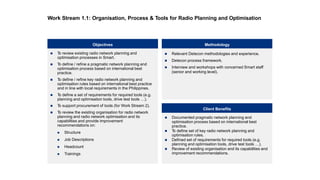
 To review existing radio network planning and
optimisation processes in Smart.
 To define / refine a pragmatic network planning and
optimisation process based on international best
practice.
 To define / refine key radio network planning and
optimisation rules based on international best practice
and in line with local requirements in the Philippines.
 To define a set of requirements for required tools (e.g.
planning and optimisation tools, drive test tools …).
 To support procurement of tools (for Work Stream 2).
 To review the existing organisation for radio network
planning and radio network optimisation and its
capabilities and provide improvement
recommendations on:
 Structure
 Job Descriptions
 Headcount
 Trainings
Objectives Methodology
 Documented pragmatic network planning and
optimisation process based on international best
practice.
 To define set of key radio network planning and
optimisation rules.
 Defined set of requirements for required tools (e.g.
planning and optimisation tools, drive test tools …).
 Review of existing organisation and its capabilities and
improvement recommendations.
 Relevant Detecon methodologies and experience.
 Detecon process framework.
 Interview and workshops with concerned Smart staff
(senior and working level).
Client Benefits
Work Stream 1.1: Organisation, Process & Tools for Radio Planning and Optimisation
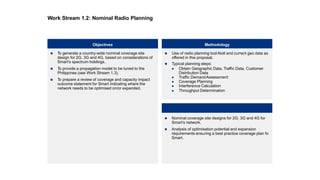
 To generate a country-wide nominal coverage site
design for 2G, 3G and 4G, based on considerations of
Smart's spectrum holdings.
 To provide a propagation model to be tuned to the
Philippines (see Work Stream 1.3).
 To prepare a review of coverage and capacity impact
outcome statement for Smart indicating where the
network needs to be optimised on/or expanded.
Objectives Methodology
Client Benefits
 Nominal coverage site designs for 2G, 3G and 4G for
Smart’s network.
 Analysis of optimisation potential and expansion
requirements ensuring a best practice coverage plan fo
Smart.
 Use of radio planning toolAtoll and current geo data as
offered in this proposal.
 Typical planning steps:
 Obtain Geographic Data, Traffic Data, Customer
Distribution Data
 Traffic DemandAssessment
 Coverage Planning
 Interference Calculation
 Throughput Determination
Work Stream 1.2: Nominal Radio Planning
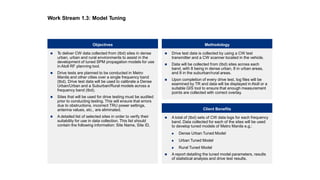
 To deliver CW data collected from (tbd) sites in dense
urban, urban and rural environments to assist in the
development of tuned SPM propagation models for use
in Atoll RF planning tool.
 Drive tests are planned to be conducted in Metro
Manila and other cities over a single frequency band
(tbd). Drive test data will be used to calibrate a Dense
Urban/Urban and a Suburban/Rural models across a
frequency band (tbd).
 Sites that will be used for drive testing must be audited
prior to conducting testing. This will ensure that errors
due to obstructions, incorrect TRU power settings,
antenna values, etc., are eliminated.
 A detailed list of selected sites in order to verify their
suitability for use in data collection. This list should
contain the following information: Site Name, Site ID,
Objectives Methodology
 A total of (tbd) sets of CW data logs for each frequency
band. Data collected for each of the sites will be used
to develop tuned models of Metro Manila e.g.:
 Dense Urban Tuned Model
 Urban Tuned Model
 Rural Tuned Model
 A report detailing the tuned model parameters, results
of statistical analysis and drive test results.
 Drive test data is collected by using a CW test
transmitter and a CW scanner located in the vehicle.
 Data will be collected from (tbd) sites across each
band, with 8 being in dense urban, 8 in urban areas,
and 8 in the suburban/rural areas.
 Upon completion of every drive test, log files will be
examined by TR and data will be displayed in Atoll or a
suitable GIS tool to ensure that enough measurement
points are collected with correct overlay.
Client Benefits
Work Stream 1.3: Model Tuning
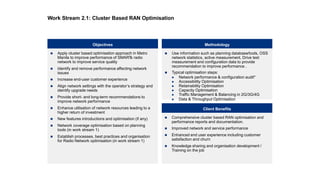
 Apply cluster based optimisation approach in Metro
Manila to improve performance of SMARTs radio
network to improve service quality
 Identify and remove performance affecting network
issues
 Increase end-user customer experience
 Align network settings with the operator’s strategy and
identify upgrade needs
 Provide short- and long-term recommendations to
improve network performance
 Enhance utilisation of network resources leading to a
higher return of investment
 New features introductions and optimisation (if any)
 Network coverage optimisation based on planning
tools (in work stream 1)
 Establish processes, best practices and organisation
for Radio Network optimisation (in work stream 1)
Objectives Methodology
 Comprehensive cluster based RAN optimisation and
performance reports and documentation.
 Improved network and service performance
 Enhanced end user experience including customer
satisfaction and churn
 Knowledge sharing and organisation development /
Training on the job
 Use information such as planning database/tools, OSS
network statistics, active measurement, Drive test
measurement and configuration data to provide
recommendation to improve performance .
 Typical optimisation steps:
 Network performance & configuration audit*
 Accessibility Optimisation
 Retainability Optimisation
 Capacity Optimisation
 Traffic Management & Balancing in 2G/3G/4G
 Data & Throughput Optimisation
Client Benefits
Work Stream 2.1: Cluster Based RAN Optimisation
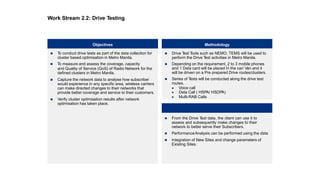
 To conduct drive tests as part of the data collection for
cluster based optimisation in Metro Manila.
 To measure and assess the coverage, capacity
and Quality of Service (QoS) of Radio Network for the
defined clusters in Metro Manila.
 Capture the network data to analyse how subscriber
would experience in any specific area, wireless carriers
can make directed changes to their networks that
provide better coverage and service to their customers.
 Verify cluster optimisation results after network
optimisation has taken place.
Objectives Methodology
Client Benefits
 From the Drive Test data, the client can use it to
assess and subsequently make changes to their
network to better serve their Subscribers.
 PerformanceAnalysis can be performed using the data
 Integration of New Sites and change parameters of
Existing Sites.
 Drive Test Tools such as NEMO, TEMS will be used to
perform the Drive Test activities in Metro Manila.
 Depending on the requirement, 2 to 3 mobile phones
and 1 Data card will be placed In the car/ Van and it
will be driven on a Pre prepared Drive routes/clusters.
 Series of Tests will be conducted along the drive test
routes.
 Voice call
 Data Call ( HSPA/ HSDPA)
 Multi-RAB Calls
Work Stream 2.2: Drive Testing

Optimisation project overview

  • 1.
  • 2.
    a. Overview b. Issues c.Delivery methodology d. Workstreams c
  • 3.
    The current 3Groll-out has been insufficiently coordinated in order to deliver the promise of quality “Internet for All” The overall roll-out of 7,300 3G across the Philippines is currently taking place  Approximately 3,000 sites are due by May 2015 The roll-out of the required transmission bandwidth is scheduled and planned to complete end November 2015 The current roll-out appears to have several issues;  Site delivery appears to be random and there appears to be no effective radio network planning, implementation and optimization program in place  Transmission and RAN equipment delivery appear to lack effective coordination  Commissioning and optimization appear to be sub-standard on a site level  Previous lack of cluster based implementation and optimization appear to have led to poor quality and performance degradation The drive tests conducted by Detecon lead suggest that :  There is a strong signal with poor performance (dropped calls, low throughput, …)  High levels of interference (no dominant cell, overshooting, poor radio layer coordination) Summary – Problem Statement Scattered 3G Roll-Out Core Current vs. needed Transmission lagging behind 3G Site
  • 4.
    Carrying out theroll-out as planned today, would result in a terrible customer experience:  Unacceptable level of call setup failure  Poor voice quality  High amount of dropped calls  Low throughput  Long page loading times (Facebook, Instagram, …)  Jerky YouTube videos  408 Request Timeout errors  Failure to establish data session The current approach does not enable maximum revenue generation capabilities:  Utilized cell capacity will not be 100%  New sites could degrade the existing operational networks (2G/3G/LTE)  Customer expectations will not be fulfilled in line with marketing campaigns  Failure to deliver expected data speeds could result in in customer churn  Under utilized bandwidths and overall invested technology costs will deliver less than optimal financial returns Summary – Consequences of Current Roll-out Non-optimized sites may downgrade the customer experience The previous strategy has now created network performance lower than that of the operators major competitor
  • 5.
    a. Overview b. Issues c.Delivery methodology d. Workstreams c
  • 6.
    2G 2G Major Issue 1:The current roll-out in Metro Manila appears to lack overall coordination so that NodeB and transmission installations are scattered around the Metro Area. Un-coordinated Roll-Out 2G 2G 3G 2G 2G 2G 2G 3G 2G 2G 2G 3G 3G 2G 2G Patchy 3G coverage 2G 2G 3G 2G 3G 2G 3G 2G 2G 2G 2G 2G 2G 3G Patched Optimization (or lack thereof) The Metro Manila 3G deployment was performed in an unplanned manner, which lead to:  Patchy 3G coverage creating limited technology continuity, reduced performance and a poor user experience  Ad-hoc and inefficient site level optimization There was also a lack of standard processes to guarantee:  The performance of newly integrated sites  That there is no impact on existing network KPIs and KQIs As the investigations only covered Metro Manila to date the same issues could be replicated with the Ericsson and Huawei rollouts (under investigation) Additionally the transmission roll-out is loosely coordinated with the 3G site deployment which can lead to congestion over the last mile and possibly in the aggregation layer – 6 –
  • 7.
    Major Issue 2:First indications point towards high levels of interference, which results in bad quality, leading to reduced bandwidth availability  Initial drive test results lead to the strong belief that the network has a lot of “leashed or locked” capacity and poor voice and data performance are mainly due to interference and other correlated technical issues, a) The root cause and geographical extension of this issue is being analyzed and will be confirmed by Detecon (target within 2-3 weeks) b) Pilot Pollution interference means that there are too many signals received at specific points of the network (so far only identified in MM) and that part of these signals are acting as a polluter rather than a supporter  As UMTS and EDGE are constrained by interference, pilot pollution will:  Lower the volume of voice calls during peak hours, even though there is physical capacity to handler further traffic  Prevent high data throughput service in many locations of the network, outside busy hours  Limited or no access to data services during the busy hour Current 3G Coverage Shows Issues 1 2 3 1 2 3 4 6 5 Interference (simplified) A) Normal Situation  Mobile device associates with up to 3 dominant cells  The cells allocate resources for the mobile device B) Pilot Pollution  Strong signals from cells 4, 5 and 6 increase noise, effectively reducing bandwidth  The mobile device will ping pong from site to site looking for the best serving cell  Excessive soft handovers increase network overheads A) B) – 7 –
  • 8.
    a. Overview b. Issues c.Delivery methodology d. Workstreams c
  • 9.
    A phased andcoordinated project progress – illustration  Max 23 clusters  Around 350 existing Sites and 100 turbo Rollout sites Possible priority CBD and Cluster Sequence  Approximately 70-80 clusters for Metro Manila  Priority based on Marketing inputs Cluster Approach for Roll-out & Optimization Roll-out sites across Metro Manila Cluster Approach on roll-out and Optimization
  • 10.
    Procedure Roll-out and optimizationprogram: a cluster approach Metro Manila Roll-out LEGEND EXISTING SITE TURBO roll-out  Agree priority clusters in key areas i.e. Makati, EDSA, Taguig and Ortigas, major highways, malls …  Optimization shall be seamless, so Cluster should be neighboring in order to optimize the borders as the 3G network grows to the same level as inside a Cluster  The optimal sequence of Clusters would be such that the areas form a spiral  Specific attention must be paid to RNC borders and BSC borders, with specific methodology  Then reach the vendor borders at the same time from the 2 sides, to ensure both resources are deployed to solve the specific technical issues of inter vendor zones 5 6 7 4 1 8 3 2 9 © Detecon
  • 11.
    Close coordination between3G roll-out, optimization and transmission guarantees the best possible customer experience RNC Cluster Area 3G in scope of Cluster 3G out of scope of Cluster but under investigation Transmission scope beyond cluster Roll-out coordination per cluster  Co-ordinated NodeB and transmission rollout  3G is expected to be faster than Tx  Optimization of radio can start with Tx still on-going  Final Optimization needs full band- width to complete 3G Sites Transmission Optimization 0 40 80 [%3G] 0 25 50 80 [%Tx] Cluster Transmission roll-out will closely follow the 3G site Cluster roll- out  FOC rings span areas greater than the individual Cluster  Bandwidth from the sites is only part of the end-to-end bandwidth requirement to be taken into account Transmission planning has to plan/decide:  Technology to use: FOC, µWave, copper  End-to-end needs: which rings are affected, where will additional bandwidth be needed  Best use of available resources Additionally, certain on-going activities affect Transmission:  VDSL (with >20Mbps/copper pair) as a technology  µW links can be used for rapid deployment. This could lead a delay in reaching a full FOC network.  Current vendors planned for a phase-out (can) get an extension (ECI, Aviat) due to rapid delivery and/or deployment Transmission © Detecon
  • 12.
    The project willbe executed in two work streams (1) RAN Planning and Optimisation Enablement and (2) Cluster Bases Radio Network Optimisation Metro Manila Solution Overview Project Ramp Up Project Execution Project Closure 26 weeks 3 weeks4 weeks Work Stream 1: RAN Planning and Optimisation Enablement Work Stream 2: Cluster Bases Radio Network Optimisation Metro Manila Optimisation Project Management Drive Test Teams I, II, III (Consultancy) SWAT Team Optimisation Team I Drive Test Teams IV, V, VI (Customer) Drive Test Teams VII – XII (SubCon via Customer or Consultancy) Optimisation Teams II, III, IV WS1.2 Nominal Radio Planning WS1.1 Orga, Process & Tools WS1.4 Training WS1.3 Model Tuning
  • 13.
    While the vendoris responsible for Site Optimisation to receive PAT, the Consultancy will manage the Custer Optimisation as soon as a Cluster is 70%-80% complete. Cluster Approach Overview Site Optimisation as part of vendor turn-key rollout Cluster Optimisation by Consultancy 2nd Cluster Optimisation (not part of this proposal)  Executed as part of vendor acceptance (PAT) from vendor  Executed by joint Smart/Detecon team as soon as Cluster completion reaches 70%-80% completion for RAN and TRX.  Executed as Cluster completion reaches 100% completion.  Assure that new sites do not significantly interfere with existing neighbouring sites  Assure that the entire cluster reaches about 80% of it optimal radio performance  Optimise for maximal cluster performance
  • 14.
    Week 1 Week2 Week 3 Data Filler / Rigger Astellia Consultant The cluster optimisation process will take 3 weeks per cluster. Parallel work teams will be utilised to maximise the throughput 1 O C 2 A  Initial cluster drive test for data collection  Optimisation based on cluster drive test data and internal OSS data e.g. including Astellia and other tools as available in Smart  Issue and execute Change Requests based on optimisation results (e.g. configuration and parameter changes, physical changes such as antenna tilts ,,,)  Second cluster drive test to validate and verify optimisation results  Cluster acceptance  Buffer day for unforeseen events Each Cluster will take 3 weeks duration to run through an entire optimisation cycle Detailed Cluster Optimisation Process Required Resources per Cluster Drive Test VAN and Equipment Driver 1 Drive Test Engineer per Technology (2G/3G/4G) Optimisation Consultant OSS Consultant C 2 2 A1 1 O O O O O C C C
  • 15.
    Drive Test Team III DriveTest Team IV Drive Test Team V Drive Test Team VI The team will consist of approximately 60 people to deliver the Cluster Optimisation in Metro Manila. Detailed Cluster Optimisation Dimensioning (Manning) 2x Drive Test Team Manager (6 Teams per Manager) Drive Test Team I Drive Test Team II Drive Test VAN & Equipment 1x Driver 1 x Drive Test Engineer Consultants Customer Local subcontractor(s) Overall Resource Requirements (w LTE): Detecon: 22 FTE, Smart: 30 FTE, SubCon 4 FTE Drive Test Team VII Drive Test Team XII Optimisation Team Manager for Team I/II (6 Clusters / 3 per Team) 2x Optimisation Consultant 2x OSS Consultant 2x Data Filler 4x Rigger Optimisation Team Manager III/IV (6 Clusters / 3 per Team) 2x Optimisation Consultant 2x OSS Consultant 2x Data Filler 4x Rigger Optimisation Project Manager PMO SWAT Team Lead 2x Optimisation Senior Experts 1x OSS Senior Experts 1x Astellia Senior Experts
  • 16.
    a. Overview b. Issues c.Delivery methodology d. Workstreams c
  • 17.
     To reviewexisting radio network planning and optimisation processes in Smart.  To define / refine a pragmatic network planning and optimisation process based on international best practice.  To define / refine key radio network planning and optimisation rules based on international best practice and in line with local requirements in the Philippines.  To define a set of requirements for required tools (e.g. planning and optimisation tools, drive test tools …).  To support procurement of tools (for Work Stream 2).  To review the existing organisation for radio network planning and radio network optimisation and its capabilities and provide improvement recommendations on:  Structure  Job Descriptions  Headcount  Trainings Objectives Methodology  Documented pragmatic network planning and optimisation process based on international best practice.  To define set of key radio network planning and optimisation rules.  Defined set of requirements for required tools (e.g. planning and optimisation tools, drive test tools …).  Review of existing organisation and its capabilities and improvement recommendations.  Relevant Detecon methodologies and experience.  Detecon process framework.  Interview and workshops with concerned Smart staff (senior and working level). Client Benefits Work Stream 1.1: Organisation, Process & Tools for Radio Planning and Optimisation
  • 18.
     To generatea country-wide nominal coverage site design for 2G, 3G and 4G, based on considerations of Smart's spectrum holdings.  To provide a propagation model to be tuned to the Philippines (see Work Stream 1.3).  To prepare a review of coverage and capacity impact outcome statement for Smart indicating where the network needs to be optimised on/or expanded. Objectives Methodology Client Benefits  Nominal coverage site designs for 2G, 3G and 4G for Smart’s network.  Analysis of optimisation potential and expansion requirements ensuring a best practice coverage plan fo Smart.  Use of radio planning toolAtoll and current geo data as offered in this proposal.  Typical planning steps:  Obtain Geographic Data, Traffic Data, Customer Distribution Data  Traffic DemandAssessment  Coverage Planning  Interference Calculation  Throughput Determination Work Stream 1.2: Nominal Radio Planning
  • 19.
     To deliverCW data collected from (tbd) sites in dense urban, urban and rural environments to assist in the development of tuned SPM propagation models for use in Atoll RF planning tool.  Drive tests are planned to be conducted in Metro Manila and other cities over a single frequency band (tbd). Drive test data will be used to calibrate a Dense Urban/Urban and a Suburban/Rural models across a frequency band (tbd).  Sites that will be used for drive testing must be audited prior to conducting testing. This will ensure that errors due to obstructions, incorrect TRU power settings, antenna values, etc., are eliminated.  A detailed list of selected sites in order to verify their suitability for use in data collection. This list should contain the following information: Site Name, Site ID, Objectives Methodology  A total of (tbd) sets of CW data logs for each frequency band. Data collected for each of the sites will be used to develop tuned models of Metro Manila e.g.:  Dense Urban Tuned Model  Urban Tuned Model  Rural Tuned Model  A report detailing the tuned model parameters, results of statistical analysis and drive test results.  Drive test data is collected by using a CW test transmitter and a CW scanner located in the vehicle.  Data will be collected from (tbd) sites across each band, with 8 being in dense urban, 8 in urban areas, and 8 in the suburban/rural areas.  Upon completion of every drive test, log files will be examined by TR and data will be displayed in Atoll or a suitable GIS tool to ensure that enough measurement points are collected with correct overlay. Client Benefits Work Stream 1.3: Model Tuning
  • 20.
     Apply clusterbased optimisation approach in Metro Manila to improve performance of SMARTs radio network to improve service quality  Identify and remove performance affecting network issues  Increase end-user customer experience  Align network settings with the operator’s strategy and identify upgrade needs  Provide short- and long-term recommendations to improve network performance  Enhance utilisation of network resources leading to a higher return of investment  New features introductions and optimisation (if any)  Network coverage optimisation based on planning tools (in work stream 1)  Establish processes, best practices and organisation for Radio Network optimisation (in work stream 1) Objectives Methodology  Comprehensive cluster based RAN optimisation and performance reports and documentation.  Improved network and service performance  Enhanced end user experience including customer satisfaction and churn  Knowledge sharing and organisation development / Training on the job  Use information such as planning database/tools, OSS network statistics, active measurement, Drive test measurement and configuration data to provide recommendation to improve performance .  Typical optimisation steps:  Network performance & configuration audit*  Accessibility Optimisation  Retainability Optimisation  Capacity Optimisation  Traffic Management & Balancing in 2G/3G/4G  Data & Throughput Optimisation Client Benefits Work Stream 2.1: Cluster Based RAN Optimisation
  • 21.
     To conductdrive tests as part of the data collection for cluster based optimisation in Metro Manila.  To measure and assess the coverage, capacity and Quality of Service (QoS) of Radio Network for the defined clusters in Metro Manila.  Capture the network data to analyse how subscriber would experience in any specific area, wireless carriers can make directed changes to their networks that provide better coverage and service to their customers.  Verify cluster optimisation results after network optimisation has taken place. Objectives Methodology Client Benefits  From the Drive Test data, the client can use it to assess and subsequently make changes to their network to better serve their Subscribers.  PerformanceAnalysis can be performed using the data  Integration of New Sites and change parameters of Existing Sites.  Drive Test Tools such as NEMO, TEMS will be used to perform the Drive Test activities in Metro Manila.  Depending on the requirement, 2 to 3 mobile phones and 1 Data card will be placed In the car/ Van and it will be driven on a Pre prepared Drive routes/clusters.  Series of Tests will be conducted along the drive test routes.  Voice call  Data Call ( HSPA/ HSDPA)  Multi-RAB Calls Work Stream 2.2: Drive Testing