Optimal Use/Employment of
Two-Variable Inputs
By:
Manoj Kumar Sunuwar
Baneshwor Multiple Campus
Shantinagar, Kathmandu
Background
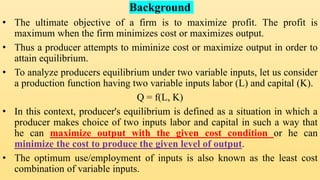
• The ultimate objective of a firm is to maximize profit. The profit is
maximum when the firm minimizes cost or maximizes output.
• Thus a producer attempts to miminize cost or maximize output in order to
attain equilibrium.
• To analyze producers equilibrium under two variable inputs, let us consider
a production function having two variable inputs labor (L) and capital (K).
Q = f(L, K)
• In this context, producer's equilibrium is defined as a situation in which a
producer makes choice of two inputs labor and capital in such a way that
he can maximize output with the given cost condition or he can
minimize the cost to produce the given level of output.
• The optimum use/employment of inputs is also known as the least cost
combination of variable inputs.
Tools Used in Analysis
i. Iso-quant
ii. Iso-cost Line
Conditions for Equilibrium or Optimum Use of Inputs
1. First Order Condition (Necessary Condition):
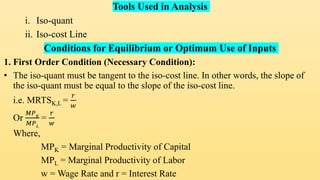
• The iso-quant must be tangent to the iso-cost line. In other words, the slope of
the iso-quant must be equal to the slope of the iso-cost line.
i.e. MRTSK,L =
𝑟
𝑤
Or
𝑀𝑃𝐾
𝑀𝑃𝐿
=
𝑟
𝑤
Where,
MPK = Marginal Productivity of Capital
MPL = Marginal Productivity of Labor
w = Wage Rate and r = Interest Rate
2. Second Order Condition (Sufficient Condition):
• The iso-quant must be convex to the origin at the point of tangency.
Explanations
• Based on the above two conditions and with the help of above mentioned two
tools, the optimal employment of two variable inputs can be discussed under
the following two cases/approaches:
Case – I: Maximization of Output for Given Cost/Total Outlay (Output
Maximization Subject to Cost Constraint)
Case – II: Minimization of Cost for the Given Level of Output (Cost
Minimization Subject to Output Constraint)
Case – I: Maximization of Output for Given Cost/Total Outlay (Output
Maximization Subject to Cost Constraint)
• In this case, the total outlay/cost of the firm is fixed/given, the main objective
of the producer is to choose the combination of two inputs in such a way that
he can maximize the level of output.
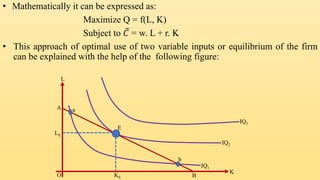
• Mathematically it can be expressed as:
Maximize Q = f(L, K)
Subject to 𝐶 = w. L + r. K
• This approach of optimal use of two variable inputs or equilibrium of the firm
can be explained with the help of the following figure:
K
L
O
A
B
IQ1
IQ2
IQ3
a
b
E
KE
LE
Case – II: Minimization of Cost for the Given Level of Output (Cost
Minimization Subject to Output Constraint)
• In case of level output to be produced is pre-determined, the objective of
the producer is to make a choice of two inputs in such a way that he can
minimize the cost of production for the given level of output.
• Mathematically it can be expressed as:
Minimize C = w. L + r. K
Subject to 𝑄 = f(L, K)
K
L
O
A0
B0
IQ
a
b
E
KE
LE
B1
A1
B2
A2
Figure
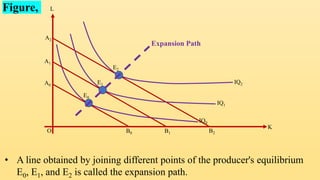
Expansion Path
• The expansion path is the locus of points showing the optimal
combination of inputs for a producer to produce different levels of output,
keeping the price of inputs constant.
• In other words, the expansion path shows how a producer can change the
mix of inputs they use to produce a given level of output while keeping
the cost of inputs the same.
• This is done by moving along the expansion path, which is a curve that
connects all of the points where the producer is producing at the least
cost.
• It is determined by the equilibrium condition:
𝑀𝑃𝐾
𝑀𝑃𝐿
=
𝑟
𝑤
• The expansion path shows the change in optimal factor combination when
a firm expands its level of output and the given factor prices.
Figure,
K
L
O
A2
B2
IQ0
IQ1
IQ2
A1
B1
A0
B0
E0
E1
E2
Expansion Path
• A line obtained by joining different points of the producer's equilibrium
E0, E1, and E2 is called the expansion path.
Numerical Example
1. A company has the following production function,
Q = 100 K0.5 L0.5, w = $30 and r = $40.
a. Determine the expansion path. What does it exhibit?
b. Determine the efficient combination of inputs for producing 1444
units of output.
c. Determine the minimum cost of production.
d.What is the degree of returns this production function exhibits?
[T.U. 2017]
[Ans: (a) L= 4/3K (b) K = 12.5, L = 16.67 (c) $1000 (d) Constant returns
to scale]
Numerical Example
2. Let, the production function realized by the Noodle factory is Q = 100 KL, wage rate =
Rs. 50, rate of interest = Rs. 40, P= Rs. 2 per unit.
a. Compute the marginal productivities of two inputs.
b. (i) Show how to determine the amount of labor and capital the firm should use to
minimize the costs of producing 1118 units of output.
(ii) What is the profit and minimum cost?
(iii) What will be the minimum cost and optimal employment of labor and capital
at output 2236 units?
c. (i) What will be the optimal employment of labor and capital in order to maximize
output under a given total cost outlay of Rs.1,000?
(ii) What is the level of output and profit?
(iii) What will be the level of output and optimal employment of labor and capital
when the total cost outlay increases to Rs. 2,000? [T.U. 2016]
[Ans: (a) MPK = 50(L/K)0.5, MPL = 50(K/L)0.5 (b) i. K = 12.5, L = 10 ii. C = 1000, 𝝅 = 1236 iii. K = 25, L
= 20 (c) i. K = 12.5, L= 10 ii. Q=1118, 𝝅 = 1236 iii. K = 25, L=20]

Optimal Use:Employment of Two Variable Inputs.pptx

  • 1.
    Optimal Use/Employment of Two-VariableInputs By: Manoj Kumar Sunuwar Baneshwor Multiple Campus Shantinagar, Kathmandu
  • 2.
    Background • The ultimateobjective of a firm is to maximize profit. The profit is maximum when the firm minimizes cost or maximizes output. • Thus a producer attempts to miminize cost or maximize output in order to attain equilibrium. • To analyze producers equilibrium under two variable inputs, let us consider a production function having two variable inputs labor (L) and capital (K). Q = f(L, K) • In this context, producer's equilibrium is defined as a situation in which a producer makes choice of two inputs labor and capital in such a way that he can maximize output with the given cost condition or he can minimize the cost to produce the given level of output. • The optimum use/employment of inputs is also known as the least cost combination of variable inputs.
  • 3.
    Tools Used inAnalysis i. Iso-quant ii. Iso-cost Line Conditions for Equilibrium or Optimum Use of Inputs 1. First Order Condition (Necessary Condition): • The iso-quant must be tangent to the iso-cost line. In other words, the slope of the iso-quant must be equal to the slope of the iso-cost line. i.e. MRTSK,L = 𝑟 𝑤 Or 𝑀𝑃𝐾 𝑀𝑃𝐿 = 𝑟 𝑤 Where, MPK = Marginal Productivity of Capital MPL = Marginal Productivity of Labor w = Wage Rate and r = Interest Rate
  • 4.
    2. Second OrderCondition (Sufficient Condition): • The iso-quant must be convex to the origin at the point of tangency. Explanations • Based on the above two conditions and with the help of above mentioned two tools, the optimal employment of two variable inputs can be discussed under the following two cases/approaches: Case – I: Maximization of Output for Given Cost/Total Outlay (Output Maximization Subject to Cost Constraint) Case – II: Minimization of Cost for the Given Level of Output (Cost Minimization Subject to Output Constraint) Case – I: Maximization of Output for Given Cost/Total Outlay (Output Maximization Subject to Cost Constraint) • In this case, the total outlay/cost of the firm is fixed/given, the main objective of the producer is to choose the combination of two inputs in such a way that he can maximize the level of output.
  • 5.
    • Mathematically itcan be expressed as: Maximize Q = f(L, K) Subject to 𝐶 = w. L + r. K • This approach of optimal use of two variable inputs or equilibrium of the firm can be explained with the help of the following figure: K L O A B IQ1 IQ2 IQ3 a b E KE LE
  • 6.
    Case – II:Minimization of Cost for the Given Level of Output (Cost Minimization Subject to Output Constraint) • In case of level output to be produced is pre-determined, the objective of the producer is to make a choice of two inputs in such a way that he can minimize the cost of production for the given level of output. • Mathematically it can be expressed as: Minimize C = w. L + r. K Subject to 𝑄 = f(L, K) K L O A0 B0 IQ a b E KE LE B1 A1 B2 A2 Figure
  • 7.
    Expansion Path • Theexpansion path is the locus of points showing the optimal combination of inputs for a producer to produce different levels of output, keeping the price of inputs constant. • In other words, the expansion path shows how a producer can change the mix of inputs they use to produce a given level of output while keeping the cost of inputs the same. • This is done by moving along the expansion path, which is a curve that connects all of the points where the producer is producing at the least cost. • It is determined by the equilibrium condition: 𝑀𝑃𝐾 𝑀𝑃𝐿 = 𝑟 𝑤 • The expansion path shows the change in optimal factor combination when a firm expands its level of output and the given factor prices.
  • 8.
    Figure, K L O A2 B2 IQ0 IQ1 IQ2 A1 B1 A0 B0 E0 E1 E2 Expansion Path • Aline obtained by joining different points of the producer's equilibrium E0, E1, and E2 is called the expansion path.
  • 9.
    Numerical Example 1. Acompany has the following production function, Q = 100 K0.5 L0.5, w = $30 and r = $40. a. Determine the expansion path. What does it exhibit? b. Determine the efficient combination of inputs for producing 1444 units of output. c. Determine the minimum cost of production. d.What is the degree of returns this production function exhibits? [T.U. 2017] [Ans: (a) L= 4/3K (b) K = 12.5, L = 16.67 (c) $1000 (d) Constant returns to scale]
  • 10.
    Numerical Example 2. Let,the production function realized by the Noodle factory is Q = 100 KL, wage rate = Rs. 50, rate of interest = Rs. 40, P= Rs. 2 per unit. a. Compute the marginal productivities of two inputs. b. (i) Show how to determine the amount of labor and capital the firm should use to minimize the costs of producing 1118 units of output. (ii) What is the profit and minimum cost? (iii) What will be the minimum cost and optimal employment of labor and capital at output 2236 units? c. (i) What will be the optimal employment of labor and capital in order to maximize output under a given total cost outlay of Rs.1,000? (ii) What is the level of output and profit? (iii) What will be the level of output and optimal employment of labor and capital when the total cost outlay increases to Rs. 2,000? [T.U. 2016] [Ans: (a) MPK = 50(L/K)0.5, MPL = 50(K/L)0.5 (b) i. K = 12.5, L = 10 ii. C = 1000, 𝝅 = 1236 iii. K = 25, L = 20 (c) i. K = 12.5, L= 10 ii. Q=1118, 𝝅 = 1236 iii. K = 25, L=20]